185 Best Sights in London, England

Background Illustration for Sights

We've compiled the best of the best in London - browse our top choices for the top things to see or do during your stay.

Ranger's House and the Wernher Collection

Greenwich Fodor's Choice

This handsome, early-18th-century villa, which was the Greenwich Park ranger's official residence during the 19th century, is home to the Wernher Collection, nearly 700 artworks that were amassed by the diamond millionaire Sir Julius Wernher (1850–1912). Once housed in his fabulous stately house, Luton Hoo in Bedfordshire, the collection ranges from old master paintings to Renaissance jewelry and assorted pieces of decorative art and curios from the medieval period onward, including the gorgeous Madonna of the Pomegranates from the workshop of Sandro Botticelli. The Ranger's House is just under a mile's walk from the DLR station at Greenwich, or you can catch a bus there from Greenwich or Deptford DLR. Check the English Heritage website to confirm ticket prices as they tend to change seasonally.

Regent's Canal

East End Fodor's Choice

The 19th-century waterway known as Regent's Canal officially starts in Little Venice in West London, but you'll find this quirky section east of City Road Basin. Join the towpath, where horses once walked as they pulled barges carrying all manner of cargo, at Wharf Road in Islington (N1), then head east on foot or by bike to experience the East End from an unusual perspective. What was once a no-go area is now a route lined with trendy cafés, floating bookshops, and a distinct community of water-dwelling Londoners. Regent's Canal runs through Hackney before heading south through Bethnal Green and Mile End, ending up at Limehouse Basin and the River Thames. Or you can continue eastward by turning off along the Hertford Union Canal at Victoria Park, a route that eventually leads to Queen Elizabeth Olympic Park.

Regent's Park

Regent's Park Fodor's Choice

The formal cultivated Regent's Park, more country-house grounds than municipal amenity, began life in 1812, when John Nash was commissioned by the Prince Regent (later George IV) to create a master plan for the former royal hunting ground. Nash's original plan included a summer palace for the prince and 56 villas for friends, none of which were realized except for eight villas (only two survive). But the the scope of Nash's ambitions are reflected in the grand neoclassical terraced houses he built on the south, east, and west edges of the park.

Today the 395-acre park, with the largest outdoor sports area in central London, draws the athletically inclined from around the city. At the center of the park is Queen Mary's Gardens, a fragrant 17-acre circle created in the 1930s containing more than 400 varieties of roses that is a favorite spot for weddings. Just to the east of the gardens is the Regent's Park Open Air Theatre and the Boating Lake, which you can explore by renting a pedalo or a rowboat. Heading east from the rose gardens along Chester Road past the Broad Walk will bring you to Nash's renowned white-stucco Cumberland Terrace, with its central Ionic columns surmounted by a triangular Wedgwood-blue pediment. At the north end of the Broad Walk, you'll find London Zoo, while to the northwest of the central circle is The Hub, a state-of-the-art community sports center that has changing rooms, exercise classes, and a café with 360-degree views of the surrounding sports fields, used for soccer, rugby, cricket, field hockey, and softball. There are also tennis courts toward the park's southeast (Baker Street) entrance, and the park is a favorite north–south route for cyclists.

Regent's Park also hosts two annual events: the prestigious Frieze London art fair and Taste of London, a foodie-oriented extravaganza.

Recommended Fodor's Video

Richmond Park

Richmond Fodor's Choice

This enormous park was enclosed in 1637 for use as a royal hunting ground—like practically all other London parks. Unlike the others, however, Richmond Park still has wild red and fallow deer roaming its 2,500 acres (three times the size of New York's Central Park) of grassland and heath. Its ancient oaks are among the last remnants of the vast, wild forests that once encroached on London in medieval times. The Isabella Plantation (near the Ham Gate entrance) is an enchanting and colorful woodland garden, first laid out in 1831. There's a splendid protected view of St. Paul's Cathedral from King Henry VIII's Mound, the highest point in the park; find it, and you have a piece of magic in your sights. The park is also home to White Lodge, a 1727 hunting lodge that now houses the Royal Ballet School.

Royal Observatory

Greenwich Fodor's Choice

Greenwich is on the prime meridian at 0° longitude, and the ultimate standard for time around the world has been set here at the Royal Observatory since 1884, when Britain was the world's maritime superpower. The observatory is actually split into two sites, a short walk apart: one devoted to astronomy, the other to the study of time. The enchanting Peter Harrison Planetarium is London's only planetarium, its bronze-clad turret glinting in the sun. Shows on black holes and how to interpret the night sky are enthralling and enlightening, and there are dedicated shows for young children, too.

Across the way is Flamsteed House, designed by Sir Christopher Wren in 1675 for John Flamsteed, the first Astronomer Royal. The Time Ball atop Flamsteed House is one of the world's earliest public time signals. Each day at 12:55, it rises halfway up its mast. At 12:58 it rises all the way to the top, and at 1 pm exactly, the ball falls. A climb to the top of the house also reveals a 28-inch telescope, built in 1893 and now housed inside an onion-shape, fiberglass dome. It doesn't compare with the range of modern optical telescopes, but it's still the largest in the United Kingdom. Regular wintertime viewing evenings reveal startlingly detailed views of the lunar surface.

In the Time Galleries, linger over the superb workmanship of John Harrison (1693–1776), whose famous maritime clocks won him the Longitude Prize for solving the problem of accurate timekeeping at sea, paving the way for modern navigation. Don't miss the Camera Obscura, which showcases views down to the river below. Outside, a brass line laid among the cobblestones marks the meridian. As darkness falls, a green laser shoots out, following exactly the path of the meridian line. The hill that is home to the observatory gives fantastic views across London, topped off with £1-a-slot telescopes to scour the skyline.

St. Bartholomew the Great

City of London Fodor's Choice

Originally founded in 1123 as part of an Augustinian monastery, this is one of the oldest churches in London and one of the city's few surviving Norman buildings. Although much of the church has been destroyed or demolished over the centuries, with restoration only beginning in the mid-19th century (it even saw use as a stable and a factory in the interim), it nevertheless remains perhaps the best preserved example of Romanesque architecture in London. Most notable are the 13th-century arch with a half-timbered gatehouse at the entrance and the fine Romanesque chancel, apse, and triforium at the east end of the interior. The artist William Hogarth was baptized in the font, which dates back to 1404. The redolent atmosphere has made it a favorite filming location, and you can see it in The Other Boleyn Girl, Four Weddings and a Funeral, and Shakespeare in Love, to name just a few.

Strawberry Hill House

Twickenham Fodor's Choice

From the outside, this rococo mishmash of towers, crenellations, and white stucco is dazzling in its faux-medieval splendor. Its architect and owner, Sir Horace Walpole (1717–97), knew a thing or two about imaginative flights of fancy; the flamboyant son of the first British prime minister, Robert Walpole, he all but single-handedly invented the Gothic novel with The Castle of Otranto (1764).

Once you pass through Strawberry Hill's forbidding exterior, you'll experience an explosion of color and light, for Walpole boldly decided to take elements from the exteriors of Gothic cathedrals and move them inside. The detail is phenomenal, from the cavernous entrance hall with its vast Gothic trompe-l'oeil decorations, to the Great Parlour with its Renaissance stained glass, to the Gallery, where extraordinary fan vaulting is a replica of the vaults found in the Henry VII Chapel at Westminster Abbey. The gardens have been meticulously returned to their original 18th-century design, right down to a white marble loveseat sculpted into the shape of a shell. Opening days can vary, so call ahead to check times.

Theatre Royal Drury Lane

Covent Garden Fodor's Choice

This is London's most popular auditorium—most commonly known simply as Drury Lane—and almost its largest. Since World War II, its forte has been musicals (from My Fair Lady and South Pacific to Miss Saigon and Shrek), although playwright David Garrick, who managed the theater from 1747 to 1776, made its name by reviving the works of the by-then-obscure William Shakespeare. Drury Lane enjoys all the romantic accessories of a London theater: a history of fires (it burned down three times), riots (in 1737, when a posse of footmen demanded free admission), attempted regicides (George II in 1716, and his grandson George III in 1800), and even sightings of the most famous phantom of the West End, the Man in Grey (seen in the Circle during matinees). Seventy-five-minute dramatized tours, led by actors, take place daily.

Trafalgar Square

Westminster Fodor's Choice

This is officially the center of London: a plaque on the corner of the Strand and Charing Cross Road marks the spot from which distances on U.K. signposts are measured. (London's actual geographic center is a rather dull bench on the Victoria Embankment.) Medieval kings once kept their aviaries of hawks and falcons here; today the humbler gray pigeons flock en masse to the open spaces around the ornate fountains (feeding them is banned).

The square was designed in 1830 by John Nash, who envisaged a new public space with striking views of the Thames, the Houses of Parliament, and Buckingham Palace. Of those, only Parliament is still clearly visible from the square, but it remains an important spot for open-air concerts, political demonstrations, and national celebrations, such as New Year's Eve. Dominating the square is the 168-foot Nelson's Column, erected as a monument to the great admiral in 1843. Note that the lampposts on the south side, heading down Whitehall, are topped with ships—they all face Portsmouth, home of the British navy. The column is flanked on either side by enormous bronze lions. Climbing them is a very popular photo op, but be extremely careful, as there are no guardrails and it's a long fall onto concrete if you slip. Four plinths border the square; three contain militaristic statues, but one was left empty—it's now used for contemporary art installations, often with a wry and controversial edge. Surprisingly enough, given that this was a square built to honor British military victories, the lawn at the north side, by the National Gallery, contains a statue of George Washington—a gift from the state of Virginia in 1921.

At the southern point of the square is the equestrian statue of Charles I. After the Civil War and the king's execution, Oliver Cromwell, the antiroyalist leader, commissioned a brazier, John Rivett, to melt the statue down. The story goes that Rivett instead merely buried it in his garden. He made a fortune peddling knickknacks wrought, he claimed, from its metal, only to produce the statue miraculously unscathed after the restoration of the monarchy—and then made another fortune reselling it. In 1675 Charles II had it placed where it stands today, near the spot where his father was executed in 1649. Each year, on January 30, the day of the king's death, the Royal Stuart Society lays a wreath at the foot of the statue.

The Viktor Wynd Museum of Curiosities, Fine Art & Natural History

Hackney Fodor's Choice

This tiny basement establishment professes to be a museum but feels more like an art installation, with real historical and occult artifacts (the range of taxidermy is astonishing) displayed alongside satirical items like celebrity poops, all accompanied by serious handwritten description cards. It's a hoot, especially following a visit to the upstairs cocktail bar, which specializes in absinthe. The museum is sometimes hired out for private events, so check before you visit.

Southbank Centre

South Bank Fodor's Choice

The public has never really warmed to the Southbank Centre's hulking concrete buildings (beloved by architecture aficionados), products of the Brutalist style popular when the Centre was built in the 1950s and '60s, but all the same they flock to the concerts, recitals, festivals, and exhibitions held here at Europe's largest arts center. The Royal Festival Hall is truly a People's Palace, with seats for 2,900 and a schedule that ranges from major symphony orchestras to pop stars (catch the annual summer Meltdown Festival, where artists like Patti Smith or David Byrne put together a personal selection of concerts by favorite performers). The smaller Queen Elizabeth Hall is more strictly classically oriented. It contains the smaller Purcell Room, which hosts lectures and chamber performances. For art, head to the Hayward Gallery, which hosts shows on top contemporary artists such as Anthony Gormley and Cy Twombly. (The terrace here has some restaurants worth a visit.) Not officially part of the Southbank Centre but moments away on the east side of Waterloo Bridge, the National Theatre is home to some of the best productions in London (several, such as War Horse, have become movies) at prices well below those in the West End. You can hear leading actors, directors, and writers discuss their work at the National Theatre's Platforms, a series of inexpensive early evening and afternoon talks. Meanwhile, film buffs will appreciate the BFI Southbank (formerly the National Film Theatre), which has a schedule that true cinema connoisseurs will relish. The Centre's riverside street level has a terrific assortment of restaurants and bars. The BFI's Benugo bar and the Wahaca restaurant at Queen Elizabeth Hall are particularly attractive. Note that the Hayward Gallery, Purcell Room, and Queen Elizabeth Hall have been closed for renovations but are due to open in late 2017.

The London Dungeon

South Bank
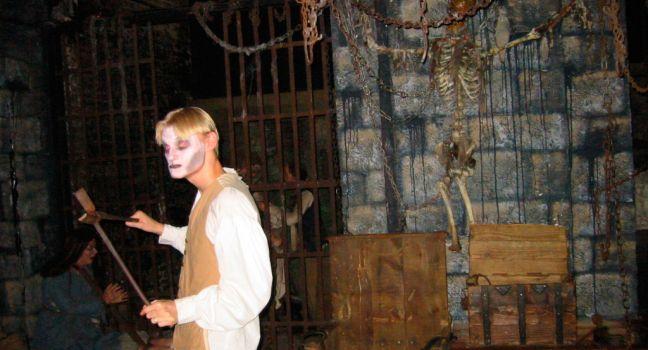
London Dungeon, South Bank, London, England.
Kjetilbjørnsrud / Kjetil Bjørnsrud, via Wikimedia Commons [CC BY-SA 3.0]

Saved by a keen sense of its own borderline ridiculousness, this gory attraction is full of over-the-top tableaux depicting the bloody demise of famous figures alongside the torture, murder, and ritual slaughter of lesser-known victims, all to a soundtrack of screaming, wailing, and agonized moaning. There are lively dramatizations about the Great Plague, Henry VIII, (the fictional) Sweeney Todd, and (the real) Jack the Ripper, just to name a few, with costumed characters leaping out of the gloom to bring the information to life and add to the fear and fun. There's also an Escape Room (make it and you won't be hanged) attraction. Perhaps most shocking are the crowds of children baying to get in: most kids absolutely love this place, although those with more a sensitive disposition may find it too frightening (that goes for adults as well). Expect long lines on weekends and during school holidays. Adults-only evening tours also include drinks. Tickets bought online and in advance can be up to 30% less than walk-up prices.

Tower Bridge

City of London
Tower Bridge, London,at sunset, span open.
Angelina Dimitrova / Shutterstock

Despite its medieval appearance, London's most famous bridge was actually built at the tail end of the Victorian era in the then-popular neo-Gothic style, first opening to traffic in 1894. With a latticed steel construction clad in Portland stone, the bridge is known for its enormous bascules—the 1,000-ton "arms" that open to allow ships taller than its normal 28-foot clearance to glide beneath. The steam-powered bascules were a marvel of Victorian engineering when they were created (you can still visit the Engine Rooms, now with explanatory films and interactive displays), and required 80 people to raise and lower. Initially, heavy river traffic meant this happened 20 to 30 times a day, but it's now reduced to a number of days per month, with greater frequency depending on the time of year (see the bridge's website for a schedule).

The family-friendly Tower Bridge Exhibition includes the ground-level Engine Room, displays in the North Tower documenting the bridge's history, access to the east and west walkways that run alongside the road between the turrets and provide views over the river and city, and for those untroubled by vertigo, a transparent walkway 138 feet up between the towers that lets you look down on the traffic or, if the bascules are raised, the ships below.

Tower Bridge Rd., London, SE1 2UP, England
020-7403–3761
Sight Details
From £12.30

Something incorrect in this review?

18 Stafford Terrace

Kensington

The home of Punch cartoonist Linley Sambourne in the 1870s, this charming house is a rare example of the "Aesthetic interior" style; it displays delightful Victorian and Edwardian antiques, fabrics, and paintings, as well as several samples of Sambourne's work for Punch. The Italianate house was the scene for society parties when Sambourne's granddaughter Anne Messel was in residence in the 1940s. This being Kensington, there's inevitably a royal connection: Messel's son, Antony Armstrong-Jones, was married to the late Princess Margaret, and their son has preserved the connection by taking the title Viscount Linley.

18 Stafford Terr., London, W8 7BH, England
0207-361–3783
Sight Details
£11; joint ticket with Leighton House £20
Closed Mon. and Tues.

Something incorrect in this review?

2 Willow Road

Hampstead

Among the many artists and intellectuals fleeing Nazi persecution who settled in the area was noted architect Ernö Goldfinger, who built this outstanding and influential modernist home opposite Hampstead Heath in 1939 as his family residence. (His plans drew the ire of several local residents, including novelist Ian Fleming, who supposedly got his revenge by naming the Bond villain after his neighbor.) Along with design touches and building techniques that were groundbreaking at the time, the unique house, a place of pilgrimage for 20th-century architecture enthusiasts, also contains Goldfinger's impressive collection of modern art and self-designed innovative furniture. Admission between 11 am and 2 pm is by hourly guided tour or you can embark on a self-guided tour at 3, 3:20, or 3:40. All must be booked in advance.

Albert Memorial

Kensington

After Prince Albert's early death from typhoid in 1861, his grieving widow, Queen Victoria, had Sir Gilbert Scott create this ornate, High Victorian Gothic tribute erected near the site of Albert's brainchild, the Great Exhibition of 1851. A 14-foot gilt-bronze statue of the prince (holding an Exhibition catalog) rests on a 15-foot-high pedestal, surrounded by marble figures representing his passions and interests. A frieze at the base depicts 187 exquisitely carved figures of well-known Victorian painters, poets, sculptors, musicians, and architects.

Kensington Gardens, London, SW7 2AP, England

Something incorrect in this review?

Bank of England

City of London

Since its establishment in 1694 as England's central bank, the role of the "Old Lady of Threadneedle Street" (a political cartoon caption that stuck) has grown to include managing foreign exchanges, issuing currency, storing the nation's gold reserves, and regulating the United Kingdom's banking system. Since 1997, it has had operational responsibility for Britain's monetary policy, most visibly setting interest rates (similar to the Federal Reserve in the United States).

The 3-acre site is enclosed in a massive, neoclassical curtain wall designed by Sir John Soane. This 1828 windowless outer wall is all that survives of Soane's original bank building, which was demolished in 1925. You can discover more about the bank's history in the surprisingly varied Bank of England Museum (the entrance is around the corner on Bartholomew Lane). In addition to the bank's original Royal Charter, there's a lively program of special exhibitions, plus interactive displays (you can even try your hand at controlling inflation). The most popular exhibit remains the solid-gold bar in the central trading hall that you can actually hold—but before you get any ideas, there's security everywhere.

Threadneedle St., London, EC2R 8AH, England
020-3461–4878
Sight Details
Free
Closed weekends, bank holidays, and 2 wks over Christmas

Something incorrect in this review?

Bankside Gallery

Southwark

Two artistic societies—the Royal Society of Painter–Printmakers and the Royal Watercolour Society—have their headquarters in this gallery next to Tate Modern. Together they mount exhibitions of current members' work, which is usually for sale, along with art books, making this a great place for finding that unique, not too expensive gift. There are also regular themed exhibitions.

Banqueting House

Westminster

James I commissioned Inigo Jones, one of England's great architects, to undertake a grand building on the site of the original Tudor Palace of Whitehall, which was (according to one foreign visitor) "ill-built, and nothing but a heap of houses." Jones's Banqueting House, finished in 1622 and the first building in England to be completed in the neoclassical style, bears all the hallmarks of the Palladian sophistication and purity that so influenced Jones during his time in Italy. James's son, Charles I, enhanced the interior by employing the Flemish painter Peter Paul Rubens to glorify his father and himself (naturally) in a series of vibrant painted ceiling panels called The Apotheosis of James I. As it turned out, these allegorical paintings, depicting a wise monarch being received into heaven, were the last thing Charles saw before he stepped through the open first-floor window onto the scaffold, which had been erected directly outside for his execution by Cromwell's Parliamentarians in 1649. Twenty years later, his son, Charles II, would celebrate the restoration of the monarchy in the exact same place. 

In summer 2024, these magnificent artworks will be taken down so conservators can get to work on a yearslong conservation process. While this work occurs Banqueting House will be closed until at least fall 2025; check the website for the most up-to-date information.

Belgrave Square

Belgravia

This is the heart of Belgravia, once the preferred address for some of London's grandest families, although it's now mostly occupied by organizations, embassies, and the international rich. The square and the streets leading off it share a remarkably consistent elegant architectural style thanks to all being part of a Regency redevelopment scheme commissioned by the Duke of Westminster and designed by Thomas Cubitt with George Basevi. The imposing, cream-color stucco terraced houses, now mostly divided into apartments, were snapped up by aristocrats and politicians due to their proximity to Buckingham Palace just around the corner, and still command record prices on the rare occasions when they come onto the market. The private garden in the center is open to the public once a year. Walk down Belgrave Place toward Eaton Place and you pass two of Belgravia's most beautiful mews: Eaton Mews North and Eccleston Mews, both fronted by grand rusticated entrances right out of a 19th-century engraving. Traffic can really whip around Belgrave Square, so be careful.

London, SW1X 8PG, England

Something incorrect in this review?

Berkeley Square

Mayfair

A lovely public square to stop for a break, not many of its original mid-18th-century houses are left but there are still a few gems. Look at Nos. 42–46 (especially No. 44, which the architectural historian Sir Nikolaus Pevsner thought to be London's finest terraced house) and Nos. 49–52 to get an idea of why this was once London's top address. Incidentally, No. 50 is known as London's most haunted house, with claims of ghostly goings-on stretching back to the early 19th century. As anyone who's heard the old song knows, the "Berkeley" actually rhymes with "starkly."

London, W1, England

Something incorrect in this review?

Bevis Marks Synagogue

Whitechapel

This is Britain's oldest synagogue still in use and is certainly its most splendid. It was built in 1701, after Jewish people, having been expelled from England in 1290, were allowed to return under Cromwell in 1656. Inspired by the Spanish and Portuguese Great Synagogue of Amsterdam, the interior is embellished with rich woodwork, seven hanging brass candelabra (representing the seven days of the week), and 12 trompe-l'oeil wood columns painted to look like marble. The magnificent Ark, which contains the sacred scrolls of the five books of Moses, is modeled on contemporary Wren neoclassical altarpieces, with oak doors and Corinthian columns. In 1992 and 1993 the synagogue was seriously damaged by IRA bombs, but it was subsequently completely restored. It's closed to visitors during Jewish holidays and has been undergoing construction work in 2023, so check the website before visiting.

Bevis Marks, London, EC3A 7LH, England
020-7621–1188
Sight Details
£6
Closed Sat. and Mon. bank holidays

Something incorrect in this review?

Bond Street

Mayfair

This world-class shopping haunt is divided into northern "New" (1710) and southern "Old" (1690) halves. You can spot the juncture by a bronzed bench on which Franklin D. Roosevelt sits companionably next to Winston Churchill. At No. 34--35, on New Bond Street, you'll find Sotheby's, the world-famous auction house, as well as upscale retailers like Chanel, Burberry, Louis Vuitton, and Church's. You'll find even more opportunities to flirt with financial ruin on Old Bond Street, with flagship boutiques of top-end designers like Prada, Saint Laurent, and Alexander McQueen; an array of fine jewelers including Tiffany & Co.; and art dealers Richard Green, Richard Nagy, and Trinity Fine Art. Cork Street, which parallels the top half of Old Bond Street, is where many top dealers in contemporary art have their galleries.

British Library

Bloomsbury

With a collection totaling more than 170 million items, plus 3 million new additions every year, the British Library is a world-class repository of knowledge. Its greatest treasures are on view to the general public in the Sir John Ritblat Gallery: the Magna Carta, the Codex Sinaiticus (an ancient Bible containing the oldest complete copy of the New Testament), Jane Austen's writings, and Shakespeare's First Folio, as well as musical manuscripts by Handel and Beethoven, and original handwritten lyrics by the Beatles. There's also a lively and eclectic program of special exhibitions and talks (previous speakers have included legendary playwright Tom Stoppard, Monty Python's Michael Palin, and trailblazing Nigerian writer Chimamanda Ngozi Adichie).

96 Euston Rd., London, NW1 2DB, England
0330-333–1144
Sight Details
Free, donations appreciated; charge for special exhibitions and talks

Something incorrect in this review?

Brompton Oratory

Knightsbridge

This is a late product of the mid-19th-century English Roman Catholic revival led by Cardinal John Henry Newman (1801–90), who established the oratory in the 1840s and whose statue you see outside. Architect Herbert Gribble was an unknown 29-year-old when he won a competition to design the church, bringing a baroque exuberance to his concept for the vast, incredibly ornate interior. It's punctuated by treasures far older than the church itself, like the giant Carrara marble Twelve Apostles in the nave, sculpted by Giuseppe Mazzuoli in the 1680s for Siena's cathedral. A working church, the Oratory is known for the quality of its organs and choir, with exceptional music being an integral part of services here.

Brompton Rd., London, SW7 1EX, England
0207-808–0900
Sight Details
Free

Something incorrect in this review?

Burgh House and Hampstead Museum

Hampstead

One of Hampstead's oldest buildings, Burgh House was built in 1704 to take advantage of the natural spa waters of the then-fashionable Hampstead Wells. A private house until World War II, it was saved from dereliction in the 1970s by local residents, who have maintained it ever since. The building is a fine example of the genteel elegance typical of the Queen Anne period, with brick frontage, oak-paneled rooms, and a terraced garden that was originally designed by Gertrude Jekyll. Today the house contains a small but diverting collection of objects, paintings, textiles, and furniture related to the history of the house and the surrounding area, and also hosts regular talks, concerts, and recitals (and weddings). The secluded garden courtyard of the café is a lovely spot for lunch, tea, or a glass of wine on a summer's afternoon.

New End Sq., London, NW3 1LT, England
020-7431–0144
Sight Details
Free
House closed Mon., Tues., and Sat. Café closed Mon. and Tues.

Something incorrect in this review?

Camden Arts Centre

Hampstead

This community-oriented gallery, with a mandate to help new audiences engage with art and the people who make it, has become one of the city's most highly regarded exhibition spaces. Since 1965, it has nurtured and given early exposure to important artists including Martin Creed, Sophie Calle, and Yinka Shonibare, and continuing its support for emerging talent by hosting the Bloomberg New Contemporaries exhibition that features 55 of the most exciting emerging artists from art schools in the United Kingdom.

A café serves organic breakfasts, light lunches, and small plates of Italian-inspired food (plus wine, beer, and cocktails in the afternoon), with outdoor seating in the lovely garden, weather permitting. There's also a bookshop selling books by and about artists.

Camden Passage

Islington

A pretty pedestrian thoroughfare just off Upper Street, Camden Passage is famous for its many antique shops selling everything from vintage furniture to period jewelry to timeless timepieces. In recent years, a sprinkling of independent boutiques, delis, and cafés has given the passage an eclectic, vibrant feel. There are stalls here every day except for Monday and Tuesday, but the best, busiest days to come are Wednesday and Saturday.

Camley Street Natural Park

King's Cross

These 2 acres of splendid calm are bang in the middle of the King's Cross hustle and bustle. This nature reserve, just across the road from the concrete and glass of the Eurostar terminal, provides a habitat for birds, butterflies, bats, and a wide variety of plant and pond life. Complete with a visitor's center and café, this delightful urban oasis is popular with schoolchildren and office workers on lunch break, but chances are you could have the whole place to yourself.

Carlton House Terrace

Westminster

Architect John Nash designed Carlton House, a glorious example of the Regency style, under the patronage of the Prince Regent (later George IV), who ruled in place of George III while the "mad king" was considered too unstable to rule. Carlton House was considered a most extravagant building for its time; it was demolished after the prince's accession to the throne in 1820. In its place Nash built Carlton House Terrace—no less imposing, with white-stucco facades and massive Corinthian columns. Carlton Terrace was a smart address, home to a number of the 19th-century's greatest luminaries—including two prime ministers, William Gladstone (1856) and Lord Palmerston (1840–46). Today Carlton House Terrace houses the Royal Society (No. 6–9), Britain's most prestigious society of scientific minds; still active, its previous members have included Isaac Newton and Charles Darwin.

The Mall, London, SW1Y 5AG, England

Something incorrect in this review?