185 Best Sights in London, England

Background Illustration for Sights

We've compiled the best of the best in London - browse our top choices for the top things to see or do during your stay.

Victoria and Albert Museum
Kensington Fodor's Choice
Victoria & Albert Museum, Kensington, London, England.
© Ross Brinkerhoff / Fodors Travel

Known to all as the V&A, this huge museum with more than 2 million items on display in 145 galleries is devoted to the applied arts of all disciplines, all periods, and all nationalities. First opened as the South Kensington Museum in 1857, it was renamed in 1899 in honor of Queen Victoria's late husband and has since grown to become one of the country's best-loved cultural institutions, with high-profile temporary exhibitions alongside an impressive permanent collection. Many collections at the V&A are presented not by period but by category—textiles, sculpture, jewelry, and so on. It's a tricky building to navigate, so use the free map.

Nowhere is the benefit of the categorization more apparent than in the Fashion Gallery (Room 40), where formal 18th-century court dresses are displayed alongside the haute couture styles of contemporary designers. The museum has become known for high-profile temporary exhibitions devoted to fashion icons such as Chanel, Balenciaga, and Christian Dior, and to explorations of pop legends including David Bowie and Pink Floyd.

The British Galleries (Rooms 52–58 and 118–125) survey British art and design from 1500 to 1900 and are full of rare and beautiful artifacts, such as the Tudor Great Bed of Ware (immortalized in Shakespeare's Twelfth Night) and silks woven by Huguenot refugees in 18th-century Spitalfields. Among the series of actual rooms that have been painstakingly reconstructed piece by piece are the glamorous rococo Norfolk House Music Room and the serenely elegant Henrietta St. Drawing Room, originally designed in 1722.

The Asian Galleries (Rooms 44–47) are full of treasures, but among the most striking items on display is a remarkable collection of ornate samurai armor in the Japanese Gallery (Room 44). Works from China, Korea, and the Islamic Middle East have their own displays. Also of note is a gallery thematically grouped around Buddhist sculptures from different regions and periods. The Europe Gallery (Rooms 1–7) brings together more than 1,100 objects created between 1600 and 1815, while the Medieval and Renaissance galleries, which document European art and culture from 300 to 1600, have the largest collection of works from the period outside of Italy.

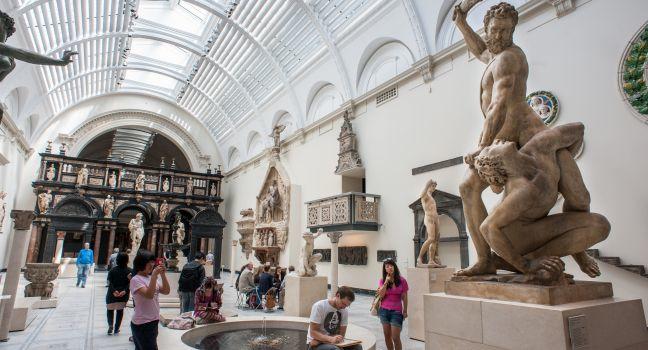
An entrance off Exhibition Road offers access through Britain's first porcelain-tiled public courtyard, which also serves as a venue for contemporary installations and a glass-fronted café. A photography center houses books, photo equipment, and more than 270,000 prints formerly held by the Royal Photographic Society, joining the more than 500,000 photos already in the museum's collection. A room in the center has been named the Elton John and David Furnish Gallery after the couple donated some 7,000 photographs by 20th-century masters, a selection of which are displayed in the center. A free 45-minute introductory tour of the museum's highlights twice daily helps you take it all in. There are also free lunchtime lectures on Thursday with deep dives into subjects like the Dog in Early British Photography. Whatever time you visit, the spectacular sculpture hall will be filled with artists, both amateur and professional, sketching the myriad artworks on display there. Don't be shy; bring a pad and join in.
The Wallace Collection

Marylebone Fodor's Choice
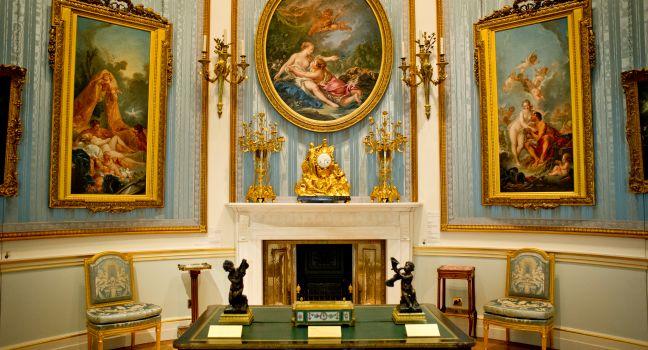
Gallery, Wallace Collection, Marylebone, London, England.
© Zach Nelson / Fodors Travel

With its Great Gallery stunningly refurbished, there's even more reason to visit this exquisite gem of an art gallery—although housing one of the world's finest assemblies of Old Master paintings is reason enough. This glorious collection and the 18th-century mansion in which it's located were bequeathed to the nation by Lady Julie-Amélie-Charlotte Wallace, the widow of Sir Richard Wallace (1818–90). Wallace's father, the fourth marquess of Hertford, took a house in Paris after the French Revolution and set about snapping up paintings by what were then dangerously unpopular artists.

Frans Hals's The Laughing Cavalier is probably the most famous painting here, or perhaps Jean-Honoré Fragonard's The Swing. The full list of painters in the collection reads like a "who's who" of classical European art—from Rubens, Rembrandt, and van Dyck to Canaletto, Titian, and Velázquez. English works include paintings by Gainsborough and Turner. There are also fine collections of furniture, porcelain, Renaissance gold, and majolica (15th- and 16th-century Italian tin-glazed pottery). With craft activities, hands-on sessions, and the chance to try on a suit of armor in the "Arms and Armour" collection, there's plenty to keep kids occupied, too.

The conditions of the bequest mean that no part of the collection can leave the building; this is the only place in the world you'll ever be able to see these works.

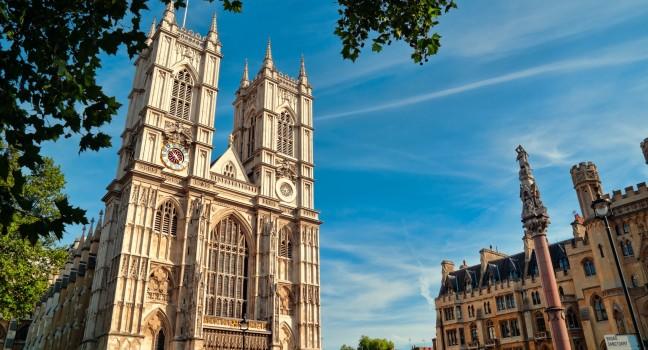
Westminster Abbey

Westminster Fodor's Choice
Westminster Abbey, London, UK.
r.nagy / Shutterstock

Steeped in hundreds of years of rich and occasionally bloody history, Westminster Abbey is one of England's iconic buildings. An abbey has stood here since the 10th century, although the current building mostly dates from the 1240s. It has hosted 38 coronations—beginning in 1066 with William the Conqueror—and no fewer than 16 royal weddings, the latest being that of Prince William and Kate Middleton in 2011. But be warned: there's only one way around the abbey, and it gets very crowded, so you’ll need to be alert to catch the highlights.

The Coronation Chair, which you'll find in St. George's Chapel by the east door, has been used for nearly every coronation since Edward II’s in 1308, right up to Queen Elizabeth II’s in 1953. Farther along, the exquisite confection of Henry VII's Lady Chapel is topped by a magnificent fan-vaulted ceiling. The tomb of Henry VII lies behind the altar. Elizabeth I is buried above her sister "Bloody" Mary I in the tomb in a chapel on the north side, while her archenemy, Mary Queen of Scots, rests in the tomb to the south. The Chapel of St. Edward the Confessor contains the shrine of the pre-Norman king, who reigned from 1042 to 1066. Because of its great age, you must join a verger-guided tour to be admitted to the chapel (£10; book at the admission desk). To the left, you'll find Poets' Corner. Geoffrey Chaucer was the first poet to be buried here, and other statues and memorials include those to William Shakespeare, D. H. Lawrence, T. S. Eliot, and Oscar Wilde.

The medieval Chapter House is adorned with 14th-century frescoes and a magnificent 13th-century tiled floor, one of the finest in the country. Near the entrance is Britain's oldest door, dating from the 1050s. If you walk toward the West Entrance, you'll see a plaque to Franklin D. Roosevelt—one of the abbey's very few tributes to a foreigner. The poppy-wreathed Grave of the Unknown Warrior commemorates soldiers who lost their lives in both world wars.

With a separate timed ticket (£5), you can visit the Queen's Diamond Jubilee Galleries located 52 feet above the abbey floor; it's worth it for the views onto the abbey's interior below alone, but it also gets you access to a remarkable collection of historical objects that tell the story of the building, including its construction and relationship to the monarchy. Don't miss the marriage license of the Prince and Princess of Wales, the bright white vellum it's written on in stark contrast to the aged documents elsewhere on display.

Exact hours for the various parts of the abbey are frustratingly long and complicated, and can change daily, so it's important to check before setting out, particularly if you're visiting early or late in the day, or off-season. The full schedule is posted online daily (or you can call). Certain areas of the abbey are completely inaccessible to wheelchair users; however, you will get free entry for yourself and one other.

Broad Sanctuary, London, SW1P 3PA, England
020-7222–5152
Sight Details
£29
Closed Sun. except for worship and the gift shop

Something incorrect in this review?

Recommended Fodor's Video

Whitechapel Gallery

Whitechapel Fodor's Choice
Whitechapel Art Gallery, London, England
© Halie Cousineau/ Fodors Travel

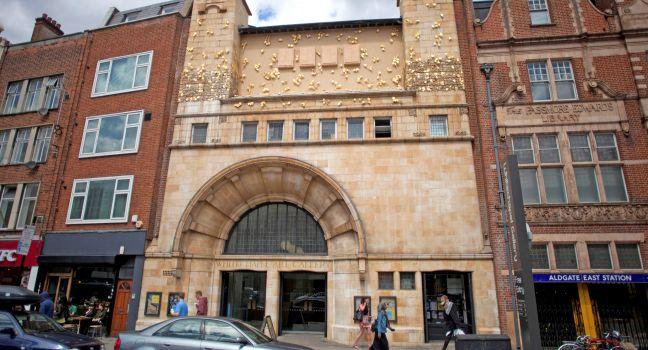
Founded in 1901, this internationally renowned gallery mounts exhibitions that rediscover overlooked masters and showcase tomorrow's legends. Painter and leading exponent of abstract expressionism Jackson Pollock was exhibited here in the 1950s as was pop artist Robert Rauschenberg in the 1960s; the 1970s saw a young David Hockney's first solo show. The exhibitions continue to be on the cutting edge of contemporary art. The gallery also hosts talks, film screenings, workshops, and other events; First Thursdays is a regular event designed to highlight monthly openings at more than 150 local galleries, with the Whitechapel offering curated tips about where to visit on the first Thursday of the month. Pick up a free East London art map (also available online) to help you plan your visit to the area. Townsend, the gallery's on-site restaurant, serves good-quality modern British food in a bright and pretty room.

Young V&A

Bethnal Green Fodor's Choice
The Central Hall, V and A Museum of Childhood, London, England
Childhood Museum - London - September 2008 by Cristian Bortes

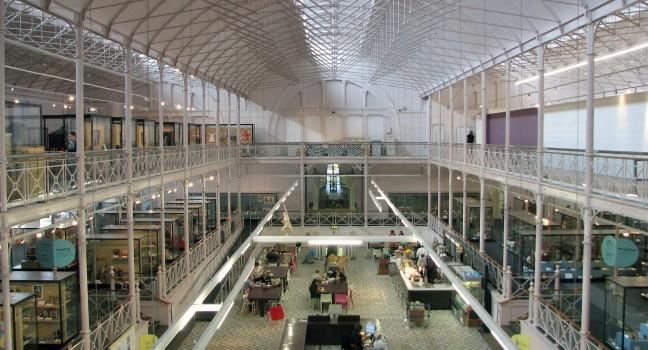
A treat for all but designed specifically for children under age 14, this East London outpost of the Victoria & Albert Museum houses one of the world's biggest toy collections. The iron, glass, and brown-brick building—an architectural joy in itself—was transported here from South Kensington in 1868 and reopened July 2023 following an extensive five-year renovation project. The collection of more than 2,000 objects is organized into three galleries: Play, Imagine, and Design, all offering plenty of interactive experiences, including an amphitheater-style stage, a free-play construction area, and a working design studio. Fun new acquisitions include a skateboard belonging to 13-year-old 2020 Olympic medalist Sky Brown. The shop is a good spot to pick up original toys.

ZSL London Zoo

Regent's Park Fodor's Choice
London Zoo, Regent's Park, London, England.
© Zach Nelson / Fodors Travel

With an emphasis on education, wildlife conservation, and the breeding of endangered species, London Zoo offers visitors the chance to see tigers, gorillas, meerkats, and more in something resembling a natural environment rather than a cage. Operated by the nonprofit Zoological Society of London, the zoo grew out of the monarch's animals collection, which moved here from the Tower of London in 1828. The zoo itself did not open to the public until 1847. Big attractions include Land of the Lions, a walk-through re-creation of an Indian forest where you can see the two resident Asiatic lions relaxing at close range; Gorilla Kingdom, which provides a similar re-created habitat (in this case an African rain forest) for its troop of six Western Lowland Gorillas (including a youngster born in 2024); and the Attenborough Komodo Dragon House, renamed to honor the renowned naturalist, who led the first film crew to capture Komodo dragons on camera.

The zoo also offers the chance to get up close and personal with 15 ring-tailed lemurs. The Giants of the Galapagos is a lagoon inhabited by the resident giant tortoises while Rainforest Life is an indoor tropical rainforest (complete with humidity) inhabited by the likes of armadillos, monkeys, and sloths. A special nighttime section offers glimpses of nocturnal creatures like slow lorises and bats. The Animal Adventure playground allows kids to observe coatis, as well as interact with llamas, donkeys, small pigs, sheep, and goats. An ever-popular attraction, especially at feeding time (noon in winter and 4:20 pm in other months), is Penguin Beach, an enclosure and pool that hosts a colony of Humboldt penguins.

If you're feeling flush, try to book tickets for VIP experiences (£54) that offer a 20-minute guided close encounter where you can feed and interact with meerkats (2:30 pm), monkeys (2 pm), giraffes (10 am, £115 for 90 minutes), tigers (9 am, £170) and even Komodo dragons (9 am, £110). Other zoo highlights include a Butterfly Paradise and the Tiger Territory, an enclosure for four beautiful endangered Sumatran tigers (including two cubs born at the zoo). There are also 90-minute early evening "relaxed tours" for the neurodiverse from June to August (they're also offered at 8:30 am before the usual opening hours in other months) to ensure a calmer experience. You can also experience the zoo after-hours by booking an overnight stay in one of the cozy cabins near (not in) the Asiatic lion enclosure. Check the website or the information board out front for free events, including creature close encounters and "ask the keeper" sessions. Booking in advance online for all tickets is required.

Outer Circle, London, NW1 4RY, England
0844-225–1826
Sight Details
From £27

Something incorrect in this review?

Benjamin Franklin House

Covent Garden Fodor's Choice

This architecturally significant 1730 Georgian town house is the only surviving residence of American statesman, scientist, writer, and inventor Benjamin Franklin, who lived and worked here for 16 years preceding the American Revolution. The restored Georgian home has been left unfurnished, the better to show off the original features, like the 18th-century wood paneling, stoves, beams, bricks, and windows. Visitors are led around the house by the costumed character of Polly Hewson, the daughter of Franklin's landlady, who interacts with engaging video projections and recorded voices (weekends only). On Friday you can take a guided tour focusing on the architectural details of the building while a walking tour of the surrounding area lasting up to 90 minutes sets off from the house at noon.

Borough Market

Borough Fodor's Choice

There's been a market in Borough since 1014, and this latest incarnation, spread under the arches and railroad tracks leading to London Bridge Station, is where some of the city's best food producers sell their wares, with more than 100 stalls selling food from around the world. Fresh coffees, gorgeous cheeses, and baked goods complement the organically farmed meats, fresh fish, condiments, fruits, and vegetables, along with treats from Taiwan, Spain, France, Italy, India, Iraq, Thailand, Japan, Singapore, Jamaica, Mexico, and more. The market is divided into three areas: one for larger producers and merchants, one for small specialist produce traders, and one for street food traders, all surrounded by above-average restaurants, bars, and shops.

Don't make any other lunch plans for the day; this is where celebrity chef Jamie Oliver's scallop man cooks them fresh at Shellseekers, and Ginger Pig's free-range rare-breed sausages sizzle on grills, while for the sweets lover, there are chocolates, preserves, and Whirld's handmade fudge. The Market Hall hosts workshops, tastings, and a demonstration kitchen, and even houses an orchard. The market is open weekdays 10–5, Saturday 9–5, and Sunday 10–4, though not all traders operate on all days; check the website for more details.

On weekends, a separate, highly regarded market specializing in produce and street food operates on nearby Maltby Street. It was originally established by eight breakaway Borough Market traders. There you'll find some 16 stalls specializing in gyoza, sausage and mash, Ethiopian dishes, duck frites, Argentinian street food, crepes, and more, plus a craft beer shop, a pizzeria, a bodega, a florist, and other shops in the surrounding railway arches.

Churchill War Rooms

Westminster Fodor's Choice

It was from this small warren of underground rooms—beneath the vast government buildings of the Treasury—that Winston Churchill and his team directed troops in World War II. Designed to be bombproof, the whole complex has been preserved almost exactly as it was when the last light was turned off at the end of the war. Every clock shows almost 5 pm, and the furniture, fittings, and paraphernalia of a busy, round-the-clock war office are still in situ, down to the colored map pins.

During air raids, the leading government ministers met here, and the Cabinet Room is arranged as if a meeting were about to convene. In the Map Room, the Allied campaign is charted on wall-to-wall maps with a rash of pinholes showing the movements of convoys. In the hub of the room, a bank of differently colored phones known as the "Beauty Chorus" linked the War Rooms to control rooms around the nation. Spot the desk from which the PM made his morale-boosting broadcasts; the Transatlantic Telephone Room (a converted broom cupboard) has his hotline to FDR. You can also see the restored rooms that the PM used for dining and sleeping. Telephonists (switchboard operators) and clerks who worked 16-hour shifts slept in lesser quarters in unenviable conditions.

An excellent addition to the War Rooms is the Churchill Museum, a tribute to the great wartime leader himself.

The Courtauld Gallery

Covent Garden Fodor's Choice

One of London's most beloved art collections, the Courtauld Gallery is to your right as you pass through the archway into the grounds of the beautifully restored, grand 18th-century neoclassical Somerset House. Founded in 1931 by textile magnate Samuel Courtauld to house his remarkable private collection, this is one of the world's finest impressionist and postimpressionist galleries, with artists ranging from Bonnard to van Gogh. A déjà vu moment with Cézanne, Degas, Seurat, Monet, and more awaits on every wall (Manet's Bar at the Folies-Bergère and van Gogh’s Self-Portrait with Bandaged Ear are two of the stars). Botticelli, Bruegel, Tiepolo, and Rubens are also represented, thanks to the bequest of Count Antoine Seilern's Princes Gate collection. German Renaissance paintings include the sublime Adam and Eve by Lucas Cranach the Elder. The second floor has a more provocative, experimental feel, with masterpieces such as Modigliani's famous Female Nude. Look out for a full program of additional blockbuster one-off exhibitions, and don't miss the little café downstairs, a perfect place for a post-gallery pot of tea.

Covent Garden Piazza

Covent Garden Fodor's Choice

Once home to London's main flower market, where My Fair Lady's flower girl Eliza Doolittle peddled her blooms, the square around which Covent Garden pivots is known as the Piazza. In the center, the fine old market building now houses stalls and shops selling expensive clothing, plus several restaurants, cafés, and knickknack stores that are good for gifts. One particular gem is Benjamin Pollock's Toyshop at No. 44 in the market. Established in the 1880s, it sells enchanting toy theaters. The Apple Market has good crafts stalls on most days, too. On the south side of the Piazza, the indoor Jubilee Market, with its stalls of clothing, army surplus gear, and more crafts, feels more like a flea market.

In summer, it may seem that everyone in the huge crowds around you in the Piazza is a fellow tourist, but there's still plenty of office life in the area. Londoners who shop here tend to head for Neal Street and the area to the north of Covent Garden Tube station, rather than the market itself. In the Piazza, street performers—from foreign musicians to jugglers and mimes—play to the crowds, as they have done since the first English Punch and Judy show, staged here in the 17th century.

Hampton Court Palace

Fodor's Choice

The beloved seat of Henry VIII's court, sprawled elegantly beside the languid waters of the Thames, Hampton Court is steeped in more history than virtually any other royal building in England. The Tudor mansion, begun in 1515 by Cardinal Wolsey to curry favor with the young Henry, actually conceals a larger 17th-century baroque building, which was partly designed by Sir Christopher Wren. The earliest dwellings on this site belonged to a religious order founded in the 11th century and were expanded over the years by its many subsequent residents until George II moved the royal household closer to London in the early 18th century.

After entering through the magnificent Tudor courtyard, start with a look through the State Apartments, decorated in the Tudor style, and on to the wood-beamed magnificence of Henry's Great Hall, before taking in the strikingly azure ceiling of the Chapel Royal. Watch out for the ghost of Henry VIII's doomed fifth wife, Catherine Howard, who lost her head yet is said to scream her way along the Haunted Gallery. (Believe it or not, what is certainly true is that the corridor is prone to sudden drops in temperature—and no one quite knows why.) Latter-day masters of the palace, the joint rulers William and Mary (reigned 1689–1702), were responsible for the beautiful King's and Queen's Apartments and the elaborate baroque of the Georgian Rooms.

Well-handled reconstructions of Tudor life take place all year, from live appearances by "Henry VIII" to cook-historians preparing authentic feasts in the Tudor Kitchens. (Dishes on offer in the adjacent café include a few of these traditional recipes.) The highlight of the formal grounds is undoubtedly the famous maze (the oldest hedge maze in the world); its half mile of pathways among clipped hedgerows is still fiendish to negotiate. There's a trick, but we won't give it away here; it's much more fun just to go and lose yourself. Meanwhile, the Lower Orangery Garden shows off thousands of exotic species that William and Mary, avid plant collectors, gathered from around the globe.

Highgate Cemetery

Highgate Fodor's Choice

Highgate is not the oldest cemetery in London, but it is probably the best known, both for its roster of famous "inhabitants" and the quality of its funerary architecture. After it was consecrated in 1839, Victorians came from miles around to appreciate the ornate headstones, the impressive tombs, and the view. At its summit is the Circle of Lebanon, a ring of vaults built around an ancient cypress tree, a legacy of the 17th-century gardens that formerly occupied the site. Leading from the circle is the Egyptian Avenue, a subterranean stone tunnel lined with catacombs, itself approached by a dramatic colonnade that screens the main cemetery from the road. Such was its popularity that 19 acres on the other side of the road were acquired in 1850, and this additional East Cemetery is the final resting place of numerous notables including Karl Marx (the site's most visited) as well as George Eliot and, a more recent internment, George Michael. Both sides are impressive, with a grand (locked) iron gate leading to a sweeping courtyard built for the approach of horses and carriages.

By the 1970s the cemetery had become unkempt and neglected until a group of volunteers, the Friends of Highgate Cemetery, undertook the huge upkeep. Tours are conducted by the Friends, who will show you the most interesting graves among the numerous statues and memorials once hidden by overgrowth. The tours of the West and East sides are 75 minutes each. Alternatively, you can go on a self-guided ramble, but admission to the catacombs is by guided tour only. There is a reduced price for East side only admission. You're expected to dress respectfully, so skip the shorts and the baseball cap; children under eight are not admitted and neither are dogs, tripods, or video cameras.

Swains La., London, N6 6PJ, England
020-8340–1834
Sight Details
East Cemetery only £6, tours £14; West Cemetery (includes includes admission to East Cemetery) £10, tours £18

Something incorrect in this review?

Houses of Parliament

Westminster Fodor's Choice

The Palace of Westminster, as the complex is called, was first established on this site by Edward the Confessor in the 11th century. William II built a new palace in 1097, and this became the seat of English power. A fire destroyed most of the palace in 1834, and the current complex dates largely from the mid-19th century. The best view is from the opposite (south) bank of the Thames, across Lambeth Bridge. It is most dramatic at night when lighted green and gold.

The Visitors' Galleries of the House of Commons provide a view of democracy in action when the benches are filled by opposing MPs (members of Parliament). Debates are formal but raucous, especially during Prime Minister's Questions (PMQs), when any MP can put a question to the nation's leader. Tickets to PMQs are free but highly sought after, so the only way for non–U.K. citizens to gain access is by lining up on the day and hoping for returns or no-shows—expect to wait for up to two hours, with no guarantee of entry. The action starts at noon every Wednesday when Parliament is sitting, and the whole shebang is broadcast live on television. For non-PMQ debates, embassies and high commissions have a quota of tickets available to their citizens, which can help you avoid long lines. The easiest time to get into the Commons is during an evening session—Parliament is still sitting if the top of the Clock Tower is illuminated. There are also visitors galleries for the House of Lords.

The Clock Tower—renamed Elizabeth Tower in 2012, in honor of Queen Elizabeth II's Diamond Jubilee—was completed in 1858, and contains the 13-ton bell known as Big Ben. At the southwest end of the main Parliament building is the 323-foot-high Victoria Tower. The King uses the Sovereign's Entrance, at its base, when visiting Parliament. 

Engaging guided and audio tours of Parliament are available on Saturday and weekdays when Parliament isn't sitting.

IWM London

South Bank Fodor's Choice

Despite its name, the cultural venue formerly known as the Imperial War Museum (one of five IWM branches now around the country) does not glorify either empire or bloodshed but emphasizes understanding through conveying the impact of 20th- and 21st-century warfare on citizens and soldiers alike. A dramatic six-story atrium at the main entrance encloses an impressive amount of hardware—including a Battle of Britain Spitfire, a German V2 rocket, the remains of a car blown up in post-invasion Iraq, tanks, guns, and submarines—along with accompanying interactive material and a café. The First World War galleries explore the wartime experience on both the home and fighting fronts, with the most comprehensive collection on the subject in the world—some 1,300 objects ranging from uniforms, equipment, and weapons to letters and diaries. The Second World War galleries shed light on that conflict through objects, film documentation, and eyewitness testimonies, as do the extensive and haunting Holocaust galleries (private tours are available for all three areas). Peace and Security 1945–2015 looks at more contemporary hostilities, including the Cold War, Iraq, and Afghanistan, right up to the current conflict in Ukraine. The Art, Photography, and Film galleries explore the wartime experience from World War I to the present day through the work of artists in these disciplines.

Keats House

Hampstead Fodor's Choice

It was while lodging in this house between 1818 and 1820 that the leading Romantic poet John Keats (1795–1821) fell in love with girl-next-door Fanny Brawne and wrote some of his best-loved poems. (Soon after, ill health forced him to move to Rome, where he died the following year.) After a major refurbishment to make the rooms more in keeping with their original Regency decor, the house, now a museum devoted to the poet's life and work, displays all sorts of Keats-related material, including portraits, letters, many of the poet's original manuscripts and books, the engagement ring he gave to Fanny, and items of her clothing. A pretty garden contains the plum tree under which Keats reputedly composed Ode to a Nightingale. There are frequent Keats-themed events, including evening poetry readings, concerts, and special talks featuring local literary luminaries (an adjoining building houses a community-operated library). Picnics can be taken onto the grounds during the summer; during the spring and summer, the house organizes monthly Keats in Hampstead guided walks (150 minutes, £10).

Kensington Palace

Fodor's Choice

This is a rare chance to get a glimpse into the more domestic and personal side of royal life. Neither as imposing as Buckingham Palace nor as charming as Hampton Court, Kensington Palace is something of a royal family commune, with various close relatives of the late Queen occupying large apartments in the private part of the palace. After purchasing the existing modest mansion in 1689 as a country retreat, Queen Mary and King William III commissioned Sir Christopher Wren to transform it into a palace, and over the years young royal families have made it their home. Princess Diana lived here with her sons after her divorce, and this is where Prince William lived with his wife, Catherine, Princess of Wales, and their three children before moving to Windsor in 2022. Prince Harry also shared his cottage on the grounds with Meghan Markle before their marriage.

The State Apartments are open to the public. The Queen's State Apartments are the private quarters of Queen Mary II, who ruled jointly with her husband, William III. By contrast, the lavish King's State Apartments are a stage set. Originally built for George I, they comprise a circuit of sumptuous rooms where Georgian monarchs received and entertained courtiers, politicians, and foreign dignitaries. Look for the King's Staircase, with its panoramic trompe-l'oeil painting, and the King's Gallery, with royal artworks surrounded by rich red damask walls, intricate gilding, and a beautiful painted ceiling. A permanent exhibition,Victoria: A Royal Childhood, is devoted to objects relating to Queen Victoria's early years, including her dollhouse, displayed in the very rooms where she was born and raised.

Outside, the grounds are almost as lovely as the palace itself. You can picnic on one of the benches or head for the Pavilion overlooking the Sunken Garden, serving breakfast, lunch, and an elegant afternoon tea. There are more casual cafés in the Italian Gardens and on the Broad Walk.

The Broad Walk, W8 4PX, England
0207-482–7799-advance booking in U.K.
Sight Details
£20; Gardens free
Closed Mon. and Tues.

Something incorrect in this review?

Kenwood House

Highgate Fodor's Choice

This largely Palladian villa offers an escape to a gracious country house with a magnificent collection of old master paintings and beautiful grounds, all a short Tube ride from central London. Originally built in 1616, Kenwood was expanded by Robert Adam starting in 1767 and later by George Saunders in 1795. Adam refaced most of the exterior and added the splendid library, which, with its vaulted ceiling and Corinthian columns, is the highlight of the house's interior. A major renovation restored four rooms to reflect Adam's intentions as closely as possible, incorporating the furniture he designed specifically for the space and his original color schemes.

Kenwood is also home to the Iveagh Bequest, a world-class collection of some 60 paintings that includes masterworks like Rembrandt's Self-Portrait with Two Circles and Vermeer's The Guitar Player, along with major works by Reynolds, van Dyck, Hals, Gainsborough, Turner, and more. Knowledgeable room guides are present to answer any questions on the rooms and the works inside. The 112 acres of grounds, designed by Humphry Repton and bordered by the less manicured Heath, are equally elegant and serene, with lawns sloping down to a little lake crossed by a trompe-l'oeil bridge. All in all, it's the perfect retreat for an 18th-century gentleman. In summer, the grounds host a series of family-oriented events, including an Easter Egg hunt. The Brew House café, occupying part of the old coach house, has outdoor tables in the courtyard and a terraced garden.

Kew Gardens

Kew Fodor's Choice

Enter the Royal Botanic Gardens, as Kew Gardens are officially known, and you are enveloped by blazes of color, extraordinary blooms, hidden trails, and lovely old buildings. Beautiful though it all is, Kew's charms are secondary to its true purpose as a major center for serious research: more than 200 academics are consistently hard at work here on projects spanning 110 countries. First opened to the public in 1840, this 326-acre site has been supported by royalty and nurtured by landscapers, botanists, and architects since the 1720s. Today the gardens, now a UNESCO World Heritage site, hold more than 30,000 species of plants from every corner of the globe.

Architect Sir William Chambers built a series of temples and follies, of which the crazy 10-story Pagoda, visible for miles around, is the star. The Princess of Wales Conservatory houses 10 climate zones, and the Treetop Walkway takes you 59 feet up into the air. Two great 19th-century greenhouses—the Palm House and the Temperate House—are filled with exotic blooms, and many of the plants have been there since the final glass panel was fixed into place, including the largest greenhouse plant in the world, a Chilean wine palm planted in 1846 (it's so big you have to climb the spiral staircase to the roof to get a proper view of it).

To get around the gardens, the Kew Explorer land train runs on a 40-minute, hop-on, hop-off route, starting at the Victoria Gate, every 30 minutes, 11–4:30 (£6.50). Free guided tours, run by volunteers, are given daily at 11 and 1:30, plus special seasonally themed tours at other times. Discovery Tours, fully accessible for visitors in wheelchairs, are also available daily with advance booking.

Kew Rd. at Lichfield Rd., for Victoria Gate entrance, London, TW9 3AB, England
020-8332–5000
Sight Details
£24, Explorer Land Train £6.50

Something incorrect in this review?

The King's Gallery

St. James's Fodor's Choice

Technically speaking, the sovereign doesn't "own" the rare and exquisite works of art in the Royal Collection: he merely holds them in trust for the nation—and what a collection it is. Only a selection is on view at any one time, presented in themed exhibitions. Let the excellent (and free) audio guide take you through the elegant galleries filled with some of the world's greatest artworks.

A rough timeline of the major royal collectors starts with Charles I (who also commissioned Rubens to paint the Banqueting House ceiling). An avid art enthusiast, Charles established the basis of the Royal Collection, purchasing works by Raphael, Titian, Caravaggio, and Dürer. During the Civil War and in the aftermath of Charles's execution, many masterpieces were sold abroad and subsequently repatriated by Charles II. George III, who bought Buckingham House and converted it into a palace, scooped up a notable collection of Venetian (including Canaletto), Renaissance (Bellini and Raphael), and Dutch (Vermeer) art, and a large number of baroque drawings, in addition to patronizing English contemporary artists, such as Gainsborough and Beechey. The Prince Regent, later George IV, had a particularly good eye for Rembrandt, equestrian works by Stubbs, and lavish portraits by Lawrence. Queen Victoria had a penchant for Landseer animals and landscapes, and Frith's contemporary scenes. Later, Edward VII indulged Queen Alexandra's love of Fabergé, and many royal tours around the empire produced gifts of gorgeous caliber, such as the Cullinan diamond from South Africa and an emerald-studded belt from India. Tickets are valid for one year from the date of entry—be sure to get a warden to stamp it as you leave.

Buckingham Palace Rd., London, SW1A 1AA, England
030-3123–7300
Sight Details
£19
Closed Tues. and Wed.

Something incorrect in this review?

Leicester Square

Covent Garden Fodor's Choice

Looking at the neon of the major movie houses, the fast food outlets, and the gaudy casino and disco entrances, you'd never guess that Leicester Square (pronounced "Lester") was a model of aristocratic formality and refinement when it was first laid out around the 1670s (it was named after its first inhabitant, the 2nd Earl of Leicester). By the 19th century, the square was already bustling and disreputable, and although it's now not a threatening place, you should still be on your guard, especially at night—any space so full of people is bound to attract pickpockets, and Leicester Square certainly does. Although there's an underlying glamour (major red carpet blockbuster film premieres often happen here), Londoners generally tend to avoid the place, though it's worth a visit for its hustle and bustle, its mime artists, and the pleasant modern fountain at its center. Also in the middle is a famous statue of a sulking William Shakespeare, perhaps remembering the days when the movie houses were live theaters—burlesque houses, but live all the same. On the northeast corner, in Leicester Place, stands the Catholic church of Notre Dame de France, with a wonderful mural by Jean Cocteau in one of its side chapels. For more in the way of atmosphere, head north and west from here, through Chinatown and the narrow early Georgian streets of Soho.

Leighton House Museum

West Holland Park Fodor's Choice

The former home of leading Victorian artist Frederic (Lord) Leighton now dazzles more than ever. Leighton spent 30 years (and a lot of money) transforming the Holland Park residence where he lived and worked into an opulent "private palace of art." His travels through the Middle East inform the sumptuousness of the interior: think peacock-blue tiled walls, beautiful mosaic wall panels, marble pillars, and gilded ceilings. The centerpiece is the Arab Hall, with its intricate ceramic murals under a stunning gold leaf dome. Leighton's fascinating Winter Studio is now fully restored, as is the original entrance hall to the house. Look out for an unassuming door to the right of the reception desk: it was the separate entrance for Leighton's models, designed to keep them away from prying Victorian eyes. There's also a delightful garden-side café.

The London Eye

South Bank Fodor's Choice

To mark the start of the new millennium, architects David Marks and Julia Barfield devised this instant icon that allows Londoners and visitors alike to see the city from a completely new perspective. The giant Ferris wheel was the largest cantilevered observation wheel ever built at the time and remains one of the city's tallest structures. The 30-minute slow-motion ride inside one of the enclosed passenger capsules is so smooth you'd hardly know you were suspended over the Thames. On a clear day you can see up to 25 miles, with a bird's-eye view of London's most famous landmarks as you circle 360 degrees. If you're looking for a special place to celebrate, champagne can be arranged ahead of time.

Buy your ticket online to avoid the long lines and get a 15% discount. For an extra £15, you can save even more time with a Fast Track flight (check in 15 minutes before your "departure").

You can also buy a combination ticket for The Eye and other London attractions (check online for details) or combine with a river cruise for a 40-minute sightseeing voyage on the Thames. In December, there's a scenic ice rink just below the wheel.

Jubilee Gardens, London, SE1 7PB, England
0871-781–3000
Sight Details
From £30, cruise package from £46 (online only)

Something incorrect in this review?

London Transport Museum

Covent Garden Fodor's Choice

Housed in the old flower market at the southeast corner of Covent Garden, this intriguing transport museum is filled with highly impressive trains, buses, posters, and photograph collections. As you watch the crowds drive a Tube train simulation and gawk at the Victorian steam locomotives and horse-drawn trams (and the piles of detritus that remained behind), it's unclear who's enjoying it more: the children or the adults. Best of all, the kid-friendly museum (under-18s admitted free, and there's a play area) has a multilevel approach to education, including clear information for the youngest visitors and transit aficionados alike. Food and drink are available at the Upper Deck Canteen café, and the shop has good options for gifts. Tickets are valid for unlimited entry for 12 months.

Lord's

St. John's Wood Fodor's Choice

Lord's Cricket Ground—home of the venerable Marylebone Cricket Club, founded in 1787 and whose rules codified the game—has been hallowed cricketing turf since 1814. Tickets for major test matches are hard to come by: obtain an application form online and enter the ballot (lottery) to purchase them.

Millennium Bridge

City of London Fodor's Choice

When the Millennium Bridge, located roughly halfway between Blackfriars Bridge and Southwark Bridge, opened to much fanfare in 2000, it became the first new pedestrian bridge across the Thames in over a hundred years. Now the steel suspension bridge (officially known as the London Millennium Footbridge) has become one of the city's most popular sights. Cross from the south bank and you'll have a first-class view of the rounded beauty of the dome of St. Paul's Cathedral fighting for space with the skyscrapers that surround it. Cross the river from the north side, and the epic sight of the Tate Modern and its towering chimney is the prize. Spend some time on the bridge itself by taking in the views and the water traffic up and down river, but don't forget to pay attention to its unique structure too. Between sunset and 2 am, it looks particularly beautiful thanks to its illumination by pulsing lights (eight other bridges up and down the river also join in for this light show). The bridge has also become known for its role in a particularly harrowing scene involving Death-Eaters in the sixth Harry Potter movie.

Thames Embankment, London, EC4V 3QH, England
020-7606–3030

Something incorrect in this review?

Old Royal Naval College

Greenwich Fodor's Choice

Built by Sir Christopher Wren between 1696 and 1751 as a rest home for ancient mariners, the college became a naval school in 1873. The site is still used for classes by the University of Greenwich and the Trinity Laban Conservatoire of Music and Dance, although you're more likely to recognize it as a film location: blockbusters to have made use of its elegant interiors include Skyfall, Les Misérables, and The King's Speech. Architecturally, you'll notice how the structures part to reveal the Queen's House across the central lawns. The Painted Hall, the college's dining hall, derives its name from the baroque murals of William and Mary (reigned jointly 1689–94; William alone 1695–1702) and assorted allegorical figures. James Thornhill's frescoes, depicting scenes of naval grandeur with a suitably pro-British note, were painstakingly completed 1707–12 and 1718–26, and were good enough to earn him a knighthood. The gallery next door tells the story of the frescoes.

In the opposite building stands the College Chapel, which was rebuilt after a fire in 1779 in an altogether more restrained, neo-Grecian style. It hosts free lunchtime concerts by Trinity students each Tuesday and Friday, beginning at 1:05 pm. The underground passage connecting the two buildings also leads to Skittle Alley, where naval veterans, known as Greenwich Pensioners, played skittles to pass the time. The college's free visitor center includes interactive exhibits on the history of Greenwich, plus an assortment of local treasures and artifacts. Most intriguing among them is a 17th-century "witch bottle," once used to ward off evil spirits. High-tech scans have revealed it to contain a mixture of human hair, fingernails, and urine.

The Photographers' Gallery

Soho Fodor's Choice

London's first gallery dedicated to photography offers cutting-edge, established, and provocative exhibitions. Open since 1980, the space has exhibited everyone from Robert Capa and Sebastião Salgado to Nick Knight and Corinne Day. The prestigious Deutsche Börse Photography Foundation Prize is shown and awarded here annually. The gallery also has a print sales room, an archive, a well-stocked bookstore, and an enticing café-bar—a great spot to chat photography and escape the crowds on nearby Oxford Circus. Admission for children is always free, and entry is also free for everyone from 5 pm on Friday evening.

Primrose Hill

Regent's Park Fodor's Choice

More conventionally parklike than Hampstead Heath, the rolling lawns of Primrose Hill, the northerly extension of Regent's Park, rise to 213 feet and provide outstanding views over the city to the southeast, encompassing Canary Wharf and the London Eye. Formerly the site of boxing matches and duels but now filled with families and picnickers in nice weather, it has been featured in several books—it was here that Pongo engaged in “twilight barking” in The Hundred and One Dalmatians and the Martians set up an encampment in H. G. Wells’s The War of The Worlds. It's also been mentioned in songs by Blur, Madness, and Paul McCartney, among others, and served as a location for films, including Bridget Jones: The Edge of Reason and Paddington.

The Queen's House

Greenwich Fodor's Choice

Next to the National Maritime Museum, you'll find the Queen's House, home to a changing selection of the extraordinary Royal Museums Greenwich art collection. The largest collection of maritime art in the world, it includes artwork by William Hogarth, Canaletto, and Joshua Reynolds. These names alone would make the Queen's House worthy of your time, but there's so much more here to enjoy, from the glorious architecture of Inigo Jones to the sensitive and thought-provoking contemporary artist responses commissioned to contextualize the collection's works.