9 Best Places to Shop in London, England

Background Illustration for Shopping

The keyword of London shopping has always been "individuality," whether expressed in the superb custom tailoring of Savile Row, the nonconformist punk roots of quintessential British designer Vivienne Westwood, or the unique small stores that purvey their owners' private passions—be they paper theaters, toy soldiers, or buttons. This tradition is under threat from the influx of chains (global luxury, domestic mid-market, and international youth), but the distinctively British mix of quality and originality, tradition, and character remains.

You can try on underwear fit for a queen at Her Majesty's lingerie supplier, track down a leather-bound Brontë classic at an antiquarian bookseller, or find a bargain antique on Portobello Road. Whether you’re just browsing—there's nothing like the size, variety, and sheer theater of London’s street markets to stimulate the acquisitive instinct—or on a fashion-seeking mission, London shopping offers something for all tastes and budgets.

Although it's impossible to pin down one particular look that defines the city, London style tends to fall into two camps: one is the quirky, somewhat romantic look exemplified by homegrown designers like Matthew Williamson, Jenny Packham, Vivienne Westwood, and Lulu Guinness; the other reflects Britain’s celebrated tradition of classic knitwear and suiting, with labels like Jaeger, Pringle, and Brora, while Oswald Boateng, Paul Smith, and Richard James take tradition and give it a very modern twist. Traditional bespoke men's tailoring can be found in the upscale gentlemen's shops of Jermyn Street and Savile Row—there's no better place in the city to buy custom-made shirts and suits—while the handbags at Mulberry, Asprey, and Anya Hindmarch are pure classic quality. If your budget can't stretch that far, no problem; the city's chain stores like Topshop, Zara, and H&M, aimed at the younger end of the market, are excellent places to pick up designs copied straight from the catwalk at a fraction of the price, while mid-market chains like Reiss, Jigsaw, and L.K. Bennett offer smart design and better quality for the more sophisticated shopper.

If there’s anything that unites London’s designers, it’s a commitment to creativity and originality, underpinned by a strong sense of heritage. This combination of posh and rock 'n' roll sensibilities turns up in everyone from Terence Conran, who revolutionized product and houseware design in the ’60s (and is still going strong), to Alexander McQueen, who combined the punk aesthetic with the rigor of couture. You'll see it in fanciful millinery creations by Philip Treacy and Stephen Jones, and in the work of imaginative shoemakers Nicholas Kirkwood, United Nude, and Terry de Havilland—and it keeps going, right through to current hot designers Erdem, Christopher Kane, Victoria Beckham, and up-and-coming names like Shrimps, Duro Olowu, and Molly Goddard.

One reason for London’s design supremacy is the strength of local fashion college Central St. Martin’s, whose graduates include Conran, Kane, McQueen, his successor at his eponymous label—and designer of the Duchess of Cambridge’s wedding dress—Sarah Burton, and Stella McCartney’s equally acclaimed successor at Céline, Phoebe Philo.

To find the McQueens and McCartneys of tomorrow, head for the independent boutiques of the East End and Bermondsey. If anything, London is even better known for its vibrant street fashion than for its high-end designers. Stock up from the stalls at Portobello, Camden, and Spitalfields markets.

Aside from bankrupting yourself, the only problem you may encounter is exhaustion. London's shopping districts are spread out over the city, so do as savvy locals do: plan your excursion with military precision, taking in only one or two areas in a day, and stopping for lunch with a glass of wine or for a pint at a pub.

Broadway Market

Hackney Fodor's Choice

This parade of shops in hipster-centric Hackney (north of Regent's Canal) is worth visiting for the specialty bookshops, independent boutiques, organic cafés, neighborhood restaurants, and welcoming community feel. But wait for Saturday (9–5), when it really comes into its own with a farmers' market and more than 70 street-food and produce stalls rivaling those of south London's famed Borough Market. Artisan breads, cheeses, pastries, organic meats, waffles, fruit and vegetables, seafood, and international food offerings: this is foodie heaven. There are also stalls selling vintage clothes, crafts, jewelry, and more. There is a smaller market on Sunday.

Columbia Road Flower Market

Hoxton Fodor's Choice

London's premier flower market is about as pretty and photogenic as they come, with more than 50 stalls selling flowers, shrubs, bulbs, and trees—everything from bedding plants to 10-foot banana trees—as well as garden tools, pots, and accessories at competitive prices. The stallholders' patter is part of the fun. It's on Sunday only, and it's all over by 3 pm. Columbia Road itself is lined with 60 interesting independent shops purveying art, fashion, and furnishings (most of which are only open on weekends), and the local cafés are superb.

Covent Garden Market

Fodor's Choice

Established in the 1670s as a thriving fruit, herb, and flower market, this popular historic piazza now has three separate market areas: the Apple Market, the East Colonnade Market, and the Jubilee Market. In the main covered area originally designed by architect Inigo Jones and known as the Apple Market, 40 stalls sell handcrafted jewelry, prints, clothes, ceramics, and crafts from Tuesday through Sunday, while Monday is given over to antiques, curios, and collectibles. The East Colonnade Market has stalls with mostly handmade specialty items like soaps and jewelry, as well as housewares, accessories, and magic tricks. The Jubilee Market, in Jubilee Hall toward Southampton Street, tends toward kitschy T-shirts and cheap household goods Tuesday through Friday but has vintage antiques and collectibles on Monday and handmade goods on weekends.

Largely aimed at the tourist trade in the past, Covent Garden Market continues its ascent, introducing a more sophisticated image (and correspondingly higher prices) with the opening of upscale restaurants and chains in the surrounding arcades, including a huge Apple Store; beauty outlets like Chanel, M.A.C., and Dior; and boutiques for top brands like Mulberry and N.Peal. Don't miss the magicians, musicians, jugglers, and escape artists who perform in the open-air piazza; the performances are free (though contributions are welcome).

Recommended Fodor's Video

Old Spitalfields Market

Spitalfields Fodor's Choice

Once the East End's wholesale fruit and vegetable market and now restored to its original architectural splendor, this fine example of a Victorian market hall is at the center of the area's gentrified revival. The original building is largely occupied by shops (mostly upscale brands like Mulberry, Lululemon, and Diptyque, but some independents like trendy homeware-and-fashion purveyor The Mercantile), with traders' stalls in the courtyard. A modern shopping precinct under a Norman Foster–designed glass canopy adjoins the old building and holds approximately 70 traders' stalls. You may have to wade through a certain number of stalls selling cheap imports and tacky T-shirts to find the good stuff, which includes vintage and new clothing, handmade rugs and jewelry, hand-carved toy trains, vintage maps, unique baby clothes, rare vinyl, and cakes. Thursday is for antiques; Friday for a biweekly record fair; while weekends offer a little of everything. The Kitchens, 10 central dining venues showcasing small, independent chefs and restaurants, provide fresh takes on Mexican, Japanese, and other world cuisines. There are also indie street-food stalls and some superior chain outlets.

Portobello Market

Notting Hill
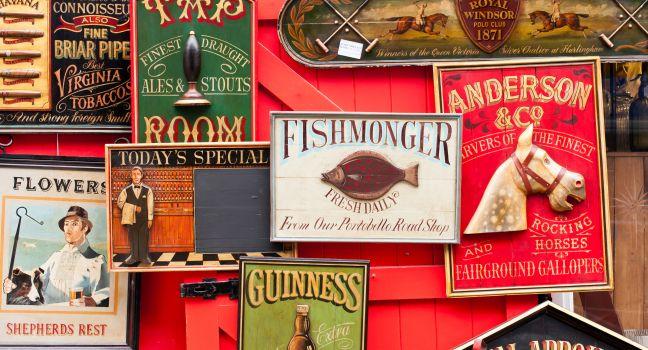
Vintage wooden signs on display in Portobello Market.
Edonalds | Dreamstime.com

Still considered the best all-around market in town by many fans, and certainly the most famous, Portobello Market stretches almost 2 miles, from fashionable Notting Hill to the lively cultural melting pot of North Kensington, changing character as it goes. The southern end, starting at Chepstow Villas and going to Elgin Crescent, is lined with shops and stalls, and, on Saturday, arcades selling antiques, silver, and bric-a-brac. The middle, from Elgin Crescent to Talbot, is devoted to fruit and vegetables, interspersed with excellent hot food stalls. On Friday and Saturday, the area between Talbot Road and the elevated highway (called the Westway) becomes more of a flea market, specializing in new household and mass-produced goods sold at a discount. North of the Westway up to Goldborne Road are more stalls selling even cheaper secondhand household goods and bric-a-brac. Scattered throughout but mostly concentrated under the Westway are clothing stalls selling vintage pieces and items from emerging designers, custom T-shirts, and supercool baby clothes, plus jewelry. New and established designers are also found in the boutiques of the Portobello Green Arcade.

Some say Portobello Road has become a tourist trap, but if you acknowledge that it's a circus and get into the spirit, it's a lot of fun. Perhaps you won't find many bargains, but this is such a fascinating part of town that just hanging out is a good enough excuse to come. There are some food and flower stalls throughout the week (try the Hummingbird Bakery for delicious cupcakes), but Saturday is when the market in full swing. Serious shoppers avoid the crowds and go on Friday morning. Bring cash—several vendors don't take credit cards—but also be sure to keep an eye on it.

Portobello Rd., London, W11, England
Shopping Details
Closed Sun.

Something incorrect in this review?

Brick Lane

Shoreditch

The noisy center of the Bangladeshi community is a hubbub of buying and selling on Sunday. Stalls have food, hardware, household and electrical goods, bric-a-brac, secondhand clothes, spices, and traditional saris. Some of the CDs and DVDs are pirated, and the bargain iron may not have a plug, so check carefully. Shoppers nevertheless flock to the market to enjoy the buzz, sample curries and Bangladeshi sweets, or browse at the many vintage stores lining the northern end of the street. Brick Lane's activity spills over into nearby Petticoat Lane Market, where there are similar goods but less atmosphere.

London, E1 6SE, England

Something incorrect in this review?

The Camden Markets

Camden Town

Begun in the early 1970s, when weekend stalls sold the output of nearby craft workshops, Camden Lock Market later expanded to five markets: Camden, Camden Lock, The Stables, Buck Street, and the Canal Market, all grouped around two locks on Regent's Canal. Though much of the merchandise is targeted at young street-fashion aficionados as well as aging hippies, anyone with a taste for alternative culture will also find plenty that appeals. This shopping experience is best suited to those who don't mind large crowds (it's the largest market in London) and a boisterous atmosphere (i.e., teenagers), especially on weekends. For many years, the markets have hosted more than 1,000 stalls offering a wide-ranging array of merchandise—vintage and new clothes, antiques and junk, rare vinyl, vintage board games, ceramics, Indian bedspreads, fetishwear, punk and skaterboi fashion, obscure band memorabilia, and toys.

The outdoor Camden Lock Market is the place to go for vinyl, crafts, clothes, and jewelry, plus loads of street food stalls while the Stables Market, which has expanded into the so-called Catacombs (Victorian brick arches), has more than 700 shops and stalls and is where you'll find vintage furniture, clothing, and jewelry, and "experiences" like an escape room. The Buck Street Market, made of largely converted containers, sells food and fashion with an emphasis on sustainability. The former Canal Market is now known as Hawley Wharf, an upscale mixed-use complex with luxury apartment buildings plus retail and independent dining outlets featuring cuisine from Afghanistan to Jamaica, a canal-side farmers' market, and a Curzon art-house cinema. The other markets are currently earmarked for further redevelopment, so more gentrification is in the cards—if the original scrappy, bohemian atmosphere of the area appeals to you, enjoy it while you can.

Camden High St. to Chalk Farm Rd., London, NW1, England

Something incorrect in this review?

Greenwich Market

Greenwich

Established as a fruit-and-vegetable market in 1700, the covered market now offers around 120 mixed stalls of art and crafts on Monday, Wednesday, Friday, and weekends, and vintage antiques on Tuesday, Thursday, and Friday. You can buy food on each day, although the offerings are usually best on weekends. Shopping for handicrafts is a pleasure here, as in most cases you're buying directly from the artist.

Victoria Park Market

Bethnal Green

Dozens of food stalls and trucks are set up in this gorgeous landscaped park (the first public park in London, opened in 1843) every Sunday, serving all manner of tasty treats from 10 am to 4 pm. Refuel after a jog around the 2.7-mile perimeter, grab a lunch to enjoy on a visit to the boating lake, or simply stock up on fresh produce and baked goods as you enjoy the free live music.