Get FREE email communications from Fodor's Travel, covering must-see travel destinations, expert
trip planning advice, and travel inspiration to fuel your passion.
We've compiled the best of the best in Singapore - browse our top choices for the top
things to see or do during your stay.
Sorry! We don't have any recommendations for Singapore right now.
Sights Filter
MacRitchie Reservoir
Fodor's Choice
Share This
(c) Eugenephoen | Dreamstime.com
This 30-acre park is a lush green wilderness, crisscrossed by a 10-km (6.2-mile) walking trail that loops around the reservoir. The trail is mostly flat and shaded, with only the warbling of birds and chatter of the park's many monkeys to break the peaceful reverie. Pick up the trail from MacRitchie Reservoir Park in the south, near the trail's main car park, where you can grab a drink from the cafés and kiosks before heading off. From here, you can follow signs towards the TreeTop Walk, which lies at around midway mark in the north of the park. This 820-foot-long suspension bridge soars above the trees, with spectacular views across the wild rain forest to the city skyscrapers in the distance. After completing the TreeTop Walk, continue following the trail towards Jelutong Tower—another spot with scenic views that lies in the west of the park—before looping back to the MacRitchie Reservoir Park along the picturesque waterside boardwalk.
Singapore Botanic Gardens
Botanic Gardens
Fodor's Choice
Share This
Janelle Lugge / Shutterstock
The first site in Singapore to gain UNESCO Heritage status is also the first and only tropical botanic gardens in the world to make the list. Once you start to explore the winding trails of the enormous park, which sprawls across more than 128 acres of lush greenery, you'll understand why. It is neatly segmented into different gardens featuring all the hallmarks of Victorian design—gazebos, pavilions, and ornate bandstands included. Highlights are the National Orchid Garden, showcasing over 1,000 species of brightly colored blooms, and the Ginger Garden, where several hundred varieties of ginger grow. Try to time your visit to coincide with the free guided tours that almost always take place around 9 am on Saturday (see the National Parks website for more details).
Sri Mariamman Temple
Chinatown
Fodor's Choice
Share This
sunsetman / Shutterstock
Singapore's oldest Hindu temple has a pagoda-like entrance topped by one of the most ornate gopurams (pyramidal gateway towers) you're likely to ever see outside of South India. Hundreds of brightly colored statues of deities and mythical animals line the tiers of this towering porch; glazed concrete cows sit, seemingly in great contentment, atop the surrounding walls. The story of this temple begins with Naraina Pillay, Singapore's first recorded Indian immigrant, who arrived on the same ship as Sir Stamford Raffles in 1819 and set up his own construction business, often using convicts sent to Singapore from India, quickly making a fortune. The first temple, built in 1827 of wood and attap (wattle and daub), was replaced in 1843 by the current brick structure. The gopuram was added in 1936. Inside are some spectacular paintings that have been restored by Tamil craftsmen brought over from South India. This is where Hindu weddings, as well as the firewalking festival Thimithi, take place.
Recommended Fodor's Video
Thian Hock Keng Temple
Chinatown
Fodor's Choice
Share This
(c) Coseymo | Dreamstime.com
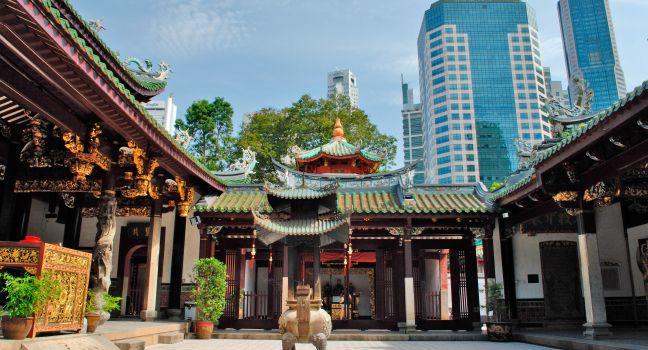
This structure was completed in 1842 to replace a simple shrine built 20 years earlier. It's one of Singapore's oldest Chinese temples, built on the spot where, prior to land reclamation, immigrants stepped ashore after a hazardous journey across the China Sea. In gratitude for their safe passage, the Hokkien people dedicated the temple to Ma Chu P'oh, the goddess of the sea. It's richly decorated with gilded carvings, sculptures, tile roofs topped with dragons, and fine carved-stone pillars. On either side of the entrance are two stone lions. The one on the left is female and holds a cup symbolizing fertility; the other, a male, holds a ball, a symbol of wealth. If the temple is open, note that as you enter, you must step over a high threshold board. This serves a dual function. First, it forces devotees to look downward, as they should when entering the temple. Second, it keeps out wandering ghosts—ghosts tend to shuffle their feet, so if they try to enter, the threshold board will trip them.
Inside, a statue of a maternal Ma Chu P'oh surrounded by masses of burning incense and candles dominates the room. On either side of her are the deities of health (on your left) and wealth. The two tall figures you'll notice are her sentinels: one can see for 1,000 miles; the other can hear for 1,000 miles. The gluey black substance on their lips—placed there by devotees in days past—is opium, meant to heighten their senses. Although the main temple is Taoist, the temple at the back is Buddhist and dedicated to Kuan Yin, the goddess of mercy. Her many arms represent how she reaches out to all those who suffer on earth.
This is a good place to learn your fortune. Choose a number out of the box, then pick up two small stenciled pieces of wood at the back of the altar and let them fall to the ground. If they land showing opposite faces, then the number you have picked is valid. If they land same-side up, try again. From a valid number, the person in the nearby booth will tell you your fate, and whether you like the outcome or not, you pay for the information. Leave the grounds by the alley that runs alongside the main temple. The two statues to the left are the gambling brothers. They will help you choose a lucky number for your next betting session; if you win, you must return and place lighted cigarettes in their hands.
Buddha Tooth Relic Temple
Chinatown
Fodor's Choice
Share This
Beautiful by day but especially lovely by night, Chinatown’s most iconic landmark is tiered in ornate red and gold, the design inspired by the Buddhist mandala, a symbol of Buddhist culture that represents the universe. The temple takes its name from what’s thought to be the left canine tooth of the Buddha, recovered from his funeral pyre in India and displayed inside the temple grounds.
Changi International Airport
Changi
Fodor's Choice
Share This
Singapore’s slick airport hasn’t just won multiple awards for World’s Best Airport—it’s also been named one of the world’s most outstanding retail real-estate projects. And it's no wonder: The sprawling four-terminal complex houses hundreds of stores and restaurants, many of which can’t be found elsewhere. If shopping and eating—the country’s most popular pastimes—aren’t your thing, there are plenty of other draws, like the Butterfly Garden, a Canopy Park (where you can walk across bouncy nets suspended across the top floor), and the Rain Vortex, a seven-story (and the world's tallest) indoor waterfall.
ION Sky
Orchard
Fodor's Choice
Share This
ION Sky offers panoramic views of Singapore from the 56th floor of ION Mall, 718 feet above the ground. It's free to enter, but only after spending S$50 in ION Mall (you need to download the ION Orchard app, then scan your receipt to receive your QR ticket). Your admission includes a complimentary welcome drink at 1-Atico Lounge. Alongside the great views are a number of interactive exhibits, including films screened on the glass walls and historic portrayals of how Singapore once looked.
Tekka Market
Little India
Fodor's Choice
Share This
Renovated in 2023, this is one of the city's largest and busiest wet markets (where meat and fish are sold). Tekka also has a staggering array of fruits, vegetables, herbs, and spices for sale. On the Sungei Road side of the ground floor are stalls selling Chinese, Indian, Malay, and Western foods. Many of the stalls are run by second- or third-generation hawkers, making this an excellent place to sample Singapore's famed hawker food. Upstairs shops sell hardware, shoes, luggage, textiles, and Indian clothing.
Abdul Gaffoor Mosque
Little India
Share This
This mosque was completed in 1910 and has recently been restored. Though it has none of the exotic, multicolor statuary of the Hindu temples, it still woos you with its intricately detailed Moorish facade in the Muslim colors of green and gold and its unusual architectural symmetry. Shorts are not allowed, and remember to take off your shoes. Only worshipers should enter the prayer hall, and visitors should avoid evening prayer sessions and Fridays.
Al-Abrar Mosque
Chinatown
Share This
Standing on a busy road in Chinatown, this ornate mosque was once just a thatched hut, built in 1827 as one of Singapore's first mosques for Indian Muslims. Also known as Kuchu Palli (Tamil for "mosque hut"), the existing structure dates from 1855. Though much of the mosque's original ornamentation has been replaced, its original timber panels and fanlight windows have remained. You can visit during the week except on a Friday lunchtime, when devotees flock in for the midday prayers.
Bukit Timah Nature Reserve
Bukit Timah
Share This
Step away from Singapore's manicured urban parks and into 405 acres of wild rain forest at this sprawling nature reserve. The walking paths are well marked, but exploring here still gives you a sense of what the island was like when tigers still roamed the jungle. Towering trees, tangled vines, and prickly rattan palms line the footpaths, while long-tailed macaques, squirrels, and tree shrews scamper overhead. The trails circle Singapore's highest hill (535 feet), with some of the routes leading to the peak for spectacular views of the dense greenery. Wear good walking shoes—the trails are rocky and muddy after the rain—and make sure you bring water. You can buy maps from the visitor center.
Changi Beach Park
Changi
Share This
One of Singapore's oldest and quietest coastal parks, Changi Beach is a two-mile stretch of sand dotted with coconut trees and public barbecue pits. Although its tranquility belies its dark history—this was one of the main sites of the Sook Ching massacre during the Japanese Occupation—today the area is a popular spot for couples as well as fishing and photography enthusiasts. Amenities: food and drink; toilets. Best for: solitude; swimming; walking.
Changi Sree Ramar Temple
Changi
Share This
This breezy, tranquil Hindu temple by the sea is the only one of its kind in Southeast Asia devoted to the Hindu god Rama. Interestingly, it also serves as the spiritual center for many non-Hindus living in Eastern Singapore, because it houses Buddha and Goddess of Mercy idols.
Collyer Quay Promenade
Marina Bay
Share This
Land reclamation projects throughout the 19th century pushed the seafront several blocks away from Collyer Quay. At that time, the view from here would have been a virtual wall of anchored ships. Today, you look out onto Marina Bay. European traders once arrived by steamship and Chinese immigrants arrived by wind-dependent junks at Clifford Pier, a covered jetty with high, vaulted ceilings that ceased operations in 2006. Nearby, the Customs House building once facilitated the arrival of leisure seekers and traders. Now, the historical buildings host some of the trendiest restaurants and bars in town, with The Fullerton Bay Hotel nestled between.
East Coast Park
East Coast Park
Share This
This breezy, 460-acre seaside park isn’t just one of Singapore’s largest beaches, it’s also the most popular, with a plethora of dining and recreational activities. There’s fun for the whole family here, whether you choose to cycle along the bike-dedicated paths, go waterskiing, have a seafood dinner, or even camp overnight, though if you do want to camp, remember to apply for an electronic camping permit first (nparks.gov.sg). A cable-ski park, Wake Park ( singaporewakepark.com), is set up around a lagoon for wakeboarding enthusiasts. You can also go windsurfing, winging, sailing, or simply take a dip in the sea. Aloha Sea Sports Center ( www.alohaseasports.com) offers rentals, storage, and courses, and also organizes occasional races. Further away along the wide, well-manicured park are public barbecue pits, 7.5 km (4.7 miles) of sandy beaches, and a hawker center. Before the upcoming Thomson–East Coast MRT Line connects the park with other parts of Singapore in 2024, a taxi or public bus is your best bet for getting here. Amenities: food and drink; parking; toilets; water sports. Best for: swimming; walking; windsurfing; winging.
Fort Canning Park
Civic District
Share This
Offering a green sanctuary from the bustling city below, Fort Canning is where modern Singapore's founder, Sir Stamford Raffles, built his first bungalow and experimented with a botanical garden. Massive fig trees, luxuriant ferns, and abundant birdlife—including piping black-naped orioles and chattering collared kingfishers—flourish here. The hill's trails are well marked by signs, or you can explore the area with the help of augmented reality via the free BalikSG app offered by the National Heritage Board. In addition to the lush greenery, there are ancient artifacts for history buffs and occasional theater productions and music festivals for arts lovers.
Fort Siloso Skywalk
Sentosa Island
Share This
Singapore loves treating visitors to sky-high views. This one on Sentosa Island might not be the tallest at just 11 stories, but it is free to enter, and there’s a short, scenic, treetop walkway leading to Fort Siloso. To gain access, climb the staircase, or ride the elevator. Either way, the view of Keppel Harbour and the Southern Islands in the distance is pretty rewarding.
Gelam Gallery
Kampong Glam
Share This
Singapore's "outdoor art gallery" is open 24/7 amid the back alleyways off Muscat Street. Here, more than 30 colorful murals have been drawn by artists like local graffiti pioneer Slacsatu, international artists, and graduates from Singapore’s LASALLE College of the Arts and the Nanyang Academy of Fine Arts.
Hajjah Fatimah Mosque
Kampong Glam
Share This
In 1845, Hajjah Fatimah, a wealthy Muslim woman married to a Bugis trader, commissioned a British architect to build this mosque (hajjah is the title given to a woman who has made the pilgrimage to Mecca). The minaret is reputedly modeled on the spire of the original St. Andrew's Church in the Civic District, but it leans at a six-degree angle. No one knows whether this was intentional or accidental, and engineers brought in to see if the minaret could be straightened have walked away shaking their heads. This relatively small mosque (and gazetted national monument) is an intimate oasis amid all the bustle. It's extremely relaxing to enter the prayer hall (remember to take your shoes off), sit in the shade of its dome, and admire the 12 lancet windows with yellow and green stained glass. French contractors and Malay artisans rebuilt the mosque in the 1930s. Hajjah Fatimah and her daughter and son-in-law are buried in an enclosure behind the mosque.
Haw Par Villa
Queenstown
Share This
Formerly known as Tiger Balm Gardens, Haw Par Villa is a charmingly bizarre park dedicated to Chinese legends and myths. Once part of an estate owned by the two eccentric brothers who created Tiger Balm ointment, the gardens were opened to the public after World War II and later transformed into this theme park. A highlight of the intriguing treasure trove of Chinese mythology, religion, and social mores is the walk-through "Ten Courts of Hell" display, which depicts a tale of life after death designed to teach traditional Chinese morality. Discover more about the display at the intriguing Hell's Museum, featuring specially curated displays that explore death and dying in belief systems around the world.
ION Art Gallery
Orchard
Share This
ION Art showcases modern and contemporary art and design, including multimedia and digital works. Part of the ION Mall, this free gallery focuses on Asian artists—both emerging and established—with a spectrum of art-based events and exhibitions held throughout the year.
Jamae Mosque
Chinatown
Share This
Popularly called Masjid Chulia, this simple, almost austere mosque was built in 1826 by Chulia Muslims from India's Coromandel Coast, on its southeast shore. So long as it's not prayer time and the doors are open, you're welcome to step inside for a look. Note that you must be dressed conservatively and take your shoes off before entering.
Kong Meng San Phor Kark See Monastery
Ang Mo Kio
Share This
The Bright Hill Temple, as it's commonly known due to its location on Bright Hill Road, is Singapore's largest Mahayana monastery. Built in the 1920s as one of the first traditional Chinese forest monasteries in Singapore, it's in a relatively modern complex made up of colorful buildings decorated with gilded carvings, as well as immaculate gardens and a large number of Buddha statues. Pick up a map of the temple at reception to help guide your wanderings, and don't miss the relaxing Zen Cafe to finish your visit. Ensure shoulders and knees are covered when visiting.
Kranji War Memorial
Kranji
Share This
More than 4,400 white gravestones line the manicured hillside in neat rows at this World War II memorial site, honoring the men and women who died in the line of duty for Singapore. You'll also find a number of larger memorial stones, one of which bears the names of more than 24,000 Allied soldiers and airmen killed in Southeast Asia who have no known grave. Visiting is a poignant experience—a reminder of the greatness of the loss in this and all wars.
Leong San See Temple
Little India
Share This
This temple's main altar is dedicated to Kuan Yin (Goddess of Mercy)—also known as Bodhisattva Avalokitesvara—and is framed by beautiful, ornate carvings of flowers, a phoenix, and other birds. The temple, also called Dragon Mountain Temple, was built in 1926. To the right of the main altar is an image of Confucius to which many parents bring their children to pray for intelligence and filial piety. If you enter from the prayer hall's side doors, you'll reach the ancestral hall in the rear, where you can see tablets with the names of deceased worshippers. When you visit, be sure to observe a modest dress code.
Library@Orchard
Orchard
Share This
If you like books and appreciate beautiful design, you will enjoy an hour spent within the walls of Library@Orchard. There are more than 100,000 books housed in the swirling, spiraling bookcases, making it popular among social media users who like to snap and share the intricate designs. It’s also a lovely spot to escape Singapore’s scorching heat.
Loyang Tua Pek Kong Temple
Changi
Share This
Tens of thousands of devotees visit this sprawling multi-religious temple every month to pay their respects to the Buddhist, Taoist, and Hindu deities and worship in the Muslim shrine here. Elaborately carved patterns on the ceilings demarcate the different areas in the temple, which is especially popular with those seeking wealth and good fortune. During the Nine Emperor Gods Festival in the ninth lunar month (from late October to early November), the temple takes on a carnival atmosphere as some 100,000 Taoist pilgrims descend on it, bringing exotic foods, flowers, joss sticks, and candles as offerings for their prayers.
Malabar Muslim Jama-Ath Mosque
Kampong Glam
Share This
The only mosque in Singapore built and managed by the Malabar Muslim community (immigrants to Singapore from Kerala) was rebuilt in 1962 and has striking blue geometric tiles and a golden dome. Friday prayers are conducted in Arabic and translated into several languages including Malayalam and Urdu. Note that photographs shouldn't be taken here after 1 pm.
Merlion Park
Marina Bay
Share This
This waterfront space is where you will find two statues of the Merlion, a mythical beast and Singapore icon that symbolizes courage, strength, and excellence. Half lion, half fish, it's based on the national symbol, the lion (from which the name Singapore was derived), while its fish tail represents the country's past as a fishing town. The larger, 28-foot statue gushes water into the Singapore River through its mouth and looks even more dramatic after dark when it's floodlit and its eyes glow. The other statue, sometimes known as the "cub" for its smaller size, faces landward and is an equally unique photo opportunity.
Opera Gallery
Orchard
Share This
This cool, contemporary space is one of Singapore's most well-known galleries, with works of art from some of the greatest painters in the world, including Salvador Dalí and Andy Warhol. The gallery, which also has outlets from Paris to New York, hosts a number of specialist exhibitions throughout the year in the Singapore branch. Many of the paintings and sculptures are also available to buy, though expect a hefty price tag.
Subscribe to Newsletter
Sign up for Travel Tips & News
I want emails from Fodor's Travel with travel information and promotions. I can unsubscribe
any time using the unsubscribe link at the end of all emails.
Thank you for your interest!
Look out for our newsletters with travel tips and special offers.
Sign up for Travel Tips & News
By signing up for the
newsletter, I agree to the Privacy Policy. You must check the box to subscribe
Thank you for your interest!
Look out for our newsletters with travel tips and special offers.