START

7 Essential Stops Along the Silk Road

Uzbekistan is home to arguably the world’s most splendid Silk Road architecture—here are the must-see stops.

At the heart of the ancient Silk Road between China and Europe, Uzbekistan was once a hub for traveling traders and camel caravans, which crisscrossed the continent laden with treasures destined for faraway lands. But despite its history as an ancient highway, the country’s doors remained firmly shut to most visitors, until huge visa reforms in 2018 saw the launch of visa-free travel for some nationalities and easy-apply e-visas for most of the rest. Uzbekistan is home to arguably the world’s most splendid Silk Road architecture, from ruined caravanserais where passing merchants and their herds could overnight to the soaring tile-covered facades of mosques and medressas, which surrounded squares that once hummed with the haggling of buyers and sellers. Today travelers can once again embark on an odyssey of their own along one of the civilization’s great cultural freeways.

1 OF 7

Registan

WHERE: Samarkand, Uzbekistan

Uzbekistan’s blockbuster sight is the huge Registan square, surrounded on three sides by the looming mosaic-bedecked porticos that hide peaceful interior courtyards ringed by small shops crammed into the pointy pentagon-shaped niches. The vendors are reminders of this plaza’s past as a center for commerce, which would have taken over the main square, now open for visitors to wander at their leisure. A highlight of the Registan is the Tilla-Kari Medressa, meaning “gold covered” and completed in 1660, and you’ll see exactly why once your eyes adjust to the shimmering bling on the mosque’s inner dome. The geometric patterns that cover the space from floor to ceiling sparkle gold leaf and blue and white floral detail and Arabic script. The mihrab, the niche that indicates the direction of Mecca, drips with stalactite-like ornamented carvings called muqarnas. The three main structures of the Registan are some of the world’s oldest because others were brought down by unforgiving earthquakes or the marauding armies of Genghis Khan.

INSIDER TIPTime your visit for late afternoon so you can experience the Registan not only by day and also in a new light once the illuminations flick on at dusk.

2 OF 7

Shah-i-Zinda

WHERE: Samarkand, Uzbekistan

This mausoleum complex is a street of departed souls billboarded by ever-grander tombs of sultans, royal families, military leaders, and even the likely resting place of a cousin of the Prophet Muhammad, who brought Islam to this part of the world in the 7th century. Though some tombs are plain inside, their exterior cladding of impeccable azure-dominated tilework is unparalleled, with swirling Arabic script and intricate interconnected arabesque designs making for a grand entrance. Shah-i-Zinda is a place of pilgrimage, so all visitors should keep everything between their elbows and knees covered.

3 OF 7

Bibi-Khanym Mosque

WHERE: Samarkand, Uzbekistan

The gargantuan iwan, or portal, into the Bibi-Khanym Mosque gives a hint at what’s to come. Once one of the largest mosques in the world, the 15th-century Bibi-Khanym measures nearly 135 feet high, dwarfing the surrounding buildings. The audacious building techniques were at the cutting-edge of architecture at the time–so much so that bricks from the dome of the mosque started to rain down on the floor below soon after its completion. The patterned blue, aqua, and tan geometric tilework on the outside of the mosque have been well restored, but inside has been left a crumbling, atmospheric ruin with stripped-blank walls, dirt floors, and nesting birds in the cracks and crevices.

4 OF 7

Po-i-Kalyan

WHERE: Bukhara, Uzbekistan

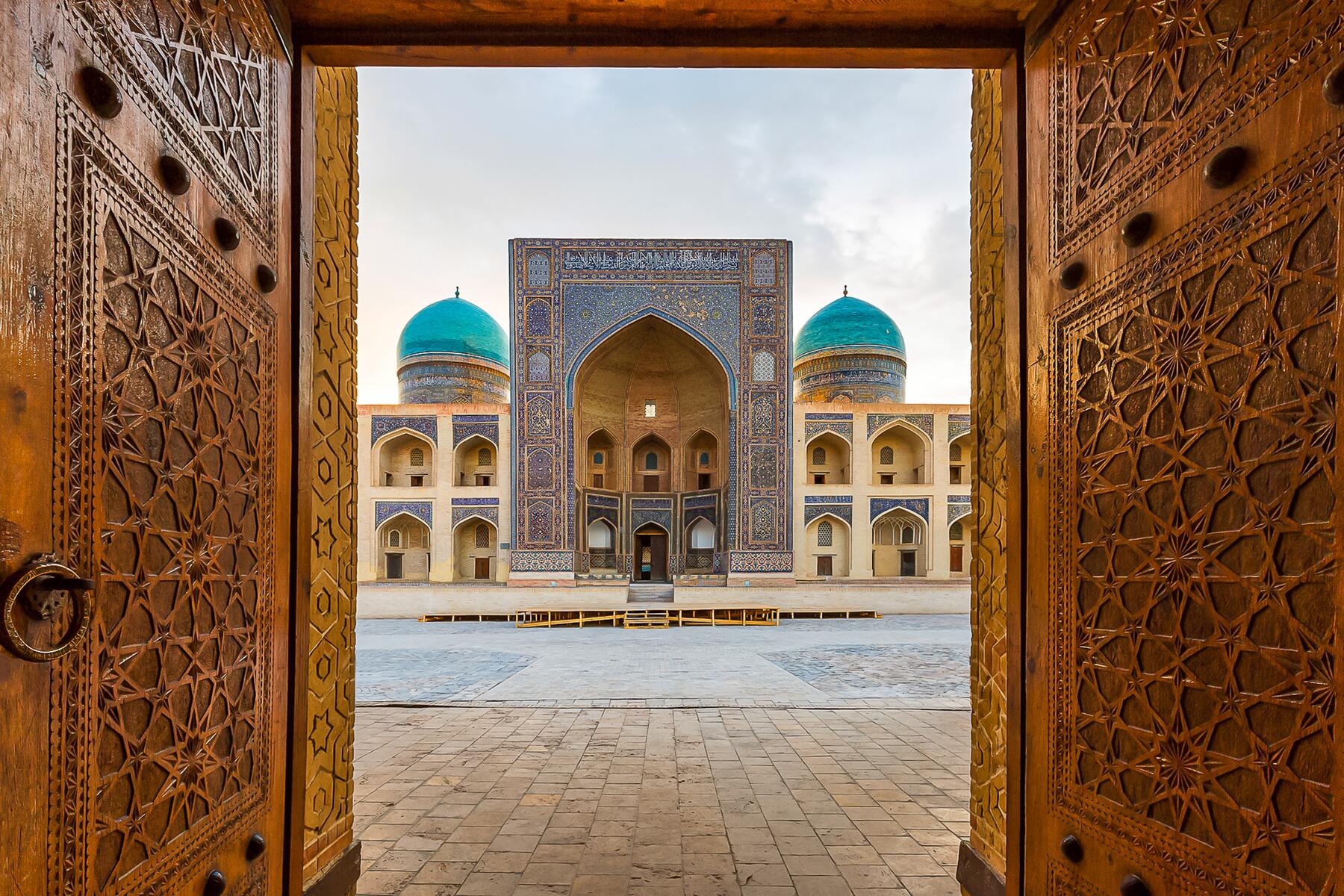
In some ways, this mosque and medressa complex is something of a miniature version of Registan in Samarkand, though Bukhara’s site feels a touch more authentic, as both the medressa (religious school) and the mosque are still in use. Visitors can only get a few feet across the entryway of the Mir-i-Arab Medressa, relegated to peering between the latticed iron gate to the schoolyard within. Across the square in the Kalyan Mosque, the modern electronic board with brightly illuminated green text showing the day’s five prayer times seems slightly incongruous with the 16th-century vaulted structure, though the Soviets used the building as a warehouse. In the open square between the mosque and the medressa is the 155ft-high freestanding Kalyan Minaret, built in 1127. Encircled with sophisticated brickwork, the minaret was spared when Genghis Khan sacked the rest of the city, so dazzled was he with its design.

5 OF 7

Bukhara’s Bazaars

WHERE: Bukhara, Uzbekistan

Harkening back to the Silk Road’s raison d’être, the multi-domed bazaars of Bukhara still house a hodgepodge of traders who flog everything from traditional Uzbek clothing to touristy trinkets. Though the stalls are open throughout the day, they really spring to life around dusk as the merchants call out to slowly strolling shoppers on their way to supper.

6 OF 7

Rabati Malik Caravanserai

WHERE: Navoi, Uzbekistan

Once one of the largest ancient inns in central Asia, the Rabati Malik Caravanserai still commands the attention of passing travelers from its location next to a busy modern highway that now covers the original Silk Road route. Made from desert-colored sun-dried adobe bricks, all that remains of this 11th-century caravanserai is its lofty entrance portal; sadly much of the structure, which would have been several stories tall, was knocked down by an earthquake in 1968, leaving this a rather lonely outpost. Animals and cargo would have been kept on the ground floor while the merchants could comfortably sleep upstairs, secure in the knowledge that their precious goods were safe below.

7 OF 7

Ichon Qala

WHERE: Khiva, Uzbekistan

Listed as a UNESCO World Heritage Site, the walled old city of Ichon Qala is an ancient quarter of Khiva that has hundreds of old homes, historic monuments, mosques, and medressas in a neighborhood resembling an occasionally mosaic-covered fortress. Khiva was once an important desert oasis for Silk Road travelers, but its location in far western Uzbekistan means it sees fewer visitors than Samarkand and Bukhara, though the rumored high-speed train extension that will soon extend out here could change that. The name Ichon Qala means “within the walls,” and the mud ramparts can even be walked to get a spectacular overview of the area. Cylindrical column-flanked gates guard this open-air museum that feels forever stuck in a bygone era.