
START

An ‘Alien’ Comet Is Passing Through Our Solar System — Are We All Going to Die?

A rare interstellar visitor is passing through our cosmic neighborhood—but astronomers say there's nothing to fear.

If you’ve been following astronomy headlines, you might have noticed a curious new arrival to the neighborhood: Comet 3I/ATLAS. It’s not just another “regular” comet from the outer solar system–this one’s an interstellar visitor, meaning it was born around another star entirely.

Thanks to its unusual origin, 3I/ATLAS has captured astronomers’ attention, and they’re using it to study conditions far beyond our solar system. For the public, however, the comet’s discovery has raised some concern. Ultimately, there’s no need to worry, as it’s not on a collision course with Earth. (And, as far as we can tell, there’s zero evidence 3I/ATLAS is alien technology, despite its extraterrestrial roots.)

Here’s everything you need to know about interstellar wanderer 3I/ATLAS, from what makes it so special to how you can spot it in the night sky.

What Is Comet 3I/ATLAS?

Comet 3I/ATLAS is, of course, a comet–a ball of ice and dust traveling through space. Comets have been likened to “dirty snowballs” by NASA. But whereas most comets we’ve observed originate from within our solar system–specifically, the Kuiper Belt beyond Neptune and the Oort Cloud at the farthest reaches of our solar system–this one came from beyond.

“Comet 3I/ATLAS is a rare interstellar visitor, only the third of its kind ever confirmed,” says Seth McGowan, president of the Adirondack Sky Center and Observatory in New York. “Its hyperbolic orbit confirms it originated outside our solar system.” Unlike the homegrown comets that are caught by the sun’s gravitational pull, orbiting our star time and time again, 3I/Atlas is just passing through our solar system–once it exits, it won’t return.

How and When Was 3I/ATLAS Discovered?

Astronomers first spotted the comet in mid-2025. “We first had images of it in June, but we didn’t know that it was something interesting to look at until July,” says Jason Steffen, an assistant professor of physics and astronomy at the University of Nevada, Las Vegas. “There are a number of astronomical surveys dedicated in full or in part to finding comets.” The one that first spotted 3I/ATLAS was the Asteroid Terrestrial-impact Last Alert System (ATLAS), developed by the University of Hawaii and funded by NASA, for which the comet is named.

Dr. Qicheng Zhang, a postdoctoral fellow at Lowell Observatory in Arizona, adds that while dozens of new comets appear annually, this one stands apart. “There are 30 major comets observable from the ground that have been discovered so far in 2025, so almost one a week,” he says. “However, interstellar comets like 3I/ATLAS are exceedingly rare.”

That said, scientists are hopeful to study more as technology advances. “We’ve only really been capable of discovering objects like this for the last 10 to 15 years, and this is the third one,” says Steffen. “So, I suspect going forward that we might see a new interstellar comet every two to five years.”

What Makes 3I/ATLAS So Interesting?

To start, its origin. So far, humanity has observed just two other interstellar visitors, 1I/ʻOumuamua and 2I/Borisov, spotted in 2017 and 2019, respectively. And both surprised astronomers with their unusual characteristics. “1I/ʻOumuamua was an enigmatic, elongated object with no visible coma [the fuzzy gas surrounding the icy core of a comet], leading to speculation about its nature. Some even proposed it might be artificial,” says McGowan. “2I/Borisov, on the other hand, behaved more like a typical comet, but its chemical composition differed from solar system comets.” It had far more carbon monoxide than expected.

3I/ATLAS has revealed surprises, too. “The overarching theme from observations published on 3I so far is that its cometary activity seems a bit delayed compared to solar system comets, which may be because it approached the sun far more quickly. It didn’t start its rapid brightening with strong H₂O outgassing until closer to the sun than normal,” says Zhang. He adds that while its gas composition is similar to that of solar system comets, its “dust also seems to have a somewhat unusual structure, size, and/or composition.” For astronomers, observing 3I/ATLAS is a front-row seat to alien chemistry. “We’re learning more about the diversity of materials that can exist in other planetary systems,” says Steffen.

Is There a Chance that Comet 3I/ATLAS Will Collide with Earth?

There is zero chance that 3I/ATLAS will collide with Earth. “This comet will not approach Earth closely at all,” says Zhang. “At its closest point in December, it will still be farther from us than Mars is from the sun. “There are several other comets much closer than that to us right now, none of which pose any impact risk either, for at least the next few centuries,” Zhang adds. Once 3I/ATLAS passes us by at this safe distance, it will exit the solar system, never to return.

How Can You See Comet 3I/ATLAS?

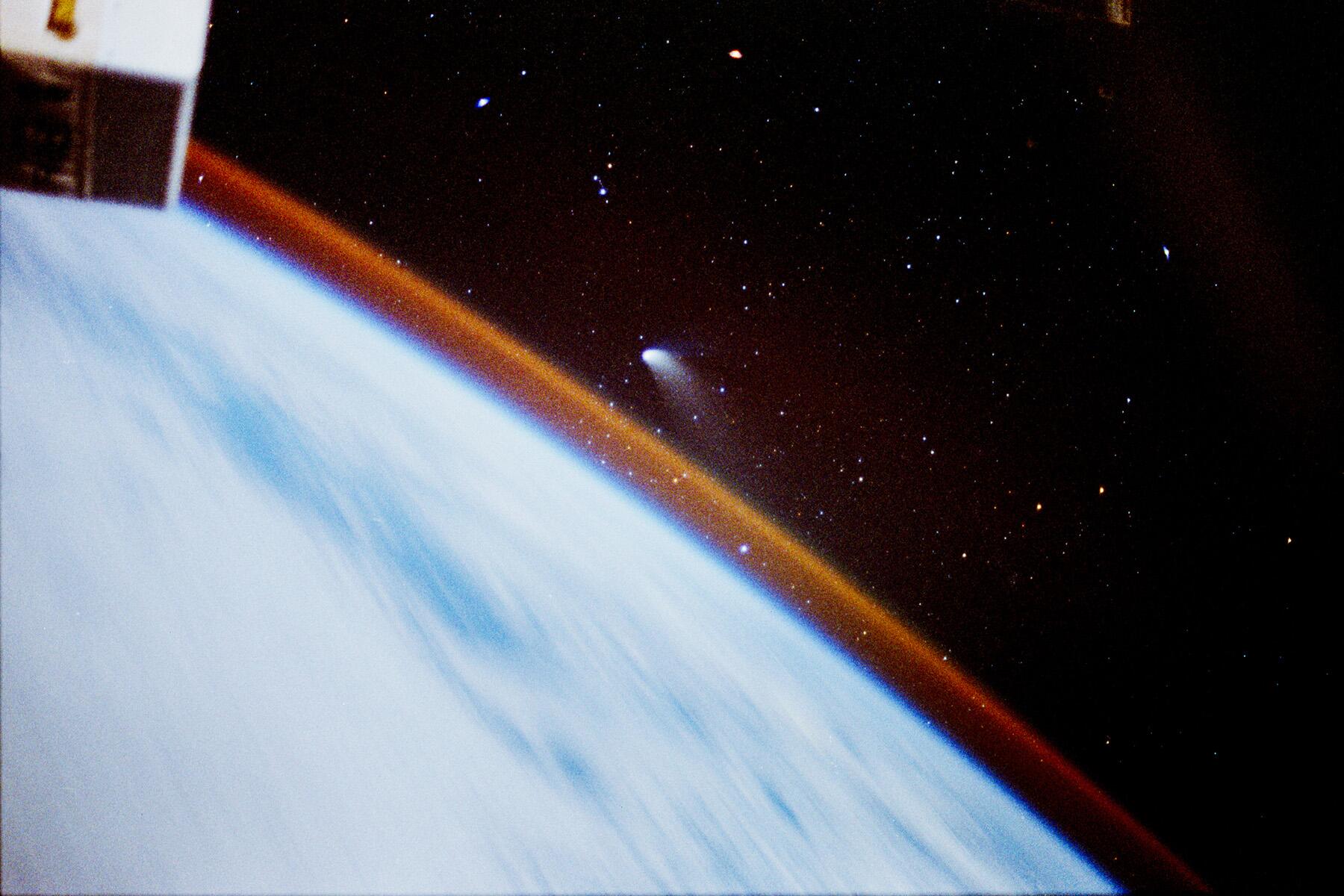
Unfortunately, 3I/ATLAS won’t make a dramatic naked-eye appearance like other popular comets, such as cometary icons Halley’s Comet and Hale-Bopp, or the currently visible comet C/2025 A6 Lemmon. To see it, you’ll need to use a reasonably powerful backyard telescope–or better yet, an extremely powerful telescope at your nearest observatory. Scientists will also continue to observe 3I Atlas with both ground-based and space observatories, including NASA’s James Webb Space Telescope and Hubble Space Telescope. “This window offers an opportunity to study interstellar material in real time, and observatories worldwide, including citizen science networks, are contributing to the effort,” says McGowan.