


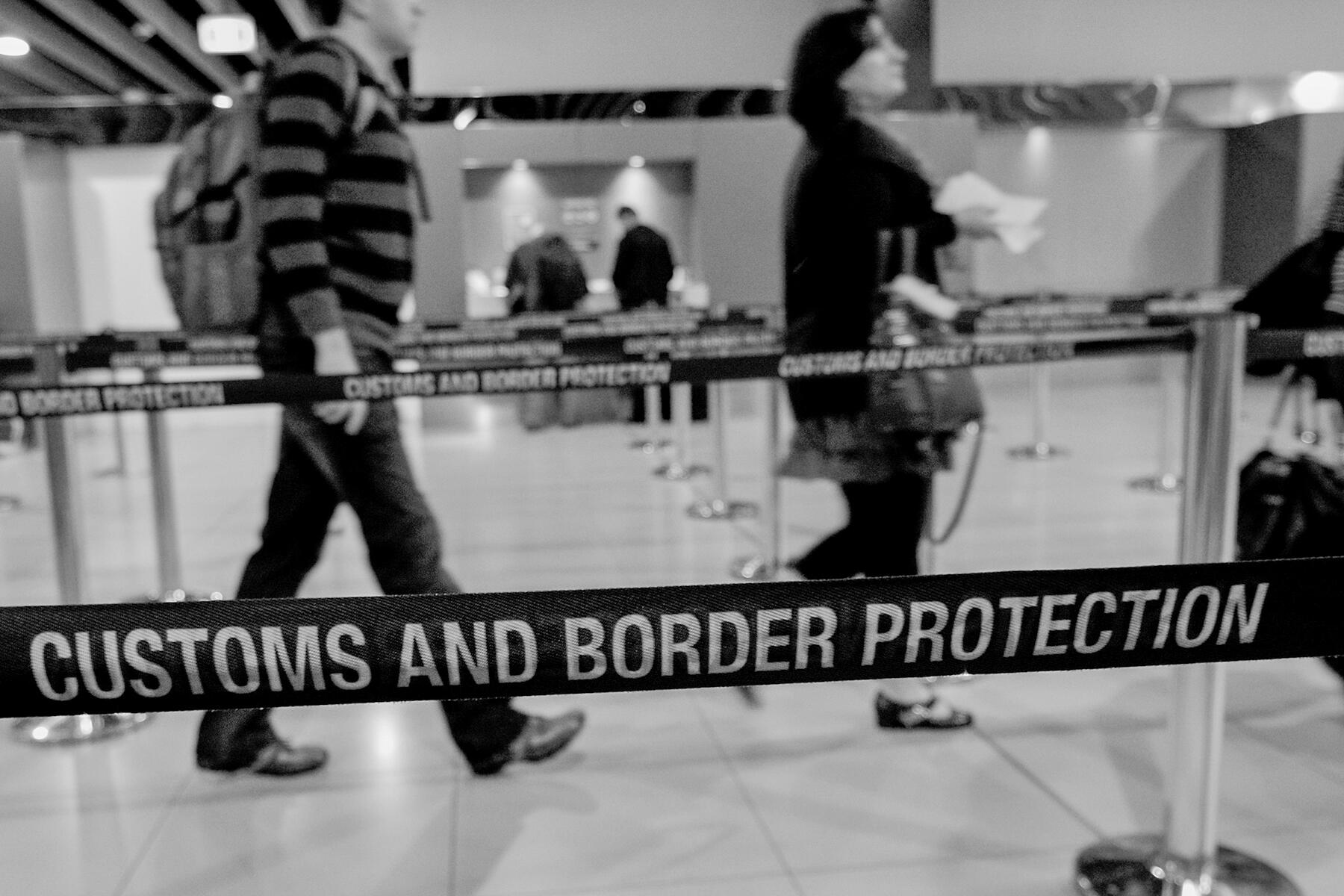

Many international travelers have noticed customs inspections seem less visible at U.S. airports.
For international travelers entering the United States, there used to be a two-step process at the border. The first stop would be an Immigration agent, who would verify your documents and your eligibility to enter the country. Once you were admitted, you’d have a second stop, where a Customs agent would ask questions about what you were bringing into the country with you.
Travelers still get the first step, but many may notice that the second step has largely disappeared. So, what happened?
The Types of Screening at the U.S. Border
The United States is a big country, and many parts of the border lack barriers or staffing, such as most of the northern land border with Canada, and most of the country’s ocean coasts. Crossing the border wherever you like, however, is against the law. To enter the United States, travelers must enter at designated Ports of Entry (POE). These can be land checkpoints, seaports, or airports—all told, there are 328 of these in the United States.



Recommended Fodor’s Video
Federal officials screen three things at a POE. First, they screen travelers, verifying citizenship status, and for non-U.S. citizens and permanent residents, verifying their eligibility to enter the country. Second, they screen commodities—either those shipped as cargo, or personal effects carried by travelers. Third, they screen for potential threats to U.S. agriculture.
These three screening types were once carried out by three different agencies. The U.S. Immigration and Naturalization Service (INS), part of the Department of Justice, was once responsible for the first type of screening. The U.S. Customs Service, part of the Department of the Treasury, was responsible for the second, and the U.S. Department of Agriculture (USDA) was responsible for the third.
Enter the Department of Homeland Security
When the Department of Homeland Security (DHS) was created in 2003 in response to the 9/11 attacks, the screening roles were merged and assigned to a single agency U.S. Customs and Border Protection (CBP). CBP is one of the largest law enforcement agencies in the United States, with over 69,000 employees—45,000 of whom are officers inspecting passengers and cargo at POEs.
A CBP spokesperson explained to Fodor’s “CBP’s Office of Field Operations integrates these functions, so OFO personnel conduct all customs, immigration, and agriculture inspections at ports of entry in a unified process. This streamlined approach, supported by modern technology such as biometrics and automated systems, enhances security and efficiency, though procedures may vary by airport based on size, layout, and available programs like Trusted Traveler Programs lanes or preclearance.”
It’s worth noting that two decades ago, before the creation of CBP, border crossing processes in the U.S. (and most other countries) relied heavily on interviews with travelers and written declarations. Much of that process is now digital, so there’s less reliance on interviewing passengers and going through the details individually.
Noted the CBP spokesperson, “While individual officer roles are less visible, CBP continues to coordinate border security and facilitate lawful travel and trade.”
The functions that were once handled by separate agencies are now all handled by CBP, and processes can vary slightly from airport to airport. I recently declared goods over my duty-free allowance on arrival at San Francisco International Airport. The CBP officer at the first screening station locked my passport in an RFID-equipped plastic case, instructing me to visit the secondary screening station in baggage claim after I had collected my checked bag.
After talking with me about what I was importing, the officer at the secondary station unlocked my passport and sent me on my way (the duty amount would have been relatively small, and officers don’t always elect to collect duties in smaller amounts—the important thing is that travelers declare the goods). Here, the CBP officers were performing the functions previously assigned to INS and the U.S. Customs Service.
In Atlanta, the process was different. I didn’t have anything to declare there, but an officer approached me in baggage claim and asked questions about what I had purchased on my trip to Peru. He seemed particularly interested in whether I had food items or plants. I suspect that CBP pays closer attention to arrivals from Peru, where unprocessed coca leaves and teas made from the leaves are sold in plastic bags in markets throughout the country.
Importing coca leaves to the United States is illegal (and so is exporting them from Peru), because they’re used to make cocaine. I did have some tea, but it was Muña (Andean Mint), and some packaged snacks, which are ok, so he waved me through. In Atlanta, the CBP officers were performing the functions previously assigned to INS and the USDA.
How CBP Screens Passengers
CBP doesn’t widely discuss details about investigations and screening procedures, but some of them are pretty common-sense. During my time working in airport operations, I spent a good amount of time in various airport Federal Inspection Stations (FIS – the specific name for a CBP screening area at a POE), and observed much of the process. I remember one instance in Anchorage, where an officer was inspecting the baggage of a passenger who had just arrived from an Asian country (at the time, Anchorage still had a handful of nonstop flights from Asia). The passenger was bound for Utgiaqvik, Alaska, and had brought with him a large supply of DVDs, which he claimed were for personal use.
“But why do you have multiple copies of the same title?” The officer asked. “Do you like those movies that much?” In the end, he had his DVDs seized and was warned not to try it again, or he could face stiffer penalties.
On another occasion, in Las Vegas, I watched as officers interviewed a lady arriving from South Asia. There was a question about her visa, and they’d similarly had her open her bags so they could be examined. The officers found that she’d packed many more clothes and household items than they considered typical for the tourist visa she’d planned to enter the country on, and they also noted she brought a lot of credentials and certifications—as though she were seeking work instead of sightseeing. They ultimately decided to revoke her visa and deny her entry, and she returned home on the next available flight.
Nowadays, much of what CBP officers do has been digitalized. There are no more paper declaration forms to fill out, and in many cases, U.S. citizens briefly stop for a facial recognition scan before being welcomed home. The work of the officers is lower touch, but that simply means a lot of the screening now simply happens faster, digitally, and behind-the-scenes, meaning that citizens can largely cross the U.S. border faster and with fewer speedbumps.