


Trip Report, Peru Part 2: Lima's Historic Center-Walking Tour
 Dec 3rd, 2024 | 02:10 PM
#1
Original Poster
Joined: Apr 2022
Posts: 202
Likes: 0
Trip Report, Peru Part 2: Lima's Historic Center-Walking Tour
Trip Report, Peru Part 2: Lima's Historic Center-Walking TourSome opening remarks
I have my biases: I’m rather drawn to large cities, especially historic ones, and I’ve come to like Lima a lot. I realize that tourists on shorter trips will not want to sacrifice time at Peru’s many other wonders, in favor of Lima. But I disagree in principle with those who have sometimes stated on this forum, and on others, that Lima is only worth a day or two. I estimate that at least a full week would be needed just to see just the city’s major attractions, and even then you might only glimpse some of them. I suppose that unlike Paris or San Francisco, Lima is not a city that visitors usually fall in love with a first sight. But I’m sure that those who have the time and interest will find that getting to know Lima will have commensurate rewards.
This report is based on my Peru trip of late October and early November of this year (2024). An illness attack, which I am inclined to attribute to the crowded airports and planes I endured on the way into Peru, rather than to Peru itself, put some serious restrictions on how much I could do, or how far I could get around, on this trip; and so my report is not as comprehensive or as detailed as I had planned it to be. On the other hand, this trip was the tenth of my several Peru trips, which span the past 20 years, so at certain points, and with proper acknowledgement, I will draw upon those earlier experiences to fill in some gaps.
To the historic center
Lima’s historic center is a great place to explore, though it is mainly a modern big-city center, where most of what you will see was built in the 19th and 20th centuries — in other words, it is not a well-preserved, thoroughly colonial district like the center of Quito, Ecuador. Still, there are a number of colonial buildings remaining in central Lima, particularly old churches, several of them very impressive; as well as two grand plazas, and several museums worth looking into.
My suggested historic-center tour starts at the Andrés del Castillo Museum, just off the Plaza San Martín at the south-west corner of the historic center. (If coming on the metropolitano from Miraflores or Barranco, get off at La Colmena station and walk towards, and across, the plaza, veering leftwards.) Located in an attractive old building, known as the Belén House, that served as the US Embassy in the 1920s, this unique museum is divided into three parts with completely different themes: one devoted to Peruvian ores and minerals; another devoted to artefacts mostly, though not exclusively, from the ancient pre-Inca cultures of the central coast; and a third devoted to examples of a Peruvian folk-art genre known as the retablo, or cajón (“big box”) — typically an intricately detailed assembly of miniature models and paintings set in a two- or three-tiered cajón, and representing scenes from the bible, or from common daily life.
Even those without a special interest in geology will probably enjoy looking at the variety of stunning shapes, colors, and crystals represented among the many mineral samples on display in the firsrt sxection (don’t miss the dark-room where the flourescent minerals are found), while the more geologically-minded will appreciate the fact that the various minerals are tagged not only with their common names, but also with their chemical formulas — the museum has the look of having been set up by real scientists, and in fact it was: its namesake, Andreas del Castillo, was a mining engineer. But if your interest lies more in ancient histlory, spend time examining the intricate, imaginative, sometimes whimsical artistry displayed in the ancient ceramics and textiles exhibited in the other half of the museum. In the case of the ancient textiles, I’m always astonished at the geometrical sophistication and exactitude that weavers were able to achieve, one thread at a time, in those pre-industrial eras — I just stare at the things wondering how they could have done it.
From the museum, cross Plaza San Martín, which was completed in the 1920s, and perhaps stop at the bar of the venerable Gran Hotel Bolívar for one of its famous pisco sours. Even if you don’t lodge there, you can enter the lobby and, if it’s still there, page through the photo album depicting the many writers, political leaders, and celebrities who have stayed in this hotel — William Faulkner, Charles de Gaulle, Robert Kennedy, Richard Nixon (sorry about that one), Walt Disney, and Mick Jagger are just a few of the famous people who once checked in just a few feet from where you’ll be standing. (Ernest Hemingway too, but of course you guessed as much!)
From the hotel walk north along Jirón de la Unión (“Union Boulevard”), a lively and popular pedestrianized shopping street. Apart from the impressive La Merced basilica and convent (dating from the 16th century, but frequently restored thereafter), there isn’t much of “touristic” interest along this street, but it’s a great place to experience modern Lima in action; and it’s a good street to check out if you need a pharmacy or a clothing store. You’ll also find several restaurants along this boulevard, though maybe not the “upscale” celebrity-chef ones serving hip fusion cuisine that many food tourists seek. On the other hand, if you love chicken, with or without an elegant venue or a multi-starred rating, Jirón Unión should serve your dining requirements adequately. Also, a few may be interested to know that the building on the SW corner of the intersection with Cusco Avenue once housed an artsy cafe known as the Palais Concert, where in the 1910s Abraham Valdelomar, one of Peru’s most acclaimed writers, held court. Valdelomar, not the humblest of writers (but a very good one), famously proclaimed that “Peru is Lima, Lima is the Jirón Unión, the Jirón Unión is the Palais Concert, and the Palais Concert is me.”
After a few blocks further northwards, the Jirón Unión leads you into the grand, expansive Plaza Mayor, or Great Plaza. There, of course, you will find the city Cathedral, completed in 1625 — completed but not finished, for over the years it has been rebuilt, and rebuilt again, mainly because of earthquake damage; the most recent fix-up occurring in the 1940s. Next-door, the archbishop’s palace looks colonial but was built in the 1920s, while the grand Government Palace on the north side of the Plaza is a decade younger. I believe that the Archbishop’s Palace is stil open for visitors, but double-check this, for I didn’t go in myself this time — gaping at aristocratic elegance is not, in itself, among my travel goals. I went in on an earlier trip, though, and I did appreciate the lesson I got in how well a career in the service of a poor preacher who wandered around with fishermen could sometimes pay off; but I didn’t feel I required another just yet.
The buildings on the other two sides of the Plaza are more moden looking than the ones mentioned above, yet somehow the whole scene manages to hang together harmoniously, and along with its sheer size the grand Plaza Mayor should still remind sensitive visitors that Lima, along with Mexico City, was once one of the two great capitals of Spanish America.
Churches aren’t necessarily my scene, but grand colonial churches like the Lima Cathedral are historic and cultural venues in their own right, and they will offer many tourists the visual splendor they seek, even as they offer tourists like me lessons not unlike the one I once got at the Archbishop’s Palace. For elegance and craftsmanship, the devotional items in the Cathedral, and in its museum, should not be missed; and among the colonial artworks on display in the museum, you may want to be alert to what I think is the most curious one. This painting shows three rows of medallion-style images, representing the Inca kings and emperors from Manco Capac, the first Inca, right up to — Felipe V! In what appears to be a bit of 18th century Spanish propaganda, the last row of Inca emperors depicted in the painting passes seamlessly from Huayna Capac to Atahualpa and onto Spanish king Carlos V and thence to Felipe, as if to argue that the Inca empire was not destroyed, but just taken over by a new management team.
(Another painting on display, which I found equally curious but for other reasons, shows Rosa of Lima, one of Peru’s five canonized saints, enduring some self-inflicted torture, presumably in an effort to appreciate what her savior went through — readers interested in the further detail will want to seek it out.)
In contrast to Mexico, which I am told has all but concluded that the Spanish conquistdors were the bad guys of history, and the native defenders the good ones, Peru — at least in Lima and the major cities — still seems a little ambivalent about it all. Over the years I’ve been visiting Peru I believe I have detected a growing pride in the country’s 4500 years of indigenous civilization, but the conquistadors seem still to lurk there in the national culture. One of the best ways to see this is to turn to your right as you enter the Cathedral and visiit the charming little shrine to the valiant conquistador Francisco Pizarro. There you’ll see his casket; a large mural illustrating one of his most valiant deeds; and another mural listing his most loyal soldiers, the “Thirteen Famous Ones” (Los de La Fama). Less majestically, there was also a replica of Pizarro’s skeleton, with wall posters calling attention to the various bruises and marks which testify to his rough-and-tumble life.
From the Cathedral walk north along Carabaya street along the Plaza Mayor, and on to the grand former train station, now the House of Peruvian Literature. This attraction may not be of general interest, but it’s free, and you may want at least to stroll through and see what you think. It’s hard to describe — it is mostly illustrated wall texts and posters describing Peruvian writers and literary movements, with several early editions of the works described therein, all embedded in a sort of modern-art environment. Most of the wall texts and item tags are just in Spanish, though a few of the larger wall texts offer cards giving translations into English — and Quechua! The lower level is devoted to Nobel Prize winner Mario Vargas Llosa.
Near the House of Peruvian Literature, on the corner of Ancash, look for El Cordano, a classic urban cafe-bar now about 120 years old, and a good place to stop for lunch, and a beer or pisco sour. From here stroll east down Ancash, one of the more attractive streets in the historic center — it’s now given over largely to souvenir and artisan shops, but there are also two small yet worth-while museums. One is the 18th-century home of Juan Francisco de la Bodega y Quadra, sea captain, explorer, and trader who plied the Pacific coast all the way up to Canada. (The rear of the house looks over excavations into 17th-century Lima.) And further along Ancash there is a small museum offering a selection of ancient Peruvian artefacts.
At the end of Ancash is the San Francisco basilica and monastery, perhaps the one site in the historic center tourists will visit even when they visit little else. The church and grounds are magnificent in themselves, while inside there is a great library to be seen (but not used), and all manner of elegant art and artisanal delights to be admired throughout. My own tastes don’t lean towards the morbid, but it appears that for many visitors one of the favorite attractions is the set of catacombs, which serve mainly as ossuaries; that is, repositories for the bones of monks past. My recollections of the basilica are from a visit several years ago (for I didn’t go inside this time), and so I won’t go into further detail. But if it’s still to be seen, don’t overlook the painting of the Last Supper: I have little artistic sensibility, but it appeared that quite a crowd was gate-crashing the dinner Jesus had planned for his twelve disciples. The San Francisco Basilica is one of the most popular tourist destinations in the historic center, which probably explains all those souvenir and artisan shops on Ancash Street leading there.
Just north of the San Francisco basilica, and stretching along the Rimac River, is the Park of the Wall (Parque de la Muralla), so-called from the 17th-century city walls being excavated along the landward side. There are a number of food and artesan stands here, and other attractions. (Having neglected my usual research this time, I was unaware until too late that there are also an aviary and a “granjita,” or “little farm,” in the park which respectively display live birds and animals.) But what I really wanted to check was whether the city’s famous equestrian statue of Francisco Pizarro was still on display, and indeed it was. Since it was first set up in the Plaza Mayor in the 1930s, this statue has been shunted here and there around the city center, depending on the current mood regarding the grand conquistadors, until it finally vanished sometime in the 1990s — only to repappear in this park, albeit shoved off to one end, perhaps in the hope that no one would actually see it. You’ll find it under a pedestrian bridge that connects the main section of the park to the part where presumably the aviary and granjita are.
If you have the time and interest, you’ll probably want to make digressions from the above tour, for there is a lot more to the historic center than what I have cited above. Other places to check out, all of which I have seen at one time or other:
[] Several grand colonial churches, mostly in the area west of the Plaza Mayor, and most impressiely the Santo Domingo Church and convent.
[] The museum of ancient artefacts located in the former Central Reserve Bank building where Ucayali and Lampa streets intersect, a couple of blocks SE of the Plaza Mayor.
[] The Torre-Tagle house on Ucayali Street, just a little east of the Central Bank, perhaps the best example of secular colonial architecture in the historic center.
[] Chinatown and the near-by central market, several blocks further east on Ucayali Street.
[] The Alameda Chabuca Granda, a wide riverside walkway to the northwest of the Plaza Mayor, named after a celebrated singer and composer of “creole” Peruvian music. If there is a festivity taking place in the historic center during your visit, this is probably where it will be.
Finally, I’ll put in a good word for the Museum of Peruvian Culture, several blocks west of Plaza San Martín on Alfonso Ugarte Avenue. It’s been nine years since I was last there, so I can’t attest to its current state, though my internet research indicates that it’s still basically the same museum that impressed me so much on my visit. It’s dedicated to Peruvian folk art, with most of the items on display dating from the 19th and 20th centuries, and it covers the range from imaginative children’s toys up to some very unique and elaborate religious art — most of it very impressive, and perhaps a change of pace from all the ancient stuff you'll have seen. I was especially intrigued by the Amazon room, and not only by the creative and often elaborately decorated artefacts on display, but also by some of the humbler ones: for example, what looked like a tiny bow and arrow, but was actually a miniature musical instriment to be grasped between the teeth. I hope it’s still there.) The grand building itself, designed to resemble an ancient Andean temple from the outside, is worth looking at in its own right — if a Celebrity Architect had designed it for Barcelona or New York, it might have been world-famous by now.
At the time of my visit in 2015, the neighborhood around this museum was rather tacky looking, though by day it was very busy, and seemed safe enough. If you feel up for it, you may want to walk a few blocks north to look at the Plaza Dos de Mayo. It was in rather poor shape when I was there all those years ago, but according to Wikipedia, a restoration program was completed just this year — if so, the plaza should be very impressive. I’m not an architecture expert, but the plaza struck me as looking renaissance French or Italian in style, maybe even based loosley on the “four corners” plaza in Palermo. (Those who know their archetecture may want to comment on this farther below.) The Plaza Dos de Mayo, the Plaza San Martín, and the several blocks of La Colmena connecting them, together were an early 20th-century attempt to make Lima more elegant and European-looking; but which, apart from the San Martín end, appears not to have worked out quite as planned.
And when you’re in Lima you may want to be alert to special activities that may be taking place in the historic center during your visit. During my earlier Lima visits, when I lodged in the historic center, I often ran unexpectedly into religious processions in the streets, or into special festivals, usually in the Alameda Chabuca Granda that I mentioned above, or on the campus of the old San Marcos University about two bocks east of Plaza San Martín (note: not the modern campus in the San Miguel municipality).
Finally, I should add that I’ve always found the historic center to be safe by day, though around its fringes you may want to be more alert (but not paranoid). During my earlier Lima visits, when I lodged in the historic center, I found that the Plaza San Martín, the Paza Mayor, and the several blocks of Jirón Unión connecting them, along with the Alameda Chabuca Granda, were busy and safe up to around 10:00pm, if not a little after, when businesses starting closing for the day; but as I have lodged in Miraflores on my most recent two visits, I can’t say what the current after-dark situation is.
I have my biases: I’m rather drawn to large cities, especially historic ones, and I’ve come to like Lima a lot. I realize that tourists on shorter trips will not want to sacrifice time at Peru’s many other wonders, in favor of Lima. But I disagree in principle with those who have sometimes stated on this forum, and on others, that Lima is only worth a day or two. I estimate that at least a full week would be needed just to see just the city’s major attractions, and even then you might only glimpse some of them. I suppose that unlike Paris or San Francisco, Lima is not a city that visitors usually fall in love with a first sight. But I’m sure that those who have the time and interest will find that getting to know Lima will have commensurate rewards.
This report is based on my Peru trip of late October and early November of this year (2024). An illness attack, which I am inclined to attribute to the crowded airports and planes I endured on the way into Peru, rather than to Peru itself, put some serious restrictions on how much I could do, or how far I could get around, on this trip; and so my report is not as comprehensive or as detailed as I had planned it to be. On the other hand, this trip was the tenth of my several Peru trips, which span the past 20 years, so at certain points, and with proper acknowledgement, I will draw upon those earlier experiences to fill in some gaps.
To the historic center
Lima’s historic center is a great place to explore, though it is mainly a modern big-city center, where most of what you will see was built in the 19th and 20th centuries — in other words, it is not a well-preserved, thoroughly colonial district like the center of Quito, Ecuador. Still, there are a number of colonial buildings remaining in central Lima, particularly old churches, several of them very impressive; as well as two grand plazas, and several museums worth looking into.
My suggested historic-center tour starts at the Andrés del Castillo Museum, just off the Plaza San Martín at the south-west corner of the historic center. (If coming on the metropolitano from Miraflores or Barranco, get off at La Colmena station and walk towards, and across, the plaza, veering leftwards.) Located in an attractive old building, known as the Belén House, that served as the US Embassy in the 1920s, this unique museum is divided into three parts with completely different themes: one devoted to Peruvian ores and minerals; another devoted to artefacts mostly, though not exclusively, from the ancient pre-Inca cultures of the central coast; and a third devoted to examples of a Peruvian folk-art genre known as the retablo, or cajón (“big box”) — typically an intricately detailed assembly of miniature models and paintings set in a two- or three-tiered cajón, and representing scenes from the bible, or from common daily life.
Even those without a special interest in geology will probably enjoy looking at the variety of stunning shapes, colors, and crystals represented among the many mineral samples on display in the firsrt sxection (don’t miss the dark-room where the flourescent minerals are found), while the more geologically-minded will appreciate the fact that the various minerals are tagged not only with their common names, but also with their chemical formulas — the museum has the look of having been set up by real scientists, and in fact it was: its namesake, Andreas del Castillo, was a mining engineer. But if your interest lies more in ancient histlory, spend time examining the intricate, imaginative, sometimes whimsical artistry displayed in the ancient ceramics and textiles exhibited in the other half of the museum. In the case of the ancient textiles, I’m always astonished at the geometrical sophistication and exactitude that weavers were able to achieve, one thread at a time, in those pre-industrial eras — I just stare at the things wondering how they could have done it.
From the museum, cross Plaza San Martín, which was completed in the 1920s, and perhaps stop at the bar of the venerable Gran Hotel Bolívar for one of its famous pisco sours. Even if you don’t lodge there, you can enter the lobby and, if it’s still there, page through the photo album depicting the many writers, political leaders, and celebrities who have stayed in this hotel — William Faulkner, Charles de Gaulle, Robert Kennedy, Richard Nixon (sorry about that one), Walt Disney, and Mick Jagger are just a few of the famous people who once checked in just a few feet from where you’ll be standing. (Ernest Hemingway too, but of course you guessed as much!)
From the hotel walk north along Jirón de la Unión (“Union Boulevard”), a lively and popular pedestrianized shopping street. Apart from the impressive La Merced basilica and convent (dating from the 16th century, but frequently restored thereafter), there isn’t much of “touristic” interest along this street, but it’s a great place to experience modern Lima in action; and it’s a good street to check out if you need a pharmacy or a clothing store. You’ll also find several restaurants along this boulevard, though maybe not the “upscale” celebrity-chef ones serving hip fusion cuisine that many food tourists seek. On the other hand, if you love chicken, with or without an elegant venue or a multi-starred rating, Jirón Unión should serve your dining requirements adequately. Also, a few may be interested to know that the building on the SW corner of the intersection with Cusco Avenue once housed an artsy cafe known as the Palais Concert, where in the 1910s Abraham Valdelomar, one of Peru’s most acclaimed writers, held court. Valdelomar, not the humblest of writers (but a very good one), famously proclaimed that “Peru is Lima, Lima is the Jirón Unión, the Jirón Unión is the Palais Concert, and the Palais Concert is me.”
After a few blocks further northwards, the Jirón Unión leads you into the grand, expansive Plaza Mayor, or Great Plaza. There, of course, you will find the city Cathedral, completed in 1625 — completed but not finished, for over the years it has been rebuilt, and rebuilt again, mainly because of earthquake damage; the most recent fix-up occurring in the 1940s. Next-door, the archbishop’s palace looks colonial but was built in the 1920s, while the grand Government Palace on the north side of the Plaza is a decade younger. I believe that the Archbishop’s Palace is stil open for visitors, but double-check this, for I didn’t go in myself this time — gaping at aristocratic elegance is not, in itself, among my travel goals. I went in on an earlier trip, though, and I did appreciate the lesson I got in how well a career in the service of a poor preacher who wandered around with fishermen could sometimes pay off; but I didn’t feel I required another just yet.
The buildings on the other two sides of the Plaza are more moden looking than the ones mentioned above, yet somehow the whole scene manages to hang together harmoniously, and along with its sheer size the grand Plaza Mayor should still remind sensitive visitors that Lima, along with Mexico City, was once one of the two great capitals of Spanish America.
Churches aren’t necessarily my scene, but grand colonial churches like the Lima Cathedral are historic and cultural venues in their own right, and they will offer many tourists the visual splendor they seek, even as they offer tourists like me lessons not unlike the one I once got at the Archbishop’s Palace. For elegance and craftsmanship, the devotional items in the Cathedral, and in its museum, should not be missed; and among the colonial artworks on display in the museum, you may want to be alert to what I think is the most curious one. This painting shows three rows of medallion-style images, representing the Inca kings and emperors from Manco Capac, the first Inca, right up to — Felipe V! In what appears to be a bit of 18th century Spanish propaganda, the last row of Inca emperors depicted in the painting passes seamlessly from Huayna Capac to Atahualpa and onto Spanish king Carlos V and thence to Felipe, as if to argue that the Inca empire was not destroyed, but just taken over by a new management team.
(Another painting on display, which I found equally curious but for other reasons, shows Rosa of Lima, one of Peru’s five canonized saints, enduring some self-inflicted torture, presumably in an effort to appreciate what her savior went through — readers interested in the further detail will want to seek it out.)
In contrast to Mexico, which I am told has all but concluded that the Spanish conquistdors were the bad guys of history, and the native defenders the good ones, Peru — at least in Lima and the major cities — still seems a little ambivalent about it all. Over the years I’ve been visiting Peru I believe I have detected a growing pride in the country’s 4500 years of indigenous civilization, but the conquistadors seem still to lurk there in the national culture. One of the best ways to see this is to turn to your right as you enter the Cathedral and visiit the charming little shrine to the valiant conquistador Francisco Pizarro. There you’ll see his casket; a large mural illustrating one of his most valiant deeds; and another mural listing his most loyal soldiers, the “Thirteen Famous Ones” (Los de La Fama). Less majestically, there was also a replica of Pizarro’s skeleton, with wall posters calling attention to the various bruises and marks which testify to his rough-and-tumble life.
From the Cathedral walk north along Carabaya street along the Plaza Mayor, and on to the grand former train station, now the House of Peruvian Literature. This attraction may not be of general interest, but it’s free, and you may want at least to stroll through and see what you think. It’s hard to describe — it is mostly illustrated wall texts and posters describing Peruvian writers and literary movements, with several early editions of the works described therein, all embedded in a sort of modern-art environment. Most of the wall texts and item tags are just in Spanish, though a few of the larger wall texts offer cards giving translations into English — and Quechua! The lower level is devoted to Nobel Prize winner Mario Vargas Llosa.
Near the House of Peruvian Literature, on the corner of Ancash, look for El Cordano, a classic urban cafe-bar now about 120 years old, and a good place to stop for lunch, and a beer or pisco sour. From here stroll east down Ancash, one of the more attractive streets in the historic center — it’s now given over largely to souvenir and artisan shops, but there are also two small yet worth-while museums. One is the 18th-century home of Juan Francisco de la Bodega y Quadra, sea captain, explorer, and trader who plied the Pacific coast all the way up to Canada. (The rear of the house looks over excavations into 17th-century Lima.) And further along Ancash there is a small museum offering a selection of ancient Peruvian artefacts.
At the end of Ancash is the San Francisco basilica and monastery, perhaps the one site in the historic center tourists will visit even when they visit little else. The church and grounds are magnificent in themselves, while inside there is a great library to be seen (but not used), and all manner of elegant art and artisanal delights to be admired throughout. My own tastes don’t lean towards the morbid, but it appears that for many visitors one of the favorite attractions is the set of catacombs, which serve mainly as ossuaries; that is, repositories for the bones of monks past. My recollections of the basilica are from a visit several years ago (for I didn’t go inside this time), and so I won’t go into further detail. But if it’s still to be seen, don’t overlook the painting of the Last Supper: I have little artistic sensibility, but it appeared that quite a crowd was gate-crashing the dinner Jesus had planned for his twelve disciples. The San Francisco Basilica is one of the most popular tourist destinations in the historic center, which probably explains all those souvenir and artisan shops on Ancash Street leading there.
Just north of the San Francisco basilica, and stretching along the Rimac River, is the Park of the Wall (Parque de la Muralla), so-called from the 17th-century city walls being excavated along the landward side. There are a number of food and artesan stands here, and other attractions. (Having neglected my usual research this time, I was unaware until too late that there are also an aviary and a “granjita,” or “little farm,” in the park which respectively display live birds and animals.) But what I really wanted to check was whether the city’s famous equestrian statue of Francisco Pizarro was still on display, and indeed it was. Since it was first set up in the Plaza Mayor in the 1930s, this statue has been shunted here and there around the city center, depending on the current mood regarding the grand conquistadors, until it finally vanished sometime in the 1990s — only to repappear in this park, albeit shoved off to one end, perhaps in the hope that no one would actually see it. You’ll find it under a pedestrian bridge that connects the main section of the park to the part where presumably the aviary and granjita are.
If you have the time and interest, you’ll probably want to make digressions from the above tour, for there is a lot more to the historic center than what I have cited above. Other places to check out, all of which I have seen at one time or other:
[] Several grand colonial churches, mostly in the area west of the Plaza Mayor, and most impressiely the Santo Domingo Church and convent.
[] The museum of ancient artefacts located in the former Central Reserve Bank building where Ucayali and Lampa streets intersect, a couple of blocks SE of the Plaza Mayor.
[] The Torre-Tagle house on Ucayali Street, just a little east of the Central Bank, perhaps the best example of secular colonial architecture in the historic center.
[] Chinatown and the near-by central market, several blocks further east on Ucayali Street.
[] The Alameda Chabuca Granda, a wide riverside walkway to the northwest of the Plaza Mayor, named after a celebrated singer and composer of “creole” Peruvian music. If there is a festivity taking place in the historic center during your visit, this is probably where it will be.
Finally, I’ll put in a good word for the Museum of Peruvian Culture, several blocks west of Plaza San Martín on Alfonso Ugarte Avenue. It’s been nine years since I was last there, so I can’t attest to its current state, though my internet research indicates that it’s still basically the same museum that impressed me so much on my visit. It’s dedicated to Peruvian folk art, with most of the items on display dating from the 19th and 20th centuries, and it covers the range from imaginative children’s toys up to some very unique and elaborate religious art — most of it very impressive, and perhaps a change of pace from all the ancient stuff you'll have seen. I was especially intrigued by the Amazon room, and not only by the creative and often elaborately decorated artefacts on display, but also by some of the humbler ones: for example, what looked like a tiny bow and arrow, but was actually a miniature musical instriment to be grasped between the teeth. I hope it’s still there.) The grand building itself, designed to resemble an ancient Andean temple from the outside, is worth looking at in its own right — if a Celebrity Architect had designed it for Barcelona or New York, it might have been world-famous by now.
At the time of my visit in 2015, the neighborhood around this museum was rather tacky looking, though by day it was very busy, and seemed safe enough. If you feel up for it, you may want to walk a few blocks north to look at the Plaza Dos de Mayo. It was in rather poor shape when I was there all those years ago, but according to Wikipedia, a restoration program was completed just this year — if so, the plaza should be very impressive. I’m not an architecture expert, but the plaza struck me as looking renaissance French or Italian in style, maybe even based loosley on the “four corners” plaza in Palermo. (Those who know their archetecture may want to comment on this farther below.) The Plaza Dos de Mayo, the Plaza San Martín, and the several blocks of La Colmena connecting them, together were an early 20th-century attempt to make Lima more elegant and European-looking; but which, apart from the San Martín end, appears not to have worked out quite as planned.
And when you’re in Lima you may want to be alert to special activities that may be taking place in the historic center during your visit. During my earlier Lima visits, when I lodged in the historic center, I often ran unexpectedly into religious processions in the streets, or into special festivals, usually in the Alameda Chabuca Granda that I mentioned above, or on the campus of the old San Marcos University about two bocks east of Plaza San Martín (note: not the modern campus in the San Miguel municipality).
Finally, I should add that I’ve always found the historic center to be safe by day, though around its fringes you may want to be more alert (but not paranoid). During my earlier Lima visits, when I lodged in the historic center, I found that the Plaza San Martín, the Paza Mayor, and the several blocks of Jirón Unión connecting them, along with the Alameda Chabuca Granda, were busy and safe up to around 10:00pm, if not a little after, when businesses starting closing for the day; but as I have lodged in Miraflores on my most recent two visits, I can’t say what the current after-dark situation is.
Last edited by Faedus; Dec 3rd, 2024 at 03:09 PM.
 Dec 3rd, 2024 | 02:42 PM
#2
Original Poster
Joined: Apr 2022
Posts: 202
Likes: 0
Lima's Historic Center: Photos
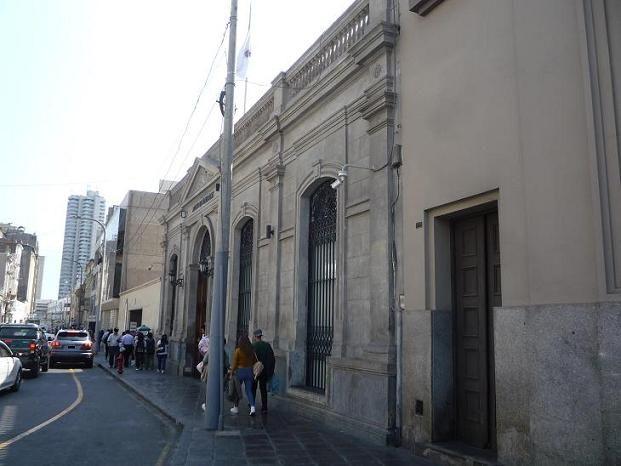
The Andrés del Castillo Museum

Looking across the Plaza San Martín

A better view of the Plaza San Martín. I took this photo several years ago, but the plaza still looks the same.

Walking north along Jirón de la Unión. The building dominating the left once housed the Palais Concert cafe, where author Abraham Valdelomar hung out. By chance, this is a rather calm looking scene for a boulevard that is usually very lively and busy.
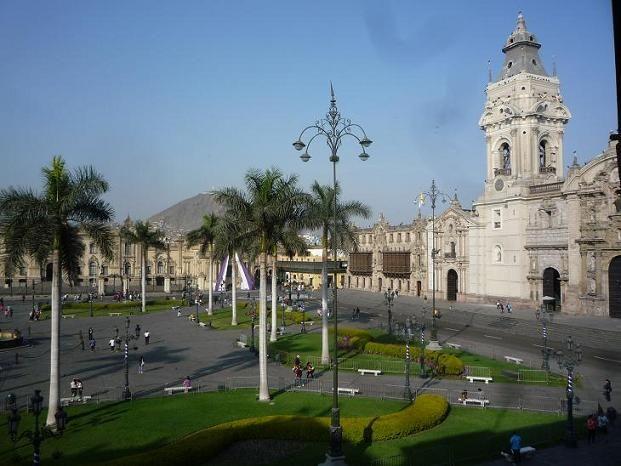
A section of the grand Plaza Mayor, with the Catherdral at far right, and the Archbishop’s palace to the left of it.
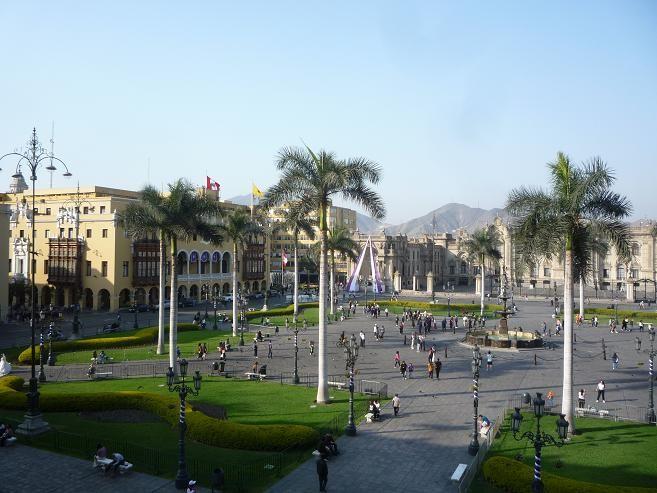
As the Plaza Mayor was too big to fit into one photo from my viewing point, here's another section. The Government Palace is to the right.
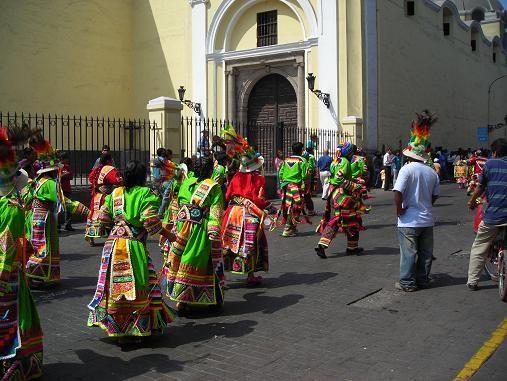
From a trip several years ago: traditional dancers participating in a procession I happened to stumble onto while walking around the historic center in my usual "flâneur" manner.
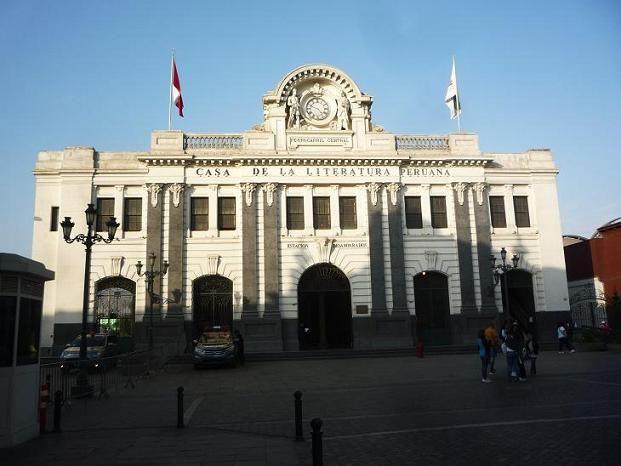
The former Desamparados train station, now the House of Peruvian Literature. Even if literature is not what you're here for, consider strolling through anyway. (It's free.)
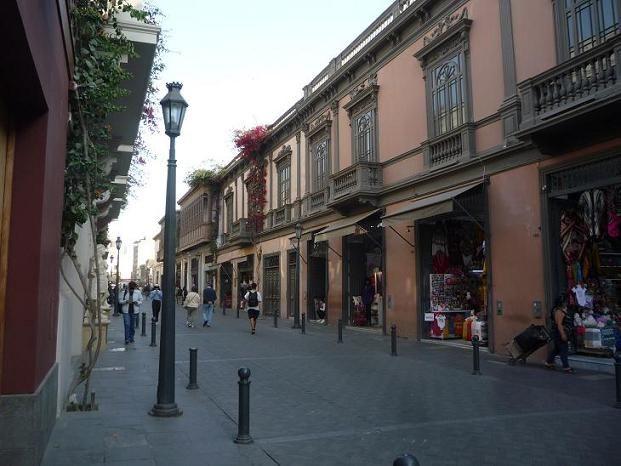
Ancash Street.

The San Francisco Basilica and Monastery. I’ve posted a picture from several years ago, only because my most recent photo is marred by construction then taking place in the front plaza. But the outward appearance hasn’t changed in the intervening years, and I can’t see why anyone would want to alter its perfect baroque look anyway.
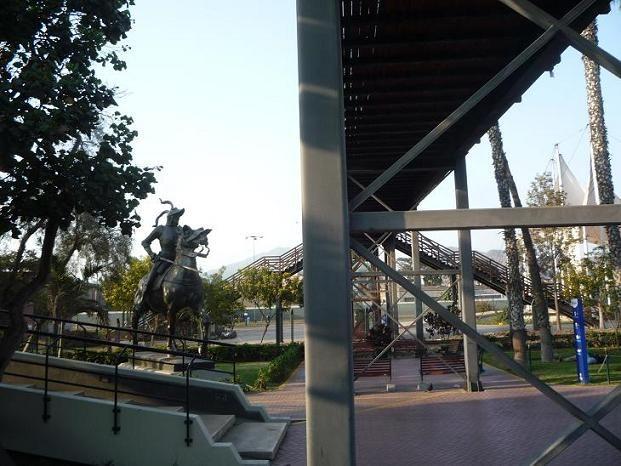
The valiant conquistador Francisco Pizarro in his corner of Lima’s Park of the Walls, dwarfed by a pedestrian bridge. (A bit of a come-down from his earlier spot in the center of the Plaza Mayor.) I’ver never found out what those two things coming out of his helmet are supposed to be.

Part of the National Museum of Peruvian Culture (Museo Nacional de la Cultura Peruana; photo from 2015), a bit to the west of the historic center on Alfonso Ugarte Avenue..
The Andrés del Castillo Museum
Looking across the Plaza San Martín
A better view of the Plaza San Martín. I took this photo several years ago, but the plaza still looks the same.
Walking north along Jirón de la Unión. The building dominating the left once housed the Palais Concert cafe, where author Abraham Valdelomar hung out. By chance, this is a rather calm looking scene for a boulevard that is usually very lively and busy.
A section of the grand Plaza Mayor, with the Catherdral at far right, and the Archbishop’s palace to the left of it.
As the Plaza Mayor was too big to fit into one photo from my viewing point, here's another section. The Government Palace is to the right.
From a trip several years ago: traditional dancers participating in a procession I happened to stumble onto while walking around the historic center in my usual "flâneur" manner.
The former Desamparados train station, now the House of Peruvian Literature. Even if literature is not what you're here for, consider strolling through anyway. (It's free.)
Ancash Street.
The San Francisco Basilica and Monastery. I’ve posted a picture from several years ago, only because my most recent photo is marred by construction then taking place in the front plaza. But the outward appearance hasn’t changed in the intervening years, and I can’t see why anyone would want to alter its perfect baroque look anyway.
The valiant conquistador Francisco Pizarro in his corner of Lima’s Park of the Walls, dwarfed by a pedestrian bridge. (A bit of a come-down from his earlier spot in the center of the Plaza Mayor.) I’ver never found out what those two things coming out of his helmet are supposed to be.
Part of the National Museum of Peruvian Culture (Museo Nacional de la Cultura Peruana; photo from 2015), a bit to the west of the historic center on Alfonso Ugarte Avenue..
Last edited by Faedus; Dec 3rd, 2024 at 03:35 PM.

Thread
Original Poster
Forum
Replies
Last Post
Faedus
South America
3
Nov 23rd, 2024 11:45 AM
VijayR
South America
5
Nov 15th, 2014 06:01 AM
jdp080367
South America
4
Dec 26th, 2011 05:58 PM


