


Sicily in 9 Days
 Apr 15th, 2025 | 10:30 AM
#1
Original Poster
Joined: Feb 2016
Posts: 388
Likes: 0
Sicily in 9 Days
Note: this trip was planned BEFORE Covid and was cancelled when the pandemc hit. I had gotten a lot of great tips from the people on this board when planning
PART I We decided on ITA despite the negative reviews (reviews such as. “I would have given a negative 5 if I could”) not just because of the price, but we really did not want to be on a Boeing right now. ITA flies all Airbus jets. Our seats were very comfortable. The food well, ok, it was pretty awful, but the service was fine. Only hitch was a kid who managed to scream 6 out of the 8-hours of flying. He did give us a reprieve for meal service but that was about it.
We landed in Palermo and I highly recommend the shared taxi service over the bus. It is 1 Euro more and while you don't get dropped off at your doorstep. You get dropped off close to your hotel vs.the the bus station. Best 1 euro we have spent so far.
We stayed at Locanda Sette Fateand I do recommend this bed and breakfast because the location is central yet quiet and the owner Giada goes above and beyond to be helpful. The bed is comfortable and the breakfast is very good (although they definitely struggled making all those coffees and cappuccinos in the morning). After getting settled we headed to the obligatory street food at Ballarò Market for lunch. I know this is sacrilegious, but it just was not my thing. It's not like the Nishiki market in Kyoto where locals and tourists both rub shoulders and nobody is hawking their goods. But we ate some good prawns and arancini and then I checked that off my list. Done. Not going back. Many enjoy it though.
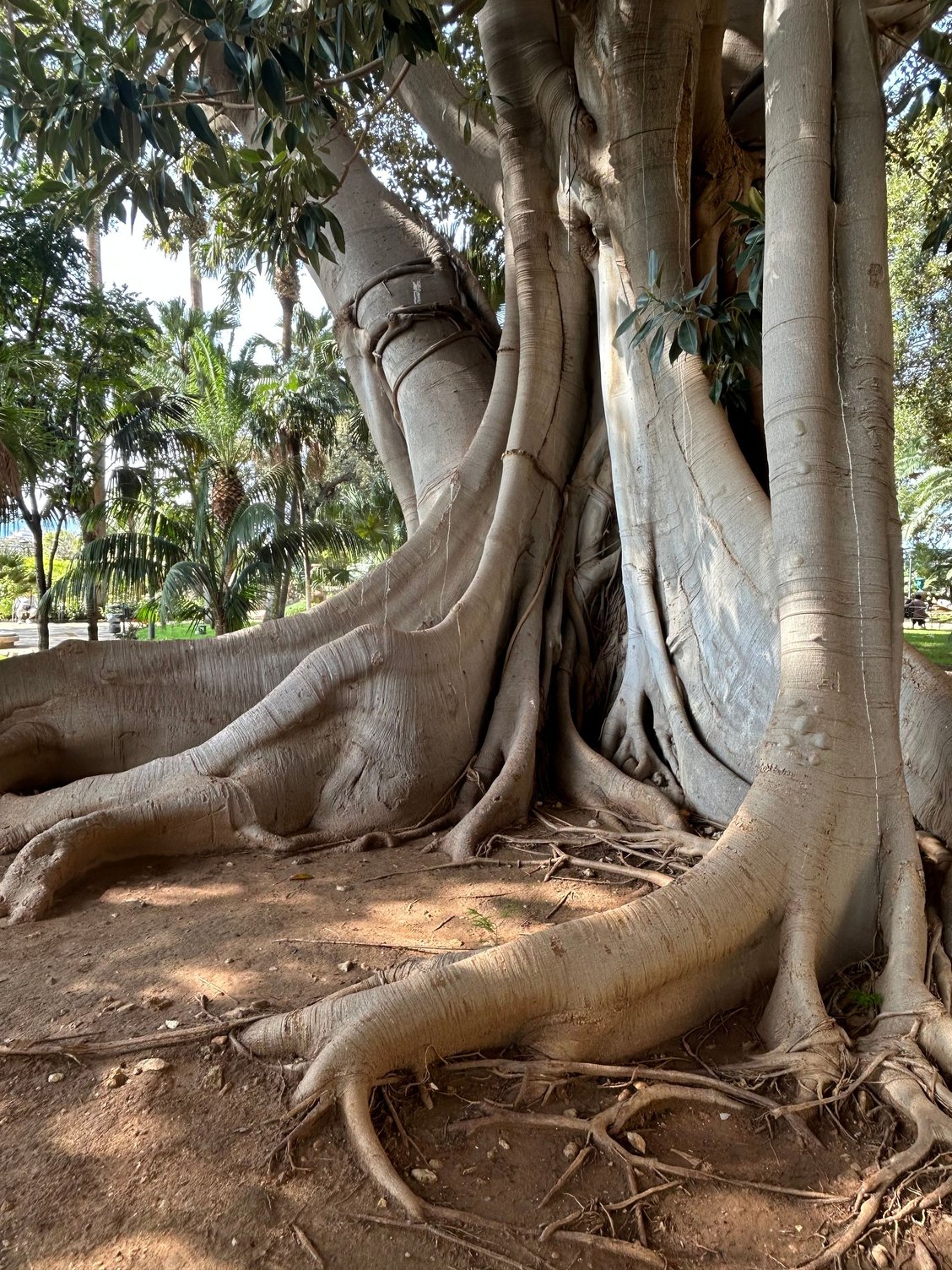
First off was the Cappella Palatinain the Palazzo dei Normanni built in 1130-1140. Living in NYC and knowing it is taking over a year and a half to put in one pickleball court on an area already paved, I was amazed to learn how much was accomplished in 10 years! This site was probably occupied since Punic times, and then was the site of the Emir's palace which was ten abandoned until the Normans showed up. Here is an example of Arab-Norman-Byzantine multicultural influences. It is surprisingly harmonious, and the mosaics are stunning. This will come up again in Monreale… and yes, I realize this is an active church with many tourists (we can be annoying I am sure)…. But this is also a UNESCO heritage site and the seats are strictly roped off. How wonderful it would be to sit for 10 minutes to be able to admire the mosaics and think about the stories. And hey, you might even get a convert this way.From there we went to the Royal Gardens, and it was lovely to sit and watch the rose ringed parakeets and the locals. It was a good respite, and I recommend it. By now, jet lag caught up and we went back for a siesta.
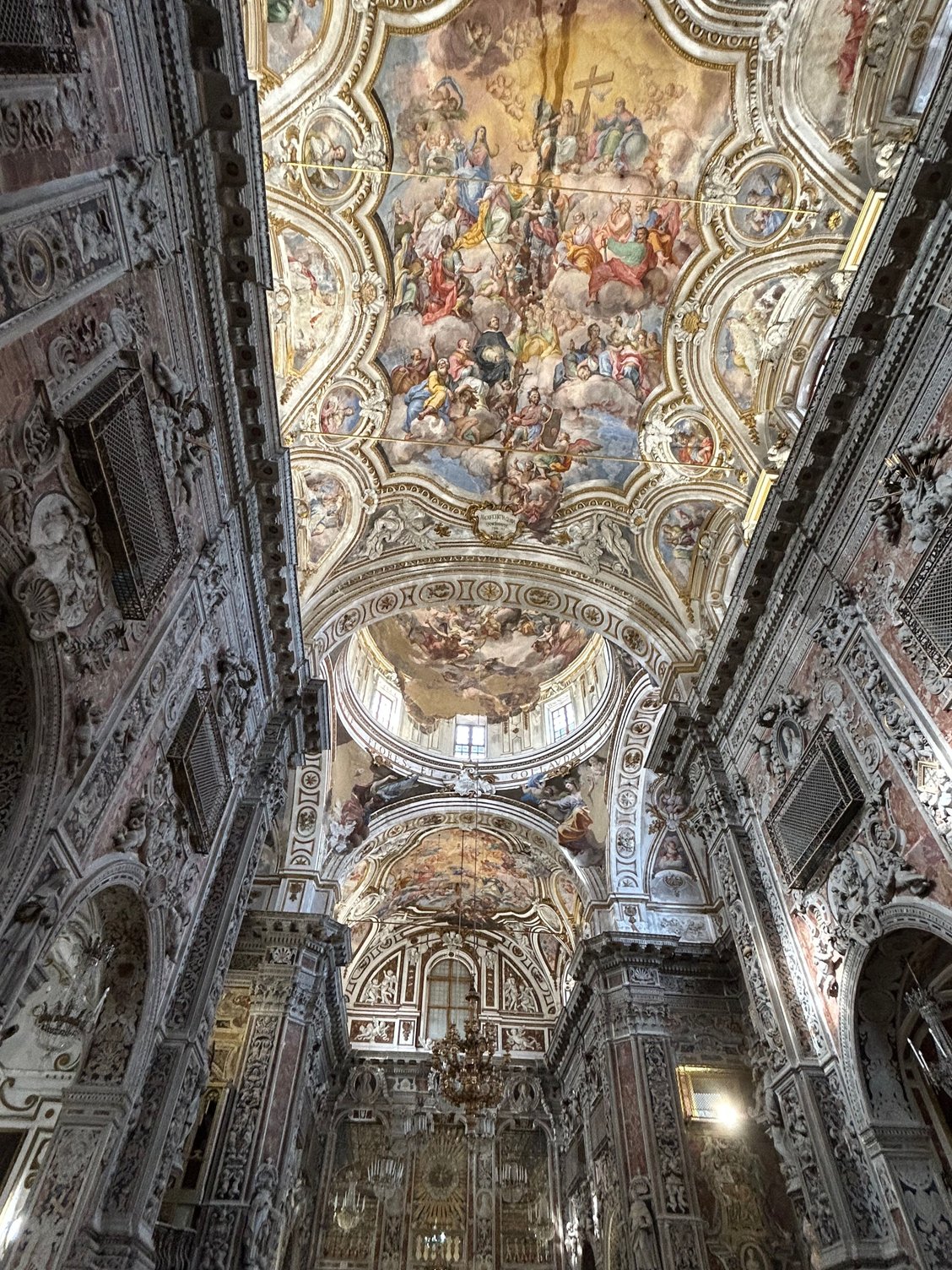
After a nap, we wandered around trying to avoid Via Vittorio Emanuele (once was enough) and poked into Santa Caterina. Hard to believe this was originally built as a hospice in the early 14th century. The church was later rebuilt with over-the-top Baroque, Rococo, and Renaissance elements. Every inch is covered with something: statues, stucco work, frescoes, marble, and paintings – it's essentially the blockbuster of churches, like Mission Impossible II with its visual excess.
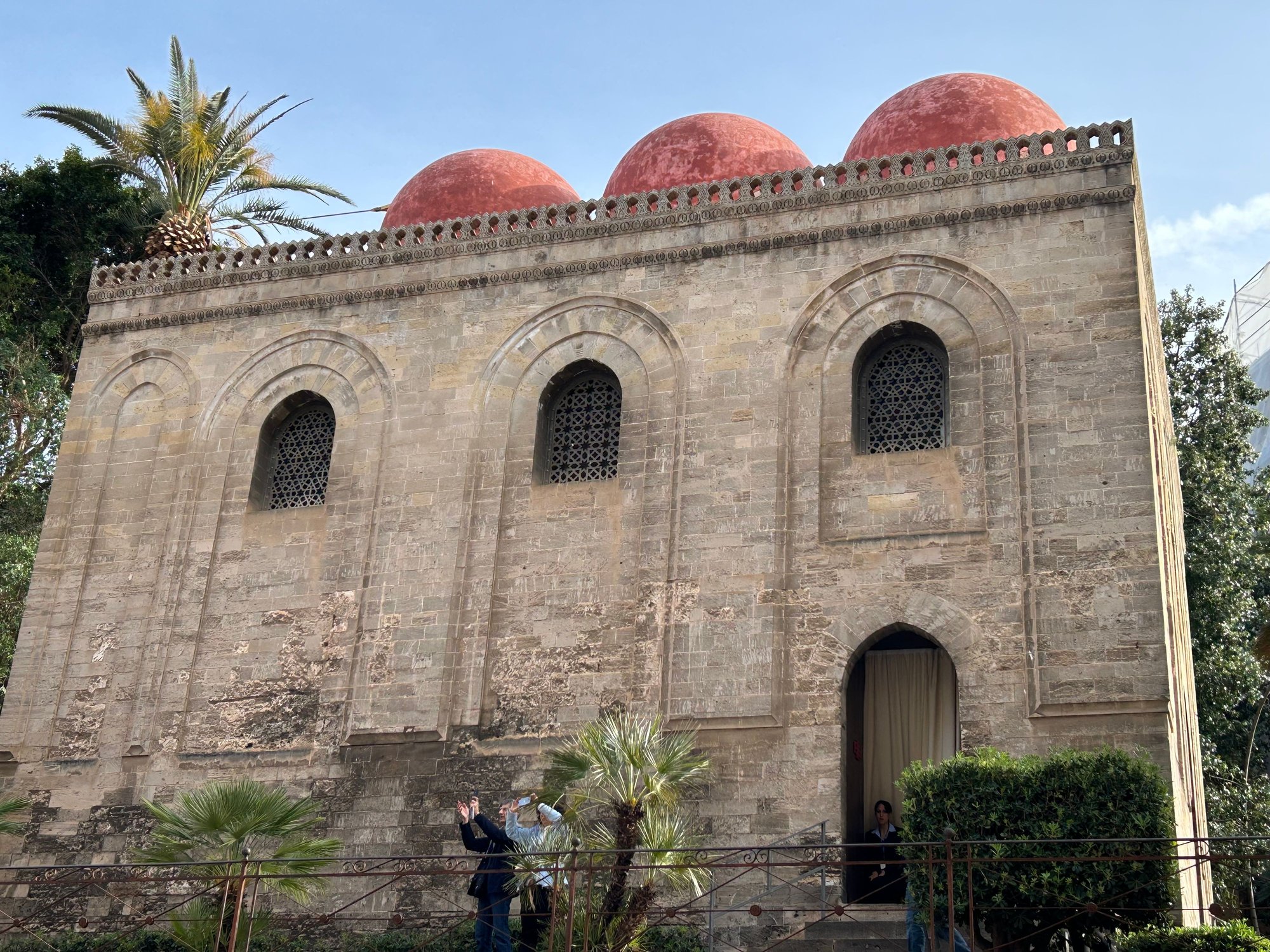
We crossed the square to find the polar opposite in Chiesa San Cataldo (don't miss this one), which is poetic in its simplicity. The church was built during the reign of William I in 1154. It's a notable example of Arab-Norman architecture that flourished in Sicily under Norman rule. With its essential structure and Arab-inspired red domes, the church represents a beautiful fusion of cultural influences that definitely gives your mind more space to contemplate. I loved seeing the two extremes in this one square.
Our first dinner we had to eat outside as we had no reservation, and it gets pretty chilly in Palermo in April. Note: in the spring, despie palm trees, bring a coat. I was prepared, but my husband was not. It must be in a guidebook since there were both tourists and locals: Osteria Ballarò. The swordfish caponata was incredible as was the sea bream. This was one of my favorite three meals of our trip.
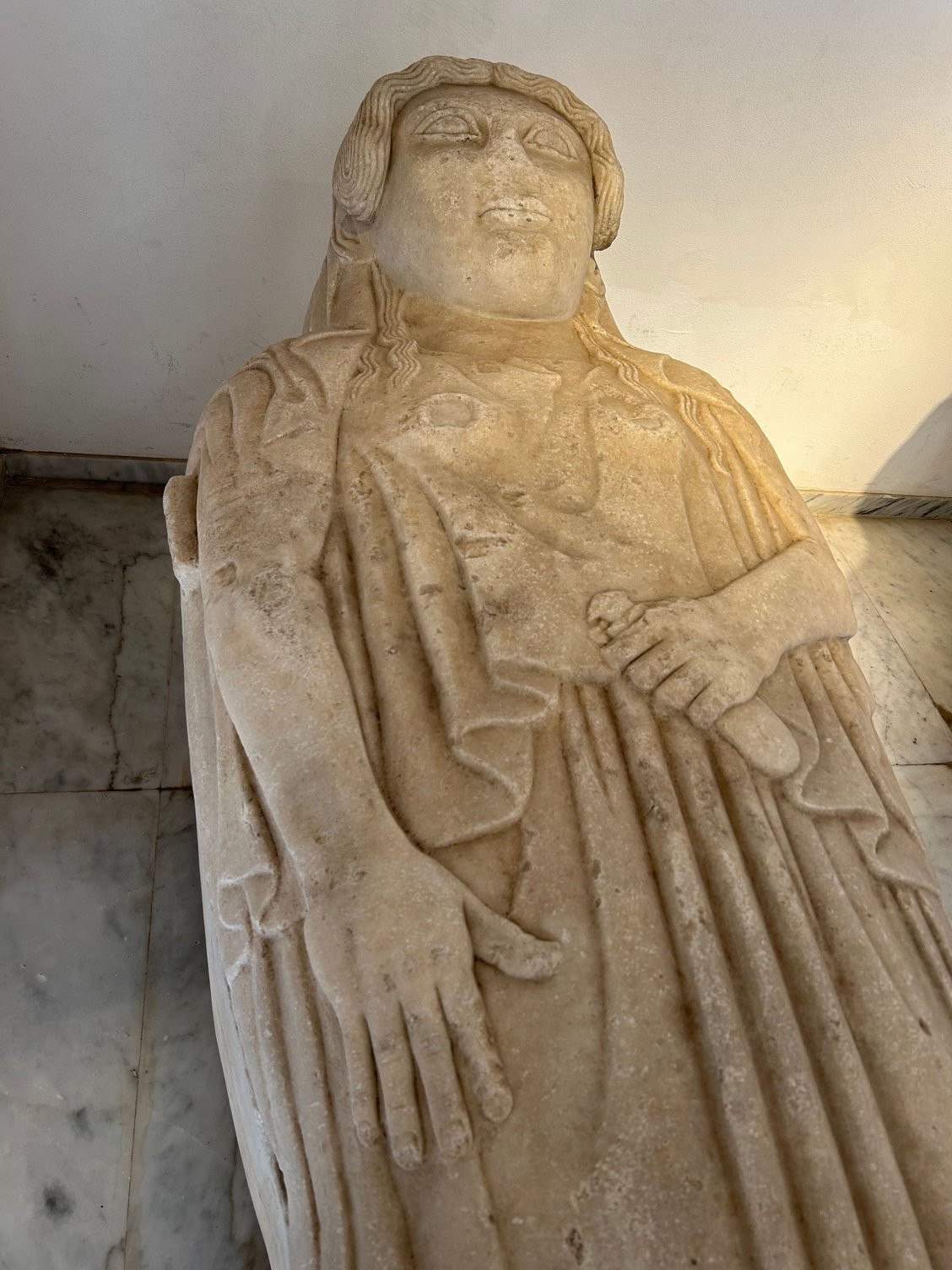
Next day, Saturday, Monreale was on our schedule, but first we decided to check out the archaeological museum in Palermo. This was a great little gem that takes about an hour to explore. Several rooms are devoted to Selinunte, the Greek colony founded around 650 BCE. What I learned from the museum is that like much of Sicily's history, Selinunte's story is one of conflict and conquest. The trouble began when Selinunte tried to expand its territory, clashing with neighboring Segeste. In 409 BCE, Hannibal (not that Hannibal who crossed the Alps with elephantsm another Carthaginian) attempted to be peacekeeper and resolve the conflict through diplomacy. When Selinunte refused any arbitration, they made a fatal mistake. Syracuse, Gela, and Agrigento never sent help. Selinunte was left to face the Carthaginan army alone.
The battle that followed was brutal. For nine days, the people fought. Women threw stones from rooftops while men built barricades in the streets. Eventually, the overwhelmingly larger Carthaginian force broke through. They slaughtered most of the inhabitants, and only spared the women and children who had taken refuge in temples. According to historical accounts, about 16,000 Greeks were killed, 5,000 men were taken as slaves, along with many thousands of women and children. The scale of destruction is a reminder of how war and conquest shaped Sicily's landscape.
MONREALE The bus to Monreale is the cheapest way to go and busiest. When we missed theh bus, we faced a 50-minute wait for the next one (I bought the round trip ticket so I wouldn't be scrambling to find a ticket back). Despite being among the first at the bus stop, by the time it arrived, there were alot of us waiting. It was a mad free for all. This crowd could move! My husband barely squeezed on! Incredibly, the driver kept stopping for more passengers and somehow they squeezed in. I could not validate my bus ticket as it was impossible to get near the machine. Eventually, it turned into a game of Twister with arms and legs contorted to accommodate more and more people. I realized that even if I'd fainted, I would have remained upright, compressed by the wall of bodies around me. Let’s just say, this would have been a nightmare in the summer!
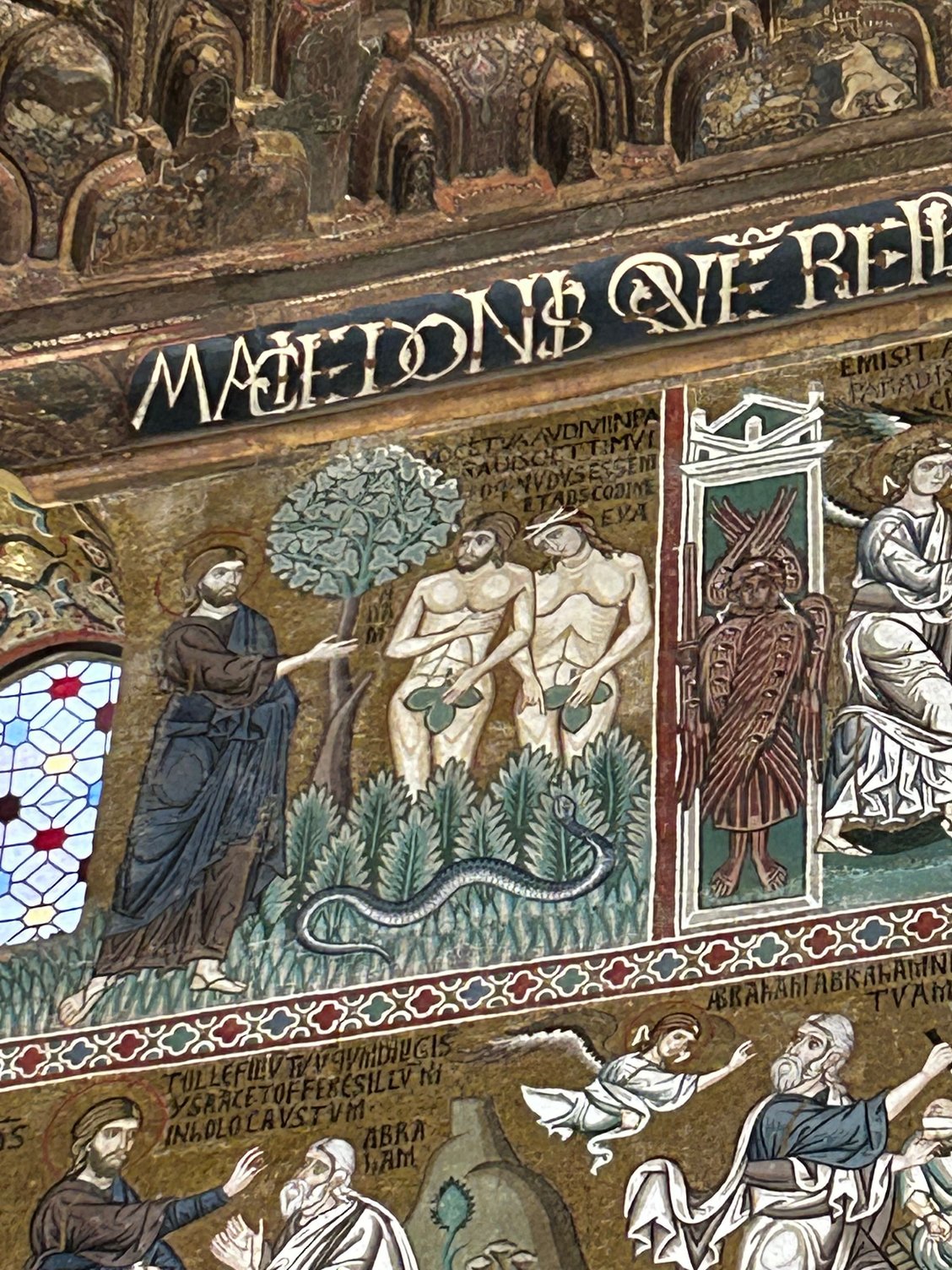
Following Rick Steves' advice, we reached Monreale Cathedral before the midday closure and avoided the crowds. We enjoyed the magnificent interior with only about 20 other visitors before they locked the doors. The cathedral is a beautiful fusion of Byzantine, Arab, Norman, and Roman influences (if you count the recycled ancient Roman columns).The Old Testament mosaic cycle was my favorite. The Creation scene depicts God like an accomplished artisan glassblower, blowing life into man (note not like the frantic reality show Blown Away of bickering glass blowers--more serene). The Noah's Ark sequence has so much personality as Noah struggles to herd the animals aboard--I get that, trying to get our poodle to listen can be exacerbating. These mosaics have such narrative power and make these stories relatable that I wished they'd provide seating so visitors could spend time with them. Meanwhile, I couldn't help wondering if the estimated two tons of gold adorning the walls might come raining down!
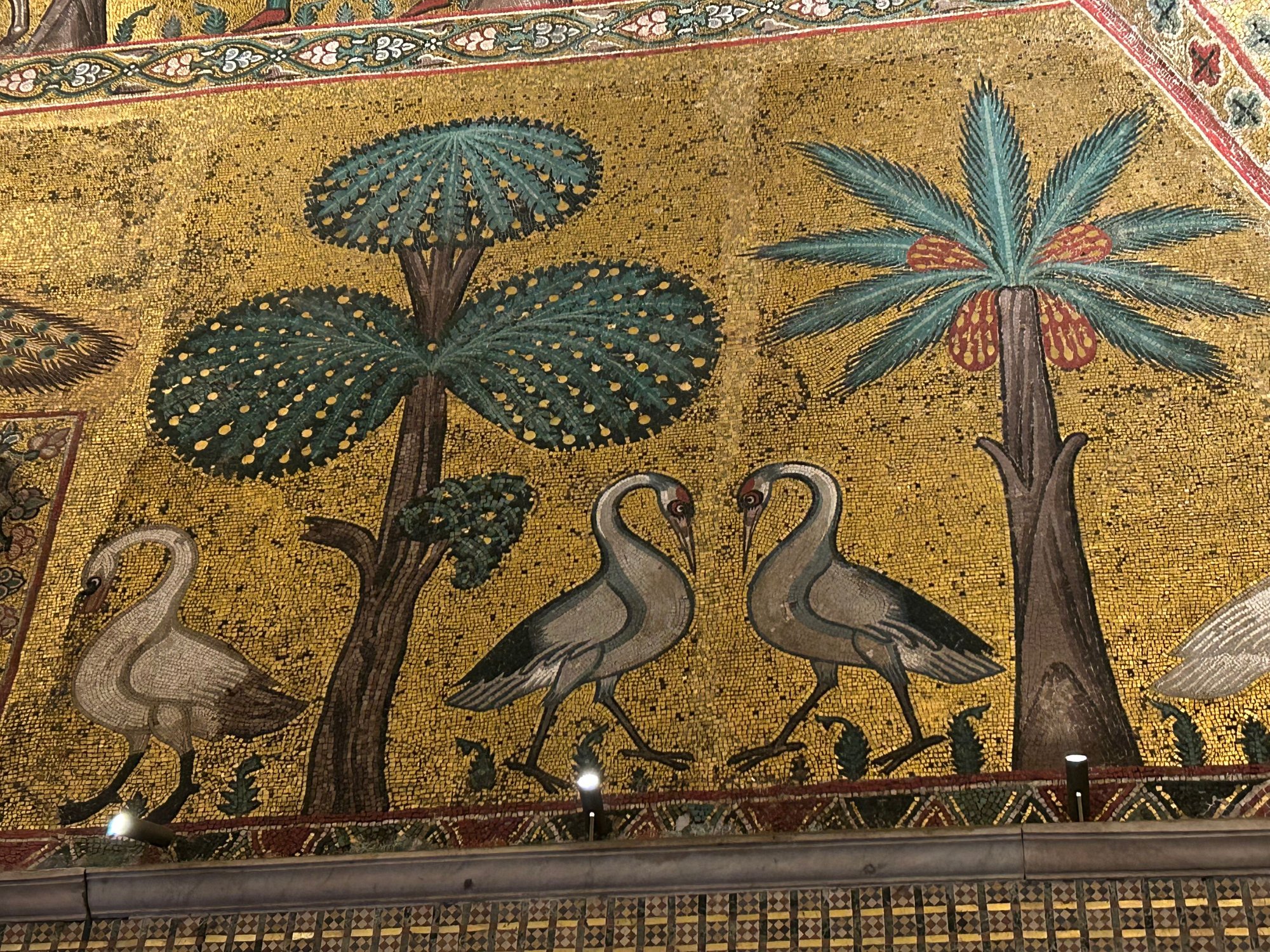
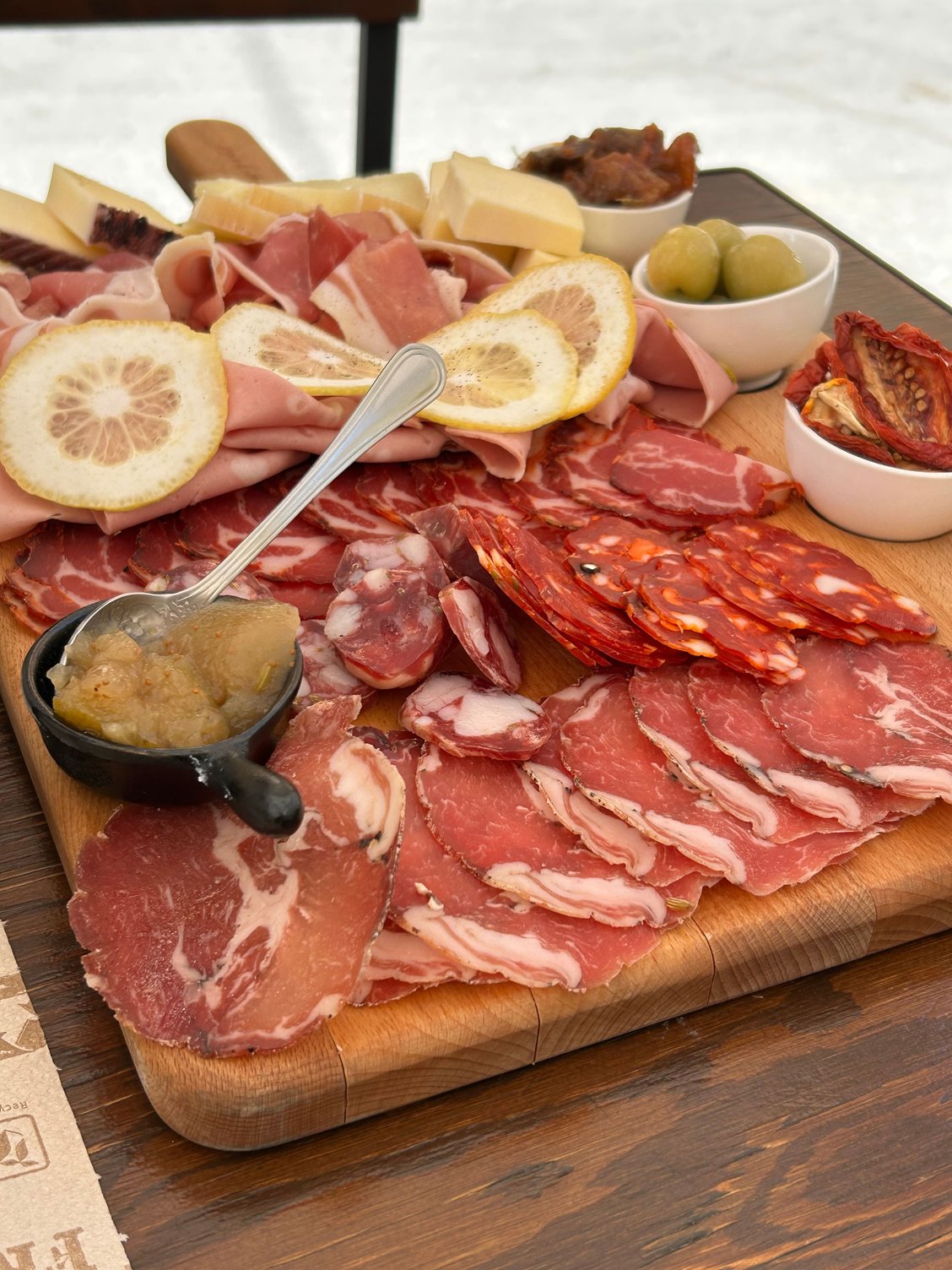
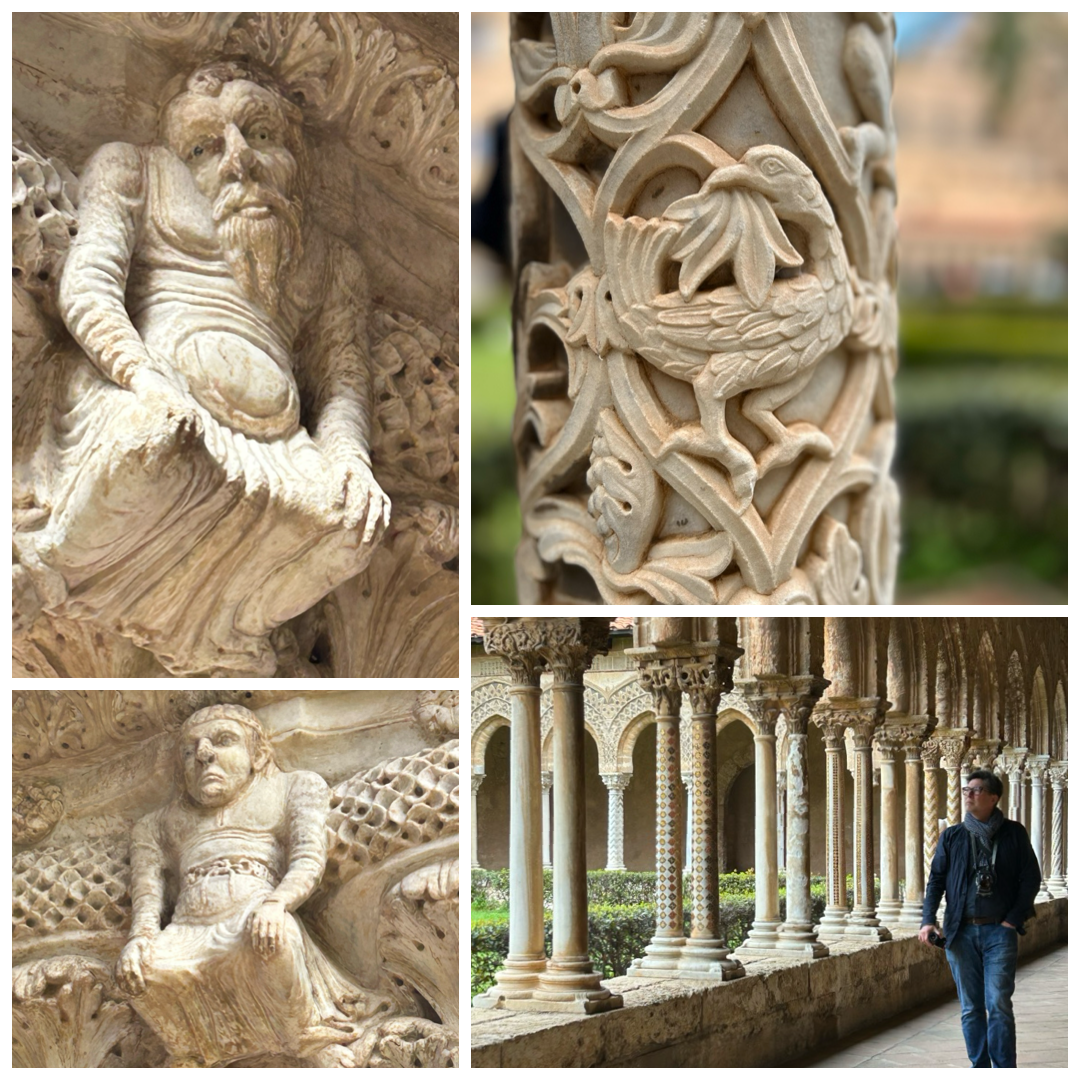
OK, GET OUT... time for the lunch closure, and so walked around and ended up at La Bodeguita and had a cold beer and the cold cut plate for two--enough for four (don’t mistake it for the restaurant next door). Great cold cuts and cheese and focaccia, which we then wrapped up the leftovers and had ithem the next day at Segeste sitting in the amphitheater. After lunch, we popped back into the cathedral for one more look before heading to the other treasure: the Benedictine cloisters. Four symbolic trees are planted in the courtyard—date palm, fig, olive, and pomegranate—representing paradise in both Biblical and Quranic traditions. The surrounding columns are a medieval art gallery, each one uniquely crafted by different artisans of varying degrees of talent. The carvings range from frightening to comical, featuring everything from sacrificial bulls and wine-making scenes to attacking lions and the biblical massacre of the innocents. It's like browsing a medieval instagram page with glimpses into the medieval mind. OK, now rushing to the bus stop. First ones there, and this time I was tired and determined to get a seat (unless I had to give it up). Ride back much more pleasant.
Unfortunately, we had to walk along Via Vittorio Emanuele again. I came to loathe that street as it felt like a generic tourist nightmare selling the same stuff over and over again like Groundhog’s Day. But it seemed impossible to avoid this street as it intersects the city. So I grabbed a fresh squeezed orange juice. WOW! Enough said.
That evening we walked to the Kalsa and over by the waterfront where there was a vibrant immigrant population out playing soccer, flying kites, and taking their passeggiate. We could not find a place to eat there, so ended up wandering and found Bisso Bistro, and I had the sardine pasta, which was really quite nice and good price. To get to our hotel we walked thorugh the Quattro Canti which felt like Madrid on a Saturday night—or the West Village. We were ready to leave Palermo. It's a beautiful city and I felt very safe. I think two days was enough,
Next up: II Part Trapani and Segest
Palermo and Monreale
PART I We decided on ITA despite the negative reviews (reviews such as. “I would have given a negative 5 if I could”) not just because of the price, but we really did not want to be on a Boeing right now. ITA flies all Airbus jets. Our seats were very comfortable. The food well, ok, it was pretty awful, but the service was fine. Only hitch was a kid who managed to scream 6 out of the 8-hours of flying. He did give us a reprieve for meal service but that was about it.
SIDE NOTE OFF TOPIC: The ancient history of Sicily is crazy—trying to keep track of who conquered and co-opted or destroyed whom can be dizzying. Plato said people flocked to Sicily's coasts "like frogs around a pond." The Sicels (one of the earliest inhabitants, around 1200 BCE), the Elymians (believed to be Trojan refugees who founded Erice and Segesta), the Phoenicians (800 BCE), the Carthaginians (540 BCE), the Greeks, the Romans (they knew a good thing when they saw it and were quick to grab it), then the Arabs in 827 CE in Palermo came and got along well with the indigenous folks in the West but the Christians in the Northeast were not having it. Next along came the Normans after fighting as mercenaries for the feuding Popes and Arabs. The ambitious knight, Roger I conquered the Emirate of Sicily during the 11th century. He is credited with the fusion of Western, Byzantine, and Arabic culture found in the art and architecture of Sicily. Probably because he he did not interfere with existing laws and customs. He granted religious freedom to Greek Christians, Jews, and Muslims. The strategic location for trading made this a place of constant upheaval and conflict. Yet the art and architecture you see, which is often a blend of many influences, makes it a unique place…anyway on to the trip… I wish I had studied up a bit more before we headed out.
We landed in Palermo and I highly recommend the shared taxi service over the bus. It is 1 Euro more and while you don't get dropped off at your doorstep. You get dropped off close to your hotel vs.the the bus station. Best 1 euro we have spent so far.
We stayed at Locanda Sette Fateand I do recommend this bed and breakfast because the location is central yet quiet and the owner Giada goes above and beyond to be helpful. The bed is comfortable and the breakfast is very good (although they definitely struggled making all those coffees and cappuccinos in the morning). After getting settled we headed to the obligatory street food at Ballarò Market for lunch. I know this is sacrilegious, but it just was not my thing. It's not like the Nishiki market in Kyoto where locals and tourists both rub shoulders and nobody is hawking their goods. But we ate some good prawns and arancini and then I checked that off my list. Done. Not going back. Many enjoy it though.
First off was the Cappella Palatinain the Palazzo dei Normanni built in 1130-1140. Living in NYC and knowing it is taking over a year and a half to put in one pickleball court on an area already paved, I was amazed to learn how much was accomplished in 10 years! This site was probably occupied since Punic times, and then was the site of the Emir's palace which was ten abandoned until the Normans showed up. Here is an example of Arab-Norman-Byzantine multicultural influences. It is surprisingly harmonious, and the mosaics are stunning. This will come up again in Monreale… and yes, I realize this is an active church with many tourists (we can be annoying I am sure)…. But this is also a UNESCO heritage site and the seats are strictly roped off. How wonderful it would be to sit for 10 minutes to be able to admire the mosaics and think about the stories. And hey, you might even get a convert this way.From there we went to the Royal Gardens, and it was lovely to sit and watch the rose ringed parakeets and the locals. It was a good respite, and I recommend it. By now, jet lag caught up and we went back for a siesta.
After a nap, we wandered around trying to avoid Via Vittorio Emanuele (once was enough) and poked into Santa Caterina. Hard to believe this was originally built as a hospice in the early 14th century. The church was later rebuilt with over-the-top Baroque, Rococo, and Renaissance elements. Every inch is covered with something: statues, stucco work, frescoes, marble, and paintings – it's essentially the blockbuster of churches, like Mission Impossible II with its visual excess.
We crossed the square to find the polar opposite in Chiesa San Cataldo (don't miss this one), which is poetic in its simplicity. The church was built during the reign of William I in 1154. It's a notable example of Arab-Norman architecture that flourished in Sicily under Norman rule. With its essential structure and Arab-inspired red domes, the church represents a beautiful fusion of cultural influences that definitely gives your mind more space to contemplate. I loved seeing the two extremes in this one square.
Our first dinner we had to eat outside as we had no reservation, and it gets pretty chilly in Palermo in April. Note: in the spring, despie palm trees, bring a coat. I was prepared, but my husband was not. It must be in a guidebook since there were both tourists and locals: Osteria Ballarò. The swordfish caponata was incredible as was the sea bream. This was one of my favorite three meals of our trip.
Next day, Saturday, Monreale was on our schedule, but first we decided to check out the archaeological museum in Palermo. This was a great little gem that takes about an hour to explore. Several rooms are devoted to Selinunte, the Greek colony founded around 650 BCE. What I learned from the museum is that like much of Sicily's history, Selinunte's story is one of conflict and conquest. The trouble began when Selinunte tried to expand its territory, clashing with neighboring Segeste. In 409 BCE, Hannibal (not that Hannibal who crossed the Alps with elephantsm another Carthaginian) attempted to be peacekeeper and resolve the conflict through diplomacy. When Selinunte refused any arbitration, they made a fatal mistake. Syracuse, Gela, and Agrigento never sent help. Selinunte was left to face the Carthaginan army alone.
The battle that followed was brutal. For nine days, the people fought. Women threw stones from rooftops while men built barricades in the streets. Eventually, the overwhelmingly larger Carthaginian force broke through. They slaughtered most of the inhabitants, and only spared the women and children who had taken refuge in temples. According to historical accounts, about 16,000 Greeks were killed, 5,000 men were taken as slaves, along with many thousands of women and children. The scale of destruction is a reminder of how war and conquest shaped Sicily's landscape.
MONREALE The bus to Monreale is the cheapest way to go and busiest. When we missed theh bus, we faced a 50-minute wait for the next one (I bought the round trip ticket so I wouldn't be scrambling to find a ticket back). Despite being among the first at the bus stop, by the time it arrived, there were alot of us waiting. It was a mad free for all. This crowd could move! My husband barely squeezed on! Incredibly, the driver kept stopping for more passengers and somehow they squeezed in. I could not validate my bus ticket as it was impossible to get near the machine. Eventually, it turned into a game of Twister with arms and legs contorted to accommodate more and more people. I realized that even if I'd fainted, I would have remained upright, compressed by the wall of bodies around me. Let’s just say, this would have been a nightmare in the summer!
Following Rick Steves' advice, we reached Monreale Cathedral before the midday closure and avoided the crowds. We enjoyed the magnificent interior with only about 20 other visitors before they locked the doors. The cathedral is a beautiful fusion of Byzantine, Arab, Norman, and Roman influences (if you count the recycled ancient Roman columns).The Old Testament mosaic cycle was my favorite. The Creation scene depicts God like an accomplished artisan glassblower, blowing life into man (note not like the frantic reality show Blown Away of bickering glass blowers--more serene). The Noah's Ark sequence has so much personality as Noah struggles to herd the animals aboard--I get that, trying to get our poodle to listen can be exacerbating. These mosaics have such narrative power and make these stories relatable that I wished they'd provide seating so visitors could spend time with them. Meanwhile, I couldn't help wondering if the estimated two tons of gold adorning the walls might come raining down!
OK, GET OUT... time for the lunch closure, and so walked around and ended up at La Bodeguita and had a cold beer and the cold cut plate for two--enough for four (don’t mistake it for the restaurant next door). Great cold cuts and cheese and focaccia, which we then wrapped up the leftovers and had ithem the next day at Segeste sitting in the amphitheater. After lunch, we popped back into the cathedral for one more look before heading to the other treasure: the Benedictine cloisters. Four symbolic trees are planted in the courtyard—date palm, fig, olive, and pomegranate—representing paradise in both Biblical and Quranic traditions. The surrounding columns are a medieval art gallery, each one uniquely crafted by different artisans of varying degrees of talent. The carvings range from frightening to comical, featuring everything from sacrificial bulls and wine-making scenes to attacking lions and the biblical massacre of the innocents. It's like browsing a medieval instagram page with glimpses into the medieval mind. OK, now rushing to the bus stop. First ones there, and this time I was tired and determined to get a seat (unless I had to give it up). Ride back much more pleasant.
Unfortunately, we had to walk along Via Vittorio Emanuele again. I came to loathe that street as it felt like a generic tourist nightmare selling the same stuff over and over again like Groundhog’s Day. But it seemed impossible to avoid this street as it intersects the city. So I grabbed a fresh squeezed orange juice. WOW! Enough said.
That evening we walked to the Kalsa and over by the waterfront where there was a vibrant immigrant population out playing soccer, flying kites, and taking their passeggiate. We could not find a place to eat there, so ended up wandering and found Bisso Bistro, and I had the sardine pasta, which was really quite nice and good price. To get to our hotel we walked thorugh the Quattro Canti which felt like Madrid on a Saturday night—or the West Village. We were ready to leave Palermo. It's a beautiful city and I felt very safe. I think two days was enough,
Next up: II Part Trapani and Segest
Palermo and Monreale
Last edited by RubyTwins; Apr 15th, 2025 at 10:41 AM. Reason: Typos
 Apr 15th, 2025 | 10:46 AM
#3


Joined: Mar 2003
Posts: 6,222
Likes: 0
Yes, you are off to a great start! Haven't been to Sicily yet, but we hope to make it there before we are too old! Your photos are beautiful and interesting, and I love your informative text. Your description of the Carthaginian battle is interesting, heartbreaking, and succinct.
Your photos are beautiful and interesting, and I love your informative text. Your description of the Carthaginian battle is interesting, heartbreaking, and succinct. Last edited by KarenWoo; Apr 15th, 2025 at 10:50 AM.
Apr 16th, 2025 | 01:20 AM
#5

Joined: Apr 2010
Posts: 1,861
Likes: 0
Thanks for your TR, we were in Palermo exactly 3 years back and were blown away by the city. We spent 13 days in all in Sicily, our second trip and there’s still so much we didn’t see.
What impressed me the most was how fiercely proud Sicilians were of their island and heritage. We were going to Naples from Catania at the end of our trip and people would say to us ‘oh, you’re going to Italy!’ Even at the airport when we were checking in for our flight!
What impressed me the most was how fiercely proud Sicilians were of their island and heritage. We were going to Naples from Catania at the end of our trip and people would say to us ‘oh, you’re going to Italy!’ Even at the airport when we were checking in for our flight!
Apr 16th, 2025 | 07:51 AM
#6
Original Poster
Joined: Feb 2016
Posts: 388
Likes: 0
Trapani and Segesta
Thanks for those following!
I won't go into the wallet fiasco but: lesson learned. I hadn't packed my license, and with my husband's wallet gone, we wouldn't be able to rent the car—potentially meaning flying home since our entire trip depended on having wheels. Long story short, disaster averted. We picked up the car at the airport. TIP: your hotel can help book the shared van to the airport that picks you up directly from your accommodation. We were advised to get insurance through the rental car company since fender benders are common in Sicily. We took that advice.
Segesta was an important trading center close enough to the coast to support a port. Pottery inscriptions reveal that the local Elymian used the Greek alphabet while maintaining their distinct identiy. Again showing the cultural exchange evident everywhere in Sicily. As mentioned earlier, they had a long-standing feud with nearby Selinunte that led to several conflicts after 580 BCE. The Segestans seemed fickle and quick to seek help from others, first from the Greeks and then switching to the Carthaginians. Early in the First Punic War, however, they massacred the Carthaginian garrison and jumped ship again over to the Romans. You get the picture.
Today, Segesta has two remarkable ancient structures. The well-preserved Doric temple dates to the 5th century BCE and somehow escaped destruction during the Carthaginian occupation. Interestingly, the temple was never completed—some believe construction halted due to the conflict with Selinunte. There's also a 3rd century BCE theater, a 30-minute walk uphill (or a bus ride) with stunning views of the surrounding countryside. April is a great time to visit. It's cool, thousands of wildflowers are blooming, and there aren't hordes of people. You can really feel like you have the temple to yourself, and the hike up to the theater is breathtaking.
That night for dinner, we sought out the region's famous couscous at Ristorante Arabo Carthage. This no-frills establishment made me a couscous convert—I never knew about the accompanying soup that makes the dish complete. Walking back to our Airbnb, we happened upon a church rehearsal for the upcoming Procession of the Mysteries, a tradition celebrated for over 400 years and one of Italy's longest religious processions. Little out of tune but interesting nonetheless.
The following day took us to Zingaro Natural Reserve, a truly beautiful hiking experience. The reserve stretches over 10 kilometers along a stunning coastline between Scopello and San Vito lo Capo. As you hike the coastal trail, you're accompanied only by the sound of wind, Sardinian warblers, crashing waves, and occasional passing hikers. A spring visit has fewer crowds and carpets of wildflowers. I would NOT recommend this in the summer heat or with mobility issues. You probably want sturdy shoes on the rocky trail and good balance, though we saw hikers of various ages managing it. We spent half a day there, enjoying the strawberries we brought from a local stand and enjoying the peacefulness. Eventually, hunger demanded more those few berries.
We chose Scopello for lunch—a place guidebooks call "the most beautiful coastal town in Sicily," likely due to an effective PR campaign by its 80 residents. While charming, what these guides fail to mention is that accessing those postcard-perfect views requires either buying property there or paying a 10 Euro "scenic view tax." The experience felt more like visiting a movie set than discovering a hidden gem—fitting since scenes from Ocean's Twelve with Brad Pitt were filmed at the old tuna factory (Tonnara di Scopello). In retrospect, Castellammare del Golfo would have been a better lunch choice unless you're determined to get that perfect Instagram shot (and shell out the 10 Euros for it). I would say, skip it.
After a siesta we visited the salt pans near Trapani. Though designated as a nature reserve managed by the WWF since 1995 where ancient Phoenician salt-harvesting methods continue today. I can safely say that what we saw is not as beautiful as the home page for the site. Our birdwatching was a little disappointing. Sicily's historical deforestation means fewer trees and consequently quieter birdsong than home. Combined with the island's substantial feral cat population, birds seem to have found safer European havens elsewhere. Nevertheless, we enjoyed our walk and purchased some of the region's specialty salt for gifts. I recommend it--just not for birdwatching.
That evening, we arrived early at Al Vicoletto without reservations—thankfully, we figured out you gotta ring the doorbell for entry. The food was really good, the atmosphere cozy, and our host Daniel charming, making for one of my favorite meals of the trip. The restaurant filled quickly after our arrival. Though we spent several days based in Trapani, we never properly explored the city itself, focusing instead on the surrounding attractions.
The next day, we headed to our agriturismo, Fattoria a Mose, but decided to push our luck with our "lock the luggage in the hatchback" strategy once more to check out Erice en route. Unfortunately, the cable car that connects upper and lower parts of Erice wasn't running. This was our first experience on the extremely winding, nerve-wracking drive up a mountain. Note: thank you for the small car. Once in Erice, we purchased the 5 Church pass. Most of these churches aren't nearly as special as those in Palermo or Monreale and I personally didn't find them particularly interesting. The medieval town itself is undeniably beautiful with its stone streets and ancient walls—though also quite crowded with tourists. We abandoned our plan to try the famous local pastries after spotting several busloads of visitors with the same guidebook recommendation. Instead, we grabbed sandwiches to go and decided to make our next stop the Riserva Naturale Orientata Torre Salsa on our way to the agriturismo.
This decision would prove to be perhaps one of our riskier moves of the trip. Torre Salsa is a nature reserve covering more than 760 hectares between Agrigento and Sciacca, managed by the WWF since 1996. It features a stunning combination of hills, chalk cliffs, sand dunes, and wetlands ALONG DUSTY ROADS. But the journey there was an adventure in itself. Reaching the entry required navigating a pretty bumpy unpaved road in what is the middle of nowhere. Our little car handled it well (maybe not my head) until we hit a section where the road had washed out completely. We pulled over, secured our hidden and locked bags, and continued pretty far on foot. The isolation made us hesitant about leaving the luggage and our car, but in the end it was worth it—a beautiful late-afternoon walk through fields again just completely blanketed with wildflowers that led down to an isolated, pristine beach. The reserve features six kilometers of wilderness coastline with diverse habitats, providing stunning views of the Mediterranean Sea's blue waters. As we started our return hike and past warning signs for wild boar, we began to second-guess our decision, picking up the pace we hoped our car would still be there. Sigh of relief.
You will soon discover this might not have been our riskiest move with the car /luggage trick.

Trapani and Segesta
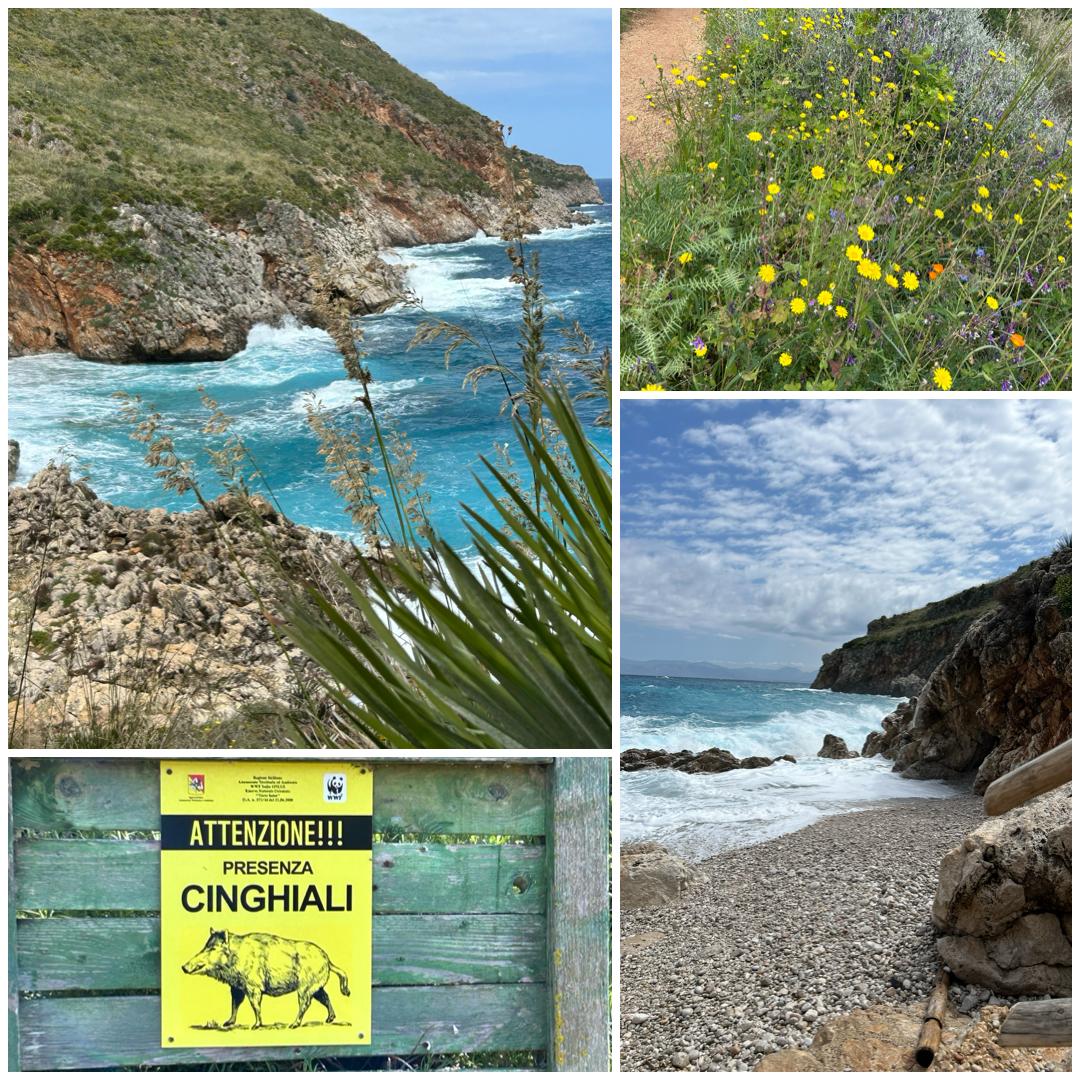
Zingarro Riserva and Torre Salsa
I won't go into the wallet fiasco but: lesson learned. I hadn't packed my license, and with my husband's wallet gone, we wouldn't be able to rent the car—potentially meaning flying home since our entire trip depended on having wheels. Long story short, disaster averted. We picked up the car at the airport. TIP: your hotel can help book the shared van to the airport that picks you up directly from your accommodation. We were advised to get insurance through the rental car company since fender benders are common in Sicily. We took that advice.
Driving 101: Because the roads to many towns are extremely winding, think twice before renting a large car, no matter how appealing the extra space might seem. Driving in Sicily is a lot like playing chicken—the slightest hesitation and the other driver goes, even if that means leaving you in a ditch. There's also an apparent addiction to passing, even in clearly marked no-passing zones. Then there's taking a hairpin curve uphill on a narrow road while a tour bus barrels down the opposite direction. Perhaps most bewildering of all: at the sharpest curves, the speed limit often suddenly goes UP, not DOWN! It's as if the road designers are testing your reflexes.You'll be grateful for a small, nimble car . You will also love your compact car when hunting for parking in ancient towns not designed for cars. One final caution: While Google Maps works remarkably well throughout the island, it doesn't always recognize one-way streets. Keep your eyes peeled for those "Senso Unico" signs that might save you from an accident. Despite these warnings, driving in Sicily was, surprisingly, fine. Just consider it part of the authentic Sicilian experience.
Guidebooks consistently recommend Trapani as an excellent base for exploring western Sicily. Our plan was to stop at Segesta on our route to Trapani.Segesta was an important trading center close enough to the coast to support a port. Pottery inscriptions reveal that the local Elymian used the Greek alphabet while maintaining their distinct identiy. Again showing the cultural exchange evident everywhere in Sicily. As mentioned earlier, they had a long-standing feud with nearby Selinunte that led to several conflicts after 580 BCE. The Segestans seemed fickle and quick to seek help from others, first from the Greeks and then switching to the Carthaginians. Early in the First Punic War, however, they massacred the Carthaginian garrison and jumped ship again over to the Romans. You get the picture.
Today, Segesta has two remarkable ancient structures. The well-preserved Doric temple dates to the 5th century BCE and somehow escaped destruction during the Carthaginian occupation. Interestingly, the temple was never completed—some believe construction halted due to the conflict with Selinunte. There's also a 3rd century BCE theater, a 30-minute walk uphill (or a bus ride) with stunning views of the surrounding countryside. April is a great time to visit. It's cool, thousands of wildflowers are blooming, and there aren't hordes of people. You can really feel like you have the temple to yourself, and the hike up to the theater is breathtaking.
Luggage Security: What did we do with our luggage while exploring Segesta? We had a small Hyundai hatchback mini. Our two suitcases and backpacks fit into the trunk with careful arrangement, and the hatch concealed them well. As an extra precaution, we purchased two long luggage locks and secured each suitcase to fixed points inside the car. The parking lot was busy with visitors, and we felt completely comfortable as we hiked up to see the theater and enjoyed our picnic lunch of leftovers while taking in the views.
Trapani was the port city for the Elymian settlement of Eryx (modern Erice). The Elymians claimed Trojan descent, but archaeologists remain skeptical about this origin story. In Trapani, expect to park some distance from your hotel—you'll be dragging luggage several blocks if you stay in the interesting historic section.. Download the Easy Park App before arriving because coins in Sicily are like white truffles: rare and hoarded--we used this app alot on our trip. Our Airbnb, housed in an old convent had probably seen better days with the nuns. I imagine they ran a tight ship. The location was good and there is a really nice cafe down the block and a well known pastry shop around the corner.That night for dinner, we sought out the region's famous couscous at Ristorante Arabo Carthage. This no-frills establishment made me a couscous convert—I never knew about the accompanying soup that makes the dish complete. Walking back to our Airbnb, we happened upon a church rehearsal for the upcoming Procession of the Mysteries, a tradition celebrated for over 400 years and one of Italy's longest religious processions. Little out of tune but interesting nonetheless.
The following day took us to Zingaro Natural Reserve, a truly beautiful hiking experience. The reserve stretches over 10 kilometers along a stunning coastline between Scopello and San Vito lo Capo. As you hike the coastal trail, you're accompanied only by the sound of wind, Sardinian warblers, crashing waves, and occasional passing hikers. A spring visit has fewer crowds and carpets of wildflowers. I would NOT recommend this in the summer heat or with mobility issues. You probably want sturdy shoes on the rocky trail and good balance, though we saw hikers of various ages managing it. We spent half a day there, enjoying the strawberries we brought from a local stand and enjoying the peacefulness. Eventually, hunger demanded more those few berries.
We chose Scopello for lunch—a place guidebooks call "the most beautiful coastal town in Sicily," likely due to an effective PR campaign by its 80 residents. While charming, what these guides fail to mention is that accessing those postcard-perfect views requires either buying property there or paying a 10 Euro "scenic view tax." The experience felt more like visiting a movie set than discovering a hidden gem—fitting since scenes from Ocean's Twelve with Brad Pitt were filmed at the old tuna factory (Tonnara di Scopello). In retrospect, Castellammare del Golfo would have been a better lunch choice unless you're determined to get that perfect Instagram shot (and shell out the 10 Euros for it). I would say, skip it.
After a siesta we visited the salt pans near Trapani. Though designated as a nature reserve managed by the WWF since 1995 where ancient Phoenician salt-harvesting methods continue today. I can safely say that what we saw is not as beautiful as the home page for the site. Our birdwatching was a little disappointing. Sicily's historical deforestation means fewer trees and consequently quieter birdsong than home. Combined with the island's substantial feral cat population, birds seem to have found safer European havens elsewhere. Nevertheless, we enjoyed our walk and purchased some of the region's specialty salt for gifts. I recommend it--just not for birdwatching.
That evening, we arrived early at Al Vicoletto without reservations—thankfully, we figured out you gotta ring the doorbell for entry. The food was really good, the atmosphere cozy, and our host Daniel charming, making for one of my favorite meals of the trip. The restaurant filled quickly after our arrival. Though we spent several days based in Trapani, we never properly explored the city itself, focusing instead on the surrounding attractions.
The next day, we headed to our agriturismo, Fattoria a Mose, but decided to push our luck with our "lock the luggage in the hatchback" strategy once more to check out Erice en route. Unfortunately, the cable car that connects upper and lower parts of Erice wasn't running. This was our first experience on the extremely winding, nerve-wracking drive up a mountain. Note: thank you for the small car. Once in Erice, we purchased the 5 Church pass. Most of these churches aren't nearly as special as those in Palermo or Monreale and I personally didn't find them particularly interesting. The medieval town itself is undeniably beautiful with its stone streets and ancient walls—though also quite crowded with tourists. We abandoned our plan to try the famous local pastries after spotting several busloads of visitors with the same guidebook recommendation. Instead, we grabbed sandwiches to go and decided to make our next stop the Riserva Naturale Orientata Torre Salsa on our way to the agriturismo.
This decision would prove to be perhaps one of our riskier moves of the trip. Torre Salsa is a nature reserve covering more than 760 hectares between Agrigento and Sciacca, managed by the WWF since 1996. It features a stunning combination of hills, chalk cliffs, sand dunes, and wetlands ALONG DUSTY ROADS. But the journey there was an adventure in itself. Reaching the entry required navigating a pretty bumpy unpaved road in what is the middle of nowhere. Our little car handled it well (maybe not my head) until we hit a section where the road had washed out completely. We pulled over, secured our hidden and locked bags, and continued pretty far on foot. The isolation made us hesitant about leaving the luggage and our car, but in the end it was worth it—a beautiful late-afternoon walk through fields again just completely blanketed with wildflowers that led down to an isolated, pristine beach. The reserve features six kilometers of wilderness coastline with diverse habitats, providing stunning views of the Mediterranean Sea's blue waters. As we started our return hike and past warning signs for wild boar, we began to second-guess our decision, picking up the pace we hoped our car would still be there. Sigh of relief.
You will soon discover this might not have been our riskiest move with the car /luggage trick.
Trapani and Segesta
Zingarro Riserva and Torre Salsa
Last edited by RubyTwins; Apr 16th, 2025 at 08:09 AM. Reason: spacing issues
Apr 17th, 2025 | 07:57 AM
#7
Joined: Mar 2003
Posts: 6,222
Likes: 0
Another Wow! I love your descriptions of Trapani and Segesta, especially your hike at the nature reserve where you had to leave your car behind. We did something similar in Scotland when I was looking for a specific beach, and we parked our car at a closed camp that displayed No Parking signs. A sigh of relief when we returned and our car was still there. We did not see any wild boars! I love the coastal photos!
I love the coastal photos!Trending Topics
Apr 19th, 2025 | 06:48 AM
#12
Original Poster
Joined: Feb 2016
Posts: 388
Likes: 0
We arrived at the Fattoria a Mose, a beautiful actual working farm outside of Agrigento—no spa treatment rooms in sight. The family built the farm in the early 1800s and still own the large home and property where they grow organic almonds, pistachios, oranges, and lemons. We had a lovely apartment off to the side. The farm was fully booked by a group of Italians there to learn to paint the spring wildflowers. Dinner is communal and of course, my husband and I arrived a bit late and most of the seats were taken at the large table. We were immediately graciously welcomed by this group. I decided to throw grammar to the wind and join in. We had such a nice time, me with broken Italian and they with broken English—butchering each other's languages brought us together! Dinner was delicious: wine, pesto, frittata, salad and fresh ricotta cheese followed by fresh strawberries. The next morning after breakfast on the veranda, we enjoyed walking around the property trails through the olive grove before heading to Agrigento. I recommend this place as the area around Agrigento is not the prettiest.
Back to the tour: After the museum, we enjoyed a quick espresso at the café and then drove to the lower parking lot. We paid the $3.00 taxi fare to bring us up to the top of the archaeological park, allowing us to walk downhill through the site. Spring is definitely much cooler than summer for exploring this shadeless area, and it's less crowded too. Either season, walking down is easier than climbing up! The city had 300,000 residents during its heyday and was incredibly wealthy. You can see it by of course the temples but also the wide main street. The horses of the city's aristocrats were well-known througout Magna Graecia, as they almost always won at the Olympic games.
We decided to try to grab lunch in modern Agrigento after walking the memorable archaeological site. I cannot say I was impressed. The city gave off a depressed vibe. First, there were the drug addicts that followed me when I was looking for the machine to buy a parking ticket (the parking app did not work here!); then we went to the recommended pastry shop where the reception was less than warm, so we moved on. Many stores were closed for midday, and we noticed numerous empty storefronts. Finally, we decided to step off the dreary main drag and take a side street back to the car. Mistake. We got sort of trapped in these back alleyways where the buildings were either abandoned with squatters in some, or else were filled to the top floors with trash like giant stone or tufa waste baskets: old mattresses, garbage bags, appliances, beer bottles, chairs sticking out of third floor windows etc. The mafia felt very much alive in Agrigento, complete with two guys who were still sitting in their car when we finally got back to ours. Honestly, I hate to turn business away, but I saw nothing to love about this city—and feel the Mafia has cast a shadow creating economic underdevelopment whether from extortion that stifles small businesses (obvious from the empty storefronts) or from the misallocation of public funds which explains the trash-filled empty buildings and random trash dumps we saw off the highway. If you were opening a business as an artisan or a restaurant, would you open here? The city felt like it is dying. I hope others can offer a better experience than we had.
Next up Siracusa but with a stop at Roman Villa of Casale.
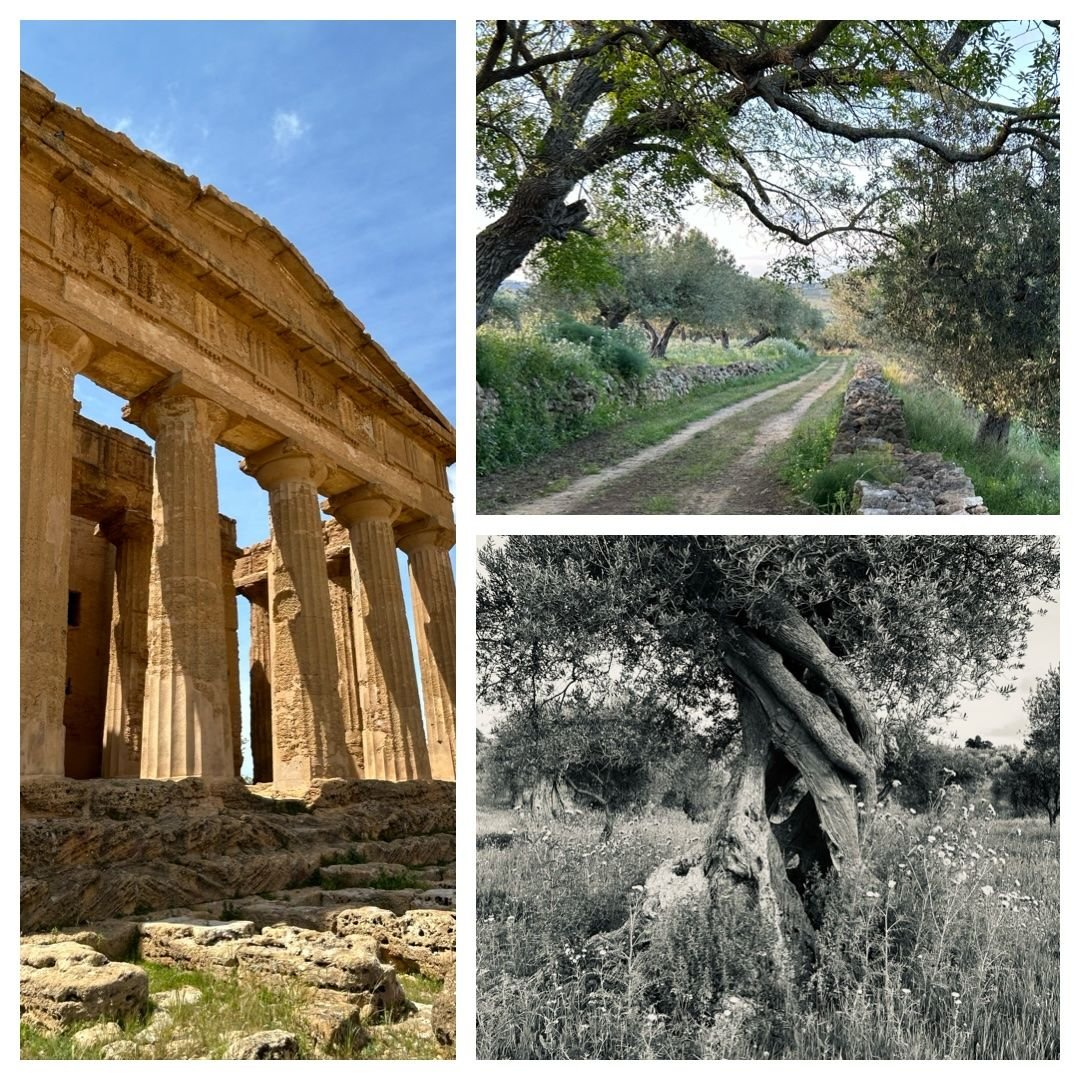
Agrigento and Fattoria a Mose
HISTORY DETOUR: little bit about Agrigento: First it was called Akragas and it was founded in 580 BCE. They claimed Daedalus as its founder, but in fact it was probably a group of Rhodian and Cretan colonists from the city of Gela. It was one of the most powerful and wealthy cities in Sicily, known for its cultural and economic success—and they wanted more (the story of Sicily). The neighbors were not thrilled with this idea and conflicts soon arose as Akragas took control of the salt pans, sulfuric mines, and other resources. Then in 406 BCE, the Carthaginians laid siege for about 8 months. The Akragas citizens were hoping for a convoy of supplies to arrive from Greece, but it was intercepted by the Carthaginians, and the people faced starvation. Everyone who could fled the city, leaving the old and infirm behind who were all massacred by the Carthaginians. Today you can even see the burn marks on one of the temples from the fires set during the Carthage invasion.
Following Rick Steves' advice, we started with the archaeological museum, exploring Early and Late Bronze Age artifacts from sites near Agrigento, including numerous vases and finds from the temple of Zeus (including a Telamon). This is a remarkable collection considering that looting of the site has been an issue since the Carthaginians first raided it in 406 BCE, and later the Romans pillaged it during the Punic Wars. The Christians didn't loot as much as they dismantled, egged on by Theodosius in 391 CE, and also recycled material for other buildings. Then there are the international smuggling rings of looters who have been selling artifacts to collectors. So much has been lost, and ironically, it's often the looters finding new sites to dig. There are numerous vases—I kind of zipped through that section, but my husband examined every single one.Back to the tour: After the museum, we enjoyed a quick espresso at the café and then drove to the lower parking lot. We paid the $3.00 taxi fare to bring us up to the top of the archaeological park, allowing us to walk downhill through the site. Spring is definitely much cooler than summer for exploring this shadeless area, and it's less crowded too. Either season, walking down is easier than climbing up! The city had 300,000 residents during its heyday and was incredibly wealthy. You can see it by of course the temples but also the wide main street. The horses of the city's aristocrats were well-known througout Magna Graecia, as they almost always won at the Olympic games.
We decided to try to grab lunch in modern Agrigento after walking the memorable archaeological site. I cannot say I was impressed. The city gave off a depressed vibe. First, there were the drug addicts that followed me when I was looking for the machine to buy a parking ticket (the parking app did not work here!); then we went to the recommended pastry shop where the reception was less than warm, so we moved on. Many stores were closed for midday, and we noticed numerous empty storefronts. Finally, we decided to step off the dreary main drag and take a side street back to the car. Mistake. We got sort of trapped in these back alleyways where the buildings were either abandoned with squatters in some, or else were filled to the top floors with trash like giant stone or tufa waste baskets: old mattresses, garbage bags, appliances, beer bottles, chairs sticking out of third floor windows etc. The mafia felt very much alive in Agrigento, complete with two guys who were still sitting in their car when we finally got back to ours. Honestly, I hate to turn business away, but I saw nothing to love about this city—and feel the Mafia has cast a shadow creating economic underdevelopment whether from extortion that stifles small businesses (obvious from the empty storefronts) or from the misallocation of public funds which explains the trash-filled empty buildings and random trash dumps we saw off the highway. If you were opening a business as an artisan or a restaurant, would you open here? The city felt like it is dying. I hope others can offer a better experience than we had.
Side Note: The Mafia's origins can be traced to the 19th century during Italy's unification. It evolved from small private armies (mafie) originally hired by absentee landlords to protect their estates in the lawless conditions that prevailed across Sicily. Research shows that the Mafia has significantly contributed to Sicily's economic underdevelopment through its impact on local governance, public services, and political competition. The mayor of Agrigento recently banned the sale of Mafia-themed souvenirs in an effort to avoid negative stereotypes of the Italian island. (FYI I am Italian American so please don't take offense at this observation).
Relieved to escape the city's atmosphere (we are from Brooklyn and have a high tolerance!) we returned to our lovely agriturismo for a dinner of swordfish and salad accompanied by delicious local wine and homemade chocolates. The evening had more lively conversation about the day the painters spent at Agrigento studying the wildflowers in the garden there. And then we walked the grounds again enjoying the beautiful evening in the olive grove.Next up Siracusa but with a stop at Roman Villa of Casale.
Agrigento and Fattoria a Mose
Apr 19th, 2025 | 02:25 PM
#13
Joined: Apr 2010
Posts: 1,861
Likes: 0
The Valley of the Temples is indeed a magnificent sight, though we didn’t have a car and the bus dropped us off st the bottom. But we went just as they opened and luckily it wasn’t too hot, so we did quite well. Unfortunately we couldn’t find the correct bus stop on the return, then had to wait almost an hour for the bus.
We got back to Agrigento past 2pm and found a restaurant on the main road, at the far end, going up. One of the few which was still open and we had quite a good meal. An absolutely delicious burrata salad and fresh pasta in a pistachio pesto. All washed down with a crisp white 😉
We stopped to pick up some pastries, but they were rather dry and not particularly tasty. Most of the shops were closed, so we just walked back to our B&B for some down time.
Many people speak of the homeless on the streets, we saw a few, but not in any large numbers. The town was mostly deserted, even later in the evening when we walked to a small church nearby. A couple of families with children playing in the square, that’s all.
We got back to Agrigento past 2pm and found a restaurant on the main road, at the far end, going up. One of the few which was still open and we had quite a good meal. An absolutely delicious burrata salad and fresh pasta in a pistachio pesto. All washed down with a crisp white 😉
We stopped to pick up some pastries, but they were rather dry and not particularly tasty. Most of the shops were closed, so we just walked back to our B&B for some down time.
Many people speak of the homeless on the streets, we saw a few, but not in any large numbers. The town was mostly deserted, even later in the evening when we walked to a small church nearby. A couple of families with children playing in the square, that’s all.
Apr 20th, 2025 | 08:24 AM
#14
Original Poster
Joined: Feb 2016
Posts: 388
Likes: 0
Final 3 Days
The drive into Ortigia is a bit stressful with numerous roundabouts and heavy traffic. Pay close attention to navigation. Upon arrival, we used the large covered public parking lot (the one covered in graffiti) but felt safe. We again used the Parking App, (Parking is t €15/day).
The city was founded in 734 BCE when Archia sailed from Corinth, landed in Ortigia, and kicked out the locals. Syracuse quickly became a Mediterranean powerhouse, defeating everyone from Carthaginians to Etruscans to Athenians in epic naval battles (again lots of conflict in Sicily's history). By the 4th century BCE, Syracuse was Europe's most powerful city with over a million inhabitants and controlled all of Sicily and parts of mainland Italy. The place became such a cultural hotspot that it attracted people like Plato and Aeschylus who all were hung out for a bit. And of course Archimedes was from there. He was was killed by a Roman soldier even though the orders were he should not be harmed.
After some ups and downs, Syracuse eventually met their match by clashing with the Roman Empire. Despite a heroic defense (featuring Archimedes and his war machines), the Romans won in 212 BCE. Even under Roman rule, Syracuse remained Sicily's capital and later became the capital of the entire Byzantine Empire for a few years in the 7th century. The city changed hands many times over the centuries — Arabs, Normans, Pisans, and Genoese all controlled this strategic port at various points. Walking around you will see these layers of history in the architecture.
Our AirBnB on Via Dion in Ortigia had a beautiful roof deck and was quiet and comfortable . I cannot say our AirBnB host offered many dining suggestions, so we winged it and ended up at a local trattoria where we lucked out with a very good dinner at Sicilia in Tavola. The stuffed sardines, gnocchi, and pasta with clams were all excellent. If you want to eat inside, make a reservation.
The next day our plan was to visit the Vendicari Reservefor a hike. We arrived mid-morning to find at least eight buses filled with high school students. We couldn't drive in because, as the mother of two, I forgot that languid teen walk and complete obliviousness so our car could not proceed. We backed up and regrouped. We knew from reading that the reserve is quite large with multiple entrances, so the trick was finding an alternative way in. After driving around and venturing down what seemed like someone's driveway that continued to get narrower and narrower. When we finally spotted a sign for the reserve, we saw there was not a parking area, which left us questioning whether to go in. We tucked our small car far off as far to the side of the road and entered. After walking a ways, we came to a locked gate with no explanation for the closure. The access was completely fenced off, but we noticed that previous visitors had lifted some of the fencing and shimmied underneath. Following their lead, I threw my backpack over and crawled through.
It was a great walk, although some trails seemed to vanish without warning. We didn't know much about this remote part of the preserve, but soon found a sign for "Cittadella dei Maccari," where an abandoned Byzantine church stood. To reach the church ruins, we walked through a field of yellow wildflowers before entering this fairly well-preserved site. Like all churches of that era, it features a square layout with three apses, a dome top, and an opening to the east so that, as tradition dictated, the moon's light could enter the building to signal the beginning of Holy Easter. A short distance away, we saw several catacombs dating from the same period, around the 6th century CE, along with the remains of Byzantine houses, showing that this was once a densely populated area. There were also quarries nearby, which I later learned were used much early by Greek colonists who extracted stone material for the construction of Eloro, an ancient Greek settlement in the area.
I was eager to see the beach and we found an ancient (what I later read) Greek road that led down to it. When we finally got to the beach, we found it was fenced off due to nesting turtles. Maybe this is why this large area of the preserve was totally closed off? Didn’t really make sense since other parts of the beach were open, but we decided to leave at that point.
From there, we decided to explore one of Sicily's beautiful Baroque towns, Noto. For me, I say no to Noto. Is it beautiful? Absolutely! The honey-colored stone buildings overlook the Asinaro valley. But once you see the beautiful architecture, I just wasn't sure why we were there. I am not one to climb up bell towers but I am sure others would enjoy it. Add to that, we were at an impasse - I didn't want to eat at what felt like tourist trap restaurants, so I got a gelato while my husband languished with low blood sugar and stubbornly refused to eat. I am glad we had gone to the market in Ortigia that morning. Loved that market. It felt very authentic and the pistachios propped him up as well as the oranges and very sweet cookies.
That night we experienced the only mediocre meal of our trip at Trattoria O‘ Scina . I felt like I was at a retirement home--there was no diversity of age. It seemed to be a favorite among British tourists and had good Trip Advisor reviews. The stuffed swordfish arrived in a huge portion, and while the tuna with pistachio crust was good, it too was American portion big. The Sicilian salad, however, was very good. I never imagined seafood could feel so heavy; I left feeling as though I'd eaten at a Texan steakhouse.
The next morning, we popped by the market again and then walked around Ortigia. We visited the Duomo and then went to see the Caravaggio but found only a poor reproduction printed on canvas (the type you might pick up at Target), which oddly enough, people were snapping away on their phones. We popped over to the ceramic shop,Ceramiche Artigianali Dolu, but we wanted espresso cups and she was sold out. I highly recommend this small shop regardless. We did purchase authentic Sicilian-style chocolate later made without milk. The packaging has great graphics and makes for good authentic gifts. Walked around the alleys and explored and time for lunch. We ended up at Cod da Saretta, Merluzzo Fritto This was one of my three favorite meals in Sicily. VERY casual and on a side street. Great Sicilian salad and grilled sea bream, good wine. So much better than the place the night before. Pisolino time.
That evening, we headed back to the main entrance of the Vendicari Reserve—and no school buses in sight! We enjoyed beautiful walks along well-maintained paths with beach access. The birding was excellent; we spotted flamingos, a spoonbill, and many small songbirds. The trails were really beautiful and thankfully easy to navigate. For dinner, tired of formal restaurant meals, we simply went to Evoe Enoteca and enjoyed a cutting board of cured meats, cheese, and very good wine.
Now our trip comes to an end. We were up early and off to Catania to fly home, first to Rome and then transferring to our ITA Airways flight. Unfortunately, the return flight wasn't as good as our outbound journey. First, we were delayed for an hour (frustrating because the ITA gate area lacked the food options available elsewhere in the airport). When we finally boarded, the first thing I noticed was the liberal use of duct tape holding things together. I suddenly felt that maybe Boeing wasn't so bad after all! My entertainment controls were taped in place, and some overhead bins were completely taped shut. After takeoff, we discovered my husband's audio was broken, so no movies for him during the long flight. We were seated near the restrooms as we had the emergency exit seats. For some reason this was a flight of people with overactive bladders. The bathrooms were a revolving door. The problem was, for some reason, nobody remembered or knew how to close the doors after. Not sure why emergency exit doors cost more... yes you get more space but you also endure the bathroom, and have to be ready to help in an emergency. A mystery. But overall a smooth, flight home and this time they remembered to bring water around.

Mosaics Villa Romana del Casale

Ortigia

Vendicari, lunch, Ortigia
The city was founded in 734 BCE when Archia sailed from Corinth, landed in Ortigia, and kicked out the locals. Syracuse quickly became a Mediterranean powerhouse, defeating everyone from Carthaginians to Etruscans to Athenians in epic naval battles (again lots of conflict in Sicily's history). By the 4th century BCE, Syracuse was Europe's most powerful city with over a million inhabitants and controlled all of Sicily and parts of mainland Italy. The place became such a cultural hotspot that it attracted people like Plato and Aeschylus who all were hung out for a bit. And of course Archimedes was from there. He was was killed by a Roman soldier even though the orders were he should not be harmed.
After some ups and downs, Syracuse eventually met their match by clashing with the Roman Empire. Despite a heroic defense (featuring Archimedes and his war machines), the Romans won in 212 BCE. Even under Roman rule, Syracuse remained Sicily's capital and later became the capital of the entire Byzantine Empire for a few years in the 7th century. The city changed hands many times over the centuries — Arabs, Normans, Pisans, and Genoese all controlled this strategic port at various points. Walking around you will see these layers of history in the architecture.
Our AirBnB on Via Dion in Ortigia had a beautiful roof deck and was quiet and comfortable . I cannot say our AirBnB host offered many dining suggestions, so we winged it and ended up at a local trattoria where we lucked out with a very good dinner at Sicilia in Tavola. The stuffed sardines, gnocchi, and pasta with clams were all excellent. If you want to eat inside, make a reservation.
The next day our plan was to visit the Vendicari Reservefor a hike. We arrived mid-morning to find at least eight buses filled with high school students. We couldn't drive in because, as the mother of two, I forgot that languid teen walk and complete obliviousness so our car could not proceed. We backed up and regrouped. We knew from reading that the reserve is quite large with multiple entrances, so the trick was finding an alternative way in. After driving around and venturing down what seemed like someone's driveway that continued to get narrower and narrower. When we finally spotted a sign for the reserve, we saw there was not a parking area, which left us questioning whether to go in. We tucked our small car far off as far to the side of the road and entered. After walking a ways, we came to a locked gate with no explanation for the closure. The access was completely fenced off, but we noticed that previous visitors had lifted some of the fencing and shimmied underneath. Following their lead, I threw my backpack over and crawled through.
It was a great walk, although some trails seemed to vanish without warning. We didn't know much about this remote part of the preserve, but soon found a sign for "Cittadella dei Maccari," where an abandoned Byzantine church stood. To reach the church ruins, we walked through a field of yellow wildflowers before entering this fairly well-preserved site. Like all churches of that era, it features a square layout with three apses, a dome top, and an opening to the east so that, as tradition dictated, the moon's light could enter the building to signal the beginning of Holy Easter. A short distance away, we saw several catacombs dating from the same period, around the 6th century CE, along with the remains of Byzantine houses, showing that this was once a densely populated area. There were also quarries nearby, which I later learned were used much early by Greek colonists who extracted stone material for the construction of Eloro, an ancient Greek settlement in the area.
I was eager to see the beach and we found an ancient (what I later read) Greek road that led down to it. When we finally got to the beach, we found it was fenced off due to nesting turtles. Maybe this is why this large area of the preserve was totally closed off? Didn’t really make sense since other parts of the beach were open, but we decided to leave at that point.
From there, we decided to explore one of Sicily's beautiful Baroque towns, Noto. For me, I say no to Noto. Is it beautiful? Absolutely! The honey-colored stone buildings overlook the Asinaro valley. But once you see the beautiful architecture, I just wasn't sure why we were there. I am not one to climb up bell towers but I am sure others would enjoy it. Add to that, we were at an impasse - I didn't want to eat at what felt like tourist trap restaurants, so I got a gelato while my husband languished with low blood sugar and stubbornly refused to eat. I am glad we had gone to the market in Ortigia that morning. Loved that market. It felt very authentic and the pistachios propped him up as well as the oranges and very sweet cookies.
That night we experienced the only mediocre meal of our trip at Trattoria O‘ Scina . I felt like I was at a retirement home--there was no diversity of age. It seemed to be a favorite among British tourists and had good Trip Advisor reviews. The stuffed swordfish arrived in a huge portion, and while the tuna with pistachio crust was good, it too was American portion big. The Sicilian salad, however, was very good. I never imagined seafood could feel so heavy; I left feeling as though I'd eaten at a Texan steakhouse.
The next morning, we popped by the market again and then walked around Ortigia. We visited the Duomo and then went to see the Caravaggio but found only a poor reproduction printed on canvas (the type you might pick up at Target), which oddly enough, people were snapping away on their phones. We popped over to the ceramic shop,Ceramiche Artigianali Dolu, but we wanted espresso cups and she was sold out. I highly recommend this small shop regardless. We did purchase authentic Sicilian-style chocolate later made without milk. The packaging has great graphics and makes for good authentic gifts. Walked around the alleys and explored and time for lunch. We ended up at Cod da Saretta, Merluzzo Fritto This was one of my three favorite meals in Sicily. VERY casual and on a side street. Great Sicilian salad and grilled sea bream, good wine. So much better than the place the night before. Pisolino time.
That evening, we headed back to the main entrance of the Vendicari Reserve—and no school buses in sight! We enjoyed beautiful walks along well-maintained paths with beach access. The birding was excellent; we spotted flamingos, a spoonbill, and many small songbirds. The trails were really beautiful and thankfully easy to navigate. For dinner, tired of formal restaurant meals, we simply went to Evoe Enoteca and enjoyed a cutting board of cured meats, cheese, and very good wine.
Now our trip comes to an end. We were up early and off to Catania to fly home, first to Rome and then transferring to our ITA Airways flight. Unfortunately, the return flight wasn't as good as our outbound journey. First, we were delayed for an hour (frustrating because the ITA gate area lacked the food options available elsewhere in the airport). When we finally boarded, the first thing I noticed was the liberal use of duct tape holding things together. I suddenly felt that maybe Boeing wasn't so bad after all! My entertainment controls were taped in place, and some overhead bins were completely taped shut. After takeoff, we discovered my husband's audio was broken, so no movies for him during the long flight. We were seated near the restrooms as we had the emergency exit seats. For some reason this was a flight of people with overactive bladders. The bathrooms were a revolving door. The problem was, for some reason, nobody remembered or knew how to close the doors after. Not sure why emergency exit doors cost more... yes you get more space but you also endure the bathroom, and have to be ready to help in an emergency. A mystery. But overall a smooth, flight home and this time they remembered to bring water around.
Mosaics Villa Romana del Casale
Ortigia
Vendicari, lunch, Ortigia
Last edited by RubyTwins; Apr 20th, 2025 at 08:26 AM. Reason: added photos
Apr 25th, 2025 | 01:48 PM
#16
Original Poster
Joined: Feb 2016
Posts: 388
Likes: 0
Thank you for all who followed this rather long trip report. Hopefully you picked up a few restaurant tips!
Somehow I left off the Roman Villa of Casale, one of the best-preserved Roman villas from 4th century CE -- the late imperial age. Our luggage was locked up in the hatch again before we set out. Parking fills up very fast and so we had to park outside and walk in.The Greeks originally chose building sites along easily defendable coasts with safe ports for trading and fertile land for crops. Rome, seeing the value of these settlements, wanted in and soon conquered the areaa making Sicily their first province. At this time, slaves made up the majority of the population in Sicily, most likely also the North African artisans who created the villa's stunning mosaics were slaves.
These massive Roman villas weren't just homes but centers of political and administrative power. The elite preferred conducting affairs from their private homes at this time, constructing large reception and banquet halls that took on an official character. Even a public bathroom for visitors when they arrive! The Villa has approximately 3,500 square meters of elaborate floor mosaics that both honor the property owner and complement each room's function. Odd that the villa's grandest space—the great basilica—doesn't have a mosaic floor but instead was paved with marble slabs. I guess marble, not the artistic mosaic, was more prestigious in the Roman world.
I couldn't help wondering how many cities were sacked and people enslaved to create this home for just one person. The owner's identity remains unsolved, but some believe the Great Hunt scene may depict the owner supervising the capture of animals destined for Roman spectacles. This villa may have been built by Marcus Aurelis Maximinanus (Maximian), co-emperor with Diocletian as it was considered a very luxurious estate.
Back to the mosaics and the poor animals running for their lives. You can see fear and individual personality in each animal as they were chased down, loaded, and carted away—a tribute to the artistry of the mosaic artists. In fact, these are considered the greatest mosaics intact and in situ in the ancient Roman world. The villa was partially destroyed by the Normans and luckily for the mosaics, later almost completely covered by an avalanche of mud from Mount Mangone
FYI: Should have eaten at the café because food was hard to find once we left so we headed straight to Ortigia. It seems the food INSIDE the gates would have been better than the stands right outside. But we stupidly didn't grab anything to eat.
Now really the end of the report.
Somehow I left off the Roman Villa of Casale, one of the best-preserved Roman villas from 4th century CE -- the late imperial age. Our luggage was locked up in the hatch again before we set out. Parking fills up very fast and so we had to park outside and walk in.The Greeks originally chose building sites along easily defendable coasts with safe ports for trading and fertile land for crops. Rome, seeing the value of these settlements, wanted in and soon conquered the areaa making Sicily their first province. At this time, slaves made up the majority of the population in Sicily, most likely also the North African artisans who created the villa's stunning mosaics were slaves.
These massive Roman villas weren't just homes but centers of political and administrative power. The elite preferred conducting affairs from their private homes at this time, constructing large reception and banquet halls that took on an official character. Even a public bathroom for visitors when they arrive! The Villa has approximately 3,500 square meters of elaborate floor mosaics that both honor the property owner and complement each room's function. Odd that the villa's grandest space—the great basilica—doesn't have a mosaic floor but instead was paved with marble slabs. I guess marble, not the artistic mosaic, was more prestigious in the Roman world.
I couldn't help wondering how many cities were sacked and people enslaved to create this home for just one person. The owner's identity remains unsolved, but some believe the Great Hunt scene may depict the owner supervising the capture of animals destined for Roman spectacles. This villa may have been built by Marcus Aurelis Maximinanus (Maximian), co-emperor with Diocletian as it was considered a very luxurious estate.
Back to the mosaics and the poor animals running for their lives. You can see fear and individual personality in each animal as they were chased down, loaded, and carted away—a tribute to the artistry of the mosaic artists. In fact, these are considered the greatest mosaics intact and in situ in the ancient Roman world. The villa was partially destroyed by the Normans and luckily for the mosaics, later almost completely covered by an avalanche of mud from Mount Mangone
FYI: Should have eaten at the café because food was hard to find once we left so we headed straight to Ortigia. It seems the food INSIDE the gates would have been better than the stands right outside. But we stupidly didn't grab anything to eat.
Now really the end of the report.
Apr 25th, 2025 | 03:53 PM
#17
Joined: Mar 2003
Posts: 6,222
Likes: 0
RubyTwins, Just getting caught up with your TR. How lucky that you unexpectedly came across the abandoned Byzantine church and had to walk through a field of yellow wildflowers! I love travel surprises like this. And I love Byzantine churches. (Mystras, in Greece, is one of my highlights from our Greek trip.) Love the mosaics of the Roman Villa of Casale. We have tickets to see the mosaics in Ravenna in May. Can't wait!
Your flight home sounds awful! Duct tape!!! Oh my!
I really hope we can make it to Sicily sometime soon. I know we would love it. How many nights were you in Sicily? And what month?
Your flight home sounds awful! Duct tape!!! Oh my!
I really hope we can make it to Sicily sometime soon. I know we would love it. How many nights were you in Sicily? And what month?
Last edited by KarenWoo; Apr 25th, 2025 at 03:57 PM.
Apr 26th, 2025 | 09:33 AM
#19
Original Poster
Joined: Feb 2016
Posts: 388
Likes: 0
I loved Mystras. Went when our sons were I think 10 or so. My sister said the mosaics in Ravenna are amazing.
I really loved the ones in Monreale because they almost seemed like a graphic novel... especially the genesis cycle. If there had been a book with good reproductions I would have bought it. Enjoy your trip next month
I really loved the ones in Monreale because they almost seemed like a graphic novel... especially the genesis cycle. If there had been a book with good reproductions I would have bought it. Enjoy your trip next month
Apr 26th, 2025 | 10:04 PM
#20
Joined: Feb 2003
Posts: 3,893
Likes: 0
Currently in Ortegia at Ortea Palace hotel. Recovering from 27 hours of traveling SFO-LHR-FRA-CTA- bus-Uber. Hotel in perfect location next to top of Ortegia. Upgraded suite with upstairs bedroom. Pleasant breakfast. Off to Etna today

