


Some hints and explanations on the Spanish/Basque way of life, before you come
 Dec 8th, 2024 | 01:22 AM
#1
Original Poster

Joined: Nov 2004
Posts: 1,830
Likes: 0
Some hints and explanations on the Spanish/Basque way of life, before you come
After over 20 years of participating in this forum as a local Basque, I've been able to learn a lot about how foreign visitors experience Spain, considering that it's a very diverse country in terms of landscapes, languages, customs and traditions, meals, drinks, climate...quite heterogeneous, indeed! And so, it may be some times complicated to understand and manage.
I've gathered a few hints about Spain ( I live in Bilbao, Basque Country, so many of my comments may apply just for this area) that may help some of you when dealing with our way of life. I hope it does not sound patronizing, it's just aimed at giving some explanations on our routines and why we do things the way we do, knowing of course that this is a very globalized world and differences among nations are less and less every day. But Spain is still a country where we love so socialize, to stay out until late and where life really starts around 8pm...
"Meals" will be the first part, starting with Breakfast and Aperitivo.
I've gathered a few hints about Spain ( I live in Bilbao, Basque Country, so many of my comments may apply just for this area) that may help some of you when dealing with our way of life. I hope it does not sound patronizing, it's just aimed at giving some explanations on our routines and why we do things the way we do, knowing of course that this is a very globalized world and differences among nations are less and less every day. But Spain is still a country where we love so socialize, to stay out until late and where life really starts around 8pm...
"Meals" will be the first part, starting with Breakfast and Aperitivo.
 Dec 8th, 2024 | 05:03 AM
#3
Original Poster
Joined: Nov 2004
Posts: 1,830
Likes: 0
Breakfast and Aperitivo.
I´ve always thought that you really become fully integrated in Spain when you get used to our meal times. Breakfast is similar to many other places, but in many parts of Spain we do stop around 11am (it´s called “amaiketako” in the Basque Country, “the eleven o´clock pause”) for coffee and a pintxo (or a tapa) in the nearest bar to our workplace. This pause is fully accepted and integrated in our working time and we normally do not take more than 20min. A classic pintxo for this stop would be a tortilla de patata (not to be mistaken with the Mexican or Central American tortillas, a whole different thing).
On Saturdays and Sundays, or festivities, we (all over Spain) like to have our “aperitivo” around 1pm. The “aperitivo”, also known as the “vermouth time”, is that time of the day when families and friends meet to enjoy a few drinks, tapas (or pintxos in the Basque Country and Navarre) while socializing in the bars in our streets and squares. You´ll see whole families meeting for a drink, including grandparents and kids and babies, meeting with friends and enjoying their wines (customarily, white in the morning --morning in Spain ends at lunch time--, red is more for the evening) and some “rabas” or “calamares”. Calamari, as most of you know them, are commonly called “rabas” in Navarre, La Rioja, Basque Country and Cantabria, and we ONLY have them during the aperitivo (bars actually only serve them during this time of the day and most only on weekends). Never for dinner (like paella, which is only for lunch…but that´ll come later), they are not a meal in many parts of Spain, just an appetizer to share with friends and family during the aperitivo.
A “vermú” is a classic drink for the aperitivo and it´s very popular, mainly in its red version. Also, small glasses of beer (known as “zuritos” in the Basque Country) or txakoli or any other white wine. Cokes or sodas are more expensive than wine where I live and they are not very popular with meals or during the aperitivo. It´s a lovely time of the day just before going for one of those very looooong weekend lunches we like so much, starting around 3pm and finishing after a long “sobremesa” two or three hours later…
(Lunch to follow)
I´ve always thought that you really become fully integrated in Spain when you get used to our meal times. Breakfast is similar to many other places, but in many parts of Spain we do stop around 11am (it´s called “amaiketako” in the Basque Country, “the eleven o´clock pause”) for coffee and a pintxo (or a tapa) in the nearest bar to our workplace. This pause is fully accepted and integrated in our working time and we normally do not take more than 20min. A classic pintxo for this stop would be a tortilla de patata (not to be mistaken with the Mexican or Central American tortillas, a whole different thing).
On Saturdays and Sundays, or festivities, we (all over Spain) like to have our “aperitivo” around 1pm. The “aperitivo”, also known as the “vermouth time”, is that time of the day when families and friends meet to enjoy a few drinks, tapas (or pintxos in the Basque Country and Navarre) while socializing in the bars in our streets and squares. You´ll see whole families meeting for a drink, including grandparents and kids and babies, meeting with friends and enjoying their wines (customarily, white in the morning --morning in Spain ends at lunch time--, red is more for the evening) and some “rabas” or “calamares”. Calamari, as most of you know them, are commonly called “rabas” in Navarre, La Rioja, Basque Country and Cantabria, and we ONLY have them during the aperitivo (bars actually only serve them during this time of the day and most only on weekends). Never for dinner (like paella, which is only for lunch…but that´ll come later), they are not a meal in many parts of Spain, just an appetizer to share with friends and family during the aperitivo.
A “vermú” is a classic drink for the aperitivo and it´s very popular, mainly in its red version. Also, small glasses of beer (known as “zuritos” in the Basque Country) or txakoli or any other white wine. Cokes or sodas are more expensive than wine where I live and they are not very popular with meals or during the aperitivo. It´s a lovely time of the day just before going for one of those very looooong weekend lunches we like so much, starting around 3pm and finishing after a long “sobremesa” two or three hours later…
(Lunch to follow)
Last edited by mikelg; Dec 8th, 2024 at 05:08 AM.
Dec 8th, 2024 | 09:51 AM
#5
Original Poster
Joined: Nov 2004
Posts: 1,830
Likes: 0
To be honest, I´ve never seen a vermú included on a fixed price menu, but I´d think it´d be a "vermouth" as the Italian or Catalan drink, that is, red or white wine, macerated in herbs, and if it´s "preparado" it will have the bar´s own mix. It´s not the classic "vermouth" as in the US (mostly based on gin), as you probably already know.
For the aperitivo, we like to have our vermú while standing in the bar, and maybe with a pintxo or a small bit in the other hand, but rarely seated.
For the aperitivo, we like to have our vermú while standing in the bar, and maybe with a pintxo or a small bit in the other hand, but rarely seated.
Last edited by mikelg; Dec 8th, 2024 at 10:01 AM.
Dec 8th, 2024 | 12:47 PM
#6

Joined: Aug 2007
Posts: 16,297
Likes: 0
It took many visits to Madrid before I learned the difference between comida and almuerzo 🙂 .
Thx for the interesting information.
I had a similar Sunday experience in a bar in Zaragoza ( Aragon).
I don’t remember what the patrons were drinking, everyone was so friendly to a solo foreigner.
Thx for the interesting information.
I had a similar Sunday experience in a bar in Zaragoza ( Aragon).
I don’t remember what the patrons were drinking, everyone was so friendly to a solo foreigner.
Trending Topics
 Dec 9th, 2024 | 05:28 AM
#9
Original Poster
Joined: Nov 2004
Posts: 1,830
Likes: 0
Lunch
Lunch is practically everywhere in Spain the most important meal of the day, not dinner. We may start lunch around 0130pm (early) and 0230 or even 3pm (this time is more common on weekends). On weekdays, it always consists of a first (soup, salad, stew…), a second (fish or meat, normally) and a dessert (in many households, it´s fruit or a yoghourt). In many homes, having lunch with a glass or two of wine is still customary and nothing extraordinary. We love to cook and spend time thinking our lunches for the week, if we have it at home. If we have lunch out, the best option is the “menú del día” (Mo-Fri, lunch only), for around 15 to 20eur per person you can have a homemade style lunch like described above, including half a bottle of wine per person (this is the standard in the Basque Country, at least), water and bread. Bread (fresh and crusty) is always included, and we do not dip it in soups or stews (like I´ve seen so many visitors doing), but use it as a “pusher” into the spoon or fork, and then to “clean” the plate after finishing our meal.
On weekends, lunches tend to be later and longer, even for hours, as we include the “sobremesa”. I have not found a translation for this word, that means “the time after lunch when people have their coffees and drinks while talking and socializing, at the lunch table”. We love to stay sitting at the table for a long time after lunch is over. Restaurants normally respect this and it´s the time when they offer their “orujos” (our local grappa), long drinks, coffees…your table is yours until you decide to leave.
Dinner is normally much lighter than lunch. Schedules are rapidly changing, due to the massive influence of tourism, and in many cities, you can have dinner as early as 8pm…but very few locals would dine that early. Our standard dinner time (when we go out on weekends) is rarely before 0930pm, and in many towns people will not go for dinner before 10pm. Again, it´s smaller than lunch and at our homes it may consist of just a soup, or a small fish, or a salad, or a French omelette, or a platter of cheese and ham, with some fruit.
Sunday evening and Monday full day are the days when bars and restaurants tend to close for their weekly rest, but not in the big cities, where you will still have many choices.
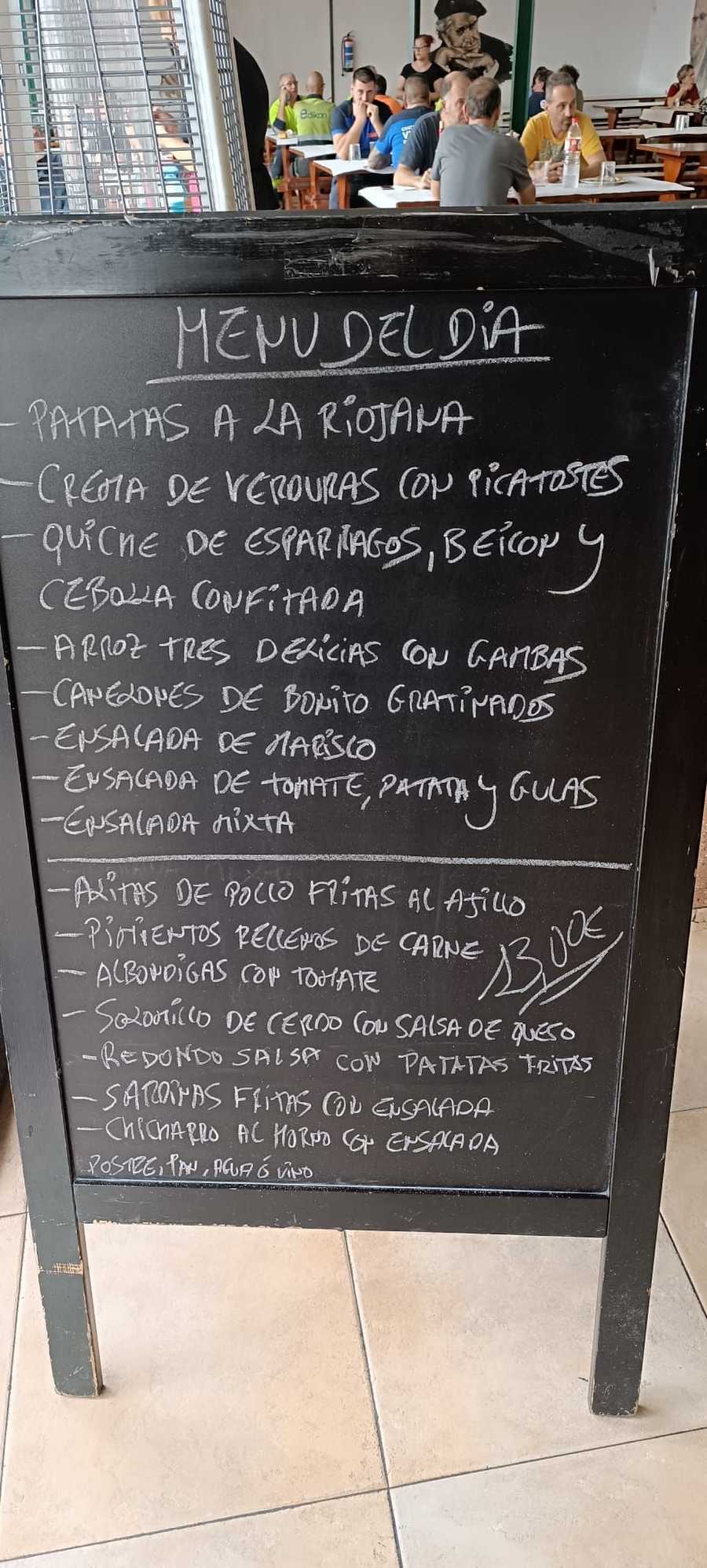
An example of a daily menu near Bilbao, Mo-Fri lunch only.
Lunch is practically everywhere in Spain the most important meal of the day, not dinner. We may start lunch around 0130pm (early) and 0230 or even 3pm (this time is more common on weekends). On weekdays, it always consists of a first (soup, salad, stew…), a second (fish or meat, normally) and a dessert (in many households, it´s fruit or a yoghourt). In many homes, having lunch with a glass or two of wine is still customary and nothing extraordinary. We love to cook and spend time thinking our lunches for the week, if we have it at home. If we have lunch out, the best option is the “menú del día” (Mo-Fri, lunch only), for around 15 to 20eur per person you can have a homemade style lunch like described above, including half a bottle of wine per person (this is the standard in the Basque Country, at least), water and bread. Bread (fresh and crusty) is always included, and we do not dip it in soups or stews (like I´ve seen so many visitors doing), but use it as a “pusher” into the spoon or fork, and then to “clean” the plate after finishing our meal.
On weekends, lunches tend to be later and longer, even for hours, as we include the “sobremesa”. I have not found a translation for this word, that means “the time after lunch when people have their coffees and drinks while talking and socializing, at the lunch table”. We love to stay sitting at the table for a long time after lunch is over. Restaurants normally respect this and it´s the time when they offer their “orujos” (our local grappa), long drinks, coffees…your table is yours until you decide to leave.
Dinner is normally much lighter than lunch. Schedules are rapidly changing, due to the massive influence of tourism, and in many cities, you can have dinner as early as 8pm…but very few locals would dine that early. Our standard dinner time (when we go out on weekends) is rarely before 0930pm, and in many towns people will not go for dinner before 10pm. Again, it´s smaller than lunch and at our homes it may consist of just a soup, or a small fish, or a salad, or a French omelette, or a platter of cheese and ham, with some fruit.
Sunday evening and Monday full day are the days when bars and restaurants tend to close for their weekly rest, but not in the big cities, where you will still have many choices.
An example of a daily menu near Bilbao, Mo-Fri lunch only.
Dec 9th, 2024 | 10:43 AM
#11
Joined: Jan 2009
Posts: 2,282
Likes: 0
I really appreciate this topic of information so thanks.
What do families do for the evening meal when kids would normally go to sleep earlier than adults? Do the family all eat together? I remember when we had kids that the evening meal shifted to an earlier time.
Has there been an impact on the traditional leisurely lunches from businesses being open during the afternoon or people working further from home?
What do families do for the evening meal when kids would normally go to sleep earlier than adults? Do the family all eat together? I remember when we had kids that the evening meal shifted to an earlier time.
Has there been an impact on the traditional leisurely lunches from businesses being open during the afternoon or people working further from home?
Dec 9th, 2024 | 12:38 PM
#12

Joined: May 2005
Posts: 25,364
Likes: 0
After you answer Danon's good questions, I have one:
If you go for dinner at 10pm, I imagine you do not get home until midnight or so, even if it is a light dinner, you still have to factor in the time it takes to take bus or drive home.
What time do most working people have to be at the office in the morning?
I always wonder about that, when I see the streets in Madrid and other cities packed, even on weekdays, at 20:00-22:00. And these are not only young persons.
Do you all get by on less sleep than in the US, for example?
If you go for dinner at 10pm, I imagine you do not get home until midnight or so, even if it is a light dinner, you still have to factor in the time it takes to take bus or drive home.
What time do most working people have to be at the office in the morning?
I always wonder about that, when I see the streets in Madrid and other cities packed, even on weekdays, at 20:00-22:00. And these are not only young persons.
Do you all get by on less sleep than in the US, for example?
Dec 9th, 2024 | 09:43 PM
#13
Original Poster
Joined: Nov 2004
Posts: 1,830
Likes: 0
You are right, Revulgo, you choose one from the list, one for the starter and another one for the main. Dreamon, kids in Spain go to bed much later than in the US. When we watch a US series and see that 10 year olds go to bed around 7 or 8pm it´s really shocking for us, a normal bedtime for kids that age in Spain would be around 0930-10pm. Long lunches are for weekends, during weekdays it´s a shorter lunch, around one hour more or less. Restaurants will welcome you for lunch until 0330 or maybe 4pm, but you can stay as long as you want in most places. Ekscrunchy, we normally dine at home during weekdays, on weekends we do not care much about time to wake up next morning. But yes, Spanish sleep less than in other countries (although I´ve seen lots of US persons that wake up at 5am...that´s not a normal time for us  !)
!)
!)
Dec 10th, 2024 | 03:41 AM
#14
Original Poster
Joined: Nov 2004
Posts: 1,830
Likes: 0
Coffee
There are three basic types of coffee in Spain: Solo (black coffee, in a small cup, approximately double size of an Italian espresso); Cortado, which is a shorter solo with a touch of milk, in a small cup; and Café con Leche, 50% coffee, 50% milk. Then there are many regional varieties depending on the region, Andalusia is king on this matter and you may need a guidebook to understand all their types of coffee...I must admit I´m lost when I go there and ask for a "normal" coffee. Espresso is an Italian thing and should not be mistaken with a "solo", which is a Spanish thing. There are Starbucks in most big cities, but I cannot call that "coffee". In Spain we love coffees ready-made coming from Italian coffee machines, we do not have those filtered coffees standing hours on a hot plate, quite tasteless for us. It´s rare to find someone having a coffee to go on a paper cup on the street, coffee is mainly social and "to have a coffee" means to sit down with someone for a chit-chat, in a bar or cafeteria.
The coffee bean most used for coffee in Spain is the "Arábica", mainly coming from Central and South America, quite aromating and of strong flavor.
Soy, almond milk (although legally you cannot call it "milk" in Europe), or lactose-free milk are widely available nowadays, as is decaf. A café "americano" is a solo with double water. A "carajillo" is a solo coffee with a touch of brandy on it, quite popular a few years ago. An ice coffee will be a solo, served separately, and then a small glass with one or two ice cubes on it, ready-made too.
We love coffee for the "sobremesa", that long time at the lunch or dinner table, when we talk and talk about how to solve the world issues and time does not matter.

There are three basic types of coffee in Spain: Solo (black coffee, in a small cup, approximately double size of an Italian espresso); Cortado, which is a shorter solo with a touch of milk, in a small cup; and Café con Leche, 50% coffee, 50% milk. Then there are many regional varieties depending on the region, Andalusia is king on this matter and you may need a guidebook to understand all their types of coffee...I must admit I´m lost when I go there and ask for a "normal" coffee. Espresso is an Italian thing and should not be mistaken with a "solo", which is a Spanish thing. There are Starbucks in most big cities, but I cannot call that "coffee". In Spain we love coffees ready-made coming from Italian coffee machines, we do not have those filtered coffees standing hours on a hot plate, quite tasteless for us. It´s rare to find someone having a coffee to go on a paper cup on the street, coffee is mainly social and "to have a coffee" means to sit down with someone for a chit-chat, in a bar or cafeteria.
The coffee bean most used for coffee in Spain is the "Arábica", mainly coming from Central and South America, quite aromating and of strong flavor.
Soy, almond milk (although legally you cannot call it "milk" in Europe), or lactose-free milk are widely available nowadays, as is decaf. A café "americano" is a solo with double water. A "carajillo" is a solo coffee with a touch of brandy on it, quite popular a few years ago. An ice coffee will be a solo, served separately, and then a small glass with one or two ice cubes on it, ready-made too.
We love coffee for the "sobremesa", that long time at the lunch or dinner table, when we talk and talk about how to solve the world issues and time does not matter.
Dec 10th, 2024 | 12:16 PM
#16
Joined: Jan 2003
Posts: 3,266
Likes: 0
Thank you for this, Mikel! You took my parents and I on a food and culture walking tour in Bilbao about 7 years ago; next Spring, my husband and I will get to introduce our (adult) daughter to the Spanish Basque country. I'll send this to her!
Dec 10th, 2024 | 03:36 PM
#17
Joined: Aug 2007
Posts: 3,641
Likes: 17
Probably would have a better one at one of the Mexican/Moroccan/Pizza/ Indian/Tapas restaurants on the boardwalk.

 Dec 13th, 2024 | 02:10 AM
#20
Original Poster
Joined: Nov 2004
Posts: 1,830
Likes: 0
Dinner
In Spain, as previously mentioned, it´s lunch what normally matters and dinner is usually much less important. On weekdays (Mo-Thu), we normally cook dinner at home, and it is around 0930 or 10pm in many homes. It may consist of a soup plus an omelette, or a salad, or something light and not too big. Bedtime will be somewhere between 1130 and 1230 (we do not sleep much, that´s true) and the main TV shows rarely end before midnight (even those for kids, like Masterchef or any of those singing shows).
It´s quite different on weekends. Dinner reservations at a restaurant are normally around 10pm, and it´s bigger than the one on weekdays. We meet with our family or friends at 8pm, more or less, for pintxos (or tapas) bar hopping before going for dinner. With the massive arrival of tourism, the most visited cities will offer dinner as early as 8pm, but it´s basically just for visitors who are used to other schedules, as locals will arrive much later.
After dinner, it´s very customary to “continue the night” and go out until 2 or 3am, even later, depending on age.
In Spain, as previously mentioned, it´s lunch what normally matters and dinner is usually much less important. On weekdays (Mo-Thu), we normally cook dinner at home, and it is around 0930 or 10pm in many homes. It may consist of a soup plus an omelette, or a salad, or something light and not too big. Bedtime will be somewhere between 1130 and 1230 (we do not sleep much, that´s true) and the main TV shows rarely end before midnight (even those for kids, like Masterchef or any of those singing shows).
It´s quite different on weekends. Dinner reservations at a restaurant are normally around 10pm, and it´s bigger than the one on weekdays. We meet with our family or friends at 8pm, more or less, for pintxos (or tapas) bar hopping before going for dinner. With the massive arrival of tourism, the most visited cities will offer dinner as early as 8pm, but it´s basically just for visitors who are used to other schedules, as locals will arrive much later.
After dinner, it´s very customary to “continue the night” and go out until 2 or 3am, even later, depending on age.

