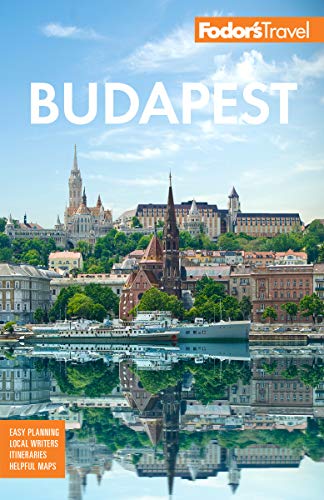
Várhegy (Castle Hill): Literally and figuratively, you can't miss Castle Hill: a UNESCO-designated neighborhood that boasts narrow cobbled streets and some of the city's most stunning sites. Its crowning glories are the Royal Palace and ornate Matthias Church. Both were originally built in the 13th century -- "originally" being the operative word. Though Castle Hill seems serene now, it has been the site of 30 devastating sieges: most recently, in the winter of 1944-45, when the Nazi's took their last stand here. As a result, buildings are more a product of architectural reconstruction than preservation per se. But they are stunning nonetheless.
Elsewhere in Buda: The area south of Várhegy has a handful of historic attractions -- like the Citadella and Liberation Monument. To the north lies the 16th-century tomb of Gül Baba; and to the west is Szobor, the Soviet statue park. However, some of the most memorable sites in this neck of the woods are the natural ones: specifically, Buda's verdant rolling hills. Visitors can hike around them; sigh over the views granted by them; and tour the labyrinthine caves that wind beneath them. Thanks to the Gellért, Rudas, Rác, and Király baths (all of which are located here), you can also soak in the thermal waters that bubble up through them.
Downtown Pest & the Small Ring Road: Hungary's Parliament, a neo-Gothic structure top heavy with ornamental stonework, visually dominates this part of town. The neighborhood around it serves as the nation's administrative nerve center. But the tone changes farther south, where the sacred and the secular collide. St. Stephen's opulent basilica is here; as are Budapest's oldest sanctuary (the 12th-century Inner City Parish Church) and Europe's largest synagogue (the 3,000-seat Nagy Zsinagóga). Yet even devout souls might be distracted by Budapest's most famous and unabashedly touristy shopping street, Váci utca, which runs from Vörösmarty tér right down to the Vásárcsarnok (Central Market).
Along Andrássy út: Starting near the basilica, Andrássy út extends over a mile, getting grander, greener, and less commercial the farther northeast it goes. Like much of Pest, the boulevard was constructed in the late 19th century, and its pedigree shows. Underneath it lies the continent's first metro line, opened in 1896, while above ground are scores of gorgeous fin de siécle buildings. Andrássy út ends with a bang at Hosök tere (Heroes' Square). Just behind it is City Park, which contains the Széchenyi Baths, the glorious Museum of Fine Arts, and the city's top children's sites.
Eastern Pest & the Large Ring Road: This area is understandably less touristed than other parts of Pest: after all, swathes of it have long been better known for seediness than sites. But this is changing due to a major urban revitalization effort. The Holocaust Memorial Center, for instance, opened here in 2004; while the new National Theater and adjacent Palace of Arts (home of the National Concert Hall, Festival Theatre, and Ludwig Contemporary Arts Museum) opened in 2002 and 2005, respectively. The renewal process makes older cultural gems -- like the Erkel (Budapest's "other" opera house) and the Vígszínház Theater -- ripe for rediscovery.
Óbuda & Margitsziget (Margaret Island): In 1873 Óbuda -- the area first settled by the ancient Romans -- was united with Buda and Pest to form the present-day city. Located on the Danube's west bank, upriver from the main sights, Óbuda today is a barrage of highways and concrete housing blocks. Yet the 2,000-year-old ruins of Aquincum stand as reminders of its more illustrious past. In the Danube, across from Óbuda, is Margaret Island. Anchored by bridges at both ends, this tranquil 250-acre parkland has gardens, paths, pools, an outdoor theatre, and two classic hotels.
Visit the Travel Talk forums for help on planning your trip