5 Best Sights in Cusco, Cusco and the Sacred Valley

Background Illustration for Sights

We've compiled the best of the best in Cusco - browse our top choices for the top things to see or do during your stay.

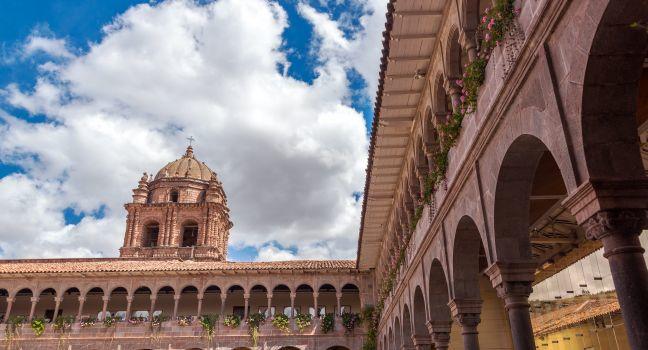
Qorikancha

Fodor's Choice
Courtyard and tower of the Santo Domingo church in Cuzco, Peru, also known as Qorikancha
Jess Kraft / Shutterstock

Built to honor the sun god, the empire’s most important deity, Qorikancha translates as "Court of Gold." Walls and altars were once plated with gold, and in the center of the complex sat a giant gold disc, positioned to reflect the sun and bathe the temple in light, while terraces were once filled with life-size gold-and-silver statues of plants and animals. Much of the wealth was removed to ransom the captive Inca ruler Atahualpa during the Spanish conquest. Eventually, the structure was passed on to the Dominicans, who constructed the church of Santo Domingo using stones from the temple and creating a jarring imperial-colonial architectural juxtaposition. An ingenious restoration lets you see how the church was built on and around the temple. In the Inca parts of the structure left exposed, estimated to be about 40% of the original temple, you can admire the mortarless masonry, earthquake-proof trapezoidal doorways, curved retaining wall, and exquisite carvings that exemplify the artistic and engineering skills of the Inca. The S/15 entrance allows you to visit the Monasterio de Santa Catalina and Qorikancha's ruins and church; a free prerecorded tour is available, but hire a guide to get the most out of the site.

Pampa del Castillo at Plazoleta Santo Domingo, Cusco, Peru
Sight Details
Ruins and church S/15; museum entrance via Boleto Turístico

Something incorrect in this review?

La Catedral

Plaza de Armas Fodor's Choice

Dominating the Plaza de Armas, the monumental Cathedral Basilica of the Assumption of the Virgin (or Cusco Cathedral) is one of Cusco's grandest buildings. Built in 1550 on the site of the palace of the Inca Wiracocha and using stones looted from the nearby Inca fortress of Sacsayhuamán, the cathedral is a perfect example of the imposition of the Catholic faith on the Indigenous population. The grander the building, went the theory, the more impressive (and seductive) the faith. With soaring ceilings, baroque carvings, enormous oil paintings, and glittering gold-and-silver altars, the cathedral certainly seemed to achieve its aim.

Today, Cusco's Catedral is one of the town's star attractions, noted mainly for its amazing collection of colonial art that mixes Christian and non-Christian imagery. Entering the Catedral from the Sagrada Familia chapel, head to your right to the first nave, where you'll find the famous oil painting (reputed to be the oldest in Cusco) depicting the earthquake that rocked the town in 1650. Among the depictions of burning houses and people fleeing, you'll see a procession in the plaza. Legend has it that during the earthquake, the citizens removed a statue of Jesus on the cross from the Catedral and paraded it around the plaza—halting the quake in its tracks. This statue, now known as the Señor de los Temblores, or Lord of the Earthquakes, is Cusco's patron, and you'll find him depicted in many Cusqueñan paintings.

To see the famous statue, head across the Catedral to the other side, where in the nave and to the right of the passage connecting the Catedral to the adjoining Iglesia del Triumfo, you'll find El Señor himself. The dark color of his skin is often claimed to be a representation of the Indigenous people of Cusco; actually, it's the effect of years of candle smoke on the native materials used in its fabrication.

Those interested in the crossover between Indigenous and Catholic iconography will find lots to look at. Figures of pumas, the Inca representation of Earth, are carved on the enormous main doors, and in the adjoining Iglesia del Triumfo you'll see an Andean Christ in one of the altars flanking the exit. No one should miss the spectacular painting of the Last Supper, by the Indigenous artist Marcos Zapata, where you'll see the diners tucking into a delicious feast of vizcacha (wild chinchilla) and chicha (a corn beverage).

The cathedral's centerpieces are its massive, solid-silver altar, and the enormous 1659 María Angola bell, the largest in South America, which hangs in one of the towers and can be heard from miles away. Behind the main altar is the original wooden altar primitivo dedicated to St. Paul. The 64-seat cedar choir has rows of carved saints, popes, and bishops, all in stunning detail down to their delicately articulated hands.

If you're interested in a more in-depth look, enlist the services of a guide—you'll find them right outside the Catedral. Agree on a price before you start; it will cost a minimum of S/30 per group. Alternatively, there is a free audio guide.

Cusco, Peru
084-254–285
Sight Details
S/40, combined admission with Templo de San Blas and Museo de Arte Religioso

Something incorrect in this review?

Mirador de San Blas

San Blas Fodor's Choice

Set seven blocks northeast of Plaza de Armas, this charming spot perched high within the cobblestoned pedestrian streets of hip San Blas is one of the best spots to observe Cusco from above—and try to make out its original puma shape. A great time to visit is at sunset, when the city starts turning on its lights and locals start packing the district's little bars and bistros.

Cl. Kiskapata at Cl. Pasñapakana 133, Cusco, Peru

Something incorrect in this review?

Recommended Fodor's Video

Museo de Arte Precolombino

Fodor's Choice

For a different perspective on pre-Columbian ceramics, head to this spectacular museum, known as MAP, where art and pre-Columbian culture merge seamlessly. Twelve rooms in the 1580 Casa Cabrera, which was used as the convent of Santa Clara until the 17th century, showcase an astounding collection of pre-Columbian art from the 13th to 16th centuries, mostly in the form of carvings, ceramics, and jewelry. The art and artifacts were made by the Huari and Nazca, as well as the Inca, cultures. The stylish displays have excellent labels in Spanish and English that place the artifacts in their artistic and historical context. On the walls is commentary from European artists on South American art. Swiss artist Paul Klee wrote: "I wish I was newly born, and totally ignorant of Europe, innocent of facts and fashions, to be almost primitive." Most Cusco museums close at dark, but MAP remains open every evening. For a break after a walk around, find your way to the on-site café, one of Cusco's best restaurants (reservations are required for dinner).

Plaza de la Nazarenas 231, Cusco, Peru
084-595–092
Sight Details
S/20

Something incorrect in this review?

Plaza de Armas

Plaza de Armas Fodor's Choice

With park benches, green lawns, and splendid views of the Catedral, Cusco's gorgeous colonial Plaza de Armas invites you to stay awhile. Take a seat on one of those park benches, and the world will come to you—without moving an inch, you'll be able to purchase postcards, paintings, and snacks, organize a trip to Machu Picchu, get your photograph taken, and get those dirty boots polished.

What you see today is a direct descendant of imperial Cusco's central square, which the Inca called the Haukaypata (the only name indicated on today's street signs) and which extended as far as the Plaza del Regocijo.

According to belief, this was the exact center of the Inca Empire, Tawantinsuyo, the Four Corners of the Earth. Today, continuing the tradition, it's the tourism epicenter. From the plaza you'll see the Catedral and Iglesia de la Compañía de Jesús on two sides and the graceful archways of the colonial portales, or covered arcades, lining the other sides. Soft lighting bathes the plaza each evening and creates one of Cusco's iconic views. Many of the city's frequent parades (and some protests) pass through the plaza, especially on Sunday. Enjoy the views of colonial Cusco, but note that any attempt to sit on one of those inviting green lawns will prompt furious whistle-blowing from the police.