


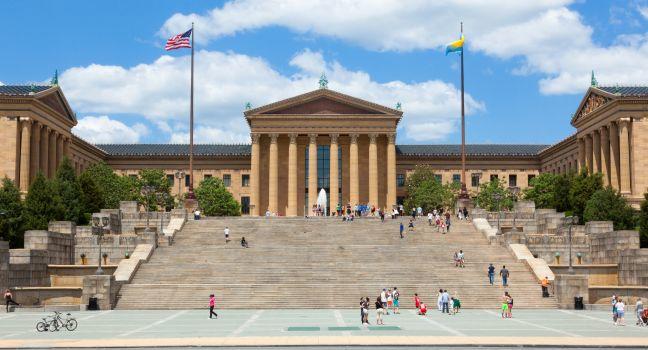
Philadelphia Art Museum
Get FREE email communications from Fodor's Travel, covering must-see travel destinations, expert trip planning advice, and travel inspiration to fuel your passion.

We've compiled the best of the best in Pennsylvania - browse our top choices for the top things to see or do during your stay.
Barnes wanted to help people "see as an artist saw," and to do this he created each gallery wall as an "ensemble" that reflected visual relationships: a Picasso could hang side by side with an African sculpture, and below an Old Master sketch and an iron door hinge. Works have no labels, but a free mobile guide, accessed via smartphone, provides information. Barnes's will decreed that nothing in the displays could be changed, so when the collection moved to the Parkway in 2012, the galleries were re-created within a structure that also has rooms for special exhibitions and a high-ceilinged court with a café. The pretty, pricier Garden Restaurant, with indoor and outdoor (in season) seating, serves delicious modern American fare.
In a beautifully converted Civil War–era gristmill, the museum presents the art of Chadds Ford native Andrew Wyeth (1917–2009), a major American realist painter, as well as works by his father, N. C. Wyeth, illustrator of many children's classics; and Jamie Wyeth, Andrew's son. The collection also emphasizes still lifes, landscape paintings, and American illustration, with works by such artists as Howard Pyle and Horace Pippin. A glass-wall lobby on each of the three floors overlooks the river and countryside that inspired artists. Seasonal guided tours (advance reservations suggested) of three other buildings enhance the museum experience; children under age seven are not permitted on these. The N. C. Wyeth House and Studio, set on a hill, holds props N. C. used in creating his illustrations. His daughter, Carolyn Wyeth, lived and painted here until 1994. Andrew Wyeth's Studio, where the artist produced many notable works, is on view, too. You can also tour the Kuerner Farm, which Andrew painted in many of his best-known paintings. A shuttle takes you from the museum to the buildings for an hour-long guided tour. Several trails on (or that pass through) the property, a gift shop, and the Millstone Café, all acessible without paying admission, round out the offerings.
\nThe nation's first art school and museum (founded in 1805) displays a notable collection of American art that ranges from the Peale family and Gilbert Stuart to Andrew Wyeth and Faith Ringgold. Fox Hunt by Winslow Homer and The Artist in His Museum by Charles Willson Peale are two famous works. PAFA's most prized work, The Gross Clinic by Thomas Eakins, depicts Samuel D. Gross, a celebrated 19th-century surgeon, presiding over an operation; the masterwork is co-owned with the Philadelphia Art Museum. The striking 1876 Gothic revival building was designed by Philadelphia architects Frank Furness and George Hewitt with a multicolor stone-and-brick exterior and an interior in rich hues of red, yellow, and blue; in time for America's 250th birthday, there's a new installation from its permanent collection. Until then, changing exhibitions in different mediums are presented in the adjacent modern Samuel M. V. Hamilton Building, an 11-story facility that holds classrooms and studios for continuing education and certificate students. Between the two buildings is the pedestrian Lenfest Plaza featuring Paint Torch, a 51-foot-tall sculpture of a paintbrush by Claes Oldenburg. The Barnes Foundation and the Philadelphia Art Museum may get more visitor attention, but art lovers will appreciate this special place.
This museum includes the restored 18th-century home, studio, and garden of Charles Demuth (1883–1935), one of America's first modernist artists, who lived in the city of Lancaster for most of his life. A watercolorist, Demuth found inspiration in the geometric shapes of machines and modern technology, as well as the flowers in his mother's garden. Items from the 42-piece collection of Demuth's works are displayed on a rotating basis; one gallery is dedicated to changing exhibits of regional and national artists. Next door is the now-shuttered Demuth Tobacco Shop, which dates to 1770.
The realization of founder Samuel S. Fleisher's open invitation "to come and learn art," this school and gallery has offered classes, some tuition-free, since 1898. Fleisher presents regular exhibits of contemporary art as well as works by faculty and students. The Memorial consists of several connected buildings, including the Sanctuary, a Romanesque Revival Episcopal church designed by the architectural firm of Frank Furness and featuring European art from the 13th to the 15th century. A satellite building at 705 Christian Street is dedicated to works on paper.
This museum, part of the University of Pennsylvania, has established a reputation for identifying promising contemporary artists and championing them at critical points in their careers. Among the creators who have had exhibitions at ICA and later gone on to international prominence are Andy Warhol (his first-ever solo museum show, in 1965), Laurie Anderson, Robert Mapplethorpe, and surveys of less famous but important artists such as Jamaican Mavis Pusey's geometric abstractions. ICA is dedicated to the one or two exhibitions they show at a time. Exhibitions are long-running but closing between them is typical, so check what's up before you go.
Named for the late best-selling novelist and Doylestown native, this museum, across the street from the Mercer Museum, has a permanent collection and changing exhibitions that focus on 19th- and 20th-century American art, especially those by Bucks County artists. It's known for its collection of early-20th-century Pennsylvania impressionists, representing such artists as Edward Redfield and Daniel Garber. The museum occupies the buildings and grounds of the former Bucks County jail, which dates from 1884. A 23-foot-high fieldstone wall surrounds seven galleries, an outdoor sculpture garden, and a Gothic-style warden's house. There's also a re-creation of Michener's Doylestown study. A relatively new gallery accommodates larger traveling exhibits, included in the price of admission.
This stunning destination for the international wood-art community cultivates and promotes education and creative expression of the form. Rebranded in 2023 to include the word "museum" in its name, this space features a two-floor, light-filled museum showcasing more than a thousand beautiful pieces of artwork all made from wood. The gift shop is stocked with gorgeous handmade works, some by accomplished artists whose works are on display, including those who are a part of the organization's annual Windgate Wood Arts Residency Program (WARP).
This 1863 three-floor town house and an adjoining building are filled with Persian rugs and 18th-century British, French, and American antiques (plus an entire living room that once belonged to poet Marianne Moore), but the real treasures are the artworks, books, and manuscripts here. Amassed by Philadelphia collectors Philip H. and A. S. W. Rosenbach, the collection includes paintings by Canaletto, Sully, and Lawrence; drawings by Daumier, Fragonard, and Blake; book illustrations ranging from medieval illuminations to the works of Maurice Sendak, author of Where the Wild Things Are; the only known copy of the first issue of Benjamin Franklin's Poor Richard's Almanack; and the library's most famous treasure, the original manuscript of James Joyce's Ulysses. The Rosenbach celebrates "Bloomsday" on June 16 with readings from Ulysses by notable Philadelphians. The library has more than 130,000 manuscripts and 30,000 rare books.
On the far side of Chestnut Hill, on the slope leading toward the suburbs, this Philly artist–centric museum focuses on 19th- and 20th-century eastern Pennsylvania art. The permanent collection features mid-1900s woodcuts and a number of 19th-century Pennsylvania landscapes. The largely contemporary special exhibitions are often very engaging, along with live jazz and classical music, movie nights, and workshops. There's a popular, if overpriced, haystack maze each October outside.


