34 Best Sights in Pennsylvania, USA

Background Illustration for Sights

We've compiled the best of the best in Pennsylvania - browse our top choices for the top things to see or do during your stay.

Fallingwater

Fodor's Choice

About an hour and a half southeast of Pittsburgh is Frank Lloyd Wright's residential masterwork—a stone, concrete, and glass house dramatically cantilevered over a waterfall. In 1936, Edgar J. Kaufmann—who'd made a fortune as owner of Kaufmann's, Pittsburgh's premier department store—hired Wright to design a weekend retreat for his family on a piece of land in Mill Run. Wright's design incorporated much of what was already on the site, including rocks, trees, and a rushing creek. Battles of will between Kaufmann and Wright over the details of the house design became legendary. Wright wanted to cover the concrete parapets of the house with gold leaf; Kaufmann didn't. Kaufmann wanted a swimming pool on one of the balconies; Wright didn't. And so on. Despite their many differences, they produced an amazing house. The only way to see the house is on a guided tour; children under six cannot tour the house. Reservations are essential for the detailed tour.
Cliveden

Germantown
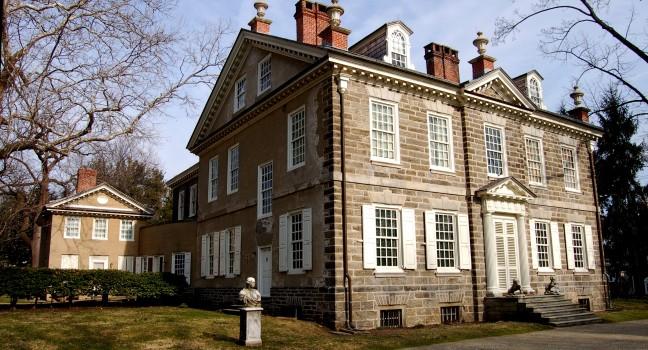
The Chew House, also known as Cliveden, in the Germantown section of Philadelphia, PA.  Americans soldiers fought from inside of the house during the Battle of Germantown in the Revolutionary War
Daniel M. Silva / Shutterstock

The grounds take up an entire block, and they are free to walk around. Cliveden's (rhymes with lived in) unique history, impressive architecture, and the guides who spin a good yarn combine to make the site perhaps the best visiting experience of the historic Germantown homes. The elaborate country house was built in 1767 by Benjamin Chew (1722–1810), a Quaker and chief justice of the colonies, and something of a fence-straddler during the Revolution. Cliveden was at the center of the Battle of Germantown, occupied by British troops, and the walls still bear the marks of American cannon fire. An elaborate reenactment of the Battle of Germantown is held here annually on the first Saturday in October. Cliveden excels at its robust programming, which is year-round, and much of which explores the experiences of slaves, servants, and workers at Cliveden, and larger themes of Northern slavery and slaveholders, like the Chew family, who owned plantations in the South. The house, on 6 acres, can be seen on a 45-minute guided tours. Off-season tours can be arranged by calling.

6401 Germantown Ave., Philadelphia, PA, 19144, USA
215-848–1777
Sight Details
$15
Closed Mon.–Wed. and Dec.–Apr.; tours on the hr, last tour at 3 pm

Something incorrect in this review?

Grumblethorpe

Germantown
Grumblethorpe Tenant House, Germantown, Pennsylvania
Smallbones [Public Domain], via Wikimedia Commons

The blood of General James Agnew, who died after being struck by musket balls during the Battle of Germantown, stains the floor in the parlor of this Georgian house—and no one has bothered to clean it up yet! Built by Philadelphia merchant and wine importer John Wister in 1744, Grumblethorpe is one of Germantown's leading examples of early-18th-century Pennsylvania-German architecture. The Wister family lived here for 160 years, and during the Revolution a teenage Sally Wister kept a diary that has become an important historical source for what that time was like. On display are period furnishings and family mementos, but the best part of the house is the large garden. Wisteria, the flowering vine, is named after Charles Wister (John's grandson), who was an avid botanist and amateur scientist, and there is plenty of it in the garden. There are also an enormous hundred-year-old rosebush, a peony alley, a two-story arbor with climbing clematis and a grapevine working its way across its base, and tulips in season.

Tours are offered May–October, on the second Saturday of the month; additional tours can be scheduled.

5267 Germantown Ave., Philadelphia, PA, 19144, USA
215-843–4820
Sight Details
$10
Closed Nov.–Apr.

Something incorrect in this review?

Recommended Fodor's Video

Parry Mansion

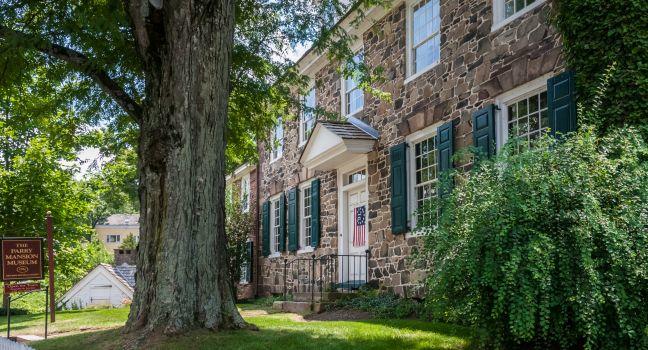
The Parry Mansion Museum, New Hope, Pennsylvania, USA.
(c) Mullan101 | Dreamstime.com

Built in 1784 and now home to the New Hope Historical Society, this stone house is fascinating because the furnishings reflect decorative changes from 1775 (Colonial) to 1900 (Victorian)—including candles, whitewashed walls, oil lamps, and wallpaper. Wealthy Quaker lumber- and flour-mill owner and businessman Benjamin Parry, often called the "father of New Hope," built the house, which was occupied by five generations of his family. Guided house tours, including a brief film, give you a good sense of town history. The historical society also offers a one-hour walking tour of New Hope ($10) from May through October on the first and third Sunday of each month.

45 S. Main St., New Hope, PA, 18938, USA
215-862--5652
Sight Details
$10 house tour
Closed for tours Sept.–Apr., also weekdays May–Aug.

Something incorrect in this review?

Amish Country Homestead

At this designated Lancaster County heritage site, take a guided tour of a replica nine-room Old Order Amish house and attached one-room schoolhouse. Along the way, you'll learn about Amish culture, clothing, and day-to-day life. The Super-Saver Tour Package ($47.95) includes a 90-minute mini-shuttle tour; a guided tour of the homestead; and a ticket to see the film Jacob's Choice.

3121 Old Philadelphia Pike, Bird-in-Hand, PA, 17505, USA
717-768–8400
Sight Details
$15.95
Closed Jan.--Mar.

Something incorrect in this review?

The Benjamin Franklin Museum

Old City

This museum built on the site that was Benjamin Franklin's first permanent home in Philadelphia was thoroughly renovated in 2013, reopening as the Benjamin Franklin Museum. The exhibits combine the latest touch-screen displays and computer-generated animation with a chess set, eyeglasses, and other items actually used by the Renaissance man. Franklin's multifaceted roles as scientist, inventor, philosopher, writer, politician, and businessman are represented in various rooms via interactive displays. Franklin, publisher of Poor Richard's Almanack, helped draft the Declaration of Independence and negotiate peace with Great Britain. He also helped found Pennsylvania Hospital, the University of Pennsylvania, the Philadelphia Contributionship, and the American Philosophical Society. In the courtyard adjacent to the museum, architect Robert Venturi erected a steel skeleton of Franklin's former home. You can peek through "windows" into cutaways to see wall foundations, outdoor privies, and other original elements uncovered during excavation. At the Market Street side are several houses, now exhibition halls, that Franklin rented in addition to his main home. Here, too, you can find a restoration of a Colonial-era print shop and an operational post office. Don't forget to get a letter hand-stamped with a "b. free franklin" cancellation.

Betsy Ross House

Old City

It's easy to find this little brick house with the gabled roof: just look for the 13-star flag displayed from its second-floor window. Whether Betsy Ross, also known as Elizabeth Griscom Ross Ashbourn Claypoole (1752–1836), actually lived here and whether she really made the first Stars and Stripes is debatable. Nonetheless, the house, built around 1740, is a splendid example of a Colonial Philadelphia home. The eight-room house overflows with artifacts such as a family Bible and Ross's chest of drawers and reading glasses. You may have to wait in line, as this is one of the city's most popular attractions. The house, with its winding narrow stairs, is not accessible to people with disabilities. Alongside the house is a courtyard with a fountain, as well as the graves of Ross and her third husband, John Claypoole. Visitors can meet Betsy in her upholstery shop (the only working Colonial upholstery shop in the country) and enjoy interactive historical programming.

Bishop White House

Old City

Built in 1787, this restored upper-class house embodies Colonial and Federal elegance. It was the home of Bishop William White (1748–1836), rector of Christ Church, the first Episcopal bishop of Pennsylvania and spiritual leader of Philadelphia for 60 years. White, a founder of the Episcopal Church after the break with England, was chaplain to the Continental Congress and entertained many of the country's first families, including Washington and Franklin. The second-floor study still contains much of the bishop's own library. The building is currently not open to the public. 

David Wills House

The David Wills House is where Abraham Lincoln stayed and completed his Gettysburg Address on November 18, 1863. The restored building features seven galleries, including the bedroom where Lincoln slept and worked on the final versions of his speech, as well as the office of Wills, a prominent lawyer who was a leading force behind the creation of the national cemetery.

Dolley Todd House

Historic Area

Built in 1775 by John Dilworth, Todd House has been restored to its 1790s appearance, when its best-known resident, Dolley Payne Todd (1768–1849), lived here. She lost her husband, the Quaker lawyer John Todd, to yellow fever in 1793. The widow later married James Madison, our fourth president. Her time as a hostess in the White House was quite a contrast to her years in this simple home. There's an 18th-century garden next to Todd House.  Open by tour only; free tickets available at the Independence Visitor Center in advance.

Ebenezer Maxwell Mansion

Germantown

Philadelphia's only mid-19th-century house-museum is a Victorian Gothic extravaganza of elongated windows and arches that are used to illustrate the way Victorian social mores were reflected through its decoration. The downstairs highlights the Rococo Revival (circa 1860), the upstairs is fashioned after the Renaissance Revival (1880s), and the difference is striking, especially the art deco–like wall details you may not associate with the time. Throughout the year there are a number of special teas and holiday-themed events, and occasionally music and period-appropriate theater productions. Sign up online for tours (noon, 1 pm, and 2 pm) that are available Thursday through Sunday.

200 W. Tulpehocken St., Philadelphia, PA, 19144, USA
215-438–1861
Sight Details
$12
Closed Sun.–Thurs.
Reservations required

Something incorrect in this review?

Edgar Allan Poe National Historic Site

Northern Liberties

One of America's most original writers, Edgar Allan Poe (1809–49), lived here from 1843 to 1844; it's the only one of his Philadelphia residences still standing. During that time some of his best-known short stories were published: "The Telltale Heart," "The Black Cat," and "The Gold Bug." You can tour the three-story brick house; to evoke the spirit of Poe, the National Park Service displays first-edition manuscripts and other rare books and offers interactive exhibits as well. An adjoining house has exhibits on Poe and his family, his work habits, and his literary contemporaries; there's also an eight-minute film and a small Poe library and reading room. A statue of a raven helps set the mood. The site is five blocks north of Market Street and just a stone's throw away from Spring Garden Street. SEPTA bus 47 travels on 7th Street to Green Street, where you should disembark.

532 N. 7th St., Philadelphia, PA, 19123, USA
215-597–8780
Sight Details
Free
Closed Mon.–Thurs.

Something incorrect in this review?

Eisenhower National Historic Site

The farm residence of President Dwight D. Eisenhower, who bought it in 1950, was a weekend retreat and a meeting place for world leaders. The property adjoins the battlefield and the brick-and-stone farmhouse is preserved in 1950s style. Free home tours are conducted Thursday through Sunday, and seasonal walking tours of the farm are offered once a week.

250 Eisenhower Farm Rd., Gettysburg, PA, 17325, USA
717-338–9114
Sight Details
Free
House closed Mon.–Wed. and Dec.--Feb.
Grounds are open to the public Mar.--Nov.

Something incorrect in this review?

Fonthill Castle

Archaeologist, collector, and noted Arts and Crafts tile maker Henry Mercer (1856–1930) designed his home, completed in 1912, creating what resembles a turreted 13th-century castle in fireproof, innovative reinforced concrete; it's stuffed with books, drawings, and, above all, tiles. The multilevel house was built without blueprints as a mazelike jumble of rooms (44 in all). Ancient tiles collected by Mercer and handcrafted Arts and Crafts tiles from his company's kilns (depicting scenes from the Bible, Dickens's Pickwick Papers, and more) cover floors, walls, columns, and ceilings. An hour-long tour—not for the claustrophobic—explains the amazing incrustations; reservations are suggested. Occasionally there are special, longer tours. Steps away, the TileWorks ( thetileworks.org) is Mercer's former tile factory; there are tours and a gift shop. 

Glencairn Museum

Built between 1928 and 1939, this neo-Romanesque 90-room former home of Raymond and Mildred Pitcairn, now houses the family's collection of antiques that were gathered by John and his son Raymond. The house has some fantastic details, but the best part is walking into old bedrooms that now serve as galleries for ancient Greek, Roman, Egyptian, African, Native American, and Sumerian artworks as well as a fantastic basement gallery full of 13th-century European stained glass and sculpture. The view from the observation deck, 149 feet up, is worth the tight elevator ride up there.

1001 Cathedral Rd., Bryn Athyn, PA, 19009, USA
267-502–2993
Sight Details
$10
Reservations strongly recommended; 4-person min. for tours

Something incorrect in this review?

Grey Towers National Historic Site

On a hill overlooking the town of Milford, this historic mansion was built to resemble a French chateau. The Pinchot family commissioned the home in 1886, and their eldest son, Gifford, went on to establish the U.S. Forest Service, which now owns and operates the property. Visits are by guided tour only. The mansion sits on a 102-acre plot of forests and gardens, and visitors can take self-guided tours of the grounds throughout the year. The garden features an amphitheater, a moat, a walled garden, and a number of classical fountains, as well as a half-mile forest trail.

151 Grey Towers, Milford, PA, 18337, USA
570-296–9630
Sight Details
$8
Daily dawn–dusk; tours Memorial Day–Oct., every hour 11–4

Something incorrect in this review?

Hill-Physick House

Society Hill

Built in 1786, this is one of the oldest freestanding houses in Society Hill, with elegantly restored interiors and some of the finest Federal and Empire furniture in Philadelphia. Touches of Napoléon's France are everywhere—the golden bee motif woven into upholstery; the magenta Aubusson rug; and stools in the style of Pompeii, the Roman city rediscovered at the time of the house's construction. Upstairs in the parlor, there’s an inkstand that retains Benjamin Franklin's actual fingerprints. Originally built by a wealthy wine importer, the house's most famous owner was Philip Syng Physick, the "Father of American Surgery" and a leading physician in the days before anesthesia. His celebrated patients included President Andrew Jackson and Chief Justice John Marshall. The garden planted outside the house is filled with plants common during the 19th century; complete with an Etruscan sarcophagus, a natural grotto, and antique cannon, it’s one of the city’s loveliest. Tour times change throughout the year, so check in advance.

321 S. 4th St., Philadelphia, PA, 19106, USA
215-925–7866
Sight Details
$10
Closed Mon.–Wed.
Tours Thurs.–Sun. Apr.–Nov. and weekends Mar. and Dec. All other times by appointment

Something incorrect in this review?

Historic Strawberry Mansion

Fairmount Park

Seen on a guided tour focused on the mansion's history and its furnishings, the largest of Fairmount Park's historic houses has antiques, art, and furniture from the Federal and Empire period. On display is rare Tucker and Hemphill porcelain, and the house also showcases antique dolls and toys. Rooms have been decorated by different groups, some in Colonial Revival style. The house was originally built around 1783–93 by Judge William Lewis, an abolitionist lawyer. The Committee of 1926, the stewardship group that operates the mansion, has events for the 2026 Semiquincentennial celebrations including a summer art exhibition featuring contemporary local artists and a look at the legacy of the city's 1926 Sesquicentennial Exposition.

2450 Strawberry Mansion Dr., Philadelphia, PA, 19132, USA
215-228–8364
Sight Details
$8 includes guided hour (on the hour)
Closed Jan.--Mar. (except by appointment) and Mon.–Wed. Apr.–Dec.

Something incorrect in this review?

Johnson House

Germantown

After bringing visitors through the hidden back entrance of this 1768 home, guides retrace the experience of slaves who found a haven here when the Johnson House was a key station on the Underground Railroad. They weave the story of the Johnson family, Quakers who worked to abolish slavery, with that of Harriet Tubman, who was sheltered here with runaway slaves and later guided them to freedom. Visitors see hiding places, including the third-floor attic hatch that runaways used to hide on the roof when the sheriff came by, learn Underground Railroad code words, and view slavery artifacts, such as ankle shackles and collars. It is the stories contained within the home that are the most captivating, as opposed to the house itself. In 1777 the house was in the line of fire during the Battle of Germantown; the shutters still show the impact of the musket rounds. In the early 1900s it was saved from demolition when it became a women's club, along with what is now the Mennonite church behind it. 

Friday and Saturday tours are offered year-round by online appointment only.

6306 Germantown Ave., Philadelphia, PA, 19144, USA
215-438–1768
Sight Details
$15
Closed Sun.–Thurs.

Something incorrect in this review?

Laurel Hill Mansion

Fairmount Park

Built around 1767, this Georgian house on a laurel-covered hill overlooking the Schuylkill River once belonged to Dr. Philip Syng Physick, who was also owner of Society Hill's Hill-Physick House. Admission includes a history-focused guided tour; the house furnishings are from a variety of periods. Women for Greater Philadelphia sponsors summer candlelight chamber music concerts here; there are other events, too, including ones planned for the 2026 celebration of America's 250th birthday. Call before visiting.

3487 Edgley Dr., Philadelphia, PA, 19121, USA
215-235–1776
Sight Details
$8
Closed Mon.–Wed. and Jan.–late Apr.

Something incorrect in this review?

Lemon Hill

Fairmount Park

An impressive example of a Federal-style country house, Lemon Hill was built in 1800 on a 350-acre farm and has distinctive oval parlors with concave doors and an entrance hall with a checkerboard floor of Valley Forge marble. It was purchased by the city in 1844 and became part of Fairmount Park. The renovated house is not furnished, but docents provide historical information; its location at the start of Kelly Drive makes it a convenient way to sample the park houses. Lemon Hill itself—the surrounding park area, but not the house—will be the site of the free FIFA World Cup Fan Festival from June 11 to July 19, 2026, with giant screens, food, and entertainment. Work may be done in the area before the event, and house tours will likely be unavailable during the Fan Festival, so check ahead. 

1 Lemon Hill Dr., Philadelphia, PA, 19130, USA
Sight Details
$8
Closed Mon.--Wed. and Jan.–Mar.

Something incorrect in this review?

Loxley Court

Old City

One of the restored 18th-century houses in this lovely court was once home to Benjamin Loxley, a carpenter who worked on Independence Hall. The court's claim to fame, according to its residents, is as the spot where Benjamin Franklin flew his kite in his experiment with lightning; the key tied to it was the key to Loxley's front door. Peer through the icon gates to see the home, as it is private and can be admired only from the outside.

321–323 Arch St., Philadelphia, PA, 19106, USA
Sight Details
Closed to public

Something incorrect in this review?

Pearl S. Buck House

Writer Pearl S. Buck, best known for her novel The Good Earth, lived at Green Hills Farm, a country house not too far from Doylestown. Here she wrote nearly 1,000 novels, children's books, and works of nonfiction while raising seven adopted children and caring for many others. The house, now a National Historic Landmark, still bears the imprint of the girl who grew up in China and became the first American woman to win both the Nobel and Pulitzer prizes. The house also contains the writer's collection of Asian and American antiques and personal belongings.

520 Dublin Rd., Perkasie, PA, 18944, USA
215-249–0100
Sight Details
$15
Tours Mar.–Dec., Mon.–Sat. 11, 1, and 2, Sun. 1 and 2; Jan.-Feb. Mon.-Fri. 1, Sat. 11, 1 and 2; Sun. 1 and 2

Something incorrect in this review?

Pennsbury Manor

On a gentle rise 150 yards from the Delaware River, Pennsbury Manor is a 1939 reconstruction of the Georgian-style mansion William Penn built in the 1680s. Living-history demonstrations on 43 of the estate's original 8,400 acres provide a glimpse of everyday life in 17th-century America. The property, including formal gardens, an icehouse, a smokehouse, and a bake-and-brew house, helps paint a picture of the life of an English gentleman 300 years ago. The plantation also shows that although history portrays Penn as a dour Quaker, as governor of the colony he enjoyed the good life by importing the finest provisions and keeping a vast retinue of servants. These extravagances led to financial difficulties that resulted in Penn's spending nine months in a debtor's prison. Though you can wander about the grounds on your own, the house can be seen only on a tour. On Sundays from April to October there are special programs, including those devoted to historic trades, living history theater and open-hearth cooking, to name a few. To get here, follow the blue-and-yellow historical markers.

400 Pennsbury Memorial Rd., Morrisville, PA, 19067, USA
215-946–0400
Sight Details
$9 ($3 grounds only)
Mar.--Dec. Tues.--Sat. 9--5, Sun. noon--5; Jan.--Feb. by appointment only
Closed Mon.

Something incorrect in this review?

Powel House

Society Hill
Built in 1765 and later purchased by Samuel Powel, the last mayor of Philadelphia under the Crown and the first in the new republic, this brick Georgian house remains one of the city's most elegant historic homes. It’s furnished with important pieces of 18th-century furniture. A mahogany staircase from Santo Domingo embellishes the front hall, and there is a signed Gilbert Stuart portrait in the parlor. In the second-floor ballroom, renowned hostess Mrs. Powel served floating islands and whipped syllabubs to distinguished guests (Adams, Franklin, Lafayette) on Nanking china that was a gift from George and Martha Washington. Today the ballroom can be rented for parties and special events.
244 S. 3rd St., Philadelphia, PA, 19106, USA
215-627–0364
Sight Details
$10
Closed Mon.–Wed.
Tours offered Thurs.–Sun. Apr.–Nov. and weekends Mar. and Dec.

Something incorrect in this review?

Rock Ford Plantation

Set on 33 acres, Historic Rock Ford Plantation is the restored homestead of General Edward Hand, a Revolutionary War commander, George Washington's confidant, and wealthy landowner. Period antiques and folk art are displayed in the 1794 Georgian-style mansion, which is on the National Register of Historic Places. In partnership with the African American Historical Society of South Central Pennsylvania, the plantation presents programs on the legacy and stories of the slaves who lived and worked on Hand’s farm and in the household.

881 Rockford Rd., Lancaster, PA, 17602, USA
717-392–7223
Sight Details
$18
Closed Mon. and Nov.–Mar.

Something incorrect in this review?

Shriver House

Costumed guides share fascinating tales at Shriver House, the home of George and Henrietta Shriver and their two children, revealing what civilian life was like during the Civil War. After George joined the Union troops and his family fled to safety, the home was taken over by Confederate sharpshooters during the Battle of Gettysburg. You can visit their attic nest, where two of them were killed during the battle, and get a look at Shriver's Saloon in the cellar. 

309 Baltimore St., Gettysburg, PA, 17325, USA
717-337–2800
Sight Details
$15
Closed Jan. and Feb. except Presidents' Day weekend; closed weekdays in Mar.

Something incorrect in this review?

Stenton

Germantown

James Logan may not be a household name, but he was a seminal figure in pre-Revolutionary America. Equal parts visionary, opportunist, and rogue, he was secretary to William Penn and managed the daily affairs of the colony. Logan, who went on to hold almost every important public office in the colonies, designed this 1730 Georgian manor himself and named it for his father's birthplace in Scotland. He used it to entertain local luminaries and Native American tribal delegates. It was also where he kept one of the area's first libraries, at a time when books were looked upon with suspicion. British General Howe claimed Stenton for his headquarters during the Battle of Germantown. The Stenton mansion is a well-curated, stately affair filled with family and period pieces; the site also includes a kitchen wing, barn, and Colonial-style garden. Starting on the hour at 1 pm, 2 pm, and 3 pm, the guided 45-minute tour interprets the life of three generations of the Logan family and the life of the region from the 1720s through the American Revolution. Stenton has one of the best interiors of any of the Germantown homes.  Tours are offered April to late December, Tuesday–Saturday, noon–4.

4601 18th St., Philadelphia, PA, 19140, USA
215-329–7312
Sight Details
$8
Closed Jan.–Mar. and Sun. and Mon.

Something incorrect in this review?

Thaddeus Kosciuszko National Memorial

Society Hill

A Polish general who later became a national hero in his homeland, Kosciuszko came to the United States in 1776 to fight in the Revolution, one of the first foreign volunteers in the war. The plain three-story brick house, built around 1776, features a series of exhibits that display artifacts from six Polish museums, depicting Kosciuszko's life in his homeland as well as some of his original possessions. An eight-minute film (in English and Polish) portrays the general's activities during the Revolution.

301 Pine St., Philadelphia, PA, 19106, USA
215-965–2305-Independence Visitor Center (call to check availability)
Sight Details
Free
Closed Nov.–Mar., and weekdays Apr.–Oct.

Something incorrect in this review?

Wharton Esherick Museum

The museum preserves the fascinating, unique former hillside home and studio created by the "Dean of American Craftsmen," who was best known for sculptural wooden furniture that influenced artists and designers. Wharton Esherick (1887–1970) shaped a new, organic aesthetic in decorative arts by bridging art with furniture. The site, a National Historic Landmark for Architecture, houses 200 examples of his work—paintings, woodcuts, wooden furniture, and sculptures. The compact studio-home, in which everything from the light switches to the spiral staircase is hand-carved from wood, is one of his monumental achievements. You can see it only by booking a small-group tour in advance. A campus architecture tour, including a separate workshop, is offered occasionally. Although you can see the tiny visitor center and part of the 12-acre grounds when the site is open, there's not much to experience without a tour. The building is not fully accessible to people with mobility issues.

1520 Horseshoe Trail, Malvern, PA, 19355, USA
610-644–5822
Sight Details
$20 tour
Closed Mon. and Tues., and Jan. and Feb.

Something incorrect in this review?