6 Best Sights in Philadelphia, Pennsylvania

Background Illustration for Sights

Philadelphia continues on its upward trend of development in terms of new construction, a restaurant renaissance, and a cultural revival. The city rests its heels on an impressive past, and thanks to aggressive civic leadership and a close-knit local community, it continues to push toward an exciting future. And in many ways, it’s only started to realize its potential.

Philadelphia is a place of contrasts: Grace Kelly and Rocky Balboa; Vetri—one of the nation's finest Italian haute-cuisine restaurants—and the fast-food heaven of Jim's Steaks; Independence Hall and the modest Mario Lanza Museum; 18th-century national icons with 21st-century–style skyscrapers soaring above them. The Philadelphia Orchestra performs in a stunning concert hall—the focal point of efforts to transform Broad Street into a multicultural Avenue of the Arts. Along the same street, 25,000 Mummers dressed in outrageous sequins and feathers historically have plucked their banjos and strutted their stuff in a parade every New Year's Day. City residents include descendants of the staid Quaker Founding Fathers, the self-possessed socialites of the Main Line, and the unrestrained sports fans, who are as vocal as they are loyal.

Philadelphia has a population of just over 1.5 million, but is known as a city of neighborhoods (some say there are 109). Shoppers haggle over the price of tomatoes in South Philly's Italian Market; families picnic in the parks of Germantown; street vendors hawk soft pretzels in Logan Circle; and all around the city vendors sell local produce and other goods at farmers' markets. There’s also a strong sense of neighborhood loyalty: ask a native where he's from and he'll tell you: Fairmount, Fishtown, or Frankford, rather than Philadelphia.

Today you can find Philadelphia's compact 5-square-mile downtown (William Penn's original city) between the Delaware and the Schuylkill (pronounced skoo-kull) rivers. Thanks to Penn's grid system of streets—laid out in 1681—the downtown area is a breeze to navigate. The traditional heart of the city is Broad and Market streets (Penn's Center Square), where City Hall now stands. Market Street divides the city north and south; 130 South 15th Street, for example, is in the second block south of Market Street. North–south streets are numbered, starting with Front (1st) Street, at the Delaware River, and increasing to the west. Broad Street is the equivalent of 14th Street. The diagonal Benjamin Franklin Parkway breaks the rigid grid pattern by leading from City Hall out of Center City into Fairmount Park, which straddles the Schuylkill River and Wissahickon Creek for 10 miles.

Although Philadelphia is the sixth-largest city in the nation (about 1.5 million people live in the city, more than 6 million in the metropolitan area), it maintains a small-town feel. It's a cosmopolitan, exciting, but not overwhelming city, a town that's easy to explore on foot yet big enough to keep surprising even those most familiar with it.

Liberty Bell Center

Old City Fodor's Choice
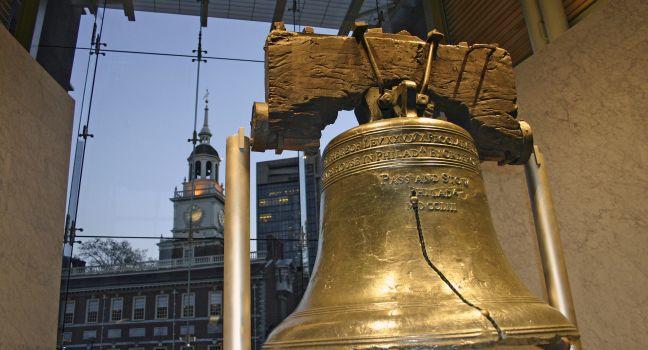
Close-up shot of the Liberty Bell with Independence Hall in the background at dusk. Located in downtown Philadelphia
drbueller / iStockphoto

The bell fulfilled the words of its inscription when it rang to "proclaim liberty throughout all the land unto all the inhabitants thereof," beckoning Philadelphians to the State House yard to hear the first reading of the Declaration of Independence. Ordered in 1751 and originally cast in England, it cracked during testing and was recast in Philadelphia by Pass and Stow two years later. To keep it from falling into British hands during the Revolution—they would have melted it down for ammunition—it was spirited away by horse and wagon to Allentown, 60 miles to the north. The Liberty Bell is the subject of much legend; one story says it cracked when tolled at the funeral of Chief Justice John Marshall in 1835. Actually, the bell cracked slowly over a period of years. It was repaired but cracked again in 1846 and was then forever silenced. It was called the State House Bell until the 1830s, when a group of abolitionists adopted it as a symbol of freedom and renamed it the Liberty Bell.

After more than 200 years inside Independence Hall, the bell was moved to a glass-enclosed pavilion for the 1976 Bicentennial, which for many seemed an incongruous setting for such a historic object. In mid-2003 it once again moved to another glass-enclosed pavilion with redbrick accents. This time, great care was taken to improve access and viewing of its former home at Independence Hall, which is seen against the backdrop of the sky—rather than 20th-century buildings. The Liberty Bell complex houses a bell chamber, an interpretive exhibit area with historic displays and memorabilia, and a covered area for waiting in line. The bell is clearly visible from outside, day or night, so if time is an issue (or if the lines are very long), you can see it without entering the building. 

During construction for the bell's current home, the foundation and other archaeological remains of the President's House, the home of the nation's chief executives before the capital shifted to Washington, D.C., were discovered, as well as evidence of slaves owned by President George Washington, who lived there during his time in office. A new permanent installation includes a series of video panels focusing on the stories of the nine enslaved African Americans, as well as glass panels through which you can view the remains of the structure's foundation.

Chinatown Friendship Arch

Chinatown

Conceptualized by the late Sabrina Soong, a Chinese-American architect/artist and Philadelphia resident, the 40-foot-tall, 88-ton “China Gate” has welcomed visitors to historic Chinatown since its introduction in 1984. Designed in a manner reminiscent of China’s Qing dynasty, it features materials and cultural flourishes fabricated by artisans from Philadelphia’s sister city of Tianjin, China. The Chinese characters emblazoned on the “Friendship Arch” translate simply to “Philadelphia Chinatown,” a paean to the neighborhood’s historic importance and resilience.

Clothespin

Center City West

Claes Oldenburg's 45-foot-high, 10-ton steel sculpture stands in front of the Center Square Building, above one of the entrances to SEPTA's City Hall subway station. Lauded by some and scorned by others, this pop-art piece contrasts with the traditional statuary so common in Philadelphia.

Recommended Fodor's Video

Curtis Center

Old City

The lobby of the Curtis Publishing Company building has a great treasure: a 16-by-50-foot glass mosaic mural, The Dream Garden, based on a Maxfield Parrish painting. It was executed by the Louis C. Tiffany Studios in 1916. The work's 260 colors and 100,000 pieces of opalescent hand-fired glass laced with gold leaf make it perhaps the finest Tiffany mural in the world. The beautiful mural was also designated a "historic object" by the Philadelphia Historical Commission after its owner, the estate of a local art patron, put it up for sale for $9 million in 1998; the designation, the first in the city's history, stopped the sale and the mural remains in public view, under the auspices of the Pennsylvania Academy of the Fine Arts.

The Philadelphia Irish Memorial

Penn's Landing

Erected in 2003 to honor the victims of the Irish Famine (1845–1849), the memorial features 35 life-size bronze figures that depict the famine in Ireland, as well as people moving to and arriving in America; more than 1 million people died in the famine and more than 1 million people left the country. The memorial was designed by Glenna Goodacre. (Note: the statue is currently in a temporary location at 109 Spruce Street, until the construction project at Penn's Landing is completed). 

The Rocky Statue and the “Rocky Steps”

Parkway Museum District

Created by artist A. Thomas Schomberg for the 1982 film Rocky III, the life-size statue was donated by the film’s director and star, Sylvester Stallone, to the City of Philadelphia after filming. The statue has moved around, but since 2006 it has stood at the bottom of the Philadelphia Art Museum’s steps. It continues to be one of the city’s most popular destinations, with visitors lining up patiently to get their selfie with the bronze version of the “Italian Stallion.” The city celebrates Rocky Day annually on December 3, and in 2026 celebrations around town will mark the 50th anniversary of the release of the first Rocky film. Steps from the Rocky statue, the Parkway Visitor Center kiosk sells Rocky merch among its offerings and services.  

2600 Benjamin Franklin Pkwy., Philadelphia, PA, 19130, USA

Something incorrect in this review?