


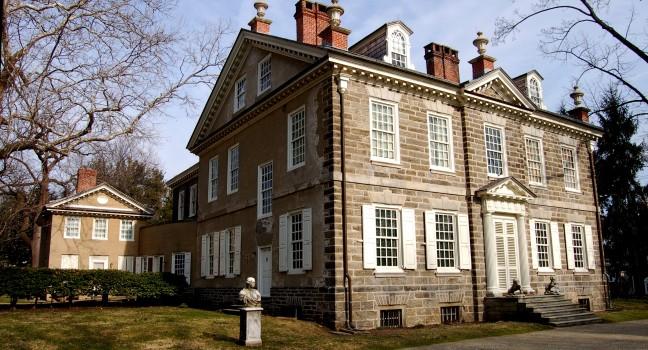
Cliveden
Get FREE email communications from Fodor's Travel, covering must-see travel destinations, expert trip planning advice, and travel inspiration to fuel your passion.

Philadelphia continues on its upward trend of development in terms of new construction, a restaurant renaissance, and a cultural revival. The city rests its heels on an impressive past, and thanks to aggressive civic leadership and a close-knit local community, it continues to push toward an exciting future. And in many ways, it’s only started to realize its potential.
Philadelphia is a place of contrasts: Grace Kelly and Rocky Balboa; Vetri—one of the nation's finest Italian haute-cuisine restaurants—and the fast-food heaven of Jim's Steaks; Independence Hall and the modest Mario Lanza Museum; 18th-century national icons with 21st-century–style skyscrapers soaring above them. The Philadelphia Orchestra performs in a stunning concert hall—the focal point of efforts to transform Broad Street into a multicultural Avenue of the Arts. Along the same street, 25,000 Mummers dressed in outrageous sequins and feathers historically have plucked their banjos and strutted their stuff in a parade every New Year's Day. City residents include descendants of the staid Quaker Founding Fathers, the self-possessed socialites of the Main Line, and the unrestrained sports fans, who are as vocal as they are loyal.
Philadelphia has a population of just over 1.5 million, but is known as a city of neighborhoods (some say there are 109). Shoppers haggle over the price of tomatoes in South Philly's Italian Market; families picnic in the parks of Germantown; street vendors hawk soft pretzels in Logan Circle; and all around the city vendors sell local produce and other goods at farmers' markets. There’s also a strong sense of neighborhood loyalty: ask a native where he's from and he'll tell you: Fairmount, Fishtown, or Frankford, rather than Philadelphia.
Today you can find Philadelphia's compact 5-square-mile downtown (William Penn's original city) between the Delaware and the Schuylkill (pronounced skoo-kull) rivers. Thanks to Penn's grid system of streets—laid out in 1681—the downtown area is a breeze to navigate. The traditional heart of the city is Broad and Market streets (Penn's Center Square), where City Hall now stands. Market Street divides the city north and south; 130 South 15th Street, for example, is in the second block south of Market Street. North–south streets are numbered, starting with Front (1st) Street, at the Delaware River, and increasing to the west. Broad Street is the equivalent of 14th Street. The diagonal Benjamin Franklin Parkway breaks the rigid grid pattern by leading from City Hall out of Center City into Fairmount Park, which straddles the Schuylkill River and Wissahickon Creek for 10 miles.
Although Philadelphia is the sixth-largest city in the nation (about 1.5 million people live in the city, more than 6 million in the metropolitan area), it maintains a small-town feel. It's a cosmopolitan, exciting, but not overwhelming city, a town that's easy to explore on foot yet big enough to keep surprising even those most familiar with it.

The blood of General James Agnew, who died after being struck by musket balls during the Battle of Germantown, stains the floor in the parlor of this Georgian house—and no one has bothered to clean it up yet! Built by Philadelphia merchant and wine importer John Wister in 1744, Grumblethorpe is one of Germantown's leading examples of early-18th-century Pennsylvania-German architecture. The Wister family lived here for 160 years, and during the Revolution a teenage Sally Wister kept a diary that has become an important historical source for what that time was like. On display are period furnishings and family mementos, but the best part of the house is the large garden. Wisteria, the flowering vine, is named after Charles Wister (John's grandson), who was an avid botanist and amateur scientist, and there is plenty of it in the garden. There are also an enormous hundred-year-old rosebush, a peony alley, a two-story arbor with climbing clematis and a grapevine working its way across its base, and tulips in season.
Tours are offered May–October, on the second Saturday of the month; additional tours can be scheduled.
It's easy to find this little brick house with the gabled roof: just look for the 13-star flag displayed from its second-floor window. Whether Betsy Ross, also known as Elizabeth Griscom Ross Ashbourn Claypoole (1752–1836), actually lived here and whether she really made the first Stars and Stripes is debatable. Nonetheless, the house, built around 1740, is a splendid example of a Colonial Philadelphia home. The eight-room house overflows with artifacts such as a family Bible and Ross's chest of drawers and reading glasses. You may have to wait in line, as this is one of the city's most popular attractions. The house, with its winding narrow stairs, is not accessible to people with disabilities. Alongside the house is a courtyard with a fountain, as well as the graves of Ross and her third husband, John Claypoole. Visitors can meet Betsy in her upholstery shop (the only working Colonial upholstery shop in the country) and enjoy interactive historical programming.
Built in 1787, this restored upper-class house embodies Colonial and Federal elegance. It was the home of Bishop William White (1748–1836), rector of Christ Church, the first Episcopal bishop of Pennsylvania and spiritual leader of Philadelphia for 60 years. White, a founder of the Episcopal Church after the break with England, was chaplain to the Continental Congress and entertained many of the country's first families, including Washington and Franklin. The second-floor study still contains much of the bishop's own library. The building is currently not open to the public.
Built in 1775 by John Dilworth, Todd House has been restored to its 1790s appearance, when its best-known resident, Dolley Payne Todd (1768–1849), lived here. She lost her husband, the Quaker lawyer John Todd, to yellow fever in 1793. The widow later married James Madison, our fourth president. Her time as a hostess in the White House was quite a contrast to her years in this simple home. There's an 18th-century garden next to Todd House. Open by tour only; free tickets available at the Independence Visitor Center in advance.
Philadelphia's only mid-19th-century house-museum is a Victorian Gothic extravaganza of elongated windows and arches that are used to illustrate the way Victorian social mores were reflected through its decoration. The downstairs highlights the Rococo Revival (circa 1860), the upstairs is fashioned after the Renaissance Revival (1880s), and the difference is striking, especially the art deco–like wall details you may not associate with the time. Throughout the year there are a number of special teas and holiday-themed events, and occasionally music and period-appropriate theater productions. Sign up online for tours (noon, 1 pm, and 2 pm) that are available Thursday through Sunday.
One of America's most original writers, Edgar Allan Poe (1809–49), lived here from 1843 to 1844; it's the only one of his Philadelphia residences still standing. During that time some of his best-known short stories were published: "The Telltale Heart," "The Black Cat," and "The Gold Bug." You can tour the three-story brick house; to evoke the spirit of Poe, the National Park Service displays first-edition manuscripts and other rare books and offers interactive exhibits as well. An adjoining house has exhibits on Poe and his family, his work habits, and his literary contemporaries; there's also an eight-minute film and a small Poe library and reading room. A statue of a raven helps set the mood. The site is five blocks north of Market Street and just a stone's throw away from Spring Garden Street. SEPTA bus 47 travels on 7th Street to Green Street, where you should disembark.
Built in 1786, this is one of the oldest freestanding houses in Society Hill, with elegantly restored interiors and some of the finest Federal and Empire furniture in Philadelphia. Touches of Napoléon's France are everywhere—the golden bee motif woven into upholstery; the magenta Aubusson rug; and stools in the style of Pompeii, the Roman city rediscovered at the time of the house's construction. Upstairs in the parlor, there’s an inkstand that retains Benjamin Franklin's actual fingerprints. Originally built by a wealthy wine importer, the house's most famous owner was Philip Syng Physick, the "Father of American Surgery" and a leading physician in the days before anesthesia. His celebrated patients included President Andrew Jackson and Chief Justice John Marshall. The garden planted outside the house is filled with plants common during the 19th century; complete with an Etruscan sarcophagus, a natural grotto, and antique cannon, it’s one of the city’s loveliest. Tour times change throughout the year, so check in advance.
Seen on a guided tour focused on the mansion's history and its furnishings, the largest of Fairmount Park's historic houses has antiques, art, and furniture from the Federal and Empire period. On display is rare Tucker and Hemphill porcelain, and the house also showcases antique dolls and toys. Rooms have been decorated by different groups, some in Colonial Revival style. The house was originally built around 1783–93 by Judge William Lewis, an abolitionist lawyer. The Committee of 1926, the stewardship group that operates the mansion, has events for the 2026 Semiquincentennial celebrations including a summer art exhibition featuring contemporary local artists and a look at the legacy of the city's 1926 Sesquicentennial Exposition.
After bringing visitors through the hidden back entrance of this 1768 home, guides retrace the experience of slaves who found a haven here when the Johnson House was a key station on the Underground Railroad. They weave the story of the Johnson family, Quakers who worked to abolish slavery, with that of Harriet Tubman, who was sheltered here with runaway slaves and later guided them to freedom. Visitors see hiding places, including the third-floor attic hatch that runaways used to hide on the roof when the sheriff came by, learn Underground Railroad code words, and view slavery artifacts, such as ankle shackles and collars. It is the stories contained within the home that are the most captivating, as opposed to the house itself. In 1777 the house was in the line of fire during the Battle of Germantown; the shutters still show the impact of the musket rounds. In the early 1900s it was saved from demolition when it became a women's club, along with what is now the Mennonite church behind it.
Friday and Saturday tours are offered year-round by online appointment only.
Built around 1767, this Georgian house on a laurel-covered hill overlooking the Schuylkill River once belonged to Dr. Philip Syng Physick, who was also owner of Society Hill's Hill-Physick House. Admission includes a history-focused guided tour; the house furnishings are from a variety of periods. Women for Greater Philadelphia sponsors summer candlelight chamber music concerts here; there are other events, too, including ones planned for the 2026 celebration of America's 250th birthday. Call before visiting.
An impressive example of a Federal-style country house, Lemon Hill was built in 1800 on a 350-acre farm and has distinctive oval parlors with concave doors and an entrance hall with a checkerboard floor of Valley Forge marble. It was purchased by the city in 1844 and became part of Fairmount Park. The renovated house is not furnished, but docents provide historical information; its location at the start of Kelly Drive makes it a convenient way to sample the park houses. Lemon Hill itself—the surrounding park area, but not the house—will be the site of the free FIFA World Cup Fan Festival from June 11 to July 19, 2026, with giant screens, food, and entertainment. Work may be done in the area before the event, and house tours will likely be unavailable during the Fan Festival, so check ahead.
One of the restored 18th-century houses in this lovely court was once home to Benjamin Loxley, a carpenter who worked on Independence Hall. The court's claim to fame, according to its residents, is as the spot where Benjamin Franklin flew his kite in his experiment with lightning; the key tied to it was the key to Loxley's front door. Peer through the icon gates to see the home, as it is private and can be admired only from the outside.
James Logan may not be a household name, but he was a seminal figure in pre-Revolutionary America. Equal parts visionary, opportunist, and rogue, he was secretary to William Penn and managed the daily affairs of the colony. Logan, who went on to hold almost every important public office in the colonies, designed this 1730 Georgian manor himself and named it for his father's birthplace in Scotland. He used it to entertain local luminaries and Native American tribal delegates. It was also where he kept one of the area's first libraries, at a time when books were looked upon with suspicion. British General Howe claimed Stenton for his headquarters during the Battle of Germantown. The Stenton mansion is a well-curated, stately affair filled with family and period pieces; the site also includes a kitchen wing, barn, and Colonial-style garden. Starting on the hour at 1 pm, 2 pm, and 3 pm, the guided 45-minute tour interprets the life of three generations of the Logan family and the life of the region from the 1720s through the American Revolution. Stenton has one of the best interiors of any of the Germantown homes. Tours are offered April to late December, Tuesday–Saturday, noon–4.
A Polish general who later became a national hero in his homeland, Kosciuszko came to the United States in 1776 to fight in the Revolution, one of the first foreign volunteers in the war. The plain three-story brick house, built around 1776, features a series of exhibits that display artifacts from six Polish museums, depicting Kosciuszko's life in his homeland as well as some of his original possessions. An eight-minute film (in English and Polish) portrays the general's activities during the Revolution.
A good choice for those who enjoy history and the decorative arts, the Naomi Wood collection of antique household goods, including Colonial furniture, unusual clocks, and English delftware, and "Colonial household gear" designated in Wood's will, can be seen on guided tours (required) in this Georgian mansion. This National Historic Landmark was built about 1756 as an elegant summer retreat from the city. The tour includes stories about the families who lived here and also presents a room representative of where some servants, including enslaved people, lived.
Between the 1690s and 1973, Wyck sheltered nine generations of the Wistar-Haines family. Their accumulated furnishings are on display, along with ceramics, children's needlework, dolls, and artifacts generally contemporary with the mid-1800s. On one side is the oldest rose garden in the United States, dating to the 1820s, which blooms in May, as well as a magnolia tree from that time. Out back are a large lawn, where you can picnic, and a vegetable garden—the land has been continuously farmed since 1690, and during the summer it hosts many kid-friendly garden-related events as well as workshops. Known as the oldest house in Germantown, Wyck was used as a British field hospital after the Battle of Germantown. Walk-in tours are offered April–November, Thursday–Saturday, noon–4 pm, and the grounds are open for wandering Tuesday–Friday 10 am–4 pm. Off-season and specialty tours are available by appointment.


