7 Best Sights in Philadelphia, Pennsylvania

Background Illustration for Sights

Philadelphia continues on its upward trend of development in terms of new construction, a restaurant renaissance, and a cultural revival. The city rests its heels on an impressive past, and thanks to aggressive civic leadership and a close-knit local community, it continues to push toward an exciting future. And in many ways, it’s only started to realize its potential.

Philadelphia is a place of contrasts: Grace Kelly and Rocky Balboa; Vetri—one of the nation's finest Italian haute-cuisine restaurants—and the fast-food heaven of Jim's Steaks; Independence Hall and the modest Mario Lanza Museum; 18th-century national icons with 21st-century–style skyscrapers soaring above them. The Philadelphia Orchestra performs in a stunning concert hall—the focal point of efforts to transform Broad Street into a multicultural Avenue of the Arts. Along the same street, 25,000 Mummers dressed in outrageous sequins and feathers historically have plucked their banjos and strutted their stuff in a parade every New Year's Day. City residents include descendants of the staid Quaker Founding Fathers, the self-possessed socialites of the Main Line, and the unrestrained sports fans, who are as vocal as they are loyal.

Philadelphia has a population of just over 1.5 million, but is known as a city of neighborhoods (some say there are 109). Shoppers haggle over the price of tomatoes in South Philly's Italian Market; families picnic in the parks of Germantown; street vendors hawk soft pretzels in Logan Circle; and all around the city vendors sell local produce and other goods at farmers' markets. There’s also a strong sense of neighborhood loyalty: ask a native where he's from and he'll tell you: Fairmount, Fishtown, or Frankford, rather than Philadelphia.

Today you can find Philadelphia's compact 5-square-mile downtown (William Penn's original city) between the Delaware and the Schuylkill (pronounced skoo-kull) rivers. Thanks to Penn's grid system of streets—laid out in 1681—the downtown area is a breeze to navigate. The traditional heart of the city is Broad and Market streets (Penn's Center Square), where City Hall now stands. Market Street divides the city north and south; 130 South 15th Street, for example, is in the second block south of Market Street. North–south streets are numbered, starting with Front (1st) Street, at the Delaware River, and increasing to the west. Broad Street is the equivalent of 14th Street. The diagonal Benjamin Franklin Parkway breaks the rigid grid pattern by leading from City Hall out of Center City into Fairmount Park, which straddles the Schuylkill River and Wissahickon Creek for 10 miles.

Although Philadelphia is the sixth-largest city in the nation (about 1.5 million people live in the city, more than 6 million in the metropolitan area), it maintains a small-town feel. It's a cosmopolitan, exciting, but not overwhelming city, a town that's easy to explore on foot yet big enough to keep surprising even those most familiar with it.

Wissahickon Valley Park (Valley Green)

Chestnut Hill Fodor's Choice
Wissahickon Park, Philadelphia, Pa
DSC_7800 by Jared Rubinsky

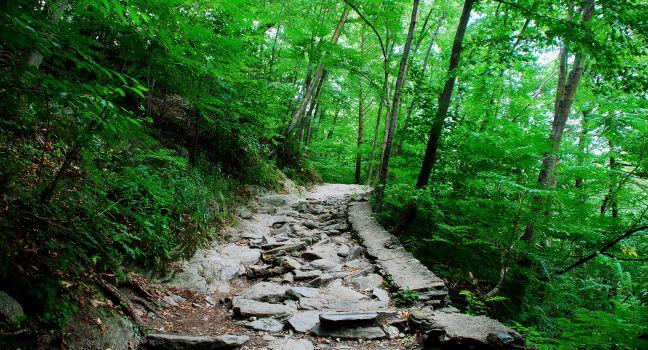
There are many great sections of Fairmount Park, but the 1,800 acres around Valley Green known as Wissahickon Valley Park may be the most stunning. Miles and miles of trails running along and above the river lead to covered bridges, a statue of a Lenape chief (rife with inaccuracies but created with good intentions), caves used by a 17th-century free-love cult, large boulders that drip water, and mallards quacking for bread bits. Forbidden Drive, on which cars are forbidden, runs from Northwestern Avenue (the westernmost part of Chestnut Hill) all the way to Lincoln Drive, where it connects to a bike and walking path that leads one way to Historic Rittenhouse Town (where you can also park and enter) and the other way to Manayunk and Kelly Drive, with additional bike/walking paths that take you to the city or out along the Schuylkill to Valley Forge. There are also many miles of surprisingly difficult mountain-bike trails. The Valley Green Inn is a very attractive restaurant with decent food at Forbidden Drive and Valley Green Road. Other recommended spots to hike to include Hudson and Andorra Meadows, Thomas Mill Covered Bridge, and Toleration Statue.

Valley Green Rd., Philadelphia, PA, 19118, USA
215-247–0417
Sight Details
Free

Something incorrect in this review?

Dilworth Park

Center City West

This welcoming outdoor space has a café and a spacious Great Lawn for relaxing. There's a fountain for cooling off in the summer, and the space transforms into the Rothman Orthopaedics Ice Rink in the winter. It's also home to free events throughout the year, including the Made in Philadelphia Holiday Market.

Franklin Delano Roosevelt Park

South Philadelphia

Frederick Law Olmsted is best known as the designer of New York’s Central Park, and his sons followed in their father’s footsteps in founding the Olmsted Brothers firm, which created this high-profile park in deep South Philly. Originally called League Island Park, when it was designed in the decade leading up to the 1926 Sesquicentennial Exposition, it’s now colloquially known as “The Lakes” for its network of channels and lagoons. The park contains numerous historical structures, including a soaring granite gazebo ringed in Doric columns, the dramatically arched boathouse, and the castlelike American Swedish Historical Museum. April through October, it's also home to the Southeast Asian Market ( www.fdrseamarket.com), where talented cooks from Cambodia, Laos, Thailand, Vietnam, and more cook street food from their cultures' cuisines.

1500 Pattison Ave., Philadelphia, PA, 19145, USA
215-683--3600
Sight Details
Open daily from sunrise to sundown

Something incorrect in this review?

Recommended Fodor's Video

Franklin Square

Old City

One of five squares William Penn placed in his original design, this park is now a family-friendly destination. In addition to the water-dancing fountain, there’s a modern playground and carousel; a food stand with burgers, fries, and shakes; and an 18-hole miniature golf course boasting scale models of Independence Hall, the Philadelphia Museum of Art, Ben Franklin Bridge, and other local landmarks. The park also plays host to numerous events throughout the year, including the Philadelphia Chinese Lantern Festival and Winter in Franklin Park.

200 N. 6th St., Philadelphia, PA, 19106, USA
215-629–4026
Sight Details
Park free; attraction prices vary

Something incorrect in this review?

Penn Park

University City

This 24-acre park stretches along the western side of the Schuylkill River and is managed by the University of Pennsylvania. The park has natural grass and turf playing fields, 12 tennis courts for public use, and bike and walking trails; its most striking feature is an elevated walk offering pedestrians panoramic views of the Philadelphia skyline. A friendly culture of pickup soccer exists here on the weekends, with small nets to accommodate games.

Schuylkill River Park

Rittenhouse Square

On any given day, runners, cyclists, walkers, dog walkers, and loungers can be found at the expansive Schuylkill River Park. The park runs along the river from Lombard Street to Manning Street, spanning more than three city blocks on the edge of Center City before University City. Even during the coldest months, the park is packed with people and their dogs in the on-site dog parks, children on the playground, athletes shooting hoops at the basketball courts, and people enjoying the skyline vantage points.

300 S. 25th St., Philadelphia, PA, 19103, USA
215-309–5523

Something incorrect in this review?

Sister Cities Park

Parkway Museum District

Marking the city's connections with eleven global "sister cities" such as Kobe, Japan, this small, family-focused park has a prime location near Logan Circle, the Logan Philadelphia hotel, and the Cathedral Basilica of Saints Peter and Paul. A play area for kids features a rocky area to explore and a toy-boat and wading pond, and kids can cool off in a fountain with water jets, April through October. Sister Cities is also home to Robert Indiana's AMOR (Spanish and Latin for "love") sculpture, a companion to nearby LOVE Park's famous LOVE. The handy seasonal café (closed mid-December to early March), in a modern building with floor-to-ceiling windows, has light fare including kid-friendly items.