


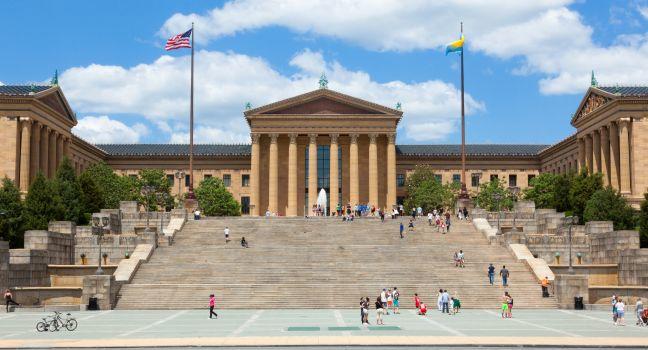
Philadelphia Art Museum
Get FREE email communications from Fodor's Travel, covering must-see travel destinations, expert trip planning advice, and travel inspiration to fuel your passion.

Philadelphia continues on its upward trend of development in terms of new construction, a restaurant renaissance, and a cultural revival. The city rests its heels on an impressive past, and thanks to aggressive civic leadership and a close-knit local community, it continues to push toward an exciting future. And in many ways, it’s only started to realize its potential.
Philadelphia is a place of contrasts: Grace Kelly and Rocky Balboa; Vetri—one of the nation's finest Italian haute-cuisine restaurants—and the fast-food heaven of Jim's Steaks; Independence Hall and the modest Mario Lanza Museum; 18th-century national icons with 21st-century–style skyscrapers soaring above them. The Philadelphia Orchestra performs in a stunning concert hall—the focal point of efforts to transform Broad Street into a multicultural Avenue of the Arts. Along the same street, 25,000 Mummers dressed in outrageous sequins and feathers historically have plucked their banjos and strutted their stuff in a parade every New Year's Day. City residents include descendants of the staid Quaker Founding Fathers, the self-possessed socialites of the Main Line, and the unrestrained sports fans, who are as vocal as they are loyal.
Philadelphia has a population of just over 1.5 million, but is known as a city of neighborhoods (some say there are 109). Shoppers haggle over the price of tomatoes in South Philly's Italian Market; families picnic in the parks of Germantown; street vendors hawk soft pretzels in Logan Circle; and all around the city vendors sell local produce and other goods at farmers' markets. There’s also a strong sense of neighborhood loyalty: ask a native where he's from and he'll tell you: Fairmount, Fishtown, or Frankford, rather than Philadelphia.
Today you can find Philadelphia's compact 5-square-mile downtown (William Penn's original city) between the Delaware and the Schuylkill (pronounced skoo-kull) rivers. Thanks to Penn's grid system of streets—laid out in 1681—the downtown area is a breeze to navigate. The traditional heart of the city is Broad and Market streets (Penn's Center Square), where City Hall now stands. Market Street divides the city north and south; 130 South 15th Street, for example, is in the second block south of Market Street. North–south streets are numbered, starting with Front (1st) Street, at the Delaware River, and increasing to the west. Broad Street is the equivalent of 14th Street. The diagonal Benjamin Franklin Parkway breaks the rigid grid pattern by leading from City Hall out of Center City into Fairmount Park, which straddles the Schuylkill River and Wissahickon Creek for 10 miles.
Although Philadelphia is the sixth-largest city in the nation (about 1.5 million people live in the city, more than 6 million in the metropolitan area), it maintains a small-town feel. It's a cosmopolitan, exciting, but not overwhelming city, a town that's easy to explore on foot yet big enough to keep surprising even those most familiar with it.
Barnes wanted to help people "see as an artist saw," and to do this he created each gallery wall as an "ensemble" that reflected visual relationships: a Picasso could hang side by side with an African sculpture, and below an Old Master sketch and an iron door hinge. Works have no labels, but a free mobile guide, accessed via smartphone, provides information. Barnes's will decreed that nothing in the displays could be changed, so when the collection moved to the Parkway in 2012, the galleries were re-created within a structure that also has rooms for special exhibitions and a high-ceilinged court with a café. The pretty, pricier Garden Restaurant, with indoor and outdoor (in season) seating, serves delicious modern American fare.
The nation's first art school and museum (founded in 1805) displays a notable collection of American art that ranges from the Peale family and Gilbert Stuart to Andrew Wyeth and Faith Ringgold. Fox Hunt by Winslow Homer and The Artist in His Museum by Charles Willson Peale are two famous works. PAFA's most prized work, The Gross Clinic by Thomas Eakins, depicts Samuel D. Gross, a celebrated 19th-century surgeon, presiding over an operation; the masterwork is co-owned with the Philadelphia Art Museum. The striking 1876 Gothic revival building was designed by Philadelphia architects Frank Furness and George Hewitt with a multicolor stone-and-brick exterior and an interior in rich hues of red, yellow, and blue; in time for America's 250th birthday, there's a new installation from its permanent collection. Until then, changing exhibitions in different mediums are presented in the adjacent modern Samuel M. V. Hamilton Building, an 11-story facility that holds classrooms and studios for continuing education and certificate students. Between the two buildings is the pedestrian Lenfest Plaza featuring Paint Torch, a 51-foot-tall sculpture of a paintbrush by Claes Oldenburg. The Barnes Foundation and the Philadelphia Art Museum may get more visitor attention, but art lovers will appreciate this special place.
The realization of founder Samuel S. Fleisher's open invitation "to come and learn art," this school and gallery has offered classes, some tuition-free, since 1898. Fleisher presents regular exhibits of contemporary art as well as works by faculty and students. The Memorial consists of several connected buildings, including the Sanctuary, a Romanesque Revival Episcopal church designed by the architectural firm of Frank Furness and featuring European art from the 13th to the 15th century. A satellite building at 705 Christian Street is dedicated to works on paper.
This museum, part of the University of Pennsylvania, has established a reputation for identifying promising contemporary artists and championing them at critical points in their careers. Among the creators who have had exhibitions at ICA and later gone on to international prominence are Andy Warhol (his first-ever solo museum show, in 1965), Laurie Anderson, Robert Mapplethorpe, and surveys of less famous but important artists such as Jamaican Mavis Pusey's geometric abstractions. ICA is dedicated to the one or two exhibitions they show at a time. Exhibitions are long-running but closing between them is typical, so check what's up before you go.
This stunning destination for the international wood-art community cultivates and promotes education and creative expression of the form. Rebranded in 2023 to include the word "museum" in its name, this space features a two-floor, light-filled museum showcasing more than a thousand beautiful pieces of artwork all made from wood. The gift shop is stocked with gorgeous handmade works, some by accomplished artists whose works are on display, including those who are a part of the organization's annual Windgate Wood Arts Residency Program (WARP).
This 1863 three-floor town house and an adjoining building are filled with Persian rugs and 18th-century British, French, and American antiques (plus an entire living room that once belonged to poet Marianne Moore), but the real treasures are the artworks, books, and manuscripts here. Amassed by Philadelphia collectors Philip H. and A. S. W. Rosenbach, the collection includes paintings by Canaletto, Sully, and Lawrence; drawings by Daumier, Fragonard, and Blake; book illustrations ranging from medieval illuminations to the works of Maurice Sendak, author of Where the Wild Things Are; the only known copy of the first issue of Benjamin Franklin's Poor Richard's Almanack; and the library's most famous treasure, the original manuscript of James Joyce's Ulysses. The Rosenbach celebrates "Bloomsday" on June 16 with readings from Ulysses by notable Philadelphians. The library has more than 130,000 manuscripts and 30,000 rare books.
On the far side of Chestnut Hill, on the slope leading toward the suburbs, this Philly artist–centric museum focuses on 19th- and 20th-century eastern Pennsylvania art. The permanent collection features mid-1900s woodcuts and a number of 19th-century Pennsylvania landscapes. The largely contemporary special exhibitions are often very engaging, along with live jazz and classical music, movie nights, and workshops. There's a popular, if overpriced, haystack maze each October outside.


