8 Best Sights in Portland, Oregon

Background Illustration for Sights

Among North America’s most livable, creative, and culinarily blessed cities, leafy Portland receives plenty of recognition these days for its youthful energy, left-of-center political bent, forward-thinking urban planning and bike friendliness, and eco-minded, locavore-driven ethic. Often compared with Austin, Brooklyn’s Williamsburg neighborhood, and San Francisco’s Mission District, this city of about 600,000 teems with new residents and visitors, many of them curious to know just how accurately the cheeky indie TV show Portlandia has captured the city’s unabashedly earnest hipster vibe.

What you might miss if you focus too closely on Portland’s hipster "it" factor is that this picturesque, easy-to-navigate, midsize metropolis has plenty to offer visitors of all styles and ages—you needn’t be a devotee of artisan-roasted single-origin coffee or the finer points of urban cycling to appreciate the city’s considerable charm.

A major draw is Portland’s proximity to astounding natural scenery, from amazingly dense-wooded and tranquil forest reserves within walking distance of downtown to breathtaking coastal panoramas, snowcapped volcanoes, a thriving wine country, and a mesmerizing river gorge all within a 90-minute drive. Unless you’re in town for just a day or two, plan at least an afternoon getaway to one of these nearby oases, which also make memorable overnight getaways.

Unlike larger West Coast cities, such as Seattle and San Francisco, Portland doesn’t contain many iconic attractions: it’s a pretty but unprepossessing city with a modest but attractive skyline and a laid-back personality. Crime is low, locals are famously friendly, and most businesses and attractions cater enthusiastically to both kids and adults. It’s a fine destination for urban strolls, and it’s easy and relatively cheap to get around using public transportation (MAX light rail, streetcars, buses) and bikes. Also (you didn’t read it here), despite its eco-conscious reputation, Portland is a remarkably easy city to get around by car, with ample (and often free) street parking in many neighborhoods, especially on the East Side.

Don’t miss out on the city’s handful of terrific museums—the Portland Art Museum and Oregon Museum of Science and Industry (aka OMSI) among them. And be sure to check out some of the lovely greenery that fringes downtown, from Washington Park and Forest Park in the West Hills to tree-shaded Tom McCall Waterfront Park along the banks of the Willamette River. As you plan your visit, remember that the truly outstanding attractions in Portland are its many distinctive neighborhoods—and the indie-spirited businesses that prosper in them.

Food tourism thrives in many of these districts, which include downtown’s Pearl District and West End, and a slew of neighborhoods and commercial strips on the East Side. Spend a little time in any of these pockets, and you’ll discover critically acclaimed coffee roasters, microbreweries, urban wineries, craft distilleries, food carts, live-music halls, and both low-frills and highly ambitious restaurants. These neighborhoods, some of which retain a fiercely countercultural mindset and others that—to the disdain of purists—reflect a more gentrified and upscale tenor, also contain quite a few boutiques and shops specializing in crafts, housewares, artwork, books, fashion, and other—often handmade—lifestyle-themed goods.

Those who most appreciate Portland arrive here with a voracious appetite for new experiences, not just for innovative food and drink but also for both urban and rural adventures. The comparatively reasonable prices you’ll find in bars, restaurants, shops, and hotels (except during the increasingly pricey summer high season) are an added bonus. The inviting pedestrian- and bike-friendly cityscape and easy proximity to nature are Portland’s capstones. You could probably see the city’s must-see attractions in a day or two, but many visitors to this leafy metropolis bisected by the beautiful Willamette River—its 10 distinctive bridges themselves a popular draw—simply venture from one eclectic neighborhood to the next, constantly discovering delicious and delightful new diversions.

Cathedral Park

Fodor's Choice

Whether it's the view of the imposing and stunning Gothic St. John's Bridge, which rises some 400 feet above the Willamette River, or the historic significance of Lewis and Clark having camped here in 1806, this 23-acre park is divine. Though there's no church, the park gets its name from the picturesque arches supporting the bridge. It's rumored that the ghost of a young girl haunts the bridge, and that may be true, but if you're told that it was designed by the same man who envisioned the Golden Gate Bridge, that's just a popular misconception. There's an off-leash area for dogs, and pollinator gardens have been added in recent years.

Forest Park

Fodor's Choice

One of the nation's largest urban wildernesses (5,200 acres), this city-owned, car-free park supports more than 50 species of birds and mammals and more than 80 miles of trails through forests of Douglas fir, hemlock, and cedar. Running the length of the park is the 30-mile Wildwood Trail, which extends into adjoining Washington Park (and is a handy point for accessing Forest Park), starting at the Vietnam Veterans Memorial in Hoyt Arboretum. You can access a number of spur trails from the Wildwood Trail, including the 11-mile Leif Erikson Drive, which picks up from the end of N.W. Thurman Street and is a popular route for jogging and mountain biking.

Mt. Tabor Park

Fodor's Choice

A playground on top of a volcano cinder cone? Yup, that's here. The cinders, or glassy rock fragments, unearthed in this 190-acre park's construction were used to surface the respite's roads; the ones leading to the very top are closed to cars, but popular with cyclists. They're also popular with cruisers—each August there's an old-fashioned soapbox derby. Picnic tables and tennis, basketball, and volleyball courts make Mt. Tabor Park a popular spot for outdoor recreation, but plenty of quiet, shaded trails and wide-open grassy lawns with panoramic views of the Downtown skyline appeal to sunbathers, hikers, and nature lovers. The whole park is closed to cars on Wednesday.

Recommended Fodor's Video

Tom McCall Waterfront Park

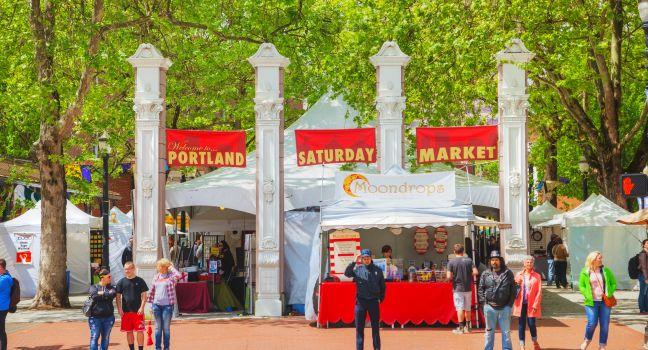
PORTLAND - MAY 04: Portland Saturday Market at Governor Tom McCall Waterfront Park on May 04, 2014 in Portland, Oregon. It's the Rose City's largest outdoor arts and craft market.
photo.ua / Shutterstock

Named for a former governor revered for his statewide land-use planning initiatives, this park stretches north along the Willamette River for about a mile from near the historic Hawthorne Bridge to Steel Bridge. Broad and grassy, Waterfront Park affords a fine ground-level view of Downtown Portland's bridges and skyline. Once an expressway, it's now the site for many annual celebrations, among them the Rose Festival, classical and blues concerts, Portland Pride, Cinco de Mayo, and the Oregon Brewers Festival. The arching jets of water at the Salmon Street Fountain change configuration every few hours, and are a favorite cooling-off spot during the dog days of summer. Both the Hawthorne Bridge and Steel Bridge offer dedicated pedestrian lanes, allowing joggers, cyclists, and strollers to make a full loop along both banks of the river, via Vera Katz Eastside Esplanade.

Council Crest Park

The highest point in Portland, at 1,073 feet, this 43-acre bluff-top patch of greenery is a superb spot to take in sunsets and sunrises. Along with nearly 180-degree views of the Portland metro area, a clear day also affords views of the surrounding peaks—Mt. Hood, Mt. St. Helens, Mt. Adams, Mt. Jefferson, and Mt. Rainier. Trails connect Council Crest with Marquam Nature Park and Washington Park.

Jamison Square Park

This gently terraced park surrounded by tony lofts, shops, and restaurants contains a soothing fountain that mimics nature. Rising water gushes over a stack of basalt blocks, gradually fills the open plaza, and then subsides. Colorful 30-foot tiki totems by pop artist Kenny Scharf stand along the park's west edge. There are tables and chairs in the park, and wading in the fountain is encouraged. The streetcar stops right at the park.

N.W. 10th Ave. and Lovejoy St., OR, 97209, USA
Sight Details
Free

Something incorrect in this review?

Laurelhurst Park

Completed in 1914 by Emanuel Mische, who trained with the iconic Olmsted Brothers landscaping design firm, resplendent Laurelhurst Park's hundred-year-old trees and winding, elegant paths are evocative of another time, and may trigger an urge to don a parasol. Laurelhurst offers plentiful trails, playgrounds, tennis courts, soccer fields, horseshoe pits, an off-leash area for dogs, and many sunny and shady picnic areas. Take a stroll around the large spring-fed pond and keep an eye out for blue heron, the city's official bird. On the south side of this 31-acre park is one of the busiest basketball courts in town. Though the park is always beautiful, it is especially so in fall.

Tanner Springs Park

Tanner Creek, which once flowed through the area, lends its name to this unusual urban wetland park that's surrounded by soaring modern condo towers. Today the creek flows underground, and this quiet, man-made oasis and spring with alder groves was built in the middle of the Pearl District as a reminder of what the area was once like. The Artwall was created using hundreds of upright railroad tracks and hand-painted fused glass.

N.W. 10th Ave. and N.W. Marshall St., OR, 97209, USA
Sight Details
Free

Something incorrect in this review?