No shirt, no shoes, big problem.
Sea Island, Georgia, is beautiful, and travelers who are taken with wide and sandy beaches, tranquil and grassy coastal marshlands, and stately trees dripping with Spanish Moss should definitely add it to their list of places to visit.
Planning my trip, I was thoroughly excited to visit the Sea Island Resort. I’d watched it named to many “Best Of” lists in travel media publications for years, and I thought to myself, “This place must be something special if it’s consistently rated one of the best resorts in the country.”
After confirming my stay and researching the resort, however, I ran across something of a speed bump—there was a dress code. Most of the dining establishments required collared, long-sleeve shirts and closed-toe shoes, and forbade “gentlemen’s hats” (i.e., any hat worn by a man). Some of the fancier restaurants even required jackets for men. While I didn’t exactly hesitate (I was going to Sea Island, and I would have rented a tuxedo if they’d wanted me to), it gave me pause.
What’s the Deal With Dress Codes?
Dress codes have traditionally served as barriers to entry for establishments of the upper crust. And it’s been an easy marker—for centuries, clothing was monstrously expensive, and until the late 20th century, even many relatively well-off people would make their own clothing. Exclusive events maintained their exclusivity by requiring formal wear—attire that was hopelessly beyond a modest budget.



Recommended Fodor’s Video
In pre-Revolution France, anybody who was suitably attired could simply walk into Versailles and mingle with the King and Queen’s entourage. But what appeared to be a laissez-faire approach to palace security came with a catch—dressing above your station was a prosecutable offense in those days, as it was considered a type of fraud. Dressing like a noble if you weren’t one could land you in the stocks.
Before a quick internet search could deliver the goods on anybody you’d meet, the upper crust relied on their social connections as a form of trust. If you met someone that none of your friends knew or trusted, you knew you couldn’t trust them either. And if you were wealthy, you could essentially assume that any stranger you met had some sort of designs on your money or connections.
In New York City, the Astor Opera House was a prime example. When it opened in 1847, the boxes were available by prescription only (ostensibly so you could be denied if you were a ticket scalper or “not from the right background”, even if you could pony up the $10,000 in today’s money for a season ticket). More importantly, there was a dress code: evening dress, kid gloves, and a clean-shaven face for gentlemen was a standard rigorously enforced.

By the end of the 20th century, dress codes in both business and social settings had relaxed for a number of reasons, such as changing tastes and a desire for comfort. Clothing is also cheaper, so it’s not the class signifier it once was. Opera houses across the country—once the arbiters of formal dress—have adopted the approach of advising patrons to “dress for the experience they want to have”—that means diamonds and silk if that tickles your fancy, or a hoodie if you want to be utterly comfortable at that production of La Traviata.
Why Is There a Dress Code at Sea Island?
If society at large is becoming less fussy about what people are wearing, why does it persist at Sea Island?
Dusty Brown, Sea Island’s Digital Marketing and Communications Manager, explains that the resort management reviews the dress code every year and fine-tunes it based on feedback.
“We’ve relaxed it some in previous years, and then we’ve heard from guests they wanted it to be a little more formal,” he said over a plate of deviled eggs in River Bar & Lounge. It’s lunchtime, so my usual uniform of a collared short-sleeve shirt and shorts with slide sandals is completely acceptable. “This is a special place, and they wanted a sense of occasion when they came.”

Forgive me for thinking it’s special because of the architecture and the service rather than what the party at the next table is wearing!
Brown also notes a general lack of negative feedback about the dress codes, saying it doesn’t cause “book away” (i.e,. people don’t like the dress code and go somewhere else).
“When guests cancel their reservations, they’re asked for a reason, and we get almost nobody saying they’re canceling because of the dress code,” added Brown.
To be fair, most resorts do have dress codes, and a lot of the hits from the Sea Island dress code are pretty par for the course. No swimwear, no tank tops, and no bare feet are pretty standard guidance during the day. Otherwise, guests can generally wear what they please—including “athleisure” attire (which I personally find rather tacky, but it doesn’t exactly put me off my pudding, as it were).
It’s also worth noting that only two restaurants—The Georgian Rooms and Colt & Alison—require men to wear a jacket. While The Georgian Rooms require both a long-sleeve collared shirt and a jacket, Colt & Alison, where I had a dinner reservation, only required a jacket, so my short sleeve, collared shirt would be fine (I am 6’9” tall, and my sleeve length measures 42”—four inches longer than the standard shirt sleeve length—rendering all but custom-tailored long sleeve shirts out of my reach). It felt a bit size-ist, but then few people are my size.
Colt & Alison was worth the jacket, by the way—it’s one of the better steaks I’ve had, but I also noted that the average age of the other patrons was at least in the late sixties. The younger set seemed much more interested in the livelier Oak Room next door, where they could get away with a collared (short sleeve) shirt, and where even (Bermuda) shorts were acceptable.
So, What’s The Problem?
I spent much of my time at Sea Island, asking myself why I found the dress code so bothersome. I’ll happily wear slacks and a jacket to a formal night on a cruise ship, and I have no problem packing closed-toe shoes and long pants to visit a temple or other religious sites during my travels.
The answer came the next morning at breakfast. I’d been on a lovely golf cart tour of Sea Island’s stately (read: expensive) homes—many of which can be rented to guests wanting more space than a resort room during their visit—and I stepped into Tavola for breakfast. Just before seating me, the hostess served a gentle reminder: “Gentlemen are requested to remove their hats in the dining room.”
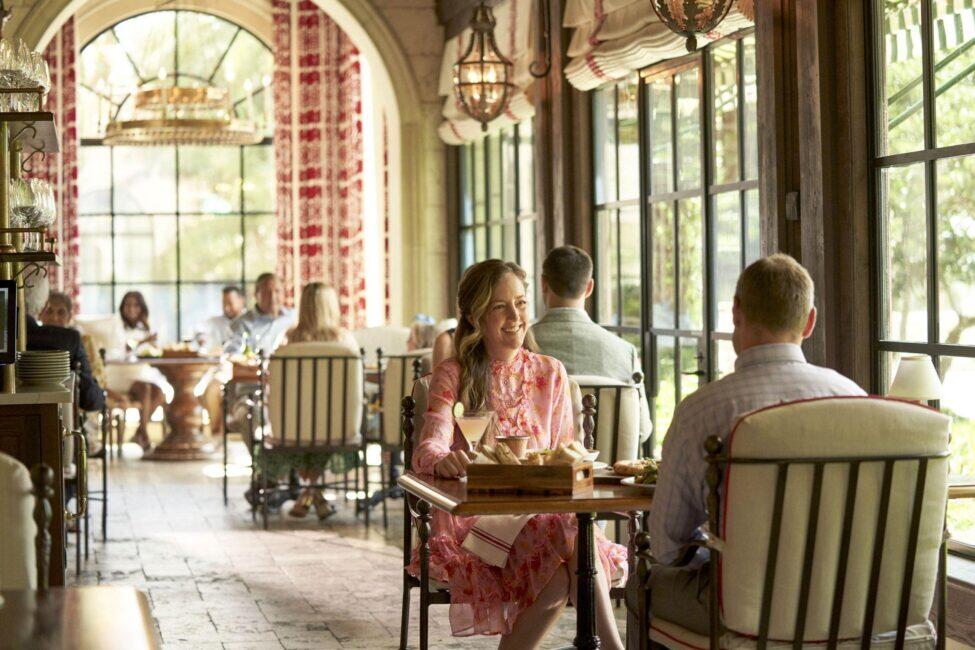
Oh, right—I’d forgotten and was wearing a hat. I gladly took it off, but no sooner had the hostess finished her sentence and turned to find my table that I spotted a woman wearing a ballcap—the same type I’d just been requested to remove before being seated. So, why is the same ballcap acceptable in the dining room when she wears it but not when I do?
Notably, the dress code outlines requirements for men but suggestions for women. Where men have prescribed minimums, women are broadly suggested “cocktail attire” or “elegant dress.” It’s perhaps one of the few times and places where restrictions on men are, in fact, more onerous than they are on women, and it’s not clear whether that stems from the resort finding it less necessary—or simply less palatable—to offer more concrete rules for its women patrons.
I’m certainly not advocating for dress restrictions on women, but I do wonder exactly why men’s heads being covered (or their arms and legs uncovered) in the resort’s dining rooms is such cause for consternation.
Later that afternoon, on the beach, I gathered some insight. Camped out on a beach chair underneath a broad umbrella, watching the Atlantic break on sand dotted with terns and gulls being chased by toddlers in bucket hats and rash guards, a nearby conversation soon piqued my interest. From what I could gather, it was a group of club members in one of the oceanfront cottages complaining that they had been “written up” for violating club rules.
It reminded me that Sea Island is, perhaps first and foremost, a private membership club. Its restaurants and facilities aren’t open to the general public—you must either be a member or an overnight resort guest to have access.
It began to make more sense. In a non-club hospitality setting, hospitality is about making guests comfortable (mostly on the guest’s own terms). That’s why plenty of luxury resorts have adopted the “dress for the experience you want to have” approach to dress codes. In some cases (like opera houses), it’s necessary to keep the tickets selling. The barriers to access endanger further public interest in a teetering art form desperate for new blood.

Clubs, on the other hand, are much more about maintaining uniformity and exclusivity with myriad rules and bylaws. Clubs are associations designed for like-minded people. Members—who may live on Sea Island fulltime or at least spend a significant portion of their year there—are also much more invested in their experience than incidental guests and wield great influence over the club’s resort policies.
But it’s troublesome that the burden of this style of cosplay falls not on those who demand the standards but on their workers. The normal social avenues for enforcing dress infractions (like social shunning) simply aren’t available when the visitors in question are short-stay guests, so it unfortunately falls to the staff to have those sometimes uncomfortable conversations with guests.
The Bottom Line
Sea Island is beautiful and fun. In addition to lovely food and lovely service, I discovered new pursuits. I spent a morning learning about falconry with a really cool Harris hawk named Betty, who scanned the seagrass for prey from atop my gloved arm, and we also spent some time with Scout, an eagle owl who I was told used to live in the shooting school clubhouse and liked to steal boots from guests.
I also visited the shooting school and spent a pleasant afternoon shooting clay pigeons over the grasslands (they’re biodegradable and specifically chosen for their compatibility with the local ecosystem). I later had a peek into the conference room where the G8 Summit was held in 2004 and the impressive collection of oak trees planted around the grounds by various Presidents and world leaders, dating back decades.
The more I thought about it, the more I considered the dress code part of the admission price. Sure, I didn’t particularly like wearing a jacket to dinner, but I also might have wished the rooms were less expensive. In the end, the fact that we’re willing to pay the published rate and follow the rules demonstrates the value of the product. From the heated bathroom floors in my suite to the soothing trickle of the water feature in the multistory atrium of the relaxation room at the spa, Sea Island was worth it—even with a dress code.