


Denali
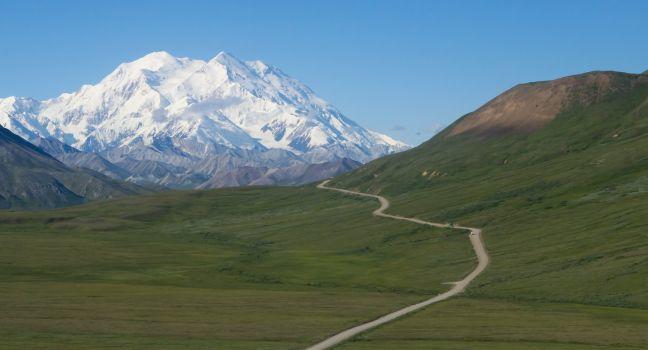
In the heart of mainland Alaska, within 6-million-acre Denali National Park and Preserve, the continent's most majestic peak rises into the heavens. Formerly known as Mt. McKinley, this 20,310-foot massif of ice, snow, and rock has been renamed to honor its Alaska Native name, Denali, or "the High One." Some simply call it "the Mountain." One thing is certain: it's a giant among giants, and the most dominant feature in a land of extremes and superlatives. Those who have walked Denali's slopes know it to be a wild, desolate place. As the highest peak in North America, Denali is a target of mountaineers who aspire to ascend the "seven summits"—the tallest mountains of each of the seven continents. A foreboding and mysterious place, it was terra incognita—unclimbed and unknown to most people—as recently as the late 1890s. Among Athabascan tribes, however, the mountain was a revered landmark; many generations regarded it as a holy place and a point of reference. The mountain's vertical rise is the highest in the world. This means that at 18,000 feet over the lowlands (which are some 2,000 feet above sea level), Denali's vertical rise is even greater than that of Mt. Everest at 29,035-feet (which sits 12,000 feet above the Tibetan plateau, some 17,000 feet above sea level). Denali's awesome height and its subarctic location make it one of the coldest mountains on Earth, if not the coldest. Primarily made of granite, Denali undergoes continual shifting and uplift thanks to plate tectonics (the Pacific Plate pushing against the North American Plate); it grows about 1 millimeter per year.


