7 Best Sights in Upper Town, Quebec City

Background Illustration for Sights

We've compiled the best of the best in Upper Town - browse our top choices for the top things to see or do during your stay.

Fairmont Le Château Frontenac
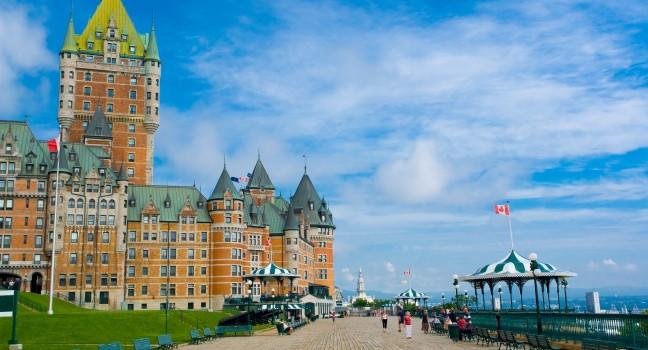
Upper Town Fodor's choice
Chateau Frontenac, best known landmark of Quebec, Canada
Asier Villafranca/Shutterstock

The most photographed landmark in Québec City, this imposing turreted castle with a copper roof owes its name to the Comte de Frontenac, governor of the French colony between 1672 and 1698. Samuel de Champlain was responsible for Château St-Louis, the first structure to appear on the site of the Frontenac; it was built between 1620 and 1624 as a residence for colonial governors. The original portions of the hotel opened the following year, one in a series of château-style hotels built across Canada to attract wealthy railroad travelers. It was remarkably luxurious for the time: guest rooms contained fireplaces, bathrooms, and marble fixtures, and a special commissioner purchased antiques for the establishment. The hotel was designed by New York architect Bruce Price, who also worked on Québec City's train station, Gare du Palais. The addition of a 20-story central tower in 1924 completed the hotel. Since then the Château, as it's called by locals, has accumulated a star-studded guest roster, including Prince William and Kate Middleton, Queen Elizabeth II, Princess Grace of Monaco, Alfred Hitchcock, and Ronald Reagan, as well as Franklin Roosevelt and Winston Churchill, who met here in 1943 and 1944 for two wartime conferences.

Those looking to get an in-depth visit can book a guided tour with local operator Québec Cicerone Tours for C$24 per adult and C$12 per child.

La Citadelle

Upper Town Fodor's choice
A member of the Canadian Royal 22nd Regiment stands guard at the gates to the Citadel in Old Quebec City, Quebec, Canada.
Gary Blakeley / Shutterstock

Built at the city's highest point, on Cap Diamant, the Citadelle is the largest fortified base in North America still occupied by troops. The 25-building fortress is, quite literally, the star of the Fortifications of Québec National Historic Site. It was intended to protect the port, prevent the enemy from taking up a position on the Plains of Abraham, and provide a refuge in case of an attack.

Since 1920, the Citadelle has served as a base for Canada's most storied French-speaking military formation, the Royal 22nd Regiment, known across Canada as the Van Doos, from the French vingt-deux (22). Firearms, uniforms, and decorations from as far back as the 17th century are displayed in the Musée du Royal 22e Régiment in the former powder magazine, built in 1750. Watch the Changing of the Guard, a ceremony in which troops parade before the Citadelle in red coats and black fur hats while a band plays. The regiment's mascot, a well-behaved goat, watches along. The King's representative in Canada, the governor-general, has a residence in the Citadelle, and it's open for tours in summer. You must take a tour to access the Citadelle, since it's a military base. The location—set high above the St. Lawrence River with stunning views of the city and surrounding countryside—is worth a visit even if you don't want to pay (or wait) to take a tour.

côte de la Citadelle, Québec City, G1R 4V7, Canada
418-694–2815
Sight Details
C$18
Changing of the Guard at 10 am in summer

Something incorrect in this review?

Plains of Abraham

Upper Town Fodor's choice
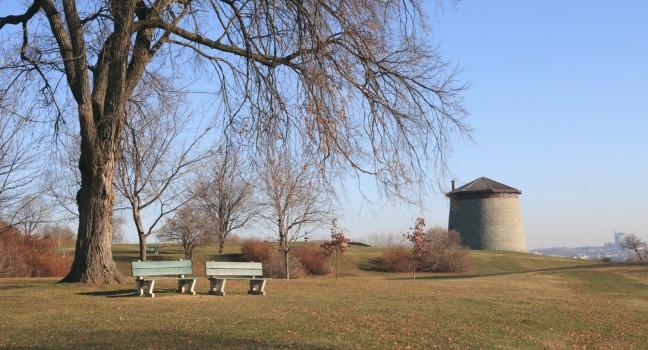
Martello Tower Plaines Abraham
LSOphoto / iStockphoto

This massive urban park is the where the famous Battle of Québec occurred on September 13, 1759, which decided Canada’s fate when the French lost the city to the British as part of the acrimonious Seven Years' War. On that date, British soldiers under the command of General Wolfe climbed the steep cliff under the cover of darkness, ultimately defeating the French through a single deadly volley of musket fire, causing the battle to be over within 30 minutes. At the Museum of the Plains of Abraham, check out the multimedia display, which depicts Canada's history, as well as the numerous family-friendly activities at Martello Towers.

Nowadays, locals come here to cross-country ski and admire the St. Lawrence River even as it freezes over in winter; in July, the Summer Festival takes over with tens of thousands of concertgoers.

Parc des Champs-de-Bataille, Québec City, G1R 2L3, Canada
418-649–6157
Sight Details
Museum C$21.50

Something incorrect in this review?

Recommended Fodor's Video

Maison de la Littérature

Upper Town Fodor's choice

Well worth a stop for design, architecture, and book lovers alike, this stunning library houses permanent exhibitions on French Canadian literature. Set in a former 19th-century Methodist church, the now white-washed, design-heavy building was completely revamped a few years ago, winning international acclaim and architecture awards in the process.

Monastère des Augustines

Upper Town Fodor's choice

Augustinian nuns arrived from Dieppe, France, in 1639 with a mission to care for the sick in the new colony. They established the first hospital north of Mexico, the Hôtel-Dieu, the large building west of the monastery. The complex underwent a complete renovation and expansion, in 2015, and now includes a quiet, health-conscious restaurant (with silent breakfast!), as well as a holistic spa and accommodations—both contemporary en suite rooms and dormlike rooms with antique furniture—for those looking for a calm retreat. The museum houses an extensive collection of liturgical and medical artifacts of all kinds, and it's also worth visiting the richly decorated chapel designed by artist Thomas Baillairgé, as well as the vaults, which date to 1659 and were used by the nuns as shelter from British bombardments. There is still a small order of nuns living in a section of the monastery.

Musée National des Beaux-Arts du Québec

Upper Town Fodor's choice

Situated on the city's liveliest avenue, the Grand Allée, this neoclassical museum in the park with a slick and modern wing is a remarkable steel-and-glass setting for its collection of 22,000 traditional and contemporary pieces of Québec art. Designed by starchitects Rem Koolhaas and Shohei Shigematsu, the Lassonde Pavilion, added in 2016, features three stacked, cascading galleries; a grand stairwell that spirals dramatically from the top floor to the basement, where a rising almost-mile-long tunnel connects to the museum’s three other wings; and views of the neighboring neo-Gothic church from both the rooftop terrace and courtyard. MNBAQ houses works by local legends Jean-Paul Riopelle, Jean-Paul Lemieux, Alfred Pellan, Fernand Leduc, and Horatio Walker that are particularly notable, as well as temporary exhibits by international artists such as Turner, Miro, and Giacometti. The original museum building in Parc des Champs-de-Bataille is part of an abandoned prison dating from 1867; a hallway of cells, with the iron bars and courtyard, has been preserved as part of a permanent exhibition on the prison's history.

Parc des Champs-de-Bataille, Québec City, G1R 5H3, Canada
418-643–2150
Sight Details
C$16 for permanent collection; C$25 for temporary exhibits
Closed Mon. Sept.–May

Something incorrect in this review?

Terrasse Dufferin

Upper Town Fodor's choice

This wide boardwalk with an intricate wrought-iron guardrail has a panoramic view of the St. Lawrence River, the city of Lévis on the opposite shore, Île d'Orléans, the Laurentian Mountains to the north, and the edge of the Appalachians to the south. There are 90-minute tours of the fortifications that leave from here. The Promenade des Gouverneurs begins at the boardwalk's western end; the path skirts the cliff and leads up to Québec's highest point, Cap Diamant, and also to La Citadelle.