9 Best Sights in Amsterdam, Netherlands

Background Illustration for Sights

We've compiled the best of the best in Amsterdam - browse our top choices for the top things to see or do during your stay.

Rijksmuseum

Fodor's choice
Rijksmuseum, Amsterdam, Holland
© Halie Cousineau / Fodors Travel

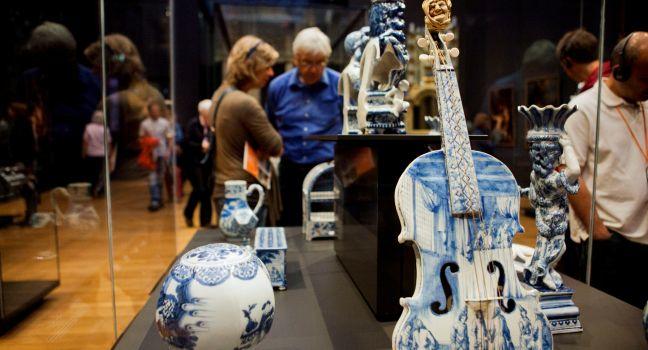
The famed Rijksmuseum houses the largest concentration of Dutch masterworks in the world, as well as paintings, sculpture, and objects from the East and West that provide global context for the history of the Netherlands. Long the nation's pride, this museum has abandoned the art/design/history divisions and has instead combined them into one panoply of art and style presented chronologically, from the Middle Ages to the 20th century. Don't be surprised, in other words, if you spot a vase in a 17th-century painting by Gerard Dou and, next to it, that very same Delft blue-and-white vase itself.

When architect P. J. H. Cuypers came up with a somewhat over-the-top design in the late 1880s, it shocked Calvinist Holland. Cuypers was persuaded to tone down some of what was thought as excessive (i.e., Catholic) elements of his Neo-Renaissance decoration and soaring Neo-Gothic lines. During the building's construction, however, he did manage to sneak some of his ideas back in (including a cheeky statue of himself peeking around a corner), and the result is a magnificent turreted building that glitters with gold leaf and is textured with sculpture.

If your time is limited, head directly for the Gallery of Honor on the upper floor to admire Rembrandt's The Night Watch with its central figure, Frans Banningh Cocq. His militia buddies each paid 100 guilders to be included alongside him—quite a sum in those days, so a few of them complained about being lost in all those shadows. It should be noted that some of these shadows are formed by the daylight coming in through a small window. Daylight? Indeed, The Night Watch is actually the Day Watch, but it received its name in the 18th century when the varnish had discolored—imagine the conservators' surprise. The rest of this "Best of the Golden Age" hall features other well-known Rembrandt paintings as well as works by Vermeer, Frans Hals, and other great artists of the 17th century.

The 20th-century section on the third floor of the two towers includes works by Mondrian and the CoBrA movement, a Nazi chess set (with tanks and cannon instead of castles and bishops), and even a complete Dutch-designed fighter plane, built in 1917 for the Royal Air Force.

In one wing of the ground floor are the Special Collections—room after room of antique furniture, silverware, and exquisite porcelain, including Delftware. An overlooked (and freely accessible) part of this museum is its sculpture garden formed in the triangle by Hobbemastraat and Jan Luijkenstraat. There's a minimuseum in Schiphol Airport, which is free and open 24/7 (after passport control, Holland Boulevard between Piers E and F).

Tickets are timed and can only be purchased online.
Museumstraat 1, 1071 XX, Netherlands
020-674–7000
Sight Details
€23
Tickets are only available for purchase online

Something incorrect in this review?

Stedelijk Museum of Modern Art

Fodor's choice
Stedelijk Museum of Modern Art, Amsterdam, Holland Stedelijk Museum of Modern Art, Amsterdam, Netherlands
Ross Brinkerhoff / Fodors Travel

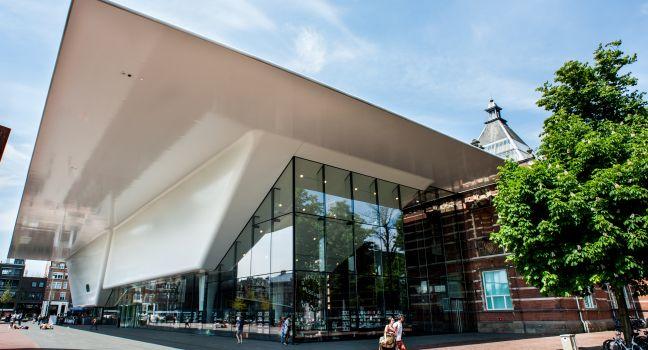
Amsterdam's celebrated treasure house of modern art is housed in a wedding-cake Neo-Renaissance structure built in 1894. In true Amsterdam fashion, locals were quick to nickname the futuristic addition, by globally acclaimed architects Benthem/Crouwel, the "Badkuip" (Bathtub); it incorporates a glass-walled restaurant (which you can visit, along with the museum shop, without a ticket). The new Stedelijk has twice the exhibition space of the old museum, with temporary exhibitions in the extension.

As for the Stedelijk's old building, it's home to the museum's fabled collection of modern and contemporary art and design pieces. While this collection harbors many works by such giants of modernism as Chagall, Cézanne, Picasso, Monet, Mondrian, and Malevich, there is a definite emphasis on the post–World War II period: with such local CoBrA artists as Appel and Corneille (CoBrA was the avant-garde art movement from 1948 to 1951; the name comes from the initials of the members' home cities: Copenhagen, Brussels, Amsterdam); American Pop artists like Warhol, Johns, Oldenburg, and Liechtenstein; Abstract Expressionists including De Kooning and Pollock; contemporary German Expressionists such as Polke, Richter, and Baselitz; and works by Dutch essentials of the De Stijl school, including the game-changing Red Blue Chair that Gerrit Rietveld designed in 1918 and Mondrian's 1920 trail-blazing Composition in Red, Black, Yellow, Blue, and Grey.

Van Gogh Museum

Fodor's choice
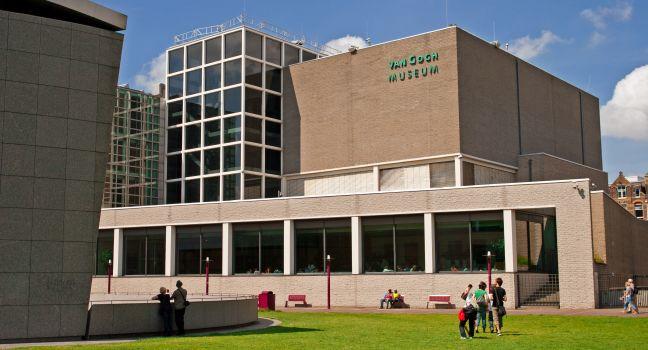
AMSTERDAM, NETHERLANDS - AUG 05: Van Gogh Museum on August 5, 2008 in Amsterdam, Netherlands.  It has the largest collection of Van Gogh's paintings and drawings in the world.
Ivica Drusany / Shutterstock

Opened in 1973, this remarkable light-infused building, based on a design by famed De Stijl architect Gerrit Rietveld, venerates the short and productive career of tortured 19th-century artist Vincent van Gogh. Although some of the Van Gogh paintings scattered throughout the world's museums are of dubious provenance, this collection's authenticity is indisputable: its roots trace directly back to Vincent's brother, Theo van Gogh, who was his artistic and financial supporter.

The 200 paintings and 500 drawings on permanent display here can be divided into five basic periods, the first beginning in 1880 at age 27 after his failure in finding his voice as schoolmaster and lay preacher. These early depictions of Belgian and Dutch country landscapes and peasants were notable for their dark colors and a refusal to romanticize. The Potato Eaters is perhaps his most famous piece from this period. In 1886, he followed his art-dealing brother, Theo, to Paris, where the heady atmosphere—and drinking buddies like Paul Signac and Henri de Toulouse-Lautrec—inspired him to new heights of experimentation. While heavily inspired by Japanese woodcuts and their hard contrasts and off-kilter compositions, he also took the Neo-Impressionist obsession with light and color as his own, and his self-portraits (he was the only model he could afford) began to shimmer with expressive lines and dots. With a broadened palette, Vincent returned to the countryside in 1888 to paint still lifes—including the famous series of Sunflowers (originally meant to decorate the walls of a single bedroom in the Maison Jaune he had set up to welcome Paul Gauguin)—and portraits of locals around Arles, France. His hopes to begin an artists' colony there with Paul Gauguin were dampened by the onset of psychotic attacks, one of which saw the departure of his ear lobe (a desperate gesture to show respect for Gauguin—in southern France, matadors had ears cut off of bulls and presented them to their lady loves). Recuperating in a mental health clinic in Saint-Rémy from April 1889, he—feverishly, one assumes—produced famous works like Irises and Wheatfield with a Reaper, whose energetic brushwork powerfully evoke the area's sweeping winds. In May 1890, Van Gogh moved to the village of Auvers-sur-Oise, where he traded medical advice from Dr. Paul Gachet for paintings and etching lessons. The series of vibrantly colored canvases the pained painter made shortly before he died are particularly breathtaking. These productive last three months of his life were marred by depression, and on July 27, he shot himself while painting Tree Roots and died two days later.

In 1999, the 200th anniversary of Van Gogh's birth was marked with a museum extension designed by the Japanese architect Kisho Kurokawa, which provides space for superb temporary exhibitions. In 2015, a glass structure was added to create a new entrance hall on the Museumplein side and to connect the original museum building to the Kurokawa wing.

Tickets are timed and can only be purchased online. Book well in advance since time slots fill up fast.
Recommended Fodor's Video

FOAM

Fodor's choice

The Netherlands' most popular photography museum (200,000 visitors a year, and counting) hosts large-scale international photography exhibitions, alongside smaller shows for up-and-coming artists. World-renowned Dutch photographers such as Inez van Lamsweerde, Vinoodh Matadin, Hendrik Kerstens, and Rineke Dijkstra have all had shows here. The shop, café, small library, and museum have a dramatically contemporary interior.

Keizersgracht 609, 1017 DS, Netherlands
020-551–6500
Sight Details
€15

Something incorrect in this review?

H'ART Museum

AMSTERDAM, NETHERLANDS - 6 SEPT. 2013: Inside the courtyard of the Hermitage dependance museum in Amsterdam which hosts a permanent presentation on the Netherlands-Russia relations as well as temporary exhibitions.
(c) Hipproductions | Dreamstime.com

Set on the Amstel river, in the stately Amstelhof (once a home for the elderly), this newly renamed museum features high white interiors and smaller side rooms connected by long unadorned corridors. After breaking ties with the State Hermitage Museum in St. Petersburg following the Russian invasion of Ukraine, the former Hermitage Amsterdam will now present exhibitions in partnership with the British Museum in London, the Centre Pompidou in Paris, and the Smithsonian American Art Museum in Washington D.C. The quality of the shows have always been excellent and the programming for the coming years looks promising. The Amsterdam Museum, which is undergoing massive renovations, has also taken up residency in a wing of the building, where it draws on its collection of 100,000 objects spanning almost five centuries to tell the fascinating story of a city that transformed itself from a boggy swamp in the 13th century to a worldwide mercantile powerhouse by the 1600s. Situated on the ground floor, the Museum of the Mind showcases the inner worlds of artists through so-called outsider art.

Amstel 51, 1018 EJ, Netherlands
020-530–8755
Sight Details
€23; or book an all-in ticket online (€33)

Something incorrect in this review?

Museum Rembrandthuis

Nieuwmarkt
Rembrandt House Museum, Amsterdam
Rembrandt House Museum by Eugene Phoen

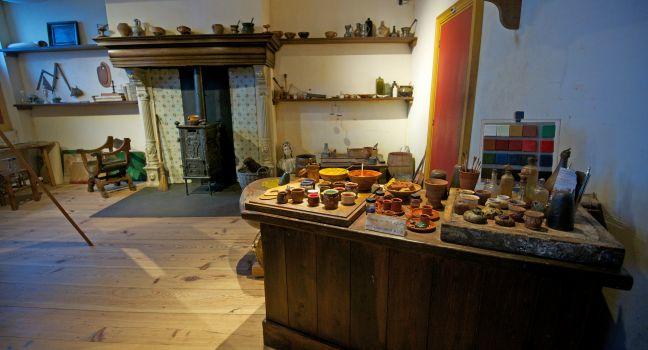
This is the house that Rembrandt, flush with success, bought for 13,000 guilders (a princely sum) in 1639, and where he lived and worked until 1656, when he declared bankruptcy. The house interior has been restored with elegant contemporaneous furnishings and artwork in the reception rooms—a collection of rarities that match as closely as possible the descriptions in the inventories made when Rembrandt was forced to sell everything—but it doesn't convey much of the humanity of Rembrandt himself. When he left here, he was not only out of money but also out of favor with the city after relationships with servant girls following the death of his wife, Saskia. The little etching studio is perhaps the most atmospheric. Littered with tools of the trade, a printing press, and a line hung with drying prints (there are demonstrations), it's easy to imagine Rembrandt finding respite here, experimenting with form and technique, away from uncomfortable schmoozing for commissions (and loans) in the grander salon. The museum owns a huge collection of etchings (260 of the 290 he made), and a changing selection is on permanent display. His magisterial prints Hundred Guilder and Three Crosses show that Rembrandt was almost more revolutionary in his prints than in his paintings, so this collection deserves respectful homage, if not downright devotion, by printmakers today.

Jodenbreestraat 4, Amsterdam, 1011 NK, Netherlands
020-520–0400
Sight Details
€18

Something incorrect in this review?

Cobra Museum of Modern Art

Just south of Amsterdam, in the town of Amstelveen, this wonderful museum is worth a detour. Hundreds of the avant-garde CoBrA movement's artworks (1948–51) are on permanent display here, including paintings, sculptures, and ceramics by Karel Appel, CoBrA's biggest name. The movement proved to be a milestone in the development of European abstract expressionism, and its name is an acronym created from the initials of the members' hometowns of Copenhagen, Brussels, and Amsterdam. In addition to its own collection, the museum organizes temporary modern art exhibitions. For public transport to the museum visit  9292-ov.nl for up-to-date information.

Sandbergplein 1, 1181 ZX, Netherlands
020-547–5050
Sight Details
€24

Something incorrect in this review?

Huis Marseille

This cutting-edge contemporary photography museum is housed in 14 exhibition rooms of a gorgeous 17th-century canal house and its neighbor. Originally owned by a merchant who earned his wealth from a ship that sailed from Marseille, there's still a gable stone that depicts a map of the French port for which the house was named. The widest possible range of genres is covered by new shows every three months. There are also thousands of photography books in the library.

Keizersgracht 401, 1016 EK, Netherlands
020-531–8989
Sight Details
€13
Closed the wk before exhibition opening

Something incorrect in this review?

Moco Museum

Moco Museum was founded in 2016 by collectors Kim and Lionel Logchies as an independent museum focused on modern, contemporary, and street art by big names like Andy Warhol, Jean-Michel Basquiat, Banksy, Keith Haring, THE KID, Yayoi Kusama, Damien Hirst, Tracey Emin, and others. The founders’ goal was to create a museum that would make art more accessible to a broader (and younger) audience. Situated in the historic Villa Alsberg with its fin de siècle features designed by Eduard Cuypers (the nephew of the Rijksmuseum’s famous architect Pierre Cuypers), the museum has quickly established a reputation for its innovative approach to showcasing iconic paintings, street art pieces and sculptures that question the world around us, challenge the norm and broaden perspectives.

Honthorststraat 20, 1071 DE, Netherlands
Sight Details
€22

Something incorrect in this review?