3 Best Sights in Venice, Italy

Background Illustration for Sights

It's called La Serenissima, "the most serene," a reference to the majesty, wisdom, and impressive power of this city that was for centuries the leader in trade between Europe and the Orient, and a major source of European culture. Built on and around a cluster of tiny islands in a lagoon by a people who saw the sea as a defense and ally, Venice is unlike any other city.

No matter how often you've seen Venice in photos and films, the city is more dreamlike than you could ever imagine. The key landmarks, the Basilica di San Marco and the Palazzo Ducale, are hardly what we normally think of as Italian: fascinatingly idiosyncratic, they are exotic mixes of Byzantine, Romanesque, Gothic, and Renaissance styles. Shimmering sunlight and silvery mist soften every perspective here; it’s easy to understand how the city became renowned in the Renaissance for its artists' use of color. The city is full of secrets, inexpressibly romantic, and, in both art and everyday life, given over to an unabashed celebration of the material world.

You'll see Venetians going about their daily affairs in vaporetti (water buses), aboard the traghetti (gondola ferries) that carry them across the Grand Canal, in the campi (squares), and along the calli (narrow streets). They are skilled—and remarkably tolerant—in dealing with the hordes of tourists from all over the world, attracted by the city's fame and splendor.

Venice proper is divided into six sestieri, or districts (the word sestiere means, appropriately, "sixth"): Cannaregio, Castello, Dorsoduro, San Marco, San Polo, and Santa Croce. More-sedate outer islands float around them—San Giorgio Maggiore and the Giudecca just to the south, beyond them the Lido, the barrier island; to the north, Murano, Burano, and Torcello.

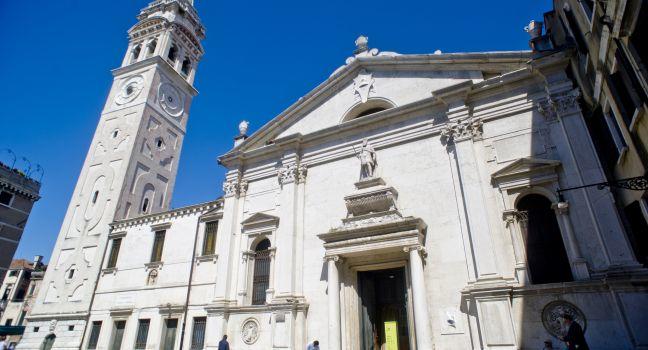
Santa Maria Formosa

Castello
Santa Maria Formosa; Castello, Venice, Italy.
© Zach Nelson / Fodors Travel

Guided by his vision of a beautiful Madonna, 7th-century St. Magno is said to have followed a small white cloud and built a church where it settled. Gracefully white, the marble building you see today dates from 1492, built by Mauro Codussi on an older foundation. Codussi's harmonious Renaissance design is best understood by visiting the interior; the Renaissance facade facing the canal was added later, in 1542, and the baroque facade facing the campo was added in 1604. Of interest are three fine paintings: Our Lady of Mercy by Bartolomeo Vivarini, Santa Barbara by Palma Vecchio, and Madonna with St. Domenic by Gianbattista Tiepolo. The surrounding square bustles with sidewalk cafés and a produce market on weekday mornings.

Castello 5267, Venice, 30122, Italy
041-2750462-Chorus Foundation
Sight Details
€3.50 (free with Chorus Pass)

Something incorrect in this review?

Chiesa della Pietà

Castello

Unwanted babies were left on the steps of this religious institute, founded by a Franciscan friar in 1346. The adjoining orphanage provided the children with a musical education. The quality of the performances here reached continental fame—the in-house conductor was none other than Antonio Vivaldi (1678–1741), who wrote some of his best compositions here for the hospice. The present church was designed in the 18th century by Giorgio Massari, but the facade was completed only in the early 20th century. The main reason for a visit is to view the magnificent ceiling fresco by Gianbattista Tiepolo. In a room to the left of the entrance is a tiny collection of baroque instruments, including the violin played by Vivaldi. There are guided tours Tuesday through Sunday.

Castello 3701, Venice, 30122, Italy
041-5222171
Sight Details
€3 church; €7 museum by appointment
No guided tours Mon.

Something incorrect in this review?

Chiostro di Sant'Apollonia

Castello

Within this Benedictine monastery is a peacefully shady 12th-century cloister that has been modified over the centuries. It remains the only surviving example of a Romanesque cloister in Venice. The brick pavement is original, and the many inscriptions and fragments on display (some from the 9th century) are all that remain of the first Basilica di San Marco.

Recommended Fodor's Video