The Best Sight in Venice, Italy

Background Illustration for Sights

It's called La Serenissima, "the most serene," a reference to the majesty, wisdom, and impressive power of this city that was for centuries the leader in trade between Europe and the Orient, and a major source of European culture. Built on and around a cluster of tiny islands in a lagoon by a people who saw the sea as a defense and ally, Venice is unlike any other city.

No matter how often you've seen Venice in photos and films, the city is more dreamlike than you could ever imagine. The key landmarks, the Basilica di San Marco and the Palazzo Ducale, are hardly what we normally think of as Italian: fascinatingly idiosyncratic, they are exotic mixes of Byzantine, Romanesque, Gothic, and Renaissance styles. Shimmering sunlight and silvery mist soften every perspective here; it’s easy to understand how the city became renowned in the Renaissance for its artists' use of color. The city is full of secrets, inexpressibly romantic, and, in both art and everyday life, given over to an unabashed celebration of the material world.

You'll see Venetians going about their daily affairs in vaporetti (water buses), aboard the traghetti (gondola ferries) that carry them across the Grand Canal, in the campi (squares), and along the calli (narrow streets). They are skilled—and remarkably tolerant—in dealing with the hordes of tourists from all over the world, attracted by the city's fame and splendor.

Venice proper is divided into six sestieri, or districts (the word sestiere means, appropriately, "sixth"): Cannaregio, Castello, Dorsoduro, San Marco, San Polo, and Santa Croce. More-sedate outer islands float around them—San Giorgio Maggiore and the Giudecca just to the south, beyond them the Lido, the barrier island; to the north, Murano, Burano, and Torcello.

Biblioteca Nazionale Marciana
Piazza San Marco
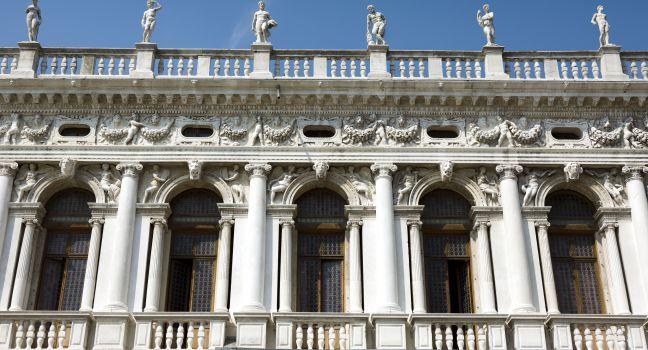
Facade of the National Library (Biblioteca Nazionale Marciana) in St Mark's Square. ; Shutterstock ID 157845704; Project/Title: World's 20 Most Stunning Libraries; Downloader: Fodor's Travel
Myroslava/Shutterstoc

There's a wondrous collection of centuries-old books and illuminated manuscripts at this library, located across the piazzetta (small square) from Palazzo Ducale in two buildings designed by Renaissance architect Sansovino, Libreria Sansoviniana (Sansovinian Library) and the adjacent Zecca (Mint). The complex was begun in 1537, and the Zecca was finished in 1545. Facing the Bacino (San Marco basin), the Zecca along with the Palazzo Ducale form Venice's front door. The Palazzo Ducale, built during a period of Venetian ascendance and self-confident power, is light and decidedly unmenacing. The Zecca, built in a time when the Republic had received some serious defeats and was economically strapped, is purposefully heavy and stresses a fictitious connection with the classical world. The library is, again, much more graceful and was finished according to Sansovino's design only after his death. Palladio was so impressed by the Biblioteca that he called it "beyond envy."

The books can only be viewed by written request and are primarily the domain of scholars. But the Monumental Rooms in the Sansoviniana are worth visiting for the works of Veronese, Tintoretto, and Titian that decorate its walls. You reach the Monumental Rooms, which often host special exhibits, through the Museo Correr.

Piazza San Marco 7, Venice, 30124, Italy
041-2407211
Sight Details
Museums of San Marco Pass €30 (€25 when booked online at least 30 days in advance), includes Museo Correr, Museo Archeologico, Biblioteca Nazionale Marciana, and Palazzo Ducale. Museum Pass €41, includes all four museums plus seven civic museums

Something incorrect in this review?