40 Best Sights in The Bodensee, Germany

Background Illustration for Sights

We've compiled the best of the best in The Bodensee - browse our top choices for the top things to see or do during your stay.

Kloster and Schloss Salem

Fodor's choice

This huge castle in the tiny inland village of Salem began its existence as a convent and large church. After many architectural permutations, it was transformed into a palace for the Baden princes, though traces of its religious past can still be seen. You can view the royally furnished rooms of the abbots and princes, a library, stables, and the church. The castle also houses an interesting array of museums, workshops, and activities, including a museum of firefighting that has a café, a metalsmith shop, a goldsmith shop, a glassblowing shop, the winery Markgrafen von Baden (which also has a shop in Überlingen), and an adventure playground for children. A great path leads from the southwestern part of the grounds through woods and meadows to the pilgrimage church of Birnau. The route was created by the monks centuries ago and is still called the Prälatenweg (path of the prelates) today. It's an 8-km (5-mile) walk (no cars permitted).
Deutsche Zeppelin Reederei GmbH

Fodor's choice

For an unforgettable experience, take a scenic zeppelin flight out of Friedrichshafen airport. The flying season runs from March to November, and prices start at €210 for half an hour. For those who prefer to stay grounded, you can also tour the Zeppelin NT (New Technology) in its hangar.

Burg Meersburg

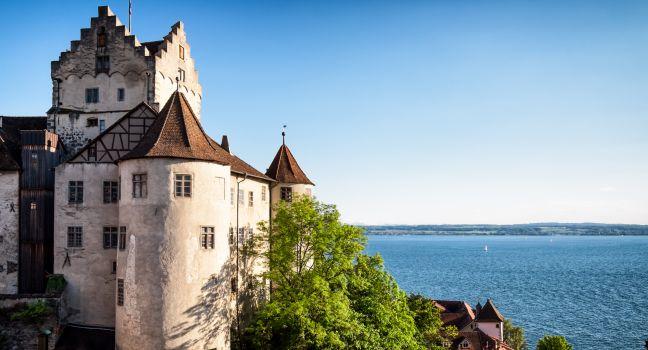
Famous facade at meersburg / germany.
(c) Fottoo | Dreamstime.com

Majestically guarding the town is the original “Meersburg” (Sea Castle). It's Germany's oldest inhabited castle, founded in 628 by Dagobert, king of the Franks. The massive central tower, with walls 10 feet thick, is named after him. The bishops of Konstanz used it as a summer residence until 1526, at which point they moved in permanently. They remained until the mid-18th century when they built themselves what they felt to be a more suitable residence—the baroque Neues Schloss. Plans to tear down the Burg Meersburg in the early 19th century were shelved when it was taken over by Baron Joseph von Lassberg, a man much intrigued by the castle's medieval romance. He turned it into a home for like-minded poets and artists, among them the Grimm brothers and his sister-in-law, the poet Annette von Droste-Hülshoff (1797–1848). Burg Meersburg is still private property, but much of it can be visited, including the richly furnished rooms where Droste-Hülshoff lived and the chamber where she died, as well as the imposing knights' hall, the minstrels' gallery, and the sinister dungeons. The castle museum contains a fascinating collection of weapons and armor, including a rare set of medieval jousting equipment.

Schlosspl. 10, Meersburg, 88709, Germany
07532-80000
Sight Details
€12.80

Something incorrect in this review?

Recommended Fodor's Video

Das Schmetterlingshaus

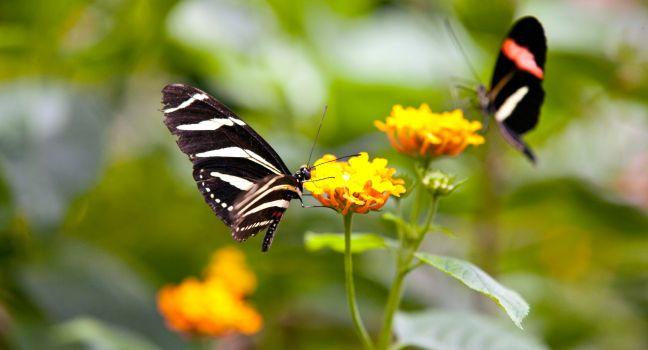
A beautiful butterflies on the Bodensee island Mainau, Germany.
(c) Bitbeerdealer | Dreamstime.com

Beyond the flora, the island of Mainau's other colorful extravagance is Das Schmetterlingshaus, Germany's largest butterfly conservatory. On a circular walk through a semitropical landscape with water cascading through rare vegetation, you'll see hundreds of butterflies flying, feeding, and mating. The exhibition in the foyer explains the butterflies' life cycle, habitats, and ecological connections. Like the park, this oasis is open year-round.

Kirche St. Georg

Oberzell
Saint george church, Reichenau island on Lake Constance, Germany.
(c) Delstudio | Dreamstime.com

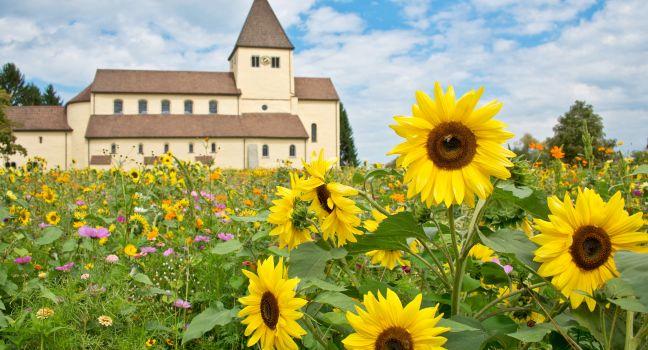
The Kirche St. Georg, in Oberzell, was built around 900; now cabbages grow in ranks up to its rough plaster walls. Small round-head windows, a simple square tower, and massive buttresses signal the church's Romanesque origin from the outside. The interior is covered with frescoes painted by the monks in around 1000. They depict the eight miracles of Christ. Above the entrance is a depiction of the Resurrection. From April through October you can only visit by taking one of the daily guided tours at 11, 1, and 4.

Seestr. 4, Reichenau, 78479, Germany
Sight Details
Guided tours €6 (free Nov.--Mar.)
Closed to all but paid tour groups Apr.–Oct.

Something incorrect in this review?

Marktplatz

The church of St Stephen in Lindau, a picturesque village situated on an island on the Bavarian shore of the Constance Lake.
(c) Faaabi | Dreamstime.com

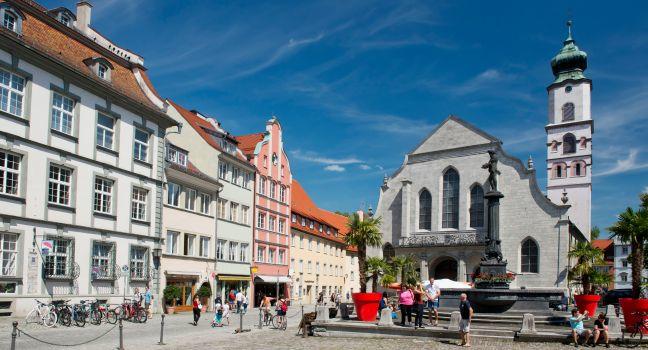
Lindau's market square is lined by a series of sturdy and attractive old buildings. The Gothic Stephanskirche (St. Stephen's Church) is simple and sparsely decorated, as befits a Lutheran place of worship. It dates to the late 12th century but went through numerous transformations. One of its special features is the green-hue stucco ornamentation on the ceiling, which immediately attracts the eye toward the heavens. In contrast, the Catholic Münster Unserer Lieben Frau (St. Mary's Church), which stands right next to the Stephanskirche, is exuberantly baroque.

Münster

Konstanz Minster (Cathedral) - Germany, Baden-Wurttemberg.
(c) Electropower | Dreamstime.com

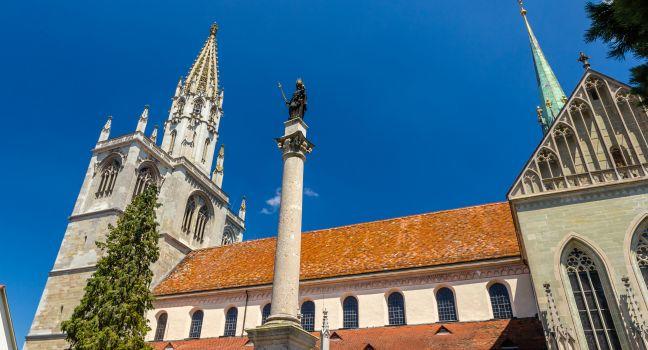
Konstanz's cathedral, the Münster, was the center of one of Germany's largest bishoprics until 1827, when the seat was moved to Freiburg. Construction on the cathedral continued from the 10th through the 19th century, resulting in an interesting coexistence of architectural styles: The twin-tower facade is sturdily Romanesque; the elegant and airy chapels along the aisles are full-blown 15th-century Gothic; the complex nave vaulting is Renaissance; and the choir is severely neoclassical. The Mauritius Chapel behind the altar is a 13th-century Gothic structure, 12 feet high, with some of its original vivid coloring and gilding. It's studded with statues of the Apostles and figures depicting the childhood of Jesus. For €4, you can climb the Münsterturm (Münster Tower) and get views over the city and lake.

Münsterpl. 4, Konstanz, 78462, Germany

Something incorrect in this review?

Wasserburg

The old town of Wasserburg am Inn is situated on a peninsula of Inn River; Shutterstock ID 56888284; Project/Title: Top 100; Downloader: Fodor's Travel
PeJo / Shutterstock

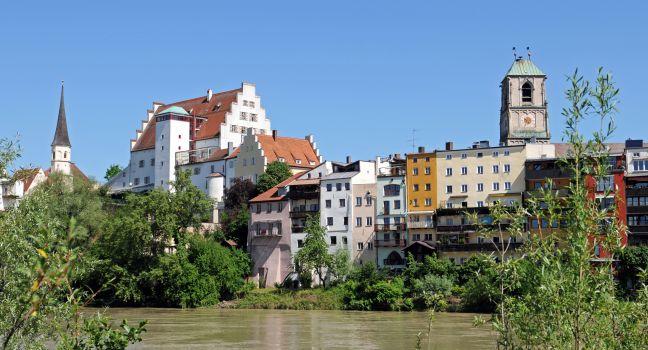
Six kilometers (4 miles) west of Lindau lies Wasserburg, whose name means \"water castle,\" a description of what this enchanting island town once was—a fortress. It was built by the St. Gallen monastery in 924, and the owners, the counts of Montfort zu Tettnang, sold it to the Fugger family of Augsburg. The Fuggers couldn't afford to maintain the drawbridge that connected the castle with the shore and instead built a causeway. In the 18th century, the castle passed into the hands of the Hapsburgs, and in 1805 the Bavarian government took it over. Wasserburg has some of the most photographed sights of the Bodensee: the yellow, stair-gabled presbytery; the fishermen's St. Georg Kirche, with its onion dome; and the little Malhaus museum, with the castle, Schloss Wasserburg (now a luxury hotel), in the background.

Affenberg

On the road between Überlingen and Salem, Affenberg is a 50-plus-acre park that serves as home to up to 200 free-roaming Barbary apes, as well as deer, aquatic birds, gray herons, ducks, coots, and—during nesting time—a colony of white storks.

Mendlishauser Hof, Überlingen, 88682, Germany
07553-381
Sight Details
€12.50
Closed Nov.–mid-Mar.

Something incorrect in this review?

Alamannenmuseum

If you want to learn about early Germans—residents from the 6th, 7th, and 8th centuries whose graves are just outside town—visit the Alamannenmuseum in the Kornhaus, which was once a granary. Archaeologists discovered the hundreds of Alemannic graves in the 1950s.

Karlstr. 28, Weingarten, 88250, Germany
0751-49343
Sight Details
€2
Closed Mon.–Tues.

Something incorrect in this review?

Altes Rathaus

The Old Town Hall is the finest of Lindau's handsome historic buildings. It was constructed between 1422 and 1436 amid a vineyard and given a Renaissance facelift 150 years later, though the original stepped gables remain. Emperor Maximilian I held an imperial diet (deliberation) here in 1496; a fresco on the south facade depicts the scene. The building retains city government functions, thus its interior is closed to the public.

Blaserturm

Ravensburg is home to a remarkable collection of well-preserved medieval towers and city gates. Highlights include the Grüner Turm (Green Tower), so called for its green tiles, many of which are 14th-century originals. Another stout defense tower is the massive Obertor (Upper Tower), the oldest gate in the city walls. The curiously named Mehlsack (Flour Sack) tower—so called because of its rounded shape and whitewash exterior—stands 170 feet high and sits upon the highest point of the city. From April to September, visitors can climb to the top of the Blaserturm for rooftop views over the city.

Marienpl. 28, Ravensburg, 88212, Germany
0751-82800
Sight Details
€3.50
Closed Oct.–Apr.

Something incorrect in this review?

Der Bayerische Löwe

A proud symbol of Bavaria, the lion is Lindau's most striking landmark. Carved from Bavarian marble and standing 20 feet high, the lion stares out across the lake from a massive plinth at the harbor's entrance.

Römerschanze, Lindau, 88131, Germany

Something incorrect in this review?

Dornier Museum

Explore a century of pioneering aviation history. Along with the main focuses on Claude Dornier and his company, restored classic Dornier aircraft, and Dornier's explorations into aerospace technology, the museum shows temporary exhibitions on various aviation themes. A special Dornier Museum/Zeppelin Museum combination ticket provides a discount for those exploring the major aviation attractions of Friedrichshafen.

Claude-Dornier-Pl. 1, Friedrichshafen, 88046, Germany
07541-487–3600
Sight Details
€12.50
Closed Mon.

Something incorrect in this review?

Fürstenhäusle

An idyllic retreat almost hidden among the vineyards, the Fürstenhäusle was built in 1640 by a local vintner and later used as a holiday house by the poet Annette von Droste-Hülshoff. It's now the Droste Museum, containing many of her personal possessions and giving a vivid sense of Meersburg in her time. You'll need to join a guided tour to enter the museum.

Stettenerstr. 11, Meersburg, 88709, Germany
07532-6088
Sight Details
€5
Closed Nov.–Mar.

Something incorrect in this review?

Gärtnerturm

At the middle of the island, the Gärtnerturm contains an information center, a shop, and an exhibition space. Several films on Mainau and the Bodensee are also shown.

Haus zum Cavazzen

Dating to 1729, this house belonged to a wealthy merchant and is now considered one of the most beautiful in the Bodensee region, owing to its rich decor of frescoes. Today it serves as a local history museum, with collections of glass and pewter items, paintings, and furniture from the past five centuries, alongside touring exhibitions. Now closed due to renovation, it is due to reopen at an unspecified date, probably sometime in 2025, but a reopening date has not been announced at this writing.

Marktpl. 6, Lindau, 88131, Germany
08382-944–073
Sight Details
€3
Closed Sept.–Feb.

Something incorrect in this review?

Humpis-Quartier Museum

Glass walkways, stairways, and a central courtyard connect the well-preserved medieval residences at this museum, where visitors can take a close look into the lives of Ravensburgers in the Middle Ages. The residences once belonged to the Humpis family, who were traders in the 15th century.

Kirche St. Peter und Paul

The Kirche St. Peter und Paul, at Niederzell, was revamped around 1750. The faded Romanesque frescoes in the apse contrast with bold rococo paintings on the ceiling and flowery stucco.

Mangturm

At the harbor's inner edge, across the water from the Neuer Leuchtturm, stands this 13th-century former lighthouse, one of the lake's oldest. After a lightning strike in the 1970s, the roof tiles were replaced, giving the tower the bright top it now bears. The interior of the tower can be visited as part of organized storytelling events and on weekends during Christmas market season—contact Tourist-Information Lindau.

Marienplatz

Many of Ravensburg's monuments that most recall the town's wealthy past are concentrated on this central square. To the west is the 14th-century Kornhaus (Granary); once the corn exchange for all of Upper Swabia, it now houses the public library. The late-Gothic Rathaus is a staid, red building with a Renaissance bay window and imposing late-Gothic rooms inside. Next to it stands the 15th-century Waaghaus (Weighing House), the town's weigh station and central warehouse. Its tower, the Blaserturm (Trumpeter's Tower), which served as the watchman's abode, was rebuilt in 1556 after a fire and now bears a pretty Renaissance helmet. Finally there's the colorfully frescoed Lederhaus, once the headquarters of the city's leather workers, and now home to a café. On Saturday morning the square comes alive with a large market.

Münster of St. Maria and St. Markus

Mittelzell

Begun in 816, the Münster of St. Maria and St. Markus, the monastery's church, is the largest and most important of Reichenau's Romanesque churches. Perhaps its most striking architectural feature is the roof, whose beams and ties are open for all to see. The monastery was founded in 725 by St. Pirmin and became one of the most important cultural centers of the Carolingian Empire. It reached its zenith around 1000, when 700 monks lived here. It was then probably the most important center of manuscript illumination in Germany. The building is simple but by no means crude. Visit the Schatzkammer (Treasury) to see some of its more important holdings. They include a 5th-century ivory goblet with two carefully incised scenes of Christ's miracles, and some priceless stained glass that is almost 1,000 years old.

Münster St. Nikolaus

The huge Münster St. Nikolaus was built between 1512 and 1563 on the site of at least two previous churches. The interior is all Gothic solemnity and massiveness, with a lofty stone-vaulted ceiling and high, pointed arches lining the nave. The single most remarkable feature is not Gothic at all but opulently Renaissance: the enormous high altar, carved by Jörg Zürn from lime wood that almost looks like ivory. The subject of the altar carvings is the Nativity.

Museum Ravensburger

Ravensburg is a familiar name to all jigsaw-puzzle fans, because the Ravensburger publishing house produces the world's largest selection of puzzles, as well as many other children's games. Here you can explore the history of the company, founded in 1883 by Otto Robert Maier. Be sure to try out new and classic games via the interactive game stations throughout the museum.

Museum Reichenau

Mittelzell

This museum of local history, in the Old Town Hall of Mittelzell, lends interesting insights into life on the island over the centuries.

Ergat 1 & 3, Reichenau, 78479, Germany
07534-999–321
Sight Details
€8
Closed weekdays Nov.–Mar.

Something incorrect in this review?

Neuer Leuchtturm

Germany's southernmost lighthouse stands sentinel with the Bavarian Lion across the inner harbor's passageway. A viewing platform at the top is open in good weather from April until the end of October. Climb the 139 steps for views over the harbor.

Hafeneinfahrt, Lindau, 88131, Germany
Sight Details
€4.50
Closed Nov.–Mar.

Something incorrect in this review?

Neues Schloss

The spacious and elegant \"New Castle\" is directly across from its predecessor. Designed by Christoph Gessinger at the beginning of the 18th century, it took nearly 50 years to complete. The grand double staircase, with its intricate grillwork and heroic statues, was the work of Balthasar Neumann. The interior's other standout is the glittering Spiegelsaal (Hall of Mirrors).

Schlosspl. 12, Meersburg, 88709, Germany
07532-807–9410
Sight Details
€6
Closed weekdays Nov.–Dec.; closed Jan.--Mar.

Something incorrect in this review?

Niederburg

Niederburg, the oldest part of Konstanz, is a car-free tangle of twisting streets leading to the Rhine. From the river take a look at two of the city's old towers: the Rheintorturm (Rhine Gate Tower), the one nearer the lake, and the aptly named Pulverturm (Powder Tower), the former city arsenal.

Pfahlbauten

As you proceed northwest along the lake's shore, a settlement of \"pile dwellings\"—a reconstructed village of Stone Age and Bronze Age houses built on stilts—sticks out of the lake. This is how the original lake dwellers lived, surviving off the fish that swam outside their humble huts. Museum interpreters in authentic garb give you an accurate picture of prehistoric lifestyles. Since 2011, 111 lake dwelling settlements are part of the UNESCO World Heritage. The on-site Pfahlbaumuseum (Lake Dwelling Open-Air Museum and Research Institute) contains actual finds excavated in the area.

Strandpromenade 6, Unteruhldingen, 88690, Germany
07556-928–900
Sight Details
€12
Closed Fri.–Mon. Mar. and Nov.; closed Nov.--Feb

Something incorrect in this review?

Rathaus

This town hall was built during the Renaissance and painted with vivid frescoes—swags of flowers and fruits, shields, and sturdy knights wielding immense swords. Walk into the courtyard to admire its Renaissance restraint.