120 Best Sights in France

Background Illustration for Sights

We've compiled the best of the best in France - browse our top choices for the top things to see or do during your stay.

The Louvre

Louvre Fodor's Choice
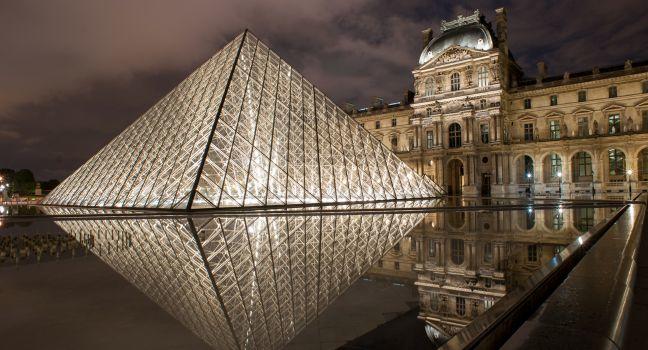
Louvre Pyramid, The Louvre, Paris, France
© Ross Brinkerhoff / Fodor’s Travel

Simply put, the Louvre is the world's greatest art museum—and the largest, with 675,000 square feet of works from all over the world. The Mona Lisa is, of course, a top draw, along with the Venus de Milo and Winged Victory. These and many more of the globe’s most coveted treasures are displayed in three wings—Richelieu, Sully, and Denon—which are arranged like a horseshoe around I. M. Pei's Pyramide. The giant glass pyramid surrounded by a trio of smaller ones opened in 1989 over the new entrance in the Cour Napoléon.

While booking admission tickets online in advance is not required, it's the best way to avoid disappointment: the €22 timed entry guarantees admission, while tickets bought on-site are only sold when space is available—and given a recent decision to limit daily visitors to 30,000 (a third of the previous norm), it's unlikely that spontaneous appearances at the museum will result in a successful visit. Be aware that children under 18 get in for free. Slick Nintendo 3DS multimedia guides (€5), available at the entrance to each wing, offer a self-guided discovery of the museum in a variety of languages, and extended openings (noctournes) on Friday evening allow you to visit the museum until 9:45 pm.

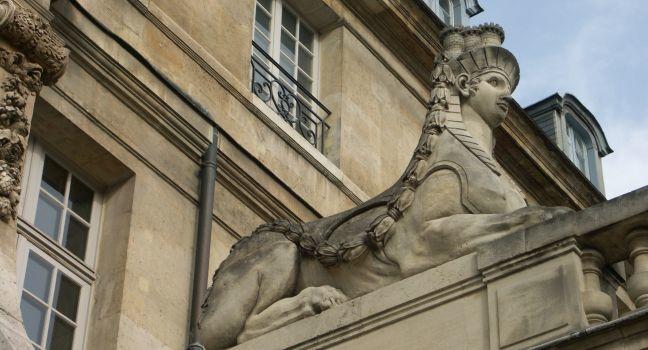
Having been first a fortress and later a royal residence, the Louvre represents a saga that spans nine centuries. Its medieval roots are on display underground in the Sully wing, where vestiges of the foundation and moat remain. Elsewhere in this wing, you can ogle the largest display of Egyptian antiques outside of Cairo, most notably the Great Sphinx of Tanis, one of the largest outside of Egypt (Salle 338). Upstairs is the armless Venus de Milo, a 2nd-century representation of Aphrodite (Salle 345). Highlights of the wing’s collection of French paintings from the 17th century onward include One Odalisque by Jean-August-Dominique Ingres (Salle 702). In the Denon wing, climb the sweeping marble staircase (Escalier Daru) to see the sublime Winged Victory of Samothrace, carved in 305 BC. This wing is also home to the iconic, enigmatic Mona Lisa (Salle des Etats); two other Leonardo da Vinci masterpieces hang in the nearby Grand Galerie. The museum’s 30,000-square-foot Arts of Islam exhibition space is here, too. Topped with an undulating golden roof evoking a flowing veil, its two-level galleries contain one of the largest collections of art from the Islamic world. After admiring it, be sure to visit the Richelieu wing and the Cour Marly, with its quartet of horses carved for Louis XIV and Louis XV. On the ground floor, the centerpiece of the Near East Antiquities Collection is the Lamassu, carved 8th-century winged beasts (Salle 229). The elaborately decorated Royal Apartments of Napoléon III are on the first floor. On the second floor, French and Northern School paintings include Vermeer's The Lacemaker (Salle 837).
Palais du Louvre, Paris, 75001, France
01–40–20–53–17
Sight Details
€22, includes entrance to Musée National Eugène-Delacroix within 2 days of use
Closed Tues.
Online booking strongly encouraged

Something incorrect in this review?

Musée Cernuschi

Grands Boulevards Fodor's Choice
Sculptures, Paris-Musee Cernuschi, Paris, France
© Halie Cousineau/ Fodor’s Travel

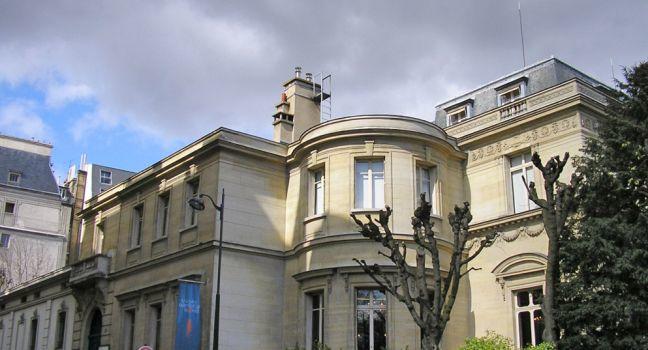
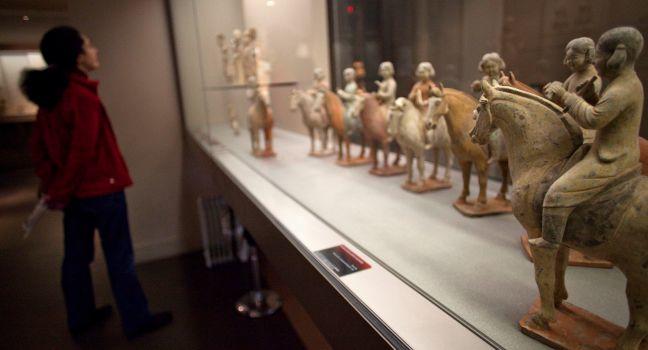
Wealthy Milanese banker and patriot Enrico (Henri) Cernuschi fled to Paris in 1850 after the new Italian government collapsed, only to be arrested during the 1871 Paris Commune. He subsequently decided to wait out the unrest by traveling and collecting Asian art. Upon his return 18 months later, he had a special mansion built on the edge of Parc Monceau to house his treasures, notably a two-story bronze Buddha from Japan. Reopened in 2020 after restoration, France's second-most-important collection of Asian art, after the Musée Guimet, expanded its galleries to include objects never before displayed, widening the collection to include more works from Japan, Korea, and Vietnam. Cernuschi had an eye not only for the bronze pieces he adored but also for Neolithic pottery (8000 BC), mingqi tomb figures (AD 300–900), and an impressive array of terra-cotta figures from various dynasties. A collection highlight is La Tigresse, a bronze wine vessel in the shape of a roaring feline (11th century BC), purchased after Cernuschi's death. Although the museum is free, there is a charge for temporary exhibitions.

Musée d'Orsay

St-Germain-des-Prés Fodor's Choice
Galleries, Musee dOrsay, Paris, France
© Ross Brinkerhoff / Fodor’s Travel

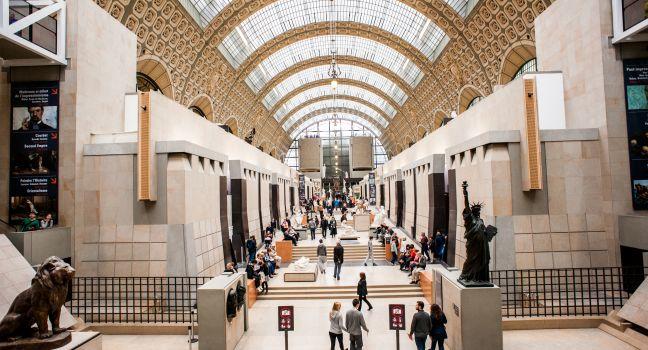
Opened in 1986, this gorgeously renovated Belle Époque train station displays a world-famous collection of Impressionist and Postimpressionist paintings on three floors. To visit the exhibits in a roughly chronological manner, start on the ground floor, take the escalators to the top, and end on the middle floor. If you came to see the biggest names here, head straight for the top floor and work your way down. English audio guides and free color-coded museum maps (both available just past the ticket booths) will help you plot your route.

Galleries off the first floor's main alley feature early works by Manet and Cézanne in addition to pieces by masters such as Delacroix and Ingres. The Pavillon Amont has Courbet's masterpieces L'Enterrement à Ornans and Un Atelier du Peintre. Hanging in Salle 14 is Édouard Manet's Olympia, a painting that pokes fun at the fashion for all things Greek and Roman (his nubile subject is a 19th-century courtesan, not a classical goddess). Impressionism gets going on the top floor, with iconic works by Degas, Pissarro, Sisley, and Renoir. Don't miss Monet's series on the cathedral at Rouen and, of course, samples of his water lilies. Other selections by these artists are housed in galleries on the ground floor. On the middle floor, you'll find an exquisite collection of sculpture as well as Art Nouveau furniture and decorative objects. There are rare surviving works by Hector Guimard (designer of the swooping green Paris métro entrances), plus Lalique and Tiffany glassware. Postimpressionist galleries include work by van Gogh and Gauguin, while Neo-Impressionist galleries highlight Seurat and Signac. The museum also regularly curates large, temporary exhibits of major historic artists.

To avoid the lines here, which are among the worst in Paris, book ahead online or buy a Museum Pass, then go directly to Entrance A2 for tickets with time slots or C1 if you have a museum pass (guards will help direct you). Otherwise, go early. Thursday evening the museum is open until 9:45 pm and is less crowded from 5 pm until closing. Don't miss the views of Sacré-Coeur from the balcony—this is the Paris that inspired the Impressionists. The museum has several restaurants and cafés; Café Cabana's views of the city through the ex-train station's giant clock face are legendary. The Musée d'Orsay is closed Monday, unlike the Louvre, which is closed Tuesday.

1 rue de la Légion d'Honneur, Paris, 75007, France
01–40–49–48–14
Sight Details
€16; €25 combined ticket with Musée Rodin
Closed Mon.

Something incorrect in this review?

Recommended Fodor's Video

Musée Guimet

Challiot Fodor's Choice
Musee Guimet, Paris
David Monniaux [CC BY-SA 3.0], via Wikimedia Commons

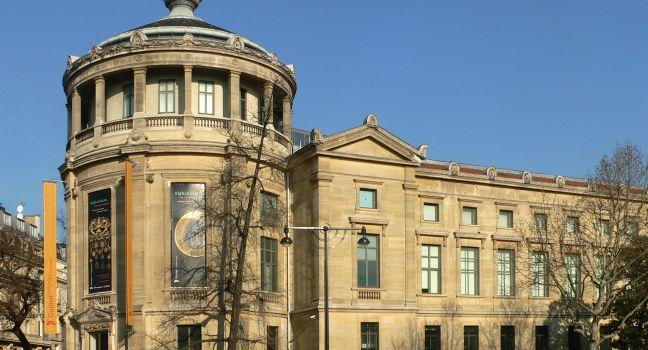
The outstanding Musée Guimet boasts the Western world's biggest collection of Asian art, thanks to the 19th-century wanderings of Lyonnaise industrialist Émile Guimet. Exhibits, enriched by the state's vast holdings, are laid out geographically in airy, light-filled rooms. Just past the entry is the largest assemblage of Khmer sculpture outside Cambodia. The second floor has statuary and masks from Nepal, ritual funerary art from Tibet, and jewelry and fabrics from India. Peek into the library rotunda, where Monsieur Guimet once entertained the city's notables; Mata Hari danced here in 1905, and the museum still hosts an impressive series of musical events. The much-heralded Chinese collection, made up of 20,000-odd objects, covers seven millennia. Recently restored and reopened, the Panthéon Bouddhique, in the Hôtel d'Heidelbach a few steps from the museum, houses Émile Guimet's collection of Japanese and Chinese works of art collected during his travels and arranged as they would appear in Buddhist temples. In the mansion's Japanese garden, authentic tea ceremonies are held in a pavilion built in the traditional Japanese style. Grab a free brochure at the museum entrance, and stop at the Salon des Porcelaines café on the lower level for a ginger milkshake or an Asian-influenced meal. The museum also has a charming bookstore. The Guimet's offshoot, the Musée d'Ennery, is housed in a Belle Époque mansion on Avenue Foch and is noted for its collection of Japanese netsuke, as well as 7,000 works of Chinese and Japanese art.

6 pl. d'Iéna, Paris, 75016, France
01–56–52–54–33
Sight Details
€13
Closed Tues.

Something incorrect in this review?

Musée Jacquemart-André

Grands Boulevards Fodor's Choice
Musee Jacquemart-André, Paris
Musée Jacquemart André, Paris by

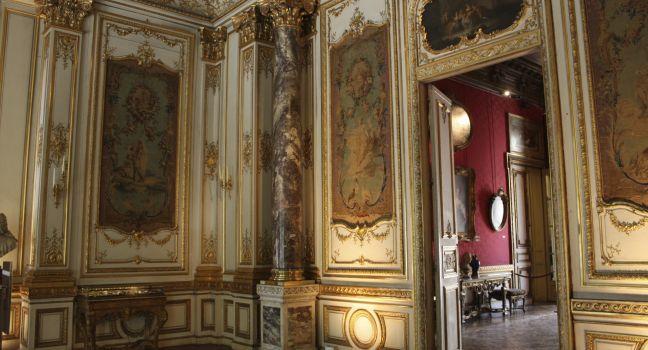
Among the city's best small museums, the opulent Musée Jacquemart-André is home to a huge collection of art and furnishings lovingly assembled in the late 19th century by banking heir Edouard André and his artist wife, Nélie Jacquemart, when this was their home. Their midlife marriage in 1881 raised eyebrows—he was a dashing bachelor and a Protestant, and she, no great beauty, hailed from a modest Catholic family. Still, theirs was a happy union fused by a common passion for art. For six months every year, the couple traveled, most often to Italy, where they hunted down works from the Renaissance, their preferred period, and prominently displayed them in their home. Their collection also includes masterworks by French painters Fragonard, Jacques-Louis David, and François Boucher, plus Dutch masters van Dyck and Rembrandt. The Belle Époque mansion itself is a major attraction. Its elegant ballroom, equipped with collapsible walls operated by then-state-of-the-art hydraulics, could hold 1,000 guests. The winter garden was a wonder of its day, spilling into the fumoir, where André would share cigars with the grands hommes (important men) of the time. You can tour the separate bedrooms—his in dusty pink, hers in pale yellow. The former dining room, now an elegant café, features a ceiling by Tiepolo. Don't forget to pick up the free audio guide in English, and do inquire about the current temporary exhibition, which is always world-class. Plan on a Sunday visit, and enjoy the popular brunch (€32) in the café from 11 am to 2:30 pm. Reservations are not accepted, so come early or late to avoid waiting in line.

Musée Jean Cocteau

Fodor's Choice
Musée Jean Cocteau à Menton
Musée Jean Cocteau à Menton by C D _Fr

On the waterfront opposite the market, a squat medieval bastion crowned with four tiny watchtowers houses this extraordinary museum, France's memorial to the eponymous artist-poet-filmmaker (1889–1963). Cocteau spotted the fortress, built in 1636 to defend the port, as the perfect site for a group of his works. The museum has nearly 1,800 oeuvres graphiques, and about 990 are original Cocteaus, a donation from the late California businessman and Holocaust survivor Severin Wunderman's personal collection. This is a must-see.

Musée Marmottan Monet

Western Paris Fodor's Choice
Musee Marmottan-Monet
Musée Marmottan-Monet by Daniela Ionesco

This underrated museum has the largest collection of Monet's work anywhere. More than 100 pieces, donated by his son Michel, occupy a specially built basement gallery in an elegant 19th-century mansion, which was once the hunting lodge of the duke de Valmy. You can find such works as the Cathédrale de Rouen series (1892–96) and Impression: Soleil Levant (Impression: Sunrise), 1872, the painting that helped give the Impressionist movement its name. Other exhibits include letters exchanged by Impressionist painters Berthe Morisot and Mary Cassatt. Upstairs, the mansion still feels like a graciously decorated residence. Empire furnishings fill the salons overlooking the Jardin du Ranelagh on one side and the private yard on the other. There's also a captivating room of illuminated medieval manuscripts. To best understand the collection's context, pick up an English-language audio guide (€4) on your way in.

2 rue Louis-Boilly, Paris, 75016, France
01–44–96–50–33
Sight Details
€14
Closed Mon.

Something incorrect in this review?

Musée Matisse

Cimiez Fodor's Choice
Matisse Museum, Nice, France.
Corentin / Shutterstock

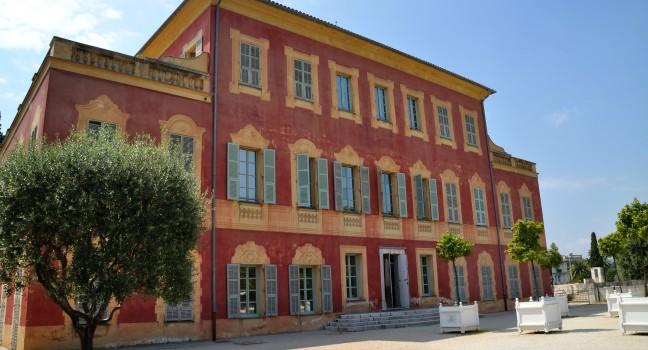
In the 1960s, the city of Nice bought this lovely, light-bathed, 17th-century villa, surrounded by the ruins of Roman civilization, and restored it to house a large collection of Henri Matisse's works. The Fauvist artist settled along Nice's waterfront in 1917, seeking a sun cure after a bout with pneumonia, and remained here until his death in 1954. During his years on the French Riviera, Matisse maintained intense friendships and artistic liaisons with Renoir, who lived in Cagnes, and with Picasso, who lived in Mougins and Antibes. He eventually moved up to the rarefied isolation of Cimiez and took an apartment in the Hôtel Regina (now an apartment building, just across from the museum), where he lived out the rest of his life. He walked often in the parklands around the Roman remains and was buried in an olive grove outside the Cimiez cemetery.

The museum's collection includes several pieces the artist donated to the city before his death; the rest were donated by his family. In every medium and context—paintings, gouache cutouts, engravings, and book illustrations—the collection represents the evolution of his art, from Cézanne-like still lifes to exuberant dancing paper dolls. Even the furniture and accessories speak of Matisse, from the Chinese vases to the bold-printed fabrics with which he surrounded himself. A series of telling black-and-white photographs captures the artist at work.  You can't enter the museum with a backpack or travel bag, so have a €1 coin handy for a locker.

Musée National Picasso-Paris

Marais Quarter Fodor's Choice
Entrance to Picasso Museum in Paris.
imagesbytakache/Shutterstock

Home to the world’s largest public collection of Picasso’s inimitable oeuvre, this spectacular museum covers almost 54,000 square feet in two buildings: the splendid 17th-century Hôtel Salé and a sprawling structure in the back garden dedicated to temporary exhibitions. Diego Giacometti’s exclusively designed furnishings in the former are a bonus. The 200,000-plus paintings, sculptures, drawings, documents, and other archival materials (most of them donated to the City of Paris by Picasso or his family members) span the artist's entire career. Although it doesn't include his most recognizable works, it does contain many of the pieces Picasso himself treasured most. The first two floors cover his work from 1895 to 1972. The top floor illustrates his relationship to his favorite artists: landscapes, nudes, portraits, and still life works taken from his private collection detail his "artistic dialogue" with Cézanne, Gauguin, Degas, Rousseau, Matisse, Braque, Renoir, Modigliani, Miró, and others. The basement centers on Picasso’s workshops, with photographs, engravings, paintings, and sculptures that document or evoke key pieces created at the Bateau Lavoir, Château de Boisgeloup, Grands-Augustins, Villa La Californie, and his farmhouse, Notre-Dame-de-Vie, in Mougins. With excellent temporary exhibitions and plenty of multimedia components and activities that cater to kids, this is ideal for children and adult art lovers alike. Buy tickets online well in advance of your planned visit. Also, try to avoid visiting on weekends, when the crowds are largest.

Bourse de Commerce–Collection Pinault Paris

Louvre Fodor's Choice

After years of false starts, tycoon François Pinault is now showcasing his billion-dollar trove of contemporary works by bold-faced names such as Mark Rothko and Damien Hirst under the historic iron-and-glass dome of the 19th-century Commerce Exchange, one of the city's most stunning, if underused, buildings. After losing a previous bid to open a museum outside Paris and taking his works to Venice instead, Gucci owner Pinault could only watch as archrival Bernard Arnault opened his Frank Gehry–designed Fondation Louis Vuitton in 2014. Not one to be outdone, Pinault tapped star Japanese architect Tadao Ando to carry out a nearly $140 million redesign of Paris' former grain exchange in 2017. Inside, four levels of exhibition space spiral skyward along a giant concrete cylinder ringed at the top by a walkway offering a bird's-eye view of the galleries below. The sparsity of the collections only contributes to the spaceship-like appeal of the contemporary renovation, with a handful of 19th-century details remaining: double-helix stone staircases, wooden display cases dating to 1889, the engine room on the lower level, and the realist mural adorning the underside of the dome, displaying seasonal panoramas of French traders engaged in commerce with the rest of the world. Paris Mayor Anne Hidalgo, who supplied a 50-year lease, called Pinault's creation an "immense gift" to the city. Free 20-minute tours depart daily from the ground-floor level; on the hour, tours explore the collection, while on the half-hour, they delve into the history and architecture of the building. A children's area allows kids to engage with a tour guide, discovering the collection by way of games and books, while the Halle aux Grains restaurant from Michelin-starred father-and-son team Michel and Sébastien Bras allows you to discover a tasting menu in three, five, or seven courses or an à la carte selection of upscale, contemporary French specialties. Don't miss the 100-foot-tall Medici Column on the back side of the building. It was once the stargazing perch of Marie de Medici's powerful astrologer, Cosimo Ruggieri. Legend has it that on stormy nights, a silhouetted figure can be seen in the metal cage at the top.

Centre Pompidou-Metz

Fodor's Choice

Opened in 2010, this offshoot of the famed Parisian museum is one of the city’s biggest pulls. It features similarly bold architecture: its roof is composed of a shell-like white fiberglass membrane held in place by an intricate network of wooden lattices. Light passes through the roof and through the huge picture windows in the galleries, bathing the interior in an ambience of airy luminosity. The eclectic temporary exhibitions are themed or monographic, showcasing the work of modern and contemporary artists.

Château de Chantilly

Fodor's Choice

Although its lavish exterior may be 19th-century Renaissance pastiche, the Château de Chantilly, sitting snugly behind an artificial lake, houses the outstanding Musée Condé, with illuminated medieval manuscripts, tapestries, furniture, and paintings. The most famous room, the Santuario (sanctuary), contains two celebrated works by Italian painter Raphael (1483–1520)—the Three Graces and the Orleans Virgin—plus an exquisite ensemble of 15th-century miniatures by the most illustrious French painter of his time, Jean Fouquet (1420–81). Farther on, in the Cabinet des Livres (library), is the world-famous Book of Hours, whose title translates as The Very Rich Hours of the Duc de Berry. It was illuminated by the Brothers Limbourg with magical pictures of early-15th-century life as lived by one of Burgundy's richest lords; unfortunately, due to their fragility, painted facsimiles of the celebrated calendar illuminations are on display, not the actual pages of the book. Other highlights of this unusual museum are the Galerie de Psyché (Psyche Gallery), with 16th-century stained glass and portrait drawings by Flemish artist Jean Clouet II; the Chapelle, with sculptures by Jean Goujon and Jacques Sarrazin; and the extensive collection of paintings by 19th-century French artists, headed by Jean-Auguste-Dominique Ingres. In addition, there are grand and smaller salons, all stuffed with palace furniture, family portraits, and Sèvres porcelains, making this a must for lovers of the decorative and applied arts.

Domaine de Chantilly, Chantilly, 60500, France
03–44–27–31–80
Sight Details
€18, includes Grandes Écuries and park
Closed Tues. in Nov.–Mar.

Something incorrect in this review?

Collection Lambert

Fodor's Choice

Housed in two elegant 17th-century mansions, this impressive assembly of contemporary artworks came out of the private collection of Paris art dealer Yvon Lambert, who founded the museum in 2000 in honor of Avignon's designation as European Capital of Culture. The museum is known both for the breadth of its collection—more than 1,200 pieces dating from the 1960s to the present—and the scope of its three to four major exhibitions per year, as well as its cultural events, lectures, and arts eduction programs, done independently or in conjunction with other arts institutions worldwide. The foundation closes three months out of the year between exhibitions, so be sure to check before going. The impressive bookshop carries dozens of original, limited-edition works by artists represented in the collection, including prints by Cy Twombly, Sol LeWitt, and Jenny Holzer, and the breezy courtyard café offers gourmet snacks, beverages, and light lunches under the shade of sleepy plane trees.

Femmes Artistes Musée Mougins

Fodor's Choice

This museum, which replaced the Mougins Museum of Classic Art, has heralded a female-forward artistic focus. Around a hundred works created by nearly 90 female artists from around the world are on display. The four floors house paintings, sculptures, and photographs by major artists—Barbara Hepworth, Frida Kahlo, Berthe Morisot, Blanche Hoschedé-Monet, and Tracey Emin—who have shaped key artistic movements from Impressionism to 21st-century contemporary art.

32 rue Commandeur, Mougins, 06250, France
04–93–75–18–22
Sight Details
€16

Something incorrect in this review?

Fondation Henri Cartier-Bresson

Marais Quarter Fodor's Choice

Henri Cartier-Bresson, the legendary artist-photojournalist and co-creator of the Magnum photo agency, launched this foundation with his wife Martine Franck, a British-Belgian portrait and documentary photographer, and their daughter Melanie. The soaring, light-filled gallery showcases a collection of 50,000 original prints along with an exceptional series of solo exhibitions from notable photographers. The foundation's bookstore itself is a draw for photography buffs.

Fondation Louis Vuitton

Western Paris Fodor's Choice

Rising up out of the Bois de Boulogne like a magnificent ship sporting billowing crystal sails, Frank Gehry’s contemporary-art museum and cultural center is the most captivating addition to the Parisian skyline since the unveiling of the Centre Pompidou in 1977. Commissioned by Bernard Arnault (chairman and CEO of luxury-goods conglomerate LVMH), the museum, which opened in 2014, houses Arnault’s substantial private collection, including pieces by Pierre Huyghe, Gerhard Richter, Thomas Schütte, Ellsworth Kelly, Bertrand Lavier, Taryn Simon, Sarah Morris, and Christian Boltanski, among others. La Fondation Louis Vuitton also hosts extensive temporary exhibitions, like the mesmerizing light installations of Danish-Icelandic artist Olafur Eliasson. Le Frank, the pricey on-site restaurant overseen by Michelin-starred chef Jean-Louis Nomicos, is noted for its sophisticated mix of French and international cuisine. The museum is a 12-minute walk from Les Sablons métro on Line 1; alternatively, you can catch the Fondation shuttle (€2 for a return ticket), which leaves every 10–15 minutes from Avenue de Friedland at Place de l’Étoile.

Fondation Maeght

Fodor's Choice

Many people come to St-Paul-de-Vence just to visit France’s most important private art foundation, founded in 1964 by art dealer Aimé Maeght. High above the medieval town, the small modern art museum attracts 200,000 visitors a year. It's an extraordinary marriage of the arc-and-plane architecture of Josep Sert; the looming sculptures of Miró, Moore, and Giacometti; the mural mosaics of Chagall; and the humbling hilltop setting, complete with pines, vines, and flowing planes of water.

On display is an intriguing and ever-varying parade of important works by modern masters, including Chagall's wise and funny late-life masterpiece La Vie (Life). Two newer extensions provide additional exhibition, performance, and conference space, as well as panoramic windows opening to the extensive grounds. The impressive vistas help to beguile even those who aren't into modern art. Café F, should you need time to reflect, is open year-round. Contact the tourist office for a private guided visit in English (€11 plus discounted admission rate of €14).

Fondation Vasarely

Fodor's Choice

As the father of "op-art," Victor Vasarely has taken his rightful place among the great artists of the later 20th century. A visit to this exhilarating museum, a short drive or bus ride (lines 2 and 20) from Aix center, will delight art lovers (even those who aren't fans of the genre) of all ages. The building itself is an architectural wonder, composed of 16 hexagonal galleries each housing six of the artist's monumental tapestries, mosaics, paintings, or sculptures. Upstairs, a detailed timeline of Vasarely's life and work reveals the versatility and genius of an artist both of and ahead of his time.

Maison Européenne de la Photographie

Marais Quarter Fodor's Choice

Much of the credit for the city's ascendancy as a hub of international photography goes to Maison Européenne de la Photographie (MEP). Set in a landmark 17th-century mansion with a contemporary addition, MEP hosts up to four simultaneous exhibitions, which change about every three months, along with theme visits, workshops, and programs for kids. Shows feature an international crop of photographers and video artists. Works by superstar Annie Leibovitz or the late designer-photographer Karl Lagerfeld may overlap with a collection of self-portraits by an up-and-coming artist, and there are also regular retrospectives of photos by Doisneau, Cartier-Bresson, Man Ray, and other classics from MEP's vast private collection. The center has an excellent library, bookstore, and a café that spills out into the courtyard in warm months. Programs are available in English, and English-language tours are sometimes offered.

5/7 rue de Fourcy, Paris, 75004, France
01–44–78–75–00
Sight Details
€13
Closed Mon., Tues., and between exhibitions

Something incorrect in this review?

Musée d'Art Moderne André-Malraux

Fodor's Choice

Occupying an innovative 1960s glass-and-metal building, the city's art museum has soaring plate-glass windows that bathe the interior in the famous sea light that drew scores of artists to Le Havre. Two local painters who gorgeously immortalized the Normandy coast are showcased here—Raoul Dufy (1877–1953), through a remarkable collection of his brightly colored oils, watercolors, and sketches; and Eugène Boudin (1824–98), a forerunner of Impressionism, whose compelling beach scenes and landscapes tellingly evoke the Normandy sea and skyline.

Musée de l'Orangerie

Louvre Fodor's Choice

In high season, the lines to see Claude Monet's massive, meditative Water Lilies (Les Nymphéas) can stretch into the pretty Tuileries Gardens, but the paintings are well worth the wait. These works, displayed in two curved galleries designed in 1914 by the master himself, are the highlight of the Orangerie's small but excellent collection, which also features early-20th-century paintings by other Impressionist masters like Renoir, Cézanne, and Matisse. Many hail from the private holdings of high-powered art dealer Paul Guillaume (1891–1934), among them the dealer's portrait by Modigliani entitled Novo Pilota (New Pilot). Temporary exhibitions are typically quirky and well-curated. Originally built in 1852 to shelter orange trees, the long rectangular building, a twin of the Jeu de Paume across the garden, includes a portion of the city's 16th-century wall (you can see remnants on the lower floor). A small café and gift shop are here, too. Timed entrances, easily bookable online, are strongly recommended.

Jardin des Tuileries at Pl. de la Concorde, Paris, 75001, France
01–44–77–80–07
Sight Details
€12.50
Closed Tues.

Something incorrect in this review?

Musée des Beaux-Arts

Fodor's Choice

The centerpiece of this early-20th-century building, stunningly refurbished by architect Jean-Michel Wilmotte, is a vast ancient mosaic depicting a marriage ceremony that provides intriguing insights into the lifestyle of Roman aristocrats. Also in the varied collection are seven paintings devoted to Cleopatra by 18th-century Nîmes-born painter Natoire Italian, plus some fine Flemish, Dutch, and French works (notably Rubens's Portrait of a Monk and Giambono's The Mystic Marriage of St. Catherine).

23 rue de la Cite Foulc, Nîmes, 30000, France
04–66–76–71–82
Sight Details
€5
Closed Mon.

Something incorrect in this review?

Musée des Beaux-Arts–Palais Fesch

Fodor's Choice

This internationally recognized museum houses one of the most important collections from the Napoleonic era; it's undoubtedly one of the most significant displays in France of ancient Italian masterpieces spanning the 14th to 20th centuries. There are nearly 18,000 items, all part of an astounding inventory that belonged to Napoléon's uncle, Cardinal Fesch. Thanks to his nephew's military conquests, the cardinal was able to amass (steal, some would say) many celebrated old-master paintings, the most famous of which are now in Paris's Louvre. The museum's beautiful vaulted corridors showcase 700 paintings, portraits, still lifes, and sculptures from the First and Second Empire from the French school. Don't miss the gallery with engravings and drawings depicting historic Corsica. The building itself, constructed by the cardinal as the Institute of Arts and Sciences, dates back to 1837.

50–52 rue Cardinal Fesch, Ajaccio, 20000, France
04–95–26–26–26
Sight Details
€8 (includes Chapelle Impériale)

Something incorrect in this review?

Musée des Impressionnismes

Fodor's Choice

After touring the painterly grounds of Monet's house, you may wish to see some real paintings at the Musée des Impressionnismes. Originally endowed by the late Chicago art patrons Daniel and Judith Terra, it featured a few works by the American Impressionists, including Willard Metcalf, Louis Ritter, Theodore Wendel, and John Leslie Breck, who flocked to Giverny to study at the hand of the master. But in recent years the museum has extended its scope with an exciting array of exhibitions that explore the origins, geographical diversity, and wide-ranging influences of Impressionism—in the process highlighting the importance of Giverny and the Seine Valley in the history of the movement. There's an on-site restaurant and salon de thé (tearoom) with a fine outdoor terrace, as well as a garden "quoting" some of Monet's plant compositions. Farther down the road, you can visit Giverny's landmark Hôtel Baudy, a restaurant that was once the preferred watering hole of many 19th-century artists.

99 rue Claude Monet, Giverny, 27620, France
02–32–51–94–65
Sight Details
€12
Closed early Nov.–late-Mar.

Something incorrect in this review?

Musée d’Ennery

Western Paris Fodor's Choice

This museum—a branch of the Musée Guimet since 1943—is one of Paris’s best-kept secrets, a thrilling collection of Japanese and Chinese objects d’art. The stately rooms remain largely as they were when Clémence d’Ennery, a former actress and wife of an eminent Parisian playwright, amassed these treasures in her elegant Belle Époque mansion in the late 19th and early 20th centuries. Though open to the public since 1908, it remains largely off the radar, since, until now, the museum has accepted extremely limited visitors by appointment only. Whether you’re a fan of Asian art or not, it’s well worth a trip to tony Avenue Foch to view the more than 7,000 objects on display, including hundreds of delightful netsuke figurines, sculptures, lacquerware, ceramics, inlaid furniture, and porcelains. Items are arranged in carved wooden cases among marble columns and gilded neoclassical woodwork. Purchase your ticket for the guided tour (in French and only on Fridays and Saturdays) in advance on the Musée Guimet website.

Musée Granet

Fodor's Choice

Once the École de Dessin (Art School) that granted Cézanne a second-place prize in 1856, the former priory of the Église St-Jean-de-Malte now showcases eight of Cézanne's paintings, as well as a nice collection of his watercolors and drawings. Also hanging in the galleries are 300 works by Bonnard, Picasso, Klee, Rubens, David, and Giacometti.

Musée Picasso

Fodor's Choice

Rising high over the water, this museum is set in the stunning medieval Château Grimaldi. As rulers of Monaco, the Grimaldi family lived here until the revolution; this fine old castle, however, was little more than a monument until its curator offered use of its chambers to Picasso in 1946, when that extraordinary genius was enjoying a period of intense creative energy. The result was a bounty of exhilarating paintings, ceramics, and lithographs inspired by the sea and by Greek mythology—all very Mediterranean. The château, which became the museum in 1966, houses some 245 works by the artist (but not all are on display), as well as pieces by Miró, Calder, and Léger. The first floor displays more than 100 paintings by Russian-born artist Nicolas de Staël. Download the Picasso Antibes app before your visit.

Pl. Mariejol, Antibes, 06600, France
04–92–90–54–28
Sight Details
€12
Closed Mon.

Something incorrect in this review?

Musée Rodin

Invalides Fodor's Choice

Sculptor Auguste Rodin (1840–1917) briefly made his home and studio in the Hôtel Biron, a magnificent 18th-century mansion that now houses this museum dedicated to his work. He died rich and famous, but many of the works that earned him a place in art history were originally greeted with contempt by the general public, which was unprepared for his powerful brand of sexuality and raw physicality.

Most of Rodin's best-known sculptures are in the gardens. The front one is dominated by The Gates of Hell (circa 1880), which illustrates stories from Dante's Divine Comedy. Rodin worked on the sculpture for more than 30 years, and it served as a "sketch pad" for many of his later works: you can see miniature versions of The Kiss (bottom right), The Thinker (top center), and The Three Shades (top center). The museum also showcases long-neglected models, plasters, and paintings, which offer insight into Rodin’s creative process. Pieces by other artists from his personal collection are on display as well—including paintings by van Gogh, Renoir, and Monet. A room is devoted to works by Camille Claudel (1864–1943), his student and longtime lover, herself a widely acclaimed sculptor. An English audio guide (€6.50) is available for the permanent collection and for temporary exhibitions.  Tickets can be purchased online for priority access. If you wish to linger, L'Augustine café serves meals and snacks indoors or outdoors under the garden's linden trees. The fine museum boutique sells quality gifts and objects d'art, such as reproductions of some of the master's most famous sculptures made from the original molds.

77 rue de Varenne, Paris, 75007, France
01–44–18–61–10
Sight Details
€14 ; €25 combined ticket with Musée d'Orsay
Closed Mon.

Something incorrect in this review?

Musée Toulouse-Lautrec

Fodor's Choice

In a garden designed by the renowned André Le Nôtre, creator of the "green geometries" at Versailles, the landmark Palais de la Berbie (Berbie Palace), between the cathedral and the Pont Vieux (Old Bridge), is the setting for this exceptional museum. Built in 1265 as a residence for Albi's archbishops, the fortresslike structure was transformed in 1922 into a museum to honor Albi's most celebrated son, Belle Époque painter Henri de Toulouse-Lautrec (1864–1901). Toulouse-Lautrec left Albi for Paris in 1882 and soon became famous for his colorful, tumultuous evocations of the lifestyle of bohemian glamour found in and around Montmartre. Son of a wealthy and aristocratic family (Lautrec is a village not far from Toulouse), the young Henri suffered from a genetic bone deficiency and broke both legs as a child, which stunted his growth. But it was the artist's fascination with the decadent side of life that led him to an early grave at the age of 37. The museum's collection of artworks—more than a thousand, representing the world's largest Toulouse-Lautrec corpus—has been deftly organized into theme rooms, including galleries devoted to some of his greatest portraits and scenes from Paris's maisons closées (brothels), with paintings stylishly hung amid the palace's brick ogival arches. There are other masterworks here, including paintings by Georges de la Tour and Francesco Guardi.

Musée Unterlinden

Fodor's Choice

The cultural highlight of Colmar is the Musée d'Unterlinden; once a Dominican convent and a hotbed of Rhenish mysticism, the building's star attraction is one of the greatest altarpieces of the 16th century, the Retable d'Issenheim (1512–16), by Matthias Grünewald, which is displayed in the convent's Gothic chapel. Originally painted for the convent at Issenheim, 22 km (14 miles) south of Colmar, the multipanel work is either the last gasp of medievalism or a breathtaking preview of modernism and all its neuroses. Replete with raw realism (note the chamber pots, boil-covered bellies, and dirty linen), Grünewald's altarpiece was believed to have miraculous healing powers over ergotism. Widespread in the Middle Ages, this malady was caused by ingesting fungus-ridden grains, and its victims—many of whom were being nursed at the Issenheim convent—experienced delusional, nearly hallucinogenic fantasies.

\n

Arms and armor are among the treasures in the enchanting 13th-century cloister. Upstairs are fine regional furnishings and a collection of Rhine Valley paintings from the Renaissance, among them Martin Schongauer's opulent 1470 altarpiece painted for Jean d'Orlier. A copper-roofed wing has three floors dedicated to modern and contemporary art (including the Guernica tapestry by Jacqueline de La Baume-Dürbach), as well as temporary exhibition space.