
871 Best Sights in England

Background Illustration for Sights

We've compiled the best of the best in England - browse our top choices for the top things to see or do during your stay.

Winchester Cathedral

Fodor's Choice

The imposing Norman exterior of the city's greatest monument, begun in 1079 and consecrated in 1093, makes the Gothic airiness within even more breathtaking. It's one of the largest cathedrals in Europe, and throughout it are outstanding examples of every major architectural style from the 11th to 16th century: the transepts and crypt are 11th-century Romanesque; the great nave, the longest in Europe, is 14th- and 15th-century Perpendicular Gothic; and the presbytery (behind the choir, holding the high altar) is 14th-century Decorated Gothic. Other notable features include the richly carved 14th-century choir stalls, the ornate 15th-century stone screen behind the high altar, and the largest surviving spread of 13th-century floor tiles in England. Little of the original stained glass has survived, except in the large window over the entrance. When Cromwell's troops ransacked the cathedral in the 17th century, locals hid away bits of stained glass they found on the ground so that it could later be replaced. The Library's Winchester Bible, one of the finest remaining 12th-century illuminated manuscripts, is on display in an exhibition space in the South Transept, which also hosts the Kings and Scribes exhibition tracing the history of the cathedral. 

The patron saint of the cathedral is St. Swithun (died AD 862), an Anglo-Saxon bishop who is buried here. He had requested an outdoor burial plot, but his body was transferred to the newly restored church in 971, accompanied by, legend has it, 40 days of rain. Since then, folklore says that rain on St. Swithun's Day (July 15) means 40 more days of wet weather. Among the other well-known people buried here are William the Conqueror's son, William II ("Rufus"), mysteriously murdered in the New Forest in 1100, and Jane Austen, whose grave lies in the north aisle of the nave. The tombstone makes no mention of Austen's literary status, though a brass plaque in the wall, dating from 80 years after her death, celebrates her achievements, and modern panels provide an overview of her life and work. Free first-come, first-served tours are run year-round, Monday through Saturday, from 10 am to 3 pm, depending on volunteer availability. You can also book a tour of  the tower to check out its far-reaching views. Special events may mean the cathedral, the crypt, and the Treasury are closed to visits, so check the website. Outside the cathedral, explore the Close (the neat lawns to the south of the cathedral), the Deanery, Dome Alley, and Cheyney Court.
Windermere Jetty Museum

Fodor's Choice

Right beside the lake, the museum houses the world's finest collection of Victorian and Edwardian steam- and motor-powered yachts and launches. Displays about Windermere's nautical history include the famous names of motorboat racing on the lake. The Dolly, built around 1850, is one of the two oldest mechanically powered boats in the world. Among the many other vessels on view are Beatrix Potter's rowing boat and a dinghy that belonged to Arthur Ransome. From April through October, you can take a boat ride on Windermere in an antique vessel—the cost is included in the ticket price.

Windsor Castle

Fodor's Choice

From William the Conqueror to Queen Victoria, the kings and queens of England added towers and wings to this brooding, imposing castle. Visible for miles—though the most impressive view is from the A332, coming into town from the south—it's the world's largest inhabited castle and the only residence in continuous use by the British Royal Family since the Middle Ages. Despite the many hands involved in its design, the palace manages to have a unity of style and character.

As you enter, Henry VIII's gateway leads uphill into the wide castle precincts, where you're free to wander. Across from the entrance is the exquisite St. George's Chapel (closed Sunday). Here lie 10 of the kings of England, including Henry VI, Charles I, and Henry VIII (Jane Seymour is the only one of his six wives buried here) along with one very famous queen; the chapel is the last resting place of Queen Elizabeth II and her husband Prince Phillip. One of England's noblest buildings, the chapel was built in the Perpendicular style popular in the 15th and 16th centuries, with elegant stained-glass windows, a vaulted ceiling, and intricately carved choir stalls. The colorful heraldic banners of the Knights of the Garter—the oldest British Order of Chivalry, founded by Edward III in 1348—hang in the choir. The ceremony in which the knights are installed as members of the order has been held here with much pageantry for more than five centuries. The elaborate Albert Memorial Chapel was created by Queen Victoria in memory of her husband.

The North Terrace provides especially good views across the Thames to Eton College, perhaps the most famous of Britain's exclusive public schools (confusingly, "public schools" in Britain are highly traditional, top-tier private schools). From the terrace, you enter the State Apartments, which are open to the public most days. On display to the left of the entrance to the State Apartments, Queen Mary's Dolls' House is a perfect miniature Georgian palace-within-a-palace, created in 1923. Electric lights glow, the doors all have tiny keys, and a miniature library holds Lilliputian-size books written especially for the young queen by famous authors of the 1920s. Five cars, including a Daimler and Rolls-Royce, stand at the ready. In the adjacent corridor are exquisite French couturier–designed costumes made for the two Jumeau dolls presented to the Princesses Elizabeth and Margaret by France in 1938.

Although a fire in 1992 gutted some of the State Apartments, hardly any works of art were lost. Phenomenal repair work brought to new life the Grand Reception Room, the Green and Crimson Drawing Rooms, and the State and Octagonal Dining Rooms. A green oak hammer-beam (a short horizontal beam that projects from the tops of walls for support) roof looms magnificently over the 600-year-old St. George's Hall, where the late Queen Elizabeth frequently hosted state banquets. The State Apartments contain priceless furniture, including a magnificent Louis XVI bed and Gobelin tapestries; carvings by Grinling Gibbons; and paintings by Canaletto, Rubens, van Dyck, Holbein, Dürer, and Bruegel. The tour's high points are the Throne Room and the Waterloo Chamber, where Sir Thomas Lawrence's portraits of Napoléon's victorious foes line the walls. You can also see arms and armor—look for Henry VIII's ample suit. A visit October to March also includes the Semi-State rooms, the private apartments of George IV, resplendent with gilded ceilings.

To see the castle come magnificently alive, check out the Changing the Guard ceremony, which takes place daily at 11 April to July and on alternate days at the same time August to March. Confirm the exact schedule before traveling to Windsor. Note that the State rooms (and sometimes the entire castle) are closed during official state occasions; dates of these closures are listed on the website, or you can call ahead to check. Admission includes an audio guide and, if you wish, a guided tour of the castle precincts. Entrance lines can be long in season, and you're likely to spend at least half a day here, so come early.

Castle Hill, Windsor, SL4 1NJ, England
0303-123–7304-for tickets
Sight Details
£30 in advance, £33 in-person for Precincts, State Apartments, Gallery, St. George's Chapel, and Queen Mary's Dolls' House
State Apartments closed at various times throughout the year; check ahead before visiting

Something incorrect in this review?

Recommended Fodor's Video

Windsor Great Park

Fodor's Choice

The remains of an ancient royal hunting forest, this park stretches for some 5,000 acres south of Windsor Castle. Much of it is open to the public and can be explored by car or on foot. Its chief attractions are clustered around the southeastern section, known (or at least marketed) as the Royal Landscape. These include Virginia Water, a 2-mile-long lake that forms the park's main geographical focal point. More than anything, however, the Royal Landscape is defined by its beautiful gardens. Valley Gardens, on the north shore of Virginia Water, is particularly vibrant in April and May, when the dazzling multicolor azaleas are in full bloom. If you're feeling fit, the romantic Long Walk is one of England's most photographed footpaths—the 3-mile-long route, designed by Charles II, starts in the Great Park and leads all the way to Windsor Castle.

Divided from the Great Park by the busy A308 highway, the smaller Windsor Home Park, on the eastern side of Windsor Castle, is the private property of the Royal Family. It contains Frogmore House, a lavish royal residence. Completed in 1684, Frogmore was bought by George III as a gift for his wife, Queen Charlotte. The sprawling white mansion later became a beloved retreat of Queen Victoria. It was also formerly home to the duke and duchess of Sussex, otherwise known as Prince Harry and Meghan Markle, and can still only be visited by guided tour on a handful of days throughout August; see  www.rct.uk for more information.

Entrances on A329, A332, B383, and Wick La., Windsor, TW20 0UU, England
01753-860222
Sight Details
Gardens £14.50 (advance ticket), £16.95 (on the day)

Something incorrect in this review?

Worcester Cathedral

Fodor's Choice

There are few more quintessentially English sights than that of Worcester Cathedral, its towers overlooking the green expanse of the county cricket ground and its majestic image reflected in the swift-flowing waters of the River Severn. A cathedral has stood on this site since 680, and much of what remains dates from the 13th and 14th centuries. Notable exceptions are the Norman crypt (built in the 1080s), the largest in England, and the ambulatory, a cloister built around the east end. The most important tomb in the cathedral is that of King John (1167–1216), one of the country’s least-admired monarchs. He alienated his barons and subjects through bad administration and heavy taxation, and, in 1215, was forced to sign that great charter of liberty, Magna Carta; it's worth joining one of the expert talks by his tomb.

Don't miss the beautiful decoration in the vaulted chantry chapel of Prince Arthur, Henry VIII's elder brother, whose body was brought to Worcester after his death at Ludlow in 1502. His death meant that Henry was heir to the throne, changing the course of English history. The medieval library (accessible only by prebooked tour; check website for occasional closures) holds around 300 medieval manuscripts, dating from the 10th century onward. The Three Choirs Festival, rotating between Worcester, Hereford, and Gloucester, takes place here every three years for a week in late July. Worcester is 8 miles north of Great Malvern.

8 College Yard, Worcester, WR1 2LA, England
01905-732900
Sight Details
Free, but suggested donation £7; cathedral tours £8; King John's Tomb talks £8; library tours from £10

Something incorrect in this review?

Wordsworth House and Garden

Fodor's Choice

Cockermouth was the birthplace of William Wordsworth and his sister, Dorothy, whose childhood home was this 18th-century town house, carefully kept as it would have been in their day. There is no sense of dusty preservation here, though, and nothing is roped off; the house achieves a rare sense of natural authenticity, with clutter and period cooking in the kitchen and herbs and vegetables growing outside in the traditional Georgian garden. A café makes good use of the homegrown produce. Enthusiastic staffers are both knowledgable and approachable, and the busy calendar of activities adds to the sense of a house still very much alive.

Yorkshire Sculpture Park

Fodor's Choice

This outdoor exhibition space near Wakefield is part of a former 18th-century estate encompassing more than 500 acres of fields, lakes, exotic trees, and rolling hills. The galleries in the park, garden, and three indoor spaces cut into a hillside are filled with a carefully curated collection that includes works by Henry Moore and Barbara Hepworth, as well as modern sculptors like Antony Gormley, Anthony Caro, and David Nash. A visitor center has a café, a self-service restaurant, a table-service restaurant, a gallery for temporary exhibitions, and information about the ecology and history of the estate. You can get here easily from Leeds by train or car.

Southbank Centre

South Bank Fodor's Choice

The public has never really warmed to the Southbank Centre's hulking concrete buildings (beloved by architecture aficionados), products of the Brutalist style popular when the Centre was built in the 1950s and '60s, but all the same they flock to the concerts, recitals, festivals, and exhibitions held here at Europe's largest arts center. The Royal Festival Hall is truly a People's Palace, with seats for 2,900 and a schedule that ranges from major symphony orchestras to pop stars (catch the annual summer Meltdown Festival, where artists like Patti Smith or David Byrne put together a personal selection of concerts by favorite performers). The smaller Queen Elizabeth Hall is more strictly classically oriented. It contains the smaller Purcell Room, which hosts lectures and chamber performances. For art, head to the Hayward Gallery, which hosts shows on top contemporary artists such as Anthony Gormley and Cy Twombly. (The terrace here has some restaurants worth a visit.) Not officially part of the Southbank Centre but moments away on the east side of Waterloo Bridge, the National Theatre is home to some of the best productions in London (several, such as War Horse, have become movies) at prices well below those in the West End. You can hear leading actors, directors, and writers discuss their work at the National Theatre's Platforms, a series of inexpensive early evening and afternoon talks. Meanwhile, film buffs will appreciate the BFI Southbank (formerly the National Film Theatre), which has a schedule that true cinema connoisseurs will relish. The Centre's riverside street level has a terrific assortment of restaurants and bars. The BFI's Benugo bar and the Wahaca restaurant at Queen Elizabeth Hall are particularly attractive. Note that the Hayward Gallery, Purcell Room, and Queen Elizabeth Hall have been closed for renovations but are due to open in late 2017.

The London Dungeon

South Bank
London Dungeon, South Bank, London, England.
Kjetilbjørnsrud / Kjetil Bjørnsrud, via Wikimedia Commons [CC BY-SA 3.0]

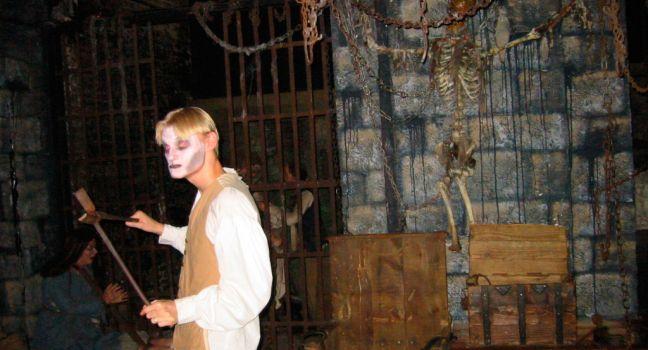
Saved by a keen sense of its own borderline ridiculousness, this gory attraction is full of over-the-top tableaux depicting the bloody demise of famous figures alongside the torture, murder, and ritual slaughter of lesser-known victims, all to a soundtrack of screaming, wailing, and agonized moaning. There are lively dramatizations about the Great Plague, Henry VIII, (the fictional) Sweeney Todd, and (the real) Jack the Ripper, just to name a few, with costumed characters leaping out of the gloom to bring the information to life and add to the fear and fun. There's also an Escape Room (make it and you won't be hanged) attraction. Perhaps most shocking are the crowds of children baying to get in: most kids absolutely love this place, although those with more a sensitive disposition may find it too frightening (that goes for adults as well). Expect long lines on weekends and during school holidays. Adults-only evening tours also include drinks. Tickets bought online and in advance can be up to 30% less than walk-up prices.

Tower Bridge

City of London
Tower Bridge, London,at sunset, span open.
Angelina Dimitrova / Shutterstock

Despite its medieval appearance, London's most famous bridge was actually built at the tail end of the Victorian era in the then-popular neo-Gothic style, first opening to traffic in 1894. With a latticed steel construction clad in Portland stone, the bridge is known for its enormous bascules—the 1,000-ton "arms" that open to allow ships taller than its normal 28-foot clearance to glide beneath. The steam-powered bascules were a marvel of Victorian engineering when they were created (you can still visit the Engine Rooms, now with explanatory films and interactive displays), and required 80 people to raise and lower. Initially, heavy river traffic meant this happened 20 to 30 times a day, but it's now reduced to a number of days per month, with greater frequency depending on the time of year (see the bridge's website for a schedule).

The family-friendly Tower Bridge Exhibition includes the ground-level Engine Room, displays in the North Tower documenting the bridge's history, access to the east and west walkways that run alongside the road between the turrets and provide views over the river and city, and for those untroubled by vertigo, a transparent walkway 138 feet up between the towers that lets you look down on the traffic or, if the bascules are raised, the ships below.

Tower Bridge Rd., London, SE1 2UP, England
020-7403–3761
Sight Details
From £12.30

Something incorrect in this review?

18 Stafford Terrace

Kensington

The home of Punch cartoonist Linley Sambourne in the 1870s, this charming house is a rare example of the "Aesthetic interior" style; it displays delightful Victorian and Edwardian antiques, fabrics, and paintings, as well as several samples of Sambourne's work for Punch. The Italianate house was the scene for society parties when Sambourne's granddaughter Anne Messel was in residence in the 1940s. This being Kensington, there's inevitably a royal connection: Messel's son, Antony Armstrong-Jones, was married to the late Princess Margaret, and their son has preserved the connection by taking the title Viscount Linley.

18 Stafford Terr., London, W8 7BH, England
0207-361–3783
Sight Details
£11; joint ticket with Leighton House £20
Closed Mon. and Tues.

Something incorrect in this review?

2 Willow Road

Hampstead

Among the many artists and intellectuals fleeing Nazi persecution who settled in the area was noted architect Ernö Goldfinger, who built this outstanding and influential modernist home opposite Hampstead Heath in 1939 as his family residence. (His plans drew the ire of several local residents, including novelist Ian Fleming, who supposedly got his revenge by naming the Bond villain after his neighbor.) Along with design touches and building techniques that were groundbreaking at the time, the unique house, a place of pilgrimage for 20th-century architecture enthusiasts, also contains Goldfinger's impressive collection of modern art and self-designed innovative furniture. Admission between 11 am and 2 pm is by hourly guided tour or you can embark on a self-guided tour at 3, 3:20, or 3:40. All must be booked in advance.

Aira Force

A spectacular 65-foot waterfall pounds under a stone bridge and through a wooded ravine to feed into Ullswater. From the parking lot it's a 10-minute walk to the falls, with more serious walks on Gowbarrow Fell and to the village of Dockray beyond. A 1¼-mile footpath allows visitors to leave their cars at Glencoyne Bay, to the south, and walk through a deer park. Bring sturdy shoes, especially in wet or icy weather, when the paths can be treacherous.

Just above Aira Force in the woods of Gowbarrow Park is the spot where, in 1802, William Wordsworth's sister, Dorothy, observed daffodils that, as she wrote, "tossed and reeled and danced and seemed as if they verily laughed with the wind that blew upon them." Two years later, Wordsworth transformed his sister's words into the famous poem "I Wandered Lonely as a Cloud." Today national park wardens patrol Gowbarrow Park in season to prevent people from picking the few remaining daffodils.

Albert Memorial

Kensington

After Prince Albert's early death from typhoid in 1861, his grieving widow, Queen Victoria, had Sir Gilbert Scott create this ornate, High Victorian Gothic tribute erected near the site of Albert's brainchild, the Great Exhibition of 1851. A 14-foot gilt-bronze statue of the prince (holding an Exhibition catalog) rests on a 15-foot-high pedestal, surrounded by marble figures representing his passions and interests. A frieze at the base depicts 187 exquisitely carved figures of well-known Victorian painters, poets, sculptors, musicians, and architects.

Kensington Gardens, London, SW7 2AP, England

Something incorrect in this review?

Alexander Keiller Museum and Avebury Manor

The Avebury Stone Circles are put into context at the museum, an English Heritage attraction, where Neolithic and Bronze Age artifacts from the site make up one of the country's most important prehistoric archaeological collections. Charts, photos, and models relating to the excavation of Avebury by the archaeologist Alexander Keiller in the 1930s are also on display. Exhibits are divided between the 17th-century Stables Gallery, which contains stone axes, flint tools, pottery shards, and other finds from Keiller's excavations, and an activity area where kids can dress up in Bronze Age clothes. (At this writing, the Barn Gallery is closed.) You can also visit the gardens of Avebury Manor (a National Trust property; house closed at this writing) where Keiller lived.

All Saints Church

Situated two miles east of Tonbridge in the little village of Tudeley, this modest 13th-century church holds one of the glories of 20th-century church art. The building is awash with the luminous yellows and blues of 12 windows by Marc Chagall (1887–1985), commissioned as a tribute by the family of a young girl who drowned in a sailing accident in 1963. To get here, take the A26 from Tonbridge, then continue a mile or so east along B2017.

Alnwick Castle

Sometimes called the "Windsor of the North," the imposing Alnwick Castle will likely provoke cries of "Hogwarts!" from younger visitors as it comes into view over the hill; the grounds appear as the exterior of the famous School of Witchcraft and Wizardry in the Harry Potter movies. Older visitors might also recognize it as Brancaster Castle from the TV series Downton Abbey. In reality, the castle is the ancestral home of the dukes of Northumberland, whose family, the Percys, dominated in the Northeast for centuries.

While the exterior is all imposing turrets and towers, the Italianate interiors are lavish and stately. Family photos and other knickknacks scattered around the state rooms are a subtle but pointed reminder that this is a family home, rather than a museum. Highlights include the extraordinary gun room, lined with hundreds of antique pistols arranged in swirling patterns; the formal dining room, its table set as if guests are due at any minute; and the magnificent galleried library, containing 14,000 books in floor-to-ceiling cases.

There's plenty here for kids, too. Join a free film tour to hear fascinating anecdotes from the filming of the first two Harry Potter films (as well as Transformers: The Last Knight, Robin Hood: Prince of Thieves, and many more). There are Potter–themed events on certain dates, including broomstick lessons on the exact spot used in the movie (check the website for the schedule). Elsewhere, Dragon Quest is a labyrinth designed to teach a bit of medieval history; there's have-a-go archery (weather permitting); and regular special events range from alchemy and wand-making to bird of prey displays and longbow demonstrations.

For the best views of the castle's dramatic exterior, follow the 20-minute Capability Brown Walk along the River Aln. Tickets are valid for one year, so you can come back if you don't see everything in a day. Keep in mind that many castle events are canceled in inclement weather (which isn't uncommon).

Off B6341, Alnwick, NE66 1NQ, England
01665-511100
Sight Details
£22.80
Closed Nov.–Mar.

Something incorrect in this review?

Althorp House

Deep in the heart of Northamptonshire sits the ancestral home of the Spencers, best known in recent years as the family home of Princess Diana. Here, on a tiny island in a lake known as the Round Oval, is Diana's final resting place. A lakeside temple is dedicated to her memory. The house has no permanent Diana exhibits, but it does have rooms filled with paintings by van Dyck, Reynolds, and Rubens—all portraits of the Spencers going back 500 years—and an entry hall that architectural historian Nikolaus Pevsner called "the noblest Georgian room in the country." Two paintings by contemporary artist Mitch Griffiths stand out in complete contrast.

On the west side of the estate park is Great Brington, the neighboring village where the church of St. Mary the Virgin holds the Spencer family crypt. It's best reached by the designated path from Althorp. The house and grounds are closed throughout the winter and open to the public in July and August. 

Rugby Rd., St. Albans, NN7 4HQ, England
01604-770006
Sight Details
House and grounds £27; grounds only £20
Closed Sept.–June

Something incorrect in this review?

Alum Bay Glass

In addition to being famous for sailing and its connections to Queen Victoria, the Isle of Wight is renowned for its glassmaking. Local craftspeople have given live demonstrations of glassblowing here since 1972. The perfume bottles, vases, bowls, doorknobs, ornaments, and other items they create are available for sale in the showroom.

The Amelia

Opened in 2022, this modern cultural centernamed after Amelia Scott, a local campaigner for women’s suffrage, and often referred to as "The Amelia Scott"—is home to a series of appealing museum and gallery spaces. You'll find everything from interactive history exhibits to Victorian-era toys to ever-changing art exhibitions. There's also an excellent children's library, a sculpture-filled garden, and a small café. The building is home to the town's tourist information office.

Mount Pleasant Rd., Royal Tunbridge Wells, TN1 1AW, England
01892-526121
Sight Details
Free

Something incorrect in this review?

American Museum & Gardens

A 19th-century Greek Revival mansion in a majestic setting on a hill 2½ miles southeast of the city holds the only museum of American decorative arts outside the United States. Rooms are furnished in historical styles, such as the 17th-century Conkey's Tavern, the elegant Greek Revival room, and the lavish, red New Orleans bedroom from the 1860s. Other galleries explore historical themes (the settlement of the West, the Civil War) or contain a large collection of quilts, as well as porcelain and Shaker objects; a separate building is devoted to folk art, including a fine collection of decoy wildfowl. The parkland includes a reproduction of George Washington's garden at Mount Vernon, and the New American Garden Project features many plants native to the United States. Take a bus headed to the University of Bath and get off at the Avenue, where signs point to the museum, half a mile away. The City Sightseeing bus also drops off here.

off A36, Bath, BA2 7BD, England
01225-460503
Sight Details
£16.50; gardens only £11
Closed Jan.--mid-Mar.

Something incorrect in this review?

Angel Hill

A walk here is a journey through the history of Bury St. Edmunds. Along one side, the Abbey Gate, Norman Gate Tower, and St. Mary's Church make up a continuous display of medieval architecture. Elegant Georgian houses line Angel Hill on the side opposite St. Mary's Church. These include the Athenaeum, an 18th-century social and cultural meeting place that has a fine Adam-style ballroom.

Angel Hill, Bury St. Edmunds, England

Something incorrect in this review?

Angel Hotel

This splendid, ivy-clad hotel was the location for Sam Weller's meeting with Job Trotter in Dickens's The Pickwick Papers. Dickens himself stayed here while he was giving readings at the nearby Athenaeum Hall. Now it's a great place to stop for lunch or afternoon tea.

3 Angel Hill, Bury St. Edmunds, IP33 1LT, England
01284-714000

Something incorrect in this review?

Anne of Cleves House

This 16th-century house, a fragile-looking, timber-frame building, was part of Anne of Cleves's divorce settlement from Henry VIIIalthough she never lived in it. Today, it offers a fascinating slice of high-class Tudor life, with well-preserved interiors including a kitchen, parlor, and a large bedroom divided into a Great Chamber with an antique four-poster bed and a smaller Hall Chamber. There's also the main hall (now the reception area and shop), a charming little Tudor garden, gallery spaces displaying collections of Sussex ironwork and pottery, and a room full of medieval dress-up clothes for kids. To get to the house from Lewes Castle and the High Street, walk down the steep, cobbled Keere Street past lovely Grange Gardens, then hang a right onto Southover High Street.

52 Southover High St., Lewes, BN7 1JA, England
01273-474610
Sight Details
£6.60; combined ticket with Lewes Castle £15
Closed Mon. and Nov.–Mar.

Something incorrect in this review?

Arlington Row

The town has a famously pretty and much-photographed group of 17th-century weavers' cottages made of stone.

Arlington Row, Bibury, GL7 5NJ, England

Something incorrect in this review?

The Armitt Museum

Ambleside's fine local museum is a scholarly place, focusing on influential German artist Kurt Schwitters (1887–1948) and Beatrix Potter. Schwitters lived out his final years in Ambleside, and the museum now has a room filled with his art. The museum also shows the less well-known aspects of Beatrix Potter, revealing her work as an important scientific and intellectual figure. Exhibits shed light on her as a naturalist, mycologist, sheep breeder, and conservationist. A large collection of her natural-history watercolors and a huge number of photographic portraits can be viewed by appointment in the excellent library upstairs.

Rydal Rd., Ambleside, LA22 9BL, England
01539-431212
Sight Details
£7
Closed Mon. and Tues. Apr.--Oct., Sun.--Tues. Nov.--Mar.

Something incorrect in this review?

Arundel Cathedral

This far-too-big-for-a-small-town Catholic cathedral in the French-Gothic style was commissioned by Henry, Duke of Norfolk in 1868 to celebrate his coming of age. Designed by Joseph Hansom (of hansom cab horse-drawn carriage fame), it opened in 1873. Stroll around the gorgeous interior, renowned for its signature stained-glass rose window and impressive 19th-century organ. Also look out for the roundels of Saxon saints high up on the walls of the aisles.

Ascot Racecourse

The races run regularly throughout the year, and Royal Ascot takes place annually in mid-June. Tickets for Royal Ascot generally go on sale in November, so buy them well in advance. Prices range from £25 for standing room on the heath to around £90 for seats in the stands. Parking costs £30 in advance or £35 on the day.

Assembly Rooms

In its role as the Assembly Rooms, this neoclassical building was one of the leading centers for social life in 18th-century Bath. Jane Austen came here often, and it's in the Ballroom that Catherine Morland has her first, disappointing encounter with Bath's beau monde in Northanger Abbey; the Octagon Room is the setting for an important encounter between Anne Elliot and Captain Wentworth in Persuasion. You might well recognize the Tea Room as the setting of Lady Danbury's ball, where Daphne and Simon first met in Bridgerton. Built by John Wood the Younger in 1771, the building was badly damaged by wartime bombing in 1942 but was faithfully restored. Its stunning chandeliers are 18th-century originals. Throughout the year, classical concerts are given here, just as they were in bygone days. The Fashion Museum was also in the building; it has closed and will reopen in a new location in 2030.

Athelhampton House and Gardens

Largely unchanged since it was built in 1485, this outstandingly well-preserved example of domestic Tudor architecture (with 16th- and 20th-century additions) turns up as "Athelhall" in some of Thomas Hardy's writings. (Hardy was a frequent visitor and his father, a stonemason, worked on roof repairs here.) Don't miss the Tudor-era Great Hall, still with its original linenfold paneling, heraldic stained glass, and vaulted hammer-beam timber roof. The paneled Library contains more than 3,000 books. Outside, 20 acres of grounds include eight formal walled gardens created in the 19th century and 12 yew pyramids, each 30 feet high.

Dorchester, DT2 7LG, England
01305-848363
Sight Details
House and gardens £19.50; gardens only £14.50

Something incorrect in this review?