
209 Best Sights in Czech Republic

Background Illustration for Sights

We've compiled the best of the best in Czech Republic - browse our top choices for the top things to see or do during your stay.

Památník Terezín – Malá pevnost

Fodor's Choice

The most powerful aspect of Terezín is that you don't need much imagination to visualize how it looked under Nazi rule. When it was a Jewish ghetto, more than 59,000 people were crammed into this camp. Terezín was actually an exception among the many Nazi concentration camps in Central Europe. The Germans, for a time, used it as a model city in order to deflect international criticism of Nazi policy toward the Jews. In the early years of the war—until as late as 1944—detainees had a semblance of a normal life, with limited self-rule, schools, a theater, and even a library. (Pictures drawn by the children at Terezín are on display in Prague's Jewish Museum.) As the Nazi war effort soured, the conditions for the people in Terezín worsened. Transports to Auschwitz and other death camps were increased to several times a week, and eventually 87,000 Jews were murdered in this way. Another 35,000 died from starvation or disease.

The enormity of Terezín's role in history is most starkly illustrated at this former military fortress. From 1940 to 1945, it functioned as a jail, mainly for political prisoners and others resisting the German occupation, holding them in abject conditions. Around 30,000 prisoners came through here during the war. A tour through the fortress is chilling; you'll first visit the administrative area, where new prisoners were brought, and then glimpse their cells, crudely furnished with stone floors and long wooden beds. Not much has been done to spruce up the place for visitors, leaving the original atmosphere intact. As a military prison, 150 people could be held in the cells; under the Nazis, it was typical to have 1,500 prisoners held in the same space. There was no gas chamber here, but the appalling hygienic conditions led to many deaths, and about 300 prisoners were executed. Many of the juxtapositions are deeply cruel, such as the swimming pools for guards and their families, which prisoners would pass on their way to their execution.

Those who did not die in detention were shipped off to other concentration camps. Above the entrance to the main courtyard stands the horribly false motto "Arbeit macht Frei" (Work Brings Freedom). At the far end of the fortress, opposite the main entrance, is the special wing built by the Nazis when space became tight. These windowless cells display a brutal captivity.
Principova alej 304, Terezín, 411 55, Czech Republic
416–782–225
Sight Details
210 Kč (incl. Magdeburg Barracks); 260 Kč (also incl. Ghetto Museum)
Crematorium closed Sat.

Something incorrect in this review?

Pilsner Urquell Brewery

Fodor's Choice

This is a must-see for any beer lover. The first pilsner beer was created in 1842 using the excellent Plzeň water, a special malt fermented on the premises, and hops grown in the region around Žatec. (Hops from this area remain in great demand today.) Guided tours of the brewery, complete with a visit to the brewhouse and beer tastings, are offered daily. The brewery is near the railway station. There are also tours of the nearby Gambrinus brewery.

U Prazdroje 7, Plzen, 304 97, Czech Republic
377–062–888
Sight Details
Pilsner Urquell Brewery 300 Kč (in English); Gambrinus Brewery 200 Kč (in English)

Something incorrect in this review?

Pravčická Brána

Fodor's Choice

The largest natural rock bridge in Europe, Pravčická Archway is the symbol of the gorgeous national park that is Czech Switzerland, which sits on the border with Germany. To reach the archway, you can either start walking from Hřensko (follow the red hiking route) or take a local bus to a stop called Tři Prameny. From here, it's a lovely and atmospheric walk up through the forest to reach the rock formation, which comes complete with a museum and restaurant called Falcon's Nest—supplies are brought in via pulley. This being the Czech Republic, there's also a pub where you can order fine beer in the shadow of the bridge itself. For an entrance fee of 95 Kč, you can scramble around nearby rock formations, which have a similarly alien appeal, for a better vantage point.

A series of gentle, well-marked hikes on pretty forest trails and mossy gorges will take you on a circular route back, ending up in Hřensko. The highlight of these trails is being punted along the river—when the paths run out—in a precarious boat with a ferryman who tells you (in German and Czech and hand gestures) how the rocks over your head look like different animals and monsters. Each boat trip costs around 50 Kč.

Recommended Fodor's Video

Státní zámek Hluboká

Fodor's Choice

Hluboká's main focus is its castle, with a cluster of white towers flanking its walls, and tour groups pop in and out regularly. Although the structure dates to the 13th century, what you see is pure 19th-century excess, perpetrated by the wealthy Schwarzenberg family attempting to prove their good taste. If you think you've seen this castle somewhere before, you're probably thinking of Windsor Castle, near London, which served as the template. Take a tour; the happy hodgepodge of styles in the interior reflects the no-holds-barred tastes of the time. On Tour A you'll see representative rooms, including the stunning morning salon and library. Tour B brings you into the private apartments and hunting salon, while Tour C takes in the kitchen. Tour D is available daily only in July and August, and weekends only in June and September, and shows off the tower and chapel. Check out the wooden Renaissance ceiling in the large dining room, which was removed by the Schwarzenbergs from the castle at Český Krumlov and brought here. Also look for the beautiful late-baroque bookshelves in the library. The gardens are free to wander in.

Zamék 142, Hluboká nad Vltavou, 373 41, Czech Republic
387–843–911
Sight Details
Tours from 130 Kč (audio headsets available with English commentary)
Closed Mon. Sept.–June

Something incorrect in this review?

Státní zámek Lednice na Moravé

Fodor's Choice

The Château Lednice na Moravé, 12 km (7 miles) east of Mikulov, is a must-see. The dining room alone, with resplendent blue-and-green silk wall coverings embossed with the Moravian eagle, makes the visit memorable. The grounds have a 200-foot-tall minaret and a massive greenhouse filled with exotic flora. The minaret halls have been recently restored. A horse-drawn carriage ride and a romantic boat ride are available and are a great way to see the grounds. The absolute splendor of the palace and gardens contrasts sharply with the workaday reality of the town of Lednice. Tickets can be bought online to save time.

Zámek 1, Mikulov, 691 44, Czech Republic
519–340–128
Sight Details
Main tours 240 Kč; Museum of Marionettes from 220 Kč; greenhouse 100 Kč; grotto 100 Kč; minaret 100 Kč; minaret halls 180 Kč; castle ruin 110 Kč
Closed weekdays Nov.–May and Mon. June–Sept.

Something incorrect in this review?

Státní zámek Litomyšl

Fodor's Choice

Built in 1568, this towering Renaissance château is a rare example of the "arcade" castle style in northern Europe. As you approach, the white-walled exterior appears to be made from thousands of bricks, but on closer inspection, it becomes clear the pattern has been achieved through intricate sgraffito. Each "brick" is etched into the plaster and has its own design, often incorporating imagery from the Old Testament or from classical mythology. Head into the courtyard to find even grander and more elaborate wall frescoes. While the exterior has remained largely unchanged for the last 450 years, the interior has a number of high baroque architectural additions. To see them, two guided tours are available: the first takes in a set of 12 castle rooms plus the perfectly preserved 18th-century baroque theater, complete with original stage machinery and decorations; the second takes in another set of 12 rooms as well as the elegant, vaulted castle chapel. Each tour lasts just 50 minutes, but if you have time for only one, choose the first. Tours are in Czech, but an English transcript is provided. It's also possible to visit the castle cellars—home to a permanent exhibition of contemporary sculptures by Olbram Zoubek—for a wine tasting and to stroll around the pretty castle gardens.

Strahovský klášter

Hradcany Fodor's Choice

Founded by the Premonstratensian order in 1140, the monastery remained theirs until 1952, when the communists suppressed all religious orders and turned the entire complex into the Památník národního písemnictví (Museum of National Literature). The major building of interest is the Strahov Library, with its collection of early Czech manuscripts, the 10th-century Strahov New Testament, and the collected works of famed Danish astronomer Tycho Brahe. Also of note is the late-18th-century Philosophical Hall. Its ceilings are engulfed in a startling sky-blue fresco that depicts an unusual cast of characters, including Socrates' nagging wife Xanthippe; Greek astronomer Thales, with his trusty telescope; and a collection of Greek philosophers mingling with Descartes, Diderot, and Voltaire.

Uměleckoprůmyslové muzeum

Fodor's Choice

Arts and crafts shine in this museum, which is without a doubt the Czech Republic's best venue to see applied arts. It has an assemblage of artifacts far more extensive than the truncated collection in Prague's museum of the same name. The collection includes Gothic and art nouveau pieces, as well as an excellent, comprehensive overview of Bohemian and Moravian glass. Keep an eye out for the elegant furniture from Josef Hoffmann's Wiener Werkstätte (Vienna Workshop). Milan Knížák's jagged, candy-color table provides a striking example of contemporary work.

Husova 14, Brno, Czech Republic
532–169–111
Sight Details
Permanent exhibits free, temporary exhibits vary
Closed Mon. and Tues.

Something incorrect in this review?

Valdštejnska zahrada

Malá Strana Fodor's Choice

With its high-walled gardens and vaulted Renaissance sala terrena (room opening onto a garden), this palace displays superbly elegant grounds. Walking around the formal paths, you come across numerous fountains and statues depicting figures from classical mythology or warriors dispatching a variety of beasts. However, nothing beats the trippy "Grotto," a huge dripstone wall packed with imaginative rock formations, like little faces and animals hidden in the charcoal-color landscape, and what's billed as "illusory hints of secret corridors." Here, truly, staring at the wall is a form of entertainment. Albrecht von Wallenstein, the one-time owner of the house and gardens, began a meteoric military career in 1622 when the Austrian emperor Ferdinand II retained him to save the empire from the Swedes and Protestants during the Thirty Years' War. Wallenstein, wealthy by marriage, offered to raise an army of 20,000 men at his own cost and lead them personally. Ferdinand II accepted and showered Wallenstein with confiscated land and titles. Wallenstein's first acquisition was this enormous area. After knocking down 23 houses, a brick factory, and three gardens, in 1623 he began to build his magnificent palace. Most of the palace itself now serves the Czech Senate as meeting chamber and offices. The palace's cavernous former Jízdárna, or riding school, now hosts art exhibitions.

Letenská 10, Prague, 118 00, Czech Republic
257–075–707
Sight Details
Free
Closed Nov.--Mar.

Something incorrect in this review?

Veletržní palác

Holešovice Fodor's Choice

This sometimes overlooked gallery, boasting the National Gallery's The Art of a Long Century (1796–1918), as well as the art of The First Republic (1918–38), has a real claim to being the city's best. Touring the vast spaces of this 1920s functionalist exposition hall filled to the brim with quirky, stimulating, comprehensive modern and contemporary local art is the best way to see how Czechs surfed the forefront of the avant-garde wave until the cultural freeze following World War II. Keep an eye out for works by František Kupka, credited as one of the first-ever abstract artists, and other Czech giants like Josef Čapek. Also on display are works by Western European—mostly French—artists from Delacroix to the present, with paintings by Gauguin, Picasso, and Braque an unexpected bonus. But painting is only the beginning—also occupying the many levels of the museum are collages, cubist sculptures, vintage gramophones, futuristic architectural models, art deco furnishings, and an exhaustive gathering of work from this new century, some of which is just as engrossing as the older stuff. Also, watch the papers and posters for information on traveling shows and temporary exhibits.

Dukelských hrdinů 47, Prague, 170 00, Czech Republic
224–301–122
Sight Details
220 Kč
Closed Mon.

Something incorrect in this review?

Vyšehrad Casemates

Vyšehrad Fodor's Choice

Buried deep within the walls of Vyšehrad Citadel, this series of long, dark passageways was built by the French army in 1742 and later improved by other occupying forces, including the Prussians and the Austrians. A guided tour leads through several hundred meters of military corridors into Gorlice Hall, once a gathering place for soldiers and now a storage site for six of the original, pollution-scarred statues from Charles Bridge. Tours start at the information center, near the Táborská brána entrance gate.

Vyšehrad Citadel

Vyšehrad Fodor's Choice

Bedřich Smetana's symphonic poem Vyšehrad opens with four bardic harp chords that echo the legends surrounding this ancient fortress. Today the flat-top bluff stands over the right bank of the Vltava as a green, tree-dotted expanse showing few signs that splendid medieval monuments once made it a landmark to rival Prague Castle.

The Vyšehrad, or "High Castle," was constructed by Vratislav II (ruled 1061–92), a Přemyslid duke who became the first king of Bohemia. He made the fortified hilltop his capital. Under subsequent rulers it fell into disuse until the 14th century, when Charles IV transformed the site into an ensemble including palaces, the main church, battlements, and a massive gatehouse whose scant remains are on V Pevnosti ulice. By the 17th century royalty had long since departed, and most of the structures they built were crumbling. Vyšehrad was turned into a fortress.

Vyšehrad's place in the modern Czech imagination is largely thanks to the National Revivalists of the 19th century, particularly writer Alois Jirásek. Jirásek mined medieval chronicles for legends and facts to glorify the early Czechs, and that era of Czech history is very much in the popular consciousness today.

Today, the most notable attraction within the fortification walls is the Basilica of Sts. Peter and Paul, the landmark neo-Gothic church that can be seen from the riverside. Head inside to see the rich art nouveau decorations, including carvings, mosaics, and figural wall paintings. Beside the church is the entrance to Hřbitov Vyšehrad (Vyšehrad Cemetery), the final resting place of some of the country's leading artists and luminaries, including composers Antonín Dvořák and Bedřich Smetana.

Traces of the citadel's distant past can be found at every turn and are reflected even in the structure chosen for the visitor center, the remains of a Gothic stone fortification wall known as Špička, or Peak Gate, at the corner of V Pevnosti and U Podolského Sanatoria. Farther ahead is the sculpture-covered Leopold Gate, which stands next to brick walls enlarged during the 1742 occupation by the French. Out of the gate, a heavily restored Romanesque rotunda, built by Vratislav II in the 11th century, stands on the corner of K Rotundě and Soběslavova. It's considered the oldest fully intact Romanesque building in the city. Down Soběslavova are the excavated foundations and a few embossed floor tiles from the late-10th-century Basilika sv. Vavřince (St. Lawrence Basilica, closed to the public). The foundations, discovered in 1884 while workers were creating a cesspool, are in a baroque structure at Soběslavova 14. The remains are from one of the few early medieval buildings to have survived in the area and are worth a look.

On the western side of Vyšehrad, part of the fortifications stand next to the surprisingly confined foundation mounds of a medieval palace overlooking a ruined watchtower called Libuše's Bath, which precariously juts out of a rocky outcropping over the river. A nearby plot of grass hosts a statue of Libuše and her consort Přemysl, one of four large, sculpted images of couples from Czech legend by J. V. Myslbek (1848–1922), the sculptor of the St. Wenceslas monument.

Zlatá ulička

Hradcany Fodor's Choice

A jumbled collection of tiny, ancient, brightly colored houses crouched under the fortification wall looks remarkably like a set for Snow White and the Seven Dwarfs. Purportedly, these were the lodgings for an international group of alchemists whom Rudolf II brought to the court to produce gold. But the truth is a little less romantic: the houses were built during the 16th century for the castle guards. By the early 20th century, Golden Lane had become the home of poor artists and writers. Franz Kafka, who lived at No. 22 in 1916 and 1917, described the house on first sight as "so small, so dirty, impossible to live in, and lacking everything necessary." But he soon came to love the place. As he wrote to his fiancée, "Life here is something special, to close out the world not just by shutting the door to a room or apartment but to the whole house, to step out into the snow of the silent lane." The lane now houses tiny stores selling books, music, and crafts, as well as including some exhibitions on former residents and their professions (including some tucked away to the left of the entrance). The houses are cute, but crowds can be uncomfortable, and the fact remains that you are paying money for the privilege of walking down a narrow street. Within the walls above Golden Lane, a timber-roof corridor (enter between No. 23 and No. 24) is lined with replica suits of armor and weapons (some of them for sale), mock torture chambers, and a shooting gallery.

As you exit Golden Lane, you will also have an opportunity to visit Daliborka on the same ticket. This round cannon tower dates back to 1496 and gained notoriety through the centuries for its use as a brutal prison. Some of the instruments of torture used on its inmates, including the knight Dalibor of Kozojedy (for whom the tower is named), are now on display.

Prague, 118 00, Czech Republic
224--372–423
Sight Details
Included in 2-day castle ticket (from 250 Kč)

Something incorrect in this review?

Jan Hus Monument

Staré Mesto
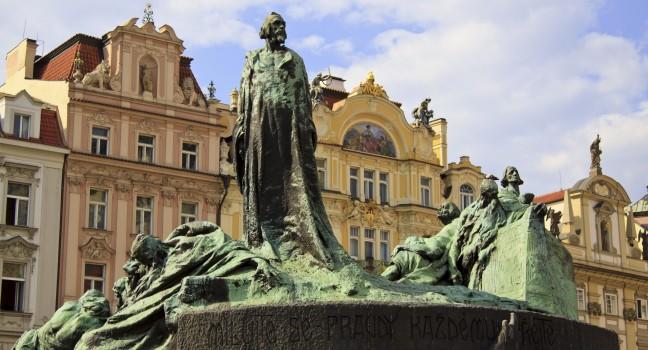
Travel in Prague, Old Town Square (Staromestske namestí), Jan Hus monument.
Lucertolone / Shutterstock

Few memorials in Prague have consistently elicited as much controversy as this one, dedicated in July 1915, exactly 500 years after Hus was burned at the stake in Constance, Germany. Some maintain that the monument's secessionist style (the inscription seems to come right from turn-of-the-20th-century Vienna) clashes with the Gothic and Baroque style of the square. Others dispute the romantic depiction of Hus, who appears here as tall and bearded in flowing garb, whereas the real Hus, as historians maintain, was short and had a baby face. Either way, the fiery preacher's influence is not in dispute. His ability to transform doctrinal disagreements, both literally and metaphorically, into the language of the common man made him into a religious and national symbol for the Czechs.

Staroměstské nám., Prague, Czech Republic

Something incorrect in this review?

Statue of St. Wenceslas

Nové Mesto
 Night view of Wenceslas Square, Prague, Czech republic.
(c) Anizza | Dreamstime.com

"Let's meet at the horse" is the local expression referring to the traditional meeting place that is Josef Václav Myslbek's impressive equestrian representation of St. Wenceslas surrounded by other Czech patron saints. In 1939, Czechs gathered here to oppose Hitler's annexation of Bohemia and Moravia. In 1969, student Jan Palach set himself on fire near here to protest the Soviet-led invasion of the country a year earlier (there's a moving monument to him in the cobbles). And in 1989, many thousands successfully gathered here and all along the square to demand the end of the communist government.

Václavské nám., Prague, 110 00, Czech Republic

Something incorrect in this review?

Trojský zámek

Troja
Medieval chateau Troja in Prague. Czech republic;
Ionia / Shutterstock

Built in the late 17th century for the Czech nobleman Count Šternberg, this sprawling summer residence, modeled on a classical Italian villa, had the first French-style gardens in Bohemia. Inside, rich frescoes that took more than 20 years to complete depict the stories of emperors. Outside, there's plenty of pomp and ceremony, with a red-and-white baroque façade and a sweeping staircase adorned with statues of the sons of Mother Earth.

The château is closed from November through March.

U trojského zámku 1, Prague, 171 00, Czech Republic
283–851–614
Sight Details
150 Kč, gardens free
Closed Mon. and Nov.–Mar.

Something incorrect in this review?

10-Z Fallout Shelter

A Cold War–era relic, this highly classified (hence the "10-Z" code name) shelter was designed to protect the political elite of the region in the event of a nuclear attack. Built during the Nazi occupation in World War II as a bomb shelter, between 1945 and 1948 it was used by a wine wholesaler, after which it served as a secret shelter until 1989. Up to 500 people could have stayed inside if needed, but fortunately no one had to. It was declassified and opened to the public in 2015. There is an exhibition about the Cold War at the entrance with English text. Guided group tours of the whole complex with a flashlight (provided) take place as well, with some at night. On the tour you can see underground offices, a phone switchboard, heavy doors, and other curious infrastructure. The entrance is across the street from Husova 12. Tour tickets are available at the Tourist Information Center at Panenská 1.

Husova, Brno, Czech Republic
Sight Details
Tours from 180 Kč
Closed Mon.

Something incorrect in this review?

Arcidiecézní muzeum

This ornate complex is home to treasures from the collections of the archdiocese, including golden monstrances, religious paintings, carved ivory objects, and a full-sized gilded coach. Modern art is also displayed in part of the building complex and included in the same admission, but it is often a bit disappointing in comparison. In 1767 the young musical prodigy Wolfgang Amadeus Mozart, age 11, spent six weeks recovering from a mild attack of chicken pox and completed his Sixth Symphony here. The 16-year-old King Wenceslas III suffered a much worse fate here in 1306, when he was murdered, putting an end to the Přemyslid dynasty.

Václavské nám. 3, Olomouc, 771 00, Czech Republic
585–514–241
Sight Details
Permanent exhibitions free; temporary exhibits vary.
Closed Mon.

Something incorrect in this review?

Bazilika sv. Jiří

Hradcany

Inside, this church looks more or less as it did in the 12th century; it's the best-preserved Romanesque relic in the country. The effect is at once barnlike and peaceful, as the warm golden yellow of the stone walls and the small arched windows exude a sense of enduring harmony. Prince Vratislav I originally built it in the 10th century, though only the foundations remain from that time. The father of Prince Wenceslas (of Christmas carol fame) dedicated it to St. George (of dragon fame), a figure supposedly more agreeable to the still largely pagan people. The outside was remodeled during early Baroque times, although the striking rusty-red color is in keeping with the look of the Romanesque edifice. The painted, house-shape tomb at the front of the church holds Vratislav's remains. Up the steps, in a chapel to the right, is the tomb Peter Parler designed for St. Ludmila, grandmother of St. Wenceslas.

Nám. U sv. Jiří, Prague, 119 08, Czech Republic
224--371–111
Sight Details
Included in 2-day castle ticket (from 250 Kč)

Something incorrect in this review?

Bazilika sv. Prokupa

The late Romanesque and early Gothic St. Procopius Basilica remains true to its original layout from 1260. New sections were added as recently as the 1950s, but the oldest parts are easy to spot. Look for a very heavy style, with lots of stone and few windows. Two baroque towers at the front were added in the early 1700s by architect F. M. Kaňka. One of the oldest sections is the crypt, with Romanesque pillars and arches. The château next door has been fully renovated and houses the Vysočina Museum Třebíč.

Betlémská kaple

Staré Mesto

The original church was built at the end of the 14th century, and the Czech religious reformer Jan Hus was a regular preacher here from 1402 until his exile in 1412. Here he gave the mass in "vulgar" Czech—not in Latin as the church in Rome demanded. After the Thirty Years' War in the 17th century, the chapel fell into the hands of the Jesuits and was demolished in 1786. Excavations carried out after World War I uncovered the original portal and three windows; the entire church was reconstructed during the 1950s. Although little remains of the first church, some remnants of Hus's teachings can still be read on the inside walls.

Betlémské nám. 3, Prague, 110 00, Czech Republic
234--678--790
Sight Details
60 Kč

Something incorrect in this review?

Bílý koníček

Look for the Little White Horse, the best-preserved Renaissance house on the square, dating to 1544. It's now a modest hotel and restaurant—the perfect spot to enjoy some excellent local beer.

Masarykovo nám. 97, Trebon, 379 01, Czech Republic
792–314–606

Something incorrect in this review?

Botanická zahrada

Troja

Not far from Zoologická zahrada v Praze (Prague Zoo), the public garden has a path in a greenhouse that first takes you through a semidesert environment, then through a tunnel beneath a tropical lake and into a rain forest; you end up cooling off in a room devoted to plants found in tropical mountains. Sliding doors and computer-controlled climate systems help keep it all together. The impressive Fata Morgana, a snaking 429-foot greenhouse that simulates the three different environments, has been drawing large crowds since it opened in 2004. There are lots of other areas in the huge outdoor gardens to explore, too, including beehives, a Japanese ornamental garden, and hilly areas with good views. The trails, including a scented trail and a nature trail, are pleasant as well. And don't miss the vineyard.

Trojská 196, Prague, 171 00, Czech Republic
234–148–122
Sight Details
150 Kč

Something incorrect in this review?

Budějovický Budvar Brewery

Tours of the brewery start at the modern glass-enclosed visitor center. On the 60-minute route, you'll see the wells that source the water, the brewhouse, and other parts of the process up to the bottling plant. A beer tasting is included at the end of the tour. Advanced booking (online) is required for tours outside the normal times.

Karolíny Světlé 4, Ceské Budejovice, Czech Republic
387–705–347
Sight Details
180 Kč
Closed Sun.--Mon. in Jan.--Feb.

Something incorrect in this review?

Celetná ulice

Staré Mesto

This is the main thoroughfare connecting Old Town Square and Náměstí Republiky; it's packed day and (most of the) night. Many of the street's façades are styled in the classic 17th- or 18th-century manner, but appearances are deceiving: nearly all of the houses in fact have foundations that, astonishingly, date back to the 12th century. Be sure to look above the street-level storefronts to see the fine examples of baroque detail.

Prague, Czech Republic

Something incorrect in this review?

Chebské muzeum

The building that houses this museum is just as interesting at its collection; it's known as the Pachelbel House, the setting for a murder during the Thirty Years' War. In 1634, General Albrecht von Wallenstein was executed in this house on the orders of Habsburg emperor Ferdinand II. He was provoked by Wallenstein's increasing power and rumors of treason. According to legend, Wallenstein was on his way to the Saxon border to enlist support to fight the Swedes when his own officers barged into his room and stabbed him through the heart with a stave. Wallenstein's stark bedroom has been left as it was with its four-poster bed and dark red velvet curtains. (The story also inspired playwright Friedrich Schiller to write the Wallenstein trilogy; he planned the work while living at the top of the square at No. 2.) The museum is also interesting in its own right, with a Wallenstein family picture gallery, a section on the history of Cheb, and a collection of minerals (including one discovered by Goethe). There's also the stuffed remains of Wallenstein's horse.

Nám. Krále Jiřího z Poděbrad 4, Cheb, 350 11, Czech Republic
601--122--664
Sight Details
100 Kč
Closed weekdays in Jan. and Feb., Mon. and Tues. in Mar., Apr., and Oct.–Dec., and Mon. May–Sept.

Something incorrect in this review?

Chebský hrad

Built with blocks of lava taken from the nearby Komorní Hůrka volcano, this castle stands on a cliff overlooking the Ohře River. The castle—now a ruin—was built in the late 12th century for Holy Roman Emperor Frederick Barbarossa. Redbrick walls are 17th-century additions. Inside the castle grounds is the carefully restored double-decker Romanesque chapel, notable for the many lovely columns with heads carved into their capitals. The rather dark ground floor was used by commoners. A bright, ornate top floor was reserved for the emperor and his family, who entered via a wooden bridge leading to the royal palace.

Dobrovského 21, Cheb, 350 02, Czech Republic
602--169--298
Sight Details
100 Kč
Closed weekdays in Nov.–Mar., and Mon. Apr.–Oct.

Something incorrect in this review?

Chodová Planá

Need a break from the rigorous healthiness of spa life? Chodovar Beer Wellness Land is a few miles south of Mariánské Lázně and offers a wellness hotel, two restaurants, and an underground complex of granite tunnels that have been used to age beer since the 1400s. Generous servings of Czech dishes can be ordered to accompany the strong, fresh Chodovar beer tapped directly from granite storage vaults. You can tour the brewery, but don't expect much English commentary. The brewery also offers a beer bath and spa services starting at 690 Kč. The brewery promises it will cause a mild and gradual rise in heart activity and "scour away any unhealthy substances that may have accumulated."

There are brewery tours daily at 2 pm.

Pivovarská 107, Mariánské Lázne, 348 13, Czech Republic
374–617–100-spa
Sight Details
Tour 140 Kč

Something incorrect in this review?

Chrám sv. Mořice

Nothing is left of the original Church of St. Maurice that stood just north of Horní náměstí in 1257. This is a new church started in 1412 on the same site and remodeled many times. Its current fierce, gray exterior dates to the middle of the 16th century. A sculpture of Christ on the Mount of Olives dates to the 15th century. The baroque organ inside, the largest in the Czech Republic, originally contained 2,311 pipes until it was expanded in the 1960s to more than 10,000 pipes. An international organ festival takes place in the church every September. The tower is sometimes open to the public, depending on the weather. A large renovation was finished in 2021.

8. května, Olomouc, 779 00, Czech Republic
Sight Details
Free

Something incorrect in this review?

Chrám sv. Petra a Pavla

Best admired from a distance, the silhouette of slim neo-Gothic twin spires—added in the 20th century—give the cathedral a touch of Gothic dignity. Up close, the interior is light and tasteful but hardly mind-blowing. The treasury and tower can be visited for a fee. The crypt can be visited on request if it is closed. This is the church pictured on the face of the 10 Kč coin.

Petrov at Petrská ul., Brno, Czech Republic
Sight Details
Free; treasury and tower 40 Kč
Tower closed Sun. May–Sept.; crypt closed weekdays Oct.–Apr. and Sun.–Fri. May–Sept.

Something incorrect in this review?