286 Best Sights in Austria

Background Illustration for Sights

We've compiled the best of the best in Austria - browse our top choices for the top things to see or do during your stay.

Nordkettenbahnen

Fodor's Choice

The Nordkette is Innsbruck's most famous mountain and it's possible to reach it directly from the city center. Hop on the funicular—the main station is just around the corner from the Hofburg—and in just eight minutes you'll be at the Hungerburg station, 2,822 feet above sea level. But that's just the start: from here, two more cable cars lead high into the mountains to the "Top Of Innsbruck," a viewing platform at 7,546 feet with staggering panoramic views of Innsbruck and the surrounding peaks. Along with the spectacular views, you can also enjoy a range of hiking and biking trails for every ability along the way, as well as restaurants, shops, cafés, and play parks for kids. There's also the Alpenzoo, which is home to an unusual collection of Alpine birds and animals, including many endangered species. Entry costs €19, including the Nordkettenbahnen up to the Hungerburg station.

Rennweg 3, Innsbruck, A-6020, Austria
0512-293344
Sight Details
Funicular round-trip €11.40; cable-car round-trip €44

Something incorrect in this review?

Österreichische Nationalbibliothek

1st District Fodor's Choice

The centerpiece of the Österreichische Nationalbibliothek, one of the grandest Baroque libraries in the world, is the spectacular Prunksaal—Grand Hall—which probably contains more book treasures than any comparable collection outside the Vatican. The main entrance to the ornate reading room is in the left corner of Josefsplatz. Designed by Fischer von Erlach the Elder just before his death in 1723 and completed by his son, the Grand Hall is full-blown high Baroque, with trompe-l'oeil ceiling frescoes by Daniel Gran. Twice a year, special exhibits highlight some of the finest and rarest tomes, well documented in German and English. From 1782, Mozart performed here regularly at the Sunday matinees of Baron Gottfried van Swieten, who lived in a suite of rooms in the grand, palacelike library. Four years later the baron founded the Society of Associated Cavaliers, which set up oratorio performances with Mozart acting as conductor. Across the street at Palais Palffy, Mozart reportedly first performed The Marriage of Figaro before a select, private audience to see if it would pass the court censor.

Josefsplatz 1, Vienna, A-1010, Austria
01-534–100
Sight Details
€10

Something incorrect in this review?

Ottakringer Brauerei

Fodor's Choice

Founded in 1837, and located in the historic workers' district of the same name and featuring an in-house well from which the water for the entire production is still sourced, the independent Ottakring Brewery is a traditional brewery with roots. It also has a creative, modern outlook, beer tastings, tours, workshops, festivals, and a craft beer sub-brand (BrauWerk) offering IPAs, Porters, and Vienna Pale Ales with fun names and flavors, which add up to a thoroughly cool old brand and a must-do beer experience. Register in advance online for guided tours (Monday to Friday 9 to 5:30).

Guided tours meet at the Ottakringer Shop, Ottakringer Strasse 95.

Recommended Fodor's Video

Pfänder

Fodor's Choice

The Pfänderbahn cable car takes you up to this 3,491-foot peak overlooking Bregenz, one of the most famous lookout points in the region. From here, you can see four countries—Austria, Germany, Liechtenstein, and Switzerland—and almost 240 Alpine peaks. It's a breathtaking view, with the city directly below on the shores of the Bodensee and the lake stretching for 64 km (40 miles) into the hazy distance. On your left lies the Rhine valley, and you can see the hills of Liechtenstein and Switzerland in the distance. Just across the water from Bregenz you'll notice the ancient and fascinating German island-city of Lindau in Bavaria, once a free state (a status it lost in 1802). The restaurant at the top is open throughout the summer, while children will enjoy the Alpenwildpark, a small outdoor zoo with Alpine ibex, mouflon, and wild boar that's open year-round.

Pöstlingberg

Fodor's Choice

When you want to escape the hustle and bustle of Linz, just hop on the electric railway Pöstlingbergbahn for a scenic ride up to the famous mountain belvedere, the Pöstlingberg. The narrow-gauge marvel has been making the journey since 1898, and today the line extends to Hauptplatz. Europe's steepest non-cog mountain railway gains 750 feet in elevation in a journey of roughly 4 kilometers (2½ miles) in just 20 minutes, with neither pulleys nor cables to prevent it from slipping. Halfway up is the Linz Zoological Garden and a children's petting zoo, but it's at the top where you'll enjoy the best views, with the city and the wide sweep of the Danube filling the foreground and the snowcapped Alps on the horizon. Also here is the Church of the Seven Sorrows of the Virgin (Sieben Schmerzen Mariens), an immense and opulent twin-towered Baroque pilgrimage church (1748) visible for miles around. Kids will enjoy the Grottenbahn, or Dragon Express, where they're whisked through a world of dwarves, forest creatures, and other fairy-tale folk, while adults can drink in the views—along with a glass of chilled white wine—from the terrace of the Pöstlingberg Schlössl restaurant.

Am Pöstlingberg 9, Linz, A-4040, Austria
Sight Details
Pöstlingbergbahn: €4.60 one way, €7.60 round-trip

Something incorrect in this review?

Prater

2nd District/Leopoldstadt Fodor's Choice

In 1766, to the dismay of the aristocracy, Emperor Josef II decreed that the vast expanse of imperial parklands known as the Prater would henceforth be open to the public. East of the inner city between the Danube Canal and the Danube proper, the Prater is a public park to this day, notable for its long promenade (the Hauptallee, more than 4½ km [3 miles] in length), the traditional amusement-park rides, a planetarium, and a small but interesting museum devoted to the Prater's long history. If you look carefully, you can discover a handful of children's rides dating from the '20s and '30s that survived the fire that consumed most of the Volksprater in 1945.

At the amusement park there are 250 rides, many of which will make thrill-ride enthusiasts happy, and on hot days there is a water park to splash around in. For little ones, there is an interactive ride featuring polar bears and penguins. Madame Tussauds is also on-site if you want a photo with famous Austrian native sons and daughters (Arnold Schwarzenegger comes to mind). The best-known attraction is the 200-foot Ferris wheel that figured so prominently in the 1949 film The Third Man. It was one of three built in Europe at the end of the 19th century (the others were in England and France but have long since been dismantled); the wheel was badly damaged during World War II but restored shortly thereafter. Its progress is slow and stately (a revolution takes 10 minutes), and the views from its cars are magnificent, particularly toward dusk.

Riesenradplatz, Vienna, A-1020, Austria
Sight Details
Park free, Ferris wheel €13.50

Something incorrect in this review?

Richard the Lionheart Castle

Fodor's Choice

It may involve a steep, 30-minute climb up to 500 feet above the town, but the ruins of this famous castle—and its spectacular views up and down the Danube—make it well worth the effort. The name comes from the fact the castle once held Richard the Lionheart of England, who was captured by Leopold V on his way back home from the Crusades. It's said that Leopold had been insulted by Richard while they were in the Holy Land, so when the English nobleman was shipwrecked and had to head back home through Austria dressed (clearly not very convincingly) as a peasant, Leopold pounced. Richard was subsequently imprisoned in the tower of the castle for four months (1192–1193), before Leopold turned his prisoner over to the emperor, Henry VI. Henry held him for months longer until ransom was paid by Richard's mother, Eleanor of Aquitaine.

Römertherme

Fodor's Choice

Experience Baden like an ancient Roman at this public spa. Set under an enormous, free-hanging glass roofthe largest in Europe—the facilities here include half a dozen pools set to different temperatures (including some filled with sulfuric spring water), as well as Jacuzzis, saunas, steam rooms, and plunge pools. There's also an outdoor swimming pool with massage jets, along with a fitness center, activity classes, spa and beauty treatments, shops, and restaurants. Make a weekend of it with a stay at the adjoining Badener Hof spa hotel.

Brusattiplatz 4, Baden, A-2500, Austria
02252-45030
Sight Details
Day ticket: €21.60. Sauna surcharge: €9.20

Something incorrect in this review?

Salzburg Museum

Fodor's Choice

Encompassing six different buildings, the Salzburg Museum's largest location is the 17th-century Neue Residenz. This building was Prince-Archbishop Wolf-Dietrich's "overflow" palace—he couldn't fit his entire archiepiscopal court into the main Residenz across the plaza—and as such, it features 10 state reception rooms that were among the first attempts at Renaissance-style design in the North. The permanent exhibition focuses on the city’s artistic, cultural, and historical development. The Mirror Hall contains an archaeological collection including remains of the town's ancient Roman ruins. The Panorama Passage, lined with archaeological excavations from the Neue Residenz, leads to the Panorama Museum, home to the spectacular Sattler Panorama. One of the few remaining 360-degree paintings in the world, it shows the city of Salzburg in the early 19th century. The Art Hall hosts three major special exhibitions a year.

Schloss Eggenberg

Fodor's Choice

This 17th-century palace, a UNESCO World Heritage site on the eastern edge of the city and the largest Baroque palace in Styria, is surrounded by a large park full of peacocks. Enjoy a guided tour of the Prunkräume (state rooms); they are noted for their elaborate stucco decorations and frescoes, and contain one of the few depictions of Osaka before 1615. There's also an arcaded courtyard lined with antlers.

The many attractions here include a traditional art gallery, a collection of coins, and an archaeology museum. The Alte Galerie contains a world-famous collection of art from the Middle Ages through the Baroque period. Among its treasures are works by Pieter Brueghel the Younger, Hans and Lucas Cranach, the Admont Madonna wood carving from 1400, and a medieval altarpiece depicting the murder of Thomas à Becket. At the Archaeology Museum, the holdings include a remarkable collection of Styrian archaeological finds, including the small and rather strange Strettweg ritual chariot from the 7th century BC. Stop by the outdoor café for a break, or wander through the park to relax in between visits to the many sights.

Eggenberger Allee 90, 8020, Austria
0316-8017–9532
Sight Details
State rooms and guided tour €17; Alte Galerie, Archaeology Museum, Coin Cabinet and Park €11; Park only €2; 24-hour ticket valid for all museums of Landesmuseum (does not include the state rooms) €17
Closed Mon. State Rooms closed Nov.–Mar. Other museums closed mid-Dec-Mar. Guided tour required Nov.–mid-Dec

Something incorrect in this review?

Schloss Esterházy

Fodor's Choice

The former palace of the ruling princes reigns over the town. Built in the Baroque style between 1663 and 1672 on the foundations of a medieval castle and later modified, it is still owned by the Esterházy family today. The highlight for visitors is the lavishly decorated Haydn Room, an extraordinarily ornate concert hall where the composer conducted his own works from 1761 until 1790. It's still used for presentations of Haydn's works today, with musicians often dressed in period garb. The hall is one of several rooms on a guided tour (in English at 1 pm every day during July and August; weekends only in winter), which lasts around 45 minutes and ends in the Baroque chapel. Below the palace is the refreshingly-cool cellar, home to the largest wine museum in Austria with 700 objects including a massive wine barrel and historical grape press. In front of the palace are the former stables, once the accommodation of Esterházy guards and horses but now home to restaurants, wine stores, and florists. And behind the palace is the sprawling, lake-filled Schlosspark, perfect for a stroll, a swim, or a picnicthe best way in is the gate between Haydn-Haus and Franziskanerkirche.

Esterhazyplatz 1, Eisenstadt, A-7000, Austria
02682-63004–7600
Sight Details
Castle: €19 (€22 with guided tour); Wine Museum: €7
Closed Jan.–Mar.; closed Mon. Apr.–June, Sept., and Oct.; closed weekdays in Nov. and Dec.

Something incorrect in this review?

Schlosshof

Fodor's Choice

A true Baroque gem, this castle is shining even more brilliantly since the completion of extensive restorations. The product of master designer and architect Johann Lukas von Hildebrandt, who in 1732 reconstructed the square castle into an elegant U-shape building, the Schloss opens up on the eastern side to a marvelous Baroque formal garden that gives way toward the river. The famed landscape painter Bernardo Bellotto, noted for his Canaletto-like vistas of scenic landmarks, captured the view before the reconstruction. His three paintings were used as a guide for restoring the gardens to their Baroque appearance.

The castle was once owned by Empress Maria Theresa, mother of Marie Antoinette. You can visit the suite the empress used during her royal visits, faithfully re-created down to the tiniest details, as well as the two-story chapel in which she prayed.

In 2016, the Schlosshof added some highly popular adventure paths to the interactive visitor experience. Children can play the roles of stable boys and maidens, performing various chores and encountering blacksmiths, falconers, or bakers along the path. You might stumble upon a large estate farm that is home to horses, goats, donkeys, and several other animals. The complex also includes a restaurant and pâtisserie, both with indoor and outdoor seating. Guided tours and audio tours of the castle and garden are available in English, but it's also possible to wander around the buildings and grounds on your own. The castle is about 8 kilometers (5 miles) south of Marchegg. Be sure to enjoy the panaromic view (you can even see across the border into Slovakia and its capital Bratislava from here). If you come in winter, you can enjoy the charming Adventmarkt set up on the sprawling grounds.

Schloßberg

Fodor's Choice

The view from the summit of Graz's midtown mountain takes in the city and much of central Styria. A zigzagging stone staircase, beginning at Schlossbergplatz, leads to the top. It's 260 steps, so you may prefer to use the Schlossbergbahn funicular railway ( Kaiser-Franz-Josef-Kai 38  €3) or a 30-second elevator ride through the rock face ( Schlossbergplatz  €2.20). The Schlossberg, a Romanesque castle with Gothic elements turned Renaissance fortress, constitutes only a portion of this site, and is one of the few places not conquered by Napoléon. A few steps east of the funicular station at the top is the Glockenturm (bell tower), an octagonal structure from 1588 containing Styria's largest bell, the four-ton Liesl, in the upper belfry. Its 101 chimes resound three times daily, at 7 am, noon, and 7 pm. The Open-Air Theater, to the north, is built into the old casements of the castle and has a retractable roof. Both opera and theater performances are presented here in summer. There are ruins of the older structure, and many a modern café here, too.

Schönbrunn Gardens

13th District/Hietzing Fodor's Choice

The palace grounds entice with a bevy of splendid divertissements, including a grand zoo (the Tiergarten) and a carriage museum (the Wagenburg). Climb to the Gloriette for a panoramic view out over the city as well as of the palace complex. If you're exploring on your own, seek out the intriguing Roman ruin. The marble schöner brunnen ("beautiful fountain") gave its name to the palace complex. Then head over the other side of the gardens to the playground and the newly grown maze.

Schönbrunn Palace

13th District/Hietzing Fodor's Choice

Originally designed by Johann Bernhard Fischer von Erlach in 1696 and altered considerably for Maria Theresa 40 years later, Schönbrunn Palace, the huge Hapsburg summer residence, lies within the city limits, just a few metro stops west of Karlsplatz on the U4. Bus trips to Schönbrunn offered by the city's tour operators cost several times what you'd pay if you traveled by subway; the one advantage is that they get you there with a bit less effort. Travel independently if you want time to wander through the grounds, which are open dawn to dusk.

The most impressive approach to the palace and its gardens is through the front gate, set on Schönbrunner-Schloss-Strasse halfway between the Schönbrunn and Hietzing metro stations. The vast main courtyard is ruled by a formal design of impeccable order and rigorous symmetry: wing nods at wing, facade mirrors facade, and every part stylistically complements every other. The courtyard, however, turns out to be a mere appetizer; the feast lies beyond. The breathtaking view that unfolds on the other side of the palace is one of the finest set pieces in all Europe and one of the supreme achievements of Baroque planning. Formal Allées (promenades) shoot off diagonally, the one on the right toward the zoo, the one on the left toward a rock-mounted obelisk and a fine false Roman ruin. But these, and the woods beyond, are merely a frame for the composition in the center: the sculpted marble fountain; the carefully planted screen of trees behind; the sudden, almost vertical rise of the grass-covered hill beyond, with the Gloriette a fitting crown.

Within the palace, the state salons are quite up to the splendor of the gardens, but note the contrast between these chambers and the far more modest rooms in which the rulers—particularly Franz Josef—lived and spent most of their time. Of the 1,441 rooms, 40 are open to the public on the regular tour, of which two are of special note: the Hall of Mirrors, where the six-year-old Mozart performed for Empress Maria Theresa in 1762 (and where he met seven-year-old Marie Antoinette), and the Grand Gallery, where the Congress of Vienna (1815) danced at night after carving up Napoléon's collapsed empire during the day. Ask about viewing the ground-floor living quarters (Berglzimmer), where the walls are painted with palm trees, exotic animals, and tropical views.

As you go through the palace, glance occasionally out the windows; you'll be rewarded by a better impression of the formal gardens, punctuated by hedgerows and fountains. These window vistas were enjoyed by rulers from Maria Theresa and Napoléon to Franz Josef.

Schönbrunner Schlossstrasse, Vienna, A-1130, Austria
01-811–13–0
Sight Details
€24 for Imperial Tour (Franz Josef's rooms); €29 Grand Tour (includes Maria Theresa's rooms)

Something incorrect in this review?

Seepromenade

Fodor's Choice

Sweeping along the southeastern shore of the Bodensee, this peaceful lakeside promenade is the perfect place for a stroll any time of year. It runs all the way from the Festspielhaus to the harbor and is lined with charming cafés, hip bars, and tree-shaded benches all the way. As well as enjoying sweeping lake views in one direction, there are also city landmarks to see in the other, from the Neoclassical Post Office, to the glass-cube Kunsthaus, to the local mountain Pfänder. If you want to wander even farther, the Pipeline promenade continues northward from the harbor all the way to Lochau, near the German border. Or, in the other direction, the lakeside gets more natural with some lovely picnic and swimming spots.

Seepromenade, Bregenz, A-6900, Austria

Something incorrect in this review?

Serlesbahnen

Fodor's Choice

Connecting the village of Mieders9 km (5½ miles) northeast of Neustiftto the upper reaches of the Serles Mountain, this cablecar climbs 640 meters in a matter of minutes. At the top, a whole host of adventures await, from forest trail hiking to mountain lake swimming, as well as an excellent kids' area with lots of water play opportunities. Grab some lunch at the nearby Gasthaus Koppeneck, or set off on a hike to one of mountainside's four other restaurants: the käsespätzle at the Ochsenhütte is well worth the 20-minute walk (or short land-train ride). To get back down to the valley, you can either get back on the Serlesbahn or, if you're feeling adventurous, take a trip on the 2½-km-long (1½-mile-long) summer rodelbahn (toboggan run). It costs €11.50 a ride. Serlesbahn is just one of many cable cars in the Stubaital region, with other options including Neustift's Elferbahna popular choice for paragliders and offroad bikers.

Sigmund Freud Museum

9th District/Alsergrund Fodor's Choice

Not far from the historic Hofburg district, the marvels and pains of the 20th century come into focus here at the former practice and private quarters of the father of psychoanalysis. The museum underwent a significant renovation in 2020 and now features all the family’s private rooms, including his first practice room. The bright airy rooms each highlight a different aspect of Freud’s family life and practice. Various memorabilia, private letters, case histories, historical manuscripts, photographs, and some original furnishings are all on display, putting into context his work and the historical period surrounding it. The museum is housed in the apartment where Freud and his wife lived from 1891–1938 and raised their six children. There’s also space dedicated to the museum’s conceptual art collection and to temporary exhibitions.

Stephansdom

1st District Fodor's Choice

Vienna's soaring centerpiece, this beloved cathedral enshrines the heart of the city—although when first built in the 12th century it stood outside the city walls. Vienna can thank a period of hard times for the Catholic Church for the cathedral's distinctive silhouette. Originally the structure was to have had matching 445-foot-high spires, a standard design of the era, but funds ran out, and the north tower to this day remains a happy reminder of what gloriously is not. The lack of symmetry creates an imbalance that makes the cathedral instantly identifiable from its profile alone. Like the Staatsoper and some other major buildings, it was very heavily damaged in World War II, but reconstruction loans have been utilized to restore the cathedral's former beauty. Decades of pollution have blackened the exterior, which is being painstakingly cleaned using only brushes and water, so as not to destroy the facade with chemicals.

It's difficult now to tell what was original and which parts of the walls and vaults were reconstructed. No matter: its history-rich atmosphere is dear to all Viennese. That noted, St. Stephen's has a fierce presence that is blatantly un-Viennese. It's a stylistic jumble ranging from 13th-century Romanesque to 15th-century Gothic. Like the exterior, St. Stephen's interior lacks the soaring unity of Europe's greatest Gothic cathedrals, much of its decoration dating from the later Baroque era.

One particularly masterly work should be seen by everyone: the stone pulpit attached to the second freestanding pier on the left of the central nave, carved by Anton Pilgram between 1510 and 1550. The delicacy of its decoration would in itself set the pulpit apart, but even more intriguing are its five sculpted figures. Carved around the outside of the pulpit proper are the four Church Fathers (from left to right: St. Augustine, St. Gregory, St. Jerome, and St. Ambrose), and each is given an individual personality so sharply etched as to suggest satire, perhaps of living models. There is no satire suggested by the fifth figure, however; below the pulpit's stairs Pilgram sculpted a fine self-portrait, showing himself peering out a half-open window.

As you stroll through the aisles, remember that many notable events occurred here, including Mozart's marriage in 1782 and his funeral in December 1791.

The bird's-eye views from the cathedral's beloved Alter Steffl (Old Stephen Tower) will be a highlight for some. The south tower is 450 feet high and was built between 1359 and 1433. The climb up the 343 steps is rewarded with vistas that extend to the rising slopes of the Wienerwald. The north steeple houses the big Pummerin bell and a lookout terrace (access by elevator).

Stephansplatz, Vienna, A-1010, Austria
01-515–52–3054
Sight Details
Cathedral only free; €20 all-inclusive guided tour tickets include the catacombs, North Tower, and South Tower; towers and catacombs separately €5.50 to €6.

Something incorrect in this review?

Stift Klosterneuburg

Fodor's Choice

This great Augustinian abbey dominates the town. The structure has undergone many changes since the abbey was established in 1114, most recently in 1892, when Friedrich Schmidt, architect of Vienna's City Hall, added neo-Gothic embellishments to its two identifying towers. Inside the abbey church, treasures include the carved-wood choir loft and oratory, the large 17th-century organ, beautifully enameled 1181 Verdun Altar in the Leopold Chapel, stained-glass windows from the 14th and 15th centuries, and a Romanesque candelabra from the 12th century. In an adjacent outbuilding there's a huge wine cask over which people slide; the exercise, called Fasslrutsch'n, takes place during the Leopoldiweinkost, the wine tasting around St. Leopold's Day on November 15. The Stiftskeller, with its atmospheric underground rooms, serves standard Austrian fare and wine bearing the Klosterneuburg label. There are several different tours available covering religious artifacts, imperial rooms and treasures, wine making, and the garden.

Guided tours are in German, but audio guides with English and other languages are available.

Stift Melk

Fodor's Choice

Part palace, part monastery, part opera set, this masterpiece of Baroque architecture looms high above the Danube thanks to its upward-reaching twin towers, its grand 208-foot-high dome, and, of course, its site high up on a rocky outcrop. The Benedictine abbey has a history that extends back to its establishment in 1089, but the glorious building you see today is architect Jakob Prandtauer's reconstruction, completed in 1736, in which some earlier elements are incorporated.

A tour of the building includes the main public rooms: a magnificent library, with more than 100,000 books, nearly 2,000 manuscripts, and a superb ceiling fresco by the master Paul Troger; the Marmorsaal, whose windows on both sides enhance the ceiling frescoes and give them a curved effect; and the glorious Stiftskirche (abbey church) of Saints Peter and Paul, an exquisite example of the Baroque style. Look out for some quirky features along the way, like a "reusable coffin" that subtly opens at the bottom, and the hidden door in the library. There are guided tours in English every day at 3 pm. Take time to explore the gardens, a lovely mix of manicured lawns and wild woodland with amazing river views.

Stift St. Florian

Fodor's Choice

Located 14 kilometers (8½ miles) southeast of Linz, this palatial Augustinian abbey—one of the most spectacular Baroque showpieces in Austria—was built in 1686 to honor the spot on the River Enns where St. Florian was drowned by pagans in 304. Landmarked by three gigantic "candle-snuffer" cupolas, it's centered on a mammoth Marmorsaal (Marble Hall), covered with frescoes honoring Prince Eugene of Savoy's defeat of the Turks, and a sumptuous library filled with 140,000 volumes. Guided tours of the abbey also take in the magnificent, three-story figural gateway, covered with symbolic statues; the Kaiserzimmer, a suite of 13 opulent salons with the "terrifying bed" of Prince Eugene (it's adorned with wood-carved figures of captives); and the over-the-top abbey church, home to an enormous organ once played by composer Anton Bruckner. You'll also see one of the great masterworks of the Austrian Baroque, Jakob Prandtauer's Eagle Fountain Courtyard, with its richly sculpted figures. If you find one day isn't enough to see it all, there are also rooms where you can spend the night in the abbey grounds (from €104 per night, including breakfast). Getting to the abbey is easy: there are regular buses from Linz's Volksgarten.

Strandbad

Fodor's Choice

This popular bathing facility on the shores of Lake Neusiedl has been attracting Viennese day trippers for the best part of a century. Today, it's home to modern lido with changing rooms and showers, sunbathing lawns, beach volleyball courts, a children's pool and play area, a surf center, and a yacht club, as well as a host of cafés and snack bars. Between July and September, there are also daily activities for four- to 12-year-olds (included with a lido entrance ticket), from Frisbee lessons to circus workshops, Nerf battles to science demonstrations.

Stubai Glacier

Fodor's Choice

At the southwesterly end of the valley lies Austria's biggest glacier. It's also one of the country's most popular ski resorts, with miles upon miles of snow-covered slopes open all year round, even in the height of summer (though skiing is limited to above 3,000 meters in the warmer months). Ski passes cost anything from €99.20 for one-and-a-half days to €648.80 for 21 days. For warm-weather visitors who prefer hiking boots to ski boots, there's also an extensive network of walking trails throughout the area. Access to the glacier is via a series of cable cars, starting with the Talstation Eisgrat and finishing at the Bergstation Schaufeljoch; you can get a ticket for the whole way up and down, or pay section by section.

Mutterberg 2, A-6167, Austria
05226-8141
Sight Details
Full ascent and descent (day pass): €32.30–€54.10, depending on season

Something incorrect in this review?

Swarovski Crystal Worlds

Fodor's Choice

If you're driving from Hall in Tirol to Zell am Ziller—or if you just want a half-day trip from Innsbruck (it's included in the Innsbruck Card)—this one-of-a-kind, crystal glass–themed attraction will entertain all the family. Located in Wattens, besides the headquarters of the world-famous Swarovski company, the main exhibition consists of 18 eye-catching "Chambers of Wonder", including an atmospheric crystal forest and an all-year-round Christmas scene (complete with fake snow and sub-zero temperatures). Perhaps the highlight is the collection of Swarovski crystal-covered costumes worn by the likes of Grace Kelly, Cher, and Elton John; keep an eye out for the red slippers from The Wizard of Oz. Outside, marvel at the water-spewing giant before exploring the gardens; kids will love the marble run play area, the carousel, and the labyrinth, as well as the Crystal Cloud Forest. Feeling peckish? Stop for lunch in Restaurant Daniel (named after founder Daniel Swarovski), which serves creative twists on classic Austrian fare.

Upper Town

Fodor's Choice

Just a short walk but a whole world away from the lakeside, Bregenz's Upper Town is its historical heart. Walk all the way up Maurachgasse to the Stadttor, complete with a scary mummified shark (supposedly caught in the Bodensee). Through the gate is Ehregutaplatz, a pretty market square flanked by remains of the ancient city wall and overlooked by Martinsturm, a tower with an enormous onion dome. Built in 1601, it was the first Baroque construction on the Bodensee, though the chapel below dates back even further; step inside to see 14th-century frescoes. From here, amble along Martinsgasse to Graf-Wilhelm-Strasse and the Altes Rathaus, the old town hall. This ornate, brightly shuttered, half-timber construction was completed in 1622. Behind here, on Eponastrasse, are the remnants of a wall fresco that depicts St. Christopher, St. Peter, and a kneeling abbot. Around the corner lies the 400-year-old castle Deuring Schlössle. This is now a private residence, but you can still admire its beautiful whitewashed facade. Better yet, head down the nearby Meissnerstiege passageway for a wider view of its majestic southwestern side. From here, you can also see the 16th-century Beckenturm, named for bakers who were imprisoned here after short-changing their customers.

Ehregutaplatz 1, Bregenz, A-6900, Austria

Something incorrect in this review?

Wiener Staatsoper

1st District Fodor's Choice

Vying with St. Stephen's Cathedral for the honor of the emotional heart of the city, the opera house is a focus for Viennese life and one of the chief symbols of resurgence after World War II. Its directorship is one of the top jobs in Austria, almost as important as that of the country's president, and one that draws even more public attention. The first of the Ringstrasse projects to be completed (in 1869), the opera house suffered disastrous bomb damage in the last days of World War II—only the outer walls, the front facade, and the main staircase survived. The auditorium is plain when compared to the red-and-gold eruptions of London's Covent Garden or some of the Italian opera houses, but it has an elegant individuality that it shows off beautifully when the stage and auditorium are turned into a ballroom for the great Opera Ball.

The construction of the opera house is the stuff of legend. When the foundation was laid, the plans for the Opernring were not yet complete, and in the end the avenue turned out to be several feet higher than originally planned. As a result, the opera house lacked the commanding prospect that its architects, Eduard van der Nüll and August Sicard von Sicardsburg, had intended. Even Emperor Franz Josef pronounced the building a bit low to the ground. For the sensitive van der Nüll (and here the story becomes a bit suspect), failing his beloved emperor was the last straw. In disgrace and despair, he committed suicide. Sicardsburg died of grief shortly thereafter. And the emperor, horrified at the deaths his innocuous remark had caused, limited all his future artistic pronouncements to a single immutable formula: "Es war sehr schön, es hat mich sehr gefreut" ("It was very nice, it pleased me very much").

Renovation could not avoid a postwar look, for the cost of fully restoring the 19th-century interior was prohibitive. The original design was followed in the 1945–1955 reconstruction, meaning that sight lines from some of the front boxes are poor at best. These disappointments hardly detract from the fact that this is one of the world's half-dozen greatest opera houses, and experiencing a performance here can be the highlight of a trip to Vienna. If tickets are sold out, some performances are shown live on a huge screen outside on Karajanplatz. Tours of the opera house are given regularly, but starting times vary according to rehearsals; the current schedule is posted under the arcades on both sides of the building. Under the arcade on the Kärntnerstrasse side is an information office that also sells tickets to the main opera and the Volksoper.

Opernring 2, Vienna, A-1010, Austria
01-514–44–2250
Sight Details
From €15 for standing room tickets, €13 for guided tours
No performances July and Aug.

Something incorrect in this review?

Wieninger

Fodor's Choice

The driving force behind the WienWein group, pioneer Fritz Wieninger is a masterful vintner. He exports to the United States and elsewhere, but luckily there are some bottles left to be savored in this pleasant, tree-shaded inner courtyard and tavern. The food is not typical heuriger fare; instead, expect more contemporary choices, like roasted scampi burgers with mango-avocado dip. It's across the Danube in Stammersdorf, one of Vienna's oldest heurige regions.

Stammersdorferstrasse 78, A-1210, Austria
01-290–1012
Sight Details
Credit cards accepted
Thu.–Sun.
Closed late Dec.–mid-May. Lunch only Sat. and Sun.

Something incorrect in this review?

Wolfsklamm

Fodor's Choice

Another popular stop between Hall and Zell, this impressive gorge hike is a great way to stretch your legs. Exhilarating and spectacular (but very safe), the climb starts in the village of Stans, follows walkways hewn from the mountainside and across bridges spanning the tumbling river and beside waterfalls—all protected by railings—and finally reaches the Benedictine monastery of St. Georgenberg. The whole thing takes about 90 minutes and features 354 steps. At the top, the monastery's sumptuously decorated Baroque church, precariously perched on a rocky peak, is worth a few minutes of your time. There is a decent restaurant, too, with a terrace dizzily located above a sheer drop of several hundred feet.

Stans, A-6135, Austria
Sight Details
€5

Something incorrect in this review?

Gaisberg and Untersberg

The Untersberg in Salzburg
Laszlo Szirtesi / Shutterstock

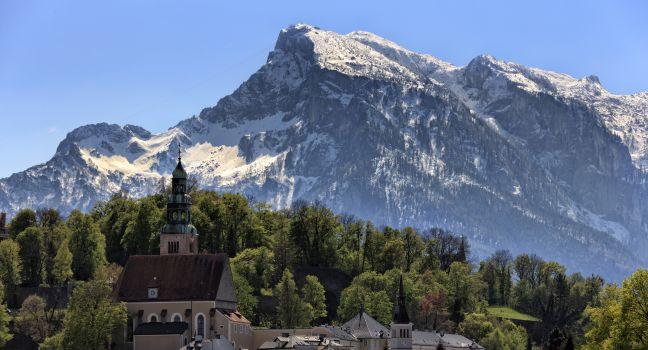
Salzburg's "house mountains" are so called because of their proximity to the city, with Gaisberg lying to the east and Untersberg to the south.

To reach Gaisberg, you can take the Albus No. 151 bus from Mirabellplatz right up to the summit of the mountain, where you'll be rewarded with a spectacular panoramic view of the Alps and the Alpine foreland. From here, there are several hiking trails and a charming little pub-restaurant with sun terrace. The bus leaves six times a day weekdays and 12 times a day weekends and takes about a half hour.

The Untersberg is the mountain Captain von Trapp and Maria climbed as they escaped the Nazis in The Sound of Music. In the film they were supposedly fleeing to Switzerland; in reality, the climb up the Untersberg would have brought them almost to the doorstep of Hitler's retreat at the Eagle's Nest above Berchtesgaden in Germany. A cable car from St. Leonhard, about 13 km (8 miles) and a 30-minute bus ride south of Salzburg, whisks you up to a height of 5,830 feet for a breathtaking view. In winter you can ski back down the Untersberg (you arrive in the village of Fürstenbrunn and taxis or buses take you back to St. Leonhard); in summer there are a number of hiking routes from the summit.

Gaisberg 32, Salzburg, A-5026, Austria

Something incorrect in this review?