286 Best Sights in Austria

Background Illustration for Sights

We've compiled the best of the best in Austria - browse our top choices for the top things to see or do during your stay.

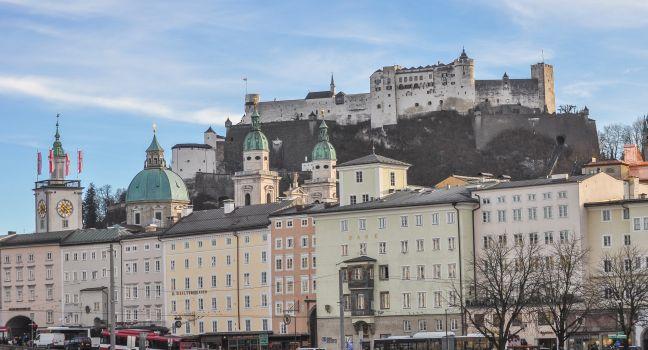
Fortress Hohensalzburg
Fodor's Choice
SALZBURG , AUSTRIA - 24 DECEMBER 2013 : Close up view of Hohensalzburg fortress from the opposite of old town in the afternoon.
fukez84 / Shutterstock

Founded in 1077, the Hohensalzburg is Salzburg's acropolis and the largest preserved medieval fortress in Central Europe. Brooding over the city from atop the Festungsberg, it was originally founded by Salzburg's Archbishop Gebhard, who had supported the pope in the investiture controversy against the Holy Roman Emperor. Over the centuries the archbishops gradually enlarged the castle, originally using it only sometimes as a residence, then as a siege-proof haven against invaders and their own rebellious subjects. The exterior may look grim, but inside there are lavish state rooms, such as the glittering Golden Room, the Castle Museum (dedicated to life in the fortress over the centuries), and the Rainer's Museum, with its collections honoring Salzburg's former home regiment. There's also a torture chamber not far from the exquisite late-Gothic St. George's Chapel (although the implements on view came from another castle and were not used here). The 200-pipe organ from the beginning of the 16th century, played three times daily, is best heard from a respectful distance (it's called "the Bull" for a reason). Children will also enjoy the World of Marionettes, including the chance to try their hands at being a puppeteer. To reach the fortress, walk up the zigzag path that begins just beyond the Stieglkeller on the Festungsgasse, or take the 110-year-old Festungsbahn (funicular railway) from behind St. Peter's Cemetery. A standard entry ticket (€10.80) includes access to the castle area, the museums, and a descent on the funicular; an all-inclusive ticket (€17.40) allows you to go both ways by funicular and includes access to a multimedia theater exhibition.

Climb up the 100 tiny steps to the Recturm, a grand outpost with a sweeping view of Salzburg and the mountains.

Mirabellgarten

Fodor's Choice
SALZBURG, AUSTRIA - AUGUST 01, 2014: Baroque Mirabell Garden (Mirabellgarten) located in Salzburg, Austria
Anibal Trejo / Shutterstock

There are a choice of entrances to the Mirabell Gardens—from the Makartplatz (framed by the statues of Roman gods), the Schwarzstrasse, and Mirabell Square—but you'll want to enter from the Rainerstrasse and head for the Rosenhügel (Rosebush Hill). That way, you'll arrive at the top of the steps where Julie Andrews and her seven charges showed off their singing ability in The Sound of Music. This is also an ideal vantage point from which to admire the formal gardens and one of the best views of Salzburg, as it shows how harmoniously architects of the Baroque period laid out the city. The center of the gardens—one of Europe's most beautiful parks, partly designed by Fischer von Erlach as the grand frame for the Mirabell Palace—is dominated by four large groups of statues representing the elements water, fire, air, and earth, and designed by Ottavio Mosto, who came to live in Salzburg from Padua. A bronze version of the winged horse Pegasus stands in front of the south facade of the palace in the center of a circular water basin. The most famous part of the Mirabell Gardens is the Zwerglgarten (Dwarfs' Garden), which can be found opposite the Pegasus fountain. Here you'll find 12 statues of "Danubian" dwarves sculpted in marble—the real-life models for which were presented to the bishop by the Landgrave of Göttweig. Prince-Archbishop Franz Anton von Harrach had the figures made for a kind of stone theater below. The Heckentheater (Hedge Theater) is an enchanting natural stage setting that dates from 1700.

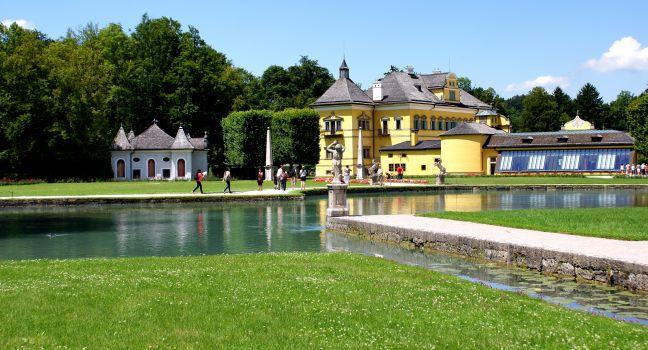
Schloss Hellbrunn

Fodor's Choice
SALZBURG,AUSTRIA - JULY 16, 2014. Hellbrunn Pallace and his gardens.Hellbrunn Palace,an early early Baroque villa,built in 1613, used as a day residence in summer.
ELEPHOTOS / Shutterstock

Just 6 km (4 miles) south of Salzburg, Schloss Hellbrunn was the prince-archbishops' pleasure palace. It was built early in the 17th century by Santino Solari for Markus Sittikus, after the latter had imprisoned his uncle, Wolf-Dietrich, in the fortress. The castle has some fascinating rooms, including an octagonal music room and a banquet hall with a trompe-l'oeil ceiling. Look out for the homemade "unicorn." Hellbrunn Park became famous far and wide because of its Wasserspiele, or trick fountains. In the formal gardens (a beautiful example of the Mannerist style) owners added an outstanding mechanical theater that includes exotic and humorous fountains spurting water from strange places at unexpected times. You will probably get doused, so bring a raincoat. A visit to the gardens is highly recommended: nowhere else can you experience so completely the realm of fantasy in which the grand Salzburg archbishops indulged. The Monatsschlösschen, the old hunting lodge, contains an excellent folklore museum. Following the path over the hill you find the Steintheater (Stone Theater), an old quarry made into the earliest open-air opera stage north of the Alps. The former palace deer park has become a zoo featuring free-flying vultures and Alpine animals that largely roam unhindered. You can get to Hellbrunn by Bus 25, by car via the B150, or by bike or on foot along the beautiful Hellbrunner Allee past several 17th-century mansions. On the estate grounds is the little gazebo filmed in The Sound of Music ("I am 16, going on 17")—though the doors are now locked. To reach Schloss Hellbrunn from Salzburg Altstadt, take bus 25.

Consider going one stop further on the bus to the zoo; there's a lovely walk from here through the park into the palace gardens.

Recommended Fodor's Video

Albertina Modern

1st District Fodor's Choice

Opened in 2020, the Künstlerverein graces a Neoclassical palace and iconic Viennese building just steps away from the opera house and its sister, the famed Albertina Museum. Exhibits focus on modern and contemporary art, and the permanent collection features works by famous Austrians like Maria Lassnig and Arnulf Rainer, and leading international artists, including Damien Hirst, Andy Warhol, Anselm Kiefer, and Cindy Sherman.

Albertina Museum

1st District Fodor's Choice

One of the largest of the Hapsburg residences, the Albertina rests on one of the last remaining fortresses of the Old City. The must-see collection of nearly 65,000 drawings and almost a million prints is one of the most prized graphic collections in the world. All the Old Masters are showcased here: Leonardo da Vinci, Michelangelo, Raphael, Rembrandt. The Batliner Collection includes excellent examples of French and German Impressionism and Russian avant-garde. The mansion's early-19th-century salons—all gilt boiserie and mirrors—provide a jewel-box setting. The excellent Do & Co restaurant, with a patio long enough for an empress's promenade, offers splendid vistas of the historical center, and the Burggarten is the perfect place to take a break.

Albertinaplatz 1, Vienna, A-1010, Austria
01-534–830
Sight Details
€18.90; €24.90 Albertina and Albertina Modern

Something incorrect in this review?

Ars Electronica Center

Fodor's Choice

Just across the Nibelungen Bridge from the Hauptplatz, this highly acclaimed "Museum of the Future," opened in 2009, pays tribute to the confluence of art, technology, and society. Permanent features at the museum include the 3D cinema room, which allows you to fly over Renaissance cathedrals or explore ancient civilizations, as well as exhibits on the latest developments in robotics and the origins of the universe—all with English explanations. As well as its permanent exhibits, the center also hosts annual festivals, with a different theme each year. Allow at least half a day to experience all the cybersites here. When you need a break, visit the Cubus bistro on the third floor for refreshments and a spectacular view overlooking the Danube and Lentos Kunstmuseum opposite ( www.cubus.at).

Augarten Porzellanmanufaktur

2nd District/Leopoldstadt Fodor's Choice

Founded in 1718, Europe's second-oldest porcelain factory is located in a former pleasure palace in Augarten Park, and is indeed a pleasure palace for lovers of handmade and painted porcelain. This company is renowned for its high-quality porcelain, delicate patterns, and constant innovation in its design and production. Augarten porcelain is still produced and painted by the hands of employees in the manufactory, just as it has been for almost 300 years. One wing of the factory houses a museum, designed around the 18th century bottle kiln that reaches to the rooftop of the first level. Guided tours of the factory (Monday to Thursday at 10:15 am and 11:30 am) take visitors behind the scenes to see creators at work and to explain the different phases of the process as well as the history and evolution of the art. Your wonder, appreciation, and awe at the final creations and the fact that it takes a porcelain artist three months to create them will be put to good use in the gift shop. Visitors looking for a more immersive experience can book a two-day seminar on the creation and painting of porcelain.

Obere Augartenstrasse 1, Vienna, 1020, Austria
01-211–24200
Sight Details
€8/€21 for a guided tour (request an English tour in advance)

Something incorrect in this review?

Belvedere Palace

3rd District/Landstrasse Fodor's Choice

One of the most splendid pieces of Baroque architecture anywhere, the Belvedere Palace—actually two imposing palaces separated by a 17th-century French-style garden parterre—is one of the masterpieces of architect Lucas von Hildebrandt. Built outside the city fortifications between 1714 and 1722, the complex originally served as the summer palace of Prince Eugene of Savoy. Much later it became the home of Archduke Franz Ferdinand, whose assassination in 1914 precipitated World War I. Though the lower palace is impressive in its own right, it is the much larger upper palace, used for state receptions, banquets, and balls, that is acknowledged as Hildebrandt's masterpiece. The upper palace displays a wealth of architectural invention in its facade, avoiding the main design problems common to palaces: monotony on the one hand and pomposity on the other.

Hildebrandt's decorative manner here approaches the Rococo, that final style of the Baroque era when traditional classical motifs all but disappeared in a whirlwind of seductive asymmetric fancy. The main interiors of the palace go even further: columns are transformed into muscle-bound giants, pilasters grow torsos, capitals sprout great piles of symbolic imperial paraphernalia, and the ceilings are aswirl with ornately molded stucco. The result is the finest Rococo interior in the city.

Both the upper and lower palaces of the Belvedere are museums devoted to Austrian painting. The Belvedere's main attraction is the collection of 19th- and 20th-century Austrian paintings, centering on the work of Vienna's three preeminent early-20th-century artists: Gustav Klimt, Egon Schiele, and Oskar Kokoschka. Klimt was the oldest, and by the time he helped found the Secession movement he had forged an idiosyncratic painting style that combined realistic and decorative elements in a way that was revolutionary. The Kiss—his greatest painting—is here on display. Schiele and Kokoschka went even further, rejecting the decorative appeal of Klimt's glittering abstract designs and producing works that ignored conventional ideas of beauty.

An ambitious 2016 European Union initiative brought 3D technology to the Belvedere. The project, entitled AMBAVis (Access to Museums for Blind and Visually-Impaired Persons), transformed Klimt's The Kiss into a remarkable and unprecedented interactive experience. Finger-tracking technology allows viewers to scan the relief, prompting audio to play. In conjunction with the Belvedere’s 300th anniversary in 2023, the museum launched an augmented reality game sending players with their cell phones on a game of exploration, searching for creatures who may have hidden here in Prince Eugene’s time.

Burg Kreuzenstein

Fodor's Choice

Seemingly lifted from the pages of a German fairy tale, Burg Kreuzenstein bristles with storybook turrets and towers. Sitting atop a hillside 3 km (2 miles) beyond Korneuburg, "Castle Cross-stone" is, in fact, a 19th-century architectural fantasy built to conjure up "the last of the knights"—Emperor Maximilian I himself. Occupying the site of a previously destroyed fort, the enormous structure was built by Count Nepomuk Wilczek between 1879 and 1908. Using old elements and Gothic and Romanesque bits and pieces, the castle was carefully laid out according to the rules of yore, complete with a towering Burgtor, "kennel" corridor (where attackers would have been cornered), Gothic arcades, and tracery parapet walls. Discover the Burghof courtyard, with its half-timbered facade and Baltic loggia, a festival and banquet hall, a library, a stained-glass chapel, vassal kitchens, and the Narwalzahn, a room devoted to hunting trophies (if you've ever wanted to see a "unicorn horn," here's your chance). Guided tours are available on the hour.

A group of falconers keeps peregrine falcons and other birds of prey near the castle grounds, and there are regular shows April through October.

The quickest and most pleasant way to reach the castle is to take the suburban train (S-Bahn) to Leobendorf, followed by a 45-minute uphill walk. Only cash payment is accepted, and there is no ATM at the castle.

Burgbau

Fodor's Choice

How was a medieval castle built? The team at Burgbau are finding out, building a castle to exacting medieval standards: no electricity, no modern tools, and only natural materials. The aim is not only to build an "authentic" castle, but also to keep these heritage crafts alive. When complete, the complex will include a residential tower, residential building with a chapel, castle courtyard, farm buildings, and a castle garden. You will see stone workers, ironmongers, and carpenters at work and discover the how and why of medieval construction practices.

St. Veiterstrasse 30, Friesach, Austria
4366-5448856
Sight Details
€11
Closed Mon., July and Aug.; Mon. and Tues., Apr.–June, Sept., and Oct.; and Nov.–Apr.

Something incorrect in this review?

Carnuntum

Fodor's Choice

The remains of the important Roman legionary fortress and civil town of Carnuntum, which once numbered 55,000 inhabitants, extend about 5 kilometers (3 miles) along the Danube from the tiny village of Petronell to the next town of Bad Deutsch-Altenburg. The discovery here of an ancient school of gladiators delighted archaeologists and significantly raised Carnuntum's stature, and rightfully so. Visitors can tour the grounds, which include two amphitheaters (the first one seating 8,000) and the foundations of former residences, reconstructed baths, and trading centers—some with mosaic floors. The ruins are quite spread out, with the impressive remains of a Roman arch, the Heidentor (Pagans' Gate), a pleasant 15-minute walk from the main excavations in Petronell. You can experience what Roman life was like circa AD 380 in the elegantly furnished Villa Urbana. Many of the excavated finds are housed at the Museum Carnuntinum at Bad Deutsch-Altenburg. The star of the collection is a carving of Mithras killing a bull. Guided tours in English are available in July and August at noon; otherwise they are in German only.

Hauptstrasse 1A, Petronell, A-2404, Austria
02163-33770
Sight Details
€13
Closed mid-Nov.–mid-Mar.

Something incorrect in this review?

Dachstein Ice Caves

Fodor's Choice

This is one of the most impressive sights of the Eastern Alps—vast ice caverns, many of which are hundreds of years old and aglitter with ice stalactites and stalagmites, illuminated by an eerie light. The most famous sights are the Rieseneishöhle (Giant Ice Cave) and the Mammuthöhle (Mammoth Cave), but there are other caves and assorted frozen waterfalls in the area. The cave entrance is at about 6,500 feet, accessed via cable car and a hike (or you can hike all the way), but still well below the 9,750-foot Dachstein peak farther south. 

Be sure to wear warm, weatherproof clothing and good shoes; inside the caves it is very cold, and outside the slopes can be swept by chilling winds. Start before 2 pm to see both caves.

34 Winkl, Hallstatt, A-4831, Austria
05-0140
Sight Details
Giant Ice and Mammoth Cave €45.30 each; combined ticket €53.10; cable car €39.30 round-trip
Closed Nov.–Apr.

Something incorrect in this review?

Dom zu Salzburg

Fodor's Choice

Set within the beautiful Domplatz with the Virgin's Column in its center, this gorgeous cathedral is considered to be the first early-Italian Baroque building north of the Alps. Its facade is of marble, its towers reach 250 feet into the air, and it holds 10,000 people. There has been a cathedral on this spot since the 8th century, but the present structure dates from the 17th century. The cathedral honors the patron saint of Salzburg, St. Rupert, who founded Nonnberg Abbey around 700, and also the Irish St. Virgil, the founder of the first cathedral, consecrated in 774, whose relics lie buried beneath the altar. Archbishop Wolf-Dietrich took advantage of the old Romanesque-Gothic cathedral's destruction by fire in 1598 to demolish the remains and make plans for a huge new structure facing onto the Residenzplatz to reaffirm Salzburg's commitment to the Catholic cause. His successor, Markus Sittikus, and the new court architect, Santino Solari, started the present cathedral in 1614; it was consecrated with great ceremony in 1628 during the Thirty Years' War. The church's simple sepia-and-white interior, a peaceful counterpoint to the usual Baroque splendor, dates from a later renovation. To see remains of the old cathedral, go down the steps from the left-side aisle into the crypt where the archbishops from 1600 on are buried. Mozart's parents, Leopold and Anna-Maria, were married here in 1747 and Mozart was christened, the day after he was born, at the 14th-century font. He later served as organist here from 1779 to 1781 and wrote some of his compositions such as the Coronation Mass specifically for the cathedral. It was a good fit, as this is the only house of worship in the world with five independent fixed organs. Today, they are sometimes played together during special church-music concerts.

On Sunday and all Catholic holidays, mass is held at 10 am—the most glorious time to experience the cathedral's full splendor.

DomQuartier

Fodor's Choice

For the first time since the early 1800s, you can look down on the original heart of Salzburg as once only the powerful archbishops could, as you walk the top-floor corridors surrounding the Domplatz that connect the Residenz (palace), Dom (cathedral), and St. Peter's Abbey. In the Residenz, see the magnificent State Rooms, including the Kaisersaal (Imperial Hall) and the Rittersaal (Knight's Hall). Of particular note are the frescoes by Johann Michael Rottmayr and Martino Altomonte depicting the history of Alexander the Great. Upstairs on the third floor is the Residenzgalerie, a princely art collection specializing in 17th-century Dutch and Flemish art and 19th-century paintings of Salzburg. On the State Rooms floor, Mozart's opera La Finta Semplice premiered in 1769 in the Guard Room. Also included is the fascinating Dommuseum, with cathedral art from the 8th to 18th centuries, as well as the Museum St. Peter with valuable art treasures from the monastery's collections. You'll also enjoy a beautiful balcony view of the cathedral interior, as well as expansive vistas of the city. The interior walkways make it particularly appealing on one of Salzburg's frequent rainy days.

Residenzplatz 1/Domplatz 1a, Salzburg, A-5020, Austria
0662-804–221–09
Sight Details
€13
Closed Tues.

Something incorrect in this review?

Galzigbahn

Fodor's Choice

The state-of-the-art Galzigbahn cable car rises from the heart of St. Anton up to the Galzig mountain, where it connects with the two-part Vallugabahn and climbs even higher, crossing from the province of Tirol into neighboring Vorarlberg. As well as offering spectacular mountain vistas all along the way—the panoramic mountain views from the platform at 9,222 feet are simply breathtaking—there's also a great selection of hiking and biking trails, as well as restaurants and refreshment huts along the way. It's open in the summer from July through early September (when you pay for a 'pedestrian ticket') and in winter as part of the St. Anton ski resort (when cable car access is included in your ski pass).

Kandaharweg 9, St. Anton am Arlberg, A-6580, Austria
05446-23520
Sight Details
One-way pedestrian ticket on Galzigbahn: €20 (€34.50 including Vallugabahn I + II)

Something incorrect in this review?

Goldenes Dachl

Fodor's Choice

Any walking tour of Innsbruck should start at the Goldenes Dachl, which made famous the late-Gothic mansion whose balcony it covers. In fact, the roof is capped with 2,657 gilded copper tiles, and its refurbishment is said to have taken nearly 31 pounds of gold. The house was built in 1420 for Frederick IV as the residence of the Tyrolean sovereign. The legend persists that he added the golden look to counter rumors that he was penniless, but the balcony was, in fact, added by Emperor Maximilian I in the late 15th century as a "royal box" for watching various performances in the square below. He had the roof gilded to symbolize the wealth and power of Tyrol, which had recently undergone massive financial reform. The structure was altered and expanded at the beginning of the 18th century, and now only the loggia and the alcove are identifiable as original. Maximilian is pictured in the two central sculpted panels on the balcony. In the one on the left, he is with his first and second wives, Maria of Burgundy and Bianca Maria Sforza of Milan; on the right, he is pictured with an adviser and a court jester. The magnificent coats of arms representing Austria, Hungary, Burgundy, Milan, the Holy Roman Empire, Styria, Tyrol, and royal Germany are copies. You can see the originals (and up close, too) in the Ferdinandeum. The Golden Roof building houses the Goldenes Dachl Museum with memorabilia and paintings from the life of Emperor Maximilian I.

Herzog-Friedrich-Strasse 15, Innsbruck, A-6020, Austria
0512-5360–1441
Sight Details
€5.30 (Goldenes Dachl Museum)
Closed Mon. Oct.–Apr.

Something incorrect in this review?

Hallein Salt Mine

Fodor's Choice

The second-largest town of the region, 15 kilometers (10 miles) south of Salzburg and at least 1,000 years older, Hallein was once famed for its caves of "white gold"—or salt. "Hall" is the old Celtic word for salt, and this treasure was mined in the neighboring Dürrnberg mountain, which you can now visit in the form of Hallein Salt Mine. It's the oldest salt mine in the world and probably also the most fun: you get to explore the subterranean world by foot, boat, and even slide. Your ticket also includes access to the Celtic Mountain exhibition, which includes a replica of a Celtic village. You can get to Hallein by regular bus, by car, or by bicycle alongside the River Salzach, then it's a lovely, 40-minute walk (or seven-minute taxi) up to the mine. 

Take your passport, as while underground you'll cross from Austria into Germany and back.

Hangar-7

Fodor's Choice

Red Bull founder Dietrich Mateschitz opens his fantasy toy chest for all to admire: vintage airplanes, helicopters, motorbikes, and Formula One racing cars gleam under the glass and steel of this modern multipurpose dome. The Flying Bulls, Red Bull's aerobatics experts, and their pristine fleet call this home when not circling the world on their frequent air-show tours. Watch daytime takeoffs and landings from under the shadow of a massive, silver World War II bomber at the Carpe Diem Lounge-Café or in the sunny Outdoor Lounge. The Mayday Bar is an affordable way to experience the evening atmosphere if you can't get a table at the incredibly popular Ikarus restaurant.

Haus der Musik

1st District Fodor's Choice

You could spend an entire day at this ultra-high-tech museum, housed on several floors of an early-19th-century palace near Schwarzenbergplatz. This is a highly interactive experience; in "Facing Mozart," visitors animate a Mozart portrait using a technology called facetracking. Assuming the role of virtual conductor, you can conduct the Vienna Philharmonic (or a video projection of it, anyway) and have the orchestra follow your every command; the conductor's baton is hooked to a computer, which allows you to have full control over the simulated orchestra. For added fun, the stairs at the beginning of the tour are musical; each step produces a note. Other exhibits trace the evolution of sound (from primitive noises to the music of the classical masters) and illustrate the mechanics of the human ear (you can even measure your own frequency threshold).

Hochosterwitz

Fodor's Choice

The dramatic castle of Hochosterwitz crowns the top of a steep, isolated outcropping, looking as if it has just emerged from the pages of a fairy tale. It was in this castle that the forces of "Pocket-Mouthed Meg" (Margarethe Maultasch) were tricked by two slaughtered oxen dropped onto the heads of its soldiers. Those inside the fortress were starving, but the strategy succeeded, and, dispirited by such apparent proof of abundant supplies, the Tyrolese abandoned the siege. The most recent fortifications were added in the late 1500s against invading Turks; each of the 14 towered gates is a small fortress unto itself. Inside, there's an impressive collection of armor and weaponry plus a café-restaurant in the inner courtyard. There's a glass elevator (accommodating wheelchairs) from a point near the parking-lot ticket office. The hike up the rather steep path to Hochosterwitz adds to the drama. Your reward at the summit is spectacular vistas from every vantage point. There's a restaurant in the castle and a food stand in the upper parking lot. Get to the castle on the back road from Treibach or via Route 83/E7.

Kaiserliche Schatzkammer

1st District Fodor's Choice

The entrance to the Schatzkammer, with its 1,000 years of treasures, is tucked away at ground level behind the staircase to the Hofburgkapelle. The elegant display is a welcome antidote to the rather staid Imperial Apartments, and the crowns and relics glow in their surroundings. Here you'll find such marvels as the Holy Lance (reputedly the lance that pierced Jesus's side), the Imperial Crown (a sacred symbol of sovereignty once stolen on Hitler's orders), and the Saber of Charlemagne. Don't miss the Burgundian Treasure, connected with that most romantic of medieval orders of chivalry, the Order of the Golden Fleece.

Karlskirche

Fodor's Choice

Dominating the Karlsplatz is one of Vienna's greatest buildings, the Karlskirche, dedicated to St. Charles Borromeo. This giant Baroque church is framed by enormous freestanding columns, mates to Rome's famous Trajan's Column. These columns may be out of keeping with the building as a whole, but were conceived with at least two functions in mind: one was to portray scenes from the life of the patron saint, carved in imitation of Trajan's triumphs, and thus help to emphasize the imperial nature of the building; and the other was to symbolize the Pillars of Hercules, suggesting the right of the Hapsburgs to their Spanish dominions, which the emperor had been forced to renounce. The end result is an architectural tour de force.

The Karlskirche was built in the early 18th century on what was then the bank of the River Wien. The church had its beginnings in a disaster. In 1713 Vienna was hit by a brutal outbreak of plague, and Emperor Charles VI made a vow: if the plague abated, he would build a church dedicated to his namesake, St. Charles Borromeo, the 16th-century Italian bishop who was famous for his ministrations to Milanese plague victims. In 1715 construction began, using an ambitious design by Johann Bernhard Fischer von Erlach that combined architectural elements from ancient Greece (the columned entrance porch), ancient Rome (the Trajanesque columns), contemporary Rome (the Baroque dome), and contemporary Vienna (the Baroque towers at either end). When it was finished, the church received decidedly mixed press. History, too, delivered a negative verdict: the Karlskirche spawned no imitations, and it went on to become one of European architecture's curiosities. Still, when seen lighted at night, the building is magical in its setting.

The main interior of the church utilizes only the area under the dome and is conventional despite the unorthodox facade. The space and architectural detailing are typical High Baroque; the fine vault frescoes, by J. M. Rottmayr, depict St. Charles Borromeo imploring the Holy Trinity to end the plague. If you are not afraid of heights, take the panorama elevator up into the sphere of the dome and climb the top steps to enjoy an unrivaled view to the heart of the city.

Karmelitermarkt

2nd District/Leopoldstadt Fodor's Choice

The market and lively surrounding area is one of Vienna's coolest food and drink hot spots and its sunny picturesque square is a favorite option for breakfasting and people-watching over coffee. The market itself has more than 80 vendors and has existed since 1671, making it one of Vienna's oldest—and yet it never gets old. There's a farmers' market on Saturday and new spots serving international and Viennese cuisine are popping up all the time. Quieter and more spacious than the buzzing 6th and 7th districts, this area is a great alternative to the busier central areas. Allow ample time to wander the surrounding streets and linger in cafés and boutiques.

Karmelitermarkt, Vienna, 1020, Austria

Something incorrect in this review?

Kunsthistorisches Museum

1st District Fodor's Choice

Even if you're planning on a short stay in Vienna, you'll want to come here to visit one of the greatest art collections in the world, standing in the same class as the Louvre, the Prado, and the Vatican. This is no dry-as-dust museum illustrating the history of art, as its name might imply, but rather the collections of Old Master paintings that reveal the royal taste and style of many members of the mighty House of Hapsburg, which ruled over the greater part of the Western world in the 16th and 17th centuries.

The museum is most famous for the largest collection of paintings under one roof by the Netherlandish 16th-century master Pieter Brueghel the Elder. Many art historians say that seeing his sublime Hunters in the Snow is itself worth the trip to Vienna. Brueghel's depictions of peasant scenes, often set in magnificent landscapes, distill the poetry and magic of the 16th century as few other paintings have done. The Flemish wing also includes masterful works by Rogier van der Weyden, Holbein, Rembrandt, and Vermeer, while the Italian wing features Titian, Giorgione, Raphael, and Caravaggio. The large-scale works concentrated in the main galleries shouldn't distract you from the equal share of masterworks in the more intimate side wings.

There is also the remarkable but less-visited Kunstkammer, displaying priceless objects created for the Hapsburg emperors. These include curiosities made of gold, silver, and crystal (including Cellini's famous salt cellar "La Saliera"), and more exotic materials such as ivory, horn, and gemstones. In addition, there are rooms devoted to Egyptian antiquities, Greek and Roman art, sculpture, and numerous other collections.

One of the best times to visit the Kunsthistorisches Museum is on Thursday evenings, when you can enjoy a sumptuous gourmet dinner with a massive dessert buffet (€65) in the cupola rotunda. Just across from the seating area, take a leisurely stroll through the gallery chambers.

Maria-Theresien-Platz, Vienna, A-1010, Austria
01-525–240
Sight Details
€21
Closed Mon. Sept.–May

Something incorrect in this review?

Landesgalerie Niederösterreich

Fodor's Choice

When it opened in 2019, the Landesgalerie instantly became the most eye-catching building in Krems. Well, its gracefully swooping, tent-like, zinc-tiled and glass-dotted roof isn't exactly easy to ignore. Step inside and things get even more interesting, with its 3,000 square meters of exhibition space dedicated to visual artworks from the last two centuries. Visitors can enjoy prints, paintings, photographs, sculptures, and installations from renowned Lower Austrian artists including Leo Navratil and Christa Hauer-Fruhmann. The on-site Restaurant Poldi Fitzka is well worth a visit, too.

Museumplatz 1, Krems, A-3500, Austria
02732-908010
Sight Details
€12; Combined ticket with Kunsthalle and Landesgalerie: €18
Closed Mon.

Something incorrect in this review?

Mozart-Wohnhaus

Fodor's Choice

The Mozart family moved from its cramped quarters in Getreidegasse to this house on the Hannibal Platz, as it was then known, in 1773. Wolfgang Amadeus Mozart lived here until 1780, his sister Nannerl stayed here until she married in 1784, and their father Leopold lived here until his death in 1787. The house is accordingly referred to as the Mozart Residence, signifying that it was not only Wolfgang who lived here. During the first Allied bomb attack on Salzburg in October 1944, the house was partially destroyed, but was reconstructed in 1996. Mozart composed the "Salzburg Symphonies" here, as well as all five violin concertos, church music, and some sonatas, and parts of his early operatic masterpieces, including Idomeneo. Take the informative audio tour for an introduction to the museum's interesting collection of musical instruments—like his own pianoforte in the Dance Master Hall—as well as books from Leopold Mozart's library, family letters, and portraits. Before you leave, take a peek inside the Mozart Audio Visual Collection, an archive of thousands of Mozart recordings as well as films and video productions, all of which can be listened to or viewed on request.

Makartplatz 8, Salzburg, A-5020, Austria
0662-874–227–40
Sight Details
€12; combined ticket with Mozarts Geburtshaus €18.50

Something incorrect in this review?

Mozarthaus

1st District Fodor's Choice

This is Mozart's only still-existing abode in Vienna, with three floors of displays about his life and the masterworks that he composed here. Equipped with an excellent audio guide and starting out on the third floor of the building, you can hear about Mozart's time in Vienna: where he lived and performed, who his friends and supporters were, and his passion for expensive attire—he spent more money on clothes than most royals at that time. The second floor deals with Mozart's operatic works. The first floor focuses on the 2½ years that Mozart lived at this address (he moved around a lot in Vienna), when he wrote dozens of piano concertos, as well as The Marriage of Figaro and the six quartets dedicated to Joseph Haydn (who once called on Mozart here, saying to Mozart's father, "Your son is the greatest composer that I know in person or by name"). For two weeks in April 1787, Mozart took on a 16-year-old pupil from Germany named Ludwig van Beethoven. Concerts are staged here, and there are activities for children.

Save on the entrance fee by purchasing a combined ticket for Mozarthaus Vienna and Haus der Musik for €20.

Mozarts Geburtshaus

Fodor's Choice

This homage to Salzburg's prodigal son offers fascinating insights into his life and works, with carefully curated relics of Mozart's youth, listening rooms, and models of famous productions of his operas. As an adult, the great composer preferred Vienna to Salzburg, complaining that audiences in his native city were no more responsive than tables and chairs. Still, home is home, and this was Mozart's—when not on one of his frequent trips abroad—until the age of 17. Mozart was born on the third (in American parlance, the fourth) floor of this tall house on January 27, 1756, and his family lived here in the front apartment, when they were not on tour, from 1747 to 1773. As the child prodigy composed many of his first compositions in these rooms, it is fitting and touching to find Mozart's tiny first violin on display. Buy a combination ticket and you can also visit the Mozart-Wohnhaus (his onetime residence) across the river.

Getreidegasse 9, Salzburg, A-5020, Austria
0662-844313
Sight Details
€12; combined ticket with Mozart-Wohnhaus €18.50

Something incorrect in this review?

MuseumsQuartier

7th District/Neubau Fodor's Choice

The MQ—as many call it—is a sprawling collection of galleries housed in what was once the Imperial Court Stables, the 260-year-old Baroque complex designed by Fischer von Erlach. Where once 900 cavalry horses were housed, now thousands of masterworks of the 20th and 21st centuries are exhibited, all in a complex that is architecturally an expert and subtle blending of historic and cutting-edge: the original structure (adorned with pastry-white stuccoed ceilings and Rococo flourishes) was retained, while ultramodern wings were added to house five museums, most of which showcase modern art at its best.

The Architekturzentrum, Kunsthalle, Leopold Museum, mumok (Museum Moderner Kunst Stiftung Ludwig), and ZOOM Kindermuseum are all part of the MuseumsQuartier complex. In addition, the Quartier21 showcases up-and-coming artists and musicians in the huge Fischer von Erlach Wing facing the Museumsplatz. Lovers of modern art will find it easy to spend at least an entire day at MuseumsQuartier, and with several cafés, a lovely inner courtyard perfect for lounging and people-watching, restaurants, gift shops, and bookstores, you won't even need to venture outside.

Neue Burg

1st District Fodor's Choice

Standing today as a symbol of architectural overconfidence, the Neue Burg was designed for Emperor Franz Josef in 1869 as a "new château" that was part of a much larger scheme meant to make the Hofburg rival the Louvre, if not Versailles. The German architect Gottfried Semper planned a twin of the present Neue Burg on the opposite side of the Heldenplatz, with arches connecting the two with the other pair of twins on the Ringstrasse, the Kunsthistorisches Museum (Museum of Art History) and the Naturhistorisches Museum (Museum of Natural History). But World War I intervened, and with the empire's collapse the Neue Burg became the last in a long series of failed attempts to bring architectural order to the Hofburg. Today the Neue Burg houses four specialty museums: the Imperial Armor Collection, the Collection of Historical Musical Instruments, the Ephesos Museum, and the Ethnological Museum.