7 Best Sights in Cuba

Background Illustration for Sights

We've compiled the best of the best in Cuba - browse our top choices for the top things to see or do during your stay.

Museo de la Revolución

Centro Habana Fodor's Choice

Batista's Palacio Presidencial, unsuccessfully attacked by students on March 13, 1957, was converted into the Museum of the Revolution after Castro's 1959 victory. The Russian tank outside was used by Cuban forces to repel the Bay of Pigs invasion. The marble staircase and the magnificent upstairs ceiling mural tell one story, while galleries with displays of items from colonial times to the present tell another; the contrast is effective. Photographs of tortured revolutionaries, maps tracing the progress of the war, the bloodstained uniforms of rebels who fell in the 1953 Santiago de Cuba Moncada Barracks attack, and photos of Fidel and Che complete a comprehensive tour of the Revolution's history.

Don't miss Cretin's Corner for a look at some familiar faces.
Calle Refugio 1, Havana, 10200, Cuba
7862–4098
Sight Details
CUC$8 for combined ticket to museum and Memorial Granma
Daily 9–5

Something incorrect in this review?

Capitolio

Centro Habana
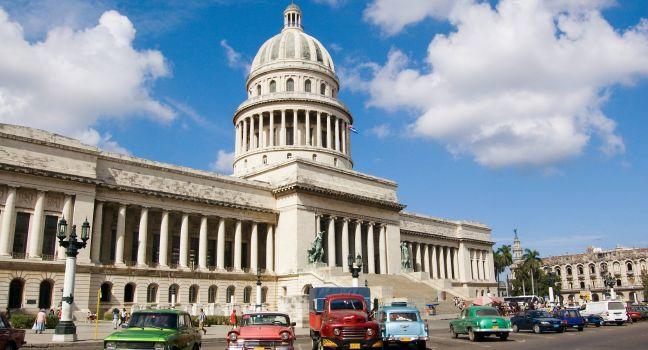
Home of Cuba's legislature - the Capitolio in Havana.
Basphoto | Dreamstime.com

Modeled after Washington, D.C.'s domed Capitol building, Havana's Capitolio was built in 1929 and is rich in iconography. The statue to the left of the entrance stairway represents Work (considered a masculine ethic); that on the right is of Virtue (a perceived feminine attribute). Some 30 bas-reliefs on the main door depict events in Cuba's history. The giant main hall is called the Salon de los Pasos Perdidos (Hall of the Lost Steps), allegedly for the fading reverberations of footsteps. It's dominated by the gigantic bronze statue of Minerva (once known as La República). Set into the floor at her feet is a diamond (presently a replica) from which all distances on the island are measured. The former Senate Chamber is at the end of the right-hand corridor; the one-time Chamber of Representatives is on the far left. The on-site restaurant, El Salón de los Escudos, serves a reasonable lunch; the Café Mirador offers lighter fare. The building seems to be undergoing perpetual renovation.

Paseo de Martí (Prado), Havana, 10200, Cuba
7860–3411
Sight Details
Free

Something incorrect in this review?

Biblioteca

The Neoclassical Biblioteca, on Plaza Serafín Sánchez's southwest corner, is the most conspicuous edifice. Built in 1929 by the city's wealthiest citizens as an exclusive club, it became a public library following the Revolution, and was meticulously restored in 1998. On the second floor in the former ballroom, students now read beneath painted columns and crystal chandeliers. Be sure to check out the view from the balcony.

Calle Máximo Gómez 1 Norte, Sancti Spíritus, 60100, Cuba
4132–3313
Sight Details
Free
Weekdays 8 am–9 pm, Sat. 8–4.

Something incorrect in this review?

Recommended Fodor's Video

Edificio Bacardí

Centro Habana

Built in 1930, the former Bacardí rum headquarters (the family elected not to brave the Revolution and now makes rum in Puerto Rico) is an Art Deco outburst best admired from the roof of the Hotel Plaza across the street. Its terra-cotta facade is covered with nymphs, sylphs, salamanders, and undines; its bell tower is capped with a brass, winged bat you'll recognize from the Bacardí rum label (or from the coat of arms of the House of Aragón, a clue to the family's Catalonian heritage). Visitors can't go inside, but it's worth a look at the outside nonetheless.

Calle San Juan de Dios 202, Havana, Cuba

Something incorrect in this review?

Hospital de San Juan de Dios

On the eastern edge of Plaza de San Juan de Dios, the old hospital now holds the offices of several cultural organizations. In the portico of its large garden, you'll find a simple museum with exhibits on the building's history, some old photos, and surgical instruments from days of yore—thank goodness for modern medicine. It's worth a quick look if you have a curiosity for the history of medicine. More interesting is the view from the roof.

Camagüey, 70100, Cuba
3229–1388
Sight Details
CUC$1
Mon.--Sat. 7–11 and 2:30--4

Something incorrect in this review?

Manaca Iznaga

This site of an 18th-century farmhouse once belonged to one of the region's wealthiest families. It stands next to the Torre de Iznaga, a 43-meter (141-foot) tower built in the early 1800s. Legend has it that the two Iznaga sons were in love with a beautiful young woman, and their father told one to build a tower and the other to dig a well, with the promise that whoever built higher or dug deeper could have her. But when they were done, both the tower and well were 43 meters, so the old man married the woman himself. The tower actually had a much more practical purpose: it was a place from which to keep an eye on the thousands of slaves who worked the surrounding plantations. The large bell that was rung when slaves tried to escape lies on the ground near the farmhouse.

12 km (7 miles) beyond lookout just outside Trinidad, Cuba

Something incorrect in this review?

Museo de la Farmcia Habanera

La Habana Vieja

This still functioning Art Nouveau pharmacy may sometimes be short on drugs, but it is certainly long on design. Founded by a Catalan apothecary in 1874, it was built in the elaborate Modernist style universally favored by 19th-century pharmacies. The carved wooden racks and shelves backed by murals painted on glass are especially ornate, and the ceramic apothecary jars, though probably empty, are colorfully painted. Also known as La Reunión (note the inscription on the wall behind the counter), this pharmacy was a famous meeting place, a sort of informal neighborhood clubhouse.

Calle Brasil (Teniente Rey) 251, Havana, Cuba
7866–7554
Sight Details
Free
Daily 9–5

Something incorrect in this review?