11 Best Sights in Cuba

Background Illustration for Sights

We've compiled the best of the best in Cuba - browse our top choices for the top things to see or do during your stay.

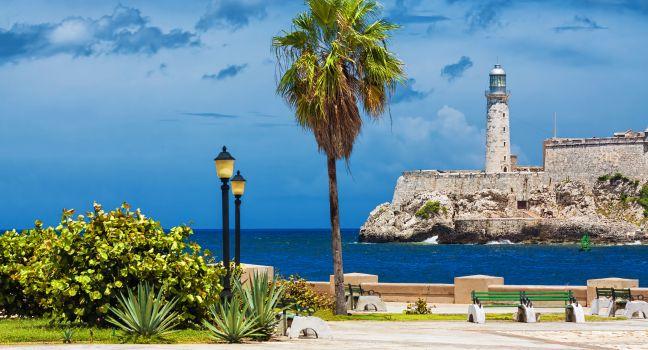
Castillo de los Tres Reyes del Morro

Habana del Este
The castle of El Morro, a symbol of Havana, and a nearby romantic park on a day with a beautiful sky; Shutterstock ID 111410624; Project/Title: Fodor's Cuba; Downloader: Fodor's Travel
Kamira / Shutterstock

Begun in 1589, Havana's landmark fort is named for the Reyes Magos—the Magi or Three Kings of Bethlehem, who are the patrons of its chapel—and for the fact that it occupies a morro (promontory) at the harbor entrance. It and its sister fort across the way, La Punta, made Havana the safest port in the Americas at a time when both pirates and imperialists helped themselves to whatever could be had. Built into cliffs, El Morro was furnished with a battery of 12 cannons christened La Batería de los Doce Apóstoles (The Battery of the Twelve Apostles) facing the sea and another dozen, called Las Pastoras (The Shepherdesses), nearer the ramparts. The active lighthouse flashes its beam over Havana every 15 seconds. Inside the castle, across a moat and drawbridge, are stables, the chapel, dungeons, and a wine cellar. You'll also find the fortified vaults, which contain the Museo del Morro, with displays on the fortress itself; the Museo de la Navegación, with navigation and seafaring artifacts; and the Museo de Piratas, with exhibits and bits of folklore on pirates. The armory displays weapons from around the world.

Havana, 10900, Cuba
7861–9727
Sight Details
CUC$6 for the fort, CUC$2 extra for lighthouse
Daily 8–7, lighthouse 10–noon and 2–7

Something incorrect in this review?

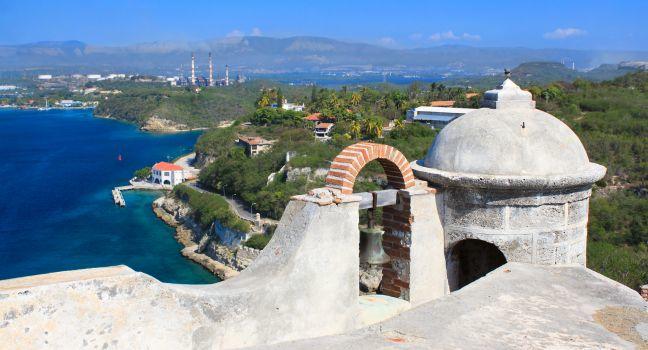
Castillo del Morro

Castle San Pedro de la Roca del Morro near Santiago de Cuba, Cuba.
Master2 | Dreamstime.com

The Spanish fortress known as El Morro, south of Santiago, was constructed between 1638 and 1700 and was designed by Giovanni Antonelli, the Italian architect and engineer responsible for fortresses bearing the same name in both Havana and San Juan, Puerto Rico. Dominating a bluff at the entrance to the Bahía de Santiago de Cuba, El Morro was built to ward off pirates (and rebuilt after a 1662 attack by the English pirate Henry Morgan). Inside you'll find a museum with exhibits on, appropriately enough, pirates. Signage is in Spanish only, but English-speaking guides can lead you around. (Tip them, of course.) There are wonderful views from interior rooms, which have wooden floors and stone walls, as well as from various terraces. From the lowest terrace, the view of the fortress itself, formed from the sheer face of the bluff, is powerful. The way into the structure takes you down and then back up a 207-step staircase; a drawbridge over a moat leads to the entrance. You'll find little shade here; sunscreen and a brimmed hat are musts. Midday gets unbearably hot.

Visit early in the morning or late afternoon if your schedule permits.

An impressive flag-lowering, cannon-firing ceremony winds up the day, and that makes a good case for a late-afternoon visit.

Santiago de Cuba, 90100, Cuba
2269–1569
Sight Details
CUC$4
Daily 8–sunset

Something incorrect in this review?

Antiguo Cuartel Moncada

If you have an interest in all things revolutionary, a visit to the Moncada Barracks is a must, because here's where it all started. On July 26, 1953, Castro and 100 men attempted to storm this former army barracks. It was carnival time in Santiago; the streets were full of revelers, and Castro had hoped that security would be lax. Unfortunately, his hopes were dashed, and the rebels were either killed or captured. Castro, who fled to the mountains, was eventually caught, tried, and imprisoned on the Isla de la Juventud off Western Cuba's southern coast. Although unsuccessful, the attack ignited the sparks of Castro's Revolution. He wrote his famous speech "La historia me absolverá" ("History will absolve me"), which was smuggled out of prison, printed, and distributed throughout the island. Although luck had not been on his side in 1953, it certainly was in 1955, when Batista granted many political prisoners their freedom. Castro left for the United States, where he began soliciting support for his 26th of July Movement (named in honor of the ill-fated barracks attack) to rid Cuba of Batista's regime. From there, he took his cause to Mexico. In 1956, just a year after being released from prison, Castro made his historic journey from Mexico to Cuba aboard the Granma.

Today the former stronghold of Batista's troops contains a grammar school and the Museo de 26 de Julio. The bullet holes surrounding the doorway to the museum are re-creations of those left after the original attack, which were quickly patched over by Batista's men. The exhibits here tell, in Spanish only, the entire story of the attack and the events that followed. They're among the nation's most comprehensive ones on revolutionary history. Take the guided tour (it's customary to tip docents CUC$1).

Av. General Portuondo (Trinidad) y Av. Moncada, Santiago de Cuba, 90100, Cuba
2262–0157
Sight Details
CUC$2
Tues.–Sat. 9:30–5:15, Sun. 9–2:30

Something incorrect in this review?

Recommended Fodor's Video

Castillo de Jagua

Above a fishing village overlooking the narrow entrance to the Bahía de Cienfuegos (35 km [21 miles] south of the historical center) is a Spanish fortress built in 1745 to keep out pirates who had grown accustomed to trading with locals. It's completely refurbished (even the drawbridge works) and has a historical museum with weapons and other antiques. The dungeon houses a bar and restaurant. On your way down, note the small chamber beneath the steps; prisoners were chained and tortured here.

If you're a woman, we suggest you not wear blue when you visit. Local legend holds that the site is haunted by the ghost of a mysterious female figure dressed in a blue gown; given the fort's notorious history, who can say for sure? We wouldn't want anyone to mistake you for her.

You have three ways to get here: take a taxi (or drive) the whole way, looping counterclockwise around the bay; travel overland directly south of Cienfuegos to the Hotel Pasacaballos at the entrance of the bay and take the short ferry that crosses back and forth to the fort all day long; or board the ferry at the south end of Calle 25 in Cienfuegos with departures at 8 am, 1 pm, and 5:30 pm and returns from the fort at 6:30 am, 10 am, and 3 pm.

Cienfuegos, 55100, Cuba
4359–6402
Sight Details
CUC$3
Mon.–Sat. 9–5, Sun. 9–1

Something incorrect in this review?

Castillo de la Real Fuerza

La Habana Vieja

Constructed in 1558 by order of Spanish king Felipe II three years after an earlier fortress was destroyed by the French pirate Jacques de Sores, this classic, moat-enclosed fortress was the residence of the local military commanders until 1762. The tower, added in 1632, is topped by the famous Giraldilla (weather vane), a nod to the one atop the Giralda minaret in Seville, the city whose Casa de Contratación (House of Trade) oversaw financial and shipping operations between Spain and its territories in the Americas. Havana's favorite symbol—it's even on the Havana Club rum label—the Giraldilla honors Doña Inés de Bobadilla, Cuba's lone woman governor, who replaced her husband, Hernando de Soto, when he left to conquer Florida (and search for the Fountain of Youth) in 1539. De Soto and his expedition went on to explore much of North America and were among the first white men to cross the Mississippi River. He died in 1542, but Doña Inés spent years scanning the horizon, awaiting his return. The current Giraldilla is a copy of an earlier bronze one toppled by a hurricane and now on display in the Museo de la Ciudad de La Habana. Today the museum houses an exhibition on Cuban navigation, dating from 1577 to today. On display are miniatures of the galleons that once passed through the island with gold coins, treasures, and documentation of maritime life over the centuries.

e/Calle O'Reilly y Av. del Puerto (Calle Desamparado/San Pedro), Havana, 10100, Cuba
7864–4488
Sight Details
CUC$3
Tues.–Sun. 9:30–5

Something incorrect in this review?

Castillo de San Carlos de la Cabaña

Habana del Este

In 1762 Lord Albemarle took El Morro for the English after a 44-day siege. A year later, Carlos III recovered Cuba in exchange for Florida and promptly ordered the construction of what was then the largest fort in the Americas. Sprawling across the hill east of El Morro, the fortress was named for the Spanish king and for the typical Cuban cabanas or bohíos (cabins) that once occupied the site. With the capacity to house 1,000 troops, this immense bastion was said to be so big that Carlos was given a telescope with which to admire it from Madrid.

The infamous Foso de los Laureles (Graveyard of the Laurels) was the execution wall where hundreds died during the wars of independence. The 9 pm ceremonia del cañonazo (ceremony of the cannon shot) is a must-see event filled with nostalgia and mystery. First, a lamplighter lights the gas lanterns. Then, a crier (a recruit with a voice so good he's been signed on permanently even though his military service ended years ago) begins an eery plainsong chant that reverberates throughout the fortress and, when the wind is right, across the bay to La Punta: "Silencio; ha llegado la noche / Las luces están encendidas / Nuestro cañon se llama Capitolino / A las nueve sonará" ("Silence; night has fallen / The lanterns are lit / Our cannon is named Capitolino / At nine it will sound"). Finally, a detail of some half-dozen soldiers dressed in scarlet 18th-century uniforms marches in and loads and fires the cannon, which makes a deafening noise (cover your ears).

La Cabaña's two museums are of moderate interest. The Museo de la Cabaña documents Cuba's military history, and the Museo del Che is dedicated to the life of Ernesto "Che" Guevara, who ranks alongside José Martí as one of Cuba's national martyrs.

Carretera de la Cabaña, Havana, 10900, Cuba
7862–4092
Sight Details
CUC$6 for entrance to fort, CUC$8 for nighttime cannon ceremony
Daily 10–10

Something incorrect in this review?

Castillo de San Salvador de la Punta

Habana del Este

On a point (hence, the name) directly across from El Morro, La Punta took 11 years to build (1589–1600), under the supervision of the same Italian military engineer—Juan Bautista Antonelli—responsible for its sister fortress. The two forts are so close, it's said that voice communication is possible in calm weather. In the early 17th century, a heavy chain was stretched between them, sealing the port at night and during attacks. Today the fortress has an even more romantic role in the city's unfolding drama: it's a favorite spot for lovers. At the time of writing, it was closed to the public due to ongoing renovations, but walking around the outside still makes for an impressive view.

Paseo de Martí (Prado) y Av. del Puerto (Calle Desamparado/San Pedro), Havana, 10900, Cuba

Something incorrect in this review?

Fuerte de la Punta

Baracoa's third fortress, Fuerte de la Punta, was built in 1803 on a spit of land over the entrance to the bay. The fortress now contains the Restaurante La Punta.

Av. Los Mártires y el Malecón, Baracoa, 97310, Cuba

Something incorrect in this review?

Loma de San Juan

Made famous by Teddy Roosevelt and his Rough Riders, San Juan Hill marks the sight of the decisive July 1, 1898 battle in the Spanish-American War. (The conflict is known here as the Guerra hispano-cubano-norteamericana, or Spanish-Cuban-American War.) Today it's a park, in the Reparto San Juan neighborhood, covered by monuments left by U.S. and Cuban militaries, dedicated to the battle fought here during the Spanish-American War. It's a lovely spot, with amusements for small children in the Parque de Diversiones—identifiable by its large Ferris wheel—at the base of the hill.

Santiago de Cuba, 90100, Cuba

Something incorrect in this review?

Memorial Granma

Centro Habana

A glass enclosure behind the Museo de la Revolución shelters the Granma, the yacht that transported Castro and 81 guerrillas back to Cuba from exile in Mexico in 1956. Bought from an American, the 38-foot craft designed to carry 25 (presumably unarmed) passengers nearly foundered during the week-long crossing. It eventually ran aground at Oriente Province in Eastern Cuba, but it was two days behind schedule. The saga gets worse: Castro's forces were ambushed and only 16 survived, including Fidel, Che, Raúl Castro, and Camilo Cienfuegos. The park around the yacht is filled with military curios: tanks, jeeps, the delivery truck used in the 1957 assault on the Palacio Presidencial, and an airplane turbine, allegedly from a U-2 spy plane downed during the 1962 Cuban Missile Crisis.

Calle Colón, e/Av. de la Bélgica (Misiones/Edigio/Monserrate) y Calle Agramonte (Zulueta), Havana, 10200, Cuba
7862–4091
Sight Details
CUC$8 for combined ticket to memorial and Museo de la Revolución
Daily 10–5

Something incorrect in this review?

Parque Nacional Turquino

Cuban history and majesty are preserved in Turquino National Park. Santo Domingo, on the banks of the Río Yara and in a valley between two steep mountainsides, is a hub for visitors. The village has restaurants, accommodations, and shops with provisions. You can hire a guide (they're obligatory, but charge only about CUC$5 per person per day) and buy a CUC$10-permit to enter the park at the Villa Santo Domingo hotel. Whether you need that permit or not depends on who’s talking. Some guides are able to finagle entrance without the permit. It's best to call ahead to find out what you need and to make sure that the park is open; if the Cuban National Institute of Science or another agency is conducting research, the park may be closed to visitors.

It's a steep 5-km (3-mile) ascent from Santo Domingo village to the Alto del Naranjo—a parking lot with beautiful views—which marks the entrance to the park. If you haven't hired a guide in Santo Domingo, you can do so at the visitor center here.

The Comandancia de la Plata, the headquarters of the Revolution, is just 3 km (2 miles) west of the entrance to the park. A relaxing, one-hour walk on a clearly marked trail along a ridge brings you to a remote forest clearing. Here you'll find Castro's command post, hospital, and residence—built with an escape route into an adjacent creek. This is the perfect trek if you have limited time: you can get a taste of the region in the morning and return to the lowlands by early afternoon.

If you’re feeling truly intrepid, the summit of Pico Turquino, Cuba's highest peak at 1,974 meters (6,476 feet), beckons, some 13 km (8 miles) from the Comandancia de la Plata. A journey here involves a night of camping, typically at a tent camp at the mountain's base. Cooks are sometimes available, but you have to bring your own food. Showers and fog alternate with sun and daytime heat, and humidity alternates with chilly windy nights, so in addition to good hiking boots, you need clothing that you can layer and a lightweight rain jacket.

Municipio Bartolomé Masó, 88000, Cuba
Sight Details
CUC$10
Daily 7--4

Something incorrect in this review?