9 Best Sights in Vietnam

Background Illustration for Sights

We've compiled the best of the best in Vietnam - browse our top choices for the top things to see or do during your stay.

My Son Sanctuary

Fodor's Choice

About 70 km (43 miles) southwest of Danang, or 45 km (28 miles) due west of Hoi An, are the My Son Cham ruins: former temples and towers dedicated to kings and deities, particularly Shiva, who was considered the founder of the Kingdom of Champa. Construction first began in the 4th century under the order of the Cham king Bhadresvara and continued until the 13th century. With more than 70 brick structures, of which some 20 remain in recognizable form today, My Son was the most important religious and architectural center of the Kingdom of Champa and was declared a UNESCO World Heritage Site in 1999. Although extensively damaged during World War II and the Vietnam War, extensive conservation work has ensured that the My Son complex still displays vestiges of its former glory. An interesting small museum and performance stage that hosts ad hoc Aspara dance and music performances is located at the entrance.

The best tours incorporate a visit to the Danang Museum of Cham Sculpture. From Hoi An it's possible to take a boat tour to the ruins.
Trang An Landscape Complex

Fodor's Choice

Closer to Ninh Binh city than Tam Coc, UNESCO World Heritage-listed Trang An offers a very similar experience to its more famous near neighbor. Although it is very popular with Vietnamese tourists, most visitors find it less crowded and more hassle-free than Tam Coc. Boat trips leave from the garish main office and take around 2½ hours, although the ticket operators will ask if you would like the 2-hour "short" tour instead. Boats will depart when they have four passengers. The journey by rowboat takes you through nine caves, some of which are very low and twisting, and along beautiful waterways lined with limestone karst. The landscape is of high historic and archaeological importance. Several pagodas can be visited on the boat tours, while the highest altitude caves dotted around the area have archaeological traces of human activity dating back almost 30,000 years. Unfortunately, it is not yet possible for visitors to access these higher altitude caves. Your boat operator will ask if you would like to stop and view the pagodas, and you can opt-in or -out (but if you say yes, the rower's arms will get a break). There are bathrooms at these small stops. There has been increasing pressure put on these rowers to deliver good customer service, so don't be surprised when they hand you a survey to indicate your opinion of the tour. Tips are not mandated but still appreciated.

If you're already in Ninh Binh, there is no need to book a reservation for any of the boat trips. Just show up and hop on!

Ninh Binh, Vietnam
Sight Details
200,000d

Something incorrect in this review?

Po Nagar Cham Towers

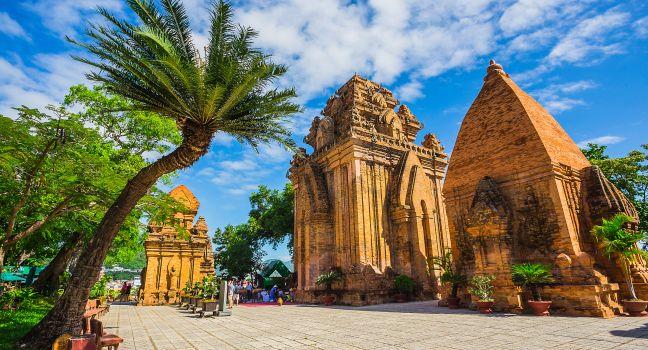
Po Ngar Cham Towers in Nha Trang, Vietnam.
Alan64 | Dreamstime.com

Perched on Cu Lao hillside overlooking the Cai River, there are four towers remaining of the original seven or eight built from the 7th to 12th centuries during the Panduranga period of the Champa kingdom. Evidence suggests the site itself was used for worship since the 2nd century AD by the Sa Huynh. Impressive up close, the towers are the best remaining Cham ruins in Vietnam, along with My Son in Hoi An. The largest tower of the four stretches 75 feet high and contains a statue of the Goddess Po Nagar, the mother of the Cham, creator of the earth and rice. The other towers were built in honor of Cri Cambhu, Shiva, and the elephant-headed god of prosperity and wisdom Ganesh. The temples are still used for worship today; visitors must cover knees and shoulders to enter inside. Po Nagar stays open until 9 pm on full moon days and the first day of the lunar calendar. The Po Nagar Festival takes place the 20th to 23rd of the third lunar month, usually April or May.

Thap Ba, Nha Trang, Vietnam
Sight Details
30,000d, guide 100,000d

Something incorrect in this review?

Recommended Fodor's Video

Banh It Towers

Around 30 minutes inland from Quy Nhon is the 11th-century Banh It Cham Temple, four surviving towers set high on a hill with lovely 360-degree views of the surrounding land. The towers have had some extensive restorations, but some of the bas-relief remains. Watch out for guano when you enter the 22-meter-high main tower as it's now home to bats.

Phuoc Hiep, Tuy Phuoc District, Quy Nhon, Vietnam
Sight Details
15,000d

Something incorrect in this review?

Co Loa Citadel

The first fortified citadel in Vietnamese history (dating back to the 3rd century BC) and a former capital of the country, Co Loa is worth visiting for those with an interest in the nation's early history. Only three of the original earthen ramparts are extant today. You can explore the site of the ancient imperial palace and, under an old banyan tree, is the Ba Chua temple. A large and colorful festival on the sixth day of Tet, the lunar new year, celebrates King An Vuong Duong, now considered the guardian spirit of Co Loa. This is a popular destination for school groups, which can sometimes transform the normally serene temples into playgrounds reverberating with the laughter and chatting of hundreds of children.

Co Loa Citadel, Hanoi, Vietnam
Sight Details
30,000d per attraction

Something incorrect in this review?

Forbidden Purple City

Built at the beginning of the 19th century, the Forbidden Purple City, inside the Imperial City, was almost entirely destroyed during the Vietnam War; now it's slowly being restored to its former glory. The preserved open corridors, which were used to connect the main palaces in the Forbidden Purple City together, are ornately adorned with lavish red and gold paint. Paintings and photographs about Nguyen Dynasty and old Hue are also exhibited in these open corridors. In its glory days the Forbidden Purple City housed members of the Imperial family and the concubines and eunuchs who served them. Anyone else who entered was executed. After the 1968 Tet Offensive, only the Royal Theater on the right-hand side and the intimate and restored Royal Library remained intact.

At the end of the Forbidden Purple City stands the magnificent Kien Trung Palace. Surprisingly, this East-meets-West building is a remake and has been open to visitors of the Imperial City since February 2024 after five years of reconstruction. The opulent palace was built in 1921-1923 and was where the last king of Vietnam, Bao Dai, lived with his wife and children until 1945.

Hue, Vietnam
Sight Details
200,000d admission to Imperial City includes Forbidden Purple City

Something incorrect in this review?

Imperial City

The Imperial City, also known as the Imperial Enclosure, was once a complex of palaces and pavilions where civil and religious ceremonies took place. Inside it was the Forbidden Purple City, where the royal family lived. Now the Imperial City has buried the few remnants of its past glory beneath the sporadic vegetation that has taken over the ruins, but restoration work is in progress and the site still conveys a sense of splendor. There are four gateways into the enclosure: the Gate of Peace (Cua Hoa Binh), the Gate of Humanity (Cua Hien Nhan), the Gate of Virtue (Cua Chuong Duc), and the South Gate (Ngo Mon). You can only get to the Imperial City after you have entered the citadel.

Hue, Vietnam
Sight Details
200,000d
Discounted tickets for multiple sites are available at ticket office

Something incorrect in this review?

Po Sah Inu Towers

These three Hindu towers, relics from the 9th century when the Cham Empire ruled this part of Vietnam, are not the grandest of such ruins—Po Nagar in Nha Trang and My Son in Hoi An are more extensive and better preserved—but it is worth stopping here for a look. A significant portion has been reconstructed with new brick, detracting from the authenticity; however, the hilltop they are situated on affords a panoramic view of Phan Thiet city and the ocean. Local Cham still celebrate the Kate Festival here with dancing and processions, on the first three days of the seventh month in the Cham calendar (usually the beginning of October). The towers are about 7 km (4½ miles) east of Phan Thiet on Ong Hoang Hill, in the direction of Mui Ne.

Ong Hoang Hill, Phan Thiet, Vietnam
Sight Details
15,000d (5,000d for motorbike parking)

Something incorrect in this review?

Thap Doi Cham Towers

Framed by towering palm trees and within a small park, these restored twin Cham towers were built some time between the 12th and 13th centuries. Though not as grand as Banh It, they are located in the outskirts of the city and worth the visit since they are so easy to reach.

Thap Doi, Quy Nhon, Vietnam
Sight Details
20,000d

Something incorrect in this review?