10 Best Sights in Imperial Palace District, Tokyo

Background Illustration for Sights

We've compiled the best of the best in Imperial Palace District - browse our top choices for the top things to see or do during your stay.

Imperial Palace East Gardens

Chiyoda-ku Fodor's Choice
Imperial Palace East Gardens
by

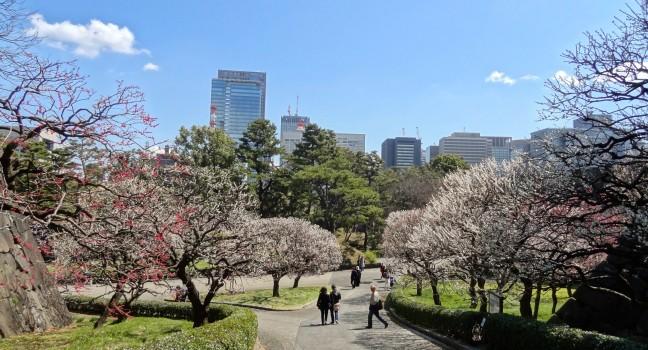
Formerly part of Edo Castle's grounds, this garden was claimed for the imperial family after the 1868 Meiji Restoration. Though most of the old castle was torn down or lost to fire, the stone foundations hint at the scale of the former seat of power. In the East Gardens you'll find the National Police Agency dojo (martial arts hall) and the Ote Rest House; the Museum of the Imperial Collection (Sannomaru Shozokan) is next door and has rotating exhibits of household treasures. The Hundred-Man Guardhouse (Hyakunin Bansho) was once defended by four shifts of 100 soldiers each. Past it is the entrance to what was once the Ninomaru, the "second circle" of the fortress, now a grove and garden. At the far end is the Suwa-no-Chaya Tea Pavilion, an early-19th-century building moved here from elsewhere on the grounds.

1–1 Chiyoda, Tokyo, 100-8111, Japan
03-3213–1111
Sight Details
Free
Closed Mon. and Fri.

Something incorrect in this review?

Chidorigafuchi National Cemetery

Chiyoda-ku

High on the northwestern edge of the Imperial Palace moat, this cemetery holds the remains of thousands of unknown soldiers and is famous for its springtime cherry blossoms. The adjacent Chidorigafuchi Boathouse rents out rowboats and pedal boats. Only a small part of the palace's outer moat is accessible, but a walk here from the East Gardens makes for a refreshing 30 minutes. The entrance to the garden is near Yasukuni Shrine.

2 Sanban-cho, Tokyo, 102-0075, Japan
03-3234–1948
Sight Details
Park free, boat rental from ¥800 in cherry blossom season (from ¥500 at other times)
Boathouse closed Mon. and Dec.–Mar.

Something incorrect in this review?

Hanzo-mon Gate

Chiyoda-ku

The house of Hattori Hanzo (1541–96) once sat at the foot of this small wooden gate. Hanzo was a legendary leader of Ieyasu Tokugawa's private corps of spies and infiltrators—and assassins, if need be. They were the menacing, black-clad ninja—perennial material for historical adventure films and television dramas. The gate is a minute's walk from the subway.

1 Chiyoda, Tokyo, 100-1001, Japan

Something incorrect in this review?

Recommended Fodor's Video

Hirakawa-mon Gate

Chiyoda-ku

The approach to this gate crosses a wooden bridge over the Imperial Palace moat. The gate and bridge are reconstructions, but Hirakawa-mon is beautiful, looking much as it must have when the shogun's wives and concubines used it on their rare excursions.

1 Chiyoda, Tokyo, 100-0001, Japan

Something incorrect in this review?

Imperial Palace Outer Garden

Chiyoda-ku

When the office buildings of the Meiji government were moved from this area in 1899, the expanse along the palace's east side was turned into a public promenade and planted with 2,800 pine trees. The Outer Garden affords the best view of the castle walls and their Tokugawa-period fortifications—the Nijubashi and Seimon bridges, 17th-century Fujimi Yagura watchtower, and Sakurada-mon gate. The 5-km (3.1-mile) loop around the moats, starting and finishing at Sakurada-mon, is popular with runners.

1–1 Kokyogaien, Tokyo, Japan
Sight Details
Free
East Gardens closed Mon. and Fri.

Something incorrect in this review?

National Diet Building

Chiyoda-ku

The building of the Japanese parliament exemplifies post–World War II Japanese architecture; on a gloomy day it seems as if it might have sprung from the screen of a German Expressionist movie. Started in 1920, construction took 17 years to complete. One-hour-long guided tours are available most weekdays between 9 am and 5 pm, but it's best to call ahead to confirm times, as access varies when parliament is sitting. The prime minister's residence, Kantei, is across the street; it's hidden by walls and trees, so you'll only get a glimpse of it.

1–7–1 Nagatacho, Tokyo, 100-0014, Japan
03-5521–7445
Sight Details
Free
Closed weekends

Something incorrect in this review?

National Museum of Modern Art, Tokyo

Chiyoda-ku

Founded in 1952 and moved to its present site in 1969, this was Japan's first national art museum. Often referred to by its acronym, MOMAT, it features a range of 20th- and 21st-century Japanese and Western artworks. The permanent collection, which includes paintings, prints, and sculptures by Rousseau, Picasso, Tsuguharu Foujita, Ryuzaburo Umehara, and Taikan Yokoyama, occupies the second to fourth floors.

3–1 Kitanomaru Koen, Tokyo, 102-8322, Japan
050-5541–8600
Sight Details
¥500
Closed Mon.
Additional fees for some special exhibitions

Something incorrect in this review?

Nijubashi Bridge

Chiyoda-ku

This graceful arch across the moat is the most photogenic spot on the grounds of the former Edo Castle. Mere mortals may cross only on February 23 (the emperor's birthday) and January 2 to pay their respects to the imperial family. The guards in front of the small, octagonal, copper-roof sentry boxes change every hour on the hour—alas, with nothing like the pomp and ceremony at Buckingham Palace.

1–7 Chiyoda, Tokyo, 100-0001, Japan

Something incorrect in this review?

Ote-mon Gate

Chiyoda-ku

Most of what was once the principal gate of Ieyasu Tokugawa's castle was destroyed in 1945 but was rebuilt in 1967 based on the original plans. The outer part of the gate survived and offers an impressive main entrance into the palace's East Gardens.

1–1 Chiyoda, Tokyo, 100-0001, Japan

Something incorrect in this review?

Yasukuni Shrine

Chiyoda-ku

Founded in 1869, this shrine is dedicated to approximately 2½ million Japanese, Taiwanese, and Koreans who have died since then in war or military service. As the Japanese constitution expressly renounces both militarism and state sponsorship of religion, Yasukuni has been a center of stubborn political debate, particularly since 1978, when a shrine official added the names of several class-A war criminals to the list. Numerous prime ministers have visited the shrine since 1979, causing a political chill between Japan and its close neighbors, Korea and China, who suffered under Japanese colonialism.

Despite all this, hundreds of thousands of Japanese come here every year to honor lost friends and relatives. These visits are most frenzied on August 15, the anniversary of the conclusion of World War II, when former soldiers and ultra-right-wing groups descend upon the grounds en masse.

The shrine isn't one structure but a complex that includes the Main Hall and the Hall of Worship—both built in the simple, unadorned style of the ancient Shinto shrines at Ise—and the Yushukan, a museum of documents and war memorabilia. Refurbished in 2002, the Yushukan presents Japan at its most ambivalent—if not unrepentant—about its more recent militaristic past.

Critics charge that the museum's newer exhibits glorify the nation's role in the Pacific War as a noble struggle for independence; certainly there's an agenda here that's hard to reconcile with Japan's firm postwar rejection of militarism as an instrument of national policy. Many Japanese visitors are moved by the displays, which contain things such as the last letters and photographs of young kamikaze pilots, while others find the Yushukan a cautionary, rather than uplifting, experience.

Although some exhibits have English labels and notes, the English isn't very helpful; most objects, however, speak clearly enough for themselves. Rooms on the second floor house an especially fine collection of medieval swords and armor.

The shrine is also home to the Noh stage and, in the far western corner, a sumo-wrestling ring, where matches are held in April, during the first of Yasukuni's three annual festivals. Pick up an English-language pamphlet and simplified map of the shrine just inside the grounds. Visiting on a Sunday offers a chance to forage at a flea market that runs from morning until mid-afternoon.

3–1–1 Kudankita, Tokyo, 102-8246, Japan
03-3261–8326
Sight Details
Shrine free, Yushukan ¥1,000

Something incorrect in this review?

Not finding what you're looking for?

We've got a few suggestions for nearby spots.
Marunouchi Fodor's Choice

Idemitsu Museum of Arts0.6 miles away

3–1–1 Marunouchi, Tokyo, Tokyo-to, 100-0005, Japan
We recommend 4 Sights in Marunouchi
Marunouchi

Hibiya Park0.7 miles away

1 Hibiya Park, Tokyo, Tokyo-to, 100-0012, Japan
We recommend 4 Sights in Marunouchi
Marunouchi

Tokyo Station0.7 miles away

1–9–1 Marunouchi, Tokyo, Tokyo-to, 100-0005, Japan
We recommend 4 Sights in Marunouchi
Marunouchi

Tokyo International Forum0.7 miles away

3–5–1 Marunouchi, Tokyo, Tokyo-to, 100-0005, Japan
We recommend 4 Sights in Marunouchi
Nihonbashi

Bank of Japan Currency Museum1 miles away

1–3–1 Nihonbashi Hongokucho, Tokyo, Tokyo-to, 103-0021, Japan
We recommend 4 Sights in Nihonbashi