


Tian Tan Buddha
Get FREE email communications from Fodor's Travel, covering must-see travel destinations, expert trip planning advice, and travel inspiration to fuel your passion.

We've compiled the best of the best in Lantau Island - browse our top choices for the top things to see or do during your stay.
Located just off the southern coast of Lantau Island, the 2½-km-long (1½-mile-long) Cheung Chau Island was once a haven for pirates like the notorious Cheung Po Tsai, whose treasure cave is reportedly on the island's southwest tip. These days, it is most famous for the centuries-old tradition called the Bun Festival, which celebrates Buddha's purported birthday in April/May. Residents live mostly on the sandbar connecting the two hilly tips of this dumbbell-shape island. The town harbor is lined with seafood restaurants and shops. A 35-minute fast ferry departs from Central's Pier 5 outside Two IFC shopping plaza.
\nOn sunny weekends, Cheung Chau's Tung Wan beach is so crowded that its sweep of golden sand is barely visible. At one end of the beach is the Warwick Hotel, and plenty of nearby restaurants offer food, refreshments, and shade. Apart from emergency vehicles, no private cars are allowed on this island. Among the tourist attractions, find the striking Pak Tai Temple, one of the oldest in Hong Kong, as well as a cave that allegedly housed the hidden treasures of pirate Cheung Po Tsai.
Three kilometers (2 miles) of golden sand make Cheung Sha Beach one of Hong Kong's longest stretches of sand. It gets breezy at this spot 8 km (5 miles) southwest of Mui Wo, so it's popular with windsurfers. From April through October, there are also lifeguards around, so you can swim with a bit more peace of mind. Upper Cheung Sha Beach is equipped for barbecues, and there is also a refreshment stand. Witnessing a sunset here is a swell end to a sun-drenched day.
Though Hong Kong's home to Mickey Mouse is lower-key compared with other Magic Kingdoms, there are still plenty of diversions to occupy one's time. Younger kids will find plenty of amusement at Sleeping Beauty Castle and Toy Story Land, while older siblings and parents will probably gravitate to the more-thrilling Space Mountain. Inside the dedicated Marvel area, daredevils will also enjoy the multisensory, immersive Iron Man Experience and the Ant-Man theme attraction. Plus, The World of Frozen, based on the animated musical, opened in late 2023 to much acclaim. It's highly recommended to purchase tickets online, as there's usually a crush of humanity by the main gate.
Keen to stay overnight? There are three thematic on-site hotels, including the travel-theme Disney Explorers Lodge.
The most glorious views of Lantau—and beyond—are from atop the 3,064-foot Lantau Peak. The ascent up the mountain that locals call Fung Wong Shan requires a strenuous 7½-mile hike west from Mui Wo, or you can begin at the Po Lin Monastery—from where the voyage is still a demanding two hours. The most striking views are at sunrise, particularly between December and February, when the air is dry and the sky is clear.
Mui Wo is a sleepy little town, but it has some good waterfront restaurants. Silvermine Bay Beach, a pleasant sandy stretch, is a half-mile northeast of the ferry pier. It has lifeguards every month save for December--February. A gentle uphill trail leads to the Silvermine Caves and Waterfall, the small 19th-century mine that gave the bay its English name. Given its relatively secluded location, and lower-than-expected vehicular traffic, it's a quality area to go for a bike ride.
This temple (also known as Yuk Hui Temple) on Cheung Chau is dedicated to Pak Tai, the god of the sea, who is supposed to have rid the island of pirates. The renovated temple originally dates to 1783, when an image of Pak Tai was brought to appease the spirits of people killed by pirates, thought to be the source of bubonic plague outbreaks. According to legend, he did the trick: he remains the island's favorite deity. Beside the main altar are four whale bones salvaged from nearby.
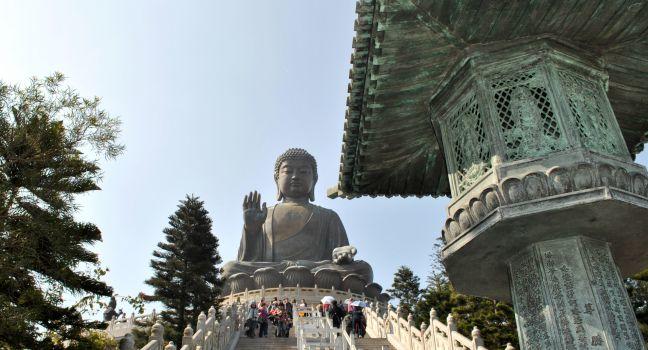
Built in 1906, this peaceful Buddhist monastery is located adjacent to the Tian Tan Buddha. The grounds feature stately halls with many intricate statues, carvings, and paintings, as well as landscaped gardens with koi fish ponds. The Grand Hall of Ten Thousand Buddhas houses, like its name, 10,000 golden buddha statues and is a sight to behold. There is a popular vegetarian restaurant on-site.
Tucked away on the western end of Lantau, this fishing village inhabited largely by the shuishangren, literally "people on the water," some of whom continue to live in stilts houses. There's a temple dedicated to Kwan Tai, god of war, that was established in the 15th century. Remains of salt pans line part of the shoreline, and a glance beyond the coast sometimes rewards you with a sighting of a rare Hong Kong pink dolphin. The 1902 Tai O Police Station, on the village's southwest tip, has been restored and converted into the Tai O Heritage Hotel, a great place for tea, or a continental meal.
All that remains of the old Tung Chung village is the hulking granite Tung Chung Fort. Considering how this neighborhood has become absolutely overcome with housing developments and shopping, that any vestige of pre-British remains makes it that much more fascinating. The first fortification on this spot was built during the Song Dynasty, some time in the late 1100s CE; the current structure dates from 1832, although it was refurbished in 1988.


