


First TIme Japan Trip Fall 2025: 4 weeks
 Jan 23rd, 2026 | 12:41 PM
#1
Original Poster

Joined: Jan 2003
Posts: 248
Likes: 0
First TIme Japan Trip Fall 2025: 4 weeks
My husband and I returned about 6 weeks ago from our first ever trip to Japan, a one-month stay from 10/26 – 11/23, and have been meaning to write up a report to share with the community here, which was so helpful in our planning and also in the moral support department! Our trip was so successful, in fact, that we are starting to plan for another visit in Fall 2026. I figured it would be good to pay it forward before asking for even more help and itinerary planning for trip #2 :~).
I tried to keep a journal while we were away, and did pretty well in writing contemporaneous thoughts for the first couple of weeks, and then all best intentions fell by the wayside……. just finished that account and rather than going through all of the details here, I will keep things short and sweet, with overall impressions and shout-outs to our favorite experiences.
Over the years we have figured out what works best for us and how we like to travel. We are independent planners and travelers, in our late 60’s and mid 70’s, fairly active and mobile, with (thank goodness!) no major health issues or special requirements. We very much felt that if we were going to take a long-haul trip somewhat out of our comfort zone, we wanted to do it sooner, rather than later.
We pored over lots of different travel guides, the Japan Guide website, various trip reports and travel for us to come up with our final itinerary. There were so many places we would have loved to visit, including Mt Fuji and the surrounding area, but we prioritized visiting the Alps region and we both felt strongly about visiting Hiroshima. So many of the Fodorites who have visited, or lived in, Japan and shared their experiences were helpful in our planning, and they turned out to be invaluable resources: arigato gozaimasu!
Here’s our final itinerary outline:
Tokyo, 5 nights @The Gate Hotel, Ginza
Matsumoto, 2 nights @Matsumoto Marunouchi Hotel
Yamonochi, 2 nights@Hotarutei Villas
Takayama, 2 nights @Air BnB rental house
Kanazawa, 3 nights @Hotel 101
Hiroshima, 2 nights @Hiroshima Hilton
Miyajima, 2 nights @Auberge Watanabe
Kurashiki, 2 nights @ Yoruya
Kyoto, 6 nights @Hotel Mume, 1 night@ Baian
Osaka KIX Airport, 1 night@Hotel Nikko
Over the next few days, I will post more information about each of these spots, what we did and what we loved. But to start, here are some basics:
Transportation
Planes
We flew to Japan on ANA airlines from JFK. Our usual international departure city is Boston, which is a bit closer for us (we live in northern Hartford County, CT, just over the line from Springfield/Longmeadow, MA) but the premium economy tickets we wanted were several thousand dollars less expensive from JFK, even factoring in round-trip car service to take us to and from the airport. Worked out great – reasonably comfortable seats and the added perk of lounge access. Our itinerary was open jaw, JFK-Tokyo(HND) and Osaka(KIX)-JFK. We flew to Tokyo on a daytime flight, which was very convenient but, alas, did not protect us from the brunt of jet lag.
Trains
We used SUICA (in my Apple Wallet and via the app) and Pasmo (physical card for my Android loving spouse) for local intra-city travel and some small purchases in kombini. Most of our local travel was in Tokyo, but it was great to use the IC cards for train and ferry to Miyajima, and I rode the bus a couple of times in Kyoto.
To travel between Tokyo and Matsumoto, and then from Kanazawa to Hiroshima and for the rest of our inter-city transfers, we used trains. Once I figured out how to read the schedules, etc. it was easy to reserve our tickets directly on the JR website and then pick them up at convenient stations, at the designated machines. Figuring out which – and how many – tickets to insert into each turnstile was another story, but there was always an English speaking attendant or ticket window nearby to assist us…….I think by the very end of our trip we figured it out. I know many travelers find using Klook and Smart-Ex the better way to book and travel via train, but I always feel more comfortable booking directly with the source.
Automobiles
To make things super easy upon arrival, we pre-booked a transfer to our hotel through www.airportstaxitransfers.com. Super convenient, and the communications were perfect – as we were heading to JFK for our flight, we received a WhatsApp message from them, wishing us a good trip and letting us know they’d be waiting at Haneda for us. When we landed, they sent detailed messages with photos of the meeting spot, and were there waiting when we arrived.
We used taxis quite a bit, either through the GO app, the UBER app, in front of stations/hotels, or having the hotel call for us. Most of the time it was pretty reasonable, and saved us time or saved us from shlepping our stuff on a 15-20 minute walk to or from the station. There were a couple of instances when we were going somewhere that would have taken an hour+ via public transportation, and those rides were quite a bit more but we had already factored that into our planning.
We rented a car from Toyota in Matsumoto when we were leaving that city to travel through the Alps to Kanazawa. Super easy process, one of our best foreign car rental experiences ever. My husband loves to drive and is comfortable driving on thewrong left side of the road. It was only for a few days, but allowed us to make our own schedule and maximize our time in that area. Plus, the drive was gorgeous.
Accommodations
This trip was a bit different for us, as we usually prefer to stay in rental apartments or villas when we travel, but overall the short-term rental market in Japan seems rather sparse. We only rented an AirBnB property in one location (Takayama). Where we stay is extremely important to us, both in terms of actual location, and in comfort/space terms. We’re not ‘go-go-go’ travelers: we like to plan one major experience or site per day, another ancillary site or walking route, leave a little time for serendipity, and then enjoy an afternoon nap and time for a cocktail and/or journal writing and playing cards before dinner. So, we actually do spend time in our lodgings and prioritize comfort and aesthetics. We ended up mostly in hotels, with a few ryokan and small boutique-type stays.
Communications
We’ve become big proponents of using eSims in our phones for data usage, and communicate with our friends and family via text messaging, WhatsApp, and FaceTime. This trip, however, it was important that my husband have 24-hr access via telephone as his brother was in the hospital when we left, soon to be moved to a rehab facility for a few weeks and we wanted to make sure that medical teams could reach us from their landlines or cell phones. I went go the eSim route (Airalo, which we have used for our last several foreign trips – worked seamlessly, as usual, and was very reasonable for 30 days, 20 GB, around $23, after using my Airalo money credits) and he used the daily Verizon data plan (we have pre-paid phone plans that are super inexpensive but don’t allow conversion to a monthly International plan on an ad-hoc basis). Having the peace of mind that medical teams could reach us any time, and that my brother-in-law could call whenever he felt like it without having to worry about wi-fi access or dialing an international phone number: priceless :~).
Within Japan, messaging and emailing was how we coordinated with guides, hotel staff, etc. Language was not a major issue on this trip, as just about everyone we interacted with had at least rudimentary English skills (to match my rudimentary Japanese skills after months of language app study) or access to a translation app. As so many others have said, using a few Japanese words and phrases appropriately was both openly appreciated, and in many cases, an icebreaker.
Food
We were really looking forward to eating in Japan and trying new foods. Both of us love pretty much all things seafood, as well as good red meat, and we were not disappointed. No food allergies, but a few dislikes that were easily avoided. Our biggest issue is that we can no longer eat the way we used to, meaning if we have a large-ish or late-ish lunch, we really aren’t hungry for anything other than a small, light dinner. Multi-course tasting menus are too much for us now, so we were hesitant to go to places > 7-10 small courses. Also, four weeks is a long time to have to eat most meals out. In the end, we had a balance of kaiseki meals at the ryokans where we stayed, some nights where we had a ‘picnic’ at our lodgings with either kombini or depachika (department store food hall), and meals we reserved based on our own research, hotel or guide recommendations, or lucky, last-minute walk-in situations. Most mornings of the trip we had breakfast at the hotel or ryokan, which was great for making sure we had our coffee (a must!) and fresh fruit, along with some form of protein. Excellent breads or pastries were a treat in a few places.
Miscellaneous
We are light packers and travelers, so we each had a lightweight carry-on size suitcase and a backpack. NB, my backpack is a Biaggi carry-cube style which has a lot of space so I didn’t feel like I was sacrificing anything. I also brought a foldable small tote bag, and a sling bag that packs flat, anticipating that on the flight home we would check our suitcases and my backpack and still be able to have room for souvenirs and any larger liquid items and/or knives. Worked like a charm, despite my husband’s initial skepticism. This made it easy to travel between destinations. Only used luggage forwarding once, to send the suitcases and backpack to the airport hotel at KIX, and it was perfect! We set them on Thursday, for pickup on Saturday.
Our clothing choices were overall excellent, however it was a little colder than usual at that time of year in Tokyo and the Alps, so we ended up supplementing with lightweight warm tops from Uniqlo. For outerwear we had lightweight water resistant jackets that we only used a couple of times, our new fleece tops, and down vests. Supplemented with 32 degree base layer tops, we were all set. My usual wardrobe is based on black clothing, so I had no problem fitting in :~). Only brought 3 pairs of shoes: Brooks Ghost (black), Vionic leather sneakers (black) and a pair of Sofft black quilted ballet flats that I only wore once and wish I had left at home.
Part I: Tokyo
Initially we weren’t very interested in the big city but we knew we’d regret bypassing it. In recent years when traveling abroad – especially when there’s a long flight and huge time differences – we have tried to build in a soft landing if possible. To us, this means booking as nice a hotel or rental as we can find at our budget level, and add on more time than we think we need (one of the best features of traveling after retirement, is no longer having to worry about how many PTO days are available). That’s how ended up going from “should we stay in Tokyo?” to 5 nights in Tokyo.
After obsessing on which area to stay in, and which hotel, we decided on The Gate Hotel in greater Ginza. I describe it that way, because technically it’s in Chuo City, and is sometimes described as being in Yurakcho. This area is not a popular choice on most travel forums, but it was a great one for us. Nice area to walk around in for window-shopping, real shopping and food choices. Plus, there’s an entrance to the Ginza line right outside the door, and a couple of other subway lines a few blocks away. We weren’t planning any day trips from the city, and had only one outing planned within city limits that was not conveniently reached by any public transportation. So, we weren’t concerned about being near a major JR train station or a massive subway-hub and had no interest in being near entertainment areas.
Service at The Gate Hotel was wonderful, and we had a comfortable room on a high floor. Breakfast was included in our rate, which worked out great as it enabled us to have lots of fresh fruit, decent coffee and other more traditional Western breakfast choices if we wished. Combination buffet and table service, and as we were long-stay guests for them, the service grew warmer and we were offered more customized choices as the days went on. They also have a nice lobby bar with reasonable prices, and an outdoor seating area we could only enjoy once without being too cold.
Experiences
Rather than a detailed day-by-day, blow-by-blow description, here are the highlights of our Tokyo itinerary:
We booked a half-day private tour for our first day, with Roko Tokiwa of rokotokyoguide.com and it was a brilliant move. We had corresponded via email and felt that we clicked. She met us in the hotel lobby and we set our final plan, then we took off and she helped us understand the subway system and get my husband set with his Pasmo card. We visited the Meiji Shrine (bought a goshuin book w/stamp), Tsukiji Outer Market with some food sampling and stop for a fantastic sushi lunch, then we went to Yanaka ginza (meh) and called it a day, though Roko could have kept going! Also, she helped us pick up our reserved train tickets at one of the subway stops which was also a JR train station……..in fact she chose that route specifically so we’d be set with getting the tickets. It was like spending the day with a dear friend we hadn’t seen in a while. Excellent English, very personable and energetic, and you could tell the folks at the market area really liked her, too. Oh, and after helping me select a paring knife, she helped us with the tax refund at the market center.
We visited Senso-ji on our own, getting there on the earlier (but not crack-of-dawn) side, and we really enjoyed walking around the entire temple complex, getting a goshuin stamp, paying our respects. It was a cool but sunny day and very pleasant, but as the crowds grew, so did our desire to get out of the area. In hindsight, we were very glad we chose to stay in Ginza, rather than Asakusa.
We arranged to participate in a tenugui cloth-dyeing experience through the Nihonbashi Information Center, and it was one of many highlights of the trip (tenugui are multi-purpose, scarf-like cotton cloths that are used as actual scarves, hand towels, table runners, etc). The center itself has a wealth of information and resources, and the lovely assistant, a Lithuanian ex-pat who had attended university in Japan and decided to stay, walked us over to the textile shop where the workshop took place and stayed to interpret for us. The process is a little bit like silk screening. Lots of fun, interesting, plus we each got a great souvenir to take home.
One morning we had food tour, also in the Nihonbashi area, with Yukari Sakamoto of www.foodsaketokyo.com. This was not a tasting tour, rather a great opportunity to learn more about Japanese foods, how to find certain foods in the department food hall, what kinds of specialty things to look for, interesting kitchen items. Yukari-sensei is a trained chef, sommelier and all around food-and-drink guru who is a superb raconteur and delightful companion. She also writes for several travel magazines and regularly contributes to Eater and the NYTimes. Getting to know her a little bit before the trip, via email, made it feel like I was meeting an old friend and she was also helpful in recommendations for where to stay and where to eat.
My husband is interested in bonsai, so I looked for a way to incorporate that into our Tokyo time, and found a small museum that offered a workshop and also had a lot of bonsai on display. I booked directly with the museum and exchanged a few emails with the person who coordinates the visit. This was quite inconvenient to reach via public transportation, so we traveled there via taxi which was a splurge. Turned out to be different than I had imagined – I thought it was going to be a private thing, but there was actually a group from a tour there already, plus another few folks like us who had booked directly – and the bonsai handling part was only around 30 minutes, before a brief tour of the inside rooms and an opportunity to wander around the small garden area. However, as I had exchanged emails with the coordinator and explained that this was a special treat for my husband, he made it a point to seek us out and spent time explaining the history of the property and how the master gardener, Kobayashi, found his calling. We both felt this was a very special experience, and putting it into words just doesn’t do it justice.
The rest of our time in Tokyo was spent walking, doing a little bit of shopping, and trying to adjust to the time change. Memorable meals included a tonkatsu lunch at Katsukichi restaurant in the Takashimiya annex store, a tempura lunch at a small place where we were the only tourists, superb ramen at Tsujita Ginza, a 10-minute walk from our hotel, and a delightful omakase dinner at Katana Bistro – small place, only 6 counter seats, with delicious, inventive sushi and a charming chef.

The Gate Hotel
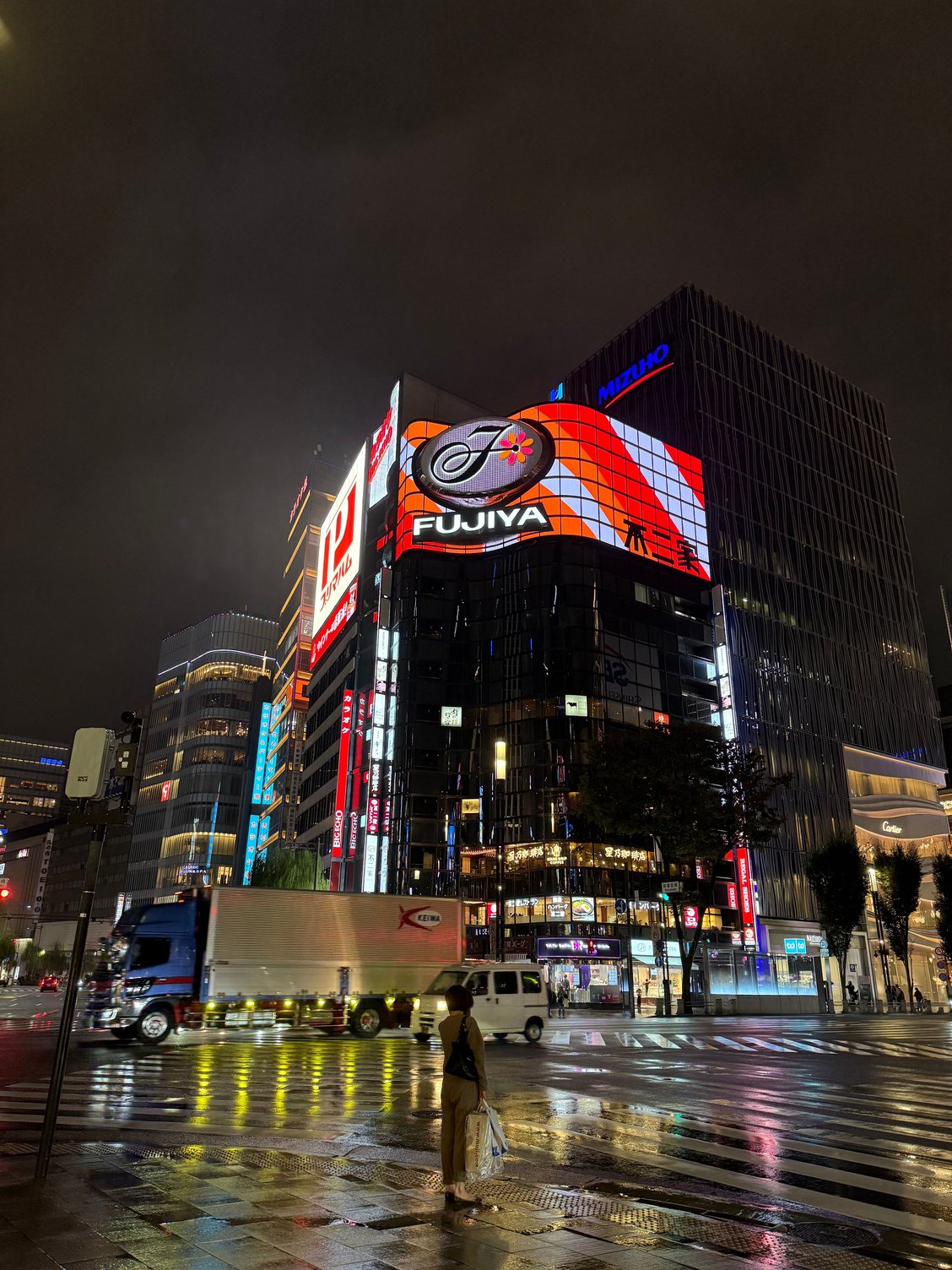
evening view from near our hotel
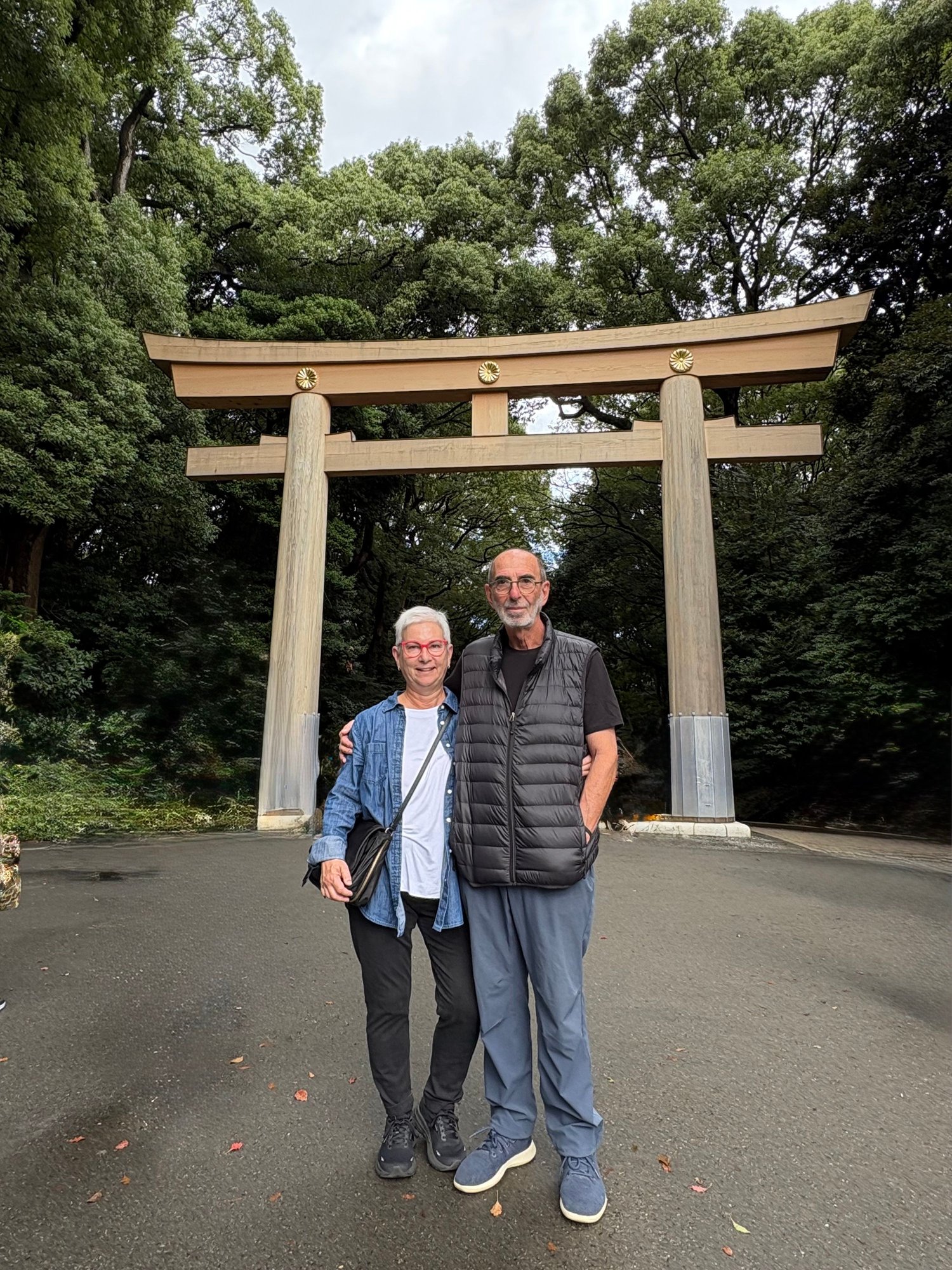
Meiji Shrine -- it was crowded but thank goodness for the clean-up tool :~)
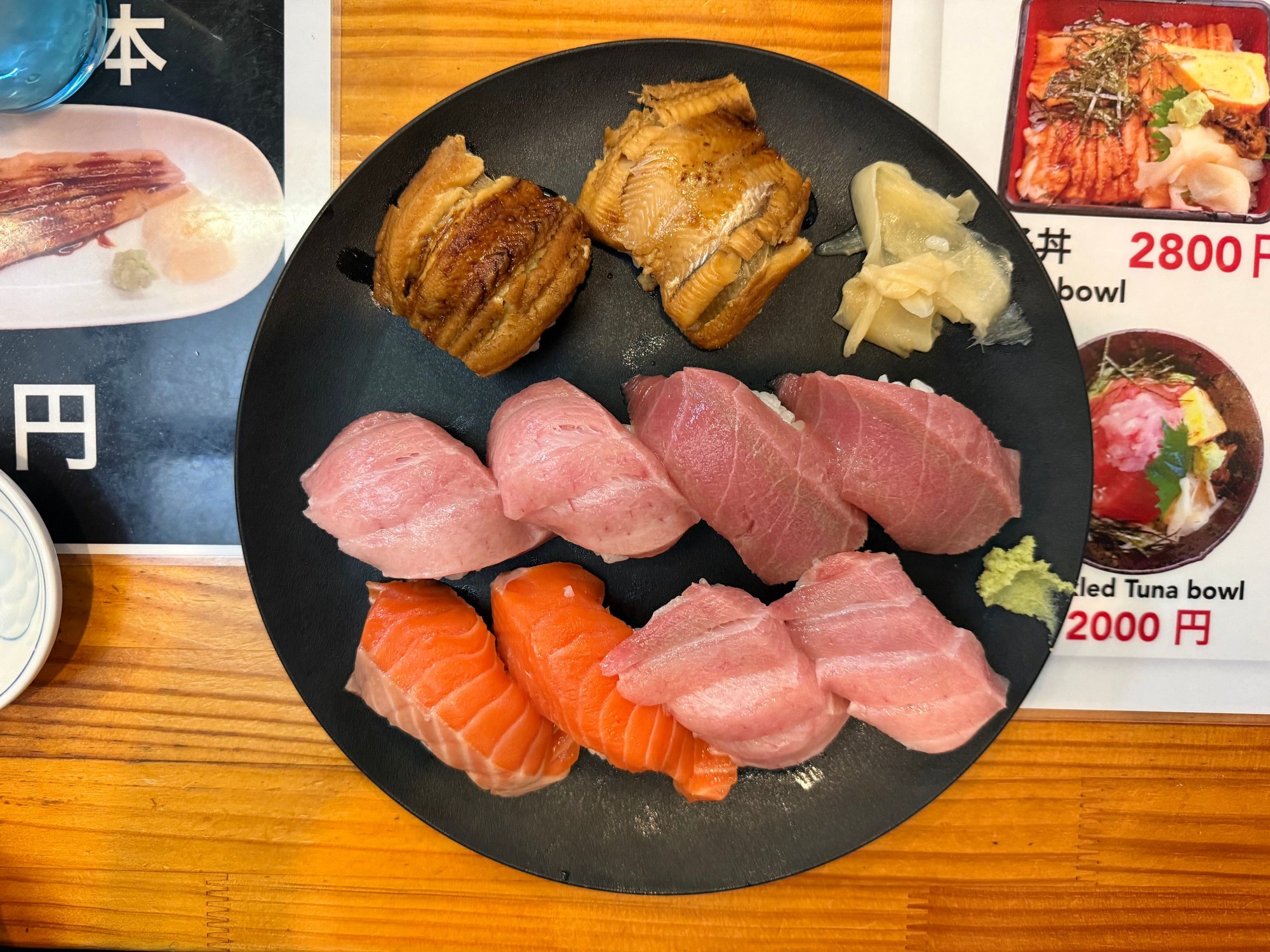
Sushi lunch @Tsukiji Market. they let us order at their streetfront counter, then relax and eat in their around-the-corner back alley restaurant space, which is closed to the public most of the time.
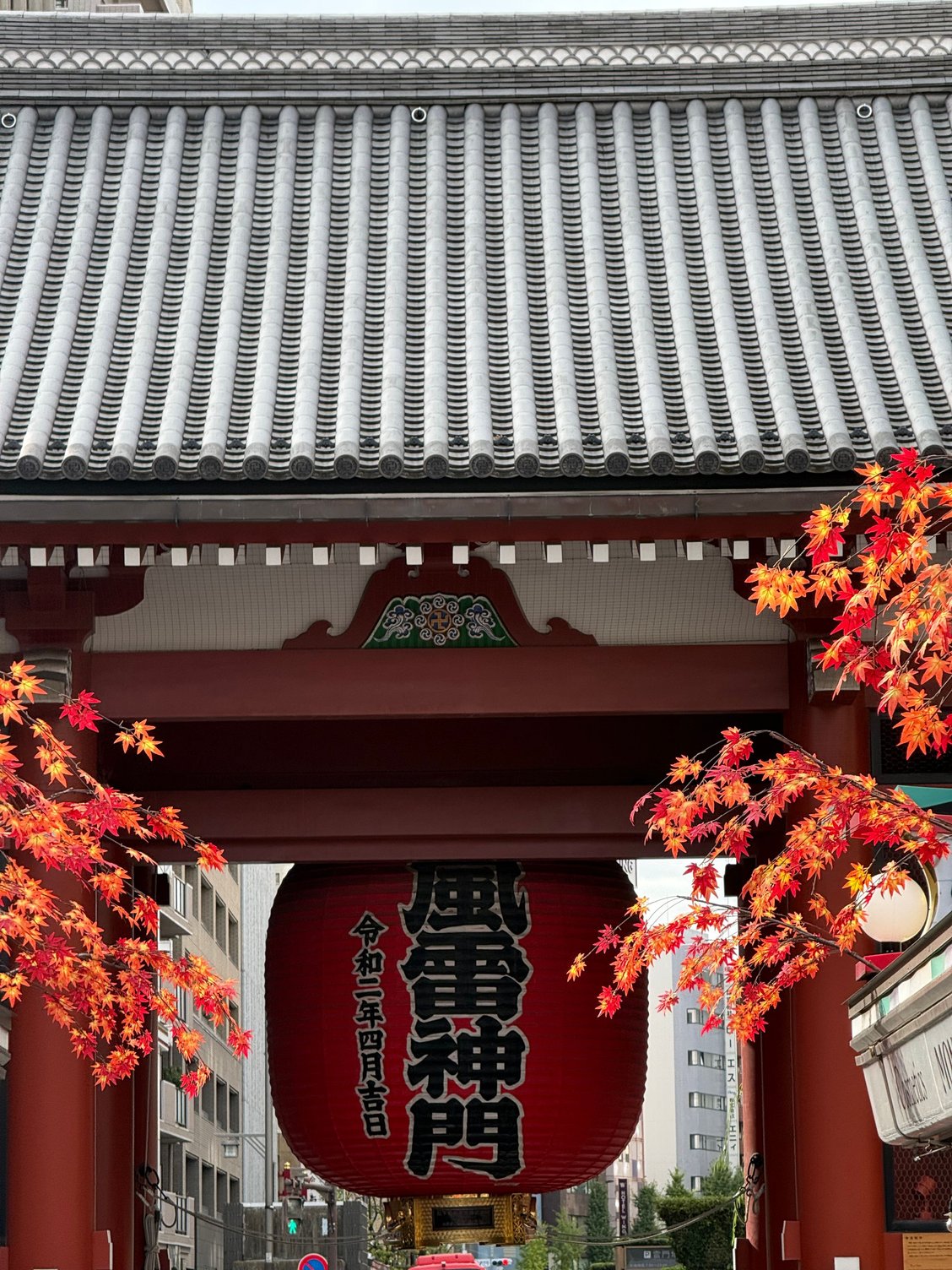
Senso-ji Temple
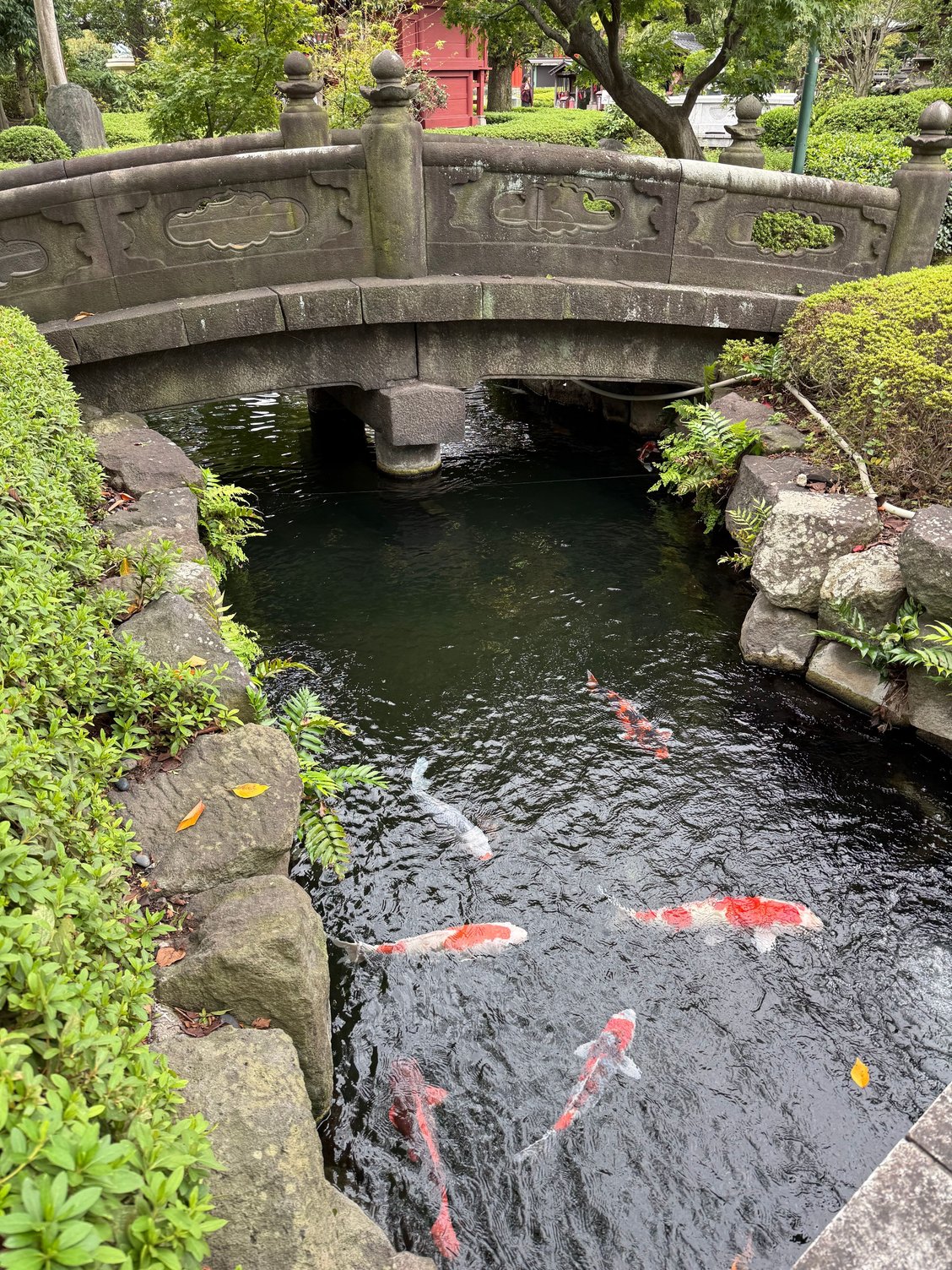
lovely bridge and koi pond on the grounds of Senso-ji
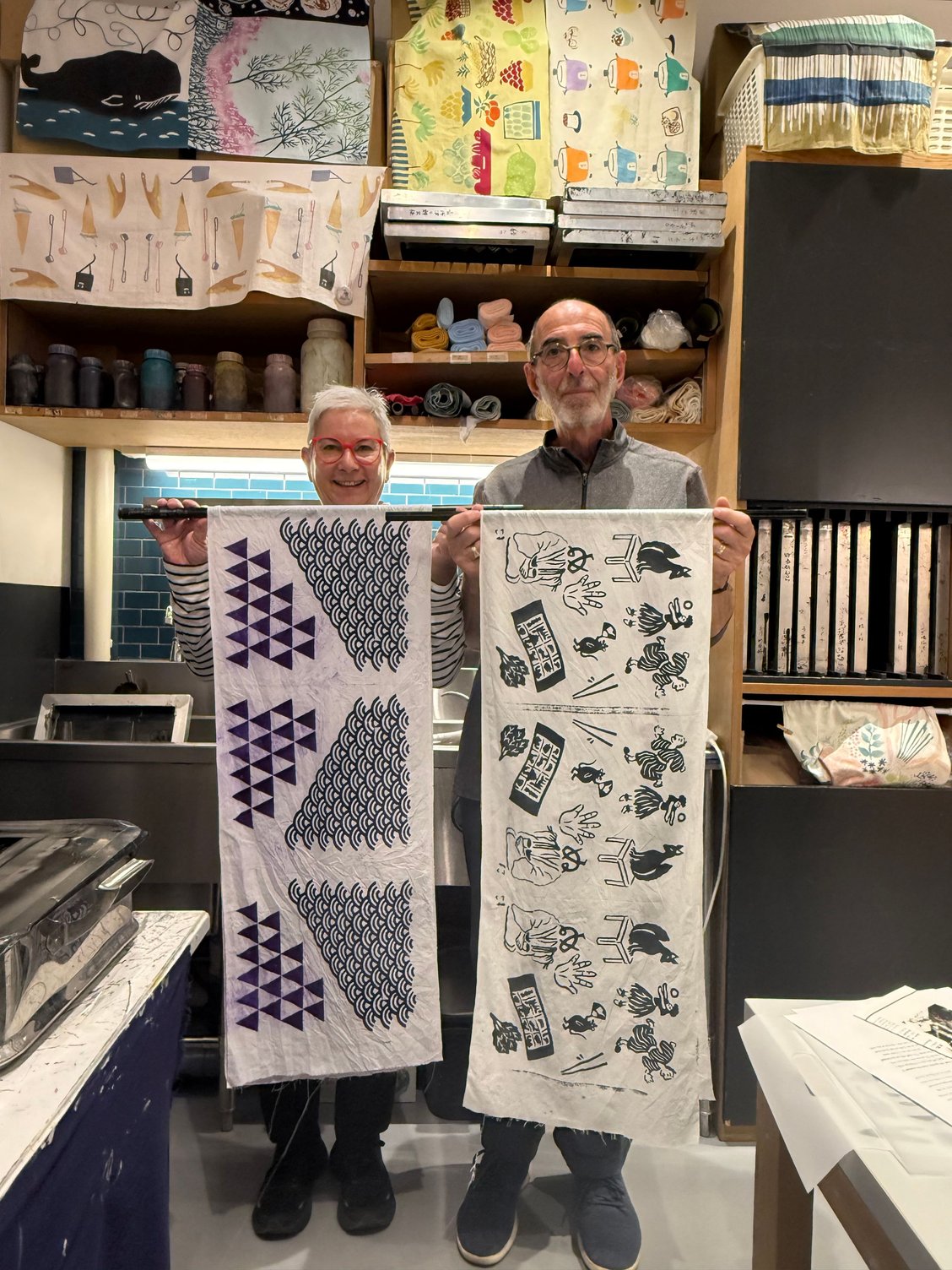
our finished tenugui cloths!
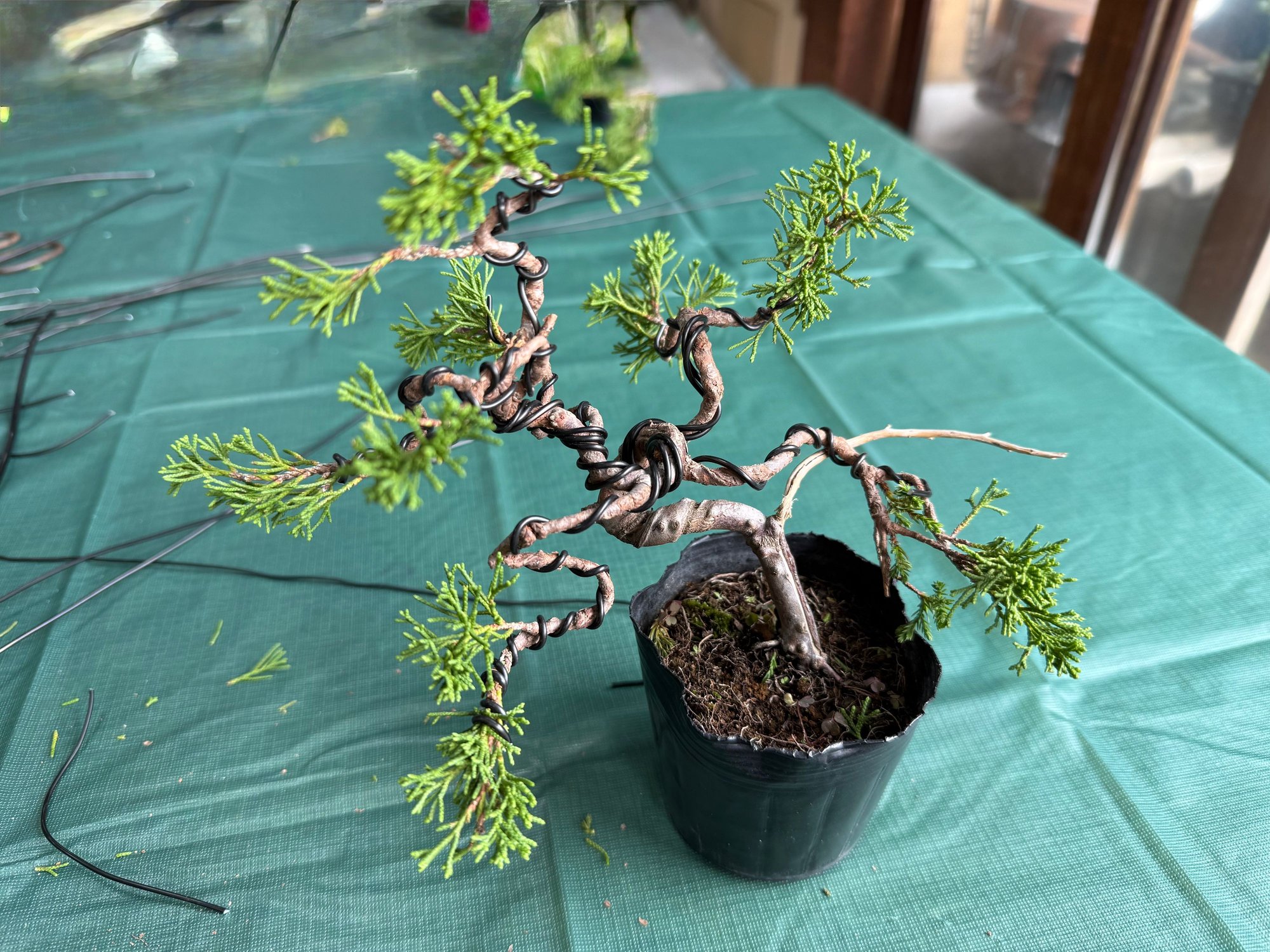
my bonsai project....could not take home, unfortunately
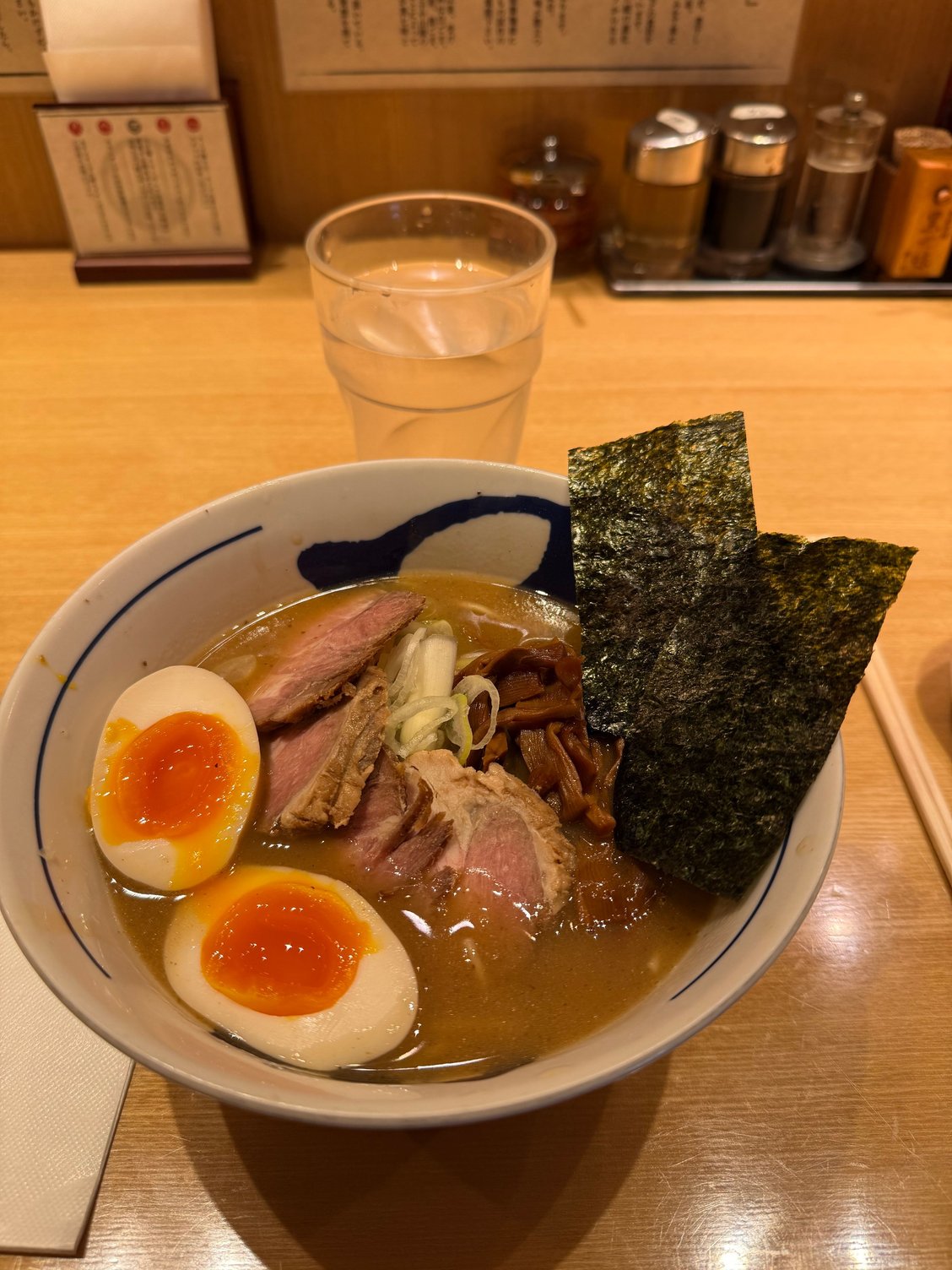
ramen lunch, two thumbs-up
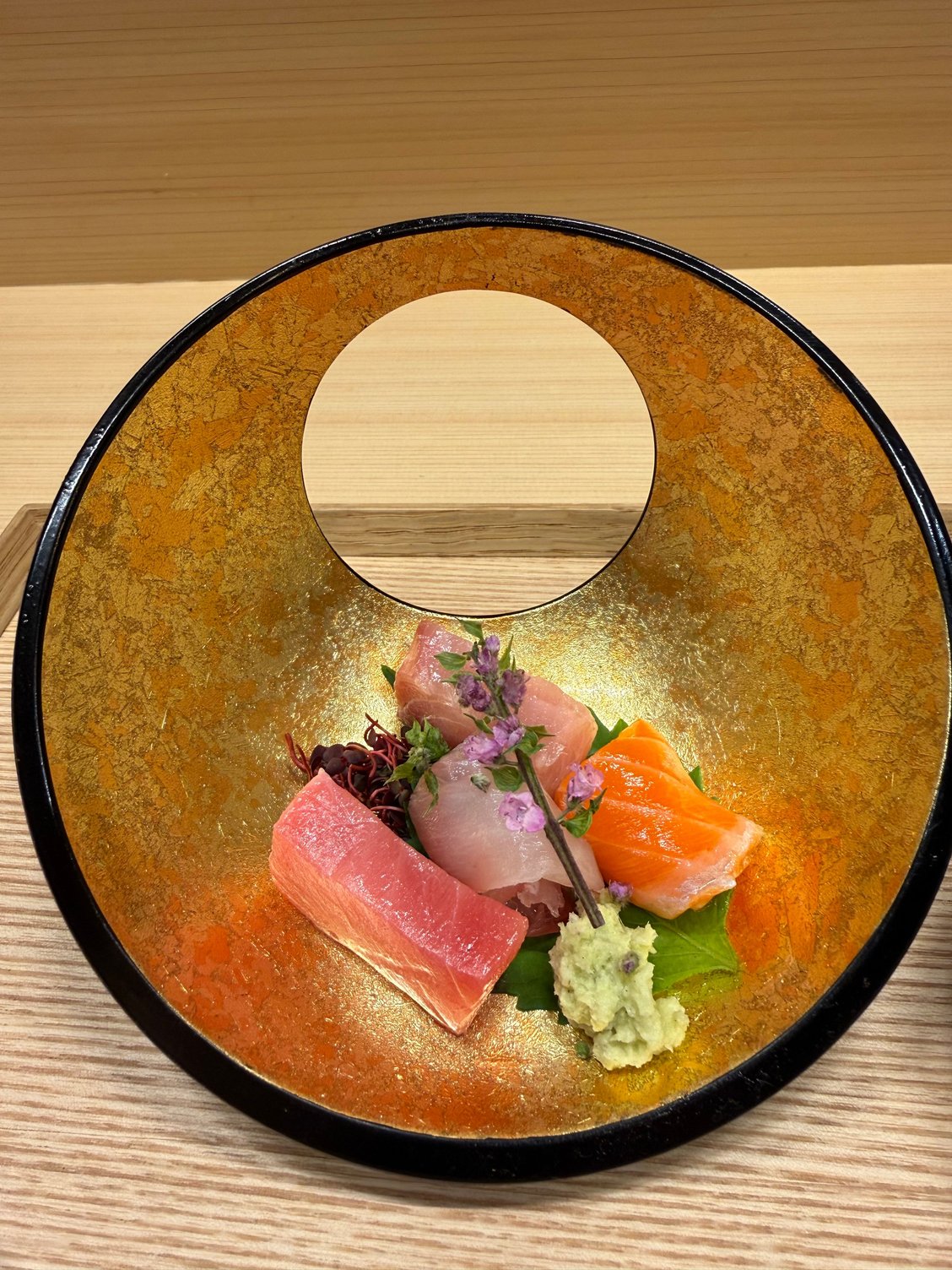
visually stunning and every bit as delicious as it looks, at Katana Bistro
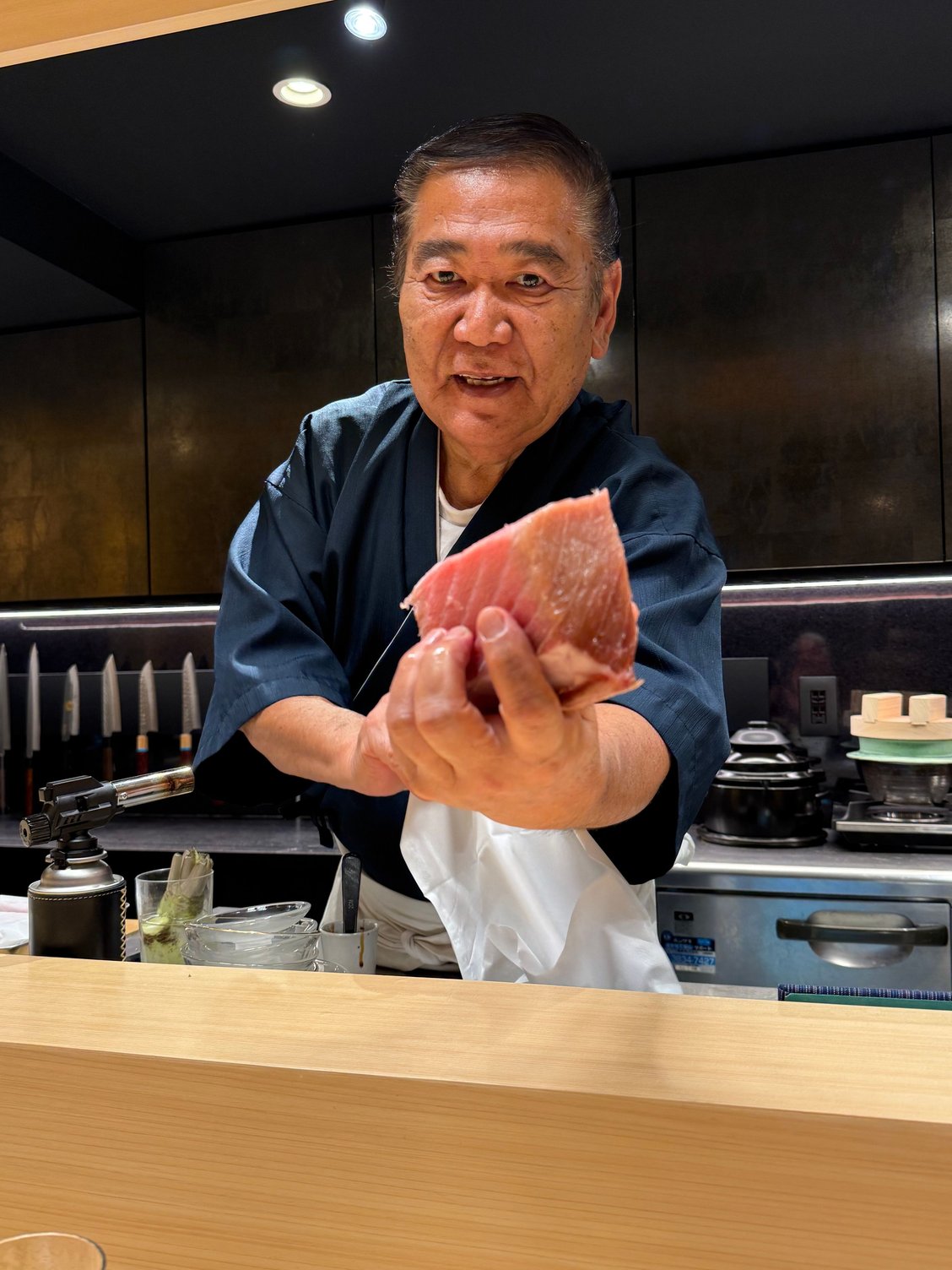
chef@Katana Bistro
I tried to keep a journal while we were away, and did pretty well in writing contemporaneous thoughts for the first couple of weeks, and then all best intentions fell by the wayside……. just finished that account and rather than going through all of the details here, I will keep things short and sweet, with overall impressions and shout-outs to our favorite experiences.
Over the years we have figured out what works best for us and how we like to travel. We are independent planners and travelers, in our late 60’s and mid 70’s, fairly active and mobile, with (thank goodness!) no major health issues or special requirements. We very much felt that if we were going to take a long-haul trip somewhat out of our comfort zone, we wanted to do it sooner, rather than later.
We pored over lots of different travel guides, the Japan Guide website, various trip reports and travel for us to come up with our final itinerary. There were so many places we would have loved to visit, including Mt Fuji and the surrounding area, but we prioritized visiting the Alps region and we both felt strongly about visiting Hiroshima. So many of the Fodorites who have visited, or lived in, Japan and shared their experiences were helpful in our planning, and they turned out to be invaluable resources: arigato gozaimasu!
Here’s our final itinerary outline:
Tokyo, 5 nights @The Gate Hotel, Ginza
Matsumoto, 2 nights @Matsumoto Marunouchi Hotel
Yamonochi, 2 nights@Hotarutei Villas
Takayama, 2 nights @Air BnB rental house
Kanazawa, 3 nights @Hotel 101
Hiroshima, 2 nights @Hiroshima Hilton
Miyajima, 2 nights @Auberge Watanabe
Kurashiki, 2 nights @ Yoruya
Kyoto, 6 nights @Hotel Mume, 1 night@ Baian
Osaka KIX Airport, 1 night@Hotel Nikko
Over the next few days, I will post more information about each of these spots, what we did and what we loved. But to start, here are some basics:
Transportation
Planes
We flew to Japan on ANA airlines from JFK. Our usual international departure city is Boston, which is a bit closer for us (we live in northern Hartford County, CT, just over the line from Springfield/Longmeadow, MA) but the premium economy tickets we wanted were several thousand dollars less expensive from JFK, even factoring in round-trip car service to take us to and from the airport. Worked out great – reasonably comfortable seats and the added perk of lounge access. Our itinerary was open jaw, JFK-Tokyo(HND) and Osaka(KIX)-JFK. We flew to Tokyo on a daytime flight, which was very convenient but, alas, did not protect us from the brunt of jet lag.
Trains
We used SUICA (in my Apple Wallet and via the app) and Pasmo (physical card for my Android loving spouse) for local intra-city travel and some small purchases in kombini. Most of our local travel was in Tokyo, but it was great to use the IC cards for train and ferry to Miyajima, and I rode the bus a couple of times in Kyoto.
To travel between Tokyo and Matsumoto, and then from Kanazawa to Hiroshima and for the rest of our inter-city transfers, we used trains. Once I figured out how to read the schedules, etc. it was easy to reserve our tickets directly on the JR website and then pick them up at convenient stations, at the designated machines. Figuring out which – and how many – tickets to insert into each turnstile was another story, but there was always an English speaking attendant or ticket window nearby to assist us…….I think by the very end of our trip we figured it out. I know many travelers find using Klook and Smart-Ex the better way to book and travel via train, but I always feel more comfortable booking directly with the source.
Automobiles
To make things super easy upon arrival, we pre-booked a transfer to our hotel through www.airportstaxitransfers.com. Super convenient, and the communications were perfect – as we were heading to JFK for our flight, we received a WhatsApp message from them, wishing us a good trip and letting us know they’d be waiting at Haneda for us. When we landed, they sent detailed messages with photos of the meeting spot, and were there waiting when we arrived.
We used taxis quite a bit, either through the GO app, the UBER app, in front of stations/hotels, or having the hotel call for us. Most of the time it was pretty reasonable, and saved us time or saved us from shlepping our stuff on a 15-20 minute walk to or from the station. There were a couple of instances when we were going somewhere that would have taken an hour+ via public transportation, and those rides were quite a bit more but we had already factored that into our planning.
We rented a car from Toyota in Matsumoto when we were leaving that city to travel through the Alps to Kanazawa. Super easy process, one of our best foreign car rental experiences ever. My husband loves to drive and is comfortable driving on the
Accommodations
This trip was a bit different for us, as we usually prefer to stay in rental apartments or villas when we travel, but overall the short-term rental market in Japan seems rather sparse. We only rented an AirBnB property in one location (Takayama). Where we stay is extremely important to us, both in terms of actual location, and in comfort/space terms. We’re not ‘go-go-go’ travelers: we like to plan one major experience or site per day, another ancillary site or walking route, leave a little time for serendipity, and then enjoy an afternoon nap and time for a cocktail and/or journal writing and playing cards before dinner. So, we actually do spend time in our lodgings and prioritize comfort and aesthetics. We ended up mostly in hotels, with a few ryokan and small boutique-type stays.
Communications
We’ve become big proponents of using eSims in our phones for data usage, and communicate with our friends and family via text messaging, WhatsApp, and FaceTime. This trip, however, it was important that my husband have 24-hr access via telephone as his brother was in the hospital when we left, soon to be moved to a rehab facility for a few weeks and we wanted to make sure that medical teams could reach us from their landlines or cell phones. I went go the eSim route (Airalo, which we have used for our last several foreign trips – worked seamlessly, as usual, and was very reasonable for 30 days, 20 GB, around $23, after using my Airalo money credits) and he used the daily Verizon data plan (we have pre-paid phone plans that are super inexpensive but don’t allow conversion to a monthly International plan on an ad-hoc basis). Having the peace of mind that medical teams could reach us any time, and that my brother-in-law could call whenever he felt like it without having to worry about wi-fi access or dialing an international phone number: priceless :~).
Within Japan, messaging and emailing was how we coordinated with guides, hotel staff, etc. Language was not a major issue on this trip, as just about everyone we interacted with had at least rudimentary English skills (to match my rudimentary Japanese skills after months of language app study) or access to a translation app. As so many others have said, using a few Japanese words and phrases appropriately was both openly appreciated, and in many cases, an icebreaker.
Food
We were really looking forward to eating in Japan and trying new foods. Both of us love pretty much all things seafood, as well as good red meat, and we were not disappointed. No food allergies, but a few dislikes that were easily avoided. Our biggest issue is that we can no longer eat the way we used to, meaning if we have a large-ish or late-ish lunch, we really aren’t hungry for anything other than a small, light dinner. Multi-course tasting menus are too much for us now, so we were hesitant to go to places > 7-10 small courses. Also, four weeks is a long time to have to eat most meals out. In the end, we had a balance of kaiseki meals at the ryokans where we stayed, some nights where we had a ‘picnic’ at our lodgings with either kombini or depachika (department store food hall), and meals we reserved based on our own research, hotel or guide recommendations, or lucky, last-minute walk-in situations. Most mornings of the trip we had breakfast at the hotel or ryokan, which was great for making sure we had our coffee (a must!) and fresh fruit, along with some form of protein. Excellent breads or pastries were a treat in a few places.
Miscellaneous
We are light packers and travelers, so we each had a lightweight carry-on size suitcase and a backpack. NB, my backpack is a Biaggi carry-cube style which has a lot of space so I didn’t feel like I was sacrificing anything. I also brought a foldable small tote bag, and a sling bag that packs flat, anticipating that on the flight home we would check our suitcases and my backpack and still be able to have room for souvenirs and any larger liquid items and/or knives. Worked like a charm, despite my husband’s initial skepticism. This made it easy to travel between destinations. Only used luggage forwarding once, to send the suitcases and backpack to the airport hotel at KIX, and it was perfect! We set them on Thursday, for pickup on Saturday.
Our clothing choices were overall excellent, however it was a little colder than usual at that time of year in Tokyo and the Alps, so we ended up supplementing with lightweight warm tops from Uniqlo. For outerwear we had lightweight water resistant jackets that we only used a couple of times, our new fleece tops, and down vests. Supplemented with 32 degree base layer tops, we were all set. My usual wardrobe is based on black clothing, so I had no problem fitting in :~). Only brought 3 pairs of shoes: Brooks Ghost (black), Vionic leather sneakers (black) and a pair of Sofft black quilted ballet flats that I only wore once and wish I had left at home.
Part I: Tokyo
Initially we weren’t very interested in the big city but we knew we’d regret bypassing it. In recent years when traveling abroad – especially when there’s a long flight and huge time differences – we have tried to build in a soft landing if possible. To us, this means booking as nice a hotel or rental as we can find at our budget level, and add on more time than we think we need (one of the best features of traveling after retirement, is no longer having to worry about how many PTO days are available). That’s how ended up going from “should we stay in Tokyo?” to 5 nights in Tokyo.
After obsessing on which area to stay in, and which hotel, we decided on The Gate Hotel in greater Ginza. I describe it that way, because technically it’s in Chuo City, and is sometimes described as being in Yurakcho. This area is not a popular choice on most travel forums, but it was a great one for us. Nice area to walk around in for window-shopping, real shopping and food choices. Plus, there’s an entrance to the Ginza line right outside the door, and a couple of other subway lines a few blocks away. We weren’t planning any day trips from the city, and had only one outing planned within city limits that was not conveniently reached by any public transportation. So, we weren’t concerned about being near a major JR train station or a massive subway-hub and had no interest in being near entertainment areas.
Service at The Gate Hotel was wonderful, and we had a comfortable room on a high floor. Breakfast was included in our rate, which worked out great as it enabled us to have lots of fresh fruit, decent coffee and other more traditional Western breakfast choices if we wished. Combination buffet and table service, and as we were long-stay guests for them, the service grew warmer and we were offered more customized choices as the days went on. They also have a nice lobby bar with reasonable prices, and an outdoor seating area we could only enjoy once without being too cold.
Experiences
Rather than a detailed day-by-day, blow-by-blow description, here are the highlights of our Tokyo itinerary:
We booked a half-day private tour for our first day, with Roko Tokiwa of rokotokyoguide.com and it was a brilliant move. We had corresponded via email and felt that we clicked. She met us in the hotel lobby and we set our final plan, then we took off and she helped us understand the subway system and get my husband set with his Pasmo card. We visited the Meiji Shrine (bought a goshuin book w/stamp), Tsukiji Outer Market with some food sampling and stop for a fantastic sushi lunch, then we went to Yanaka ginza (meh) and called it a day, though Roko could have kept going! Also, she helped us pick up our reserved train tickets at one of the subway stops which was also a JR train station……..in fact she chose that route specifically so we’d be set with getting the tickets. It was like spending the day with a dear friend we hadn’t seen in a while. Excellent English, very personable and energetic, and you could tell the folks at the market area really liked her, too. Oh, and after helping me select a paring knife, she helped us with the tax refund at the market center.
We visited Senso-ji on our own, getting there on the earlier (but not crack-of-dawn) side, and we really enjoyed walking around the entire temple complex, getting a goshuin stamp, paying our respects. It was a cool but sunny day and very pleasant, but as the crowds grew, so did our desire to get out of the area. In hindsight, we were very glad we chose to stay in Ginza, rather than Asakusa.
We arranged to participate in a tenugui cloth-dyeing experience through the Nihonbashi Information Center, and it was one of many highlights of the trip (tenugui are multi-purpose, scarf-like cotton cloths that are used as actual scarves, hand towels, table runners, etc). The center itself has a wealth of information and resources, and the lovely assistant, a Lithuanian ex-pat who had attended university in Japan and decided to stay, walked us over to the textile shop where the workshop took place and stayed to interpret for us. The process is a little bit like silk screening. Lots of fun, interesting, plus we each got a great souvenir to take home.
One morning we had food tour, also in the Nihonbashi area, with Yukari Sakamoto of www.foodsaketokyo.com. This was not a tasting tour, rather a great opportunity to learn more about Japanese foods, how to find certain foods in the department food hall, what kinds of specialty things to look for, interesting kitchen items. Yukari-sensei is a trained chef, sommelier and all around food-and-drink guru who is a superb raconteur and delightful companion. She also writes for several travel magazines and regularly contributes to Eater and the NYTimes. Getting to know her a little bit before the trip, via email, made it feel like I was meeting an old friend and she was also helpful in recommendations for where to stay and where to eat.
My husband is interested in bonsai, so I looked for a way to incorporate that into our Tokyo time, and found a small museum that offered a workshop and also had a lot of bonsai on display. I booked directly with the museum and exchanged a few emails with the person who coordinates the visit. This was quite inconvenient to reach via public transportation, so we traveled there via taxi which was a splurge. Turned out to be different than I had imagined – I thought it was going to be a private thing, but there was actually a group from a tour there already, plus another few folks like us who had booked directly – and the bonsai handling part was only around 30 minutes, before a brief tour of the inside rooms and an opportunity to wander around the small garden area. However, as I had exchanged emails with the coordinator and explained that this was a special treat for my husband, he made it a point to seek us out and spent time explaining the history of the property and how the master gardener, Kobayashi, found his calling. We both felt this was a very special experience, and putting it into words just doesn’t do it justice.
The rest of our time in Tokyo was spent walking, doing a little bit of shopping, and trying to adjust to the time change. Memorable meals included a tonkatsu lunch at Katsukichi restaurant in the Takashimiya annex store, a tempura lunch at a small place where we were the only tourists, superb ramen at Tsujita Ginza, a 10-minute walk from our hotel, and a delightful omakase dinner at Katana Bistro – small place, only 6 counter seats, with delicious, inventive sushi and a charming chef.
The Gate Hotel
evening view from near our hotel
Meiji Shrine -- it was crowded but thank goodness for the clean-up tool :~)
Sushi lunch @Tsukiji Market. they let us order at their streetfront counter, then relax and eat in their around-the-corner back alley restaurant space, which is closed to the public most of the time.
Senso-ji Temple
lovely bridge and koi pond on the grounds of Senso-ji
our finished tenugui cloths!
my bonsai project....could not take home, unfortunately
ramen lunch, two thumbs-up
visually stunning and every bit as delicious as it looks, at Katana Bistro
chef@Katana Bistro
 Jan 24th, 2026 | 06:09 AM
#2

Joined: Mar 2003
Posts: 6,173
Likes: 0
I love all the logistical details you have given at the beginning of your report. For someone who has never been to Japan, this is really important and helpful to me. My husband and I have recently talked about visiting Japan and Taiwan. Not sure when we will do this but your report is helpful along with others I have read recently. Looking forward to more.

 Jan 25th, 2026 | 12:47 PM
#5
Original Poster
Joined: Jan 2003
Posts: 248
Likes: 0
Reading54, both of our Tokyo guides were wonderful about helping us narrow down our choices on where to stay and always responsive when I had questions about all things Japan trip planning related. In addition, they each asked lots of questions about our entire itinerary, likes/dislikes, etc. to get a picture of what kind of travelers we are and what might be of particular interest. I had a preconceived notion of Ginza being only about high end shopping and kind of bougie, but after taking a closer look, it made the most sense for us.
Jan 27th, 2026 | 04:51 AM
#6
Original Poster
Joined: Jan 2003
Posts: 248
Likes: 0
Matsumoto
We were nervous about taking our first train trip, so we booked a route that didn’t involve any changes, a limited express train from Shinjuku. We also tried to leave plenty of time to get to the station and find our platform, etc. Despite having done lots of research ahead of time, and watching lots of YouTube videos, I couldn’t quite picture in my mind what it would be like………...until we actually did it. Went very smoothly, including finding a spot to buy our ekibens for lunch on the train. The train left Tokyo@noon, and arrived in Matsumoto@2:35, which was perfect timing for check in at the hotel. It also gave us a chance to visit Heian-Jingu shrine in Tokyo early in the morning, which was pretty quiet except for Shichi-Go-San celebrants taking their family photos in advance of the festival. Also got a lovely goshuin stamp!
Weather in Matsumoto was slightly drizzling and very chilly when we arrived, so we took a taxi to the Matsumoto Marunouchi Hotel. We had booked an executive room, which had a separate sitting room area, so the extra space was nice. Beds were also super comfortable and cozy, and the p.j.s were very nice. We had booked the hotel for proximity to the castle, and weren’t disappointed with the location at all, as it was an easy walk to everything. Popular with tour groups, apparently, and there is an attached banquet hall, where there were weddings over the weekend. Only negative was the breakfast: it was pretty awful, including undrinkable coffee.
Experiences
We visited the castle early in the morning, which was a good call as it got quite crowded. I was very excited to tour one of the original castles in Japan, and it did not disappoint, though it was a bit hairy climbing the steep and ladder-like steps inside, wearing only socks (carried our shoes in the provided plastic bags). It was a sunny day and the foliage simply gorgeous, so we spent a lot of time strolling around the grounds and moat. We also visited the castle park at night, to get the requisite photos and it is truly gorgeous. Still don’t understand how the castle appears dark, almost black (Crow Castle) during the day, and white at night.
Matsumoto City Museum of Art: we are fans of Yayoi Kusama’s artwork, so we visited Matsumoto City Museum of Art to see her permanent exhibit, which was very cool. There was also a special exhibit of Ishii Hakutei’s paintings, which I thought was fascinating – he had a strong influence on the art of the Nagano region, and many of the works on display were of the local countryside.
Strolling around the market and shopping streets of Matsumoto was lots of fun, crisscrossing over the river and taking in all of the sights, sounds and smells.
We had pizza one night at a fabulous Neapolitan-style place, Pizza Verde, with a real-deal pizza oven and pizzaiolo who trained in Naples. This became a theme of our trip, as we tried the pizza in several other places, wherever there was an authentic pizza oven :~). The pizza was fantastic, as was the salad we shared.
On our departure day, we were up early anyways so we took a 20-minute walk to an old school kissaten, Coffee Bigaku Abe, for a decent cup of joe and some breakfast. We just missed the first seating, so wrote our names on the list outside and waited patiently to be called in, and it was totally worth it.
Two nights was a good amount of time for us: it would have felt too rushed to get a feel for the town and see the castle in the daytime and nighttime, plus visit the museum, with a one-night stay, but after two nights, we were ready to move on.
We picked up our rental car from the Toyota outlet, and it was the #1 international car rental pickup we’ve ever had. The English-speaking representative was a very nice gentleman who had everything ready for us, and made sure we understood everything. He installed the electronic toll card (like a credit card, and the charges are settled when the car is returned) and made sure it worked. Picked up some sandwiches and cold drinks at Lawson on our way out of town, and headed out of town on a sunny day, with one last drive-by view of the castle, and admiring the snow-capped peaks in the distance.
Stopover: Obuse + Gansho-In
One of the appeals of renting a car for a drive through the Alps area as we made our way toward Kanazawa was the ability to visit some more out-of-the-way places without having to rely on public transportation schedules and having to store our bags along the way, etc. When we decided to include the northern route in our itinerary, I knew that Obuse, and the Hokusai Museum there, would be a must-see for me/us. I have long been a fan of his wood cut prints, and was very eager to see some of them in person. The small town center of Obuse is quite quaint, and the area around the museum has been developed in a lovely way, with lots of small shops celebrating (a) Chestnuts! The area is known for growing chestnuts and we were there in prime season, so lots of chestnut pastries and treats were on offer; and (b) Hokusai (obviously).
There were many tour buses in the parking area by the time we found our own spot to park nearby and figured out, with the help of a few locals, how to pay for it. The museum was crowded; the streets were crowded but overall, the experience inside the museum was manageable. There were a couple of short films to watch, very informative, and then we wandered through the galleries. It was like seeing old friends, as I had picked up a copy of Thirty-Six Views of Mt. Fuji and looked through it several times in the months leading up to the trip. Another highlight was the room with the painted festival carts that Hokusai painted. The original panels were on display, as well as replicas that were installed in carts, to show how they would have looked.
From watching one of the films, we learned that Hokusai had painted the ceiling of a nearby temple hall with a large phoenix painting, which sounded intriguing. We were already pretty tired and looking forward to checking in to our next digs, and visiting Gansho-in temple would add another 30 minutes onto our journey, but how could we not?
All I can say is that it was magical. It is out of the way, and I believe not many foreign tourists visit. The temple attendants were so nice, and made sure we had English materials to read and checked in with us a couple of times as we toured the temple. The Phoenix ceiling in the great hall was amazing. No photos allowed, but one can spend as much time as one likes observing the painting from any and every angle, including while lying on one’s back and gazing up……..the eye of the phoenix appears to be staring directly at you, no matter your perspective. There were also some exhibits of temple artifacts and local folk crafts. My favorite part was the display of the various pigments Hokusai used in the painting.
Yamanouchi
Seeing macaque monkeys (aka snow monkeys) in their natural habitat was a long-time dream of mine, from the first time I ever saw those dramatic photos of the monkeys bathing in hot springs, surrounded by snow. I knew we weren’t going to have any snow at the time of year we were visiting, but since we had decided to devote time to the Alps route, we decided to stay a couple of nights in that area, especially since we found a great-sounding small hotel with private open-air onsen baths that was only a 35-ish minute walk to the snow monkey park.
Hotarutei is hard to describe. There are only two ‘villa’ accommodations in separate buildings, each with a couple of bedrooms and bathrooms, gorgeous living room area, full kitchen (w/washer and dryer, yay!), outside seating areas and outdoor semi-sheltered onsen baths. Contemporary décor with super comfortable Western style beds and lovely toiletries from Marks & Web……..plus very soft cotton pj’s and yukatas. The main building has been a restaurant/inn for decades and decades, and was renovated by the current owners, keeping its historic style. We received a very warm welcome at check-in, set our dinner time, and settled in for rest before dinner. We had booked our stay with breakfast and dinner both nights and the food and service were top-notch. The only other diners we saw during our stay were the folks who stayed in the next-door villa our first night, so it was a private experience. The hotel manager and our server both spoke excellent English – our server was a lovely young woman from the US who studied Japanese in high school and ended up going to university in Tokyo after the pandemic, and stayed on to work and continue studying in Japan.
The kaiseki dinners were wonderful and we were encouraged to give feedback on our preferences after our first dinner so the chef could better cater to our tastes – for example, I’m not a lover of super fatty tuna, so our 2nd night’s sashimi course substituted more medium fatty tuna on my plate. Since we loved the A5 beef, our server asked if we’d like to try it in hot pot for our 2nd dinner…….and our dessert plate on 2nd night had a lovely personalized message. For breakfasts, we chose Western style one morning and Japanese the next, both excellent.
The next morning was drizzly, but we dressed appropriately and set out after breakfast, past a few small hotels and up to the wooded path to the park area. It was a lovely, mostly flat walk through the foliage and the rain mostly held off on our way there. The access road to the park entrance is a couple of kilometers before it reaches the gorge with the hot springs, and we passed a very scenic old onsen inn and some geyser activity, Alas, we did not get to see the monkeys – there were clear messages at the entrance booth that no monkeys were around, so we decided to turn around and walk back to the hotel. The monkeys tend to stay up in the mountains gathering stores for winter, and though the park wardens had been trying for a couple of weeks to encourage them to come down, no dice for us (I did keep tracking the website through the end of our trip, and still no sightings, so at least we didn’t feel like it would have been different if we had flipped our dates). The rain started coming down a bit harder on our way back, so we did get wet, but our reward at the end was a lovely soak in the onsen tub and a quiet couple of hours to read and relax. We skipped lunch, knowing we’d be having another big dinner, but we took the car out for a spin to pick up some fruit and see Yudanaka onsen, the main town on the other side of the river from where we had considered staying. It was quaint and picturesque, and while I can see the appeal of staying in a ryokan in an onsen town, where you can visit various bath houses, the secluded and private vibe is what we prefer.
A few photos from this segment of our trip:
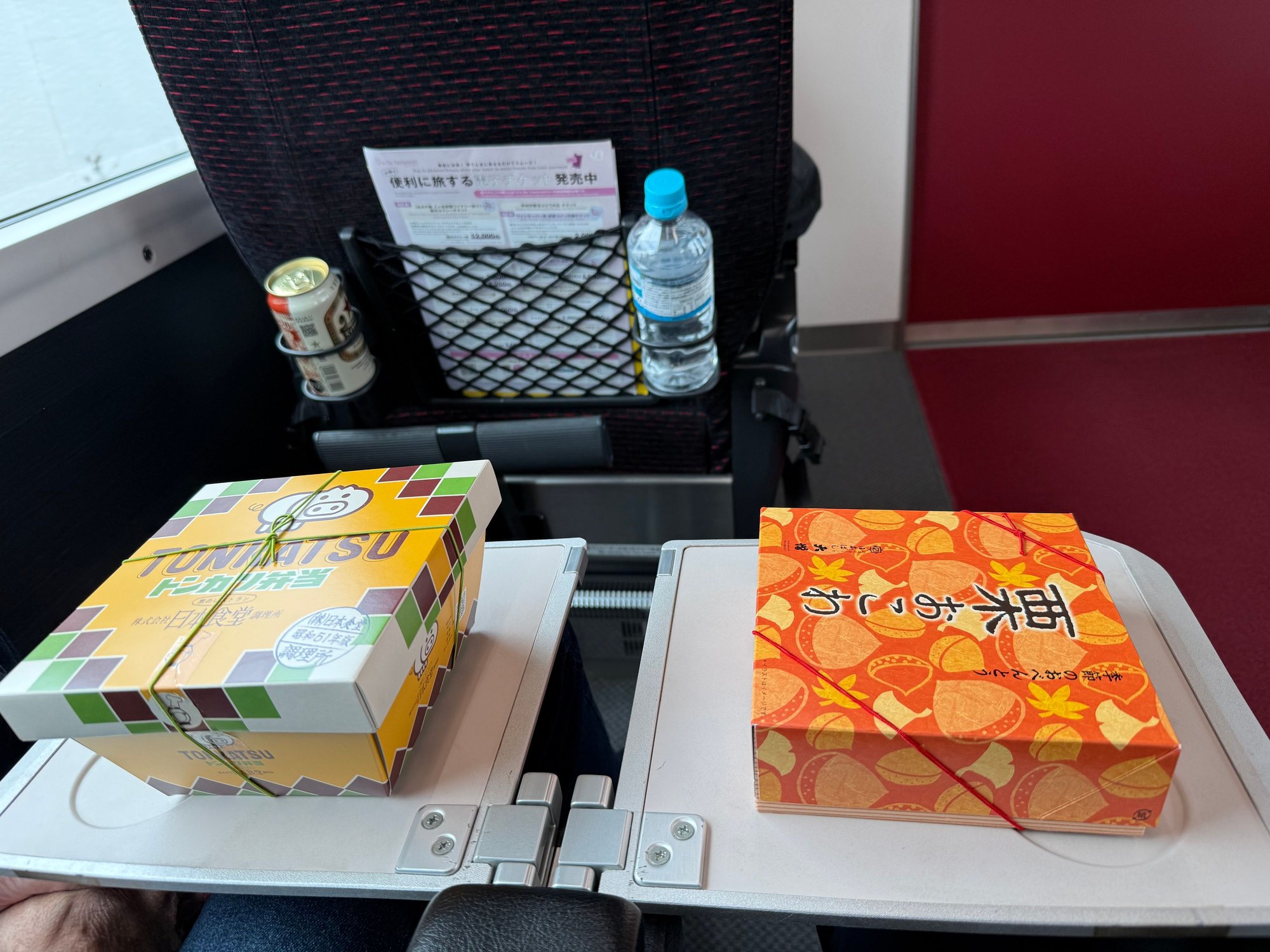
our ekiben lunch boxes
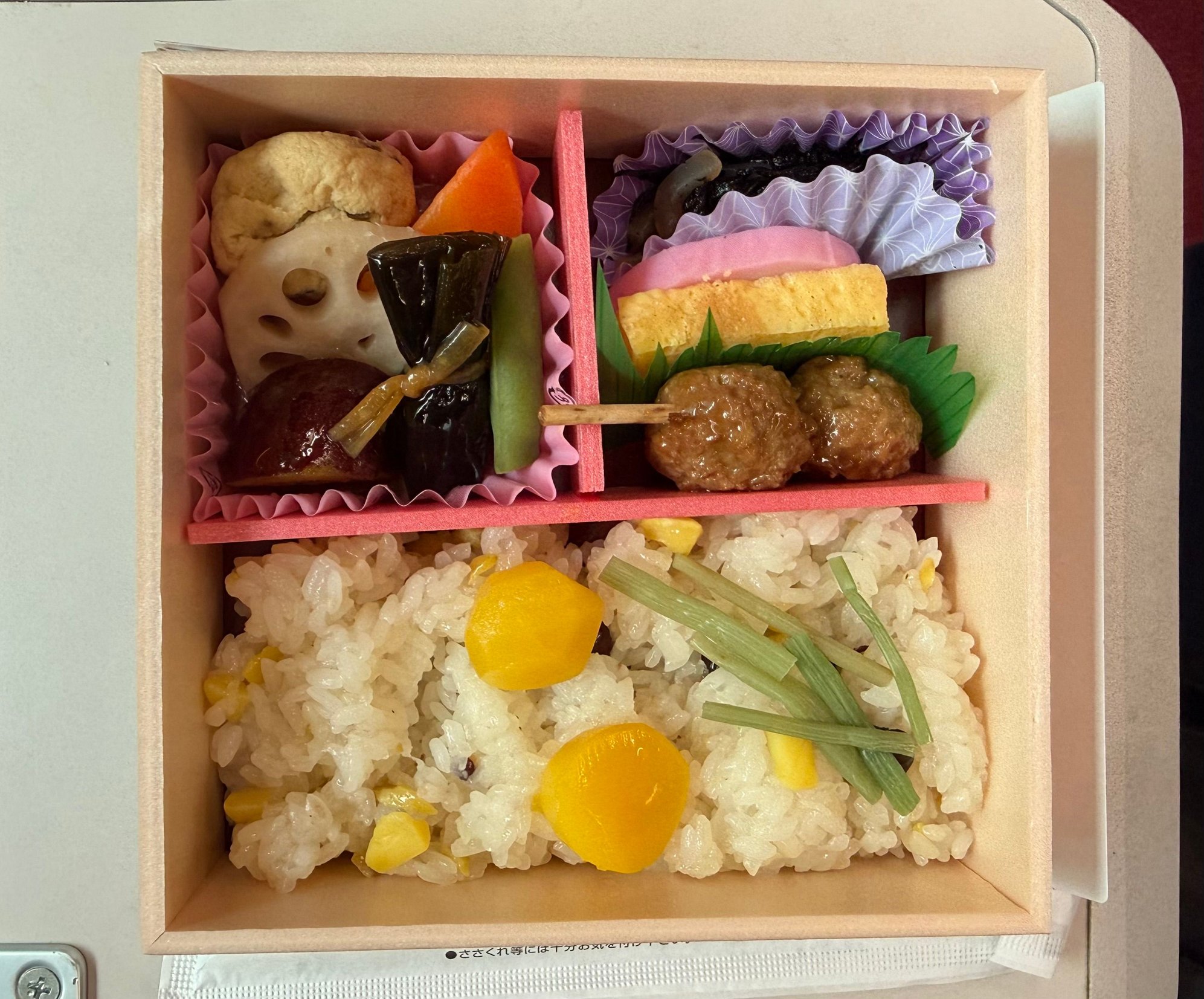
this is my seasonal special box -- the yellow disks are chestnuts
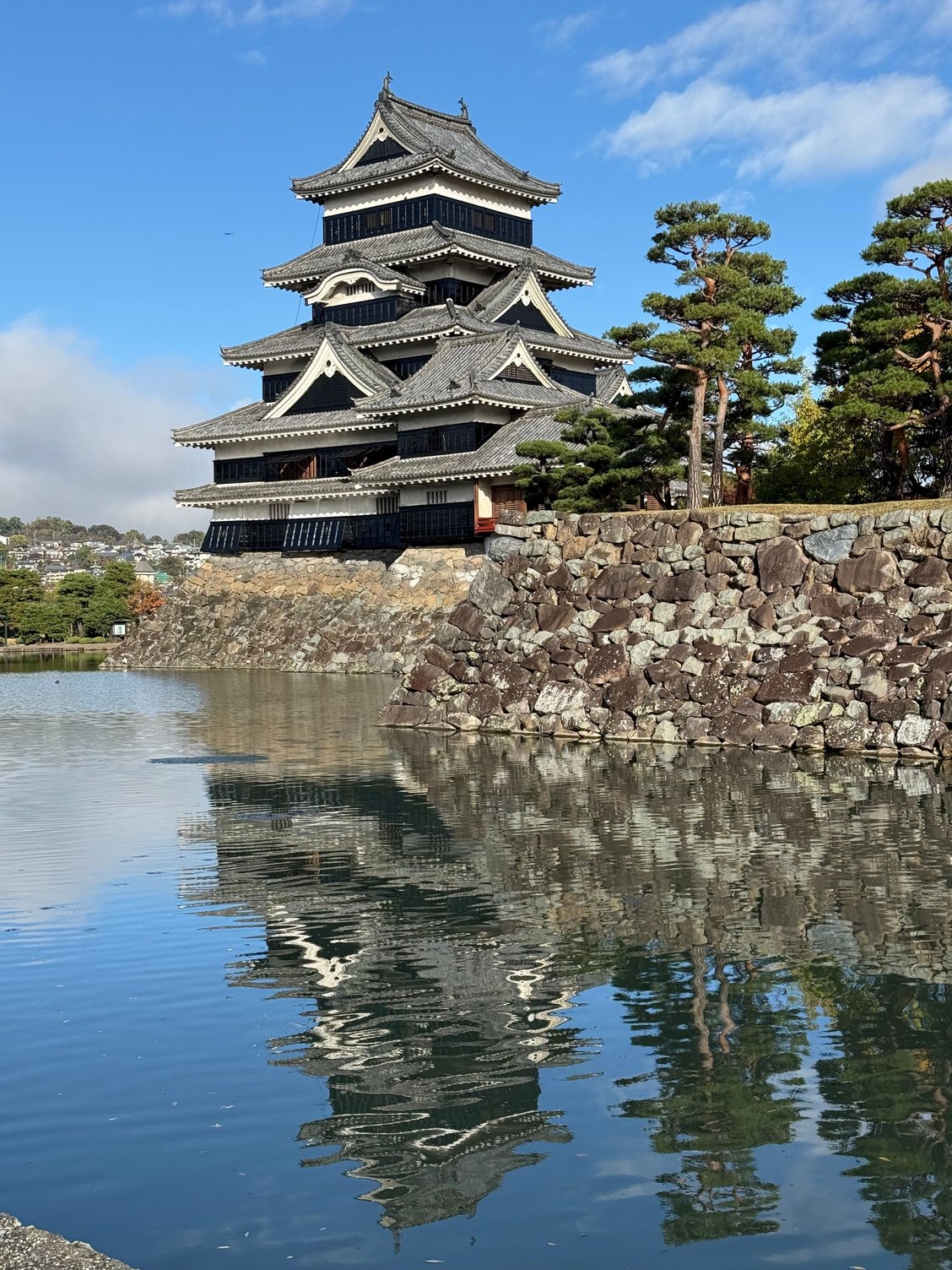
Matsumoto Castle by day.....................
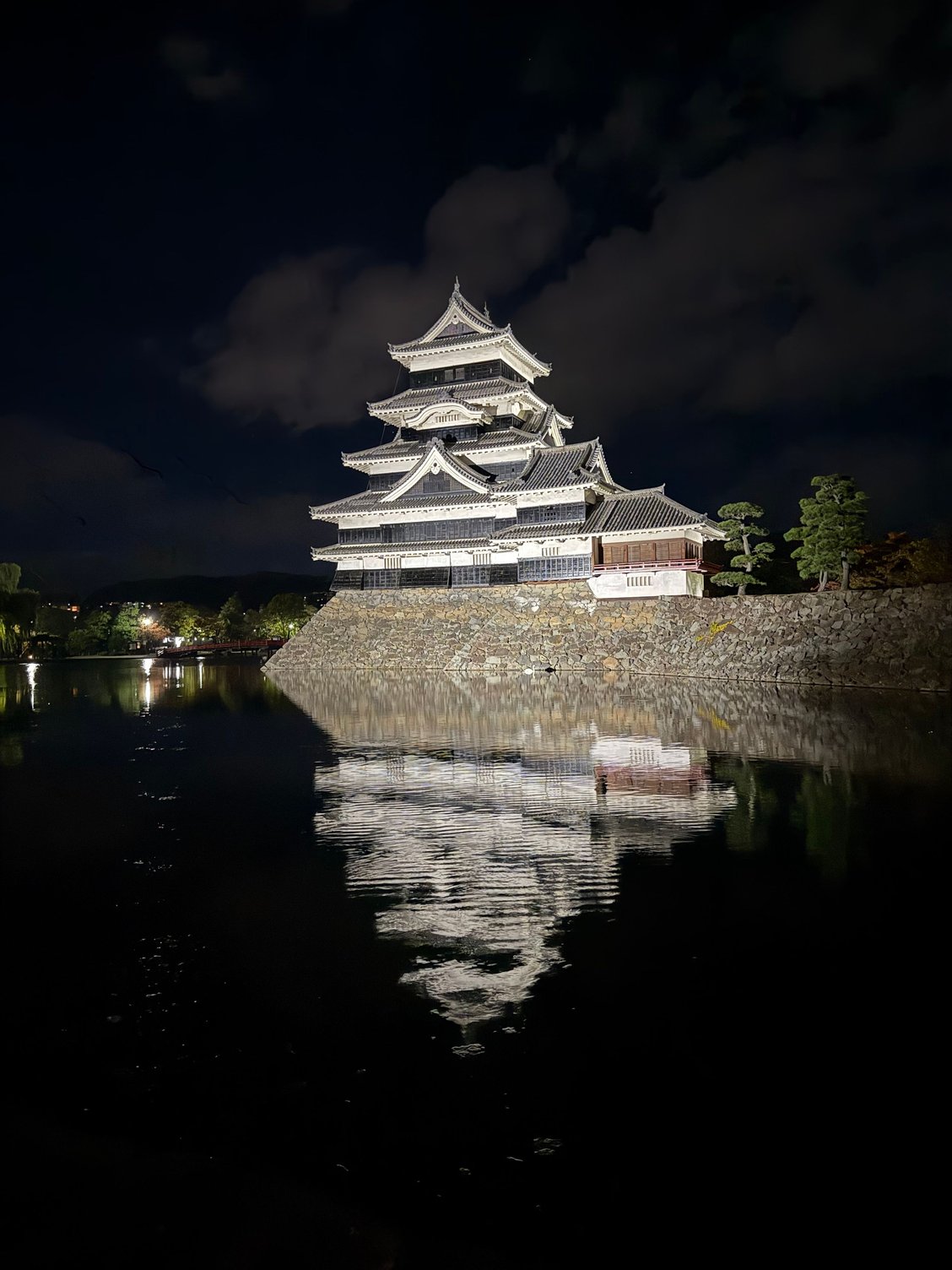
...........and Matsumoto Castle by night
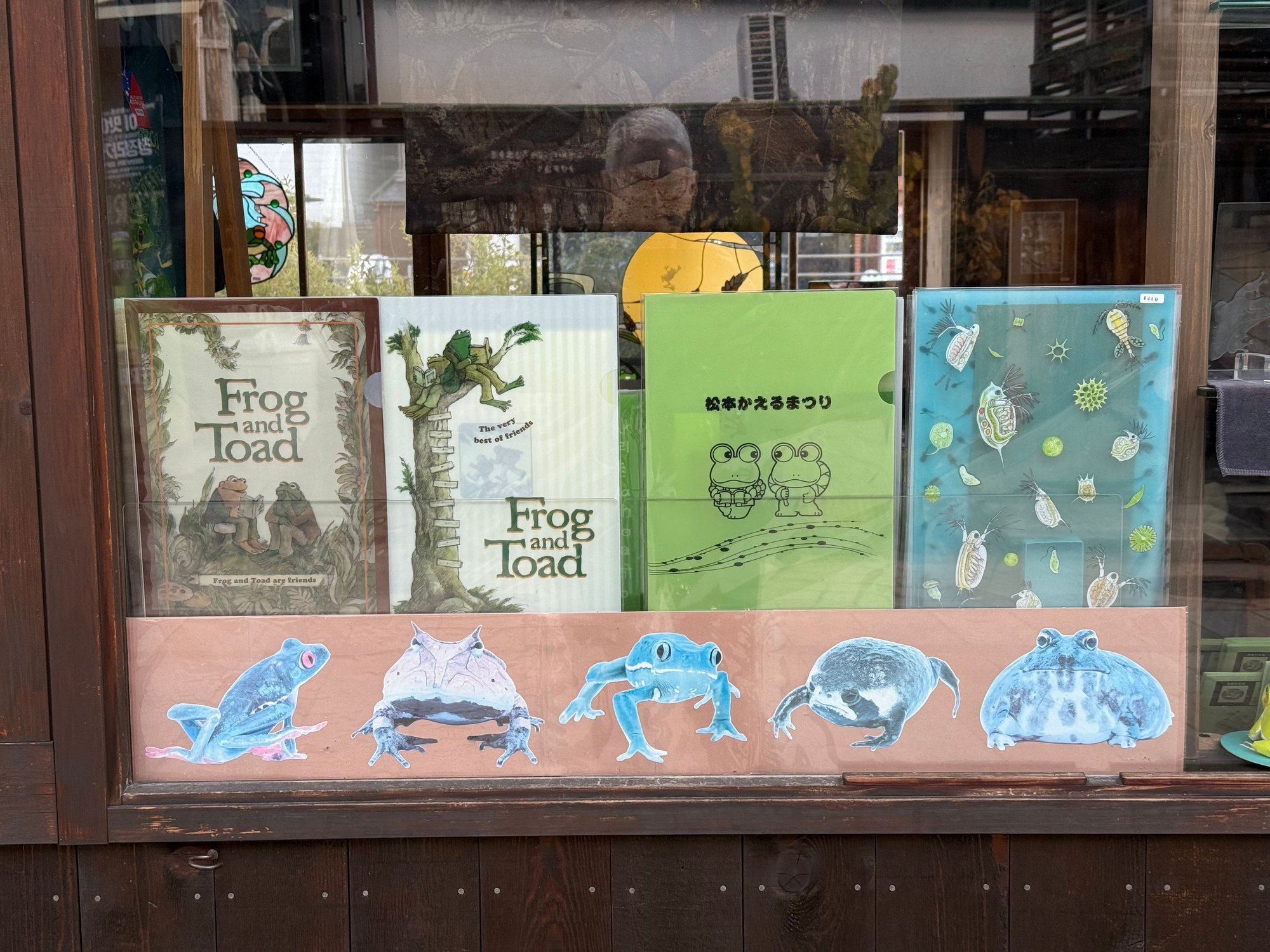
favorite childhood books in the window of a shop on Frog Street
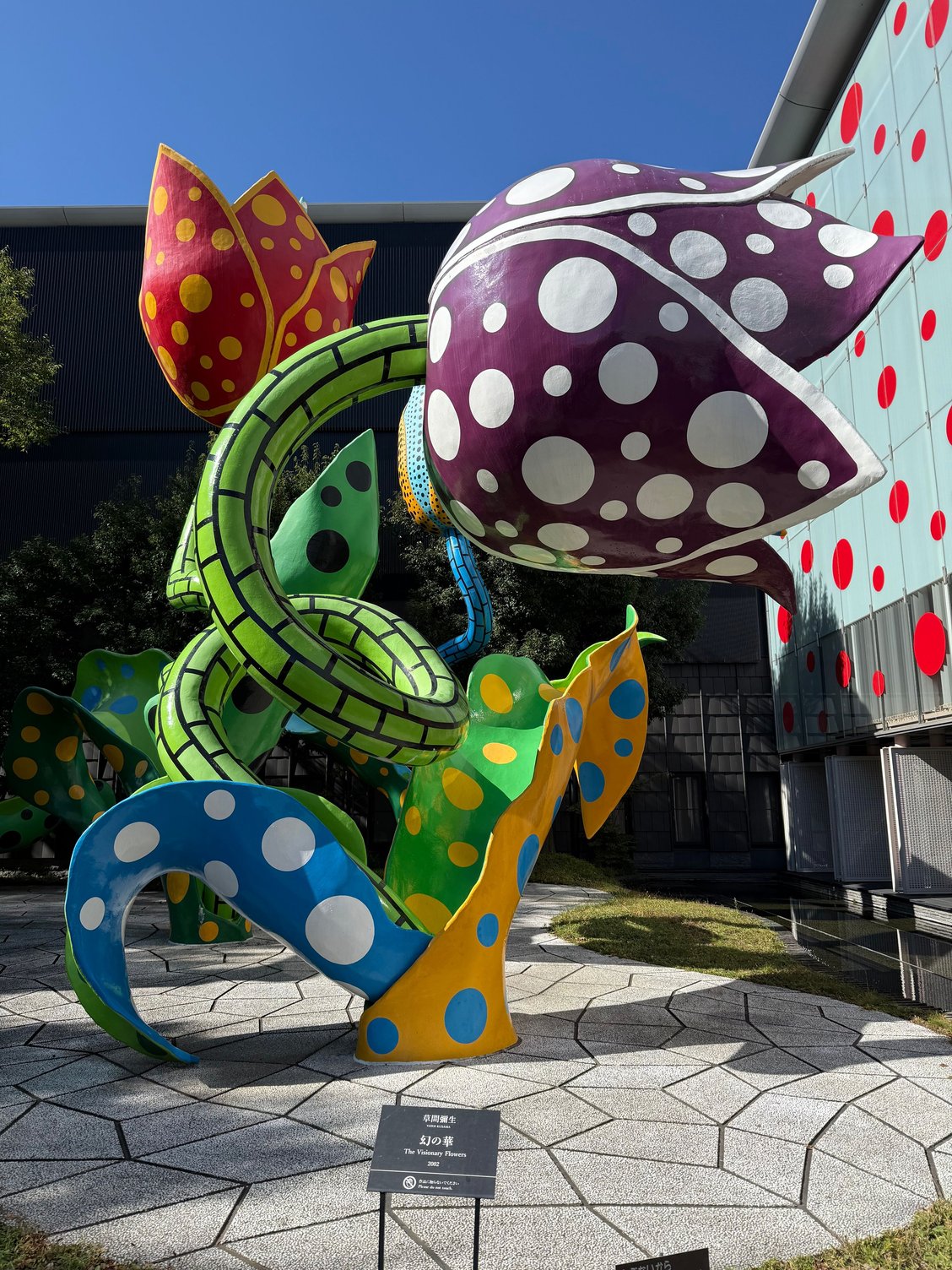
Yayoi Kusama sculptures at entrance to Matsumoto City Art Museum. photos were not allowed the indoor Kusama exhibits
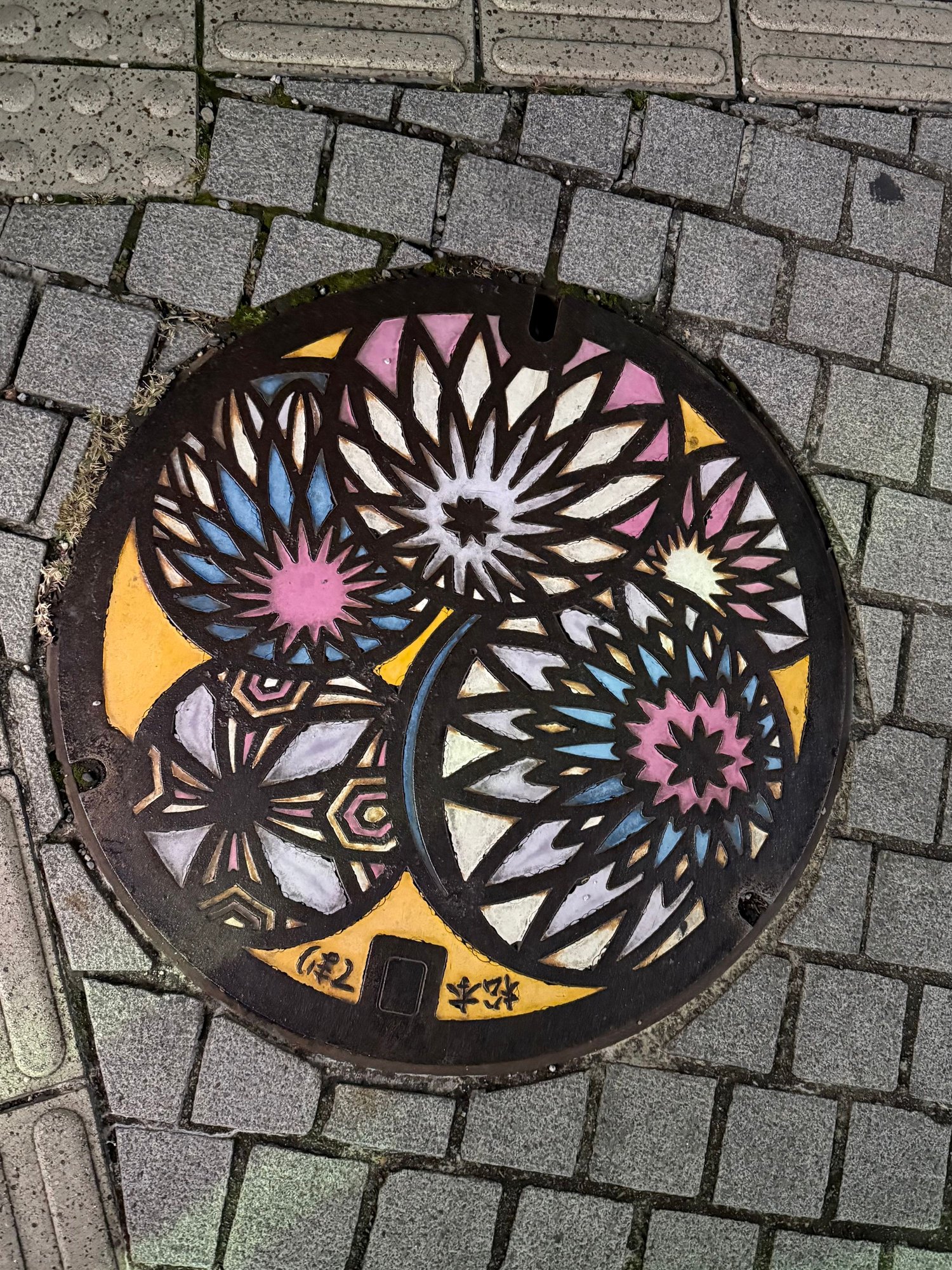
requisite manhole cover shot (I could fill a whole book with these, I spent a lot of time walking while looking down!)
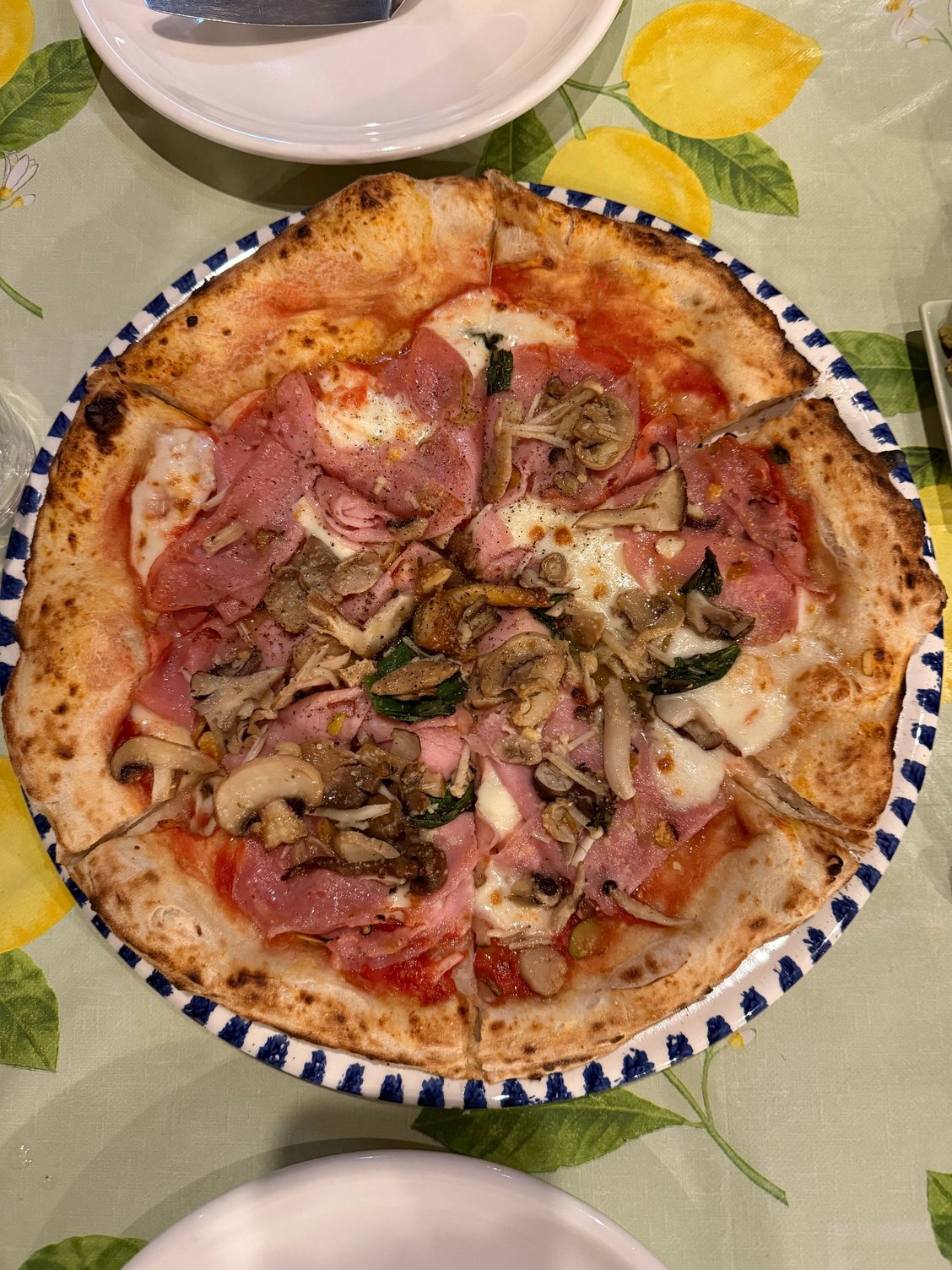
the real deal at Pizza Verde
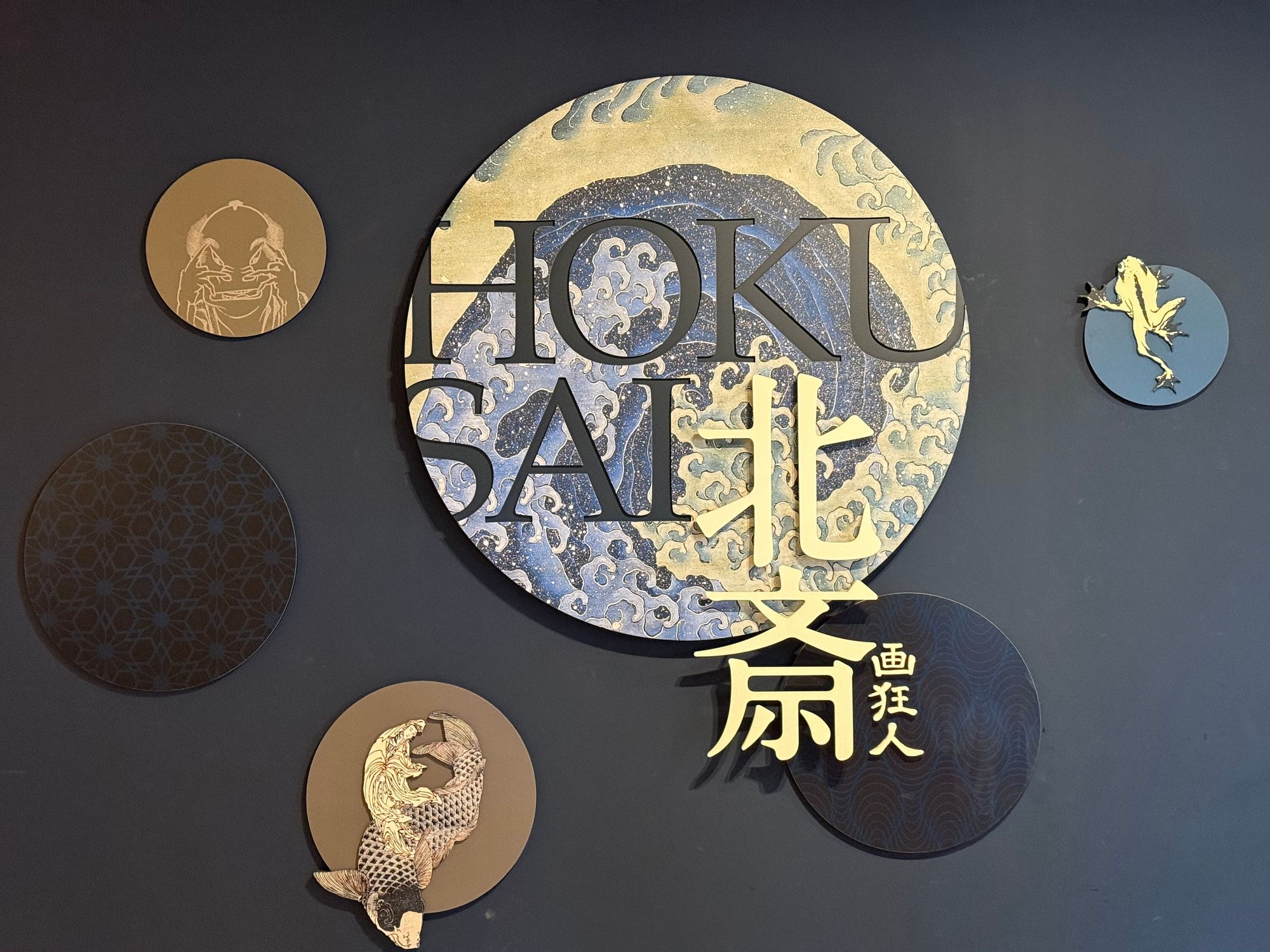
entrance to museum in Obuse
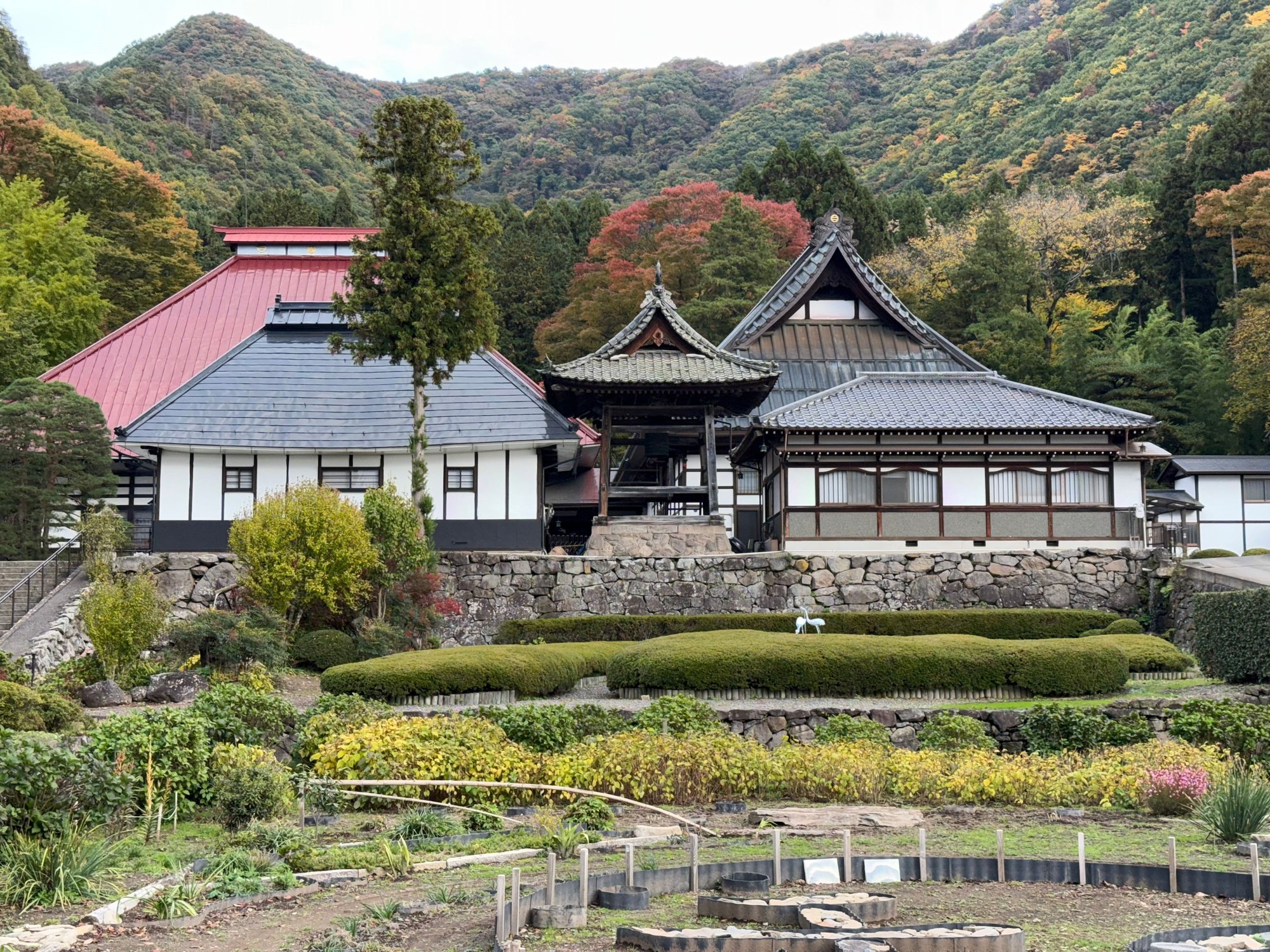
the Gansho-in temple complex
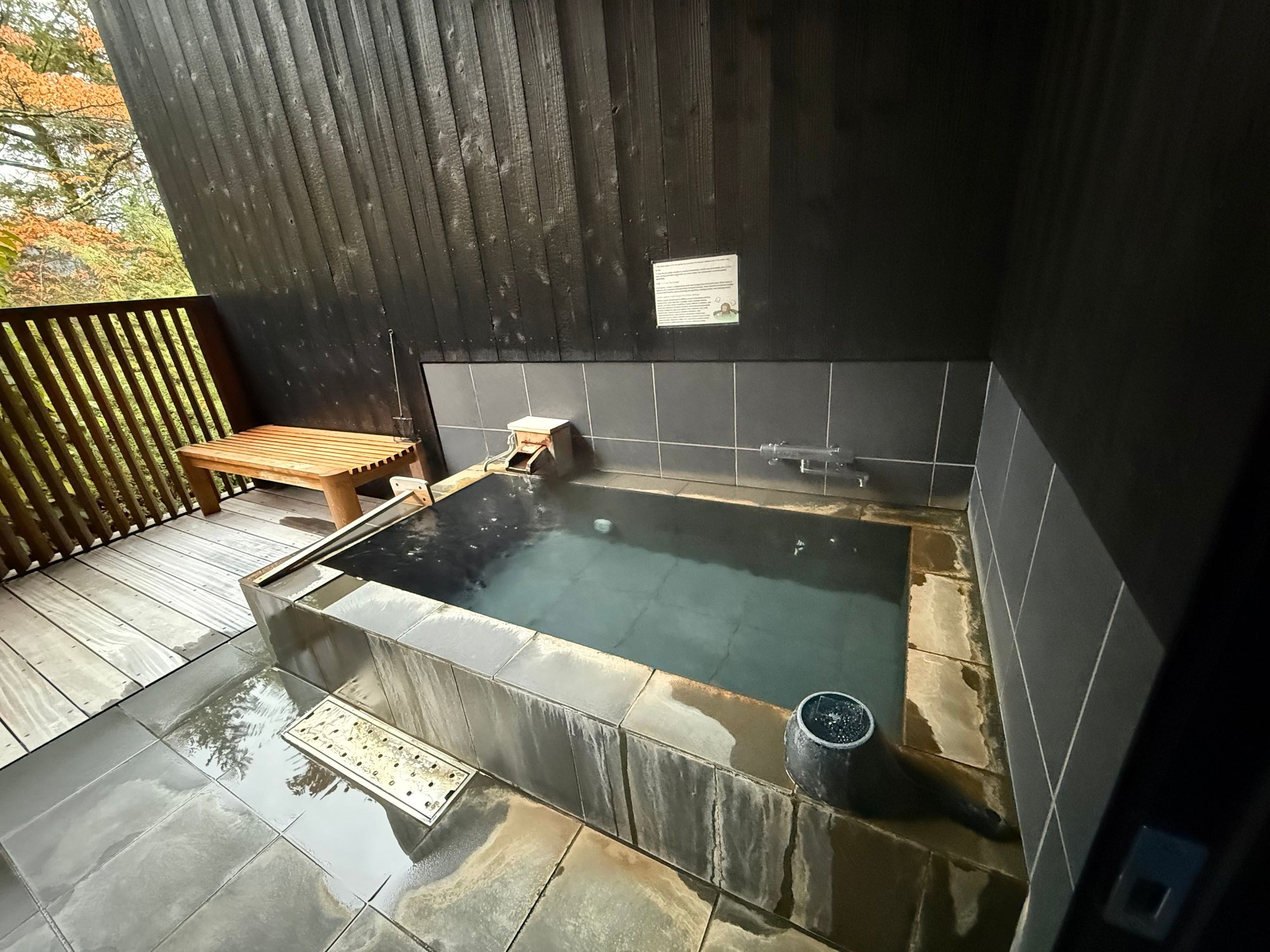
our own onsen -- same hot springs water as the monkeys enjoy nearby
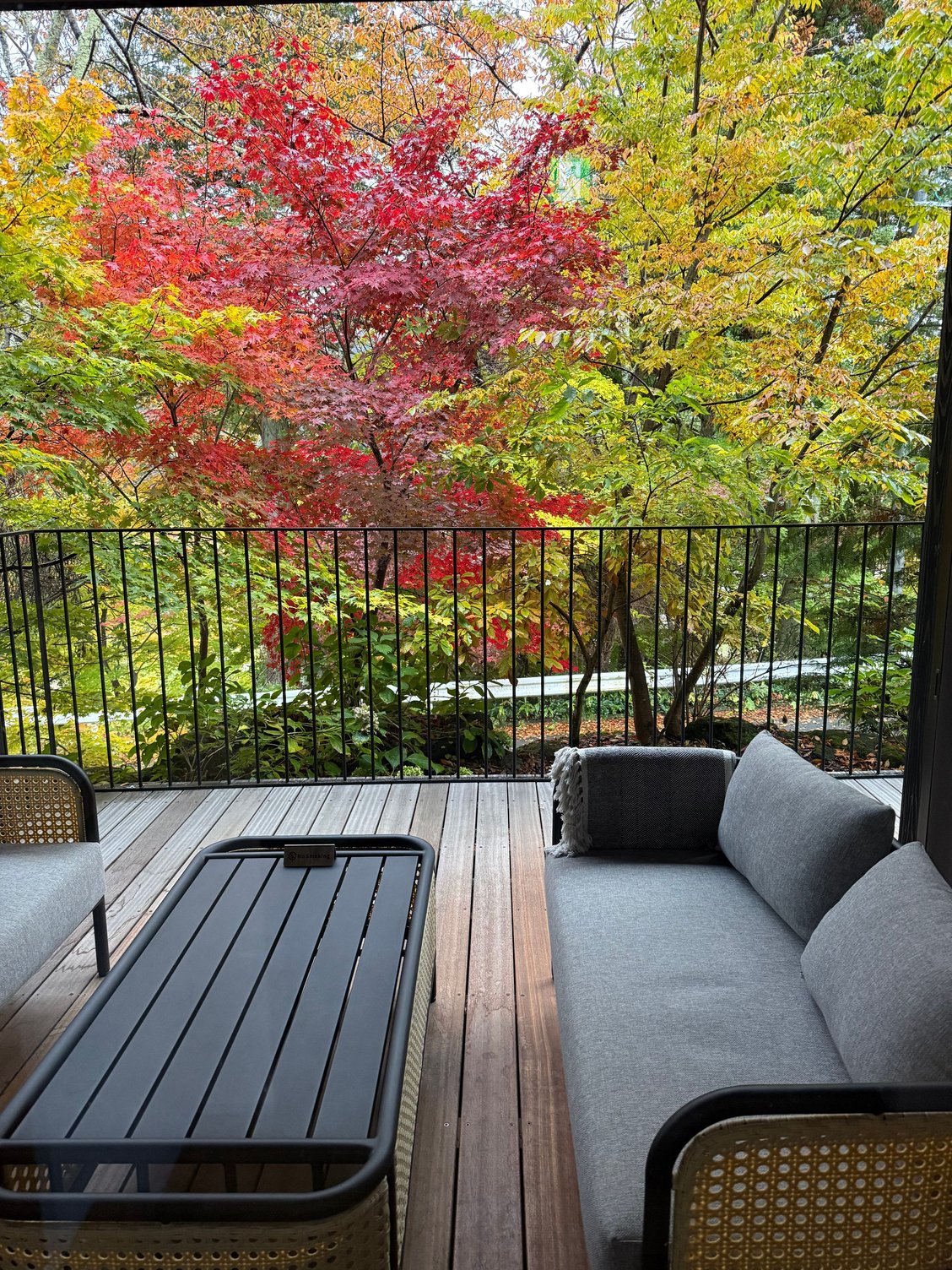
our deck sitting area, unfortunately it was too chilly and intermittently rainy to sit outside
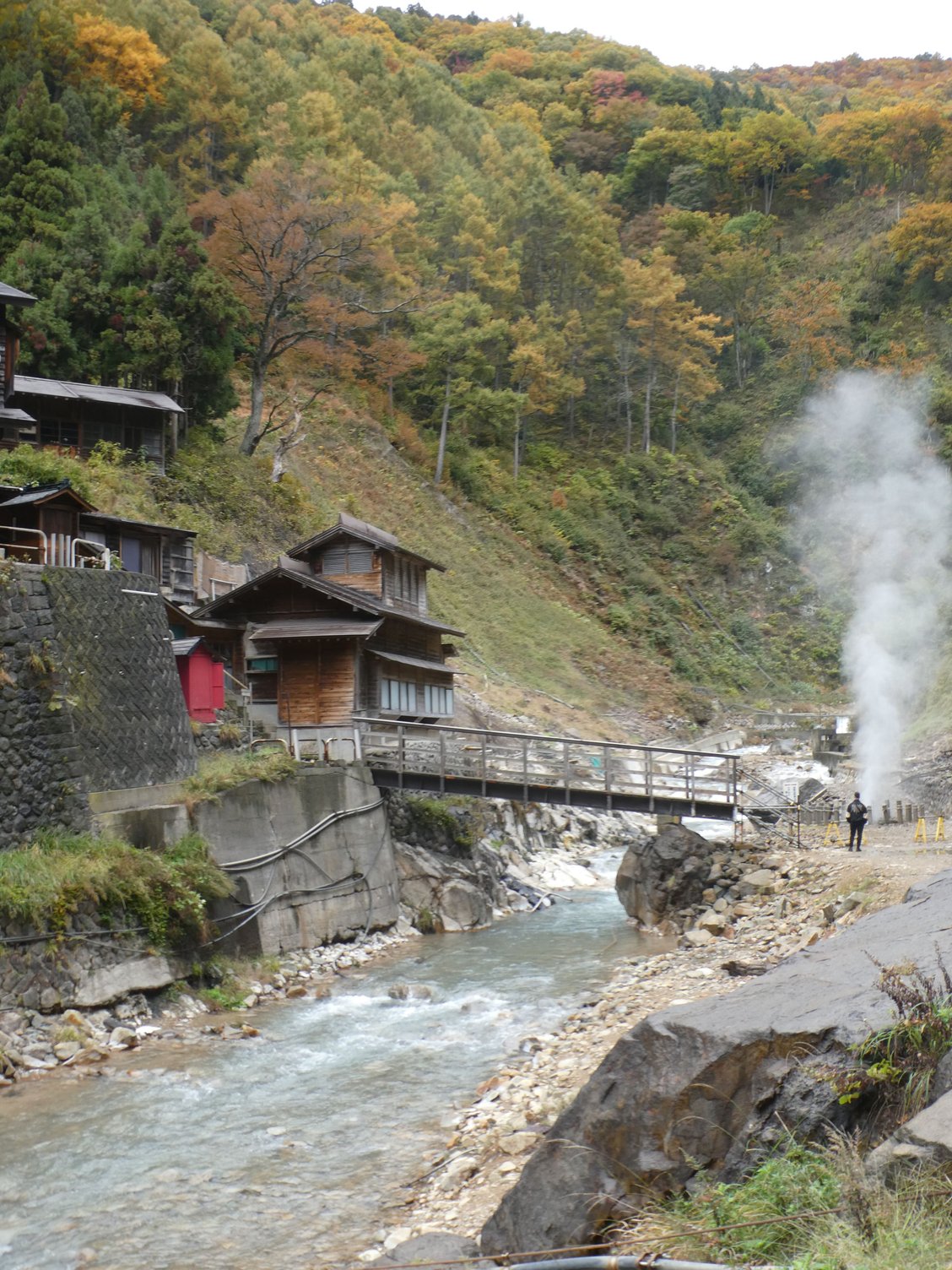
getting close to the Snow Monkey Park entrance, the geothermal activity really picks us
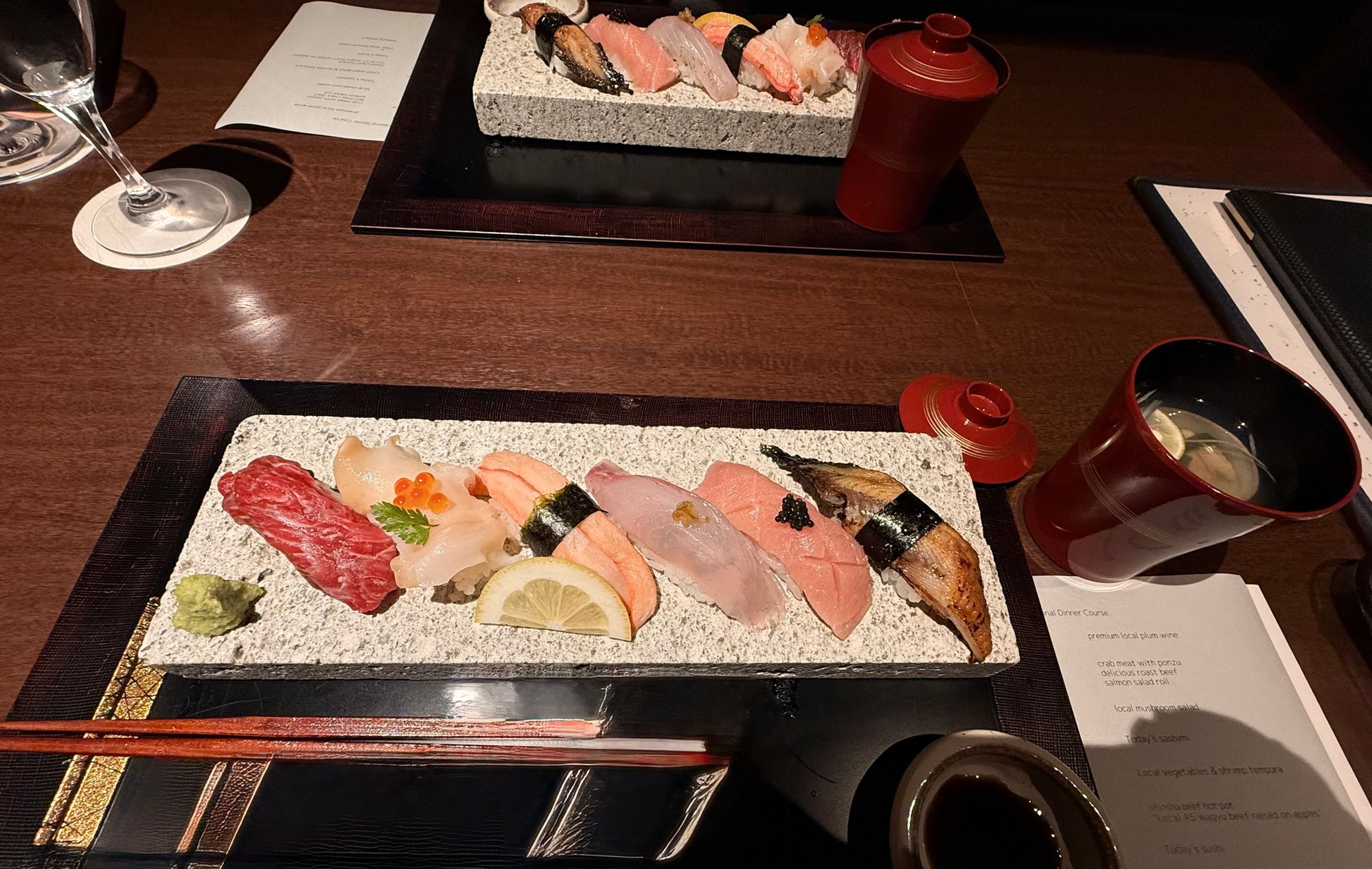
our sushi course at dinner
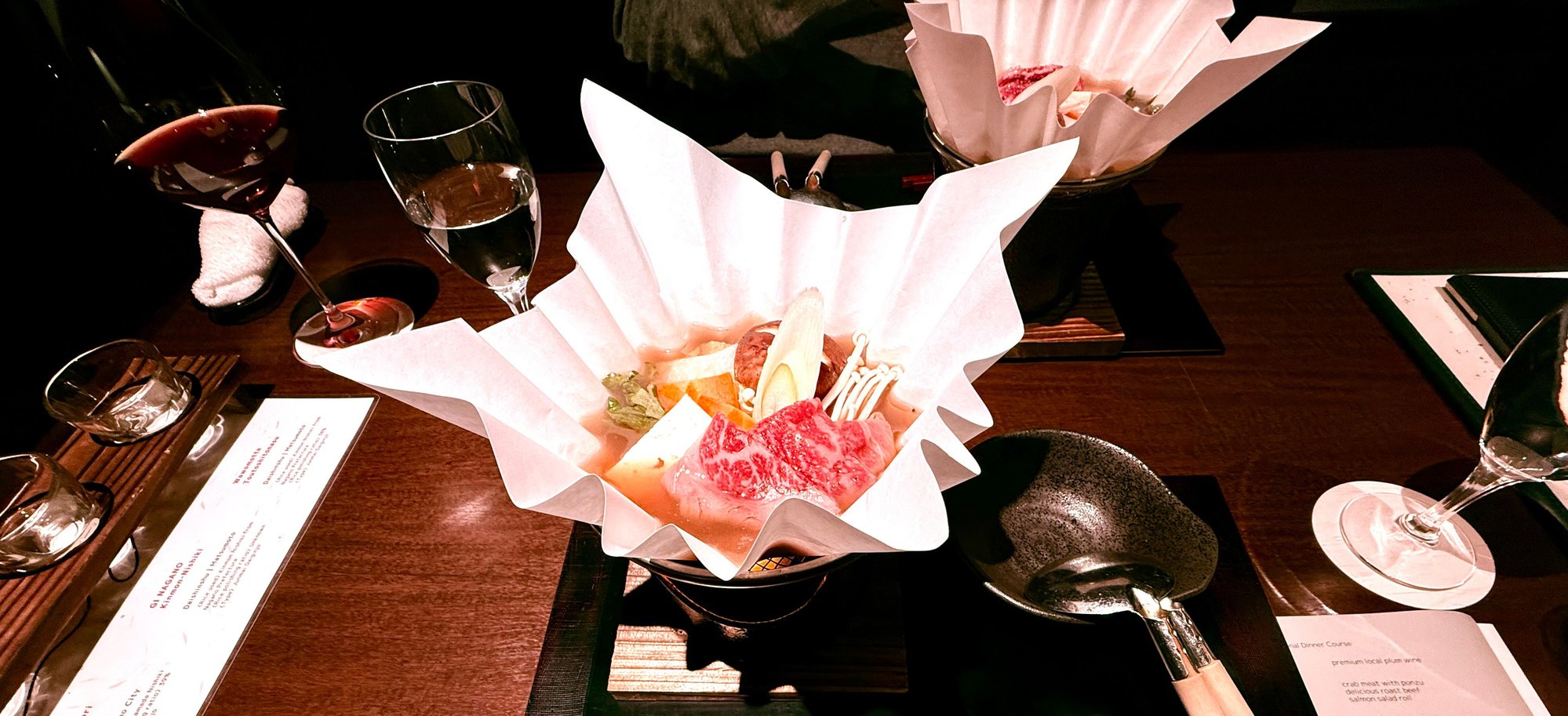
individual hot pots for each of us -- best I've ever had. there's a sterno-type heating unit in the setup, takes only a few minutes to cooke
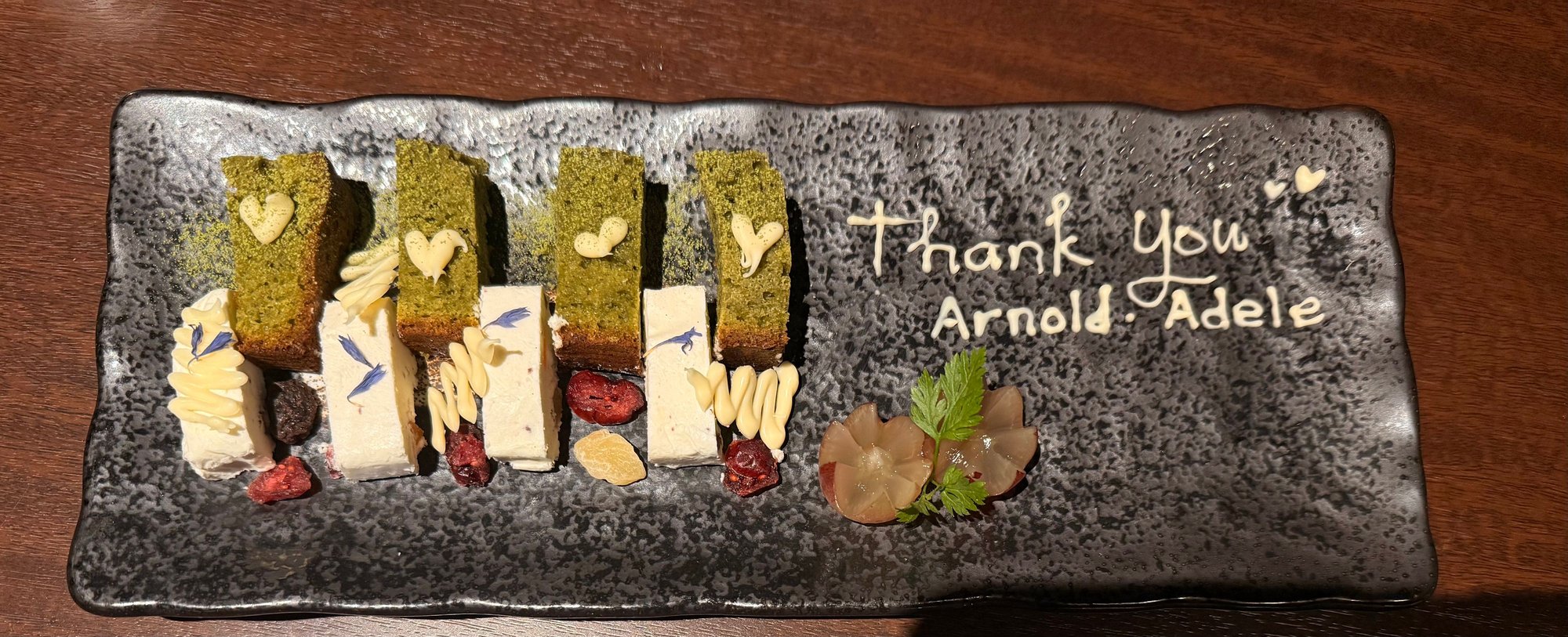
2nd night dessert plate
We were nervous about taking our first train trip, so we booked a route that didn’t involve any changes, a limited express train from Shinjuku. We also tried to leave plenty of time to get to the station and find our platform, etc. Despite having done lots of research ahead of time, and watching lots of YouTube videos, I couldn’t quite picture in my mind what it would be like………...until we actually did it. Went very smoothly, including finding a spot to buy our ekibens for lunch on the train. The train left Tokyo@noon, and arrived in Matsumoto@2:35, which was perfect timing for check in at the hotel. It also gave us a chance to visit Heian-Jingu shrine in Tokyo early in the morning, which was pretty quiet except for Shichi-Go-San celebrants taking their family photos in advance of the festival. Also got a lovely goshuin stamp!
Weather in Matsumoto was slightly drizzling and very chilly when we arrived, so we took a taxi to the Matsumoto Marunouchi Hotel. We had booked an executive room, which had a separate sitting room area, so the extra space was nice. Beds were also super comfortable and cozy, and the p.j.s were very nice. We had booked the hotel for proximity to the castle, and weren’t disappointed with the location at all, as it was an easy walk to everything. Popular with tour groups, apparently, and there is an attached banquet hall, where there were weddings over the weekend. Only negative was the breakfast: it was pretty awful, including undrinkable coffee.
Experiences
We visited the castle early in the morning, which was a good call as it got quite crowded. I was very excited to tour one of the original castles in Japan, and it did not disappoint, though it was a bit hairy climbing the steep and ladder-like steps inside, wearing only socks (carried our shoes in the provided plastic bags). It was a sunny day and the foliage simply gorgeous, so we spent a lot of time strolling around the grounds and moat. We also visited the castle park at night, to get the requisite photos and it is truly gorgeous. Still don’t understand how the castle appears dark, almost black (Crow Castle) during the day, and white at night.
Matsumoto City Museum of Art: we are fans of Yayoi Kusama’s artwork, so we visited Matsumoto City Museum of Art to see her permanent exhibit, which was very cool. There was also a special exhibit of Ishii Hakutei’s paintings, which I thought was fascinating – he had a strong influence on the art of the Nagano region, and many of the works on display were of the local countryside.
Strolling around the market and shopping streets of Matsumoto was lots of fun, crisscrossing over the river and taking in all of the sights, sounds and smells.
We had pizza one night at a fabulous Neapolitan-style place, Pizza Verde, with a real-deal pizza oven and pizzaiolo who trained in Naples. This became a theme of our trip, as we tried the pizza in several other places, wherever there was an authentic pizza oven :~). The pizza was fantastic, as was the salad we shared.
On our departure day, we were up early anyways so we took a 20-minute walk to an old school kissaten, Coffee Bigaku Abe, for a decent cup of joe and some breakfast. We just missed the first seating, so wrote our names on the list outside and waited patiently to be called in, and it was totally worth it.
Two nights was a good amount of time for us: it would have felt too rushed to get a feel for the town and see the castle in the daytime and nighttime, plus visit the museum, with a one-night stay, but after two nights, we were ready to move on.
We picked up our rental car from the Toyota outlet, and it was the #1 international car rental pickup we’ve ever had. The English-speaking representative was a very nice gentleman who had everything ready for us, and made sure we understood everything. He installed the electronic toll card (like a credit card, and the charges are settled when the car is returned) and made sure it worked. Picked up some sandwiches and cold drinks at Lawson on our way out of town, and headed out of town on a sunny day, with one last drive-by view of the castle, and admiring the snow-capped peaks in the distance.
Stopover: Obuse + Gansho-In
One of the appeals of renting a car for a drive through the Alps area as we made our way toward Kanazawa was the ability to visit some more out-of-the-way places without having to rely on public transportation schedules and having to store our bags along the way, etc. When we decided to include the northern route in our itinerary, I knew that Obuse, and the Hokusai Museum there, would be a must-see for me/us. I have long been a fan of his wood cut prints, and was very eager to see some of them in person. The small town center of Obuse is quite quaint, and the area around the museum has been developed in a lovely way, with lots of small shops celebrating (a) Chestnuts! The area is known for growing chestnuts and we were there in prime season, so lots of chestnut pastries and treats were on offer; and (b) Hokusai (obviously).
There were many tour buses in the parking area by the time we found our own spot to park nearby and figured out, with the help of a few locals, how to pay for it. The museum was crowded; the streets were crowded but overall, the experience inside the museum was manageable. There were a couple of short films to watch, very informative, and then we wandered through the galleries. It was like seeing old friends, as I had picked up a copy of Thirty-Six Views of Mt. Fuji and looked through it several times in the months leading up to the trip. Another highlight was the room with the painted festival carts that Hokusai painted. The original panels were on display, as well as replicas that were installed in carts, to show how they would have looked.
From watching one of the films, we learned that Hokusai had painted the ceiling of a nearby temple hall with a large phoenix painting, which sounded intriguing. We were already pretty tired and looking forward to checking in to our next digs, and visiting Gansho-in temple would add another 30 minutes onto our journey, but how could we not?
All I can say is that it was magical. It is out of the way, and I believe not many foreign tourists visit. The temple attendants were so nice, and made sure we had English materials to read and checked in with us a couple of times as we toured the temple. The Phoenix ceiling in the great hall was amazing. No photos allowed, but one can spend as much time as one likes observing the painting from any and every angle, including while lying on one’s back and gazing up……..the eye of the phoenix appears to be staring directly at you, no matter your perspective. There were also some exhibits of temple artifacts and local folk crafts. My favorite part was the display of the various pigments Hokusai used in the painting.
Yamanouchi
Seeing macaque monkeys (aka snow monkeys) in their natural habitat was a long-time dream of mine, from the first time I ever saw those dramatic photos of the monkeys bathing in hot springs, surrounded by snow. I knew we weren’t going to have any snow at the time of year we were visiting, but since we had decided to devote time to the Alps route, we decided to stay a couple of nights in that area, especially since we found a great-sounding small hotel with private open-air onsen baths that was only a 35-ish minute walk to the snow monkey park.
Hotarutei is hard to describe. There are only two ‘villa’ accommodations in separate buildings, each with a couple of bedrooms and bathrooms, gorgeous living room area, full kitchen (w/washer and dryer, yay!), outside seating areas and outdoor semi-sheltered onsen baths. Contemporary décor with super comfortable Western style beds and lovely toiletries from Marks & Web……..plus very soft cotton pj’s and yukatas. The main building has been a restaurant/inn for decades and decades, and was renovated by the current owners, keeping its historic style. We received a very warm welcome at check-in, set our dinner time, and settled in for rest before dinner. We had booked our stay with breakfast and dinner both nights and the food and service were top-notch. The only other diners we saw during our stay were the folks who stayed in the next-door villa our first night, so it was a private experience. The hotel manager and our server both spoke excellent English – our server was a lovely young woman from the US who studied Japanese in high school and ended up going to university in Tokyo after the pandemic, and stayed on to work and continue studying in Japan.
The kaiseki dinners were wonderful and we were encouraged to give feedback on our preferences after our first dinner so the chef could better cater to our tastes – for example, I’m not a lover of super fatty tuna, so our 2nd night’s sashimi course substituted more medium fatty tuna on my plate. Since we loved the A5 beef, our server asked if we’d like to try it in hot pot for our 2nd dinner…….and our dessert plate on 2nd night had a lovely personalized message. For breakfasts, we chose Western style one morning and Japanese the next, both excellent.
The next morning was drizzly, but we dressed appropriately and set out after breakfast, past a few small hotels and up to the wooded path to the park area. It was a lovely, mostly flat walk through the foliage and the rain mostly held off on our way there. The access road to the park entrance is a couple of kilometers before it reaches the gorge with the hot springs, and we passed a very scenic old onsen inn and some geyser activity, Alas, we did not get to see the monkeys – there were clear messages at the entrance booth that no monkeys were around, so we decided to turn around and walk back to the hotel. The monkeys tend to stay up in the mountains gathering stores for winter, and though the park wardens had been trying for a couple of weeks to encourage them to come down, no dice for us (I did keep tracking the website through the end of our trip, and still no sightings, so at least we didn’t feel like it would have been different if we had flipped our dates). The rain started coming down a bit harder on our way back, so we did get wet, but our reward at the end was a lovely soak in the onsen tub and a quiet couple of hours to read and relax. We skipped lunch, knowing we’d be having another big dinner, but we took the car out for a spin to pick up some fruit and see Yudanaka onsen, the main town on the other side of the river from where we had considered staying. It was quaint and picturesque, and while I can see the appeal of staying in a ryokan in an onsen town, where you can visit various bath houses, the secluded and private vibe is what we prefer.
A few photos from this segment of our trip:
our ekiben lunch boxes
this is my seasonal special box -- the yellow disks are chestnuts
Matsumoto Castle by day.....................
...........and Matsumoto Castle by night
favorite childhood books in the window of a shop on Frog Street
Yayoi Kusama sculptures at entrance to Matsumoto City Art Museum. photos were not allowed the indoor Kusama exhibits
requisite manhole cover shot (I could fill a whole book with these, I spent a lot of time walking while looking down!)
the real deal at Pizza Verde
entrance to museum in Obuse
the Gansho-in temple complex
our own onsen -- same hot springs water as the monkeys enjoy nearby
our deck sitting area, unfortunately it was too chilly and intermittently rainy to sit outside
getting close to the Snow Monkey Park entrance, the geothermal activity really picks us
our sushi course at dinner
individual hot pots for each of us -- best I've ever had. there's a sterno-type heating unit in the setup, takes only a few minutes to cooke
2nd night dessert plate
Trending Topics
Feb 7th, 2026 | 05:07 AM
#8
Original Poster
Joined: Jan 2003
Posts: 248
Likes: 0
Trip Report cont'd
Takayama
We had an early, but leisurely, breakfast and relaxed in the onsen tub for a bit before our final packing up and goodbyes to the lovely folks at Hotarutei. The driving distance between Yamanouchi and Takayama is roughly 3 hours, and included some backtracking towards Matsumoto to get onto the highway. It would have been more efficient to reverse the order of our Matsumoto and Yamanouchi stays, but the hotel in Matsumoto would have been fully booked on those dates (weddings). Overall, it was totally worth it to us to have to do a bit more driving – the roads are in excellent condition and the scenery was just spectacular.
Our digs for the next two nights, an Airbnb rental just outside the main touristy part of the old town, was ready for early afternoon check-in. Communication with the owner via WhatsApp, was excellent, and after finding our parking spot, we climbed the stairs and walkway (clearly described in the listing) to a neat, clean well-built home. It was a bit bare bones, and with the chilly weather it was hard to keep the bedrooms warm enough unless we kept the wood stove going -- not my husband’s favorite kind of stay, and he wasn’t feeling great to begin with. But we did love the area, and the traditional style house was not totally lacking in charm.
We hadn’t made restaurant reservations ahead of time, hoping we’d find enough choices nearby and be able to walk-in somewhere, but this proved harder than we anticipated. The ramen place across the street from us was closed our first night, so we decided to go for pizza (again!) at a recommended place that had a Neapolitan pizza oven, Hiranograno. But the owner waved us away when we popped our heads in, even though there appeared to be room. Same thing happened at a tonkatsu place, despite it being an hour before their closing time. By that time, it was after 8:00 and we were hungry, tired, a bit cranky and my husband was crashing. We finally found a large-ish yakiniku place that was willing to seat us, and enjoyed some fantastic Hida beef and nice cold beers. Restaurants, especially small ones, expect to close on time, and once they’ve reached capacity where they can serve their customers and still close the restaurant at the designated time, they stop accepting diners. I especially get it for the pizzeria, where only one or two pies can fit in the oven at a time. Very different from the States, where most places want to maximize the number of covers and will accept diners right up until kitchen closing time. We did not take this as an anti-foreign tourist thing, as there were foreigners in all of these places.
Experiences
Riverside walks to the morning markets and main shopping street, about 15 minutes away, were delightful and over the course of our stay we did it multiple times. Lots of quaint buildings and trees with designated special status to admire and enjoy along the way. We visited Takayama Jinya, the old government house, at opening time and it was quite informative and interesting, with good explanations of the purpose of the rooms, the history of Takayama and the antique artifacts. We strolled along the market street, watched some mini tayaki being made and sampled a few flavors. We also did part of the Higashiyama Walking Course, visiting a few of the temples and climbing up through the cemetery route. It was peaceful and the views out over the town and the mountains beyond made it worth the climb.
On our early walk along the main town thoroughfare, on our way to another attempt to have pizza at Hiranograno (this time for lunch, and we weren’t turned away!), we passed a restaurant that looked charming, the French bistro Le Midi, and we inquired about dinner reservations: score!! Turns out to have been a smart decision, as when we arrived in the evening, there was a sign outside, saying they were fully booked and closed to walk-ins. Both lunch and dinner were spot on: excellent pizza with just the right kind of crust, and cold beer, followed by a dinner of salad, melt-in-your-mouth A5 Takayama beef and a bottle of Cotes du Rhone :~).
Next morning we got an early start to our day with delicious coffee at stand along the market street, accompanied by sublime pastries from the neighboring stall, Andersen bakery. We shared chocolate and red bean croissants, both incredible.
We had thought about visiting either Hida Folk Village or Shirakawa-go, both of which are outdoor village type museums, but ultimately decided to skip them. We were far more interested in seeing the Mayan-style architecture of the Hikaru Museum and the special ‘Thirty-Six Views of Mt Fuji’ exhibition, which is a bit of a misnomer, since they also include Hokusai’s additional ten views, so 46 in total :~).
The museum is about 15 minutes outside of town. We pretty much had the place to ourselves, and the architecture and modern design inside was impressive. The exhibit did not disappoint, we were totally engrossed by the prints, even though we had seen many of them at the Hokusai museum a few days earlier. The museum also has a few holdings of Western art, including a lovely Pissarro, ‘Apple Harvest’.
Kanazawa
We were aiming to return the rental car at approximately 1:30, however due to an error on the part of our navigator (yours truly), we missed the ramp to one of our exits and spent an extra 20 minutes driving on stunning roads and driving through very long tunnels. In my defense, it was a tricky spot with lots of curves and there was a slight delay in seeing on the GPS screen whether we were on the correct road……….and no other exits for several miles. Drop-off at the Toyota counter near Kanazwa Station was a breeze, and our hotel manager picked us up right outside.
Hotel 101 is actually a single, large, beautifully appointed adjacent to a modern café, with a separate entrance on the side street. The corner lot and next-door building is sort of a compound: there’s the café that serves amazing coffee and pastries, an Italian restaurant, Origo, that operates in the back of the same space, the hotel, and a floral shop next door. There is an interior garden, with a small pond feature, that is visible from the private room at the back of the café (where we had breakfast), as well as from the bathroom in the hotel and the 2nd floor balcony seating area. The restaurant was closed while we were there, as the team was participating in a special event in Taiwan……. after having the incredible breakfasts in, we were disappointed that we missed out on having their dinners.
On the second floor a large sitting area with comfy sectional sofa, console table and good lighting, another large-ish tatami room that would have been perfect for yoga if I had been motivated, a large bedroom with very comfortable platform beds, a small open air sitting area with small table and chairs, ample storage for clothes, a lavatory, and set up for hot beverages and a microwave. On the ground level downstairs was an entryway and lovely bathroom with a tub overlooking the garden. Excellent pj’s :~).
The location ended up being perfect for us – about a 15–30-minute walk to most of the sights, and far enough away from the hustle and bustle, in a quiet neighborhood.
Experiences
We arranged for a tour with one of the Kanazawa Goodwill Guides for our first morning in Kanazawa, and our guide was a lovely woman named Mitsue, who was roughly the same age as me. She had spent time in the States studying when she was younger, and caring for grandchildren more recently, and wanted to keep up with her English. Turns out, she had also worked at one time at the elementary school close to the hotel! We set a plan for our morning together: visiting the Samurai district, the Kanazawa Castle area and garden, and Kenrokuen Garden. We took a bus to the Samurai district, which was super helpful because she taught us the proper etiquette for boarding, paying our fare and getting off the bus. The rest of the day we walked, which thrilled Mitsue because she is a runner, swimmer and super active.
Samurai district: not sure what I was expecting, but it was a nice area to walk through, and we stopped at a few of the houses that were open for visits, trying to steer clear of the really crowded ones and the ones which charged admission. Wouldn’t call this area a destination, but on a lovely day it was a good place to start our tour and close to other things we wanted to see.
Oyama Shrine: lovely shrine with impressive gate and a small water garden and sculptures. We visited on the walk from the Samurai district over to the Kenrokuen gardens. Peaceful place to take a short break, got a nice goshuin stamp here as well
Kanazawa Castle grounds: we walked through the castle grounds to reach Kenrokuen garden, and got some wonderful views of the castle garden in the process (no one was allowed to stroll in the garden as there were some major repairs being done to a retaining wall). The castle grounds also used to be the site of Kanazawa University, which our guide attended, so she was really familiar with the many paths to reach Kenrokuen. We didn’t tour the inside of the castle.
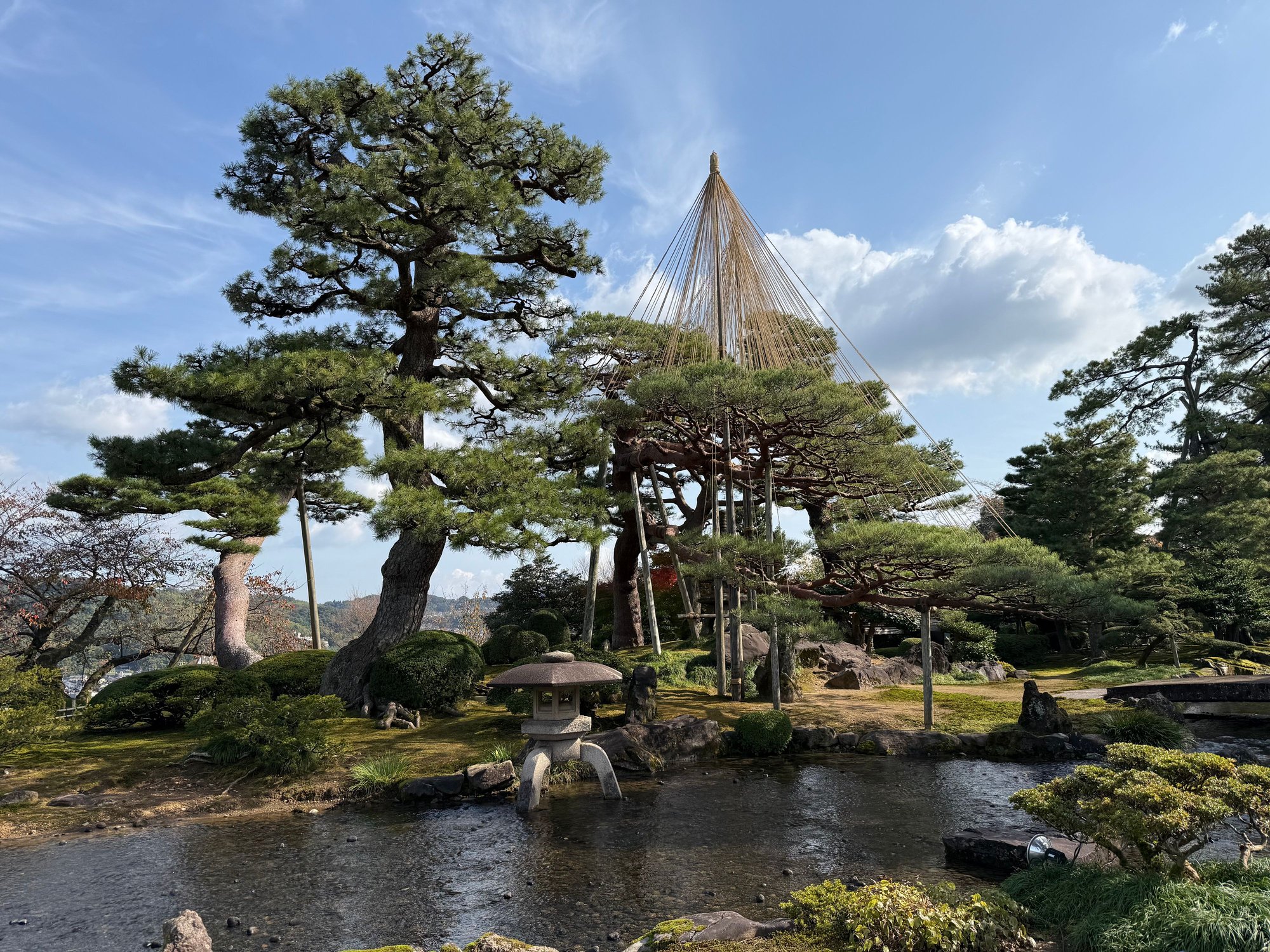
Kenrokuen: we visited the garden twice during our time in Kanazawa, once during the morning with our guide, and then a couple of nights later, when the garden was illuminated. There were lots of folks in the garden both times, but we managed to find paths and viewing spots that weren’t crowded to the point of discomfort, which made it more tolerable. During the daytime visit, we were lucky to see the master gardeners preparing trees for the winter, with supports and ropes, a process called yukizuri. This was fascinating to watch, and we really enjoyed coming back in the evening to see these same trees illuminated. Our guide told us there are approximately 800 trees and shrubs that they have to protect every winter.
Higashi Chaya district: the tea and entertainment district was an easy 20-minute walk from our hotel, and we visited one morning after breakfast, getting there before it was super crowded. The Shima House, converted into a museum, was fascinating and very well curated. The rooms are beautifully presented, with displays of traditional instruments and utensils, excellent descriptions of the objects and the overall role of entertainment houses, an interior courtyard garden and the possibility of enjoying a cup of tea (we did not indulge). There are many shrines in the district – we visited Utasu, which is small but lovely, with a picturesque stairway approach.
Gold Leaf Museum: Kanazawa was and is the center of gold leaf production in Japan, and this small museum dedicated to its history and showcasing exquisite examples of gold leaf in the arts, was fascinating. One of my disappointments of the trip was not being able to fit in a workshop on working with gold leaf.
D.T. Suzuki Museum: visited here on my own one afternoon after lunch, while my husband returned to the hotel for a rest. Gorgeous contemporary building next to a small but magnificent garden, Shofukaku. I am not well versed in Zen philosophy but couldn’t help feeling moved by my visit. The inside of the museum tells the story of Suzuki’s life, but the big draw is the building, the reflecting pool and the nearby grounds. It was about a 30-minute walk from the restaurant to the museum, and then about 45 minutes to walk back to the hotel.
Meals: our hotel manager, Ryoko, was super helpful with getting us dinner and lunch reservations, and we booked one dinner on our own directly with the restaurant (a Neapolitan pizza place, no surprise there!).
Fuwari was a great modern izakaya, specializing in seafood. We sat at the counter and probably 90% of the patrons were tourists……like us. Fabulous meal, cosmopolitan vibe.
Sasami 333 is a small yakitori place close to the hotel. Limited seating, local vibe, sat at counter and kind of ordered as we went along – excellent yakitori, crisp cold beer, young and helpful staff of 2.
Sushi Haru: we opted for an omakase sushi lunch rather than dinner, as there was a smaller menu option of 10 dishes. Small, counter only seating, chef and server had limited English but were very warm and welcoming to us. Fantastic straightforward sushi, paced very well. Don’t remember exactly how much it cost, but we felt it was good value.
Perche: not sure how I found this Neapolitan pizza place, perhaps Instagram, but we booked a late-ish dinner on the day we enjoyed our sushi lunch. Excellent Caprese salad and again, a real-deal pizza. The chef/owner/pizzaiola had recently returned from a working trip to Italy. Imported Italian beer (Moretti for me) as well.
Including just a few photos, as many of them are too large to uplaod:
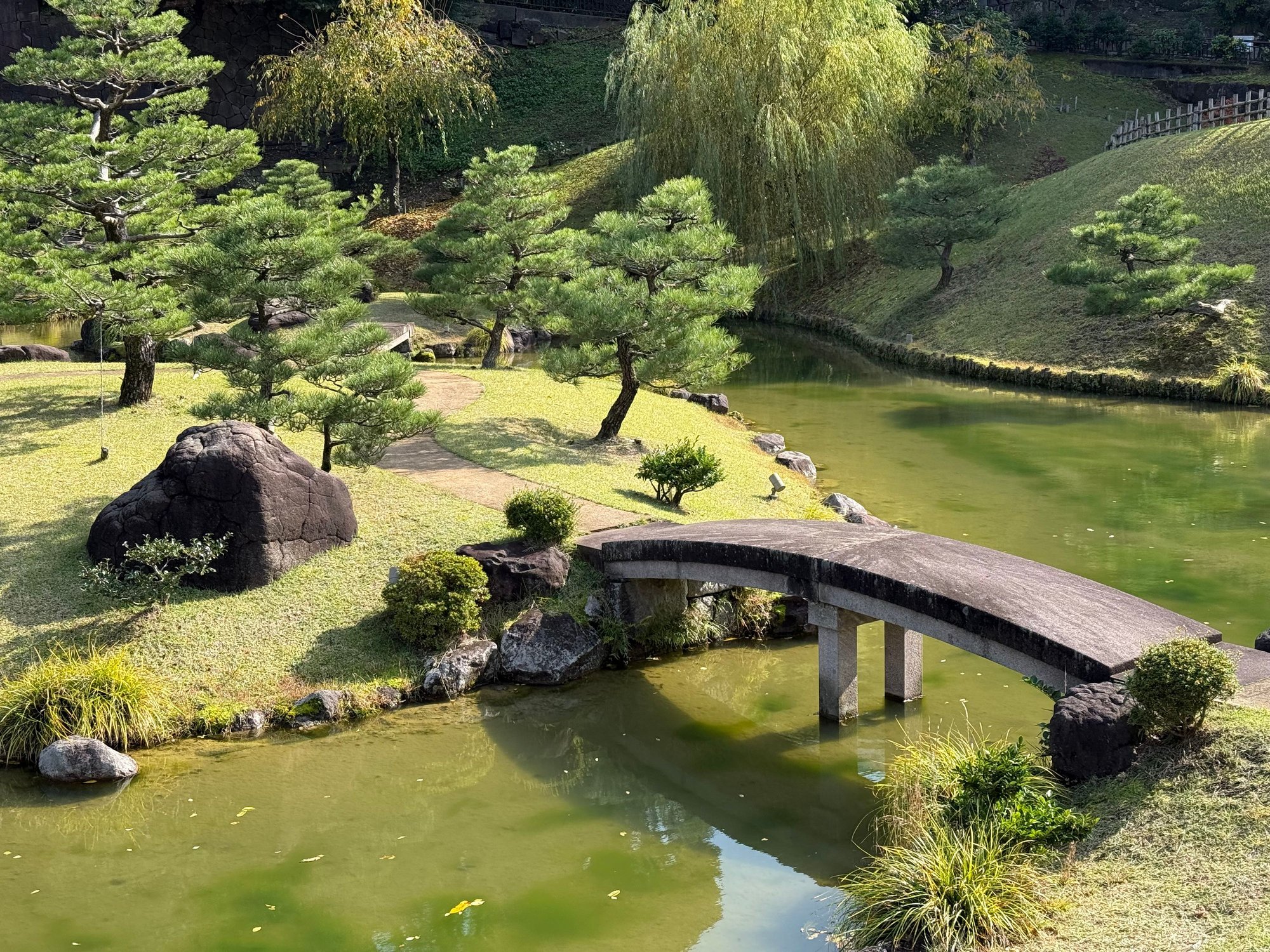
overlooking Kanazawa castle garden

the famous stone lantern at Kenrokuen (notice the uneven leg lengths)
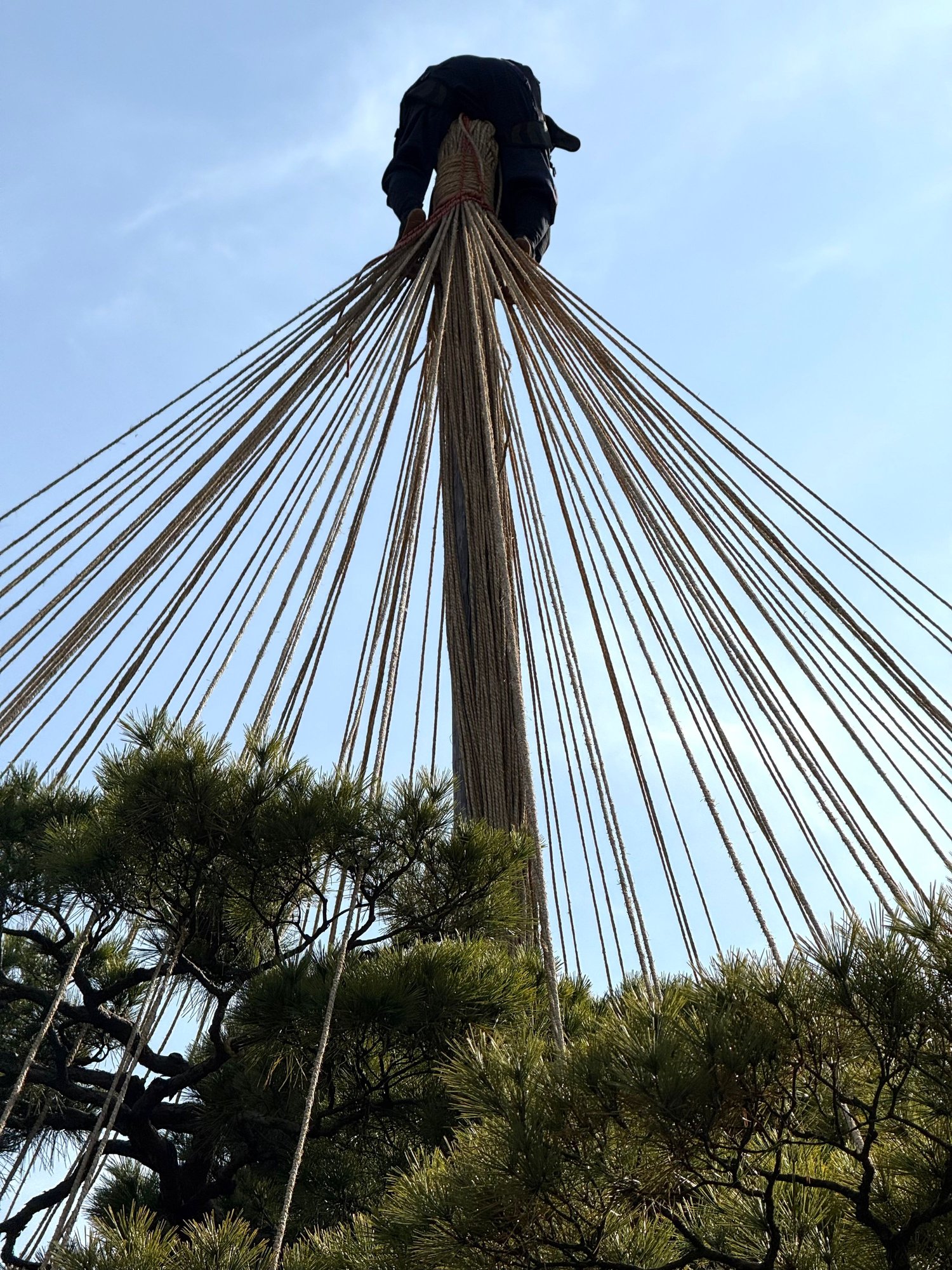
preparing the trees for winter
simply stunning
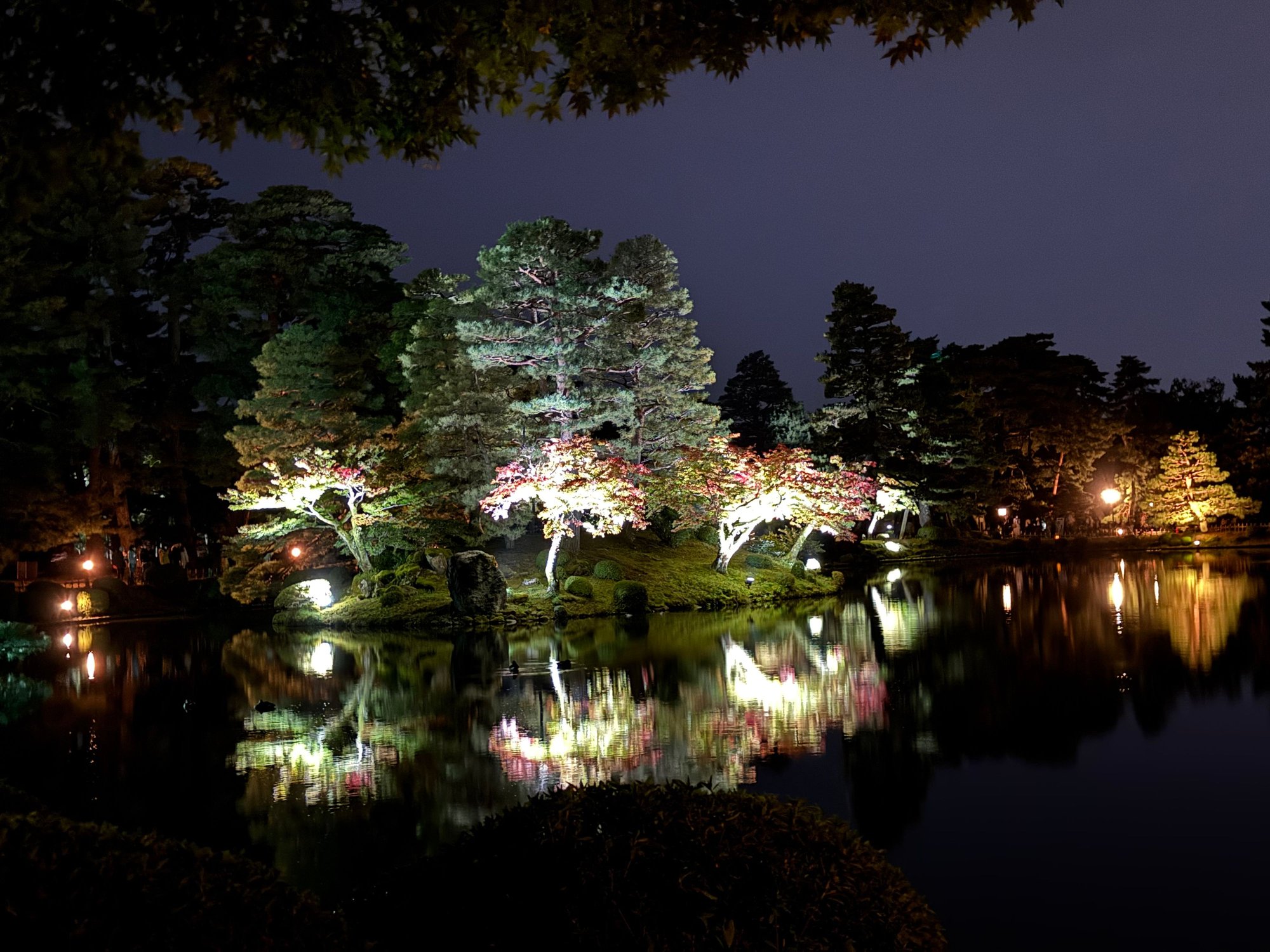
Kenrokuen during illumination evening
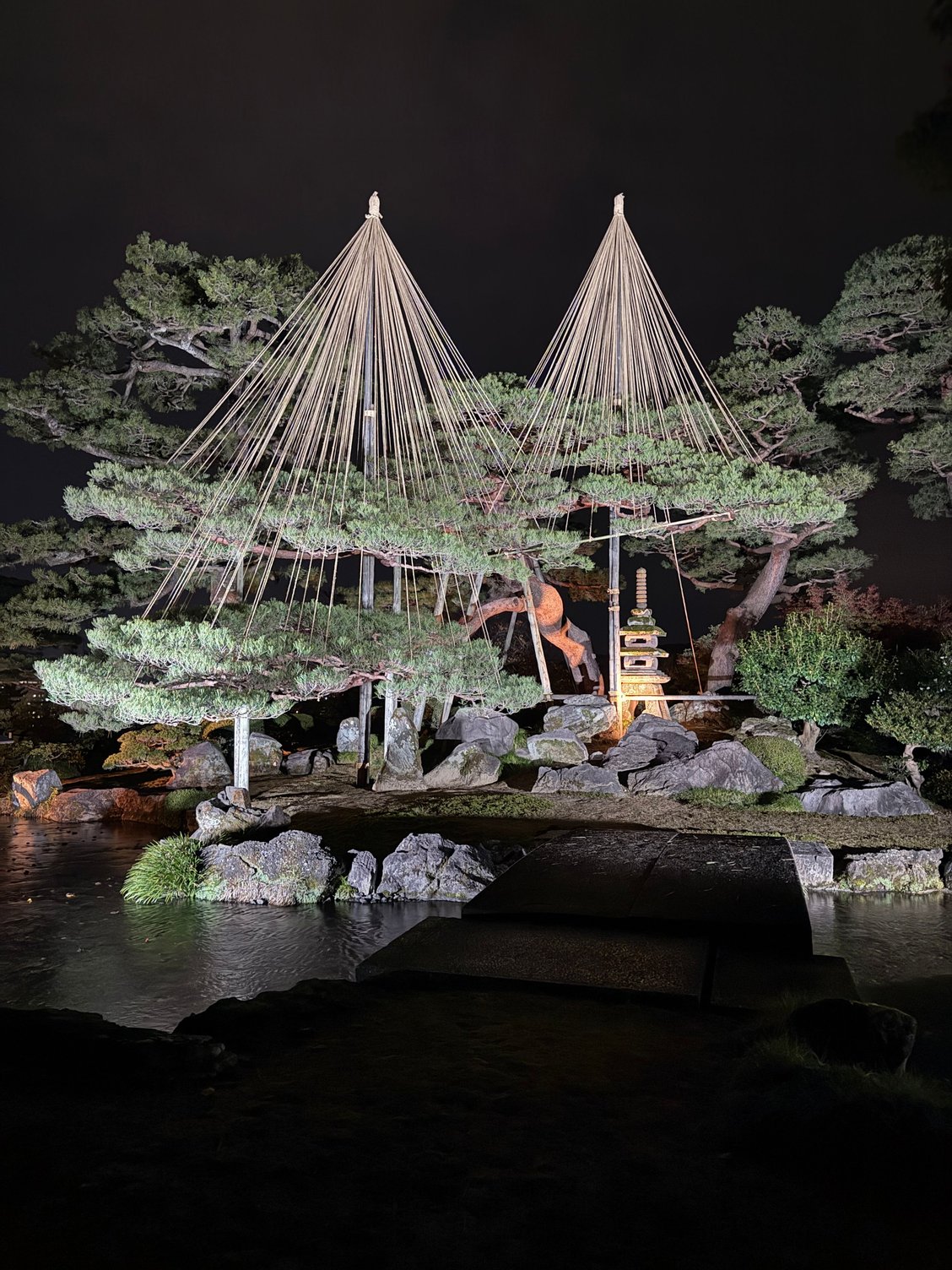
another night time view
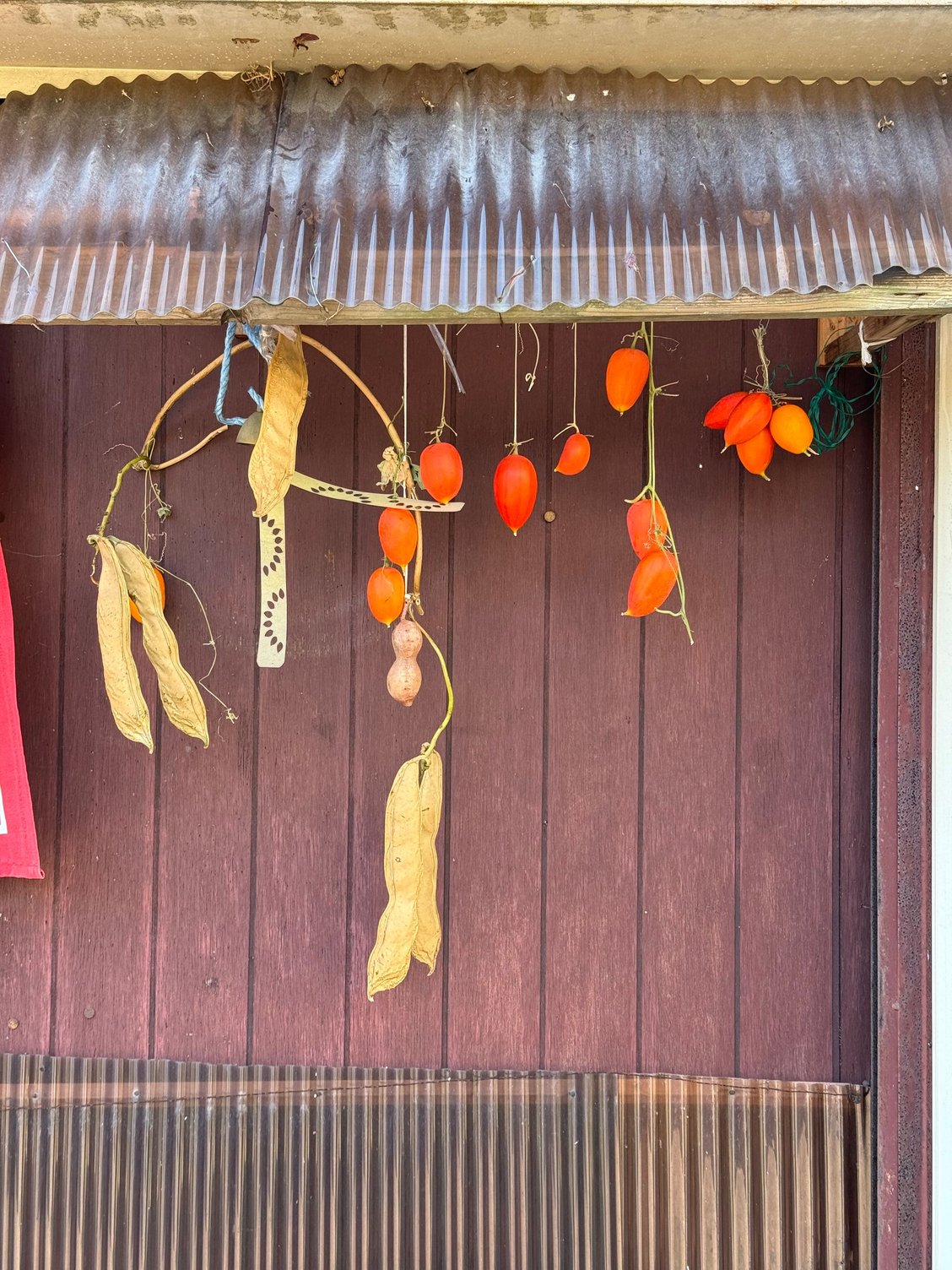
drawn to drying persimmons

self-reflection at D.T. Suzuki museum
We had an early, but leisurely, breakfast and relaxed in the onsen tub for a bit before our final packing up and goodbyes to the lovely folks at Hotarutei. The driving distance between Yamanouchi and Takayama is roughly 3 hours, and included some backtracking towards Matsumoto to get onto the highway. It would have been more efficient to reverse the order of our Matsumoto and Yamanouchi stays, but the hotel in Matsumoto would have been fully booked on those dates (weddings). Overall, it was totally worth it to us to have to do a bit more driving – the roads are in excellent condition and the scenery was just spectacular.
Our digs for the next two nights, an Airbnb rental just outside the main touristy part of the old town, was ready for early afternoon check-in. Communication with the owner via WhatsApp, was excellent, and after finding our parking spot, we climbed the stairs and walkway (clearly described in the listing) to a neat, clean well-built home. It was a bit bare bones, and with the chilly weather it was hard to keep the bedrooms warm enough unless we kept the wood stove going -- not my husband’s favorite kind of stay, and he wasn’t feeling great to begin with. But we did love the area, and the traditional style house was not totally lacking in charm.
We hadn’t made restaurant reservations ahead of time, hoping we’d find enough choices nearby and be able to walk-in somewhere, but this proved harder than we anticipated. The ramen place across the street from us was closed our first night, so we decided to go for pizza (again!) at a recommended place that had a Neapolitan pizza oven, Hiranograno. But the owner waved us away when we popped our heads in, even though there appeared to be room. Same thing happened at a tonkatsu place, despite it being an hour before their closing time. By that time, it was after 8:00 and we were hungry, tired, a bit cranky and my husband was crashing. We finally found a large-ish yakiniku place that was willing to seat us, and enjoyed some fantastic Hida beef and nice cold beers. Restaurants, especially small ones, expect to close on time, and once they’ve reached capacity where they can serve their customers and still close the restaurant at the designated time, they stop accepting diners. I especially get it for the pizzeria, where only one or two pies can fit in the oven at a time. Very different from the States, where most places want to maximize the number of covers and will accept diners right up until kitchen closing time. We did not take this as an anti-foreign tourist thing, as there were foreigners in all of these places.
Experiences
Riverside walks to the morning markets and main shopping street, about 15 minutes away, were delightful and over the course of our stay we did it multiple times. Lots of quaint buildings and trees with designated special status to admire and enjoy along the way. We visited Takayama Jinya, the old government house, at opening time and it was quite informative and interesting, with good explanations of the purpose of the rooms, the history of Takayama and the antique artifacts. We strolled along the market street, watched some mini tayaki being made and sampled a few flavors. We also did part of the Higashiyama Walking Course, visiting a few of the temples and climbing up through the cemetery route. It was peaceful and the views out over the town and the mountains beyond made it worth the climb.
On our early walk along the main town thoroughfare, on our way to another attempt to have pizza at Hiranograno (this time for lunch, and we weren’t turned away!), we passed a restaurant that looked charming, the French bistro Le Midi, and we inquired about dinner reservations: score!! Turns out to have been a smart decision, as when we arrived in the evening, there was a sign outside, saying they were fully booked and closed to walk-ins. Both lunch and dinner were spot on: excellent pizza with just the right kind of crust, and cold beer, followed by a dinner of salad, melt-in-your-mouth A5 Takayama beef and a bottle of Cotes du Rhone :~).
Next morning we got an early start to our day with delicious coffee at stand along the market street, accompanied by sublime pastries from the neighboring stall, Andersen bakery. We shared chocolate and red bean croissants, both incredible.
We had thought about visiting either Hida Folk Village or Shirakawa-go, both of which are outdoor village type museums, but ultimately decided to skip them. We were far more interested in seeing the Mayan-style architecture of the Hikaru Museum and the special ‘Thirty-Six Views of Mt Fuji’ exhibition, which is a bit of a misnomer, since they also include Hokusai’s additional ten views, so 46 in total :~).
The museum is about 15 minutes outside of town. We pretty much had the place to ourselves, and the architecture and modern design inside was impressive. The exhibit did not disappoint, we were totally engrossed by the prints, even though we had seen many of them at the Hokusai museum a few days earlier. The museum also has a few holdings of Western art, including a lovely Pissarro, ‘Apple Harvest’.
Kanazawa
We were aiming to return the rental car at approximately 1:30, however due to an error on the part of our navigator (yours truly), we missed the ramp to one of our exits and spent an extra 20 minutes driving on stunning roads and driving through very long tunnels. In my defense, it was a tricky spot with lots of curves and there was a slight delay in seeing on the GPS screen whether we were on the correct road……….and no other exits for several miles. Drop-off at the Toyota counter near Kanazwa Station was a breeze, and our hotel manager picked us up right outside.
Hotel 101 is actually a single, large, beautifully appointed adjacent to a modern café, with a separate entrance on the side street. The corner lot and next-door building is sort of a compound: there’s the café that serves amazing coffee and pastries, an Italian restaurant, Origo, that operates in the back of the same space, the hotel, and a floral shop next door. There is an interior garden, with a small pond feature, that is visible from the private room at the back of the café (where we had breakfast), as well as from the bathroom in the hotel and the 2nd floor balcony seating area. The restaurant was closed while we were there, as the team was participating in a special event in Taiwan……. after having the incredible breakfasts in, we were disappointed that we missed out on having their dinners.
On the second floor a large sitting area with comfy sectional sofa, console table and good lighting, another large-ish tatami room that would have been perfect for yoga if I had been motivated, a large bedroom with very comfortable platform beds, a small open air sitting area with small table and chairs, ample storage for clothes, a lavatory, and set up for hot beverages and a microwave. On the ground level downstairs was an entryway and lovely bathroom with a tub overlooking the garden. Excellent pj’s :~).
The location ended up being perfect for us – about a 15–30-minute walk to most of the sights, and far enough away from the hustle and bustle, in a quiet neighborhood.
Experiences
We arranged for a tour with one of the Kanazawa Goodwill Guides for our first morning in Kanazawa, and our guide was a lovely woman named Mitsue, who was roughly the same age as me. She had spent time in the States studying when she was younger, and caring for grandchildren more recently, and wanted to keep up with her English. Turns out, she had also worked at one time at the elementary school close to the hotel! We set a plan for our morning together: visiting the Samurai district, the Kanazawa Castle area and garden, and Kenrokuen Garden. We took a bus to the Samurai district, which was super helpful because she taught us the proper etiquette for boarding, paying our fare and getting off the bus. The rest of the day we walked, which thrilled Mitsue because she is a runner, swimmer and super active.
Samurai district: not sure what I was expecting, but it was a nice area to walk through, and we stopped at a few of the houses that were open for visits, trying to steer clear of the really crowded ones and the ones which charged admission. Wouldn’t call this area a destination, but on a lovely day it was a good place to start our tour and close to other things we wanted to see.
Oyama Shrine: lovely shrine with impressive gate and a small water garden and sculptures. We visited on the walk from the Samurai district over to the Kenrokuen gardens. Peaceful place to take a short break, got a nice goshuin stamp here as well
Kanazawa Castle grounds: we walked through the castle grounds to reach Kenrokuen garden, and got some wonderful views of the castle garden in the process (no one was allowed to stroll in the garden as there were some major repairs being done to a retaining wall). The castle grounds also used to be the site of Kanazawa University, which our guide attended, so she was really familiar with the many paths to reach Kenrokuen. We didn’t tour the inside of the castle.
Kenrokuen: we visited the garden twice during our time in Kanazawa, once during the morning with our guide, and then a couple of nights later, when the garden was illuminated. There were lots of folks in the garden both times, but we managed to find paths and viewing spots that weren’t crowded to the point of discomfort, which made it more tolerable. During the daytime visit, we were lucky to see the master gardeners preparing trees for the winter, with supports and ropes, a process called yukizuri. This was fascinating to watch, and we really enjoyed coming back in the evening to see these same trees illuminated. Our guide told us there are approximately 800 trees and shrubs that they have to protect every winter.
Higashi Chaya district: the tea and entertainment district was an easy 20-minute walk from our hotel, and we visited one morning after breakfast, getting there before it was super crowded. The Shima House, converted into a museum, was fascinating and very well curated. The rooms are beautifully presented, with displays of traditional instruments and utensils, excellent descriptions of the objects and the overall role of entertainment houses, an interior courtyard garden and the possibility of enjoying a cup of tea (we did not indulge). There are many shrines in the district – we visited Utasu, which is small but lovely, with a picturesque stairway approach.
Gold Leaf Museum: Kanazawa was and is the center of gold leaf production in Japan, and this small museum dedicated to its history and showcasing exquisite examples of gold leaf in the arts, was fascinating. One of my disappointments of the trip was not being able to fit in a workshop on working with gold leaf.
D.T. Suzuki Museum: visited here on my own one afternoon after lunch, while my husband returned to the hotel for a rest. Gorgeous contemporary building next to a small but magnificent garden, Shofukaku. I am not well versed in Zen philosophy but couldn’t help feeling moved by my visit. The inside of the museum tells the story of Suzuki’s life, but the big draw is the building, the reflecting pool and the nearby grounds. It was about a 30-minute walk from the restaurant to the museum, and then about 45 minutes to walk back to the hotel.
Meals: our hotel manager, Ryoko, was super helpful with getting us dinner and lunch reservations, and we booked one dinner on our own directly with the restaurant (a Neapolitan pizza place, no surprise there!).
Fuwari was a great modern izakaya, specializing in seafood. We sat at the counter and probably 90% of the patrons were tourists……like us. Fabulous meal, cosmopolitan vibe.
Sasami 333 is a small yakitori place close to the hotel. Limited seating, local vibe, sat at counter and kind of ordered as we went along – excellent yakitori, crisp cold beer, young and helpful staff of 2.
Sushi Haru: we opted for an omakase sushi lunch rather than dinner, as there was a smaller menu option of 10 dishes. Small, counter only seating, chef and server had limited English but were very warm and welcoming to us. Fantastic straightforward sushi, paced very well. Don’t remember exactly how much it cost, but we felt it was good value.
Perche: not sure how I found this Neapolitan pizza place, perhaps Instagram, but we booked a late-ish dinner on the day we enjoyed our sushi lunch. Excellent Caprese salad and again, a real-deal pizza. The chef/owner/pizzaiola had recently returned from a working trip to Italy. Imported Italian beer (Moretti for me) as well.
Including just a few photos, as many of them are too large to uplaod:
overlooking Kanazawa castle garden
the famous stone lantern at Kenrokuen (notice the uneven leg lengths)
preparing the trees for winter
simply stunning
Kenrokuen during illumination evening
another night time view
drawn to drying persimmons
self-reflection at D.T. Suzuki museum
Feb 19th, 2026 | 02:00 AM
#9
Original Poster
Joined: Jan 2003
Posts: 248
Likes: 0
Apologies for slacking on finishing up our trip report. If anyone is still interested and following along, here's the next installment:Hiroshima
Ryoko dropped us off at the train station in the morning, after another glorious breakfast. We were both a little nervous about the journey, as it involved two train changes, one in Tsuruga and then a connection in Kyoto. But, we had built in enough transfer time in Kyoto to find the Shinkasen gates and our train, so all worked out well. There was more than enough space in the overhead racks for our small suitcases and backpacks, and the seats were comfortable enough. Arrival at Hiroshima station was around 3:00, so by the time we got into the taxi line and rode to the Hilton Hiroshima hotel, we were just in time to get into the check-in line.
This was our only Western, business-style hotel of the trip and we had booked early enough (and with Hilton Honors member rate) that we splurged on a premium, corner room. It was on a higher floor and had amazing views toward Hiroshima Bay, which means we got to see the sunset glow on the surrounding hills and a had a full-on sunrise view. The room was super clean, the beds were comfortable, the provided yukatas were quite nice, with hidden buttons, and the selection of teas was to my liking. We had booked for 2 nights, which turned out to be wise…as I ended up spending about 20 hours of it in bed with a bit of a bug. Not sure where I picked it up, but I had been fighting fatigue and overall congestion for several days so I was probably more susceptible. My husband and I shared the same food for dinner that first night, so it definitely wasn’t food poisoning, but let’s just say I will probably never feel like eating okonomiyaki again :~).
[img alt="view from our room at the Hiroshima Hilton: sunrise
"]https://cimg8.ibsrv.net/gimg/www.fodors.com-vbulletin/2000x1504/img_1349_29777aa0390dee4bc02adebcf847a6bb6249e8c3. jpeg[/img]
view from our room at the Hiroshima Hilton: sunrise
Experiences
We had booked early access tickets to the Peace Museum for our first morning, but I wasn’t in any shape to go out, so my husband walked over by himself, visited the museum and grounds and spent some time wandering around a bit, came back to check on me and then took himself out for a ramen lunch. Later in the day I felt well enough to go out for a stroll around the neighborhood and to get some plain rolls and a chestnut cookie for me, and he picked up a proper dinner.
Next morning we were up and at ‘em early, going down for breakfast (still very limited for me) and then we both walked back to the Peace Museum so I could see the grounds and campus. I left him on a bench opposite the A-Bomb Dome ruins and walked back to the museum entrance for the public access opening at 8:30. One of the most moving scenes of the day was the changing of the flowers at the eternal flame memorial – the grounds staff removed the previous day’s flowers and carefully placed fresh bouquets. It was all done silently and reverently and left a lasting impression.
The permanent exhibit is tough to view and in many ways I am still processing it. For both of us, it was an important site on our itinerary.
The Hilton has a noon checkout time, which meant we had plenty of time to stroll back towards the hotel, and we stopped at Andersen Bakery in Hondori for a mid-morning coffee and pastry and decided to also pick up something to have for lunch on our journey to Miyajima. It felt really good to be in the fresh air, and walking through the shopping arcade as things were just starting to open up. Final packing and checkout were a breeze, and we returned to the station to continue our journey.
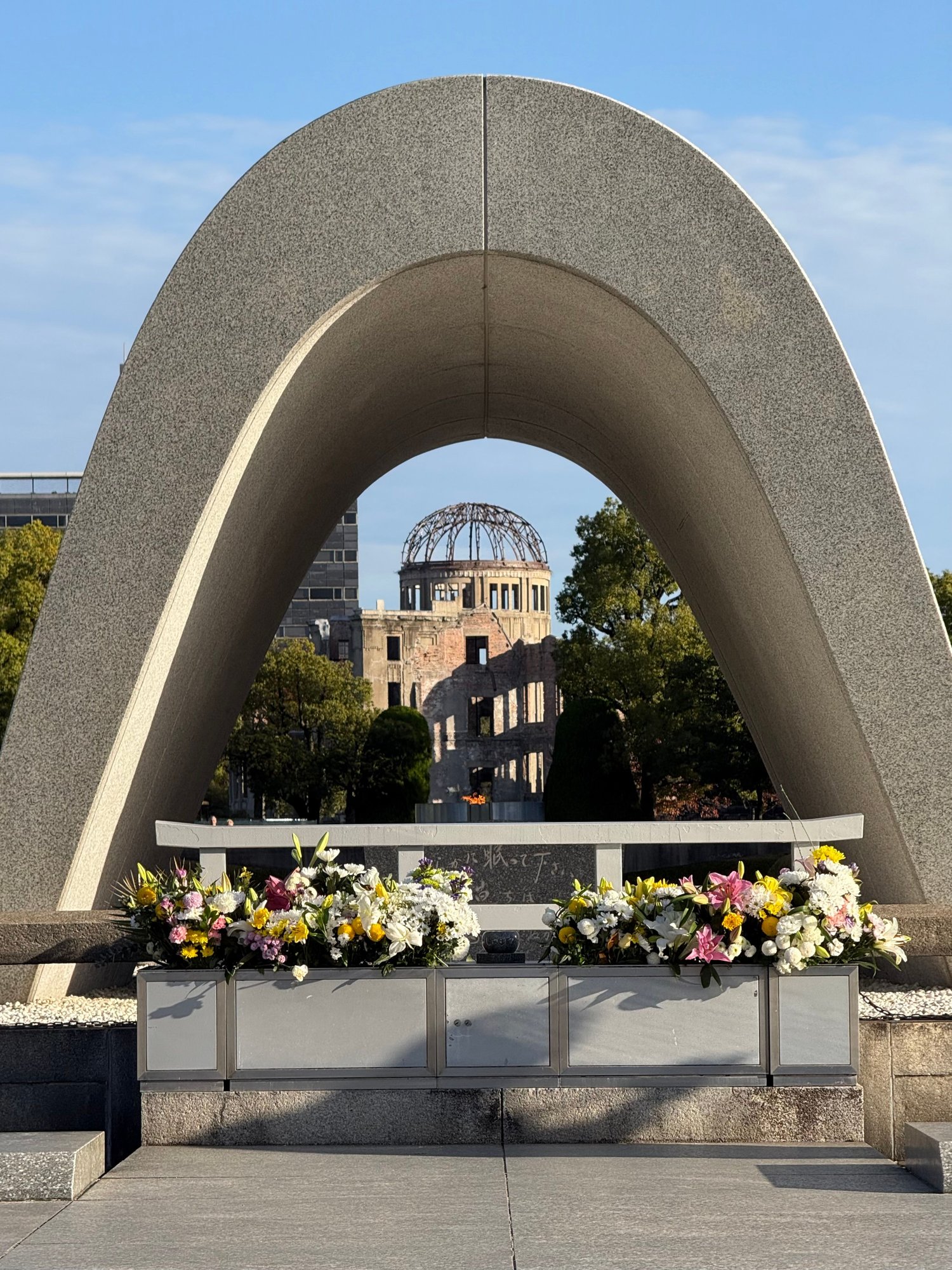
view of the Atomic dome and flower offerings
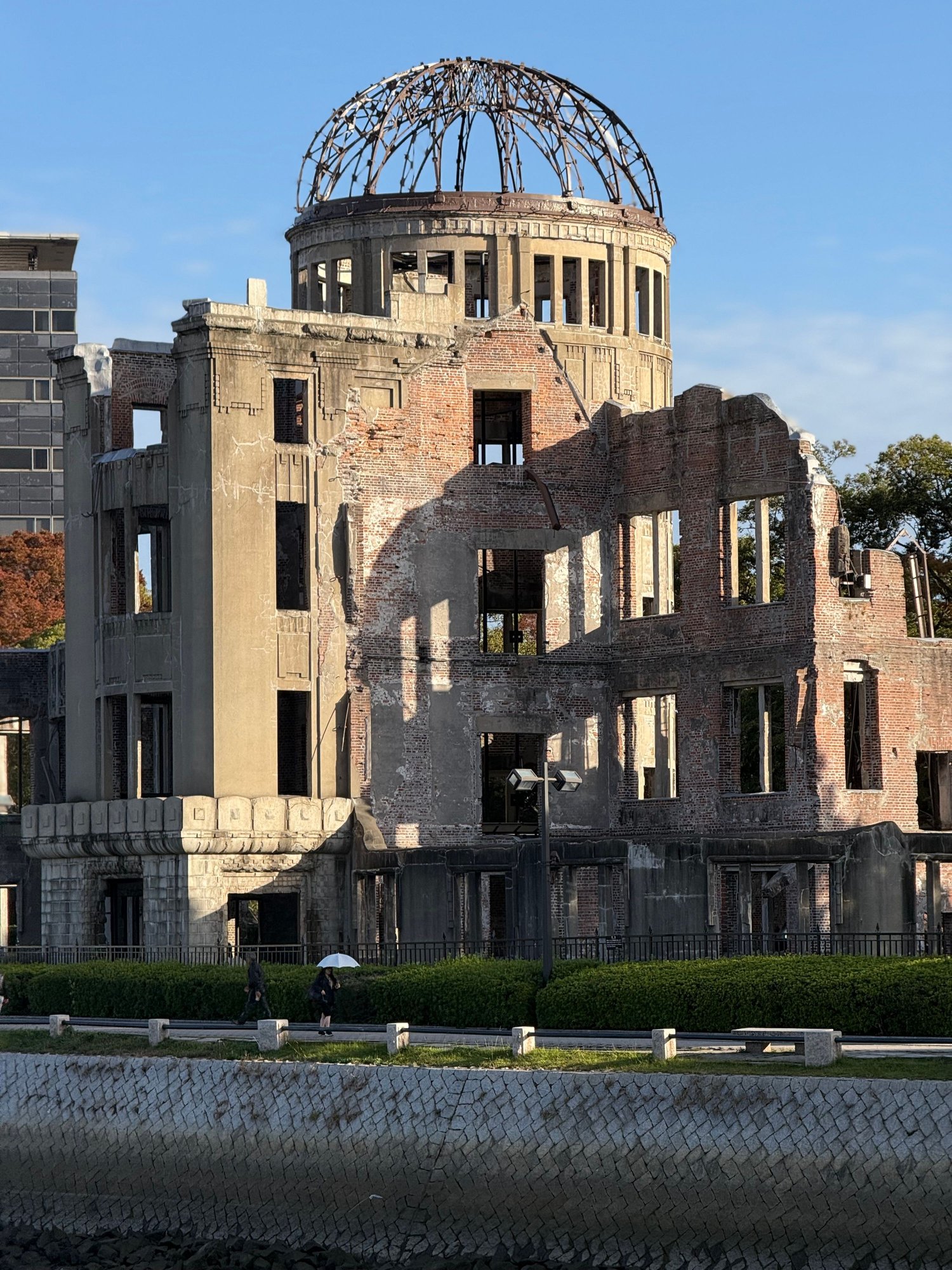
view from across the river toward dome
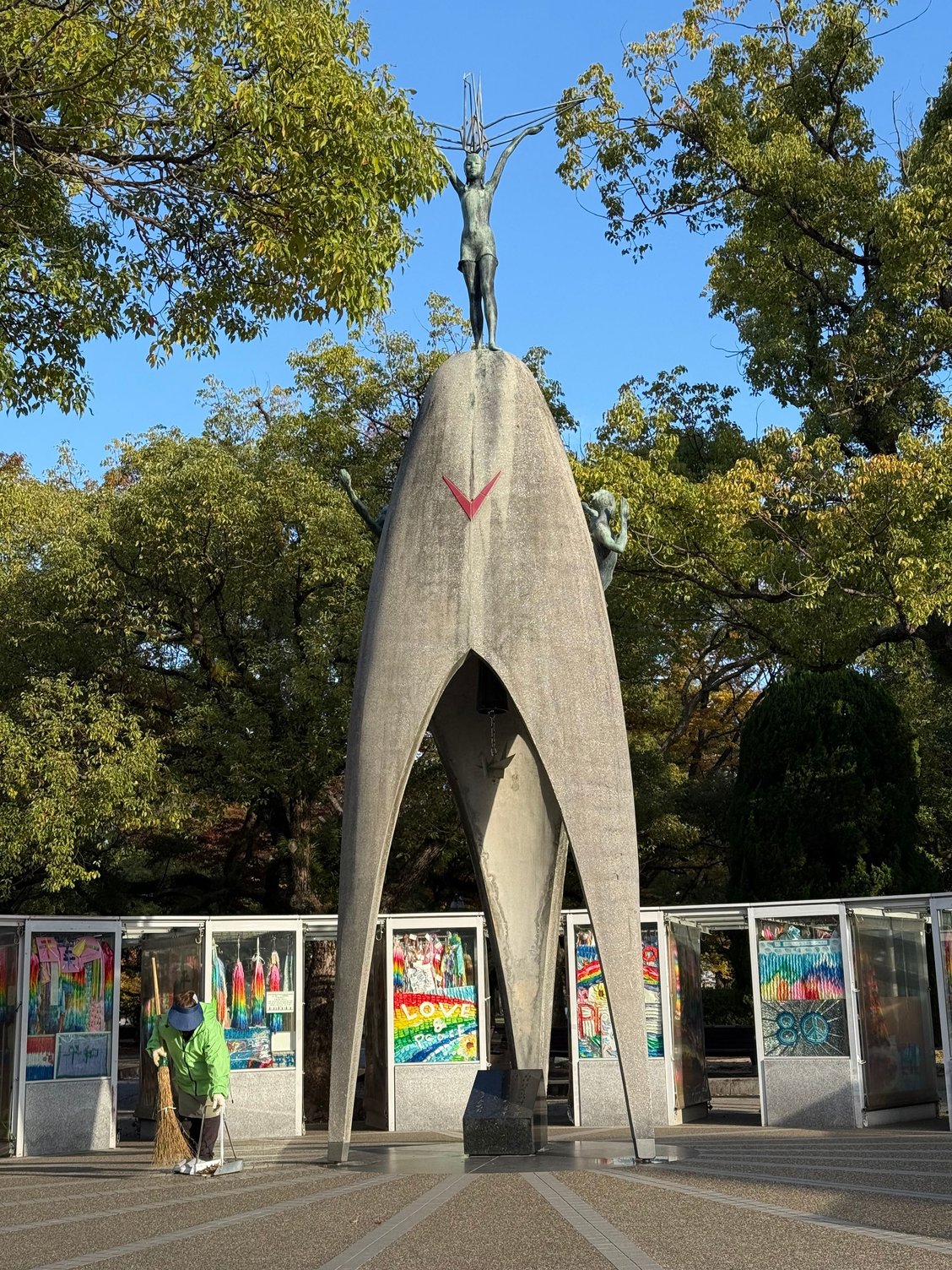
one of the moving sculptures on the Peace Museum campus
Miyajima
Getting to Miyajima turned out to be far less complicated than it seemed from both Google maps and Japan-Guide. For me it’s always a challenge to visualize things when I read the words, but one I see it, everything makes sense. We took the JR West Sanyo line to Miyajimaguchi Station, then followed the signs to exit and walk to the Miyajima Ferry – we used our IC cards for both the train and the ferry and it couldn’t have been easier. There’s a JR Ferry and another company’s ferry at the wharf and both accept IC cards, so one can simply take whichever one is there and leaving first. It was a quick ride over to the island, which great views back toward Hiroshima Port and the surrounding hills, and ahead toward Miyajima and the other islands. We passed lots of oyster beds as well.
We booked Auberge Watanabe based on good reviews and having read about it from other Fodorites’ trip reports. They had directed us to go to the information desk and have them ring the inn, and we waited about 15-20 minutes for them to pick us up, during which time we ate our lunch outside and watched the throngs of people arriving. Although we couldn’t check in until 3:00 we had some tea and lovely maple-leaf-themed treats, and the lovely owner gave us some maps and information, and then we set out to explore a bit before we could return to the inn and crash for a bit before dinner.
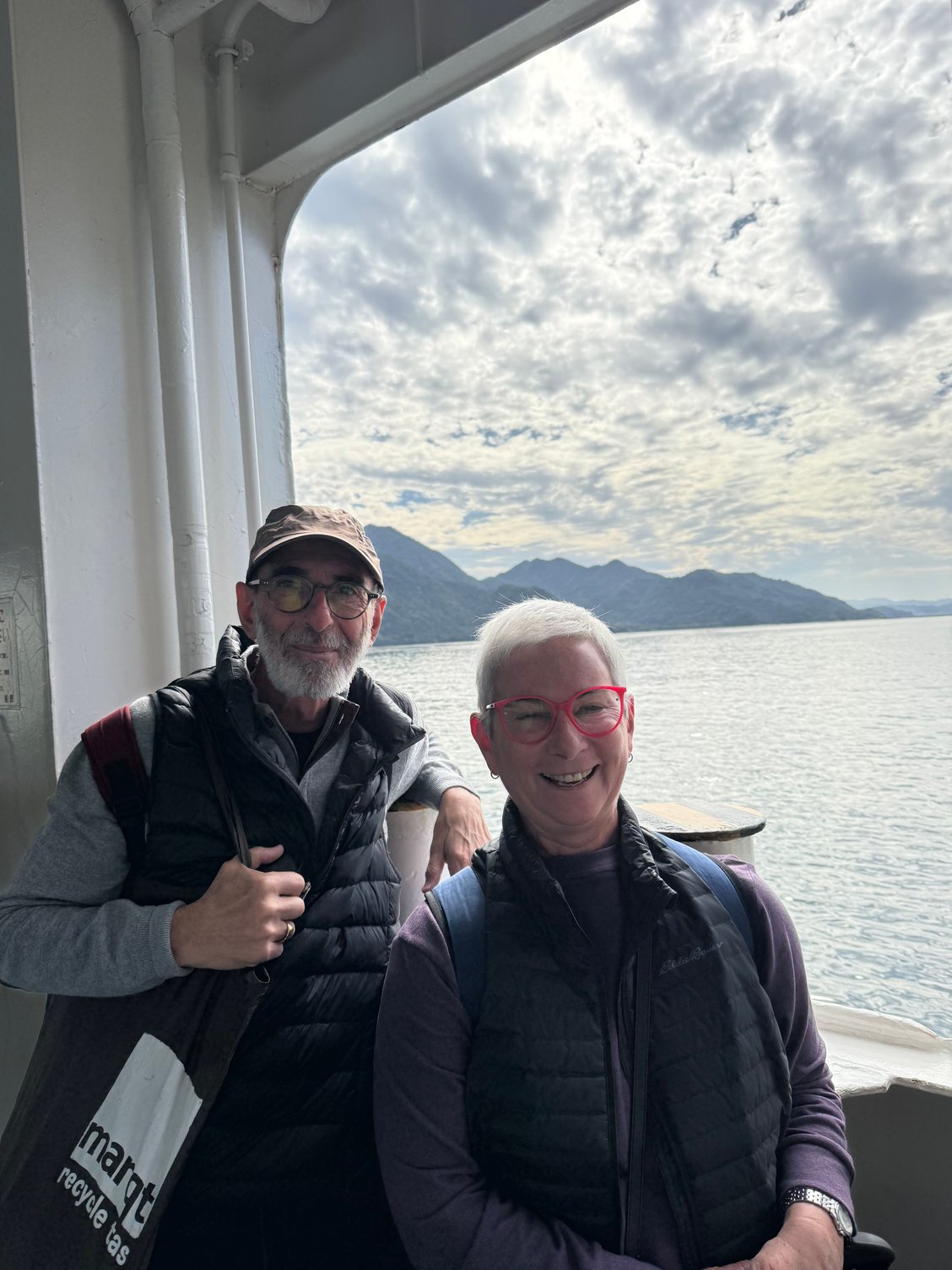
on the ferry
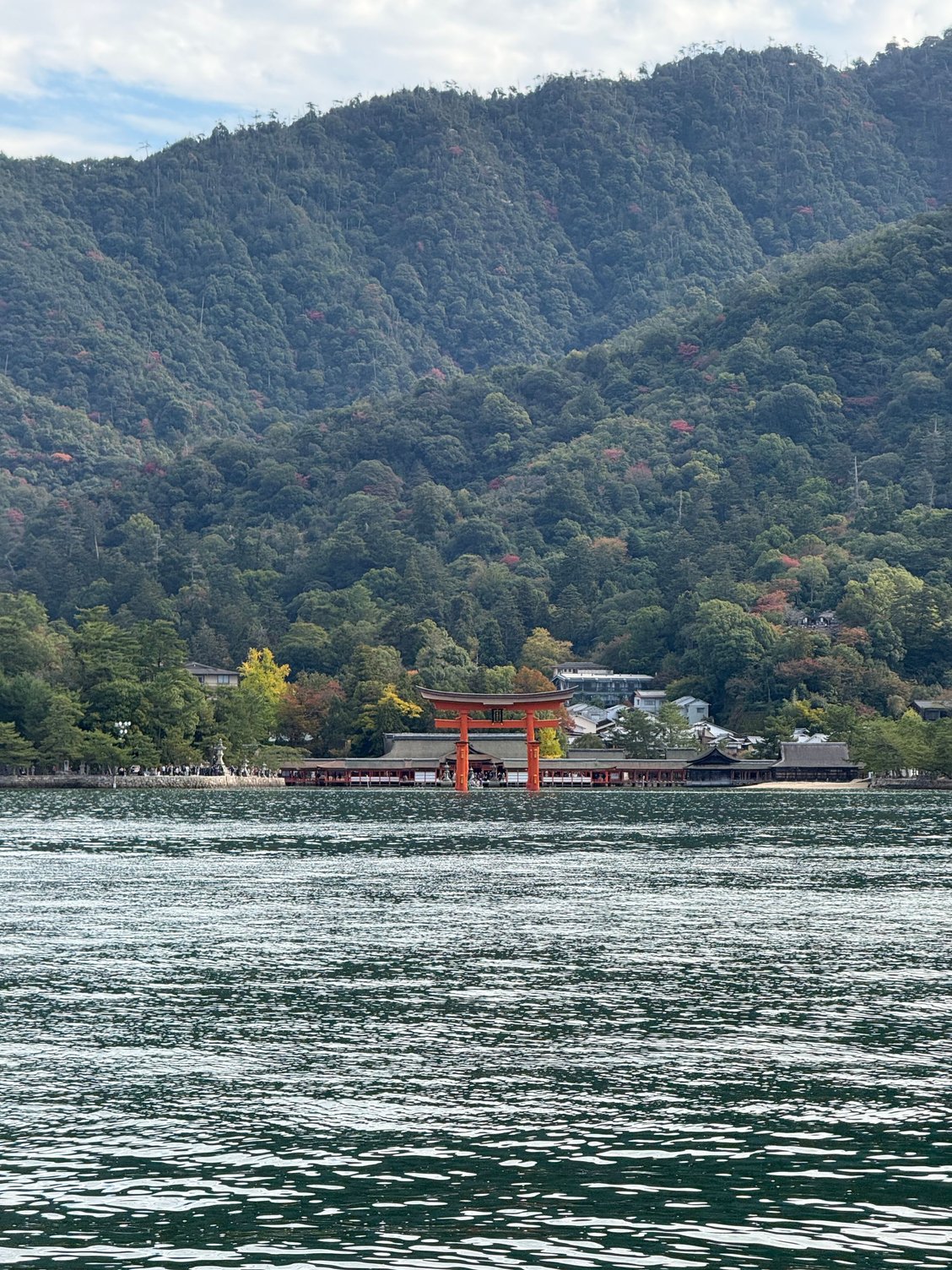
view toward Miyajima
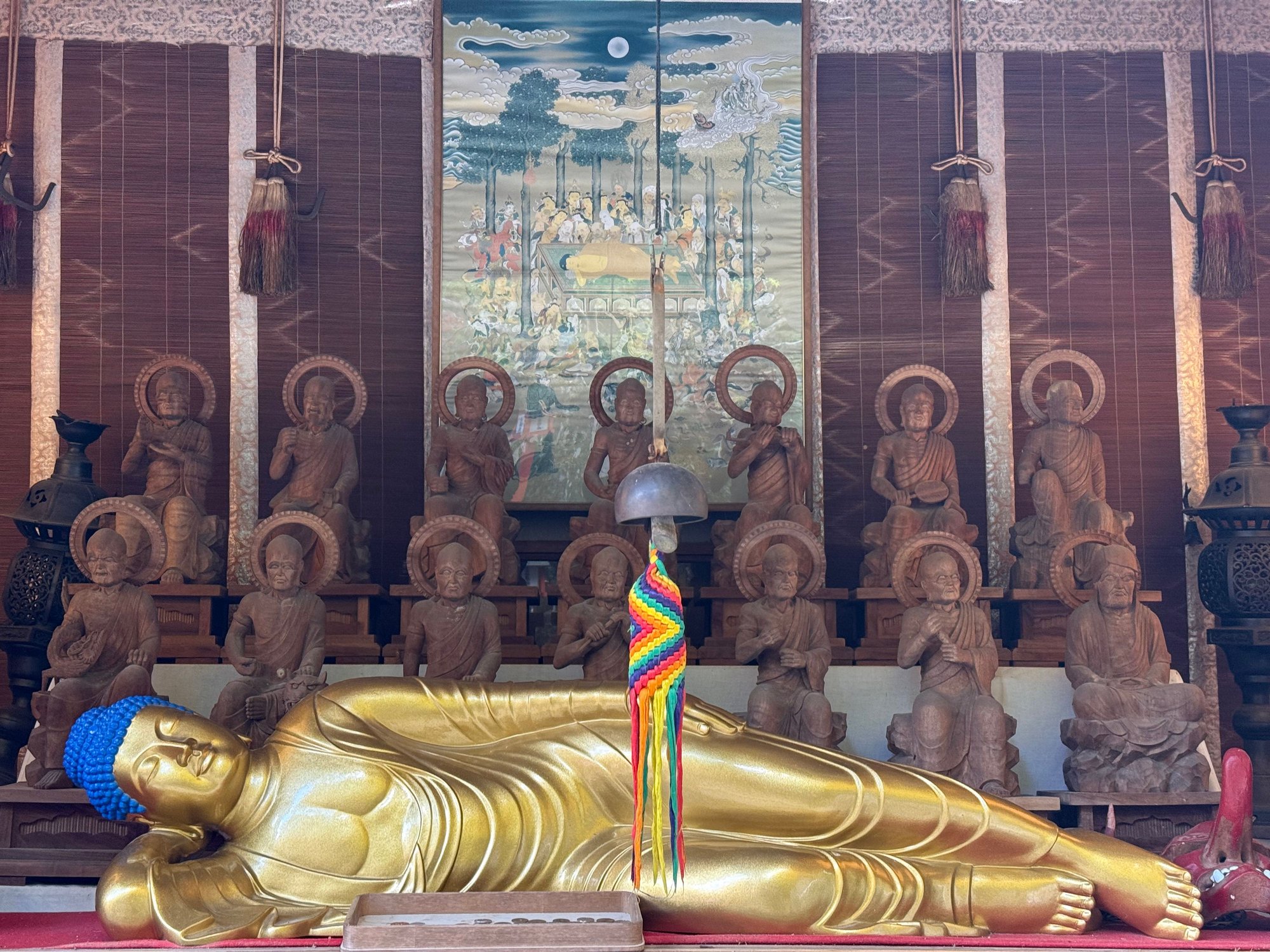
at Daisho-in
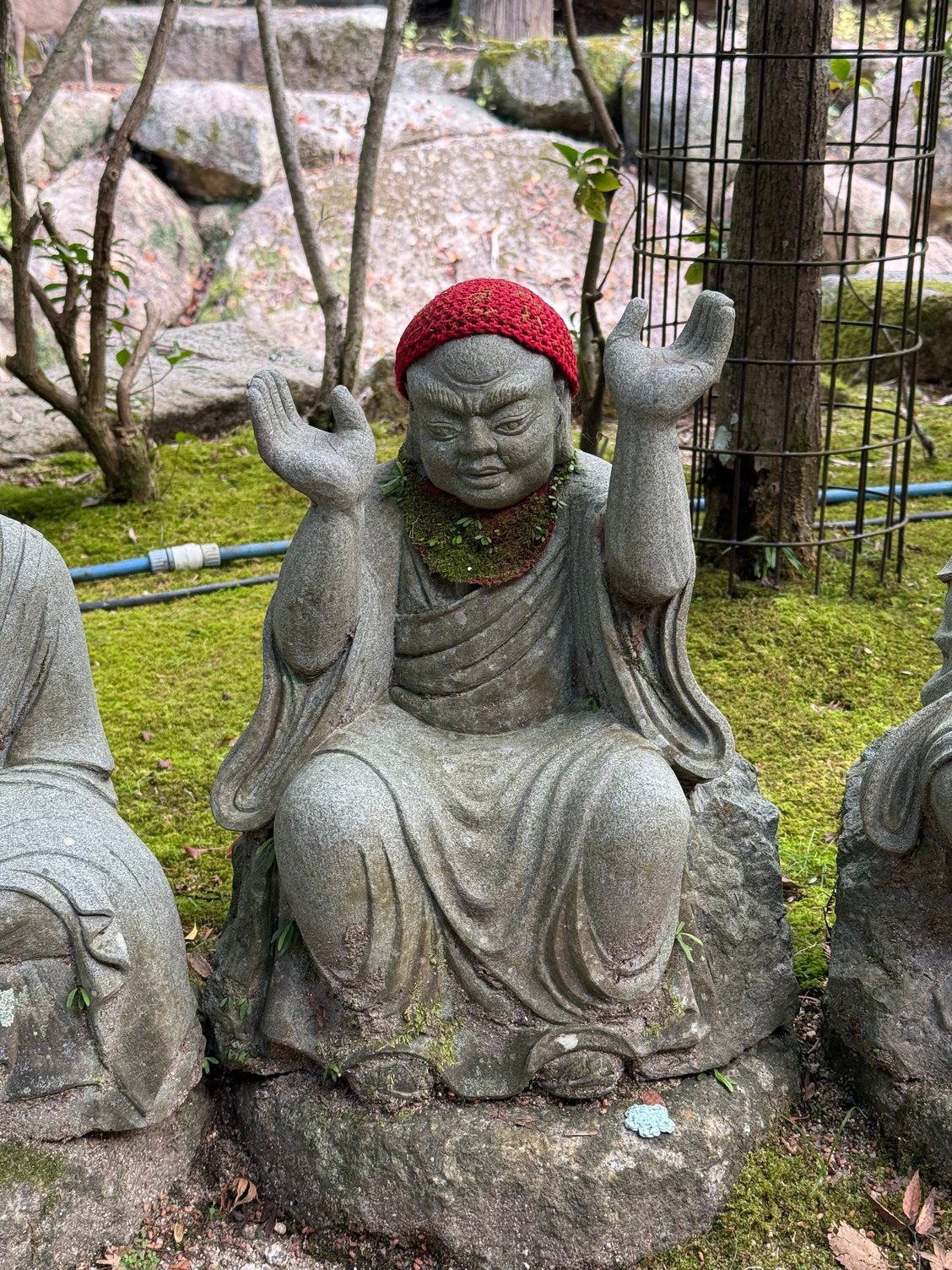
some days I feel like throwing my hands up too......
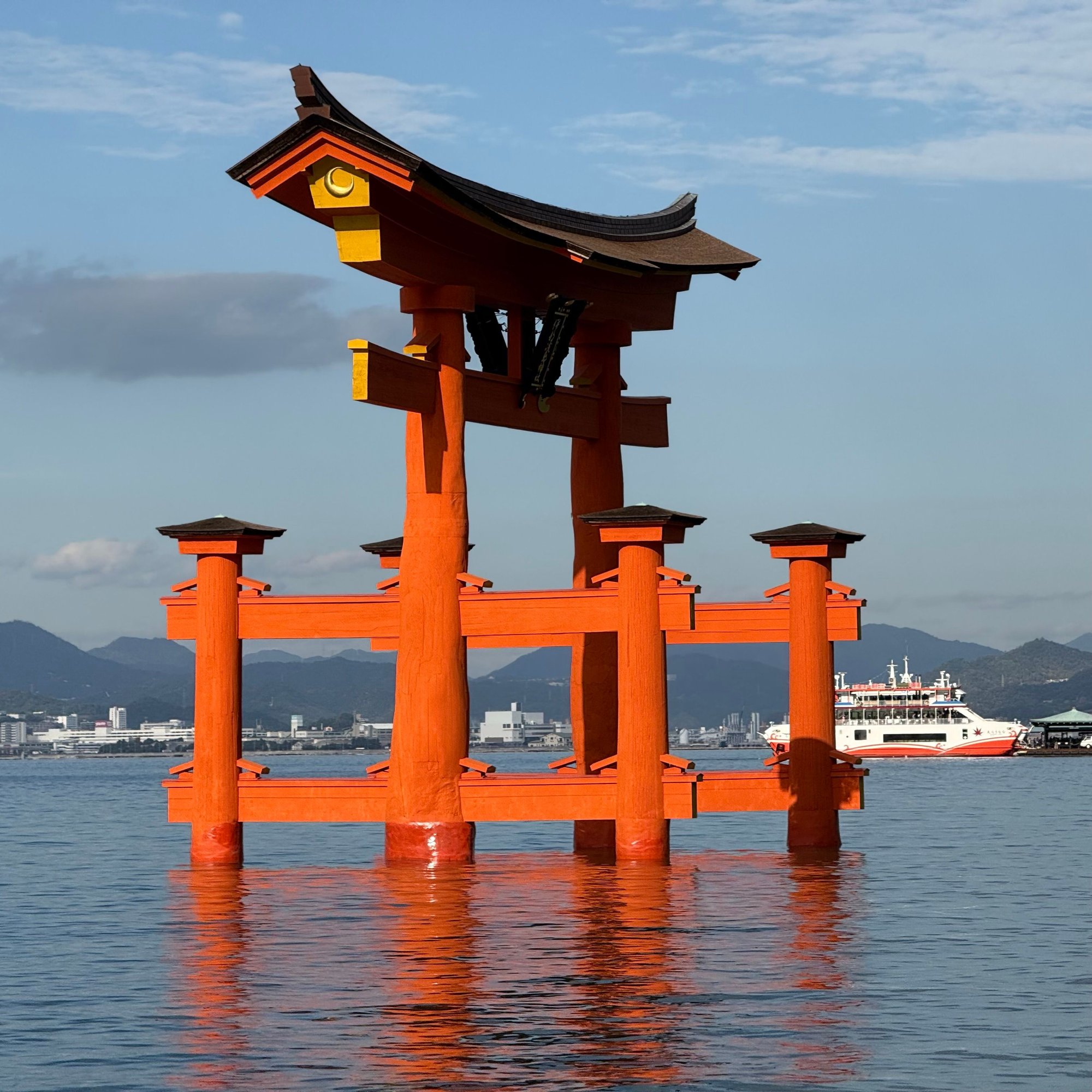
iconic view in the afternoon

first course nibbles at dinner
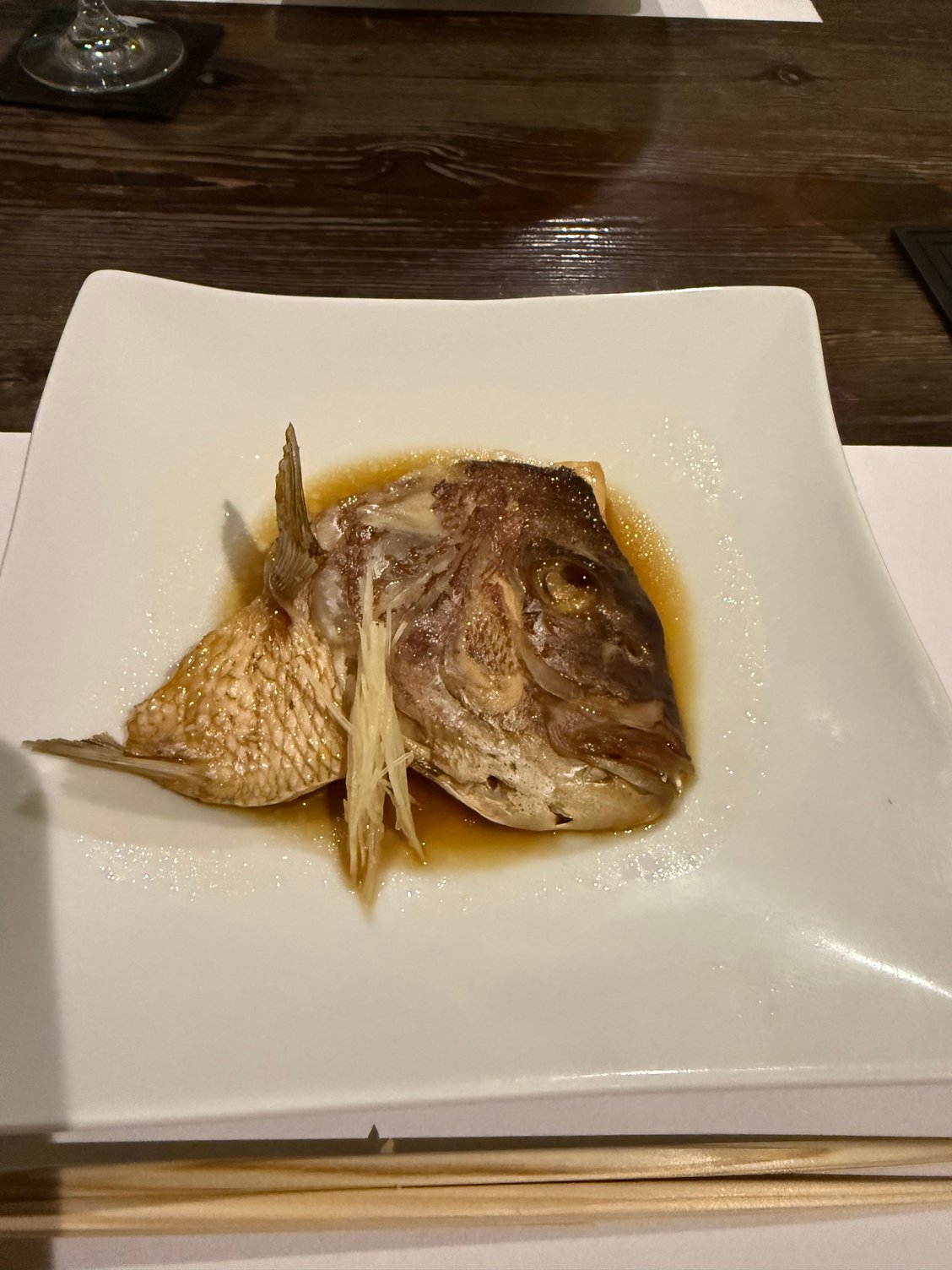
unbelieveably delicious
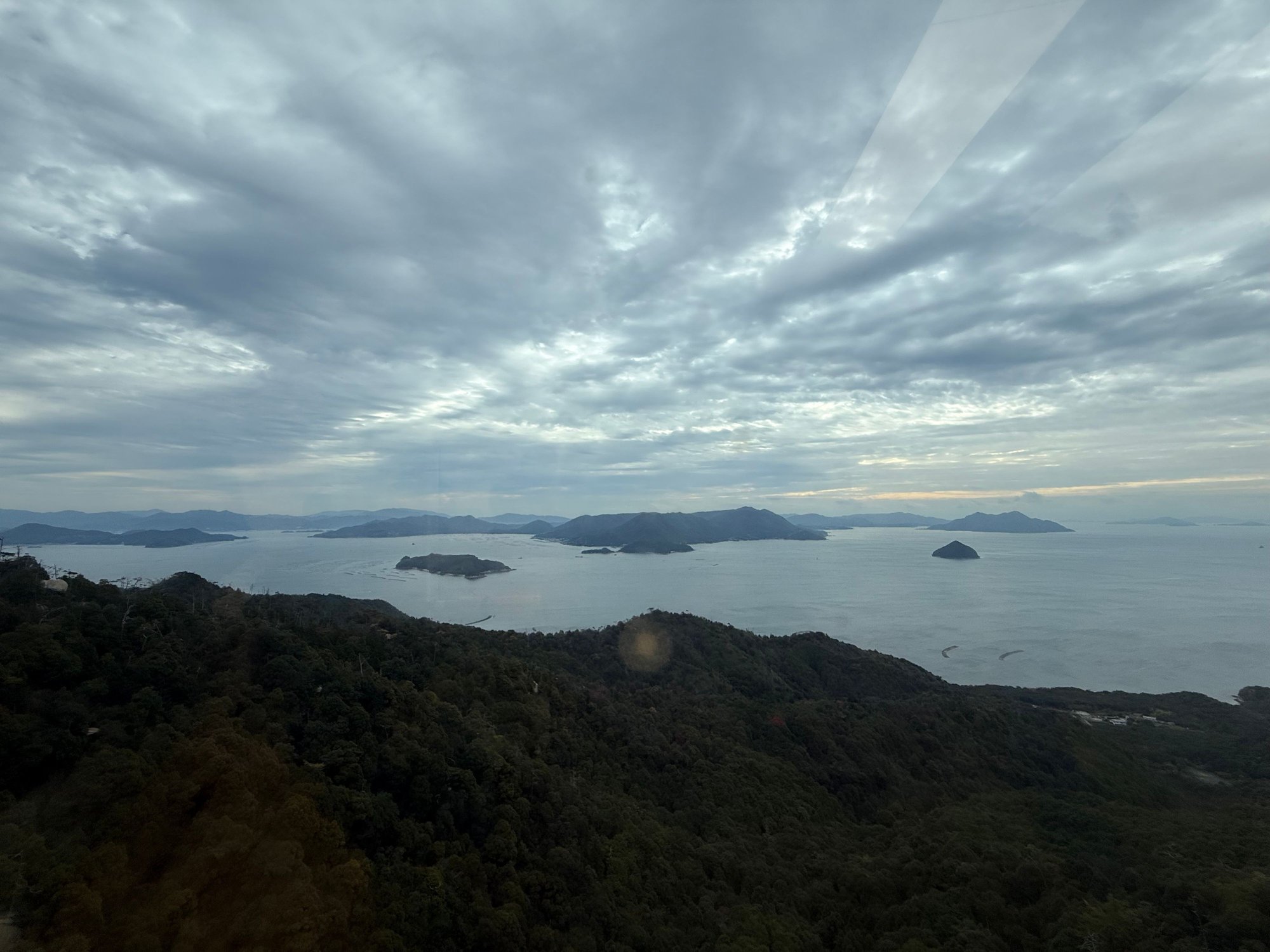
sweeping clouds from top of Mt. Misen
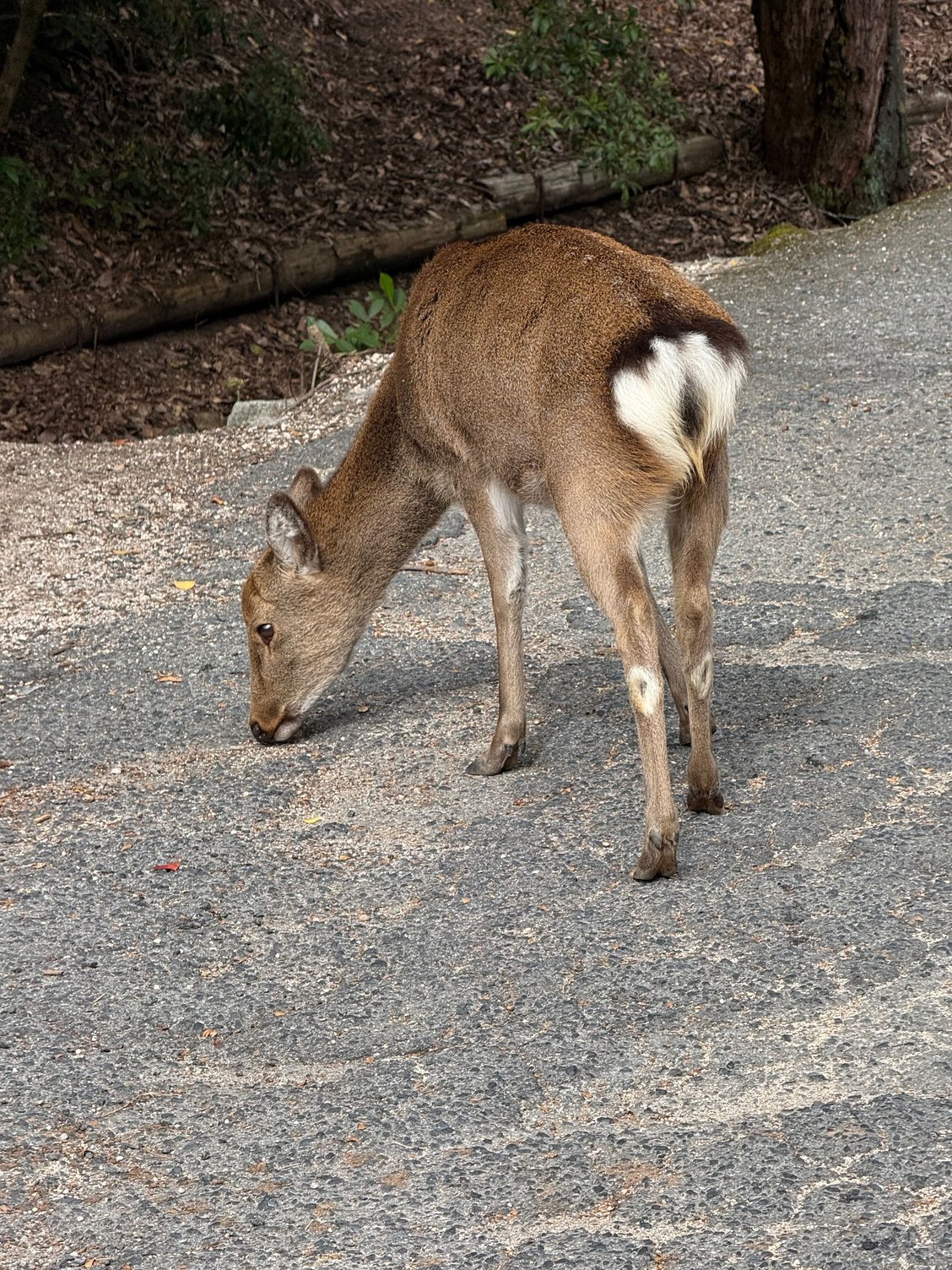
lots of deer wandering around the island, they didn't approach or bother us
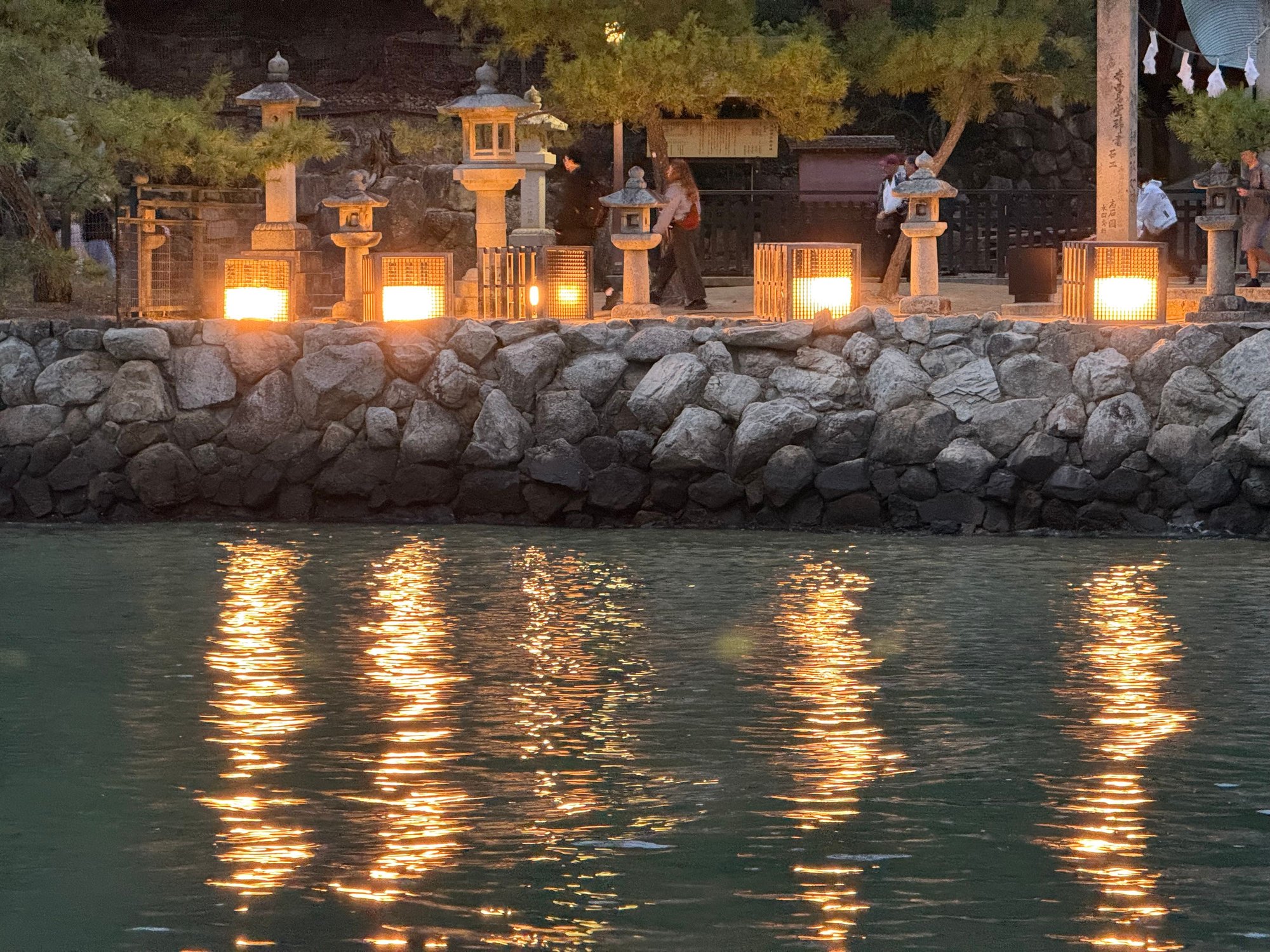
lanterns illuminated at Itsukushima in the evening
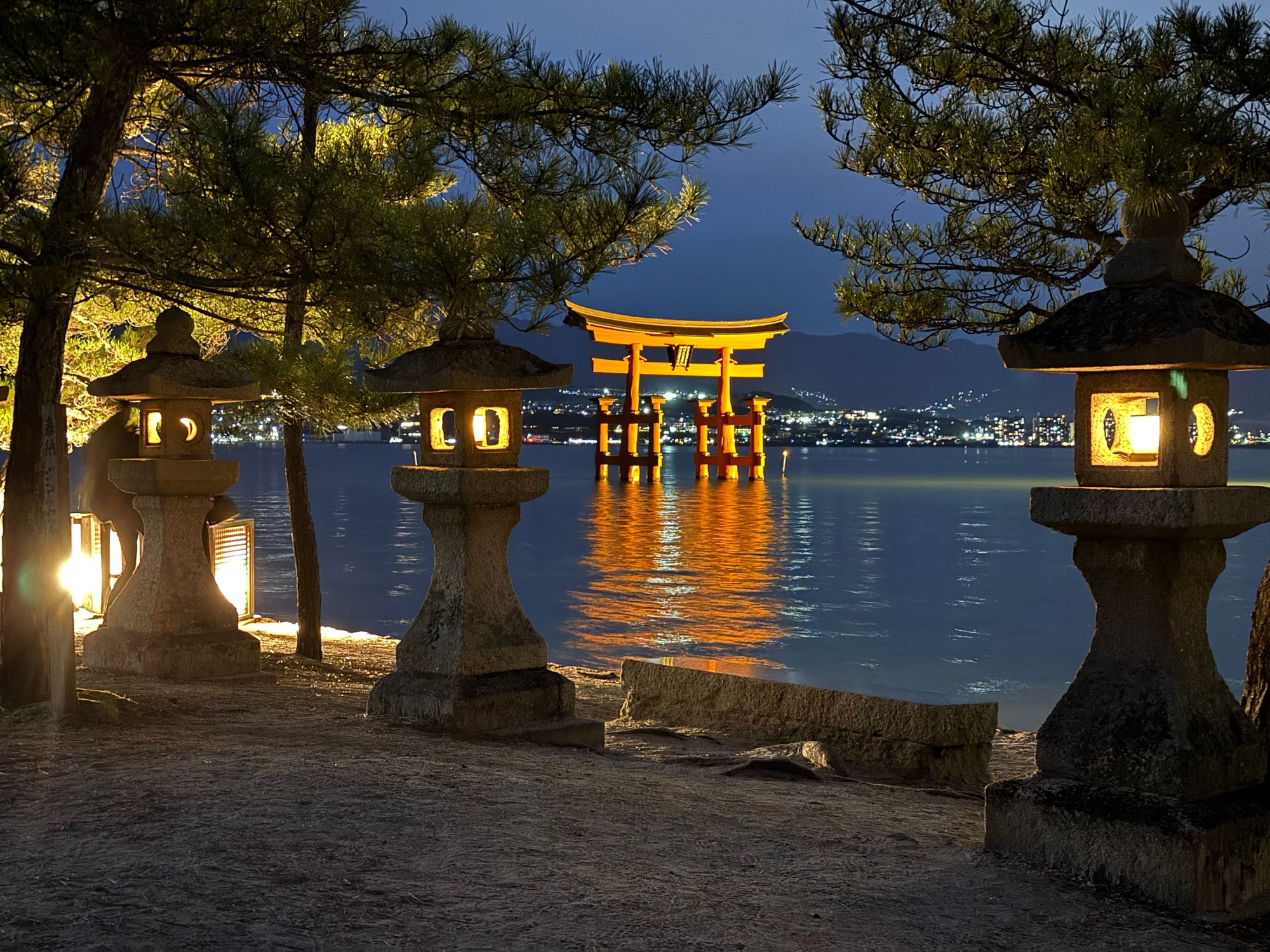
favorite view at night, as well headed back to the inn
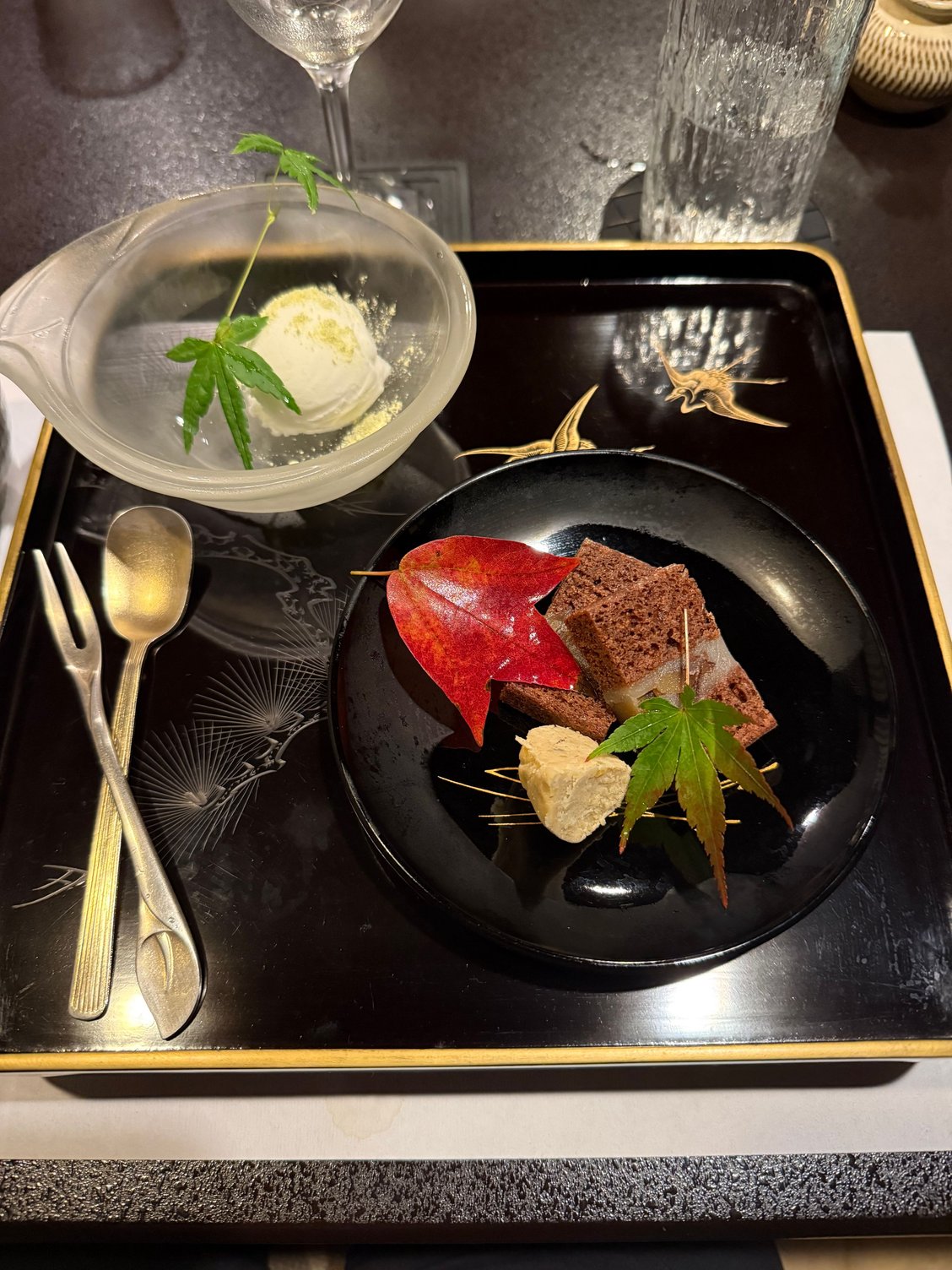
dessert on our 2nd night. it was my birthday and they presented it with a candle and the lights off, just like when I was a kid :~).
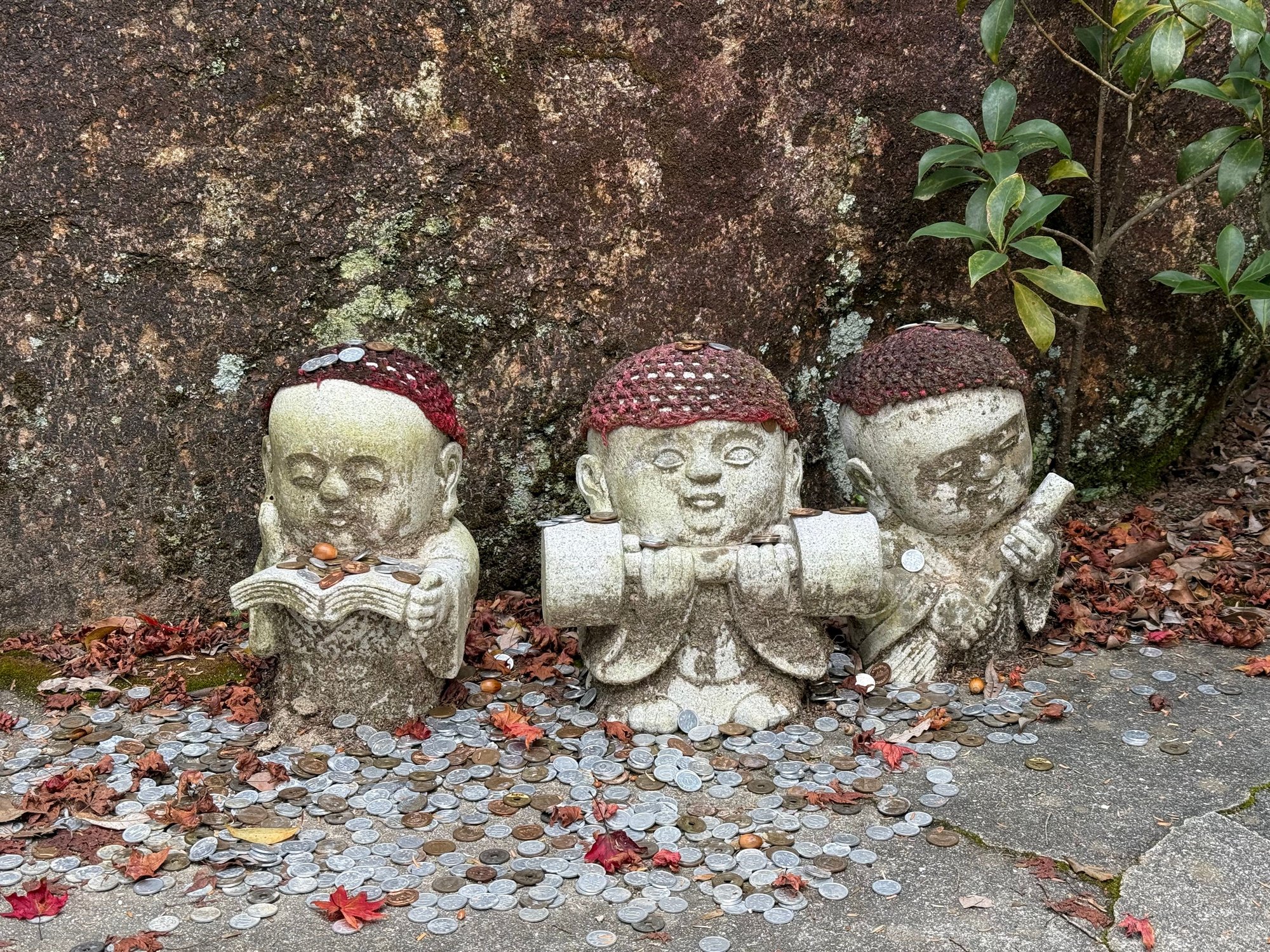
grouping of some of the more expressive figures around Daisho-in
Experiences
What really sold us on staying in Miyajima for a couple of nights was the options for hiking, visiting temples, and being able to see the magnificent torii gate in the early morning and at night. Auberge Watanabe is perfectly located for various walks – it’s practically next to Daisho-in Temple, at the base of Mt. Misen, and there are nice walking paths down to the Itsukushima Shrine area and also to Momiji Park and the Miyajima Ropeway station. There’s also a path that leads to Tahoto Pagoda, which is a scenic spot.
The first afternoon we visited Daisho-in, while waiting for our room to be ready, and it’s a vibrant, loud, colorful place, almost an assault on all of one’s senses. The rail on the long stairway leading to the temple is dotted with prayer wheels that are well worn from so many hands spinning them on ascent and descent. Lots of burning incense, and the 1600-lb temple bell is struck over and over again by visitors getting videos taken of themselves ringing it with the large wooden beam. The paths around the temple grounds are dotted with the tiny statues with colorful expressions (and very often colorful hats!), called Gohaykyu Rakan or the 500 disciples of Buddha. There is also a hall, or cave, at the back of the campus, which has images of the principals of the 88 sacred temple sites of Shikoku, and visiting the cave is thought to be equivalent to making a pilgrimage to these sites. All in all, it was one of the best waiting-for-check-in ways to spend time!
Mt. Misen hike: we rose pretty early and had requested an early breakfast, after which we layered up and headed for the top of Mt. Misen. There’s a hiking path alongside Daisho-in which leads to the top of the mountain, and we seriously considered hiking all the way up and taking the ropeway down, but it had rained a few days prior and the path was still kind of wet and muddy in places, including the sections that had stone steps partly covered in moss. We’re both fit, but decided to swallow our pride and not do the full hike – not worth the chance that one of us would slip and take a tumble, potentially affecting the rest of our vacation. As one of my beloved workout instructors always says “no shame in that game” – it was a nice 30-minute walk to the ropeway (so glad we heeded our hosts’ advice to get there right when it starts running @9:00), about a 30-minute ride in total, on a partly sunny day over forests dotted with brilliantly colored maple trees, and another 30-minute hike from the last ropeway station to the top of the mountain. It wasn’t too crowded on our way up to the very top, but by the time we descended there were lots of folks on the path. The views from the top were gorgeous, even with some cloud cover and a bit of mist in the air.
Itsukushima Shrine: the main even on Miyajima is the scenic shrine with its wooden platforms and walkways and the iconic floating torii gate. We decided to visit it in the late afternoon/early evening, so we could stay for sunset and see the gate illuminated after dark. As dusk sets in, and the lanterns surrounding the shrine come on, it’s really a magical setting. It would have been fantastic to be there in mid-April for the festival when Noh plays are performed on the specially built floating platform. My husband was infinitely patient while I took lots of photos of the gate and shrine from all angles, and then we strolled along far shore and back to our inn.
Next morning, we got up early and walked down to the gate again, as the tide was low and we could walk out almost to the base of the gate. Although it seems so cliché, it’s hard to get enough of it.
Miyajima History and Folklore Museum: I visited here on my own, while my husband was taking a rest, and it’s a lovely small museum with well curated exhibits. Loved reading about how the shrine was originally built on Miyajima and its importance in Japanese history. Lots of old maps and prints depicting
Overall, we loved our stay on Miyajima and were very glad we were there for 2 nights – like many other beautiful, but crowded, vacations spots (here’s looking at you, Taormina!), the magic happens when all of the day trippers leave and before they arrive.Our meals at Auberge Watanabe were quite good, in the manner of excellent home cooks who prepare the food they like to eat, and present it beautifully. Standout dishes were the braised yellowtail head and a delicious serving of beef seasoned with lemon and soy. We opted for Western style breakfasts and they were excellent, including delicious coffee
Ryoko dropped us off at the train station in the morning, after another glorious breakfast. We were both a little nervous about the journey, as it involved two train changes, one in Tsuruga and then a connection in Kyoto. But, we had built in enough transfer time in Kyoto to find the Shinkasen gates and our train, so all worked out well. There was more than enough space in the overhead racks for our small suitcases and backpacks, and the seats were comfortable enough. Arrival at Hiroshima station was around 3:00, so by the time we got into the taxi line and rode to the Hilton Hiroshima hotel, we were just in time to get into the check-in line.
This was our only Western, business-style hotel of the trip and we had booked early enough (and with Hilton Honors member rate) that we splurged on a premium, corner room. It was on a higher floor and had amazing views toward Hiroshima Bay, which means we got to see the sunset glow on the surrounding hills and a had a full-on sunrise view. The room was super clean, the beds were comfortable, the provided yukatas were quite nice, with hidden buttons, and the selection of teas was to my liking. We had booked for 2 nights, which turned out to be wise…as I ended up spending about 20 hours of it in bed with a bit of a bug. Not sure where I picked it up, but I had been fighting fatigue and overall congestion for several days so I was probably more susceptible. My husband and I shared the same food for dinner that first night, so it definitely wasn’t food poisoning, but let’s just say I will probably never feel like eating okonomiyaki again :~).
[img alt="view from our room at the Hiroshima Hilton: sunrise
"]https://cimg8.ibsrv.net/gimg/www.fodors.com-vbulletin/2000x1504/img_1349_29777aa0390dee4bc02adebcf847a6bb6249e8c3. jpeg[/img]
view from our room at the Hiroshima Hilton: sunrise
Experiences
We had booked early access tickets to the Peace Museum for our first morning, but I wasn’t in any shape to go out, so my husband walked over by himself, visited the museum and grounds and spent some time wandering around a bit, came back to check on me and then took himself out for a ramen lunch. Later in the day I felt well enough to go out for a stroll around the neighborhood and to get some plain rolls and a chestnut cookie for me, and he picked up a proper dinner.
Next morning we were up and at ‘em early, going down for breakfast (still very limited for me) and then we both walked back to the Peace Museum so I could see the grounds and campus. I left him on a bench opposite the A-Bomb Dome ruins and walked back to the museum entrance for the public access opening at 8:30. One of the most moving scenes of the day was the changing of the flowers at the eternal flame memorial – the grounds staff removed the previous day’s flowers and carefully placed fresh bouquets. It was all done silently and reverently and left a lasting impression.
The permanent exhibit is tough to view and in many ways I am still processing it. For both of us, it was an important site on our itinerary.
The Hilton has a noon checkout time, which meant we had plenty of time to stroll back towards the hotel, and we stopped at Andersen Bakery in Hondori for a mid-morning coffee and pastry and decided to also pick up something to have for lunch on our journey to Miyajima. It felt really good to be in the fresh air, and walking through the shopping arcade as things were just starting to open up. Final packing and checkout were a breeze, and we returned to the station to continue our journey.
view of the Atomic dome and flower offerings
view from across the river toward dome
one of the moving sculptures on the Peace Museum campus
Miyajima
Getting to Miyajima turned out to be far less complicated than it seemed from both Google maps and Japan-Guide. For me it’s always a challenge to visualize things when I read the words, but one I see it, everything makes sense. We took the JR West Sanyo line to Miyajimaguchi Station, then followed the signs to exit and walk to the Miyajima Ferry – we used our IC cards for both the train and the ferry and it couldn’t have been easier. There’s a JR Ferry and another company’s ferry at the wharf and both accept IC cards, so one can simply take whichever one is there and leaving first. It was a quick ride over to the island, which great views back toward Hiroshima Port and the surrounding hills, and ahead toward Miyajima and the other islands. We passed lots of oyster beds as well.
We booked Auberge Watanabe based on good reviews and having read about it from other Fodorites’ trip reports. They had directed us to go to the information desk and have them ring the inn, and we waited about 15-20 minutes for them to pick us up, during which time we ate our lunch outside and watched the throngs of people arriving. Although we couldn’t check in until 3:00 we had some tea and lovely maple-leaf-themed treats, and the lovely owner gave us some maps and information, and then we set out to explore a bit before we could return to the inn and crash for a bit before dinner.
on the ferry
view toward Miyajima
at Daisho-in
some days I feel like throwing my hands up too......
iconic view in the afternoon
first course nibbles at dinner
unbelieveably delicious
sweeping clouds from top of Mt. Misen
lots of deer wandering around the island, they didn't approach or bother us
lanterns illuminated at Itsukushima in the evening
favorite view at night, as well headed back to the inn
dessert on our 2nd night. it was my birthday and they presented it with a candle and the lights off, just like when I was a kid :~).
grouping of some of the more expressive figures around Daisho-in
Experiences
What really sold us on staying in Miyajima for a couple of nights was the options for hiking, visiting temples, and being able to see the magnificent torii gate in the early morning and at night. Auberge Watanabe is perfectly located for various walks – it’s practically next to Daisho-in Temple, at the base of Mt. Misen, and there are nice walking paths down to the Itsukushima Shrine area and also to Momiji Park and the Miyajima Ropeway station. There’s also a path that leads to Tahoto Pagoda, which is a scenic spot.
The first afternoon we visited Daisho-in, while waiting for our room to be ready, and it’s a vibrant, loud, colorful place, almost an assault on all of one’s senses. The rail on the long stairway leading to the temple is dotted with prayer wheels that are well worn from so many hands spinning them on ascent and descent. Lots of burning incense, and the 1600-lb temple bell is struck over and over again by visitors getting videos taken of themselves ringing it with the large wooden beam. The paths around the temple grounds are dotted with the tiny statues with colorful expressions (and very often colorful hats!), called Gohaykyu Rakan or the 500 disciples of Buddha. There is also a hall, or cave, at the back of the campus, which has images of the principals of the 88 sacred temple sites of Shikoku, and visiting the cave is thought to be equivalent to making a pilgrimage to these sites. All in all, it was one of the best waiting-for-check-in ways to spend time!
Mt. Misen hike: we rose pretty early and had requested an early breakfast, after which we layered up and headed for the top of Mt. Misen. There’s a hiking path alongside Daisho-in which leads to the top of the mountain, and we seriously considered hiking all the way up and taking the ropeway down, but it had rained a few days prior and the path was still kind of wet and muddy in places, including the sections that had stone steps partly covered in moss. We’re both fit, but decided to swallow our pride and not do the full hike – not worth the chance that one of us would slip and take a tumble, potentially affecting the rest of our vacation. As one of my beloved workout instructors always says “no shame in that game” – it was a nice 30-minute walk to the ropeway (so glad we heeded our hosts’ advice to get there right when it starts running @9:00), about a 30-minute ride in total, on a partly sunny day over forests dotted with brilliantly colored maple trees, and another 30-minute hike from the last ropeway station to the top of the mountain. It wasn’t too crowded on our way up to the very top, but by the time we descended there were lots of folks on the path. The views from the top were gorgeous, even with some cloud cover and a bit of mist in the air.
Itsukushima Shrine: the main even on Miyajima is the scenic shrine with its wooden platforms and walkways and the iconic floating torii gate. We decided to visit it in the late afternoon/early evening, so we could stay for sunset and see the gate illuminated after dark. As dusk sets in, and the lanterns surrounding the shrine come on, it’s really a magical setting. It would have been fantastic to be there in mid-April for the festival when Noh plays are performed on the specially built floating platform. My husband was infinitely patient while I took lots of photos of the gate and shrine from all angles, and then we strolled along far shore and back to our inn.
Next morning, we got up early and walked down to the gate again, as the tide was low and we could walk out almost to the base of the gate. Although it seems so cliché, it’s hard to get enough of it.
Miyajima History and Folklore Museum: I visited here on my own, while my husband was taking a rest, and it’s a lovely small museum with well curated exhibits. Loved reading about how the shrine was originally built on Miyajima and its importance in Japanese history. Lots of old maps and prints depicting
Overall, we loved our stay on Miyajima and were very glad we were there for 2 nights – like many other beautiful, but crowded, vacations spots (here’s looking at you, Taormina!), the magic happens when all of the day trippers leave and before they arrive.Our meals at Auberge Watanabe were quite good, in the manner of excellent home cooks who prepare the food they like to eat, and present it beautifully. Standout dishes were the braised yellowtail head and a delicious serving of beef seasoned with lemon and soy. We opted for Western style breakfasts and they were excellent, including delicious coffee



 . I guess it's as much a travelogue for myself, with pictures, as much as for others planning trips.
Feb 20th, 2026 | 10:50 AM
. I guess it's as much a travelogue for myself, with pictures, as much as for others planning trips.
Feb 20th, 2026 | 10:50 AM
#12

Joined: Oct 2018
Posts: 72
Likes: 0
I'm definitely still following along and I'm glad to read your update. Fully agree with you on how Miyajima changes after the day trippers leave. I still marvel at how long the queue was for the ropeway in the middle of the day. (We had gone early to miss the crowd.) Love your photography!
Mar 4th, 2026 | 02:37 AM
#14
Original Poster
Joined: Jan 2003
Posts: 248
Likes: 0
Trip Report Cont'dKurashiki
In the early stages of trip planning, we weren’t sure if we’d stay in Okayama or Kurashiki – the former seemed more convenient, but the charm of the latter won out, especially because we didn’t find any accommodations in Okayama very appealing. It turned out to be a good decision, as we ended up having a wonderful, relaxing stay. Much as I had wanted to visit the gardens at Korakuen, we were more than happy enough strolling around the Bikan historical quarter and visiting the local shrines and temples.
We stayed at Yoruya, a small hotel in the historic district that had been a merchant’s residence and has been lovingly restored by a group of young designers interested in revitalizing local crafts. Very serene and stylish rooms. We didn’t book evening meals here, as we thought the kaiseki dinners might be too much food for us and we had to decide two weeks in advance………after having wonderful breakfasts though (Japanese one day and Western the next) we realized we probably missed out on a very special meal. We went out for a yakiniku dinner one evening (Yoruya made the reservation for us) and a fun soba noodle and sushi dinner the next.
Many travelers visit Kurashiki as a day trip, but ultimately, we were very happy to have spent 2 nights there, which gave us one full day plus a half day on arrival/departure days. Did not have second thoughts at all about not going into Okayama and visiting the garden or castle, though I’m sure we would have enjoyed that as well.
Experiences
Kurashiki is sometimes called the Venice of Japan, and without a doubt the canal running through the historic district is the essence of charming and picturesque (though the gondolas are a bit much!). With the gorgeous red maple trees and weeping willows, one could simply point a camera from any angle and snap a lovely photo.
We strolled around, visited the Ohara Museum, the first museum of Western art in Japan and where we saw the companion Pissarro apple picking painting to the one we saw in Takayama at Hikaru Museum. We also had the good fortune to see El Greco’s The Annunciation, which has been undergoing restoration. Lots of contemporary Western art was on display as well, but we lost steam after that.
I went on my own to visit the former Ohara residence, which is now a small but fascinating museum, complete with family records and a delightful interior courtyard garden with viewing room. It was mid-afternoon, and the sun was low and streaming through the autumn foliage and it was fun to sit for a while in a room full of strangers who are all focused on the same view. One could also order matcha and a sweet treat (for me it was too late in the day to have caffeine).
We climbed up the many steps to the Achi shrine in the morning. It was not at all crowded and the small complex has many charming smaller shrines and great viewing areas. There’s also a walking path that winds around the hill and leads to some smaller Buddhist temples, through a cemetery, and was a lovely way to enjoy the weather and autumn foliage. On the way back to the main street, we visited the Ukiyo-e Museum, which showcases the art of Kuniyoshi and it was delightful,
There are lots of interesting craft and specialty stores throughout the historical district, as well as a renovated cotton mill complex that is now an outdoor shopping area with restaurants and a hotel. Lots of denim shops as well. We enjoyed window shopping but didn’t buy much other than a few small items for the grandkids.
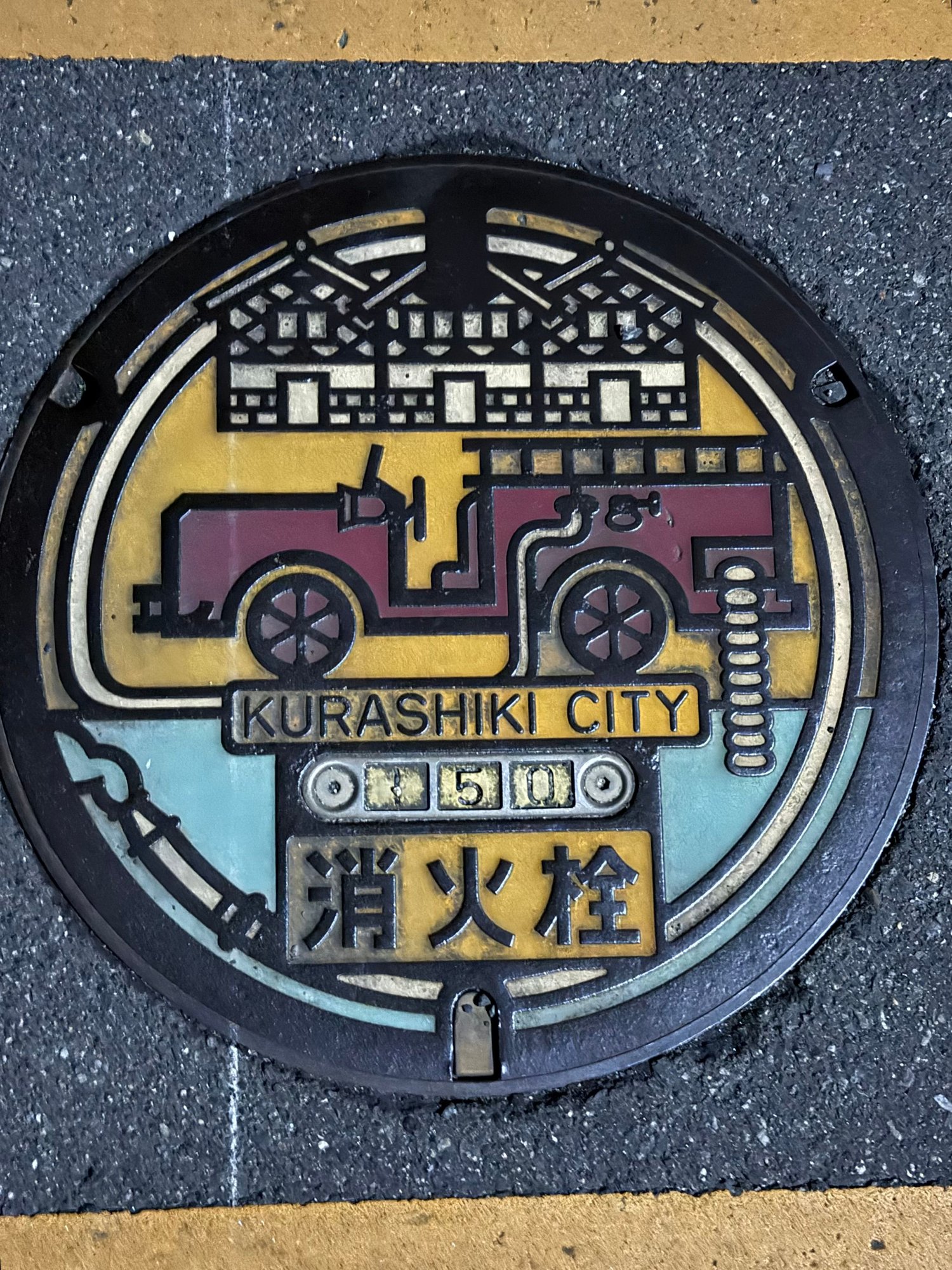
just because..............
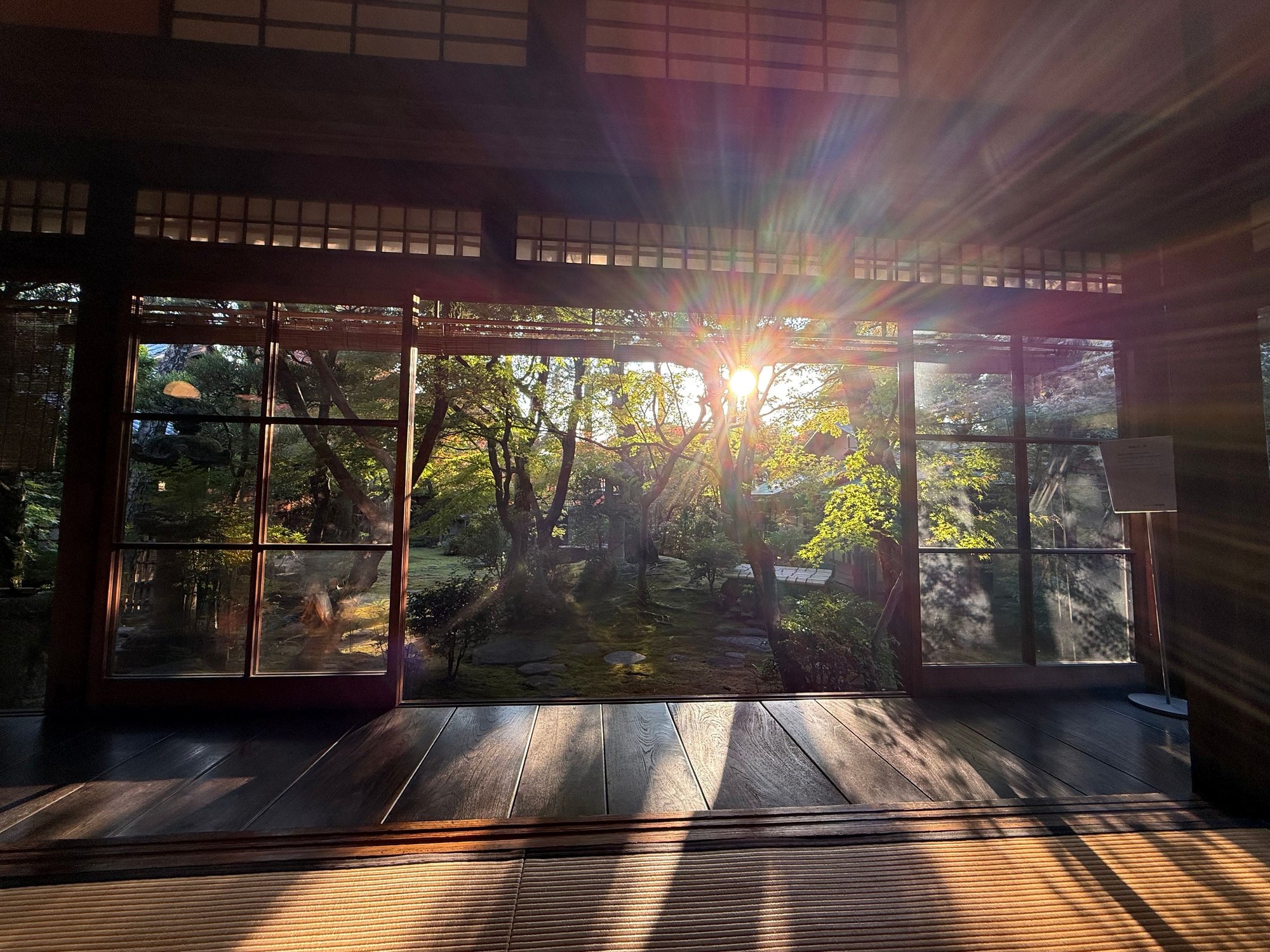
mid-afternoon in the garden viewing room at Ohara residence
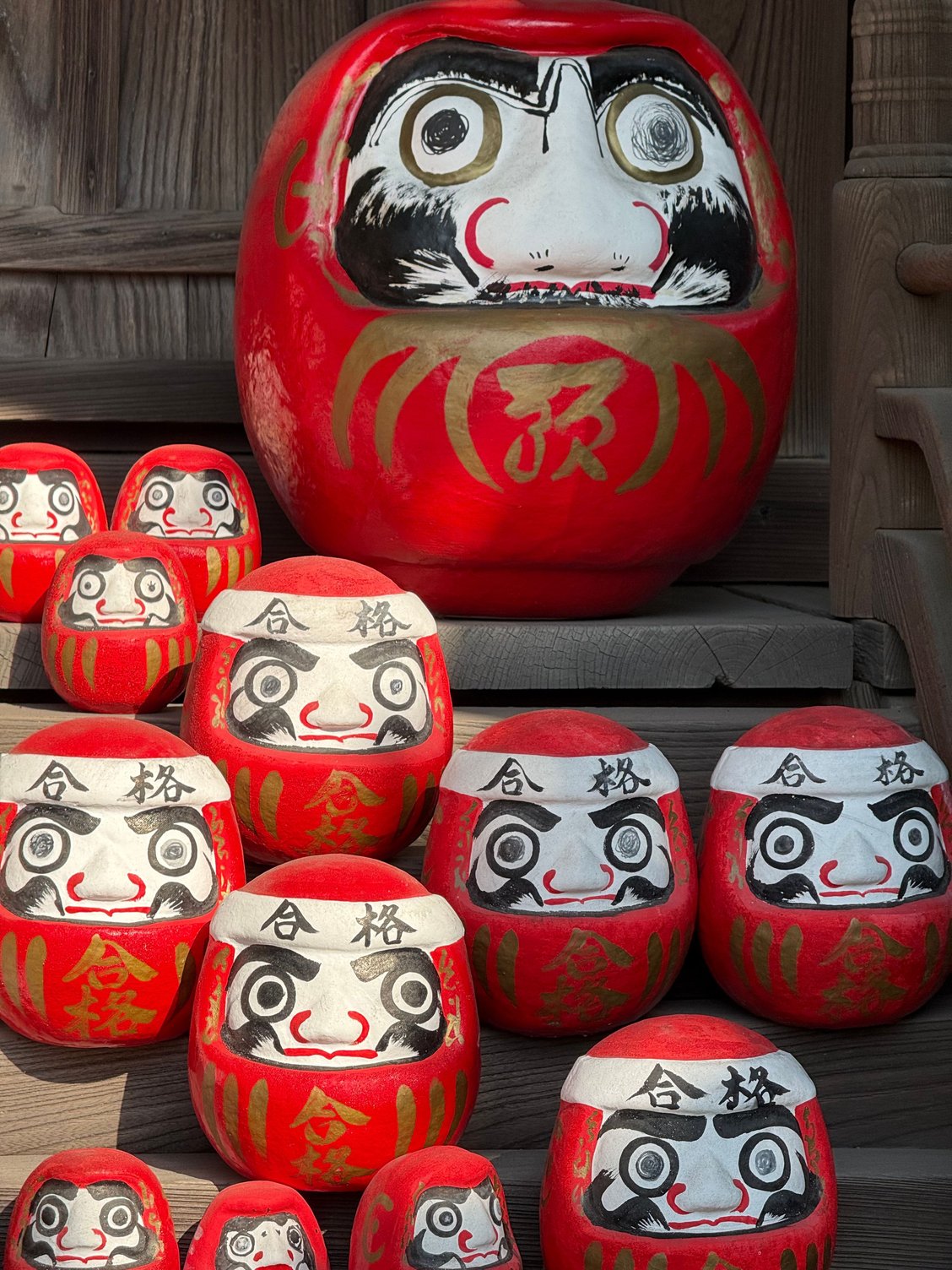
close up of daruma dolls at the Achi shrine complex
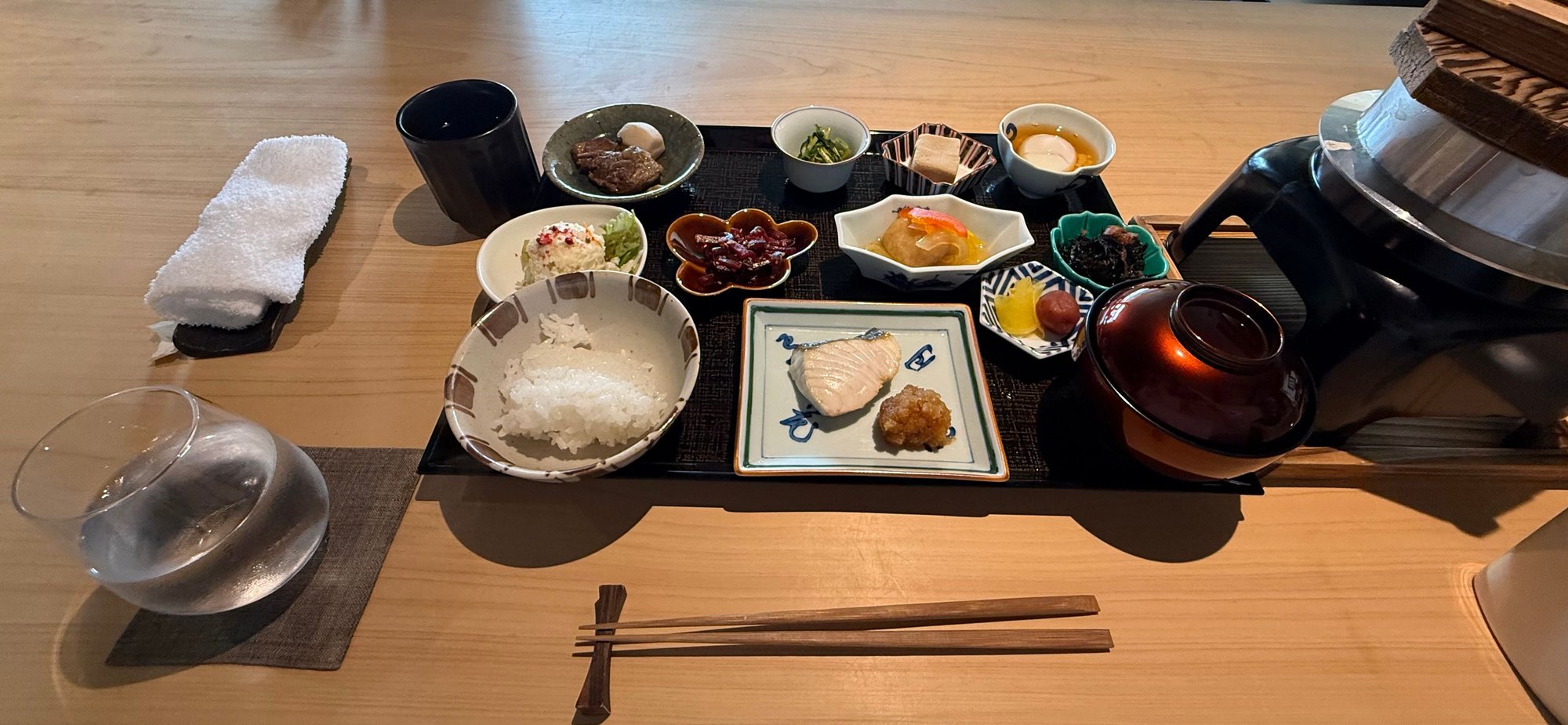
Japanese breakfast @Yoruya
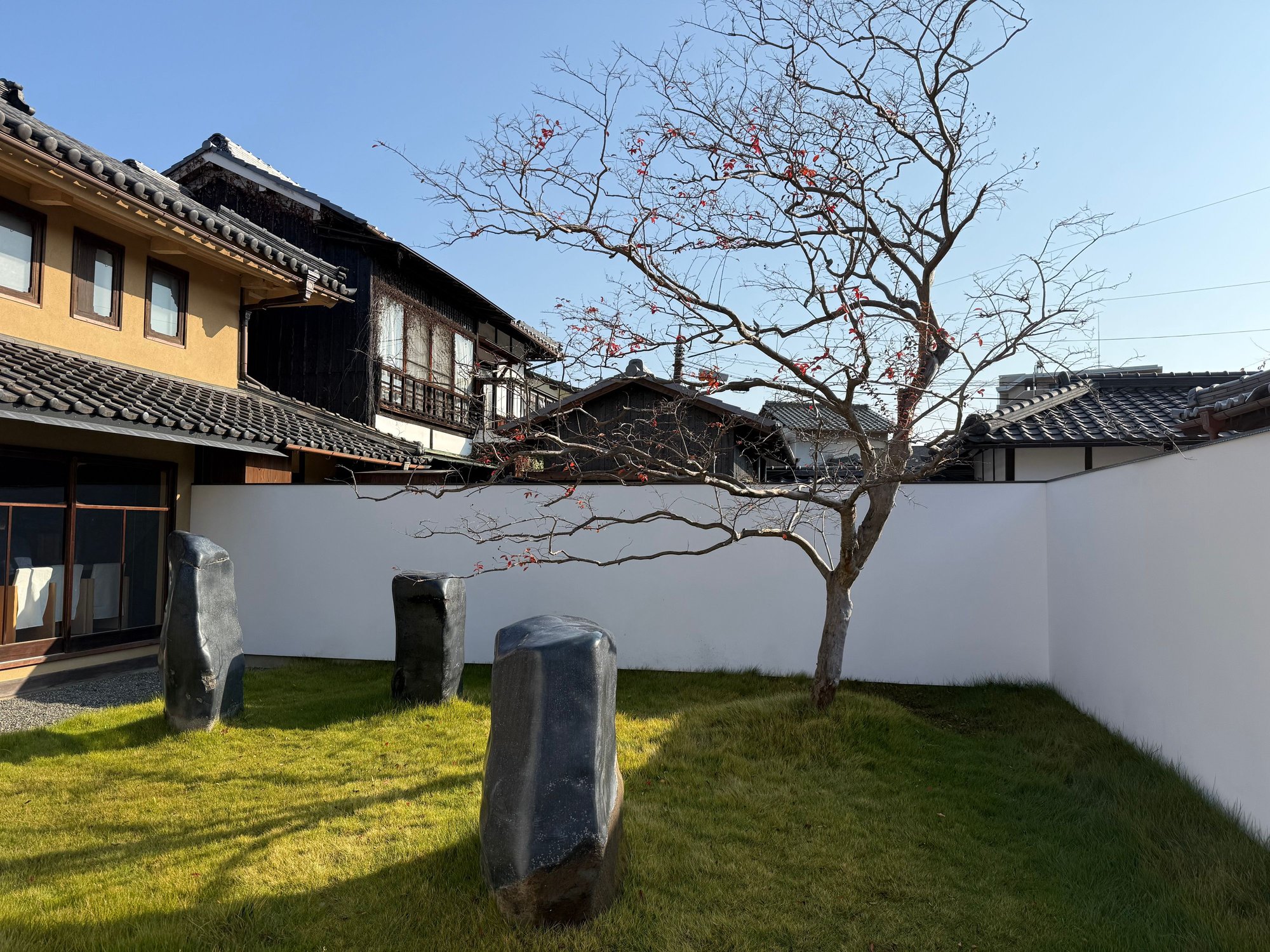
in the courtyard at Yoruya
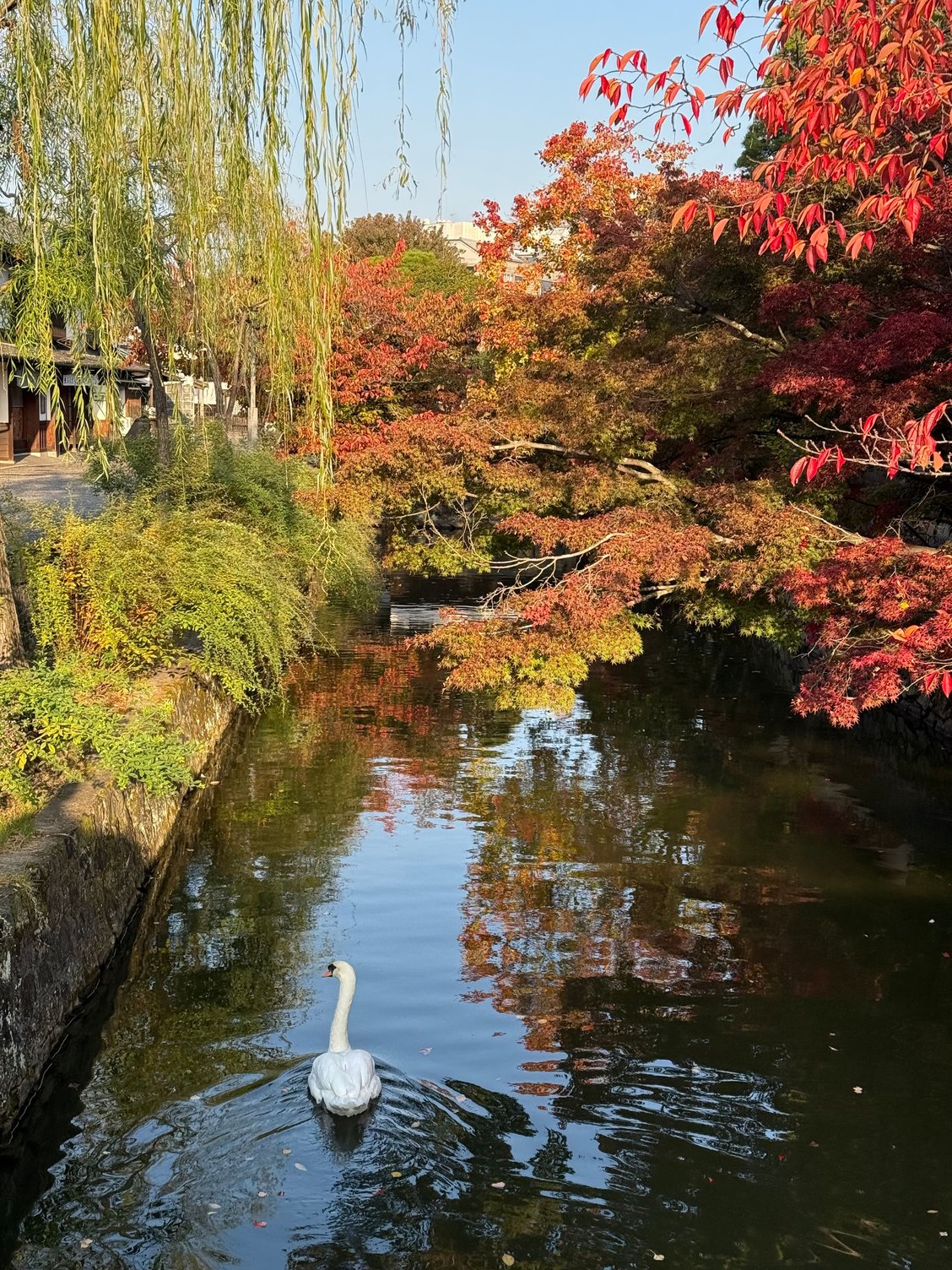
canal view
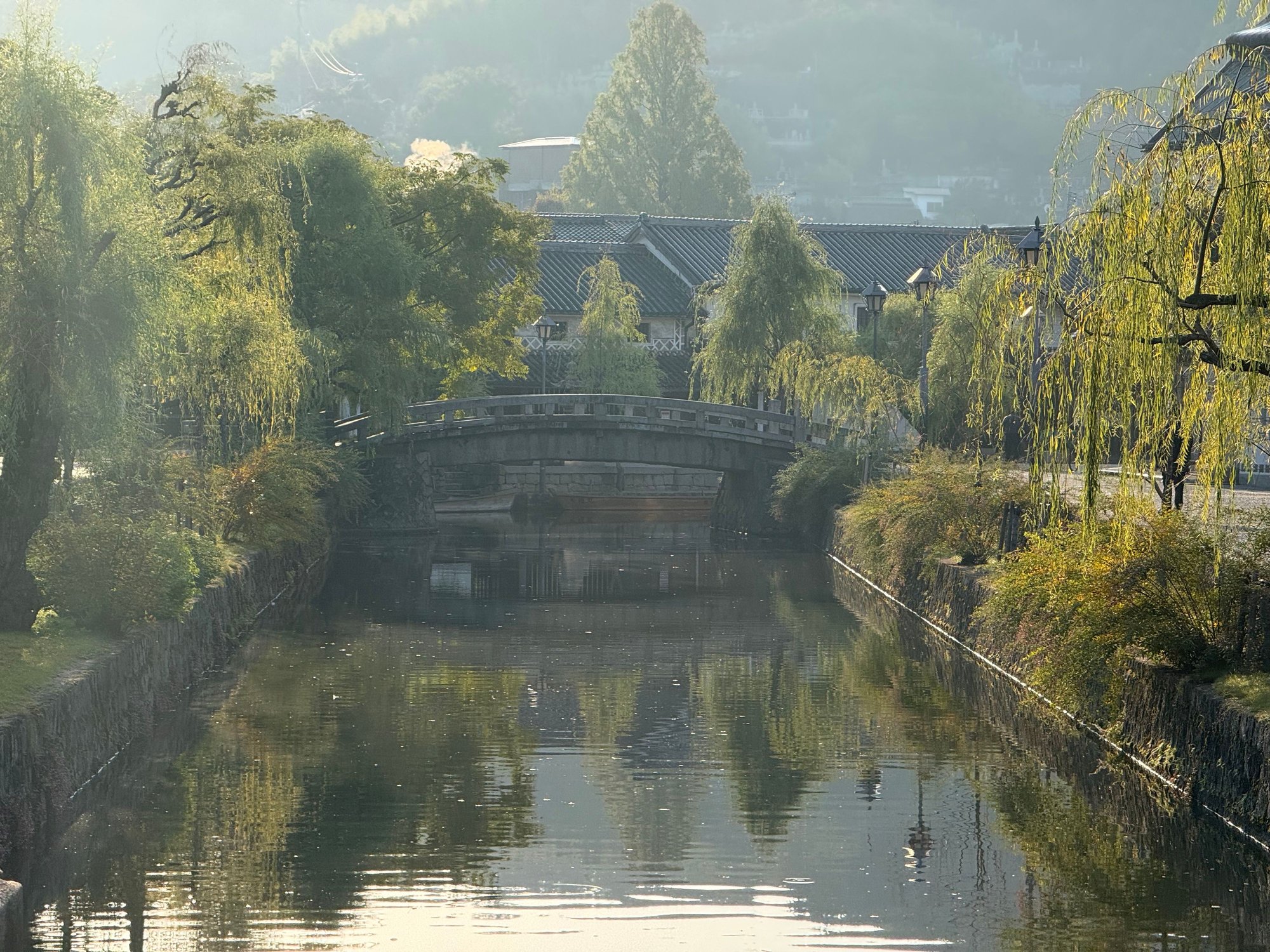
canal view
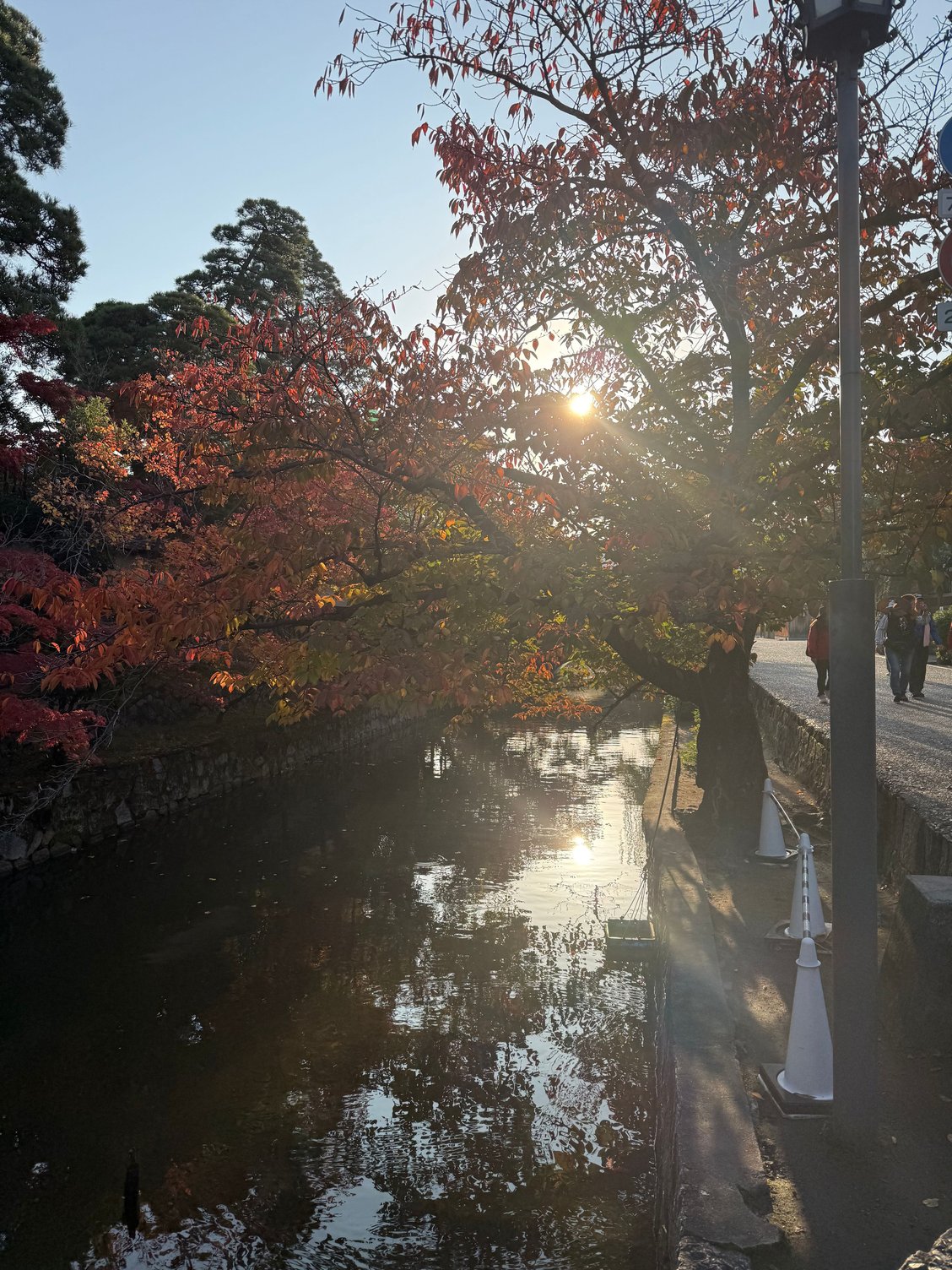
canal view
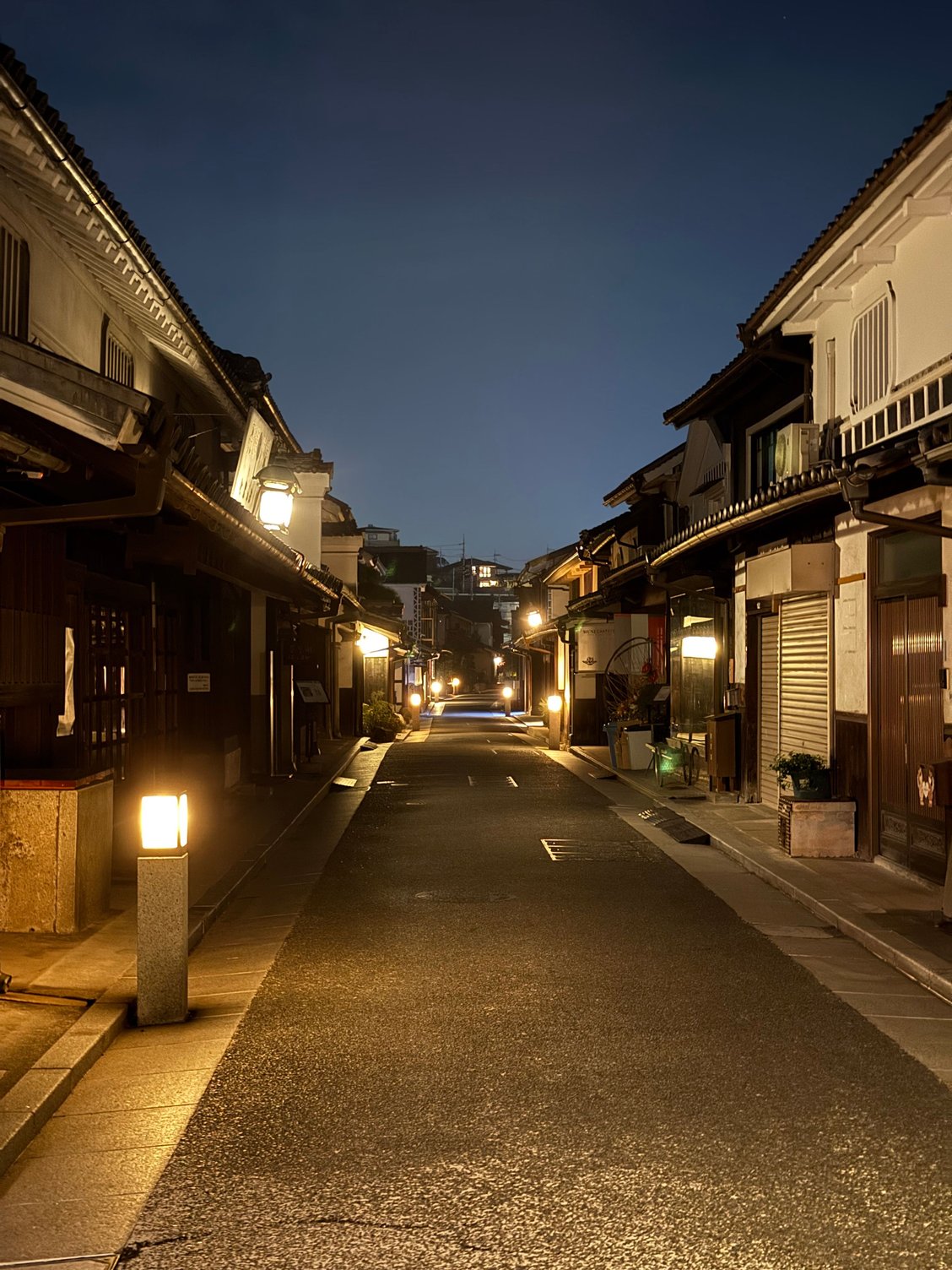
'our street' in Kurashiki

advert for the Ukiyo-e Museum
In the early stages of trip planning, we weren’t sure if we’d stay in Okayama or Kurashiki – the former seemed more convenient, but the charm of the latter won out, especially because we didn’t find any accommodations in Okayama very appealing. It turned out to be a good decision, as we ended up having a wonderful, relaxing stay. Much as I had wanted to visit the gardens at Korakuen, we were more than happy enough strolling around the Bikan historical quarter and visiting the local shrines and temples.
We stayed at Yoruya, a small hotel in the historic district that had been a merchant’s residence and has been lovingly restored by a group of young designers interested in revitalizing local crafts. Very serene and stylish rooms. We didn’t book evening meals here, as we thought the kaiseki dinners might be too much food for us and we had to decide two weeks in advance………after having wonderful breakfasts though (Japanese one day and Western the next) we realized we probably missed out on a very special meal. We went out for a yakiniku dinner one evening (Yoruya made the reservation for us) and a fun soba noodle and sushi dinner the next.
Many travelers visit Kurashiki as a day trip, but ultimately, we were very happy to have spent 2 nights there, which gave us one full day plus a half day on arrival/departure days. Did not have second thoughts at all about not going into Okayama and visiting the garden or castle, though I’m sure we would have enjoyed that as well.
Experiences
Kurashiki is sometimes called the Venice of Japan, and without a doubt the canal running through the historic district is the essence of charming and picturesque (though the gondolas are a bit much!). With the gorgeous red maple trees and weeping willows, one could simply point a camera from any angle and snap a lovely photo.
We strolled around, visited the Ohara Museum, the first museum of Western art in Japan and where we saw the companion Pissarro apple picking painting to the one we saw in Takayama at Hikaru Museum. We also had the good fortune to see El Greco’s The Annunciation, which has been undergoing restoration. Lots of contemporary Western art was on display as well, but we lost steam after that.
I went on my own to visit the former Ohara residence, which is now a small but fascinating museum, complete with family records and a delightful interior courtyard garden with viewing room. It was mid-afternoon, and the sun was low and streaming through the autumn foliage and it was fun to sit for a while in a room full of strangers who are all focused on the same view. One could also order matcha and a sweet treat (for me it was too late in the day to have caffeine).
We climbed up the many steps to the Achi shrine in the morning. It was not at all crowded and the small complex has many charming smaller shrines and great viewing areas. There’s also a walking path that winds around the hill and leads to some smaller Buddhist temples, through a cemetery, and was a lovely way to enjoy the weather and autumn foliage. On the way back to the main street, we visited the Ukiyo-e Museum, which showcases the art of Kuniyoshi and it was delightful,
There are lots of interesting craft and specialty stores throughout the historical district, as well as a renovated cotton mill complex that is now an outdoor shopping area with restaurants and a hotel. Lots of denim shops as well. We enjoyed window shopping but didn’t buy much other than a few small items for the grandkids.
just because..............
mid-afternoon in the garden viewing room at Ohara residence
close up of daruma dolls at the Achi shrine complex
Japanese breakfast @Yoruya
in the courtyard at Yoruya
canal view
canal view
canal view
'our street' in Kurashiki
advert for the Ukiyo-e Museum
Mar 6th, 2026 | 03:14 AM
#16
Original Poster
Joined: Jan 2003
Posts: 248
Likes: 0
magritten, thanks so much for your kind words! I usually travel with a small digital camera that has good optical zoom -- a Panasonic Lumix -- but find that more and more often I simply use my iPhone. I signed up for a free iPhone photography session at a nearby Apple store and it was very helpful.....I will probably sign up for one again soon to reinforce what I learned and pick up some new tricks. also, the clean-up tool is the best thing ever! makes it very easy to mask distractions and people from your photos

Thread
Original Poster
Forum
Replies
Last Post
mcsles
Asia
39
Nov 28th, 2024 06:29 AM
ronaldyongky3808
Asia
1
Nov 15th, 2024 03:03 PM


