


Our Rhine Getaway – Cruising with Viking in October 2025, From Basel to Amsterdam
 Nov 11th, 2025 | 08:27 AM
#1
Original Poster
Joined: Feb 2025
Posts: 35
Likes: 0
Our Rhine Getaway – Cruising with Viking in October 2025, From Basel to Amsterdam
By Saul Schwartz
For Fern and me, this was our third Viking cruise, and the Rhine Getaway experience was just as exceptional as our two prior Viking cruises – the Danube and Alaska.
The Rhine is one of Europe’s predominant waterways, offering spectacular picturesque cruising. Our week was full of great tours and exceptional food, tailored to our diet.
Friday: Fern and I took an Uber from our hotel in Basel, Switzerland, to the Viking Cruise port at St. Johann 1. We then were welcomed onboard by the crew to the Viking Mani. Basel is a logical place to being a Rhine cruise, as it is the Rhine’s farthest navigable point. The Rhine begins as a small stream at the foot of the Swiss Alps.
During the afternoon, we joined a local guide and fellow guests for a leisurely hour walk through Basel’s Old Town (Alstadt). Fern and I had already spent two days (on our own) walking through the cluster of old-town buildings along the hilly riverbank. During this tour, the guide pointed out information about the guild houses of Market Square with their Gothic, Baroque, and Renaissance spender, the striking red-sandstone Rathaus (Town Hall) and the large Muster (Cathedral).
Saturday: In the morning, we went on a four-hour shore excursion to the Black forest. We left the Viking Mani from its docking in Breisach, Germany, for a guided bus-ride of about one hour through the scenic Black Forest region, with its dense, lofty fir forests. The panoramic route went by many wine producing vineyards and beautiful woodlands, with lovely fall colors. This was the included excursion for the day.
We spent several hours at the Black Forest Village at the Hofgut Sternen complex. The complex is located at what was once a major traffic route through the forest.
I went on a short, hilly group hike through the forest by streams and over bridges. I walked under the Ravenna Viaduct, an historic railway viaduct with nine striking sandstone arches. Completed in 1887, portions of the bridge were blown up during the second World War, but later rebuilt.
Fern attended a cuckoo clock demonstration. Then we both watched two glass blowers in action in their workshops. Together our group watched a young woman making the world famous, decadent Black Forest cake, with its layers of chocolate sponge cake, generous drizzles of the locally produced cherry brandy, and dollops of whipped cream. Slices were available for purchase, but we waited to have our Black Forest cake on the Viking Mani!
Fern and I walked by the hotel where Marie Antionnette stayed in May 1770 on her way to marry King Louis XVI. That occasion is commemorated by a colorful mural outside the hotel restaurant. We also walked by St. Oswald’s Chappel, consecrated in 1148. This small chapel is the oldest parish church in the Black Forest.
At the hour, at one of the buildings of the complex, a life size cuckoo clock chimes and announces the hour with mechanical figures (dancers and a woodchopper), as music plays. We returned on the bus through Freiburg, a major university and church center.
In the afternoon, Fern and I selected the optional Comar Medieval Village four-hour excursion. During a short bus ride, we crossed into Alsace region of France. The Rhine serves as the border. The town is a canal-lined gem, with its medieval squares and lanes.
Our one-hour walking tour began at the Museum under the Linden Trees, a converted Dominican monastery from the thirteenth century. Highlights of the stroll through the storybook old town included the smallest house in Colmar called the fly box, a home of 270 square feet, within a block of historic, seventeenth century half-timbered framed houses. One store had my namesake “Schwartz” labeled on the store front. We went through the Little Venice quarter, with its ninth century streets, Our guide explained how the Alsatian town has switched back and forth between German and French control, and still features a colorful mix of French and German Renaissance architecture.
We also walked by a series of Auguste Bartholdi fountains and sculptures, by the creator of the Statue of Liberty, including the 1898 Schwendi fountain honoring the Protestant reformer, and the 1902 bronze sculpture of three allegorical figures – justice, work, and patriotism. Born in 1834, Bartholdi lived in Colmar.
During our free time in Colmar, we visited St. Martin’s church. Built in the thirteenth century, the sandstone exterior of this gothic Roman Catholic church features a towering spire and bell tower. The church’s interior is equally impressive, with its spacious nave, high vaulted ceilings, a gorgeous multi-colored clock, a life-size last supper, and beautiful, colorful stained-glass windows with biblical scenes.
Sunday: We left the Viking Mani from its dock in Kehl, Germany, for our four-hour included excursion in Strasbourg, France. Again, we crossed the border and took a short bus ride into the center of France’s Alsatian region. We drove through the city’s European Quarter, home to the European Union and the Council of Europe.
The one-hour guided walking tour went through delightful Strasbourg’s well-preserved old town. The old town is enclosed on all sides by the little Ill River. The cobblestone streets are lined with half-timbered wooden houses and intersected by picturesque canals. Like Colmar, this delightful city is steeped in French and German culture. Our tour began by walking by a long wooden bridge, the Old Customs House, former fortifications, a former prison, and bridges with defensive towers. Most of the tour took us through charming Petite France, past of the UNESCO heritage site, with its colorful, uneven half-timbered riverside houses, picturesque squares, and small canals.
We spent most of our free time admiring the Romanesque Notre Dame Cathedral of Strasbourg One of Europe’s finest Gothic cathedrals, Notre Dame was the world’s tallest building from 1647 to 1874. The Cathedral was built between the thirteenth and fifteenth centuries. The exterior features many sculptures on its pink sandstone, along with an astronomical clock. The interior contains a long nave, many colorful stained-glass windows dating back to the 12th century with biblical scenes, and a Gothic rosette window. We then took the bus back.
In the afternoon, Fern and I selected the optional four- and one-half-hour Alsatian Wine Tasting excursion. We began with a narrated bus ride along the Alsatian wine route. Our tour then stopped in one of the charming villages along the wine route, Obernal, where we had some free time to wander around. I found a restaurant with my namesake, called Thierry Schwartz. We admired the synagogue (which was not open). The Synagogue Obernai bears some resemblance to a Christian church. Tragically, the Jewish community, which had existed since the 13th century, suffered persecution and decimation at the hands of Nazi forces during World War II. On this day, the town was tranquil.
The Alsatian wine making tradition blends French and German techniques handed down through the centuries. We were told that the fine white wines produced here rival the crisp Rieslings of neighboring Germany. At the C & Y Zeyssolff winery in the town of Gerwiller, we toured the cellar with its huge century old oak barrels. The wine growers introduced us to local wines and described the history of harvesting and wine growing in the region. Zeyssolff is a family wintery dating back to 1778. We watched a film explaining the history of the winery over the years. We tasted five vintages and enjoyed tasty local bread. Prices in this wine shop were very reasonable. This excursion exceeded our expectations. We then headed back to the Viking Mani on the bus.
Monday: We took a bus from the dock in Speyer, Germany, to the town on the west bank of the Rhine. The included three-hour tour took place during a rainy morning. Speyer was once a major Celtic center.
We began the one-hour guided walk by a large sculpture featuring the four rulers of the Holy Roman Empire from 1024 to 1125 who are buried in the Speyer Cathedral nearby: Conrad II, Henry III, Henry IV, and Henry V. Then we entered the large Romanesque Imperial cathedral, a UNESCO world heritage site, built in the eleventh century. The exterior of the Catholic cathedral is in red sandstone, with a Mount Olives sculpture at the front. Reconstructed after Louis XIV’s invasion, its four towers and two domes dominate the skyline. Inside, a large pipe organ sits above the main bronze door entrance. The original Romanesque style is evident in the clean stone, the columns and arches, and the impressive scale of the structure. The floor plan is in a cross shape. There is no stained glass here, but there are lovely colorful frescoes of biblical scenes.
In our free time, we visited the Jewish quarter, Schpira historical museum, and courtyard. This historic collection of buildings consists of the remains of the medieval synagogue from 1104 and the well-preserved 33-foot deep mikveh bath from around 1126. This area forms the medieval heart of the Jewish quarter in Speyer. At that time, Speyer, along with Worms and Mainz, were important Ashkenazic Jewish communities. Sadly, most of the Jews from these communities were killed during World War Two, but a new community has now formed. The museum receptionist provided us with information about the museum’s paintings and sculptures. We also watched a short video about Speyer’s Jewish heritage.
We then returned by bus to the Viking Mani. During the afternoon, as we sailed along the Rhine, Fern and I listened to Captain Huub’s nautical talk about World War Two on the Rhine. Next, we sat in on a demonstration in the lounge to learn how to make (and then drink) Rudesheim coffee. This coffee drink includes coffee, brandy, sugar, dark chocolate, and whipped cream. This was followed by teatime, with a nice selection of organic teas.
In the early evening, we arrived in Rudesheim, Germany, and had time for a stroll on our own. Rüdesheim has retained its small-town riverside charms, by the Rhine and along the Drosselgasse, a narrow cobblestone pedestrian way with restaurants, wine bars, taverns, and stores. Fern and I walked below the Schloss Johannisberg estate, set amid Germany’s renowned wine-making region. Its vineyards skirt the estate’s grounds for acres and have been prolific for 900 years. Other intriguing buildings included the tower of the Overburg castle, the highest point in Rudesheim, from the ninth century, and the Adlerturm tower, each at respective ends of the small town.
Tuesday: During the morning, we enjoyed sailing on the Middle Rhine, as the river flows through one of Germany’s most scenic regions. As we sailed through its most picturesque stretch, the UNESCO World Heritage Site of the Middle Rhine, we passed vineyard-blanketed hills and a series of splendid castles that lined the banks. For about two and one-half hours, we stood on the top deck as the tour director provided narration and commentary about the castles and their current use (including hotels or restaurants). We particularly were interested in the tunnels disguised as castles to avoid being bombed in World War II. Fern and I followed along the mile markers along the Rhine, which were listed by Viking in their brochure identifying each castle. This was a cruise highlight!
In the afternoon, we went on the two-hour included excursion into historic Koblenz, Germany. For about one hour, we went on a guided walk. We began the tour at Deutsches Eck, the city’s famed German Corner, where the Rhine and Moselle Rivers meet. This public park is home to a popular large equestrian statue of Emperor Wilhelm I. As we walked through the narrow streets of the old town, highlights included three original pieces from the Berlin Wall, now a monument to the reunion of West and East Germany. The guide pointed out the bronze spitting boy fountain (also known as the Schangel fountain), built in 1941, which is a statute of a little prankster who periodically spits on surprised tourists. At the base of this locally famous statue from 1940, there are little boys engaging in other forms of mischief. In one square, a mural created by Holger Weinandt depicts Koblenz in 860 with flags and medieval figures.
In our free time, we toured the Church of our Lady, the town’s central Catholic parish church which dates to the fifth century. The exterior blends various architectural styles, with two striking onion domes. Inside, the stained-glass windows are colorful and quite stunning. Fern and I were surprised to see a large Hebrew gravestone within the church, which we were told was symbolic of the kinship between the Jewish and Christian religions. A beautiful rose window rises high above the organ.
Wednesday: Because our docking was right by the historic city of Cologne, we were able to walk over to our three-hour included tour in the morning. Cologne is the fourth largest city in Germany, and the only cruise stop where Fern and I wished we had more time to explore.
Our walking tour began at the old fish market, a small square featuring colorful old houses and the fishwife’s fountain. The 1986 fountain, with its four sad-looking fish wives, is a reminder of the former fish market that used to be located close to the Rhine. Highlights of the walking tour included above-ground Roman ruins, the 1899 fountain of legendary pixies (or elves), the small equestrian statue of St. Martin handing his cloak to a beggar, and the small beer waiter statute in front of a Cologne brewery. Most of the tour went through the old town. The tour ended at the railway and pedestrian bridge that crosses the Rhine, adorned with statutes of Prussian kings on horseback at both ends of the bridge.
In our free time, we first toured the magnificent 13th-century Cologne Cathedral, a stunning example of Gothic artistry and a UNESCO World Heritage Site. Our guide told us that construction of the largest Gothic cathedral in northern Europe began in 1248 and continued in stages over the next seven centuries. Having survived Allied bombs during World War II, the Cathedral’s imposing twin spires are easily visible throughout Cologne. The Cathedral’s stained-glass windows with biblical scenes fill the interior with brilliant colored light. Because a religious service was going on, we could not go down the long nave, but we were able to hear the playing of the large organ above the nave.
We then spent our free time at the NS documentation center. The former Gestapo headquarters, with its prison in the two basement levels, includes preserved cells and tells the sad story of the detainees. Only one detainee, Askold Kurow, was able to escape. The permanent exhibition extends over two floors, using videos, photos, and other media to outline the rise of the Nazis in Cologne, prior to and during World War Two. The museum staff answered our questions about Jewish life today in Cologne, now with about 5000 Jews. Unfortunately, we did not have enough time to fully explore the museum’s exhibits.
About 8000 Cologne Jewish residents did not survive the war. Throughout Cologne, about 2000 stumbling stones are laid in front of the residences of Jews displaced by the Nazis. Fern and I saw four of these brass plaques in front of the Brezezinski residence, indicating that they were deported from their homes in 1938.
In the afternoon, Fern and I went on the four-hour optional excursion to the Bruhl UNESCO palaces. We took a short bus ride to the Cologne suburb of Bruhl. We arrived first at Augustusburg Castle, which sits at the center of beautifully landscaped grounds. The castle/palace is a vast and splendid example of Germany’s early rococo architecture. Inside the most outstanding features are the grand staircase with its stunning frescoes and the extravagantly decorated rooms and chambers, with their sculptures and period furniture. We learned that the castle/palace was constructed in 1725 for Elector and Archbishop Clemens August as his summer palace.
Next, we had some free time to stroll through the extensive gardens behind the castle. Flowerbeds, fountains, and manicured trees line gravel paths leading to a mirror pool. Designed by Dominique Girard, a pupil of the famous French landscape architect André Le Nôtre (who designed the gardens at Versailles), these gardens embody the elegance and symmetry of French formal design.
Then we took a short bus ride over to the other edge of the grounds to Falkenlust Hunting Lodge. Built between 1729 and 1740, this charming, small Rococo lodge was used by Clemens August for his favorite pastime, falconry. The hunting lodge also features grand, mirrored rooms, and a blue-tiled staircase. Our tour guide also took us to the small chapel on the grounds and the nature reserve which goes between the hunting lodge and the castle.
We spent some time walking through Cologne’s pedestrian-only shopping zone, stopping for coffee/tea and people-watching. Our day ended at the large Lindt Chocolate shop inside the Chocolate Museum. The museum is located on a peninsula on the Rhine. The museum is located within a historic building that formerly was a spice warehouse. The selection of chocolates on offer is very large.
Thursday: In the morning, we had a surprise opportunity to tour Gorinchem, in the Netherlands, on our own. The Viking Mani had arrived early in this South Holland town. Recently voted the most beautiful town in South Holland, Gorinchem is like a mini-Amsterdam, with its small canals, picturesque Dutch houses, and many bicycles. At the meeting of the River Linge as it flows into the Merwede, the town has many scenic spots. Fern and I wandered through the small streets and into several stores for about one hour.
At the entrance to the town, there are a pair of sculpture figures donated by the town’s sister city in South Korea. At the other end of the town, there is a Jewish memorial commemorating the seventy Jewish residents killed in World War II, identifying them by name. The stone memorial features a large menorah, with candles.
In the mid-afternoon, we joined the three-hour included excursion into Kinderdijk, in the Dutch countryside. Kinderdijk is a village community in South Holland, shaped by Rhine Delta waters. The town is most known for its 19 remarkably preserved 18th-century windmills. The charming hamlet is located amid low-lying polder lands, tracts reclaimed from the sea by the power of the legendary windmills and enclosed by dikes.
From the pier, we were able to walk over to the windmills, along paths below sea level. We learned that this is the largest concentration of windmills in the Netherlands. Fern and I were able to go within a working windmill, climbing up a steep ladder to view its mechanics and living quarters. This is another UNESCO world heritage site. The working windmills are part of the water management system to prevent flooding.
Friday: Shortly after we arrived at the port in Amsterdam, the Viking staff took us by bus to Schipol airport. Since Fern and I had previously spent a week in Amsterdam, we chose not to extend our trip. We had a nonstop flight home to Dulles airport.
Dining: Breakfasts: Sit down breakfasts began at 7 a.m. in the restaurant. Each day we enjoyed fresh fruit, oatmeal, and granola. Non-dairy milk and coffee drinks were available for us. Lunch: Most days lunch begins at 12:30 p.m. in the restaurant. We ate salads with fresh vegetables, such as beets and tomatoes. Dinners: Sit down dinners begin at 7 p.m. in the restaurant. We chose different fresh fish each day, along with a variety of side dishes and desserts. The chocolate tort cake was especially delicious.
Entertainment: Live piano music takes place from 5 p.m. to 6:15 p.m. most evenings. Later in the evenings, beginning at 9 p.m., there was a piano player in the lounge. Several evenings there were lively trivial contests and on a few evenings, there was live music brought in from the local towns.
Final thoughts: The weather was mostly cloudy during the cruise, with a little rain, and highs in the mid-50s Fahrenheit. Once again, the Viking staff, with exceptional tour guides and on-board service, gave us a memorable trip.
Our suite room gave us enough space to do morning exercises. We also took advantage of the track on the top deck to do some walking.
All of the Viking crew, in the restaurant and throughout the ship, were extremely receptive and responsive to our needs and questions.
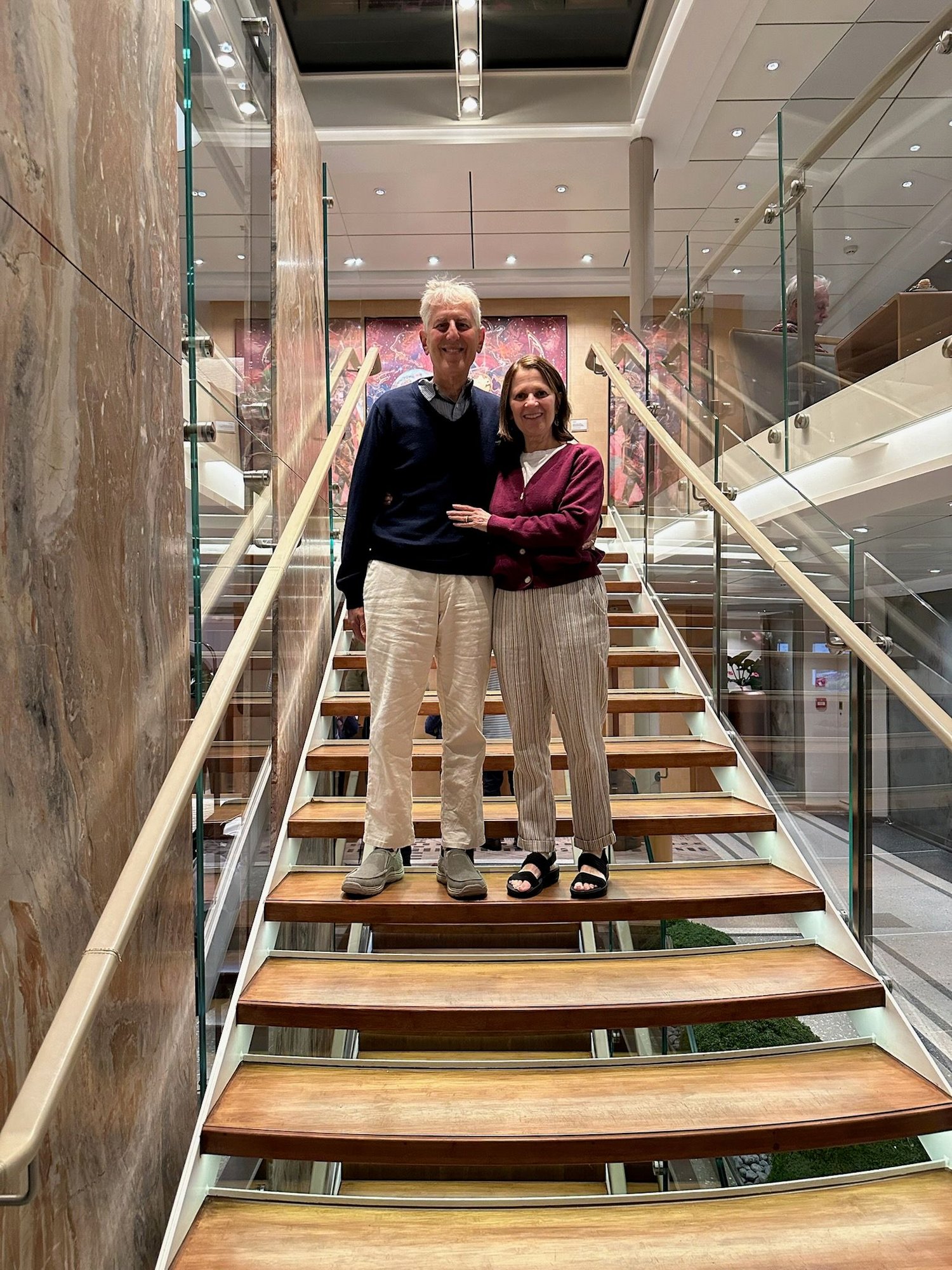
For Fern and me, this was our third Viking cruise, and the Rhine Getaway experience was just as exceptional as our two prior Viking cruises – the Danube and Alaska.
The Rhine is one of Europe’s predominant waterways, offering spectacular picturesque cruising. Our week was full of great tours and exceptional food, tailored to our diet.
Friday: Fern and I took an Uber from our hotel in Basel, Switzerland, to the Viking Cruise port at St. Johann 1. We then were welcomed onboard by the crew to the Viking Mani. Basel is a logical place to being a Rhine cruise, as it is the Rhine’s farthest navigable point. The Rhine begins as a small stream at the foot of the Swiss Alps.
During the afternoon, we joined a local guide and fellow guests for a leisurely hour walk through Basel’s Old Town (Alstadt). Fern and I had already spent two days (on our own) walking through the cluster of old-town buildings along the hilly riverbank. During this tour, the guide pointed out information about the guild houses of Market Square with their Gothic, Baroque, and Renaissance spender, the striking red-sandstone Rathaus (Town Hall) and the large Muster (Cathedral).
Saturday: In the morning, we went on a four-hour shore excursion to the Black forest. We left the Viking Mani from its docking in Breisach, Germany, for a guided bus-ride of about one hour through the scenic Black Forest region, with its dense, lofty fir forests. The panoramic route went by many wine producing vineyards and beautiful woodlands, with lovely fall colors. This was the included excursion for the day.
We spent several hours at the Black Forest Village at the Hofgut Sternen complex. The complex is located at what was once a major traffic route through the forest.
I went on a short, hilly group hike through the forest by streams and over bridges. I walked under the Ravenna Viaduct, an historic railway viaduct with nine striking sandstone arches. Completed in 1887, portions of the bridge were blown up during the second World War, but later rebuilt.
Fern attended a cuckoo clock demonstration. Then we both watched two glass blowers in action in their workshops. Together our group watched a young woman making the world famous, decadent Black Forest cake, with its layers of chocolate sponge cake, generous drizzles of the locally produced cherry brandy, and dollops of whipped cream. Slices were available for purchase, but we waited to have our Black Forest cake on the Viking Mani!
Fern and I walked by the hotel where Marie Antionnette stayed in May 1770 on her way to marry King Louis XVI. That occasion is commemorated by a colorful mural outside the hotel restaurant. We also walked by St. Oswald’s Chappel, consecrated in 1148. This small chapel is the oldest parish church in the Black Forest.
At the hour, at one of the buildings of the complex, a life size cuckoo clock chimes and announces the hour with mechanical figures (dancers and a woodchopper), as music plays. We returned on the bus through Freiburg, a major university and church center.
In the afternoon, Fern and I selected the optional Comar Medieval Village four-hour excursion. During a short bus ride, we crossed into Alsace region of France. The Rhine serves as the border. The town is a canal-lined gem, with its medieval squares and lanes.
Our one-hour walking tour began at the Museum under the Linden Trees, a converted Dominican monastery from the thirteenth century. Highlights of the stroll through the storybook old town included the smallest house in Colmar called the fly box, a home of 270 square feet, within a block of historic, seventeenth century half-timbered framed houses. One store had my namesake “Schwartz” labeled on the store front. We went through the Little Venice quarter, with its ninth century streets, Our guide explained how the Alsatian town has switched back and forth between German and French control, and still features a colorful mix of French and German Renaissance architecture.
We also walked by a series of Auguste Bartholdi fountains and sculptures, by the creator of the Statue of Liberty, including the 1898 Schwendi fountain honoring the Protestant reformer, and the 1902 bronze sculpture of three allegorical figures – justice, work, and patriotism. Born in 1834, Bartholdi lived in Colmar.
During our free time in Colmar, we visited St. Martin’s church. Built in the thirteenth century, the sandstone exterior of this gothic Roman Catholic church features a towering spire and bell tower. The church’s interior is equally impressive, with its spacious nave, high vaulted ceilings, a gorgeous multi-colored clock, a life-size last supper, and beautiful, colorful stained-glass windows with biblical scenes.
Sunday: We left the Viking Mani from its dock in Kehl, Germany, for our four-hour included excursion in Strasbourg, France. Again, we crossed the border and took a short bus ride into the center of France’s Alsatian region. We drove through the city’s European Quarter, home to the European Union and the Council of Europe.
The one-hour guided walking tour went through delightful Strasbourg’s well-preserved old town. The old town is enclosed on all sides by the little Ill River. The cobblestone streets are lined with half-timbered wooden houses and intersected by picturesque canals. Like Colmar, this delightful city is steeped in French and German culture. Our tour began by walking by a long wooden bridge, the Old Customs House, former fortifications, a former prison, and bridges with defensive towers. Most of the tour took us through charming Petite France, past of the UNESCO heritage site, with its colorful, uneven half-timbered riverside houses, picturesque squares, and small canals.
We spent most of our free time admiring the Romanesque Notre Dame Cathedral of Strasbourg One of Europe’s finest Gothic cathedrals, Notre Dame was the world’s tallest building from 1647 to 1874. The Cathedral was built between the thirteenth and fifteenth centuries. The exterior features many sculptures on its pink sandstone, along with an astronomical clock. The interior contains a long nave, many colorful stained-glass windows dating back to the 12th century with biblical scenes, and a Gothic rosette window. We then took the bus back.
In the afternoon, Fern and I selected the optional four- and one-half-hour Alsatian Wine Tasting excursion. We began with a narrated bus ride along the Alsatian wine route. Our tour then stopped in one of the charming villages along the wine route, Obernal, where we had some free time to wander around. I found a restaurant with my namesake, called Thierry Schwartz. We admired the synagogue (which was not open). The Synagogue Obernai bears some resemblance to a Christian church. Tragically, the Jewish community, which had existed since the 13th century, suffered persecution and decimation at the hands of Nazi forces during World War II. On this day, the town was tranquil.
The Alsatian wine making tradition blends French and German techniques handed down through the centuries. We were told that the fine white wines produced here rival the crisp Rieslings of neighboring Germany. At the C & Y Zeyssolff winery in the town of Gerwiller, we toured the cellar with its huge century old oak barrels. The wine growers introduced us to local wines and described the history of harvesting and wine growing in the region. Zeyssolff is a family wintery dating back to 1778. We watched a film explaining the history of the winery over the years. We tasted five vintages and enjoyed tasty local bread. Prices in this wine shop were very reasonable. This excursion exceeded our expectations. We then headed back to the Viking Mani on the bus.
Monday: We took a bus from the dock in Speyer, Germany, to the town on the west bank of the Rhine. The included three-hour tour took place during a rainy morning. Speyer was once a major Celtic center.
We began the one-hour guided walk by a large sculpture featuring the four rulers of the Holy Roman Empire from 1024 to 1125 who are buried in the Speyer Cathedral nearby: Conrad II, Henry III, Henry IV, and Henry V. Then we entered the large Romanesque Imperial cathedral, a UNESCO world heritage site, built in the eleventh century. The exterior of the Catholic cathedral is in red sandstone, with a Mount Olives sculpture at the front. Reconstructed after Louis XIV’s invasion, its four towers and two domes dominate the skyline. Inside, a large pipe organ sits above the main bronze door entrance. The original Romanesque style is evident in the clean stone, the columns and arches, and the impressive scale of the structure. The floor plan is in a cross shape. There is no stained glass here, but there are lovely colorful frescoes of biblical scenes.
In our free time, we visited the Jewish quarter, Schpira historical museum, and courtyard. This historic collection of buildings consists of the remains of the medieval synagogue from 1104 and the well-preserved 33-foot deep mikveh bath from around 1126. This area forms the medieval heart of the Jewish quarter in Speyer. At that time, Speyer, along with Worms and Mainz, were important Ashkenazic Jewish communities. Sadly, most of the Jews from these communities were killed during World War Two, but a new community has now formed. The museum receptionist provided us with information about the museum’s paintings and sculptures. We also watched a short video about Speyer’s Jewish heritage.
We then returned by bus to the Viking Mani. During the afternoon, as we sailed along the Rhine, Fern and I listened to Captain Huub’s nautical talk about World War Two on the Rhine. Next, we sat in on a demonstration in the lounge to learn how to make (and then drink) Rudesheim coffee. This coffee drink includes coffee, brandy, sugar, dark chocolate, and whipped cream. This was followed by teatime, with a nice selection of organic teas.
In the early evening, we arrived in Rudesheim, Germany, and had time for a stroll on our own. Rüdesheim has retained its small-town riverside charms, by the Rhine and along the Drosselgasse, a narrow cobblestone pedestrian way with restaurants, wine bars, taverns, and stores. Fern and I walked below the Schloss Johannisberg estate, set amid Germany’s renowned wine-making region. Its vineyards skirt the estate’s grounds for acres and have been prolific for 900 years. Other intriguing buildings included the tower of the Overburg castle, the highest point in Rudesheim, from the ninth century, and the Adlerturm tower, each at respective ends of the small town.
Tuesday: During the morning, we enjoyed sailing on the Middle Rhine, as the river flows through one of Germany’s most scenic regions. As we sailed through its most picturesque stretch, the UNESCO World Heritage Site of the Middle Rhine, we passed vineyard-blanketed hills and a series of splendid castles that lined the banks. For about two and one-half hours, we stood on the top deck as the tour director provided narration and commentary about the castles and their current use (including hotels or restaurants). We particularly were interested in the tunnels disguised as castles to avoid being bombed in World War II. Fern and I followed along the mile markers along the Rhine, which were listed by Viking in their brochure identifying each castle. This was a cruise highlight!
In the afternoon, we went on the two-hour included excursion into historic Koblenz, Germany. For about one hour, we went on a guided walk. We began the tour at Deutsches Eck, the city’s famed German Corner, where the Rhine and Moselle Rivers meet. This public park is home to a popular large equestrian statue of Emperor Wilhelm I. As we walked through the narrow streets of the old town, highlights included three original pieces from the Berlin Wall, now a monument to the reunion of West and East Germany. The guide pointed out the bronze spitting boy fountain (also known as the Schangel fountain), built in 1941, which is a statute of a little prankster who periodically spits on surprised tourists. At the base of this locally famous statue from 1940, there are little boys engaging in other forms of mischief. In one square, a mural created by Holger Weinandt depicts Koblenz in 860 with flags and medieval figures.
In our free time, we toured the Church of our Lady, the town’s central Catholic parish church which dates to the fifth century. The exterior blends various architectural styles, with two striking onion domes. Inside, the stained-glass windows are colorful and quite stunning. Fern and I were surprised to see a large Hebrew gravestone within the church, which we were told was symbolic of the kinship between the Jewish and Christian religions. A beautiful rose window rises high above the organ.
Wednesday: Because our docking was right by the historic city of Cologne, we were able to walk over to our three-hour included tour in the morning. Cologne is the fourth largest city in Germany, and the only cruise stop where Fern and I wished we had more time to explore.
Our walking tour began at the old fish market, a small square featuring colorful old houses and the fishwife’s fountain. The 1986 fountain, with its four sad-looking fish wives, is a reminder of the former fish market that used to be located close to the Rhine. Highlights of the walking tour included above-ground Roman ruins, the 1899 fountain of legendary pixies (or elves), the small equestrian statue of St. Martin handing his cloak to a beggar, and the small beer waiter statute in front of a Cologne brewery. Most of the tour went through the old town. The tour ended at the railway and pedestrian bridge that crosses the Rhine, adorned with statutes of Prussian kings on horseback at both ends of the bridge.
In our free time, we first toured the magnificent 13th-century Cologne Cathedral, a stunning example of Gothic artistry and a UNESCO World Heritage Site. Our guide told us that construction of the largest Gothic cathedral in northern Europe began in 1248 and continued in stages over the next seven centuries. Having survived Allied bombs during World War II, the Cathedral’s imposing twin spires are easily visible throughout Cologne. The Cathedral’s stained-glass windows with biblical scenes fill the interior with brilliant colored light. Because a religious service was going on, we could not go down the long nave, but we were able to hear the playing of the large organ above the nave.
We then spent our free time at the NS documentation center. The former Gestapo headquarters, with its prison in the two basement levels, includes preserved cells and tells the sad story of the detainees. Only one detainee, Askold Kurow, was able to escape. The permanent exhibition extends over two floors, using videos, photos, and other media to outline the rise of the Nazis in Cologne, prior to and during World War Two. The museum staff answered our questions about Jewish life today in Cologne, now with about 5000 Jews. Unfortunately, we did not have enough time to fully explore the museum’s exhibits.
About 8000 Cologne Jewish residents did not survive the war. Throughout Cologne, about 2000 stumbling stones are laid in front of the residences of Jews displaced by the Nazis. Fern and I saw four of these brass plaques in front of the Brezezinski residence, indicating that they were deported from their homes in 1938.
In the afternoon, Fern and I went on the four-hour optional excursion to the Bruhl UNESCO palaces. We took a short bus ride to the Cologne suburb of Bruhl. We arrived first at Augustusburg Castle, which sits at the center of beautifully landscaped grounds. The castle/palace is a vast and splendid example of Germany’s early rococo architecture. Inside the most outstanding features are the grand staircase with its stunning frescoes and the extravagantly decorated rooms and chambers, with their sculptures and period furniture. We learned that the castle/palace was constructed in 1725 for Elector and Archbishop Clemens August as his summer palace.
Next, we had some free time to stroll through the extensive gardens behind the castle. Flowerbeds, fountains, and manicured trees line gravel paths leading to a mirror pool. Designed by Dominique Girard, a pupil of the famous French landscape architect André Le Nôtre (who designed the gardens at Versailles), these gardens embody the elegance and symmetry of French formal design.
Then we took a short bus ride over to the other edge of the grounds to Falkenlust Hunting Lodge. Built between 1729 and 1740, this charming, small Rococo lodge was used by Clemens August for his favorite pastime, falconry. The hunting lodge also features grand, mirrored rooms, and a blue-tiled staircase. Our tour guide also took us to the small chapel on the grounds and the nature reserve which goes between the hunting lodge and the castle.
We spent some time walking through Cologne’s pedestrian-only shopping zone, stopping for coffee/tea and people-watching. Our day ended at the large Lindt Chocolate shop inside the Chocolate Museum. The museum is located on a peninsula on the Rhine. The museum is located within a historic building that formerly was a spice warehouse. The selection of chocolates on offer is very large.
Thursday: In the morning, we had a surprise opportunity to tour Gorinchem, in the Netherlands, on our own. The Viking Mani had arrived early in this South Holland town. Recently voted the most beautiful town in South Holland, Gorinchem is like a mini-Amsterdam, with its small canals, picturesque Dutch houses, and many bicycles. At the meeting of the River Linge as it flows into the Merwede, the town has many scenic spots. Fern and I wandered through the small streets and into several stores for about one hour.
At the entrance to the town, there are a pair of sculpture figures donated by the town’s sister city in South Korea. At the other end of the town, there is a Jewish memorial commemorating the seventy Jewish residents killed in World War II, identifying them by name. The stone memorial features a large menorah, with candles.
In the mid-afternoon, we joined the three-hour included excursion into Kinderdijk, in the Dutch countryside. Kinderdijk is a village community in South Holland, shaped by Rhine Delta waters. The town is most known for its 19 remarkably preserved 18th-century windmills. The charming hamlet is located amid low-lying polder lands, tracts reclaimed from the sea by the power of the legendary windmills and enclosed by dikes.
From the pier, we were able to walk over to the windmills, along paths below sea level. We learned that this is the largest concentration of windmills in the Netherlands. Fern and I were able to go within a working windmill, climbing up a steep ladder to view its mechanics and living quarters. This is another UNESCO world heritage site. The working windmills are part of the water management system to prevent flooding.
Friday: Shortly after we arrived at the port in Amsterdam, the Viking staff took us by bus to Schipol airport. Since Fern and I had previously spent a week in Amsterdam, we chose not to extend our trip. We had a nonstop flight home to Dulles airport.
Dining: Breakfasts: Sit down breakfasts began at 7 a.m. in the restaurant. Each day we enjoyed fresh fruit, oatmeal, and granola. Non-dairy milk and coffee drinks were available for us. Lunch: Most days lunch begins at 12:30 p.m. in the restaurant. We ate salads with fresh vegetables, such as beets and tomatoes. Dinners: Sit down dinners begin at 7 p.m. in the restaurant. We chose different fresh fish each day, along with a variety of side dishes and desserts. The chocolate tort cake was especially delicious.
Entertainment: Live piano music takes place from 5 p.m. to 6:15 p.m. most evenings. Later in the evenings, beginning at 9 p.m., there was a piano player in the lounge. Several evenings there were lively trivial contests and on a few evenings, there was live music brought in from the local towns.
Final thoughts: The weather was mostly cloudy during the cruise, with a little rain, and highs in the mid-50s Fahrenheit. Once again, the Viking staff, with exceptional tour guides and on-board service, gave us a memorable trip.
Our suite room gave us enough space to do morning exercises. We also took advantage of the track on the top deck to do some walking.
All of the Viking crew, in the restaurant and throughout the ship, were extremely receptive and responsive to our needs and questions.

 Nov 11th, 2025 | 09:24 PM
#3

Joined: Jan 2007
Posts: 3,515
Likes: 0
Awesome trip report! It sounds like you had quite a lot of discretionary time on your cruise. I have never done cruises before - is there much of a sensation of being on the water in a river cruise? I don't think I could cruise on the open water but might one day be persuaded to do a river cruise.
Maybe you will get back to Cologne. There are a lot of museums left to conquer. Last time I was there (not that I go often, but I have been a couple of times) my daughter and I went to Haus Farina, a perfume museum. Highly recommended!
Lavandula
Maybe you will get back to Cologne. There are a lot of museums left to conquer. Last time I was there (not that I go often, but I have been a couple of times) my daughter and I went to Haus Farina, a perfume museum. Highly recommended!
Lavandula


