


Ascending the Blue Dragon: Traversing Vietnam from South to North

 May 1st, 2025 | 09:12 PM
#42
Original Poster

Joined: Sep 2012
Posts: 3,517
Likes: 0
milosmitrovic3921, we arranged a day trip to My Son through our hotel in Hoi An. For our trip to the Ba Na Hills, we hired a taxi driver through Grab, the Uber of SE Asia, although from Danang, which is much closer. You can visit both as well as the Marble Mountains from Hoi An, although probably on different days. If your accommodations cannot make arrangements for you, there are numerous travel agencies on the two main streets in Hoi An's Old Town that are able to do it. When we were there we saw advertisements for My Son, the Marble Mountains, the Ba Na Hills, Monkey Mountain / Ling Unh Temple, as well as the Cham Islands. There are day trips to Hue as well, but I wouldn't recommend it due to the distance from Hoi An (3 hours each way).
May 1st, 2025 | 10:24 PM
#43

Joined: Mar 2009
Posts: 895
Likes: 0
tripplanner001 - I really enjoyed your trip report it brought back a lot of memories of our Vietnam trip, 6 years ago. I did have to laugh about some of the "Communist" country remarks because we didn't have any bad experiences due to being in a Communist country. We did find that Hanoi was a little more stiff than southern Vietnam. We also didn't feel any anti-American feelings due to the war. We encountered so many young people who might have read about the war as it sounds like you did. Vietnam has been invaded by so many countries, America was just another pick a number invader.
May 1st, 2025 | 10:36 PM
#44
Original Poster
Joined: Sep 2012
Posts: 3,517
Likes: 0
Tdiddy12, I'm glad my report helped you relive some happy memories of Vietnam. I suppose I am not surprised to hear that people in Hanoi may be a bit more reserved or cautious given the proximity to central power. We've experienced this in other countries too, particularly in Central Asia.
May 3rd, 2025 | 08:35 AM
#45
Original Poster
Joined: Sep 2012
Posts: 3,517
Likes: 0
Heaven on Earth
After a 7-hour drive from Phong Nha to Ninh Binh yesterday, we took it easy the rest of the day, relaxing at our beautiful rooms at Tam Coc Garden Resort overlooking the rice paddies and enjoying a couple of drinks at the hotel bar.
Today was a very full day in Ninh Binh. We ate a good breakfast at our hotel at 6:30 AM and were out the door by 7:30 AM. We began our day at Mua Caves. In spite of the name of the site, the attraction is above ground. We enjoyed a leisurely walk along the boardwalks of the lotus garden, taking in the incredible scenery of limestone cliffs all around us. From there we ascended one of the mountains, hiking all the way up to the top with a pagoda in honor of Quan Am and a dragon god. We savored the picturebook perfect views of mountains that looked like it was lifted out of a classical Chinese or Vietnamese landscape painting, large valleys dotted with rice paddies all around us, and temples and pagodas peeking out like exclamation points. After some time at the top we descended to a saddle and then hiked up to another high point for more views. While the hike was not difficult (about 500 steps in all), it was somewhat exhausting as the humidity was intense. As a matter of fact, the humidity (in the 80% and 90% range) has been intensive every day we've been north of the DMZ.
Anyway, after about two hours at Mua Caves, we headed by car to Bai Dinh Temple, one of the largest if not the largest active Buddhist temple in Southeast Asia. The temple was stunning and meaningful, especially for us worshippers. From the ticket gate, we hopped on electric golf carts that took us to the temple gate. The massive wooden structure were flanked by two huge statues of Buddhist gods. From here we proceeded through a hall of 500 areas to reach a giant bell tower and a successful of temple buildings: the first to Quan Am, the second to the Buddha, and the third to the Buddha in his three phases (present, past, and future). Each of the halls were home to gigantic wood carved statues covered in gold leaf. Smaller statues adorn the halls as well as geometric designs and classical Chinese poetry. We also visited a 13-story pagoda for incredible views of the temple complex as well as the surrounding landscape. We spent about 3 hours here but really could have stayed the entire day.
We ate a delicious lunch of traditional Vietnamese dishes including grilled mountain goat, the local specialty, at Truong An Restaurant, before visiting what is left of what was Hoa Lu, a capital of Vietnam in the 10th and early 11th centuries. All that still stands are two temples, one dedicated to the Dinh Dynasty rulers who governed the country from Ninh Binh, and its successor, the Le Dynasty.
We ended the day with a peaceful two-hour boat ride along the waterways of Trang An. We sat in the boat and watched the limestone mountains glide by. We also passed through several caves and sailed by temples from long ago. The water was as smooth as glass and the light breeze made the journey very comfortable. As it's a peak holiday weekend in Vietnam, the place was buzzing with Vietnamese tourists from all over the country, but the crowds did not detract from the visit. Once we were on the water and sailed, the waterways were large enough that for large stretches there were only one or two other boats nearby. We felt as if we were inside a landscape painting of yesteryear. What a relaxing day to end the day and give our legs some rest.
Dinner was back at our hotel followed by after-dinner drinks by the pool.
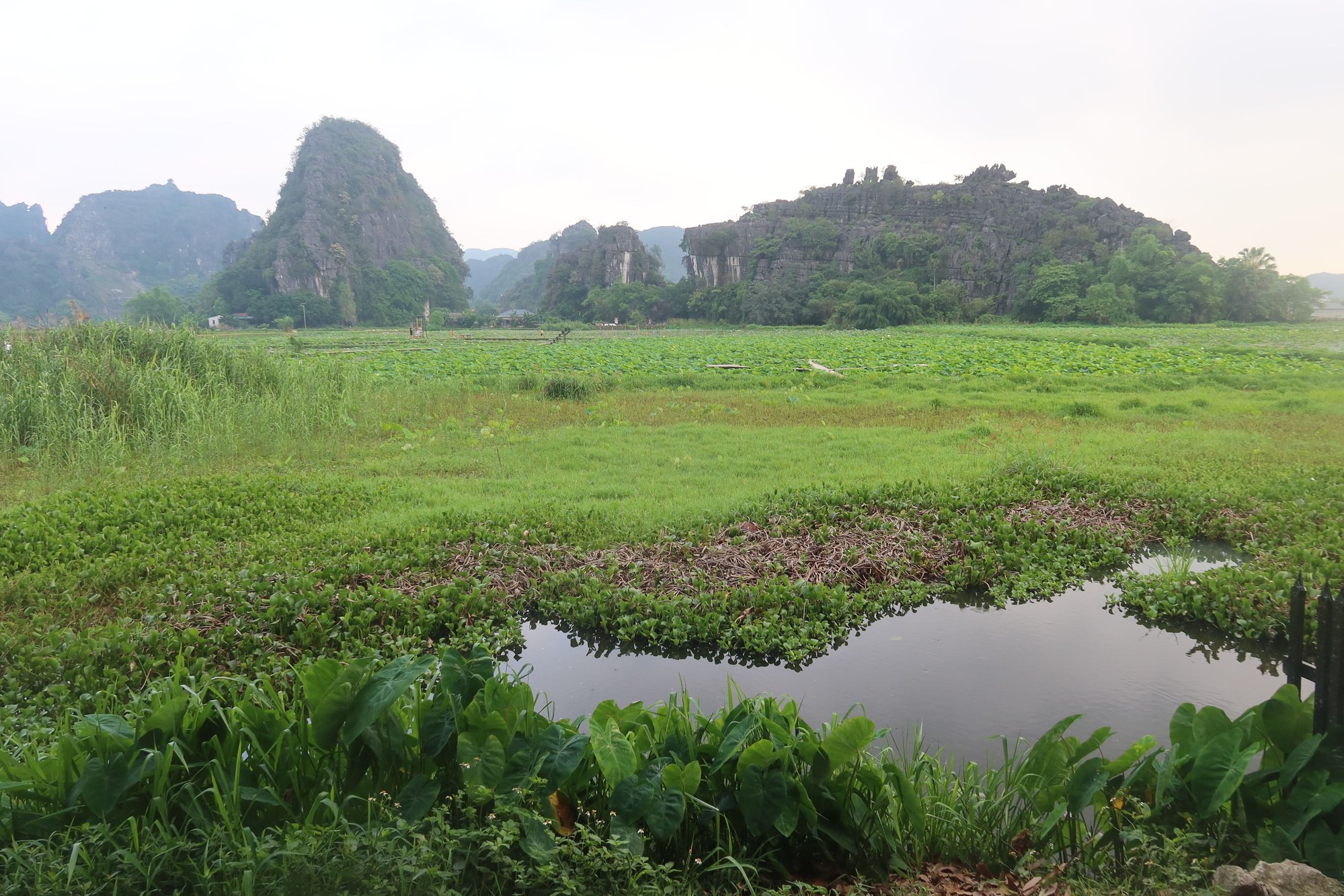
Ninh Binh Landscape

Lotus Pond, Mua Caves

View from Mua Caves Viewpoint

Pagoda, Mua Caves
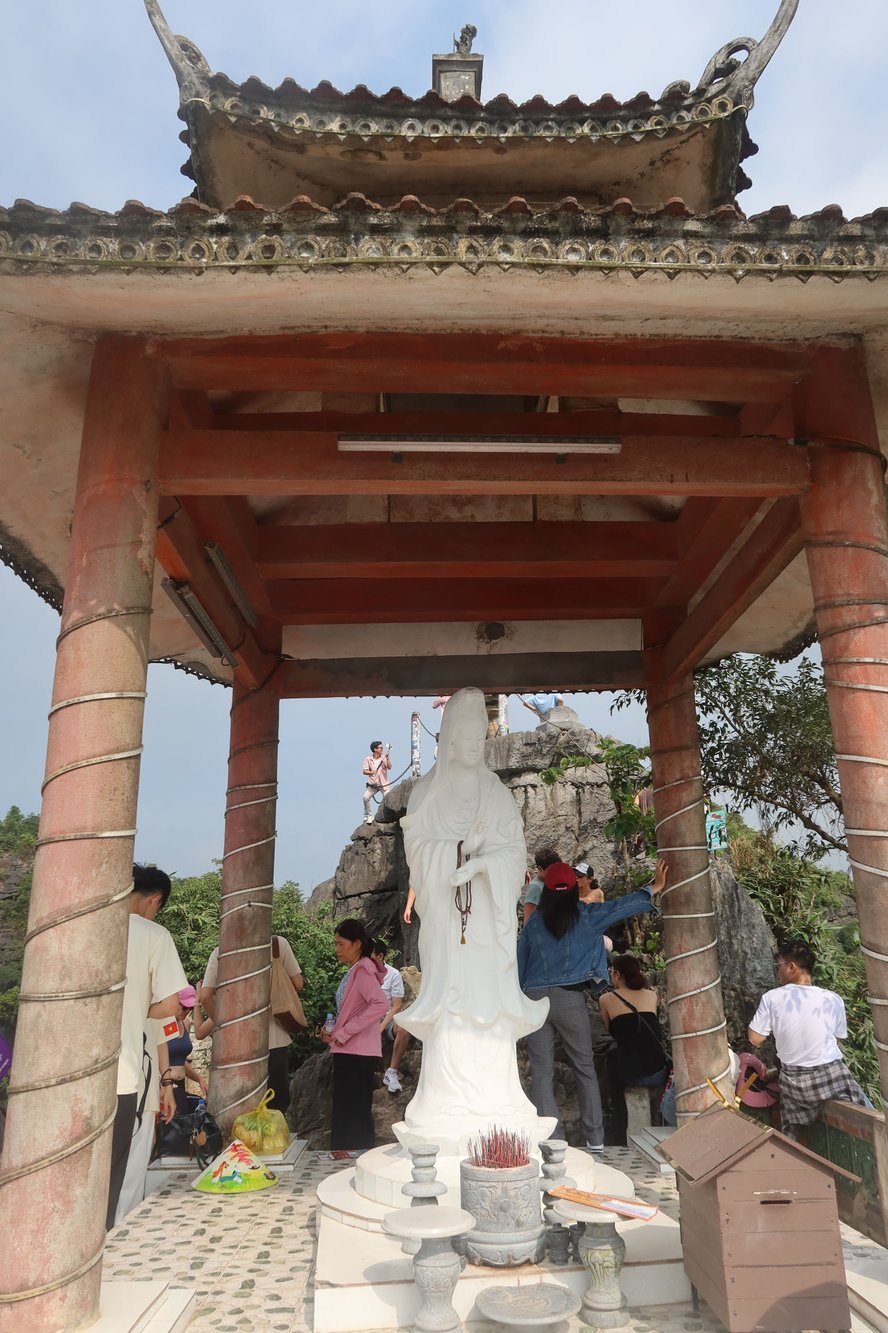
Quan Am atop Mua Caves
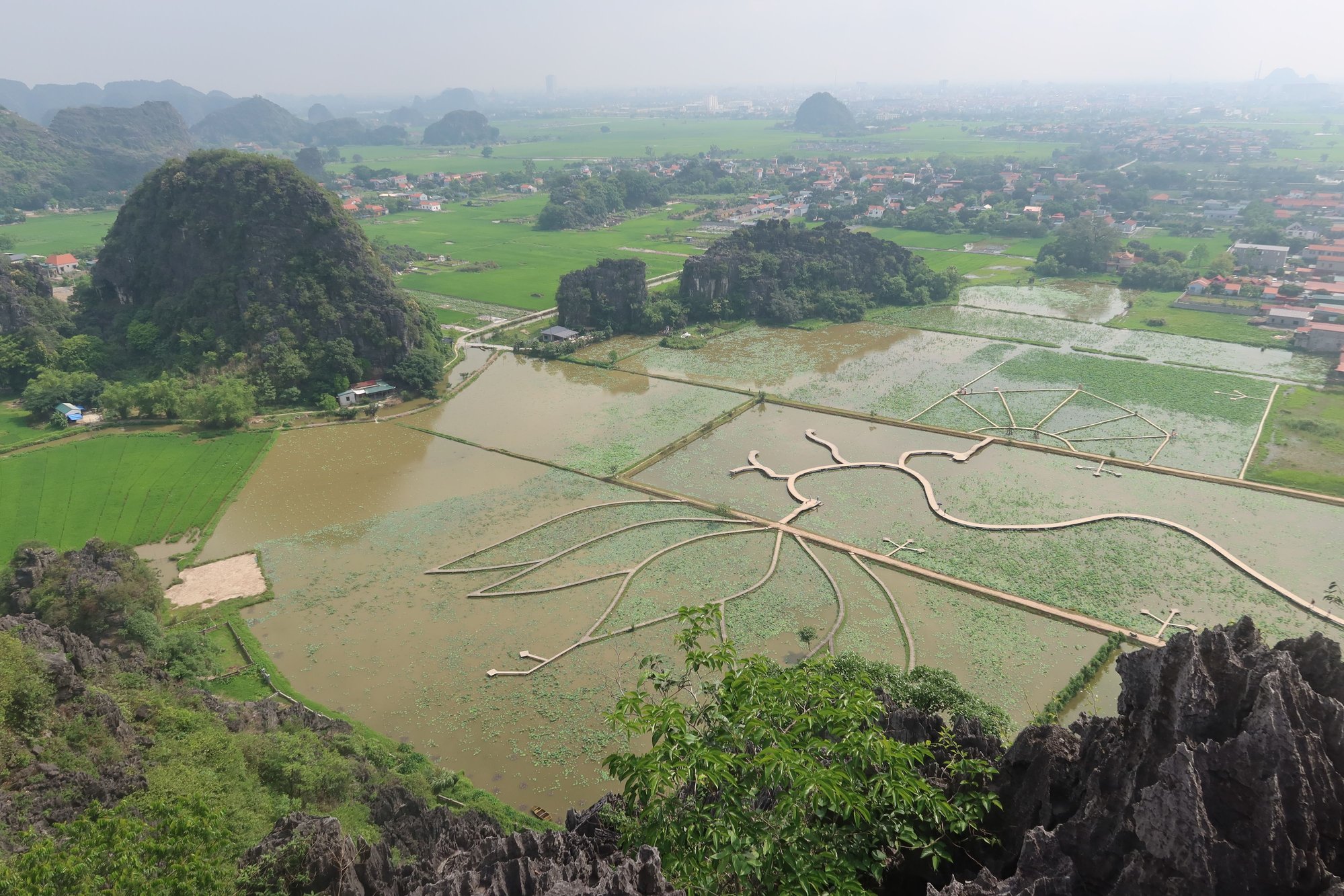
Landscape from Mua Caves Viewpoint
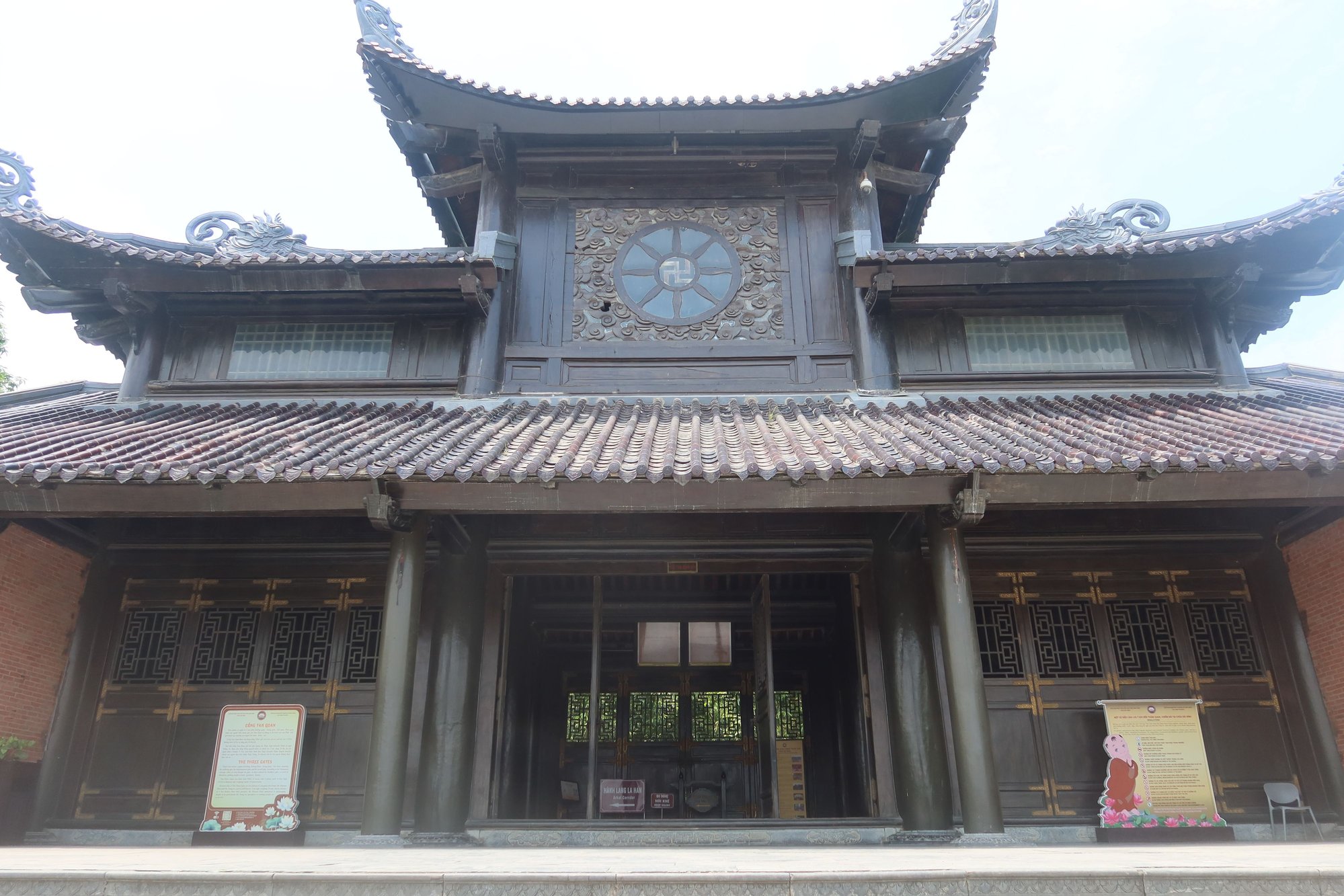
Entrance Gate, Bai Dinh
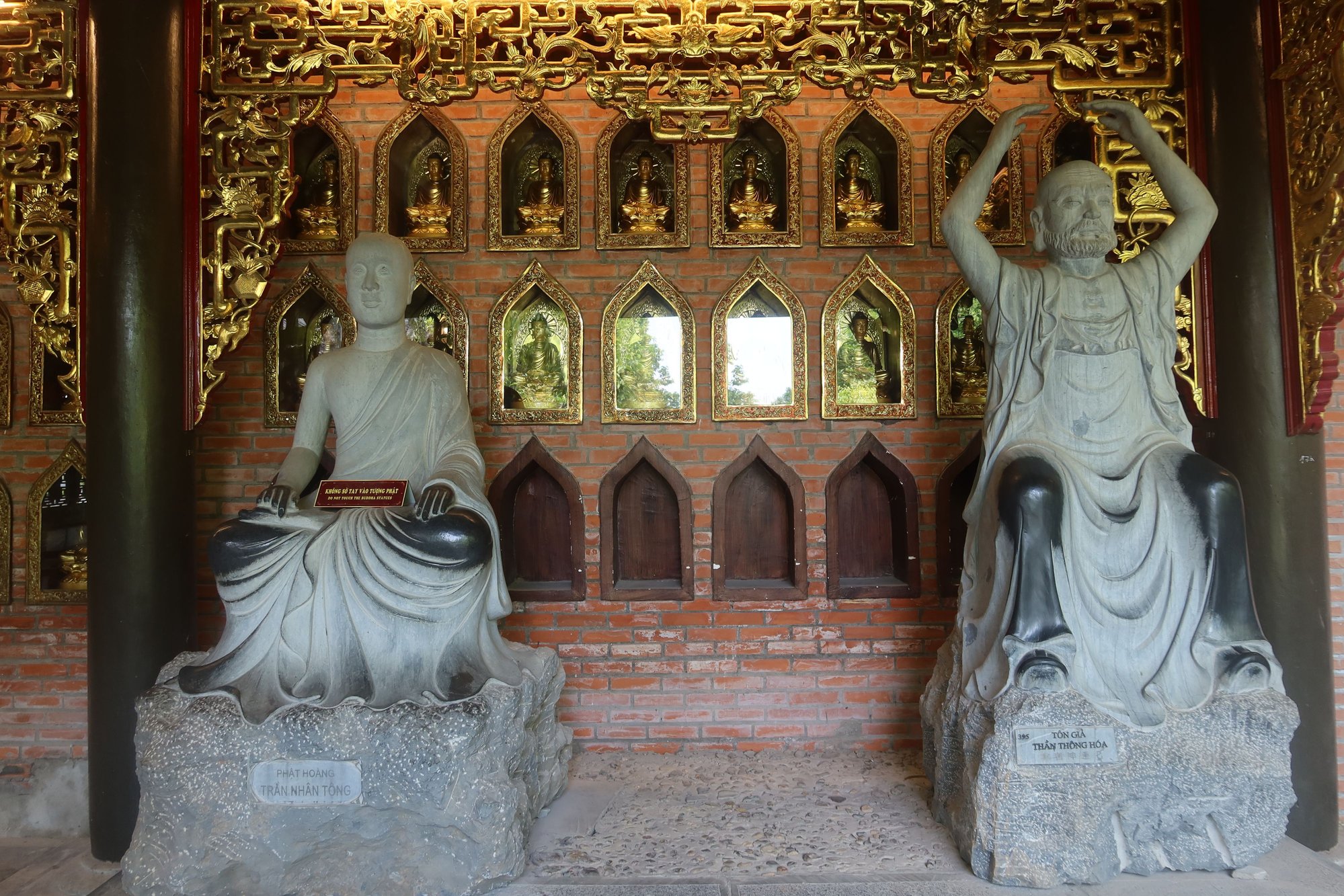
Arbats, Bai Dinh
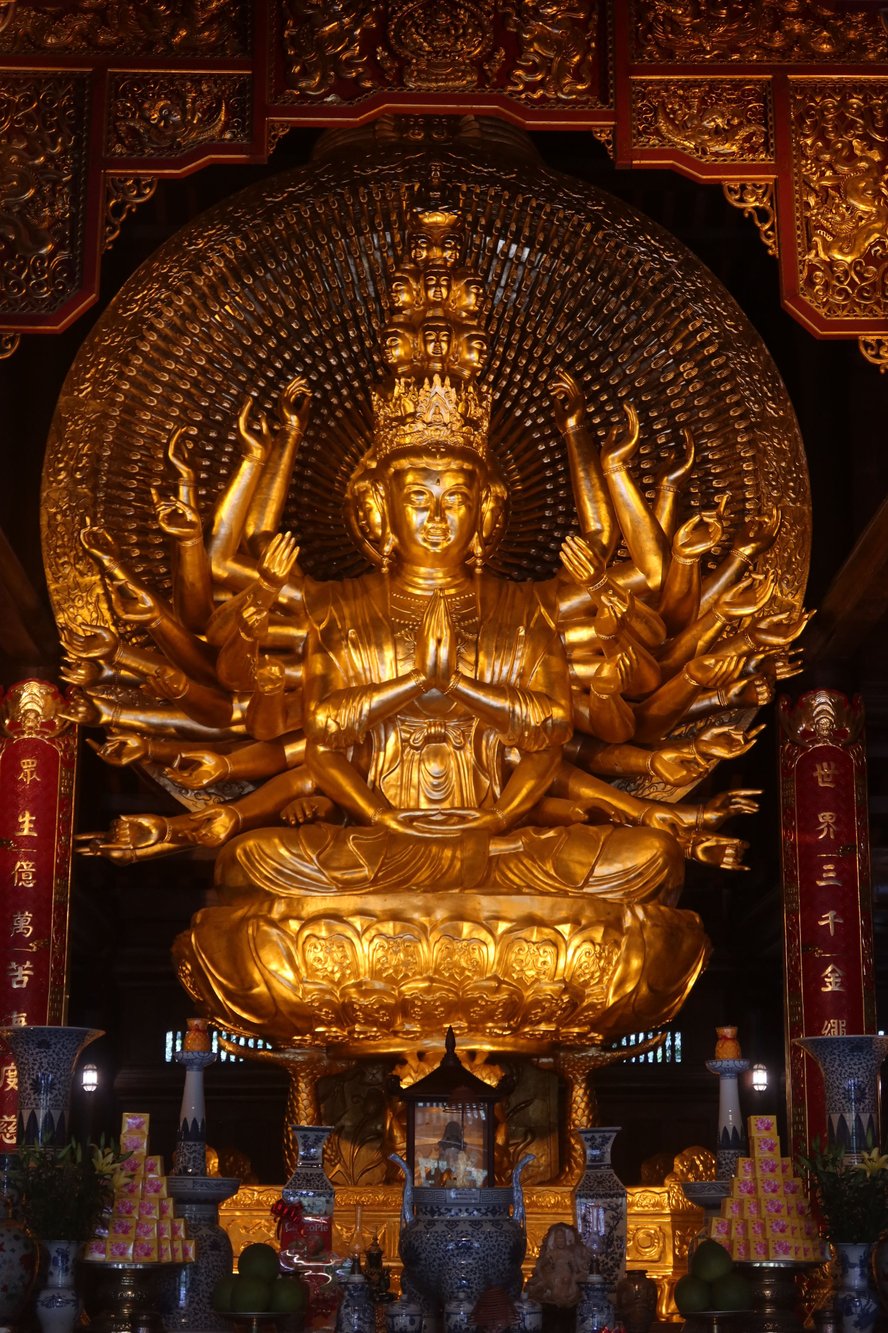
Quan Am, Bai Dinh
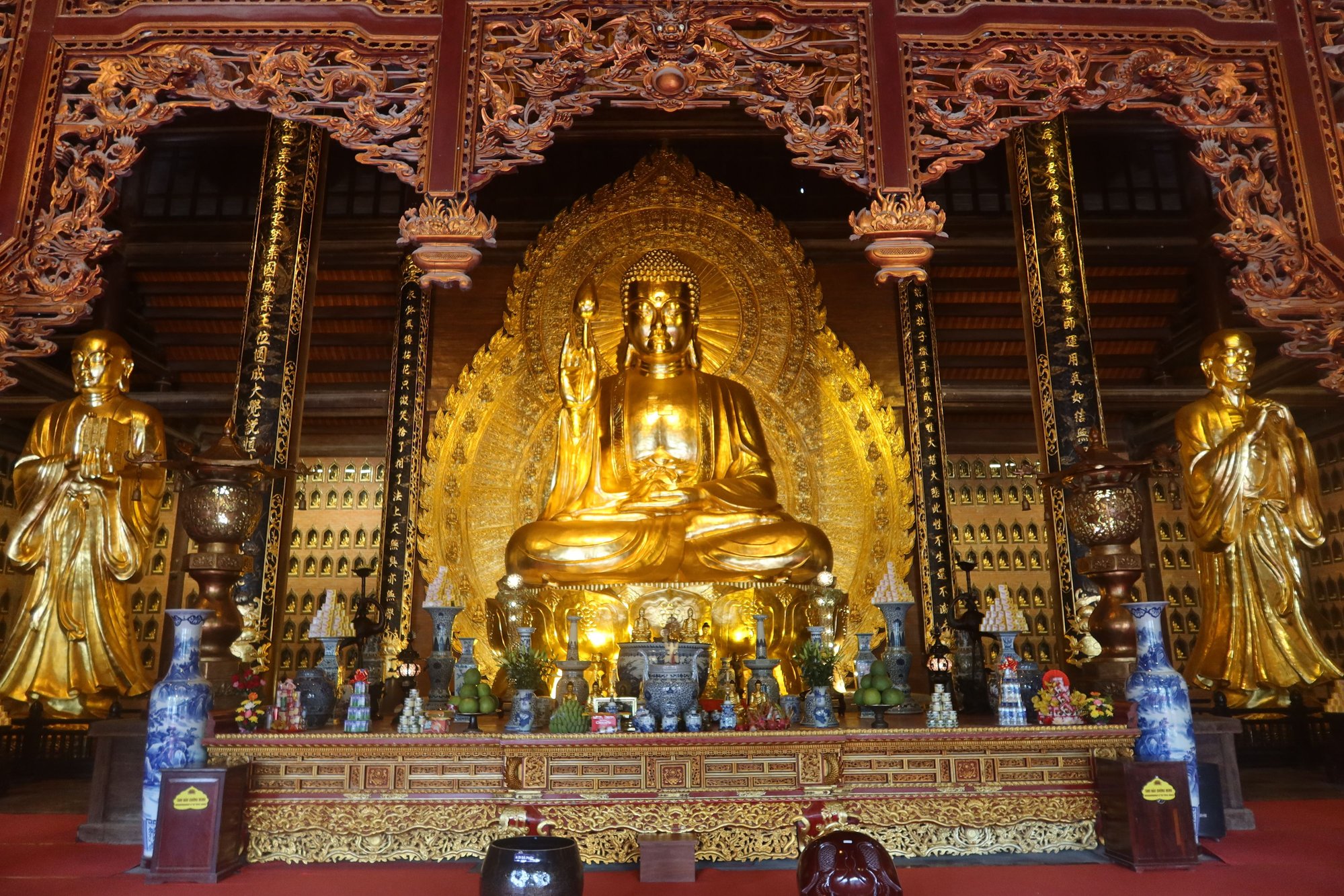
Buddha, Bai Dinh

Pagoda, Bai Dinh

Trang An Landscape
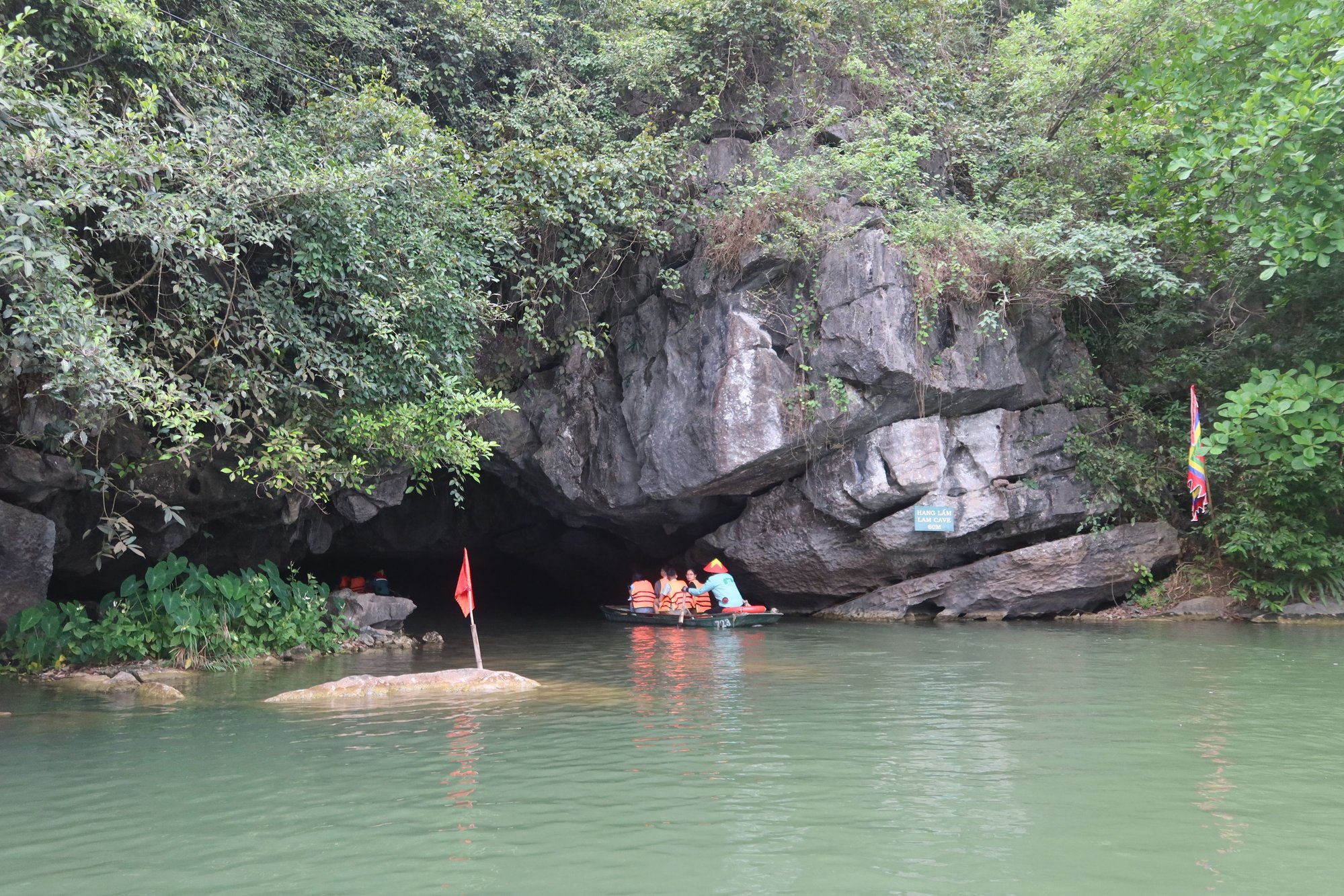
Entrance to One of the Caves at Trang An

Inside One of the Caves at Trang An

Limestone Closeup, Trang An
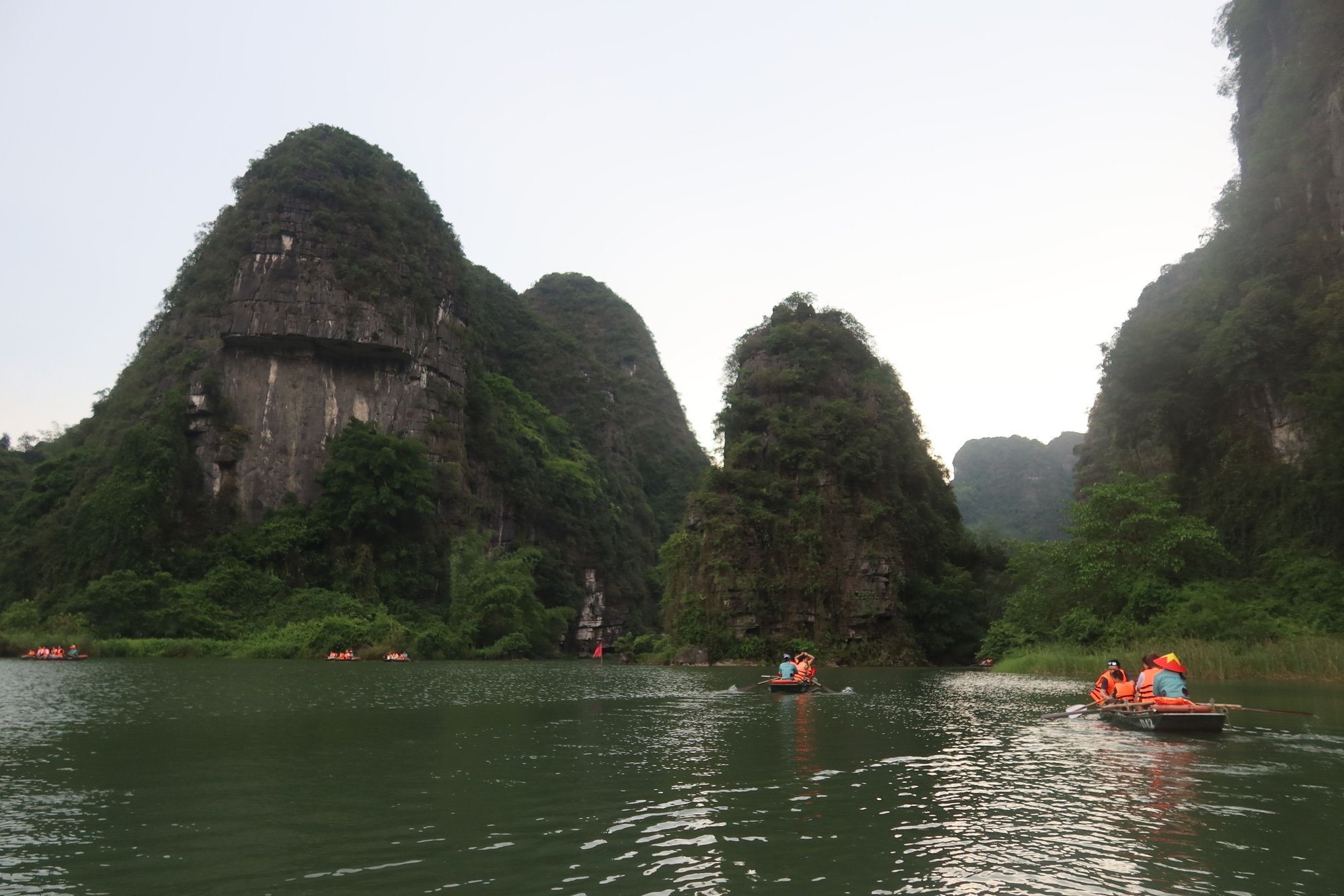
Trang An Landscape
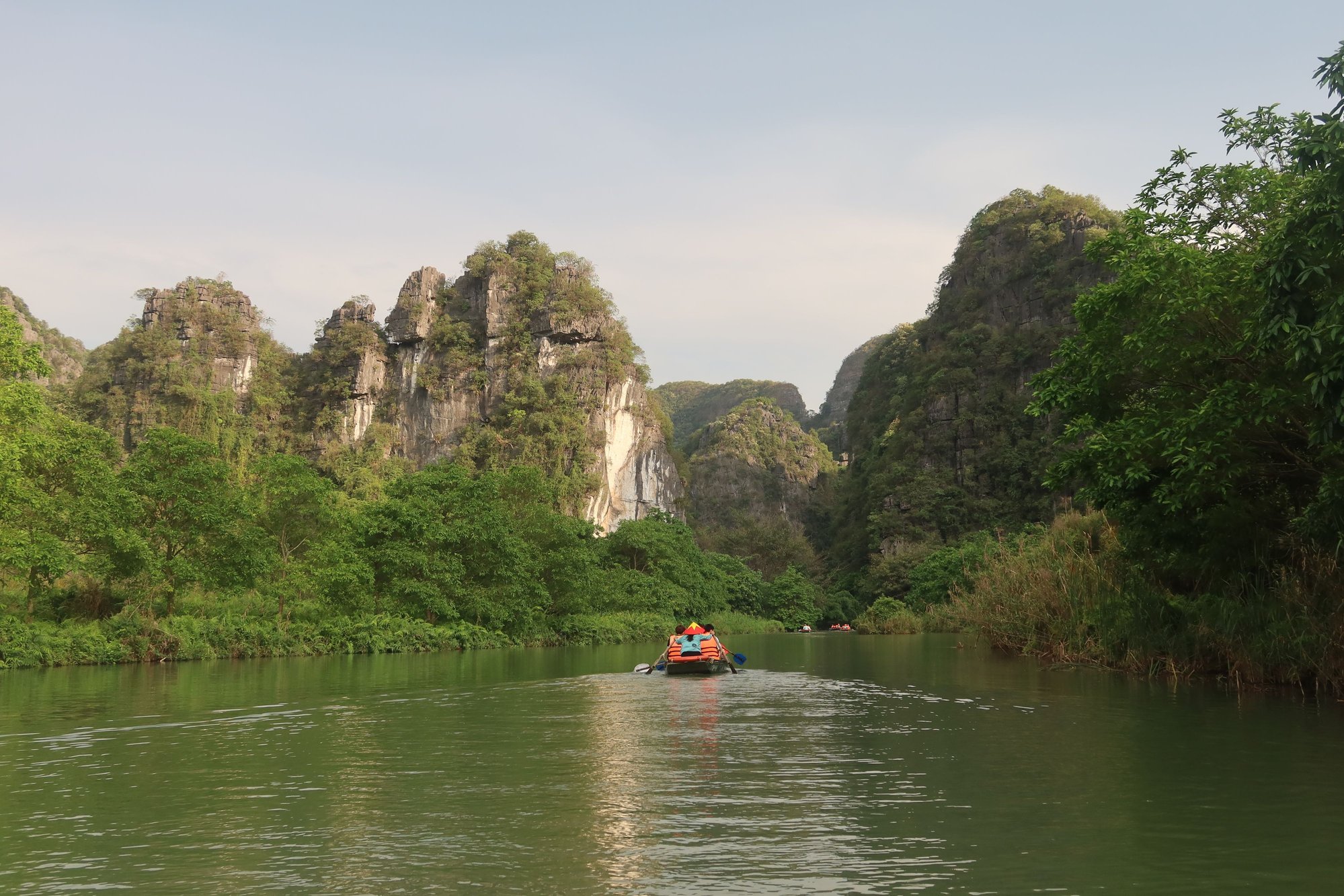
Trang An Landscape
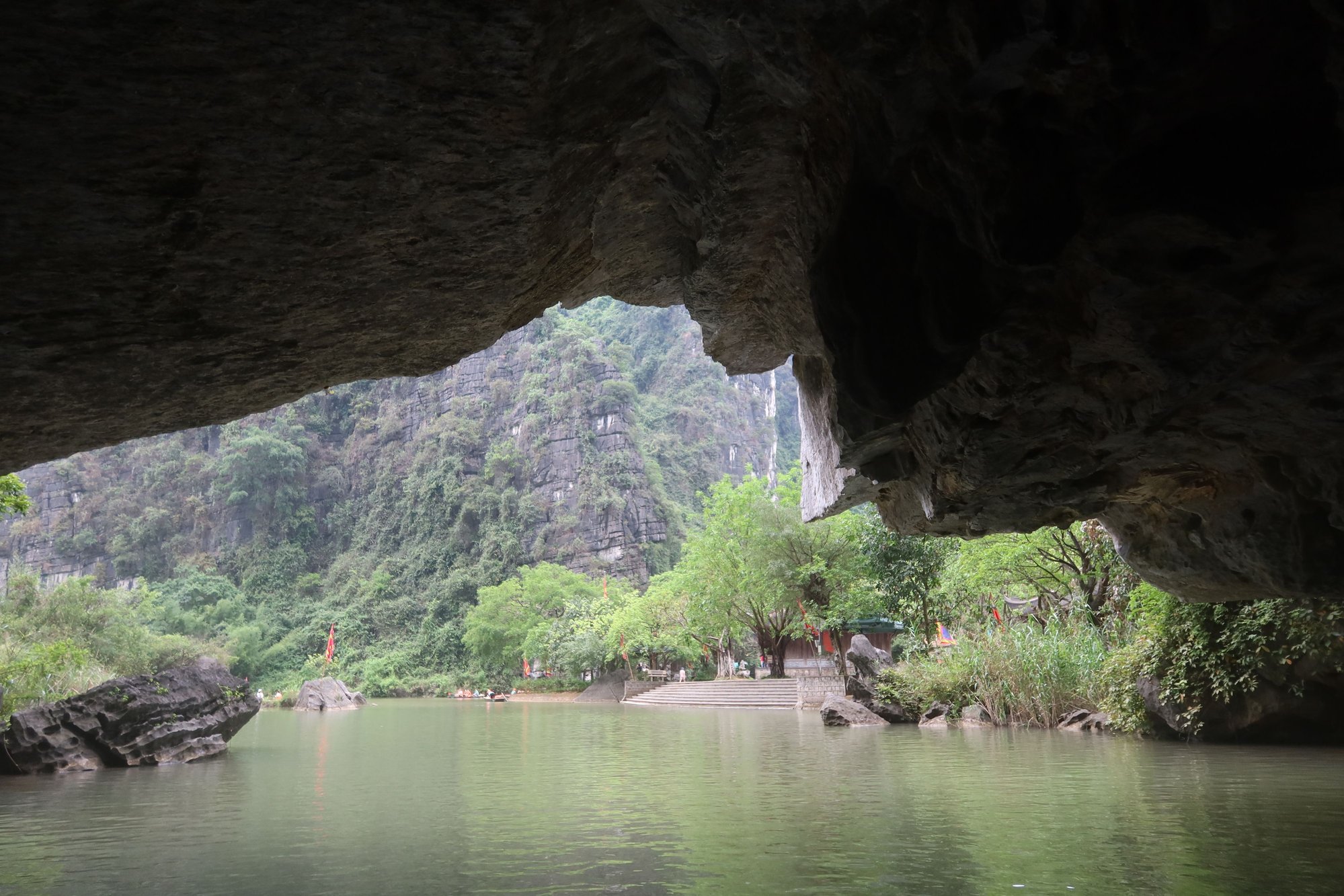
Coming Out of Cave at Trang An
After a 7-hour drive from Phong Nha to Ninh Binh yesterday, we took it easy the rest of the day, relaxing at our beautiful rooms at Tam Coc Garden Resort overlooking the rice paddies and enjoying a couple of drinks at the hotel bar.
Today was a very full day in Ninh Binh. We ate a good breakfast at our hotel at 6:30 AM and were out the door by 7:30 AM. We began our day at Mua Caves. In spite of the name of the site, the attraction is above ground. We enjoyed a leisurely walk along the boardwalks of the lotus garden, taking in the incredible scenery of limestone cliffs all around us. From there we ascended one of the mountains, hiking all the way up to the top with a pagoda in honor of Quan Am and a dragon god. We savored the picturebook perfect views of mountains that looked like it was lifted out of a classical Chinese or Vietnamese landscape painting, large valleys dotted with rice paddies all around us, and temples and pagodas peeking out like exclamation points. After some time at the top we descended to a saddle and then hiked up to another high point for more views. While the hike was not difficult (about 500 steps in all), it was somewhat exhausting as the humidity was intense. As a matter of fact, the humidity (in the 80% and 90% range) has been intensive every day we've been north of the DMZ.
Anyway, after about two hours at Mua Caves, we headed by car to Bai Dinh Temple, one of the largest if not the largest active Buddhist temple in Southeast Asia. The temple was stunning and meaningful, especially for us worshippers. From the ticket gate, we hopped on electric golf carts that took us to the temple gate. The massive wooden structure were flanked by two huge statues of Buddhist gods. From here we proceeded through a hall of 500 areas to reach a giant bell tower and a successful of temple buildings: the first to Quan Am, the second to the Buddha, and the third to the Buddha in his three phases (present, past, and future). Each of the halls were home to gigantic wood carved statues covered in gold leaf. Smaller statues adorn the halls as well as geometric designs and classical Chinese poetry. We also visited a 13-story pagoda for incredible views of the temple complex as well as the surrounding landscape. We spent about 3 hours here but really could have stayed the entire day.
We ate a delicious lunch of traditional Vietnamese dishes including grilled mountain goat, the local specialty, at Truong An Restaurant, before visiting what is left of what was Hoa Lu, a capital of Vietnam in the 10th and early 11th centuries. All that still stands are two temples, one dedicated to the Dinh Dynasty rulers who governed the country from Ninh Binh, and its successor, the Le Dynasty.
We ended the day with a peaceful two-hour boat ride along the waterways of Trang An. We sat in the boat and watched the limestone mountains glide by. We also passed through several caves and sailed by temples from long ago. The water was as smooth as glass and the light breeze made the journey very comfortable. As it's a peak holiday weekend in Vietnam, the place was buzzing with Vietnamese tourists from all over the country, but the crowds did not detract from the visit. Once we were on the water and sailed, the waterways were large enough that for large stretches there were only one or two other boats nearby. We felt as if we were inside a landscape painting of yesteryear. What a relaxing day to end the day and give our legs some rest.
Dinner was back at our hotel followed by after-dinner drinks by the pool.
Ninh Binh Landscape
Lotus Pond, Mua Caves
View from Mua Caves Viewpoint
Pagoda, Mua Caves
Quan Am atop Mua Caves
Landscape from Mua Caves Viewpoint
Entrance Gate, Bai Dinh
Arbats, Bai Dinh
Quan Am, Bai Dinh
Buddha, Bai Dinh
Pagoda, Bai Dinh
Trang An Landscape
Entrance to One of the Caves at Trang An
Inside One of the Caves at Trang An
Limestone Closeup, Trang An
Trang An Landscape
Trang An Landscape
Coming Out of Cave at Trang An
Last edited by tripplanner001; May 3rd, 2025 at 08:52 AM.
May 4th, 2025 | 06:52 AM
#46
Original Poster
Joined: Sep 2012
Posts: 3,517
Likes: 0
Heaven on Earth, Part II
We awoke to another day in heaven, with mountains and rice paddies right outside our bedroom windows. We enjoyed some coffee on the terrace before filling up our bellies for breakfast. Our sightseeing agenda was light this morning, consisting of two temples. We visited Bich Dong first. The temple consists of three buildings with the first accessed by a flight of stairs, the second built into the entrance of a cave, and the third at the summit. Built to honor Quan Am, the Buddha, and others in the pantheon, we worshipped, took some photographs, and just savored the incredible scenery.
From there we visited Thai Vy Temple, built to honor the emperors of the Tran Dynasty. The Confucian temple is laid out similar to those temples honoring the Dinh and Le Dynasties at Hoa Lu yesterday. We toured the temple and walked along the path by the Tam Coc River, watching the riverboats glide by.
After the two temples, it was back to our hotel for some rest and relaxation before embarking on our afternoon hike of the surrounding countryside near our hotel. We hiked the mountain overlooking our hotel with the help of a local guide. The ascent through jungle, via man-made steps, took about 45 minutes. Along the way, the guide pointed out medicinal plants and explained its uses to us. During the hike up, we caught glimpses of the surrounding peaks. As we were making our way down the back side of the mountain towards the Sunshine Valley, the sky suddenly opened up. We were experiencing an isolated and unexpected thunderstorm, lasting just over half an hour. Luckily there was a limestone overhang, where we sheltered while the rain poured. We made our way down after the rain stopped, but moved very gently as the wet steps were slippery in spots. We reached the valley floor in about 45 minutes, and then moved through tall grasses towards the river. The original program had us picnicking by the river, but given the wet weather, we decided to take our afternoon snack and beverage after we returned to our hotel.
Thus, we provided to the riverboats, although the boats were smaller than yesterday. The boat ride along the Tam Coc River took about 45 minutes, and was particularly enjoyable after the long trek. We passed through similar scenery as yesterday afternoon at Trang An, but we didn't mind it being a bit repetitive. After the ride, we returned to our rooms to shower and change, and enjoyed the prepared fruits and cookies along with tea and juice by the hotel pool. Dinner was again at our hotel. While we interested in something different, we didn't feel like venturing into town.

Entrance Gate, Bich Dong Temple
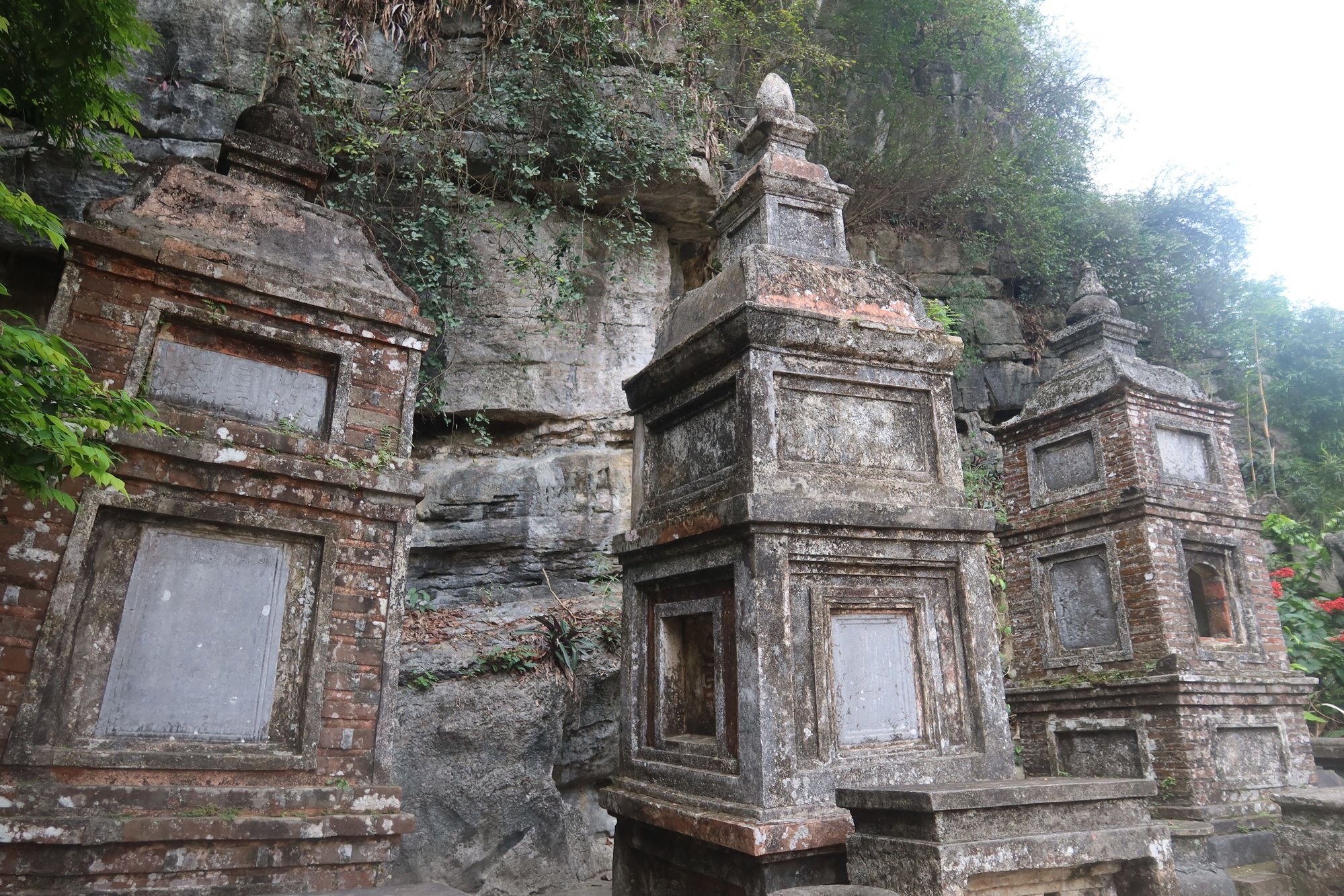
Stupas to Buddhist Monks, Bich Dong Temple

Temple Inside Cave, Bich Dong
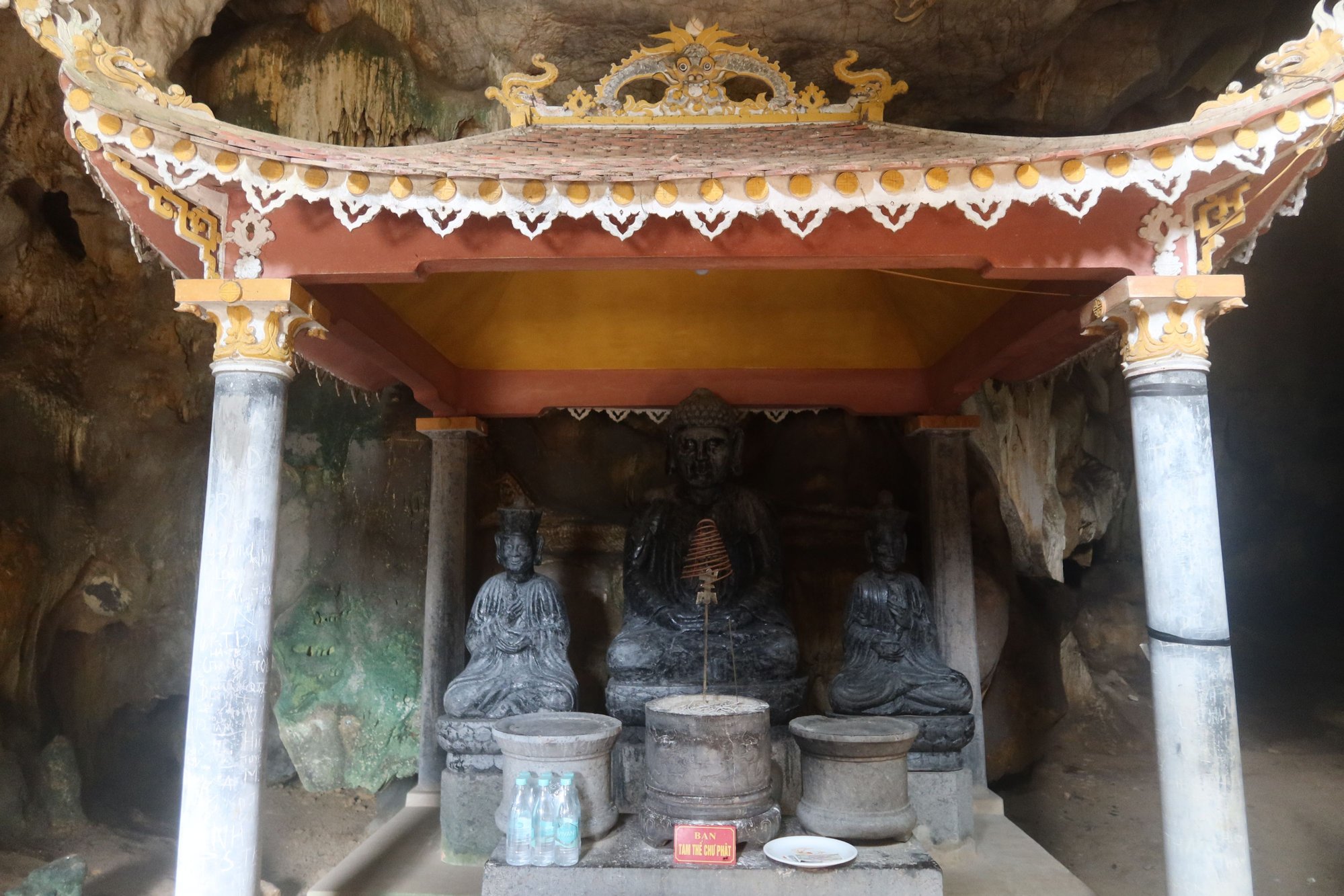
Buddha Worship Altar Inside Cave, Bich Dong
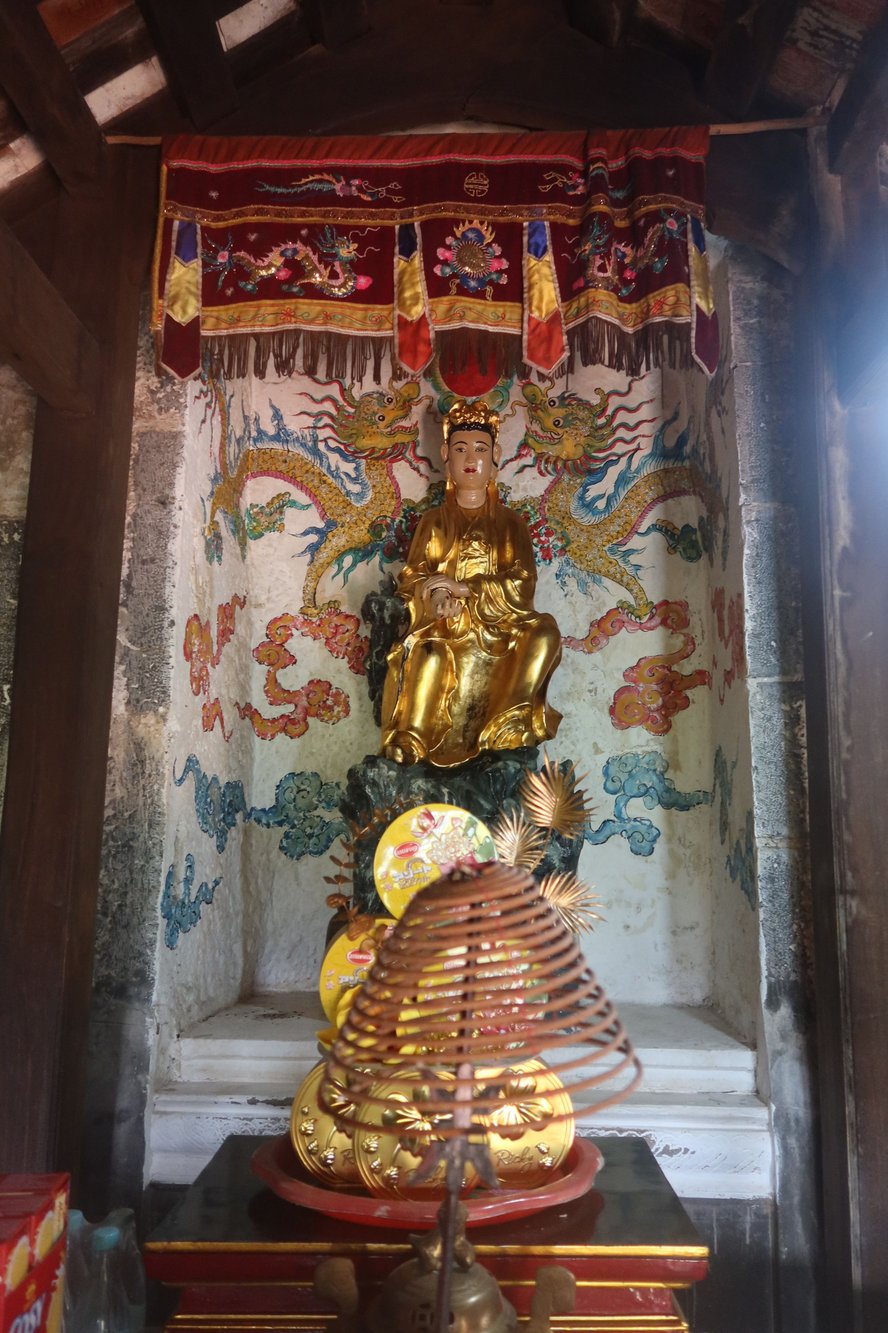
Quan Am, Bich Dong

First Tran Emperor (center), Queen (left), and Second Tran Emperor (right), Thai Vy Temple
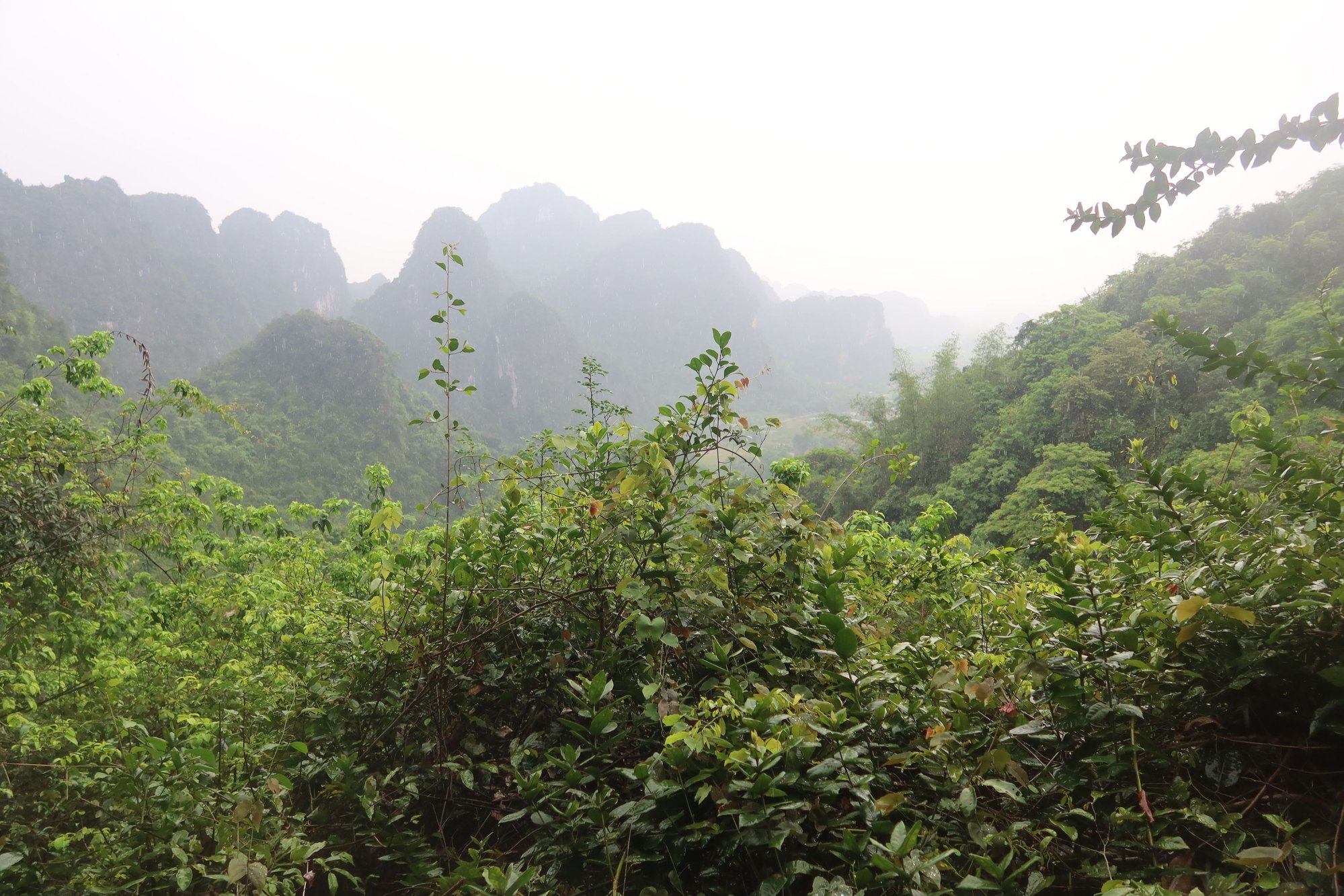
View at Summit of Sunshine Valley Hike

View at End of Sunshine Valley Hike
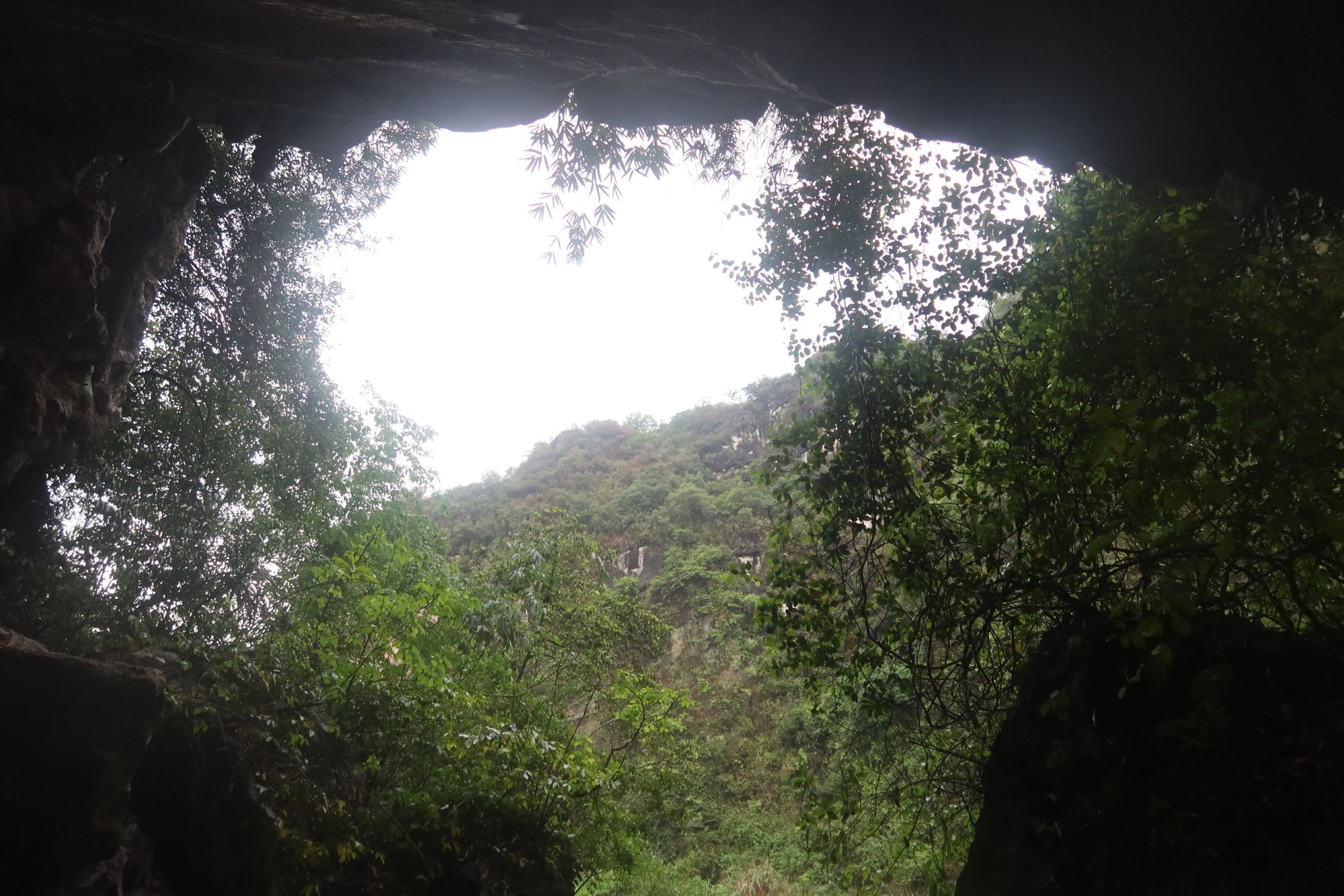
Cave on Tam Coc River
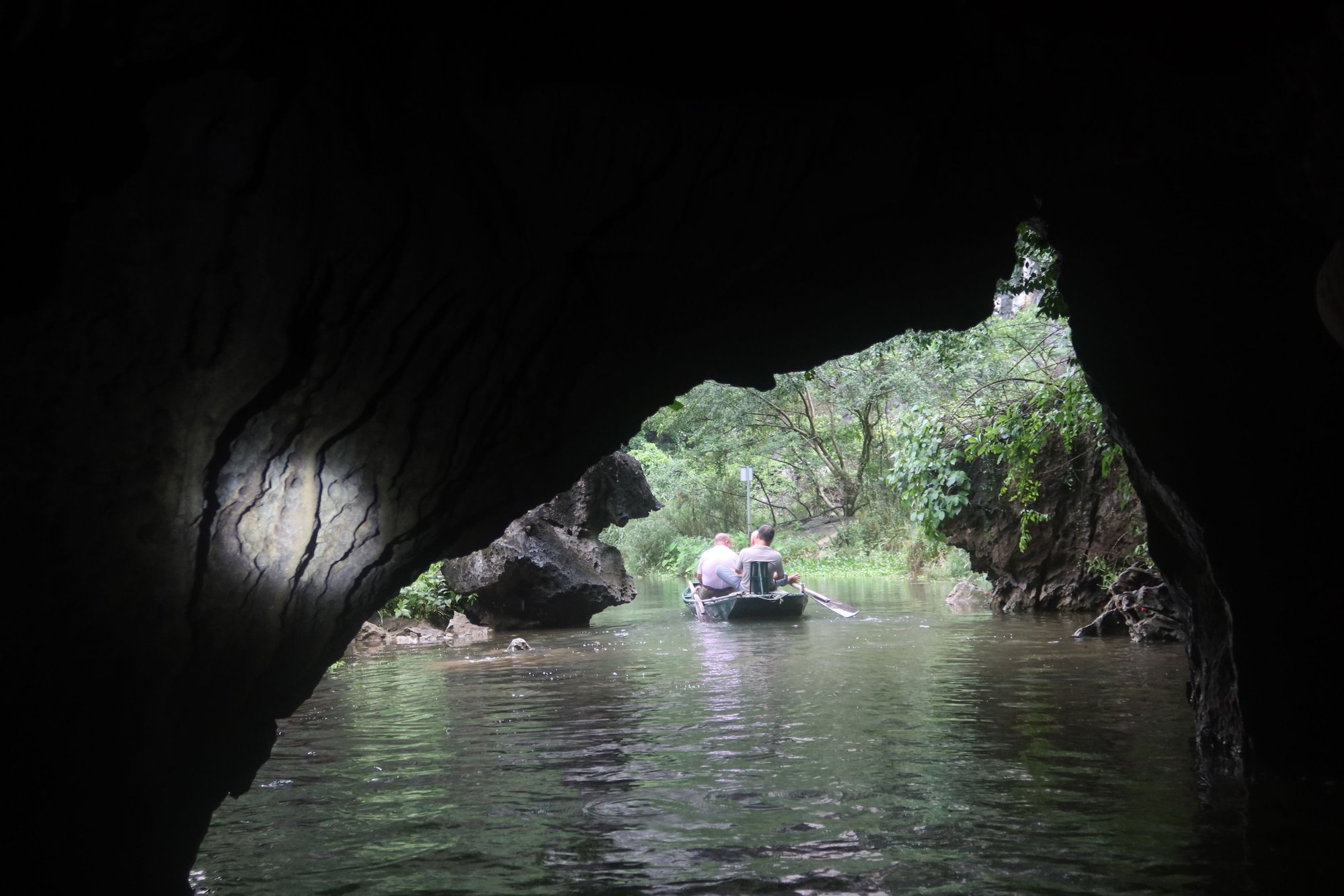
Cave on Tam Coc River

Rock Formation on Tam Coc River
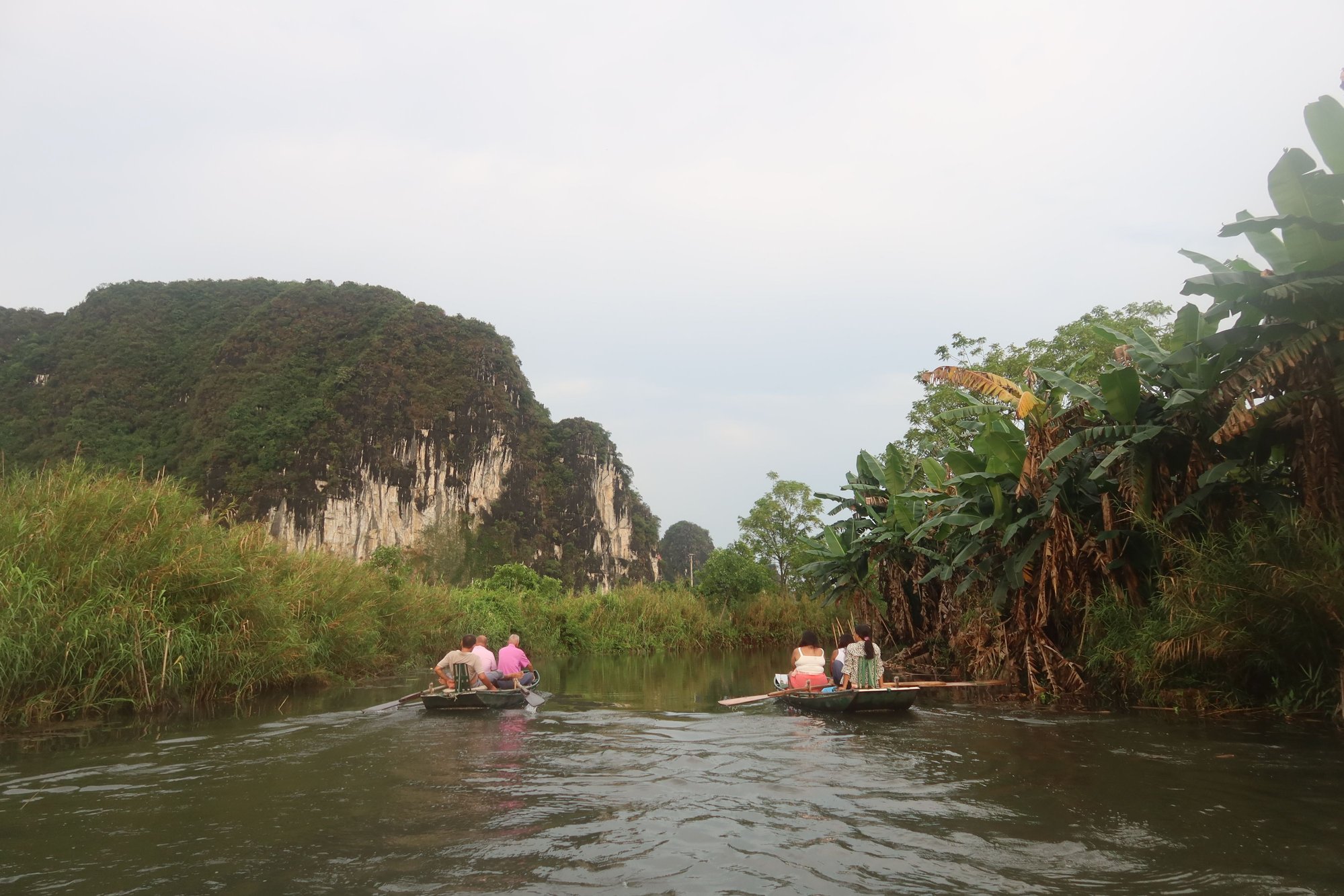
Landscape on Tam Coc River
We awoke to another day in heaven, with mountains and rice paddies right outside our bedroom windows. We enjoyed some coffee on the terrace before filling up our bellies for breakfast. Our sightseeing agenda was light this morning, consisting of two temples. We visited Bich Dong first. The temple consists of three buildings with the first accessed by a flight of stairs, the second built into the entrance of a cave, and the third at the summit. Built to honor Quan Am, the Buddha, and others in the pantheon, we worshipped, took some photographs, and just savored the incredible scenery.
From there we visited Thai Vy Temple, built to honor the emperors of the Tran Dynasty. The Confucian temple is laid out similar to those temples honoring the Dinh and Le Dynasties at Hoa Lu yesterday. We toured the temple and walked along the path by the Tam Coc River, watching the riverboats glide by.
After the two temples, it was back to our hotel for some rest and relaxation before embarking on our afternoon hike of the surrounding countryside near our hotel. We hiked the mountain overlooking our hotel with the help of a local guide. The ascent through jungle, via man-made steps, took about 45 minutes. Along the way, the guide pointed out medicinal plants and explained its uses to us. During the hike up, we caught glimpses of the surrounding peaks. As we were making our way down the back side of the mountain towards the Sunshine Valley, the sky suddenly opened up. We were experiencing an isolated and unexpected thunderstorm, lasting just over half an hour. Luckily there was a limestone overhang, where we sheltered while the rain poured. We made our way down after the rain stopped, but moved very gently as the wet steps were slippery in spots. We reached the valley floor in about 45 minutes, and then moved through tall grasses towards the river. The original program had us picnicking by the river, but given the wet weather, we decided to take our afternoon snack and beverage after we returned to our hotel.
Thus, we provided to the riverboats, although the boats were smaller than yesterday. The boat ride along the Tam Coc River took about 45 minutes, and was particularly enjoyable after the long trek. We passed through similar scenery as yesterday afternoon at Trang An, but we didn't mind it being a bit repetitive. After the ride, we returned to our rooms to shower and change, and enjoyed the prepared fruits and cookies along with tea and juice by the hotel pool. Dinner was again at our hotel. While we interested in something different, we didn't feel like venturing into town.
Entrance Gate, Bich Dong Temple
Stupas to Buddhist Monks, Bich Dong Temple
Temple Inside Cave, Bich Dong
Buddha Worship Altar Inside Cave, Bich Dong
Quan Am, Bich Dong
First Tran Emperor (center), Queen (left), and Second Tran Emperor (right), Thai Vy Temple
View at Summit of Sunshine Valley Hike
View at End of Sunshine Valley Hike
Cave on Tam Coc River
Cave on Tam Coc River
Rock Formation on Tam Coc River
Landscape on Tam Coc River
 May 5th, 2025 | 08:16 AM
#48
Original Poster
Joined: Sep 2012
Posts: 3,517
Likes: 0
shelemm, thank you. We're definitely grateful for being able to experience so much with the time we have. One of the beauties of Vietnam is its variety, which makes it easy to have a well-rounded trip even if they are more selective in what they see and do.
Capital Saunter
This morning we reluctantly said goodbye to our sanctuary by the rice fields of Ninh Binh and travelled by car to the capital of Vietnam, Hanoi, and our home for the next four nights, the Sofitel Metropole. We were greeted with cold, refreshing towels and Dom Perignon champagne upon arrival, and shown to our luxurious rooms, where we refreshed and relaxed before going out to explore the bustling metropolis.
With the Insight Guide's Explore Vietnam guidebook in hand, we set out to explore the Old and French Quarters of Hanoi on a self-guided walking tour. We began with a gentle stroll around Hoan Kiem Lake. Hoan means return in Vietnamese and kiem means sword. The lake is named after a story in Vietnamese lore in which the king of Vietnam in the 15th century, Le Thai To, also known as Le Loi, was supported a turtle in the lake that loaned it its appendage that was fashioned into a magical sword that was used to successfully defend the country from Chinese invaders. The appendage was eventually "returned" to the turtle and a temple built to honor the reptile on the lake.
On the west side of the lake is a temple to Le Thai To, which we visited. On the lake itself is a memorial to the mythical turtle. On the northeastern corner is the Ngoc Son, or Jade Mountain, Temple. Ngoc Son is accessed by a series of entrance gates and a vermilion footbridge. The temple, built in the Confucian style, honors local gods and goddesses.
After we circumnavigate the lake, we strolled in the nearby Old Quarter. We loved the charms of Old Hanoi - the streetscape, the historic buildings, the shops, the overall atmosphere, the greenery. We visited an old heritage house, a Cantonese assembly hall, a couple of Daoist temples, browsed Dong Xuan Market and streets selling everything from silk to funerary offerings, and enjoying coffee at the sweet cafes. We could have spent an entire day in the Old Quarter, and not be bored. We found our three hours here to be pure joy, and may have just fallen in love with the city here.
From Old Hanoi we walked back to Hoan Kiem Lake and the French Quarter, walking by St. Joseph's Cathedral, the University of Hanoi, and the Hanoi Opera House, as well as other buildings in the colonial French style.
We enjoyed two delicious meals on our first day in Hanoi. We ate lunch at Bancong Cafe and Restaurant, and dined on bun cha, a delicous dish of rice noodles, grilled pork patties, and grilled pork slices, all served with a savory dipping sauce. Dinner was at Luk Lak, a quick walk from our hotel, where we feasted on sticky rice, tiger prawns, fish, spring rolls, and a vegetable dish served with scrambled eggs. The meal was divine; it was, Madame Lan aside, the best meal we've enjoyed on this trip.
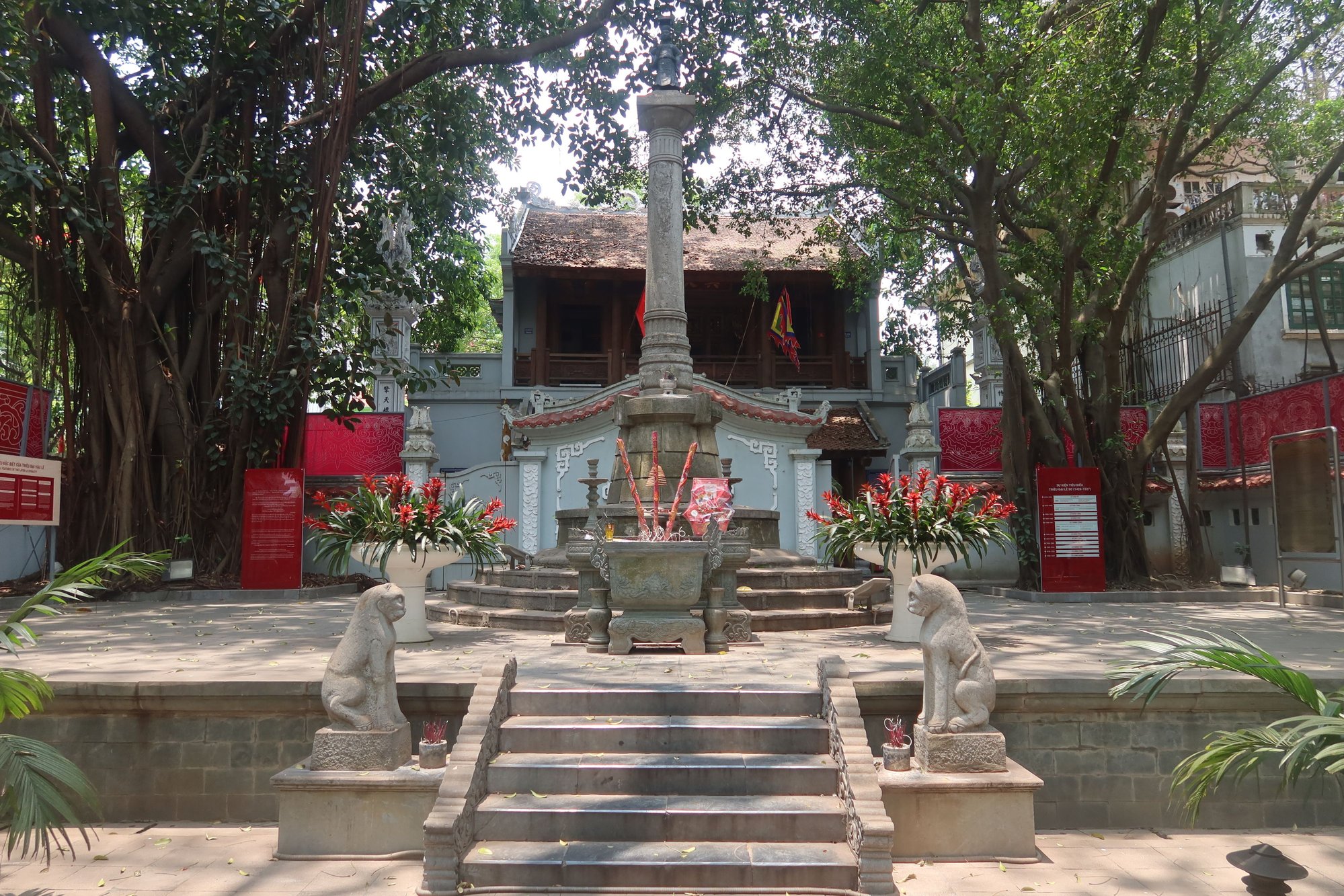
Le Thai To Temple

Turtle Tower on Hoan Kiem Lake
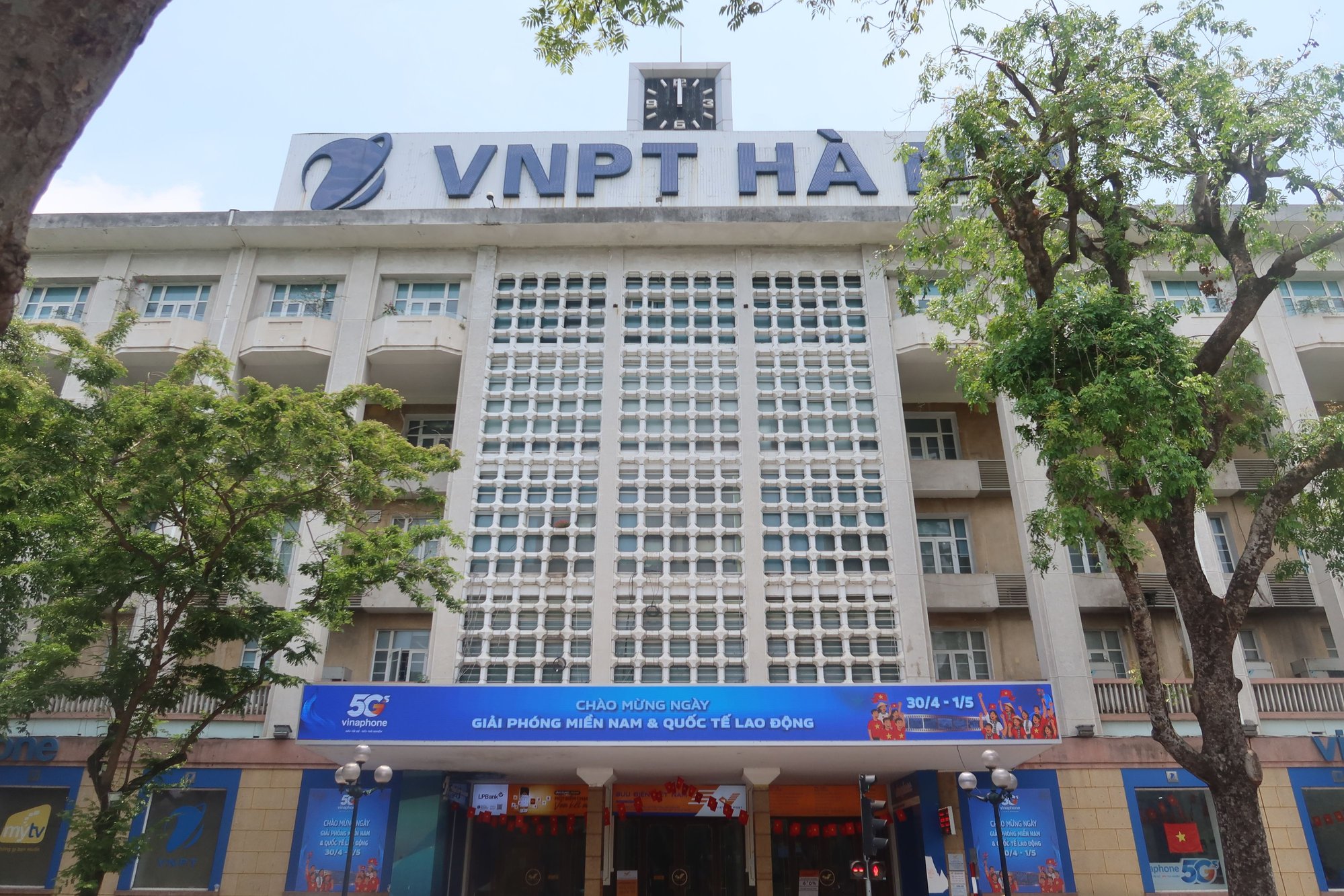
General Post Office Building

Hanoi Communist Party HQ
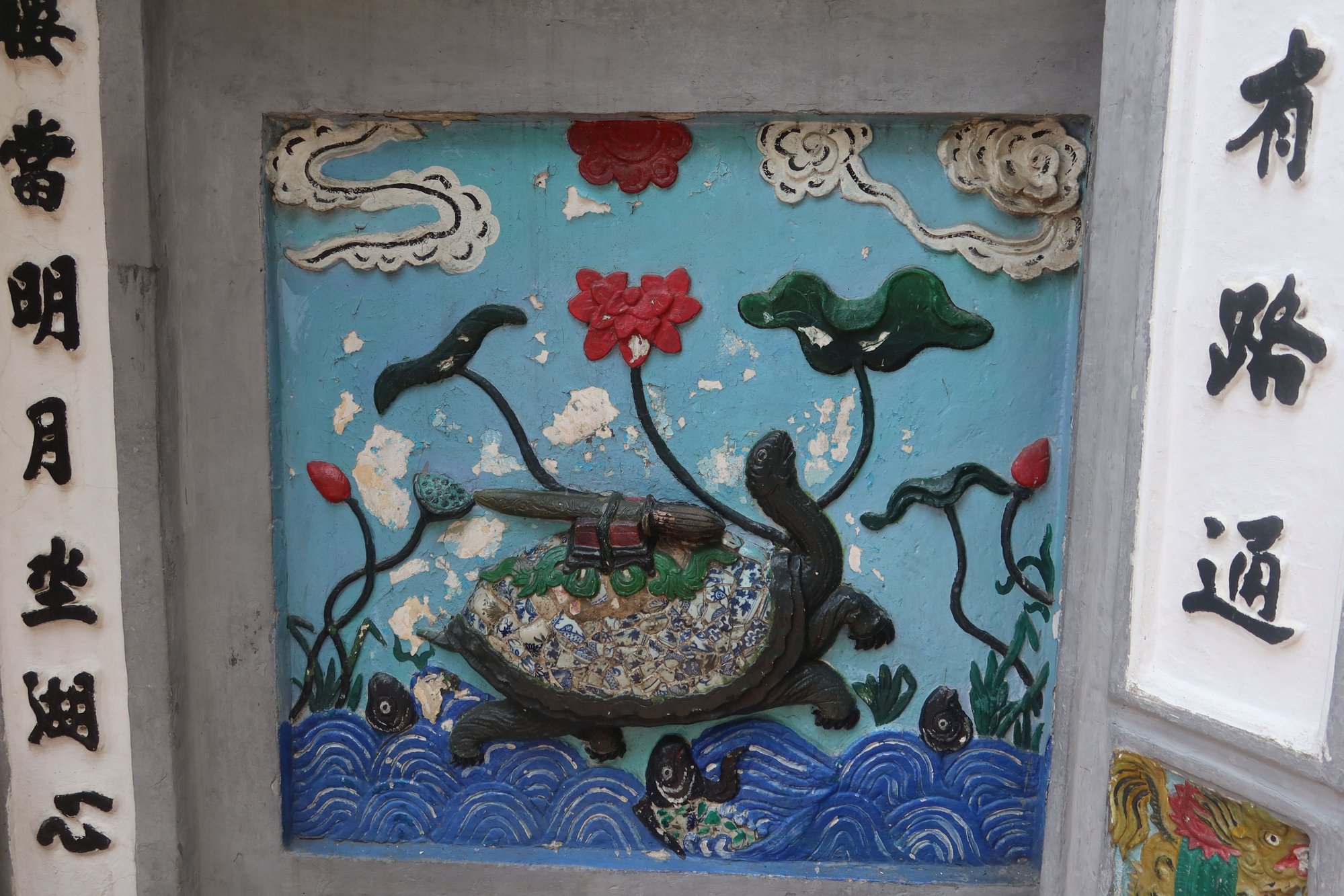
Sacred Turtle at Ngoc Son Temple

Street Stall Selling Dried Foods
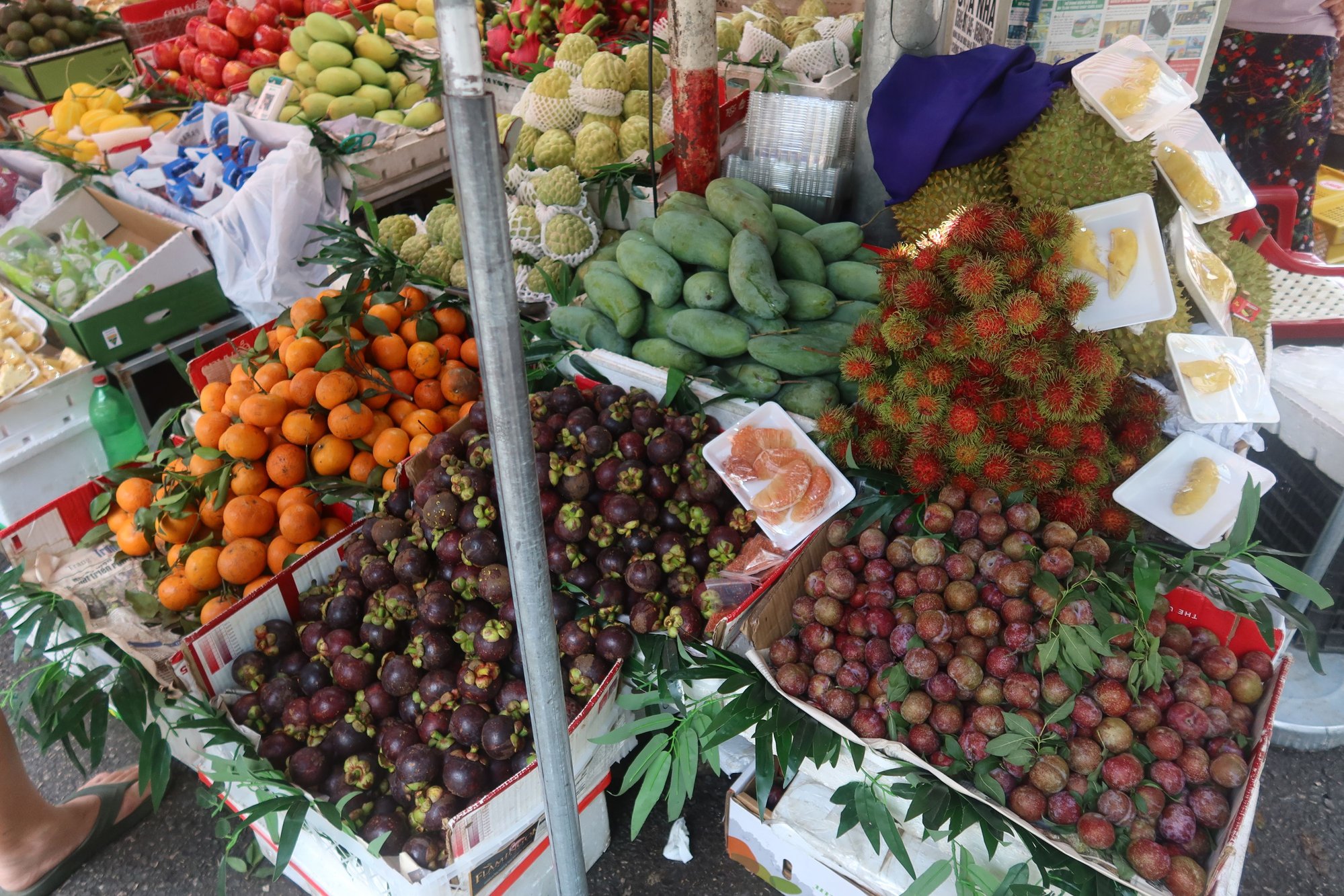
Street Stall Selling Tropical Fruits
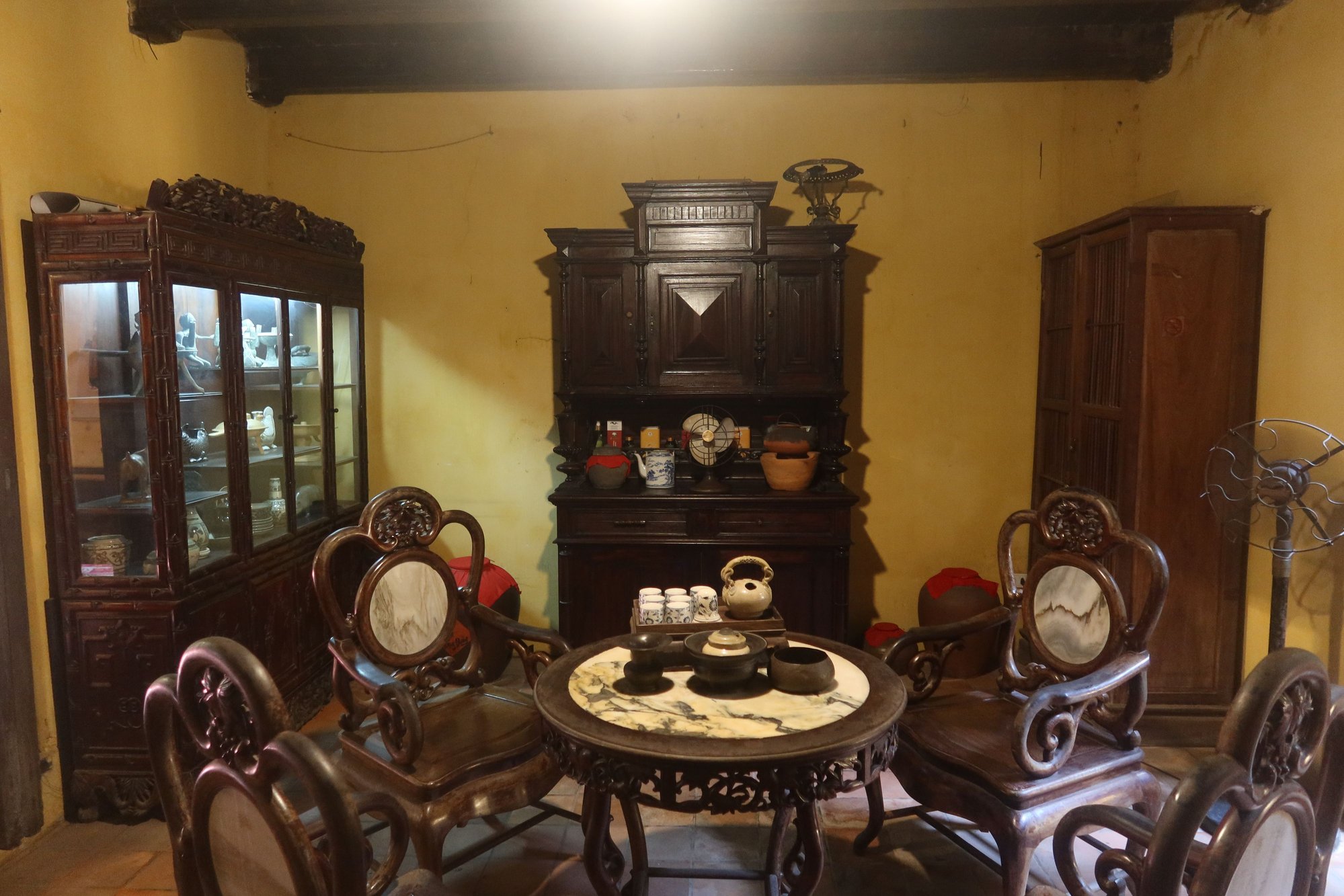
Dining Room inside Heritage Home in Old Hanoi
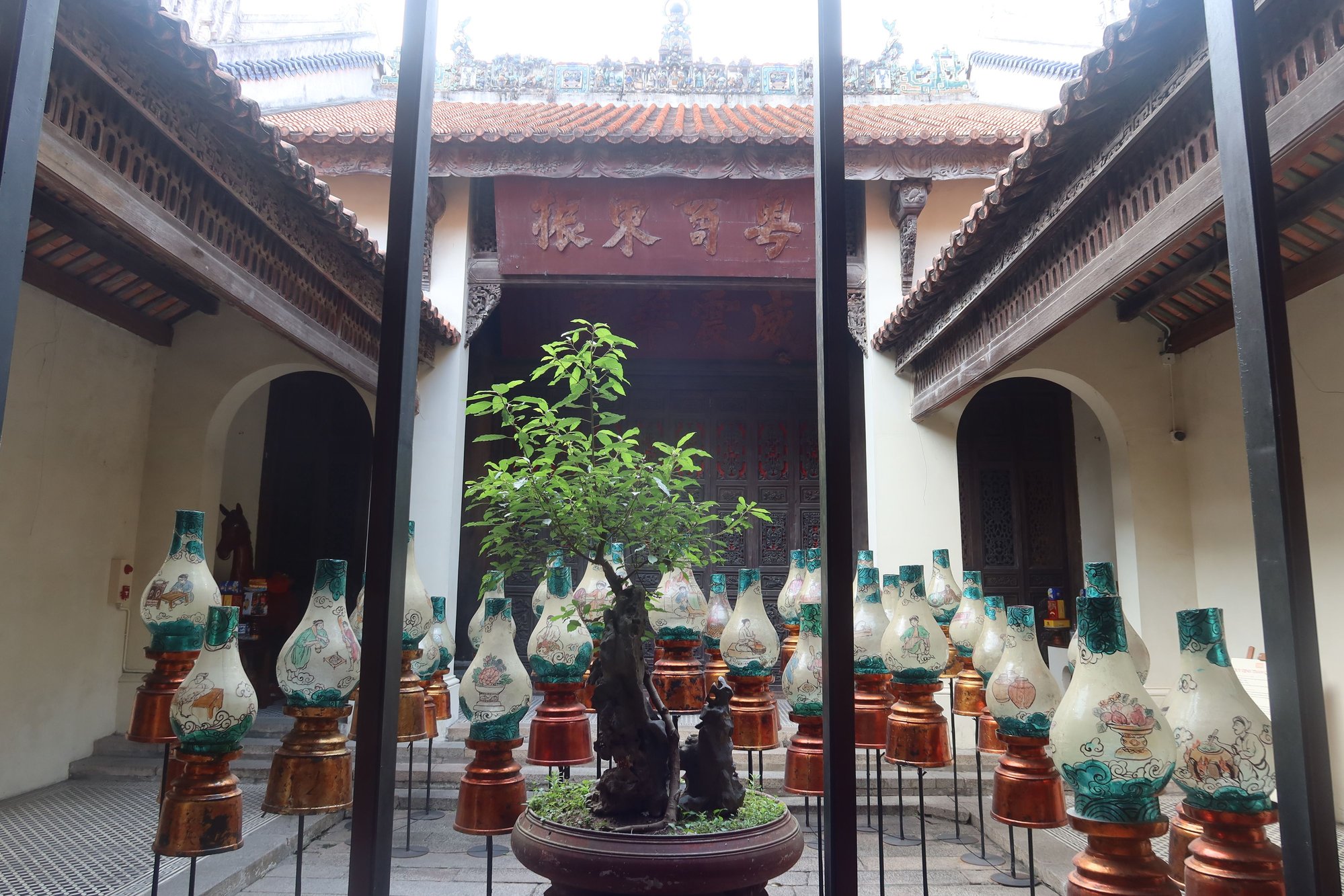
Art Installation at Cantonese Assembly Hall
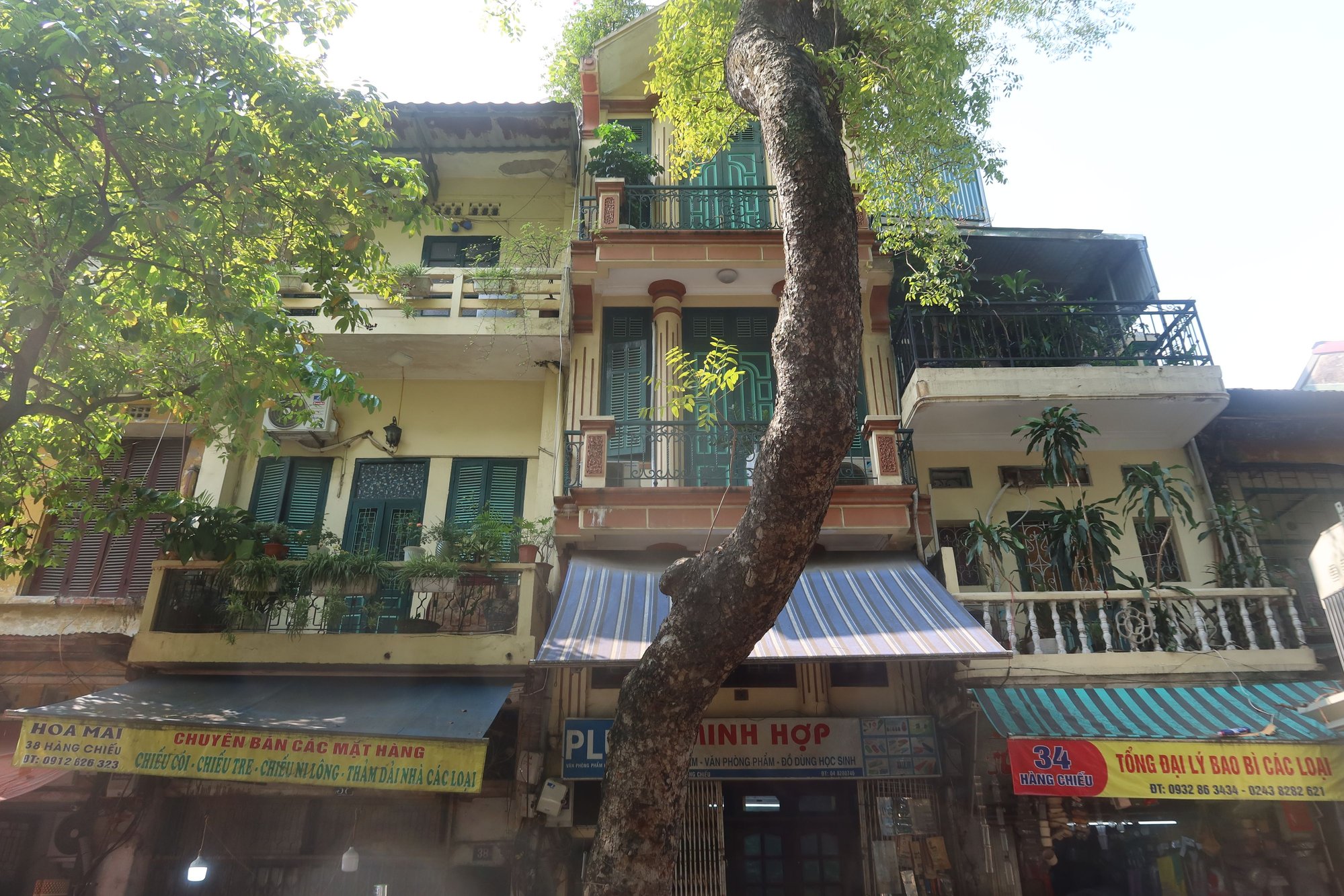
Typical Buildings in Old Hanoi
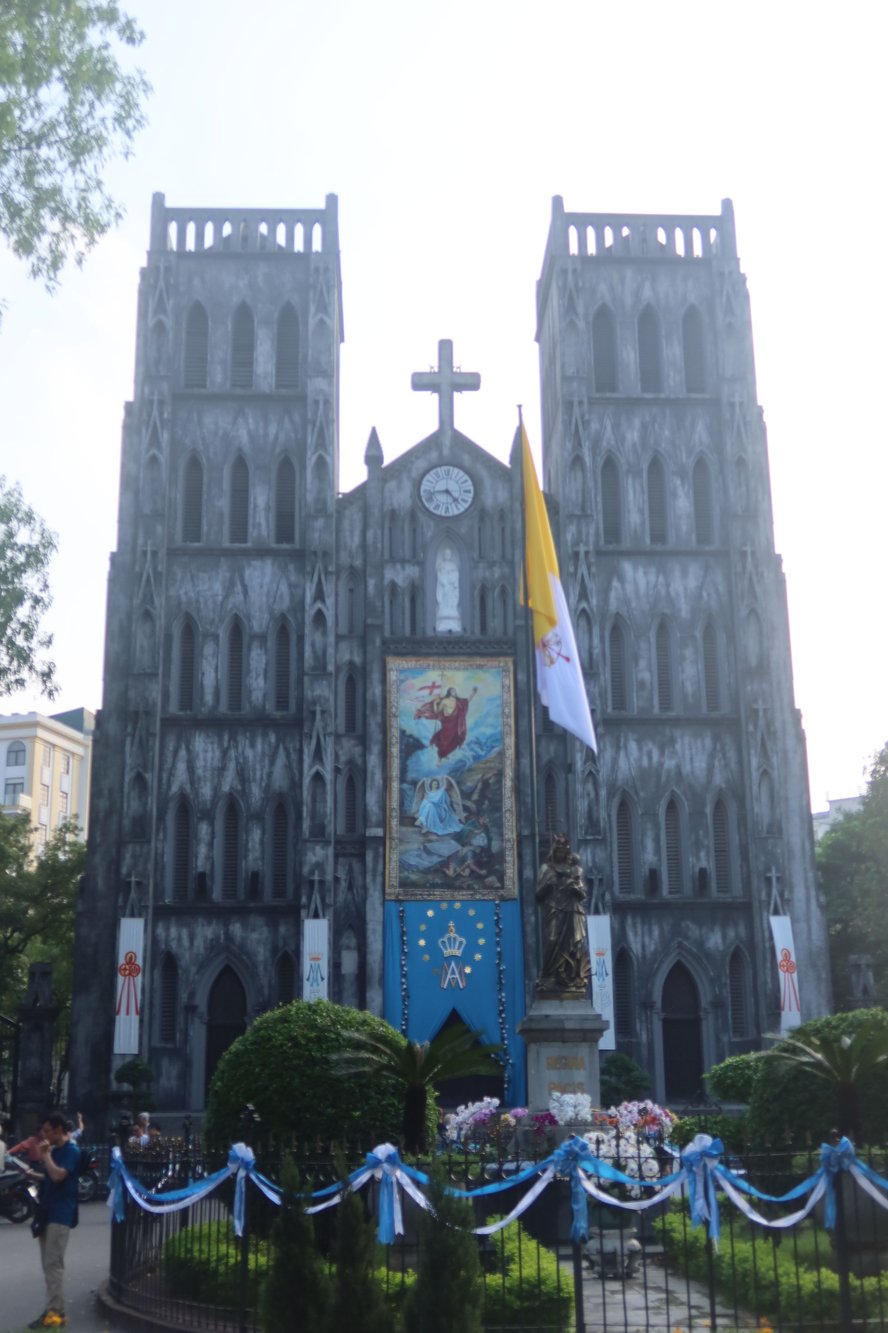
St. Joseph's Cathedral
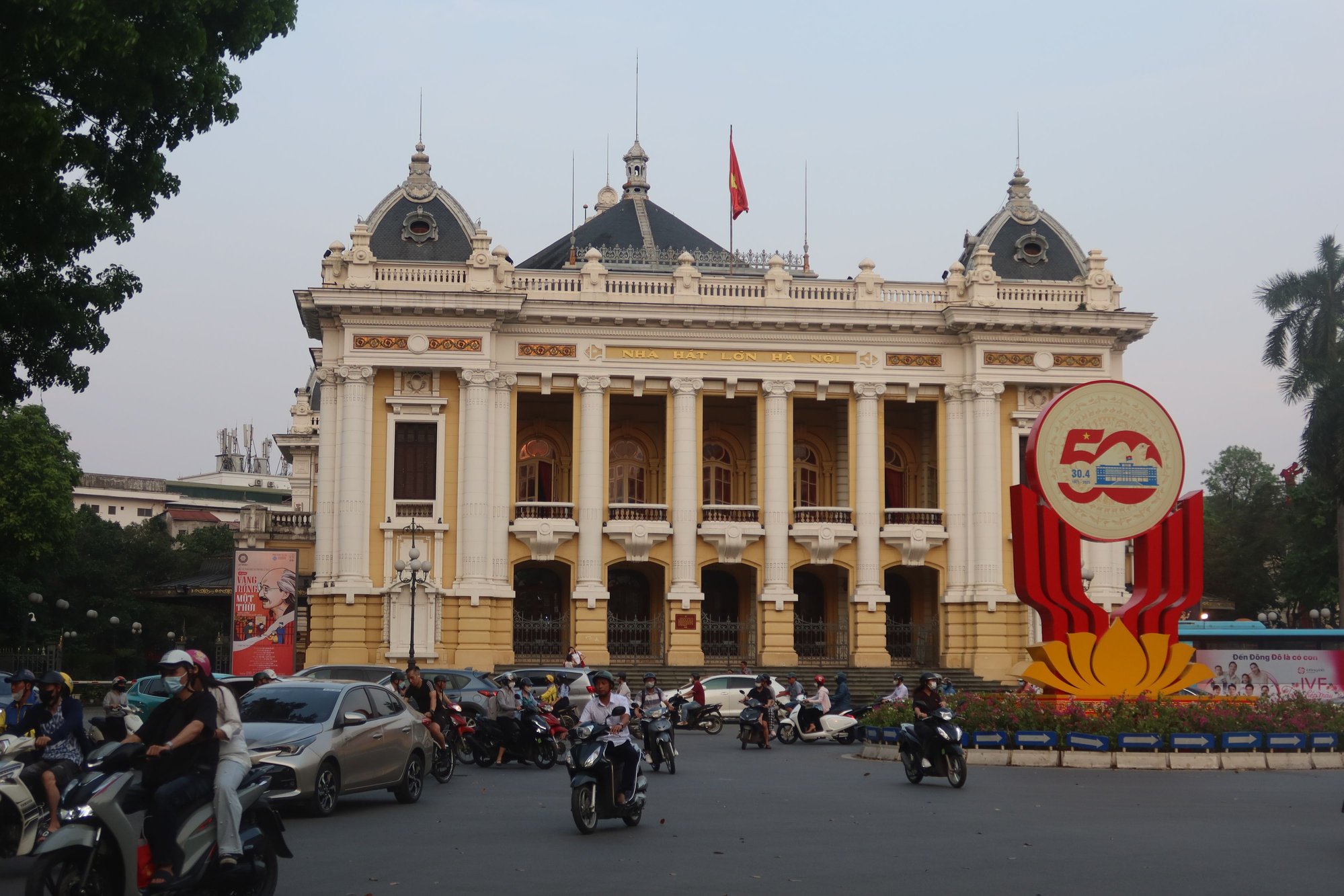
Hanoi Opera House
Capital Saunter
This morning we reluctantly said goodbye to our sanctuary by the rice fields of Ninh Binh and travelled by car to the capital of Vietnam, Hanoi, and our home for the next four nights, the Sofitel Metropole. We were greeted with cold, refreshing towels and Dom Perignon champagne upon arrival, and shown to our luxurious rooms, where we refreshed and relaxed before going out to explore the bustling metropolis.
With the Insight Guide's Explore Vietnam guidebook in hand, we set out to explore the Old and French Quarters of Hanoi on a self-guided walking tour. We began with a gentle stroll around Hoan Kiem Lake. Hoan means return in Vietnamese and kiem means sword. The lake is named after a story in Vietnamese lore in which the king of Vietnam in the 15th century, Le Thai To, also known as Le Loi, was supported a turtle in the lake that loaned it its appendage that was fashioned into a magical sword that was used to successfully defend the country from Chinese invaders. The appendage was eventually "returned" to the turtle and a temple built to honor the reptile on the lake.
On the west side of the lake is a temple to Le Thai To, which we visited. On the lake itself is a memorial to the mythical turtle. On the northeastern corner is the Ngoc Son, or Jade Mountain, Temple. Ngoc Son is accessed by a series of entrance gates and a vermilion footbridge. The temple, built in the Confucian style, honors local gods and goddesses.
After we circumnavigate the lake, we strolled in the nearby Old Quarter. We loved the charms of Old Hanoi - the streetscape, the historic buildings, the shops, the overall atmosphere, the greenery. We visited an old heritage house, a Cantonese assembly hall, a couple of Daoist temples, browsed Dong Xuan Market and streets selling everything from silk to funerary offerings, and enjoying coffee at the sweet cafes. We could have spent an entire day in the Old Quarter, and not be bored. We found our three hours here to be pure joy, and may have just fallen in love with the city here.
From Old Hanoi we walked back to Hoan Kiem Lake and the French Quarter, walking by St. Joseph's Cathedral, the University of Hanoi, and the Hanoi Opera House, as well as other buildings in the colonial French style.
We enjoyed two delicious meals on our first day in Hanoi. We ate lunch at Bancong Cafe and Restaurant, and dined on bun cha, a delicous dish of rice noodles, grilled pork patties, and grilled pork slices, all served with a savory dipping sauce. Dinner was at Luk Lak, a quick walk from our hotel, where we feasted on sticky rice, tiger prawns, fish, spring rolls, and a vegetable dish served with scrambled eggs. The meal was divine; it was, Madame Lan aside, the best meal we've enjoyed on this trip.
Le Thai To Temple
Turtle Tower on Hoan Kiem Lake
General Post Office Building
Hanoi Communist Party HQ
Sacred Turtle at Ngoc Son Temple
Street Stall Selling Dried Foods
Street Stall Selling Tropical Fruits
Dining Room inside Heritage Home in Old Hanoi
Art Installation at Cantonese Assembly Hall
Typical Buildings in Old Hanoi
St. Joseph's Cathedral
Hanoi Opera House
May 6th, 2025 | 09:35 AM
#49
Original Poster
Joined: Sep 2012
Posts: 3,517
Likes: 0
"Official Line" History and Politics
We began our day at the Ho Chi Minh Mausoleum. At the advice of our hotel concierge, we headed to the mausoleum shortly after 8:00 AM (the queue for not just the mausoleum but the entire complex closes at 11:00 AM). Finding the entrance was a bit difficult as several of the streets around the complex were closed to the public and we had to find the one for visitors. Once we were there, we just went with the flow, going through security, making our way to the mausoleum, and filing past the late Vietnamese leader lying in a transparent coffin. The atmosphere is solemn with numerous military guards present. Also located inside the security bubble are a small stilt house where Ho Chi Minh lived (consisting of a meeting room and a sleeping room), a building where he held his meetings, a museum to his life and work, botanic gardens, and a Buddhist temple. Visiting all the sites took about three hours.
From here we made our way on foot to the Imperial Citadel (the more precise Vietnamese translation is palace, not citadel) of Thang Long (which means ascending dragon in Vietnamese), the former name of Hanoi. Inside the complex are four well-preserved towers. The rest of the buildings, including the palaces, were destroyed over time, either through decay or through war. The exhibits at the Citadel goes through the succession of dynasties throughout Vietnamese history, the construction and reconstruction of buildings inside the complex, and life. Present were also underground bunkers used during the war against the United States including offices, Politburo meeting space, communications centers, etc. Also contained are unexcavated remains of buildings from over the centuries, some of it discovered recently when preparing the site for the election of the new National Assembly building. We also took about three hours here.
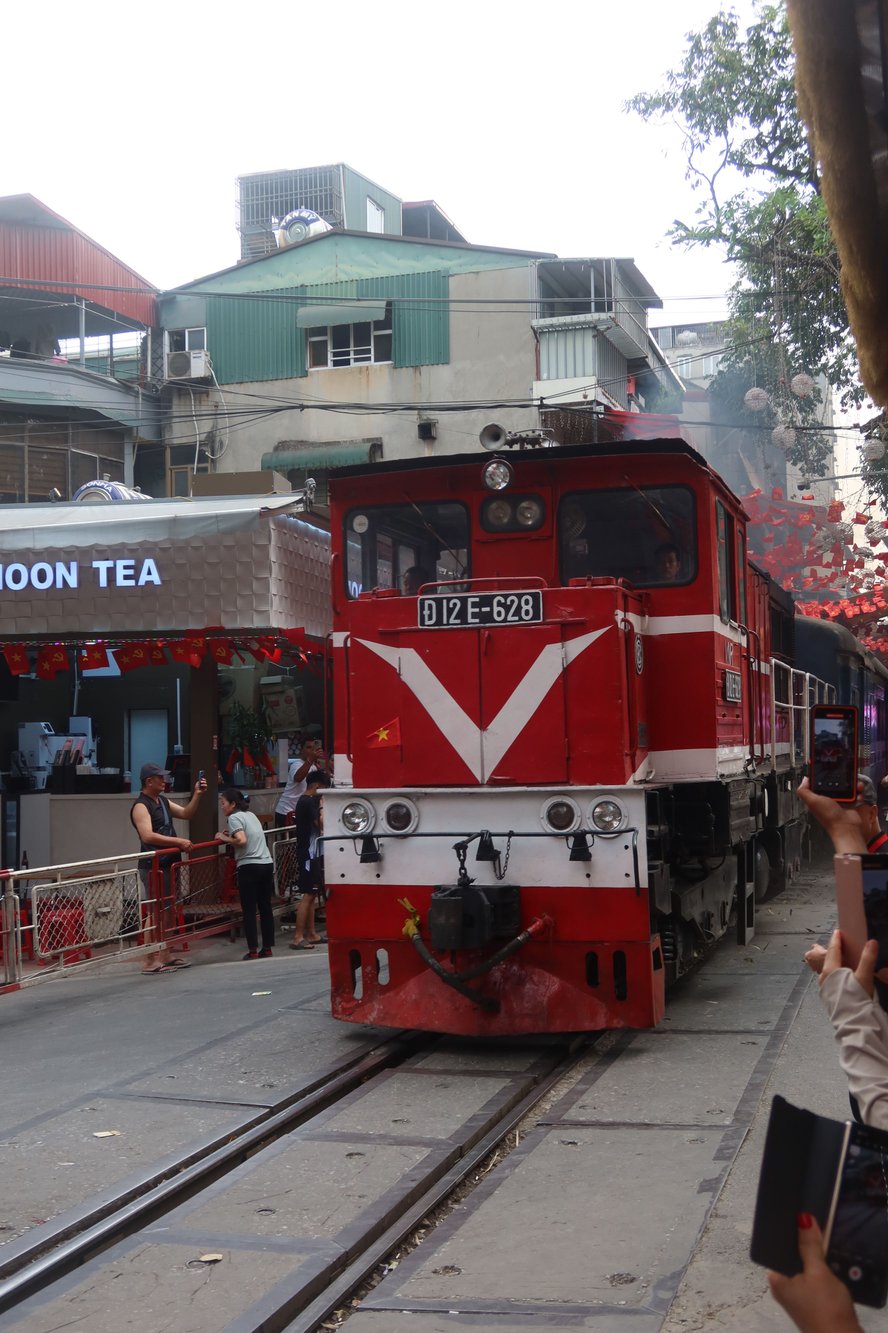
We then walked over to the social media-made-famous Train Street, where cafes line both sides of the railroad tracks. We had not intended to visit Train Street, but passed by it on the way from the Citadel to Hoa Lo Prison and thought why not. Walking up the street we saw a throng of tourists posing for photos on the tracks and the cafes buzzing with visitors. We casually asked one of the hustlers trying to lure visitors into their cafe and asked if there was a train expected to pass soon. She said yes, in 15 minutes. We walked up another half a block, saw empty seats, sat down, ordered beverages, and waited for the action. About five minutes later, the alarm sounded and the train whizzed by.
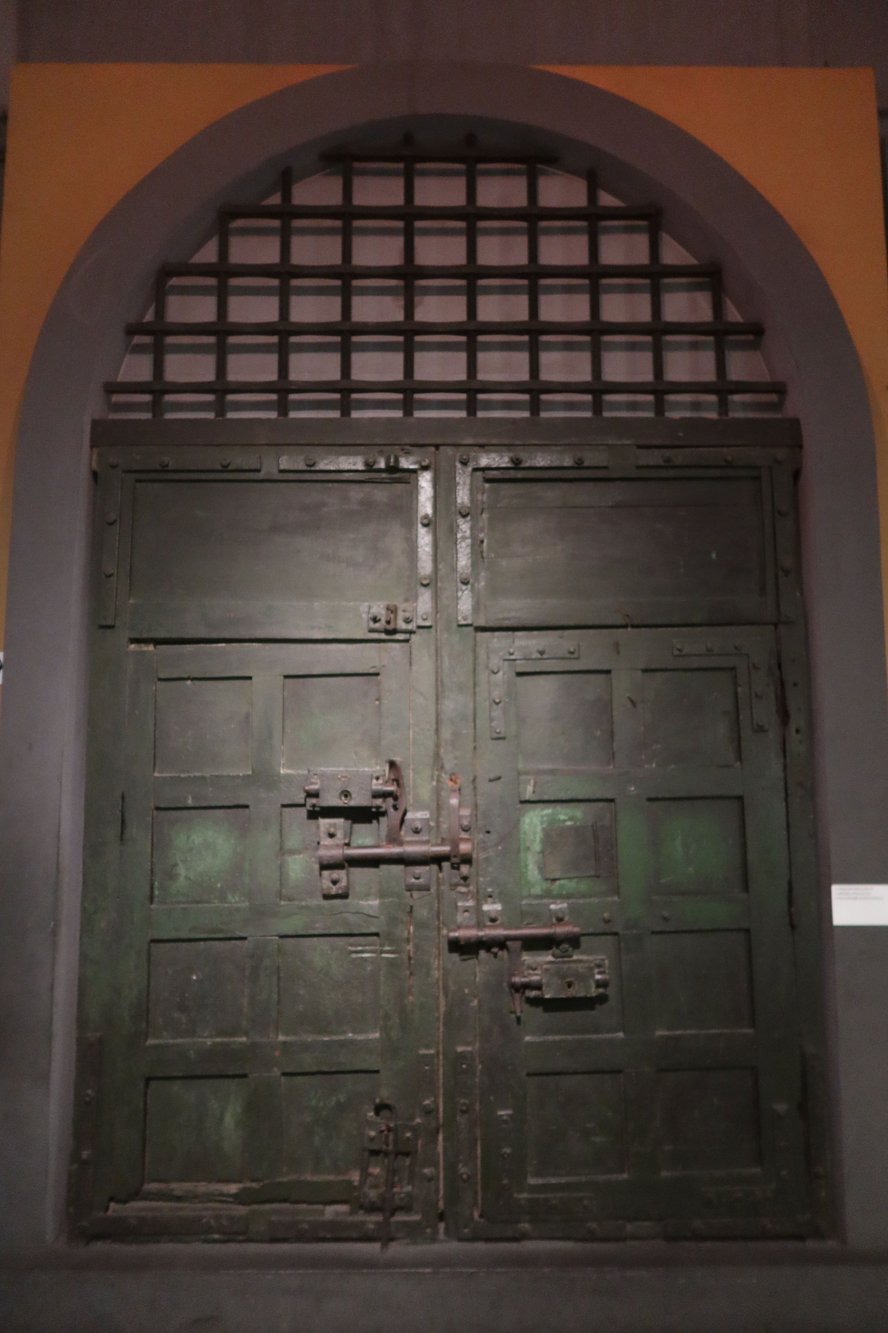
We continued on to Hoa Lo Prison. Built by the French in the 1800s, Hoa Lo was home to many Vietnamese political prisoners who fought for independence for their homeland in the 19th and 20th centuries as well as prisoners for general crimes. In the 1960s and 1970s, the prison housed numerous American prisoners of war. We toured the prison and learned about its history. Hoa Lo reminded me of Kilmainham Gaol in Dublin and Robben Island in South Africa.
About the exhibits at Hoa Lo as well as at the Ho Chi Minh Museum, I noticed that the exhibits more readily label the war in the 1960s and 1970s as the American War or the War Against American Imperialism. This was different from what we experienced in Hanoi, in which the portrayal of the United States as the aggressor was more muted. Also, there was equal if not more blame placed on the corruption and / or the harshness of the South Vietnamese government. Additionally, there was a lot more official government propaganda language used at these two museums regarding the Vietnamese Communist Party. This is the type of "official line" I had expected from a Communist country such as Vietnam, except it hasn't been as "in your face" anywhere else we visited, even with the 50th anniversary celebrations. Yet, Hanoi is no less relaxed than the other parts of Vietnam we've visited nor are the people any less friendly.
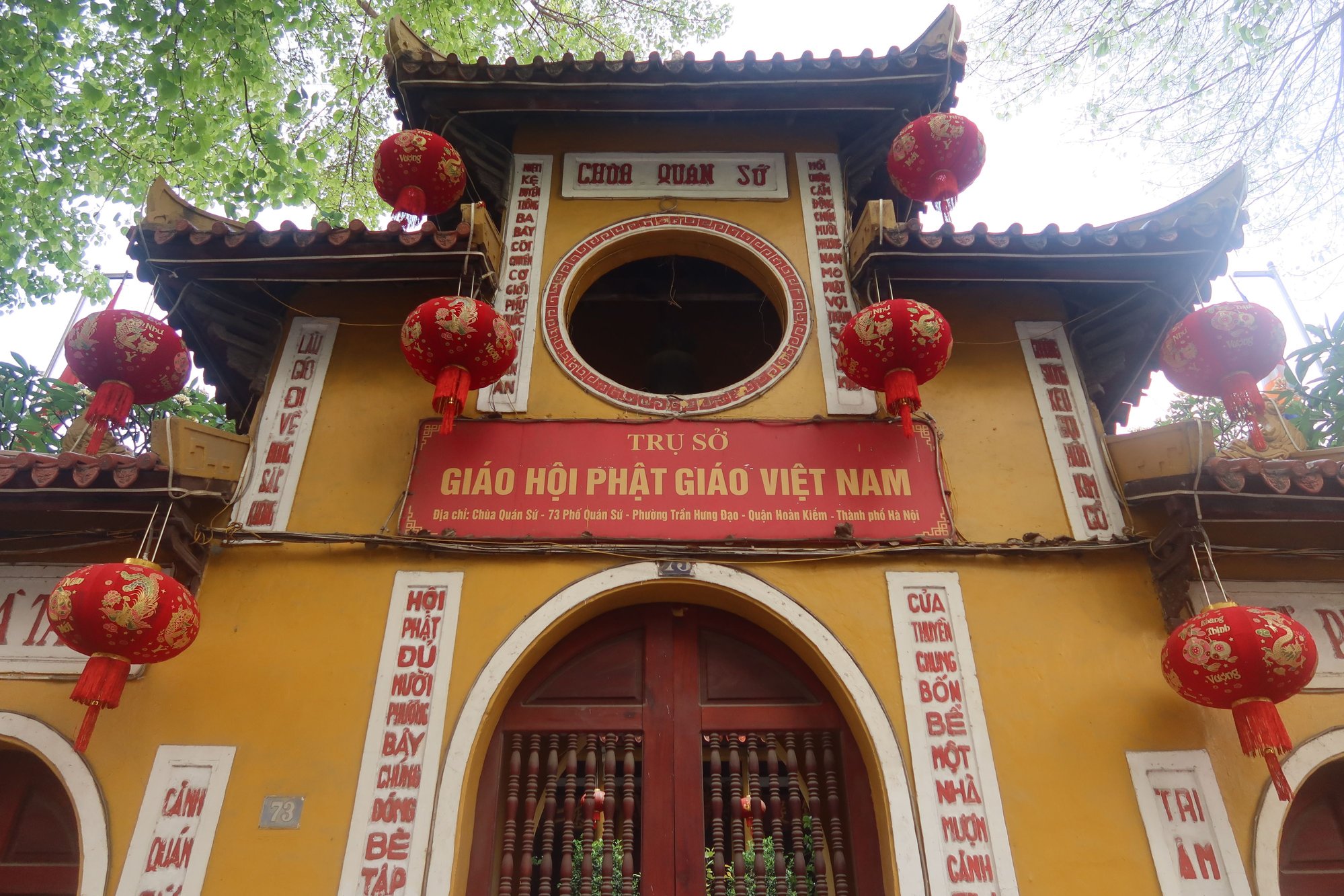
Our last stop of the day was Quan Su Temple, just around the corner from the prison. After the heavy subject of the prison, the 15th century Buddhist temple was a welcome respite. We visited, we prayed, and we sat for a bit before heading back to our hotel.
Dinner tonight was at T.U.N.G., a Scandinavian-Vietnamese tasting menu restaurant that featured ingredients from all over Vietnam as well as ingredients from Japan. The playful dining experience included an absolutely divine mini-banh mi stuffed with pork, a twist on traditional pho, divine pan-seared scallops, and more. Yet another memorable meal.
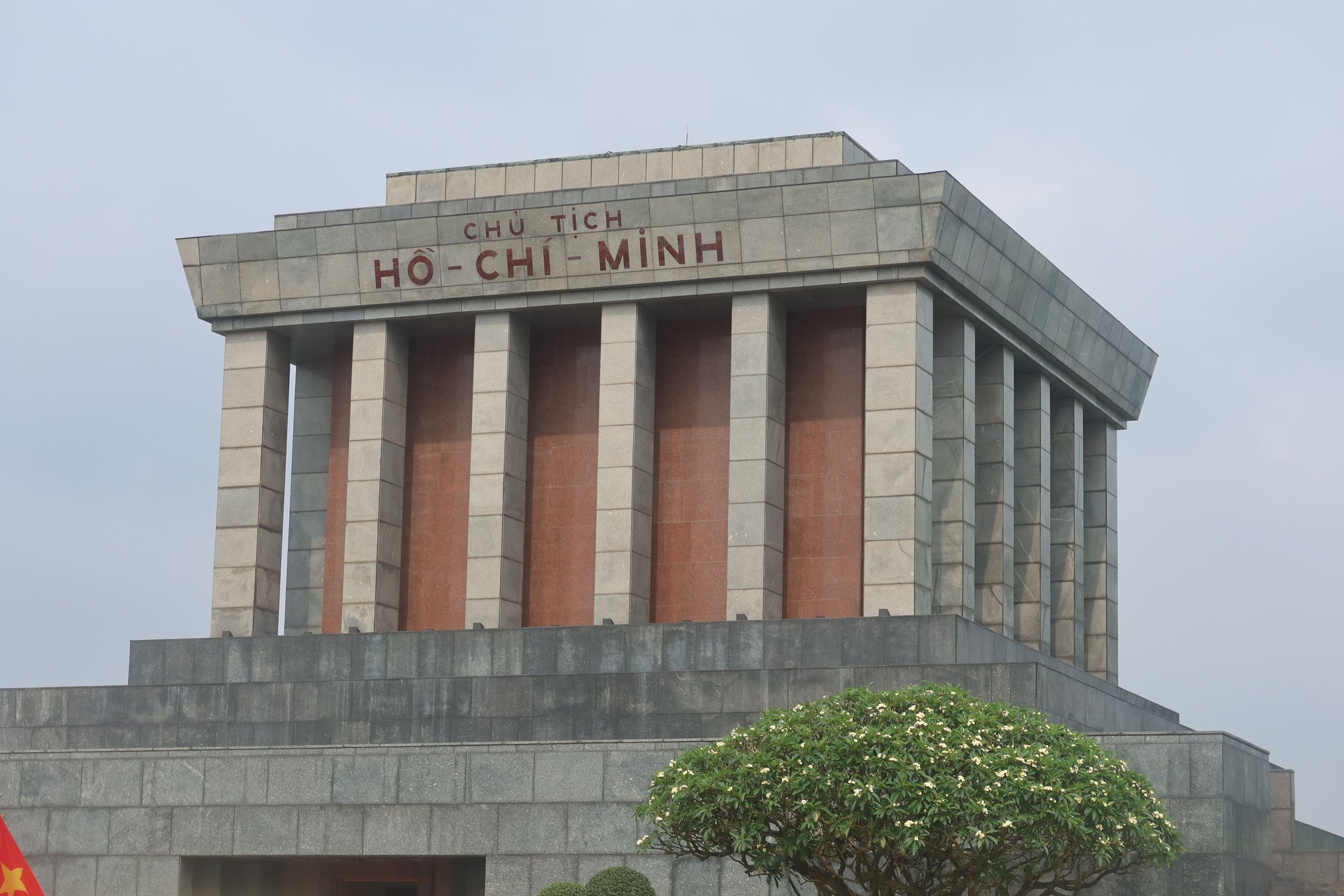
Ho Chi Minh Mausoleum
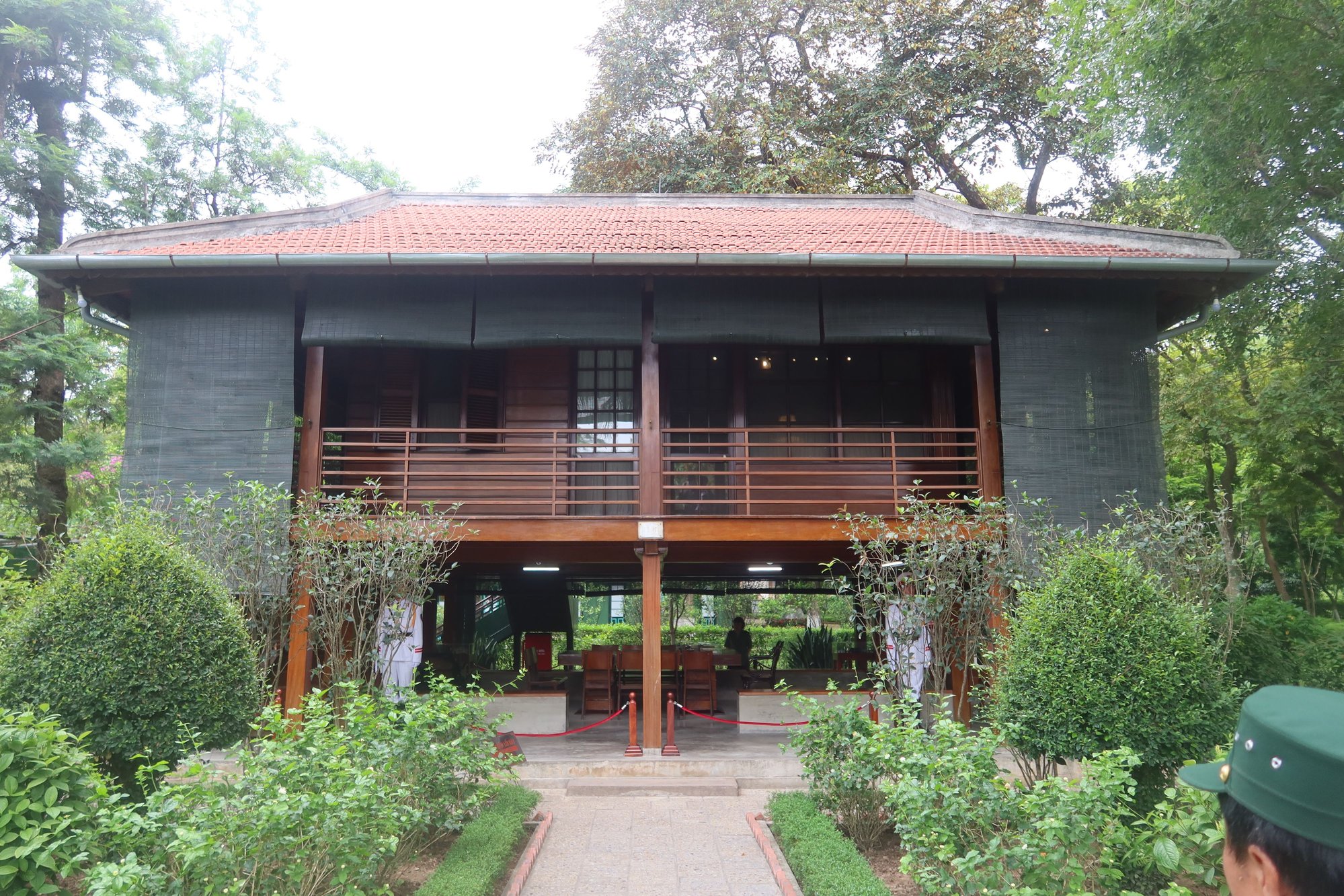
Ho Chi Minh Stilt House

One Pillar Pagoda (Buddhist Temple)
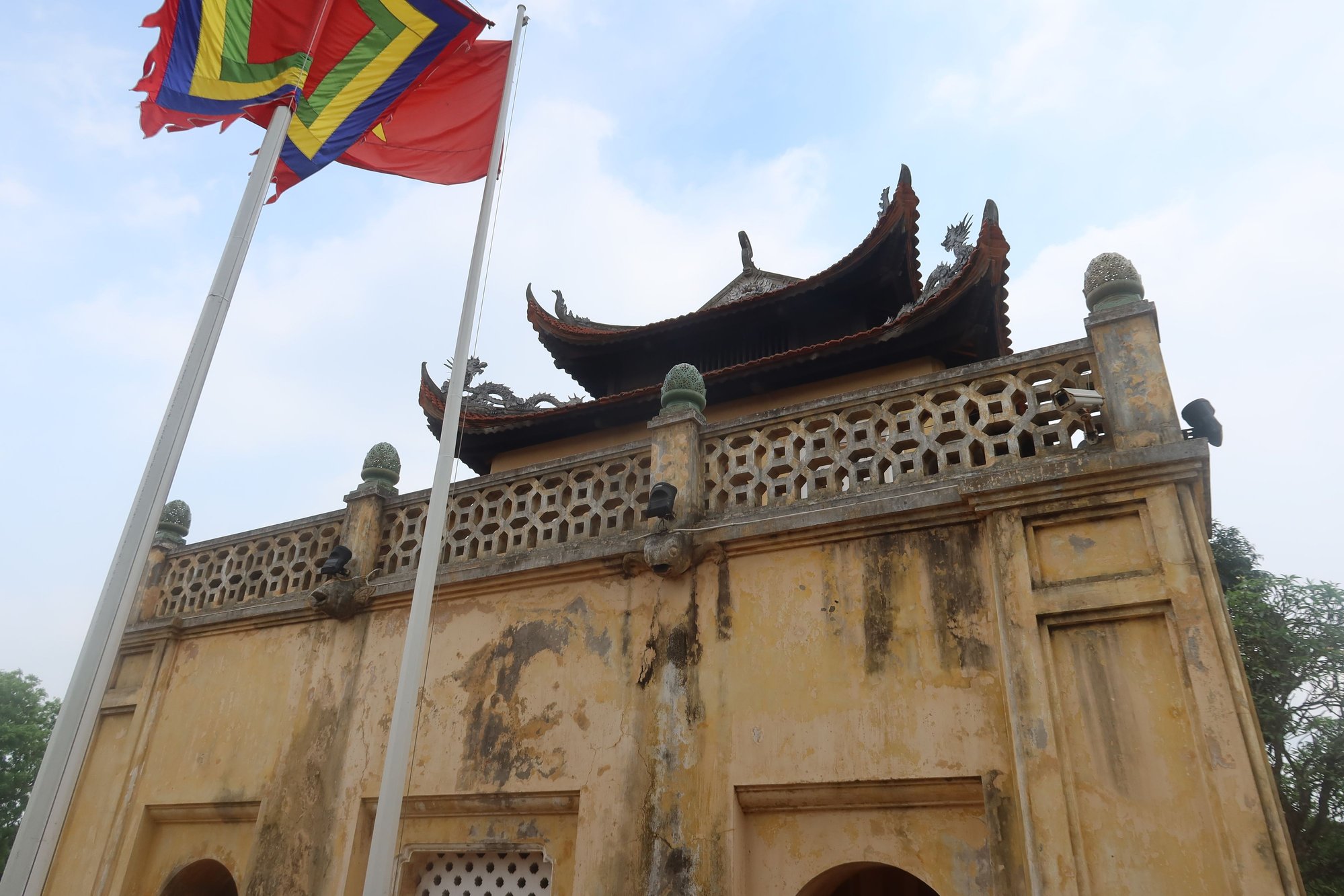
Duan Gate, Imperial Citadel
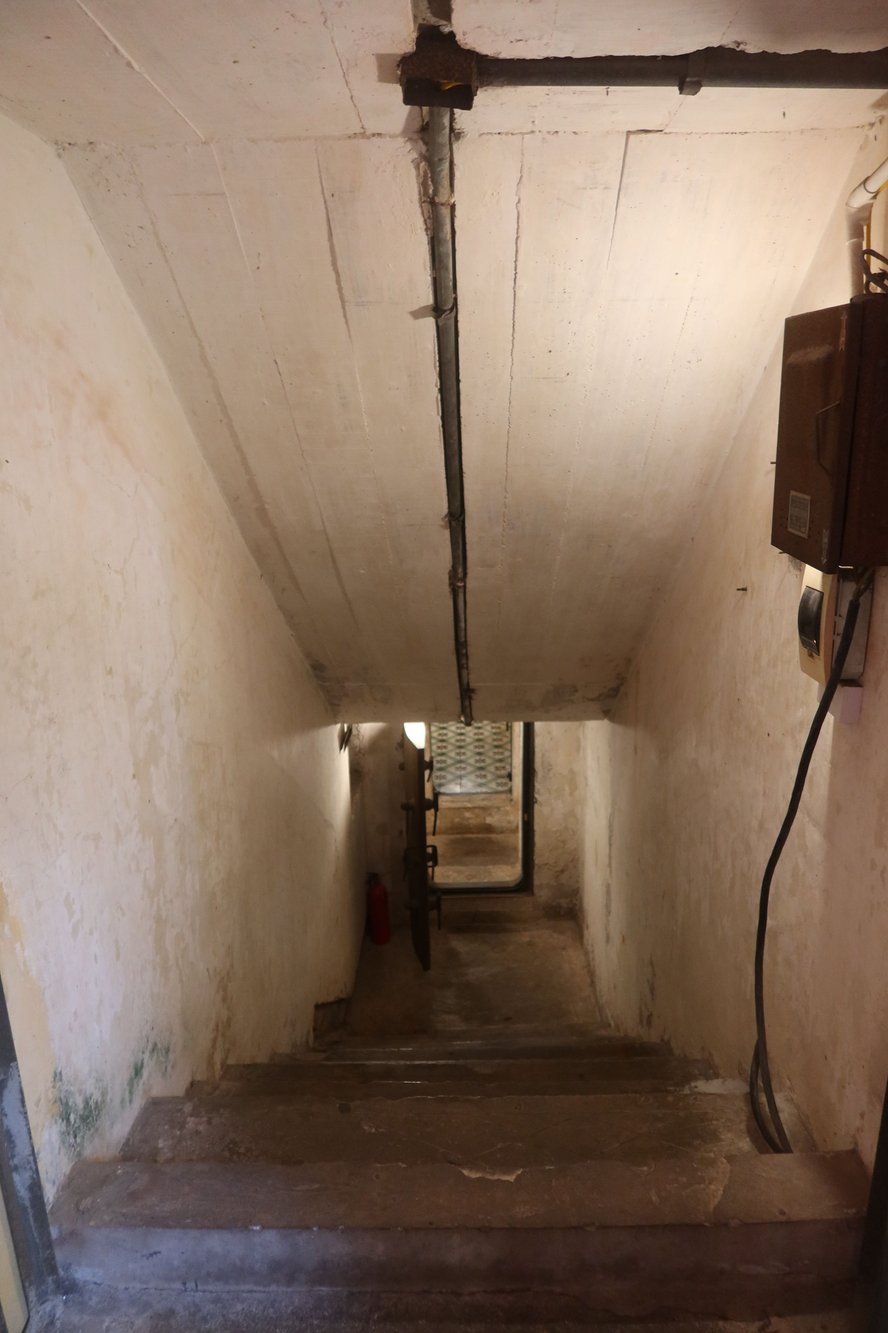
Stairway to Bunker, Imperial Citadel

Bunker Underneath Imperial Citadel

Northern Gate, Imperial Citadel
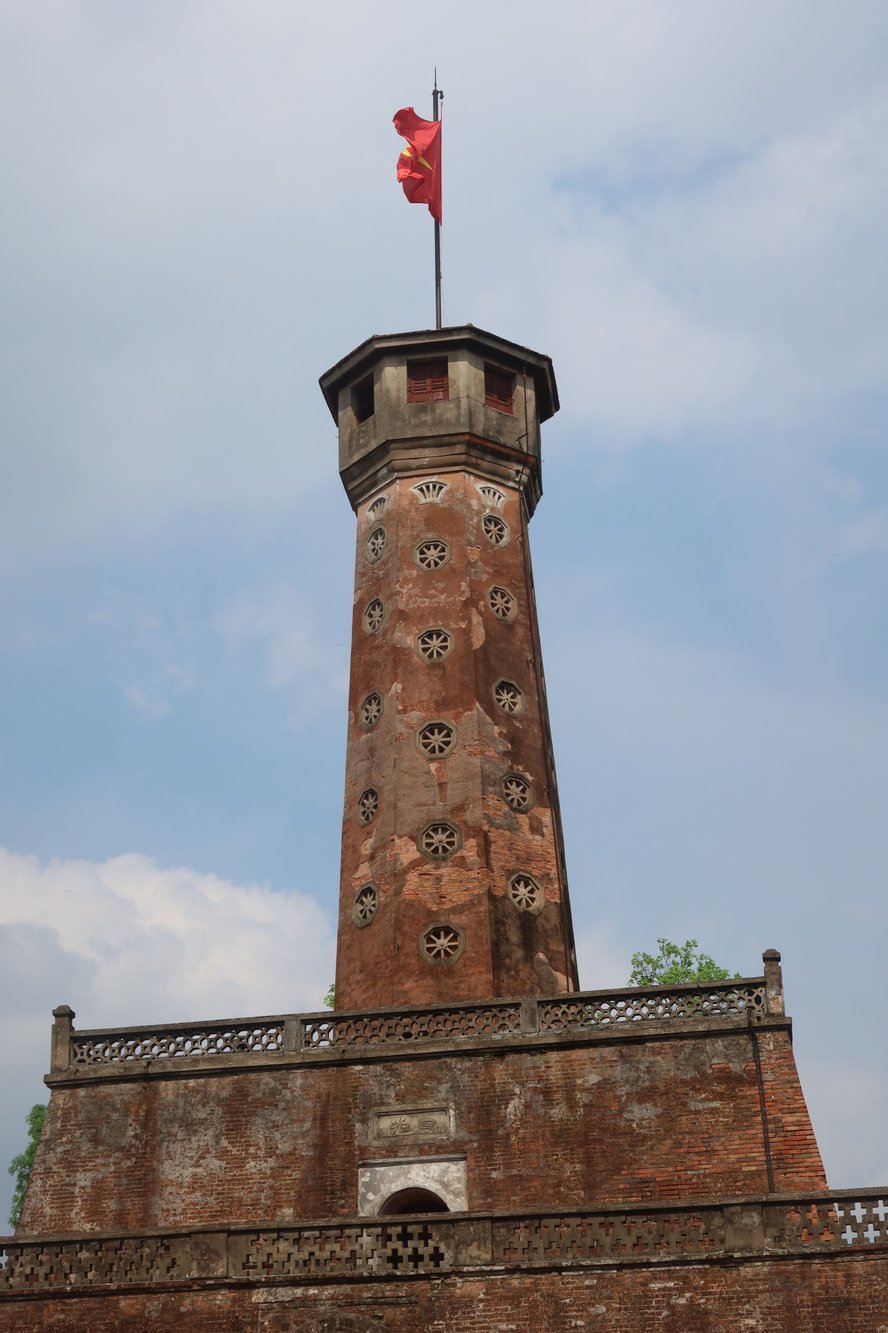
Flag Tower

Train Street before Train
Train Passing Train Street
Entrance to Hoa Lo Prison
Quan Su Temple
We began our day at the Ho Chi Minh Mausoleum. At the advice of our hotel concierge, we headed to the mausoleum shortly after 8:00 AM (the queue for not just the mausoleum but the entire complex closes at 11:00 AM). Finding the entrance was a bit difficult as several of the streets around the complex were closed to the public and we had to find the one for visitors. Once we were there, we just went with the flow, going through security, making our way to the mausoleum, and filing past the late Vietnamese leader lying in a transparent coffin. The atmosphere is solemn with numerous military guards present. Also located inside the security bubble are a small stilt house where Ho Chi Minh lived (consisting of a meeting room and a sleeping room), a building where he held his meetings, a museum to his life and work, botanic gardens, and a Buddhist temple. Visiting all the sites took about three hours.
From here we made our way on foot to the Imperial Citadel (the more precise Vietnamese translation is palace, not citadel) of Thang Long (which means ascending dragon in Vietnamese), the former name of Hanoi. Inside the complex are four well-preserved towers. The rest of the buildings, including the palaces, were destroyed over time, either through decay or through war. The exhibits at the Citadel goes through the succession of dynasties throughout Vietnamese history, the construction and reconstruction of buildings inside the complex, and life. Present were also underground bunkers used during the war against the United States including offices, Politburo meeting space, communications centers, etc. Also contained are unexcavated remains of buildings from over the centuries, some of it discovered recently when preparing the site for the election of the new National Assembly building. We also took about three hours here.
We then walked over to the social media-made-famous Train Street, where cafes line both sides of the railroad tracks. We had not intended to visit Train Street, but passed by it on the way from the Citadel to Hoa Lo Prison and thought why not. Walking up the street we saw a throng of tourists posing for photos on the tracks and the cafes buzzing with visitors. We casually asked one of the hustlers trying to lure visitors into their cafe and asked if there was a train expected to pass soon. She said yes, in 15 minutes. We walked up another half a block, saw empty seats, sat down, ordered beverages, and waited for the action. About five minutes later, the alarm sounded and the train whizzed by.
We continued on to Hoa Lo Prison. Built by the French in the 1800s, Hoa Lo was home to many Vietnamese political prisoners who fought for independence for their homeland in the 19th and 20th centuries as well as prisoners for general crimes. In the 1960s and 1970s, the prison housed numerous American prisoners of war. We toured the prison and learned about its history. Hoa Lo reminded me of Kilmainham Gaol in Dublin and Robben Island in South Africa.
About the exhibits at Hoa Lo as well as at the Ho Chi Minh Museum, I noticed that the exhibits more readily label the war in the 1960s and 1970s as the American War or the War Against American Imperialism. This was different from what we experienced in Hanoi, in which the portrayal of the United States as the aggressor was more muted. Also, there was equal if not more blame placed on the corruption and / or the harshness of the South Vietnamese government. Additionally, there was a lot more official government propaganda language used at these two museums regarding the Vietnamese Communist Party. This is the type of "official line" I had expected from a Communist country such as Vietnam, except it hasn't been as "in your face" anywhere else we visited, even with the 50th anniversary celebrations. Yet, Hanoi is no less relaxed than the other parts of Vietnam we've visited nor are the people any less friendly.
Our last stop of the day was Quan Su Temple, just around the corner from the prison. After the heavy subject of the prison, the 15th century Buddhist temple was a welcome respite. We visited, we prayed, and we sat for a bit before heading back to our hotel.
Dinner tonight was at T.U.N.G., a Scandinavian-Vietnamese tasting menu restaurant that featured ingredients from all over Vietnam as well as ingredients from Japan. The playful dining experience included an absolutely divine mini-banh mi stuffed with pork, a twist on traditional pho, divine pan-seared scallops, and more. Yet another memorable meal.
Ho Chi Minh Mausoleum
Ho Chi Minh Stilt House
One Pillar Pagoda (Buddhist Temple)
Duan Gate, Imperial Citadel
Stairway to Bunker, Imperial Citadel
Bunker Underneath Imperial Citadel
Northern Gate, Imperial Citadel
Flag Tower
Train Street before Train
Train Passing Train Street
Entrance to Hoa Lo Prison
Quan Su Temple
May 7th, 2025 | 05:30 AM
#50
Joined: Oct 2012
Posts: 2,245
Likes: 0
I had no idea that Thang Long was the former name of Hanoi. That explains a lot. There are so many places and restaurants and food names that contain Thang Long in the US, but few really with Hanoi. Now it makes sense.
Unfortunately for the US, we were in bed with an awful South Vietnam government, including a crackdown on Buddhist practices that led to infamous self-immolations by monks. That takes a hell of a lot of motivation. So yes they should receive a good share of blame.
Unfortunately for the US, we were in bed with an awful South Vietnam government, including a crackdown on Buddhist practices that led to infamous self-immolations by monks. That takes a hell of a lot of motivation. So yes they should receive a good share of blame.
May 7th, 2025 | 08:36 AM
#51
Original Poster
Joined: Sep 2012
Posts: 3,517
Likes: 0
shelemm, I hadn't known about Thang Long until this trip either and like you I've seen the name before, primarily when I lived in Chicago. Also agree about our poor choice of alliances, both past and present.
From the Mountains to the Sea, A Tapestry by Mother Nature
Today we took a day trip out of Hanoi, to Halong Bay. Halong means descending dragon in Vietnamese. Located off the coast of northeastern Vietnam near the Gulf of Tonkin, Halong Bay is known for its many limestone cliffs that rise up from the waters all throughout the bay. We went back and forth about Halong Bay including whether we would visit the main section or the lesser-trafficked Lan Ha Bay and Bai Tu Long Bay. We initially booked a 2-night stay on a ship in the bay but ultimately settled for a day trip. One, we heard a lot of negative information about the bay - the overtourism, the conditions of the bay, the trash, etc. Ultimately we decided against a longer visit given the repetitiveness of the activities, as we do not swim nor kayak. There are also hundreds of vendors for Halong Bay cruises. After doing our research, we settled on Ambassador Cruises given the proposed program and the condition of the ship.
We booked transportation with Ambassador Cruises. As such, we were picked up in front of our hotel at 6:00 AM for the 2.5-hour drive to Halong International Cruise Port, just northeast of the port city of Haiphong. Check-in at the port was smooth. The staff did a good job greeting our car, escorting us to the check-in desk, and issuing us our boarding credentials, and explaining the day's program to us.
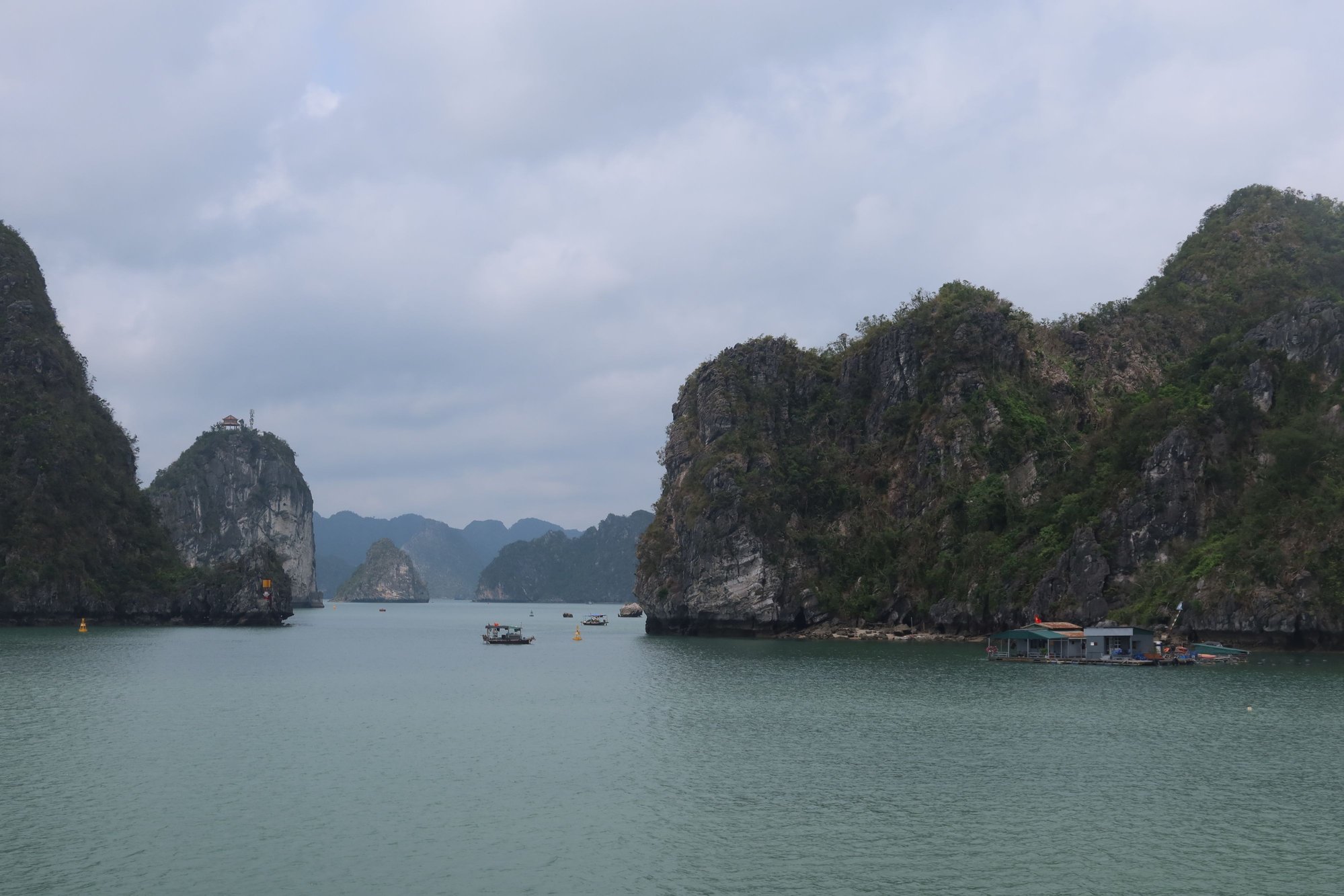
We set sail at 9:00 AM. Leaving Halong City, we sailed into the bay, with the famous limestone mountains in full panoramic view (we can see the mountains from shore as well as the last 30 minutes in the car on the way to the port). As today was cooler and there was a light breeze on the water, it was lovely to be on the outside decks, where we mostly stayed. About 30 to 45 minutes in, we were among the mountains itself, winding through the passageways.
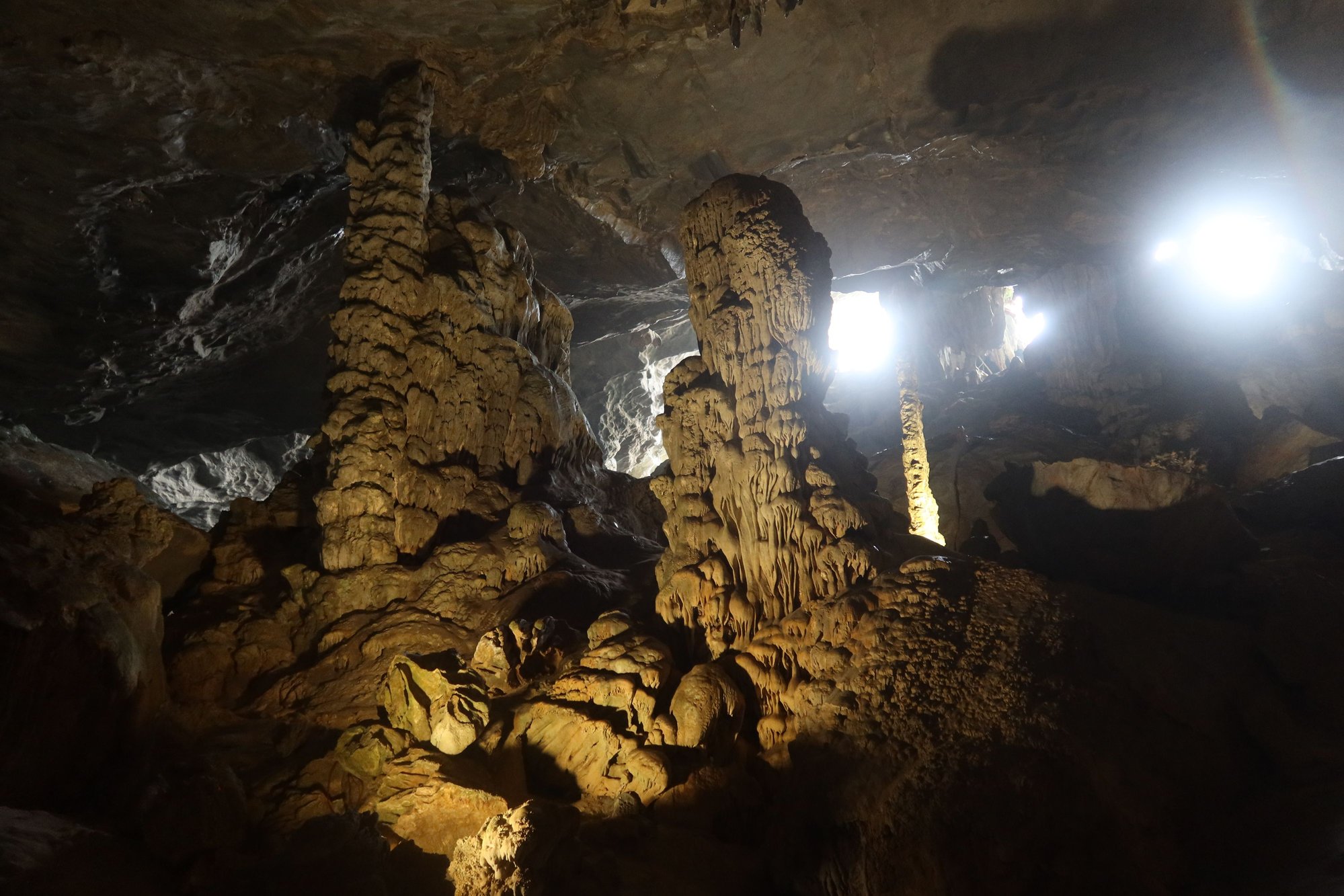
At 10:00 AM, an announcement was made that we are approaching our first stop - Sung Sot Cave. Passengers who were interested in visiting the cave were transferred to tender boats for the trip to the cave. Exploration of the beautiful underworld of stalactites and stalagmites involved about 300 steps into and out of the cave as well as one kilometer of boardwalk. We had 40 minutes, which was enough to enjoy the cave at a brisk pace. While more time would have been nice, we were content with what we were allotted given that we just came from Paradise and Phong Nha Caves a few days ago. Might I mention, in addition to the cave, we enjoyed gorgeous views of the bay - almost exactly as it appears in marketing materials. There were also only a dozen or so boats around, so the caves did not feel crowded at any time.
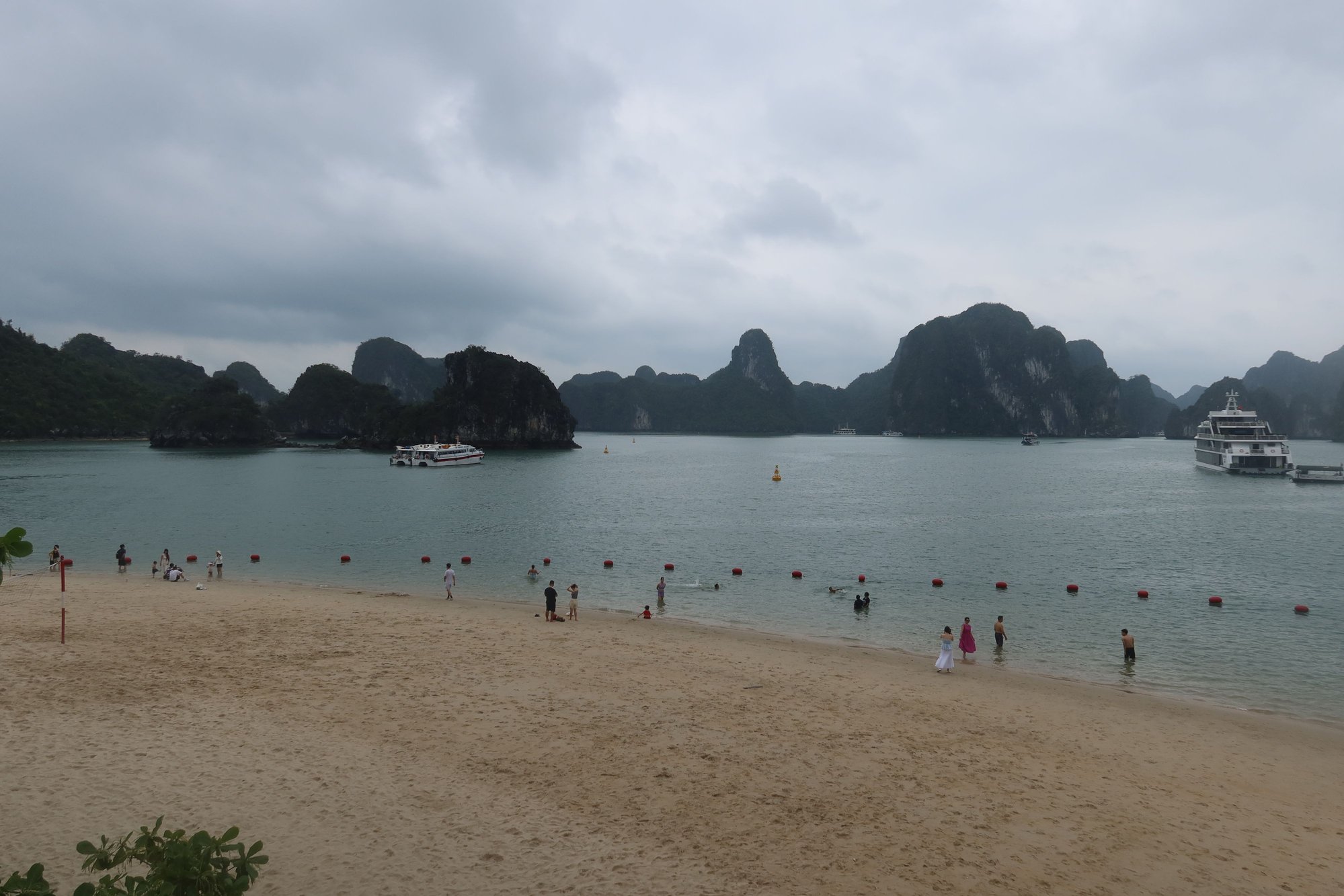
We then continued by tender to Titov Island. On the small island, we could hike to the top for views of the bay. However, given the limited time provided (40 minutes), we simply strolled along the shoreline, taking in more bay views. Other than relaxing, strolling, or hiking, there's not much to do on the island. In any way, the time passed quickly and we were back on our ship for lunch. The food is served buffet style and offered a good selection of options.
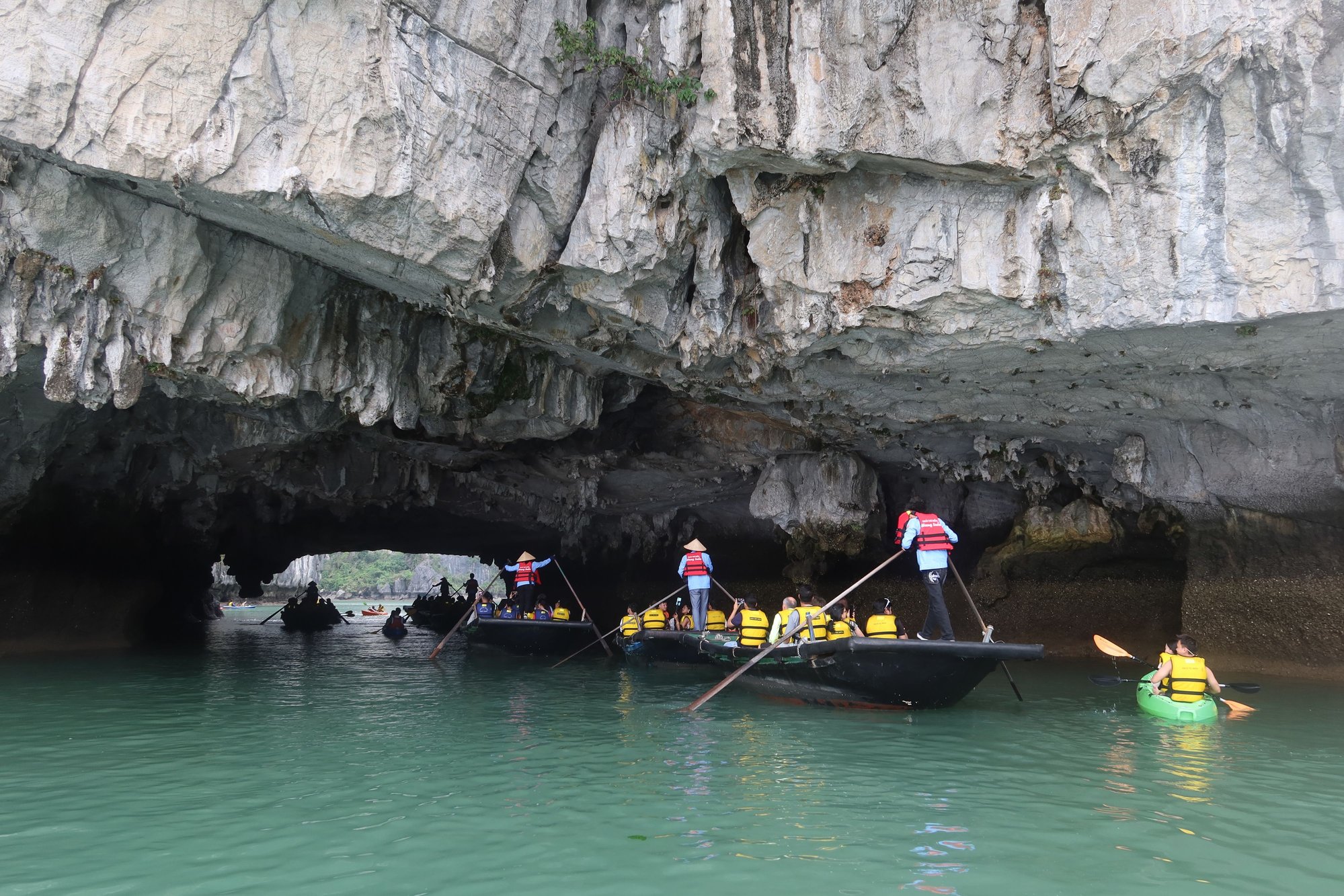
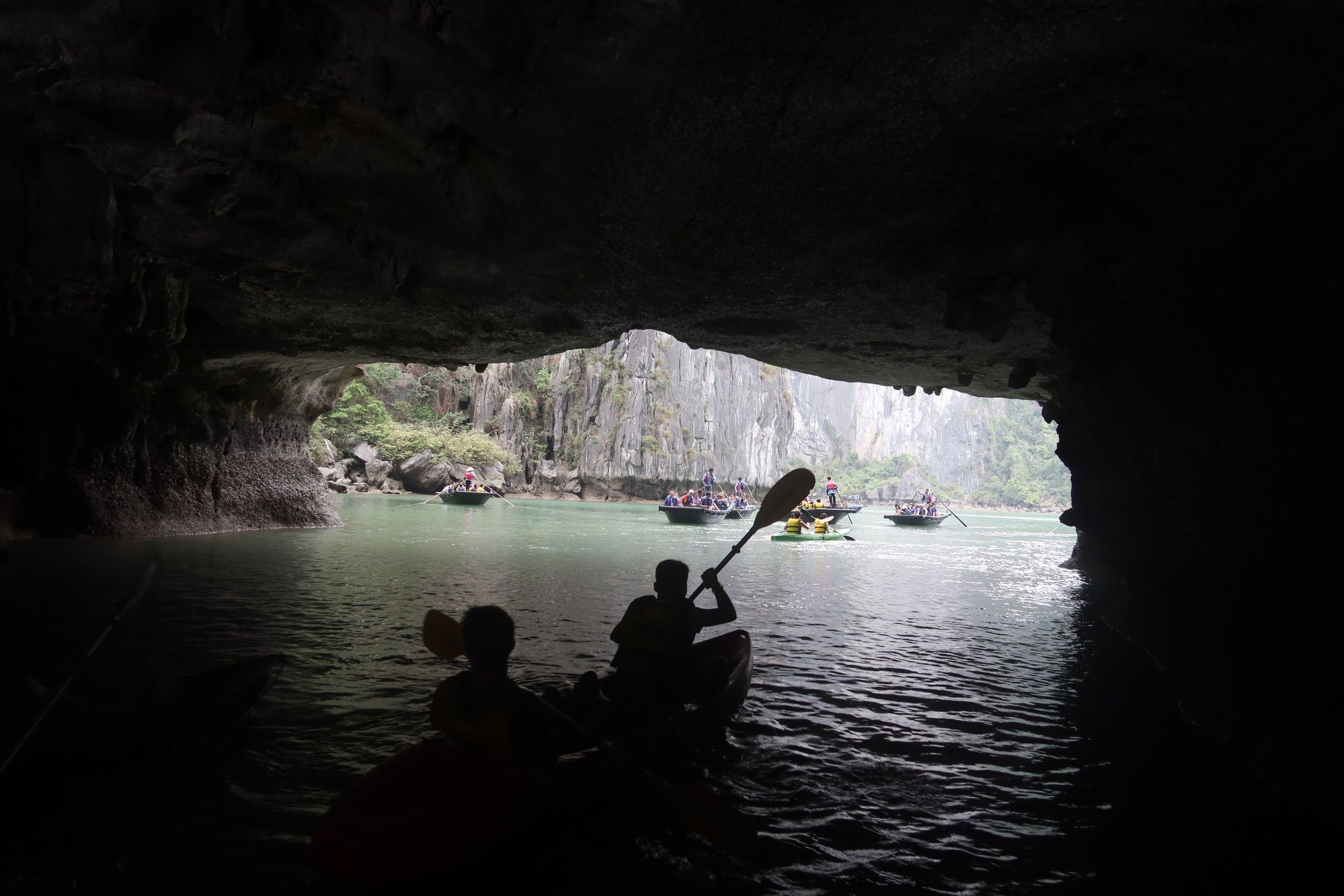
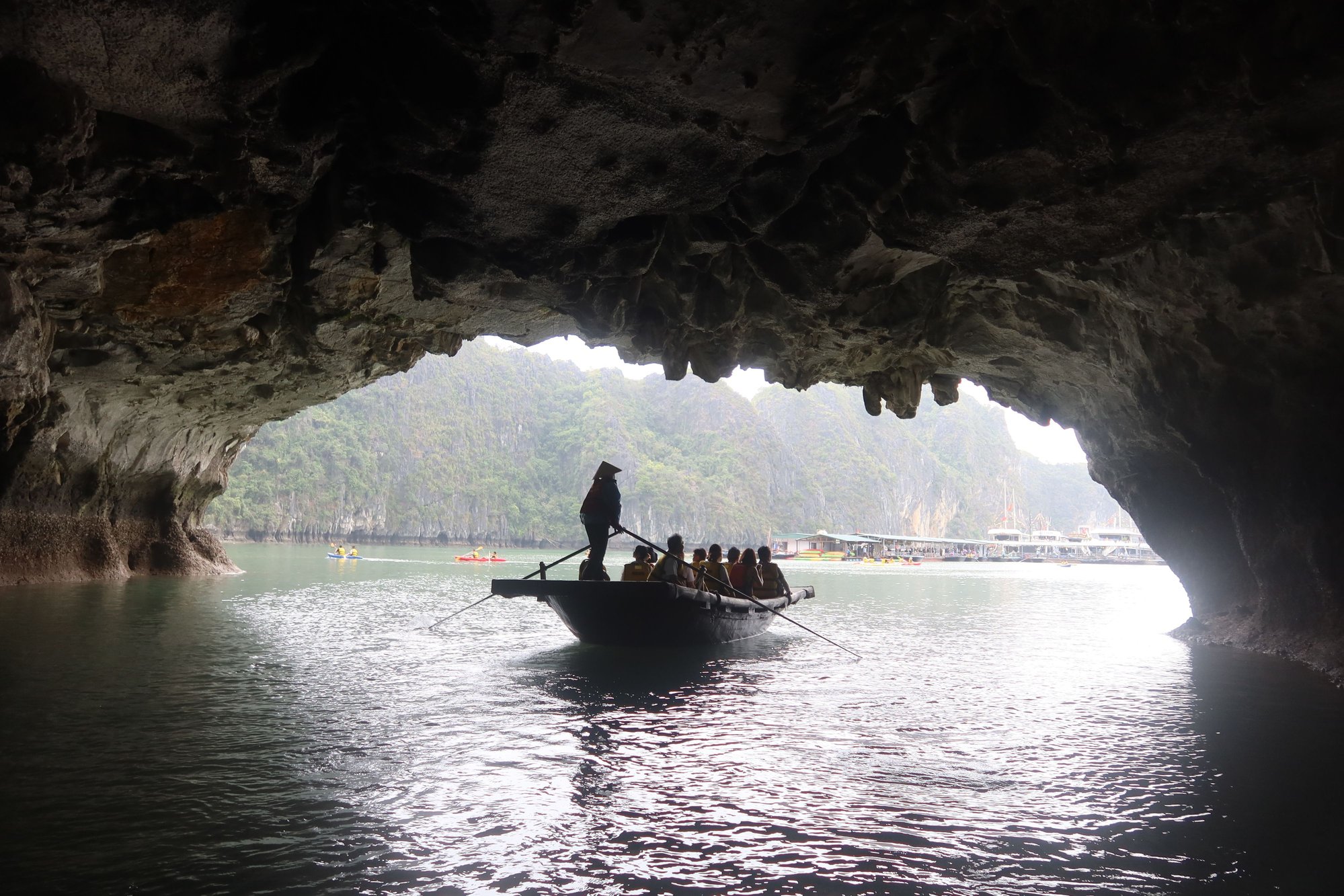
Our afternoon excursion was a bamboo boat ride through Luon Caves. An alternative was to go kayaking in the area. Similar to what we experienced in Ninh Binh and in Phong Nha, we sail through a cave, although here, on the other side of the cave is a lake with limestone on all sides. Comparably, both the rides in Ninh Binh and in Phong Nha are better. The other downside of the ride through Luon Caves is that the locals managing and operating the boats couldn't be any less friendly. They avoided any interaction with the tourists and refused to help passengers into and out of the boats, including one in front of us who asked for help (fellow passengers wound up helping her). After about 30 minutes, it was back onto the tender boats and then to the mothership. And like that, our day trip on Halong Bay was complete. We sailed back to the port, arriving before 4:00 PM, and then it was back on the highway to Hanoi, arriving at 6:00 PM.
Overall, we were glad we came to Halong Bay. The trip was more enjoyable than we had anticipated. We didn't encounter any of the crowds nor the trash that others warned us about. That said, we're also glad that we visited Halong Bay as a day trip instead of an overnight. Unless we are into swimming, kayaking, or sitting on the beach, there's not much more to do on Halong Bay. Sure, we could visit a couple more caves and but we thought Sung Sot Cave was perfect. We could visit a fishing village, but with it being so oriented towards tourism, it isn't really any authentic experience. The landscape makes Halong Bay at least worth seeing though.
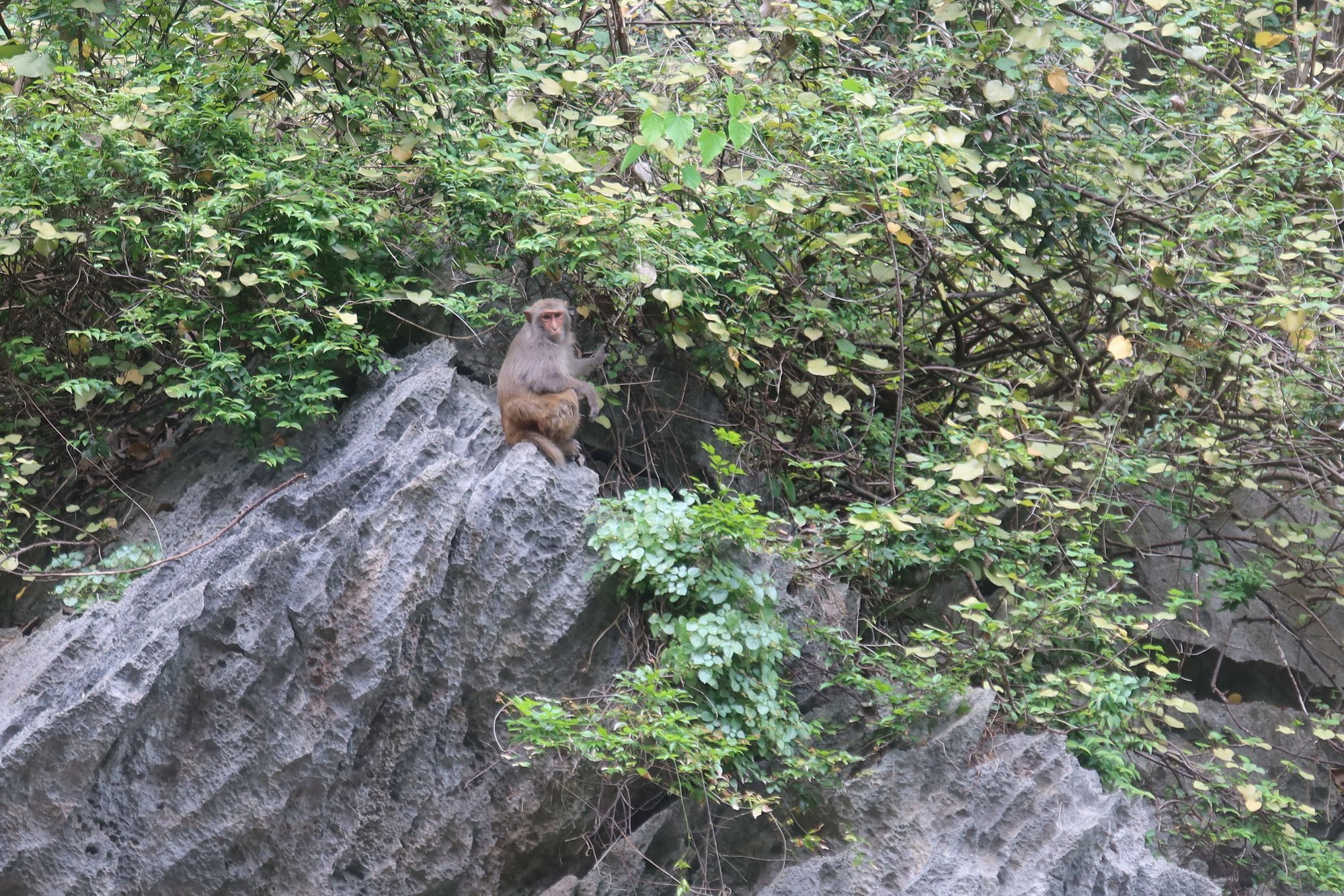
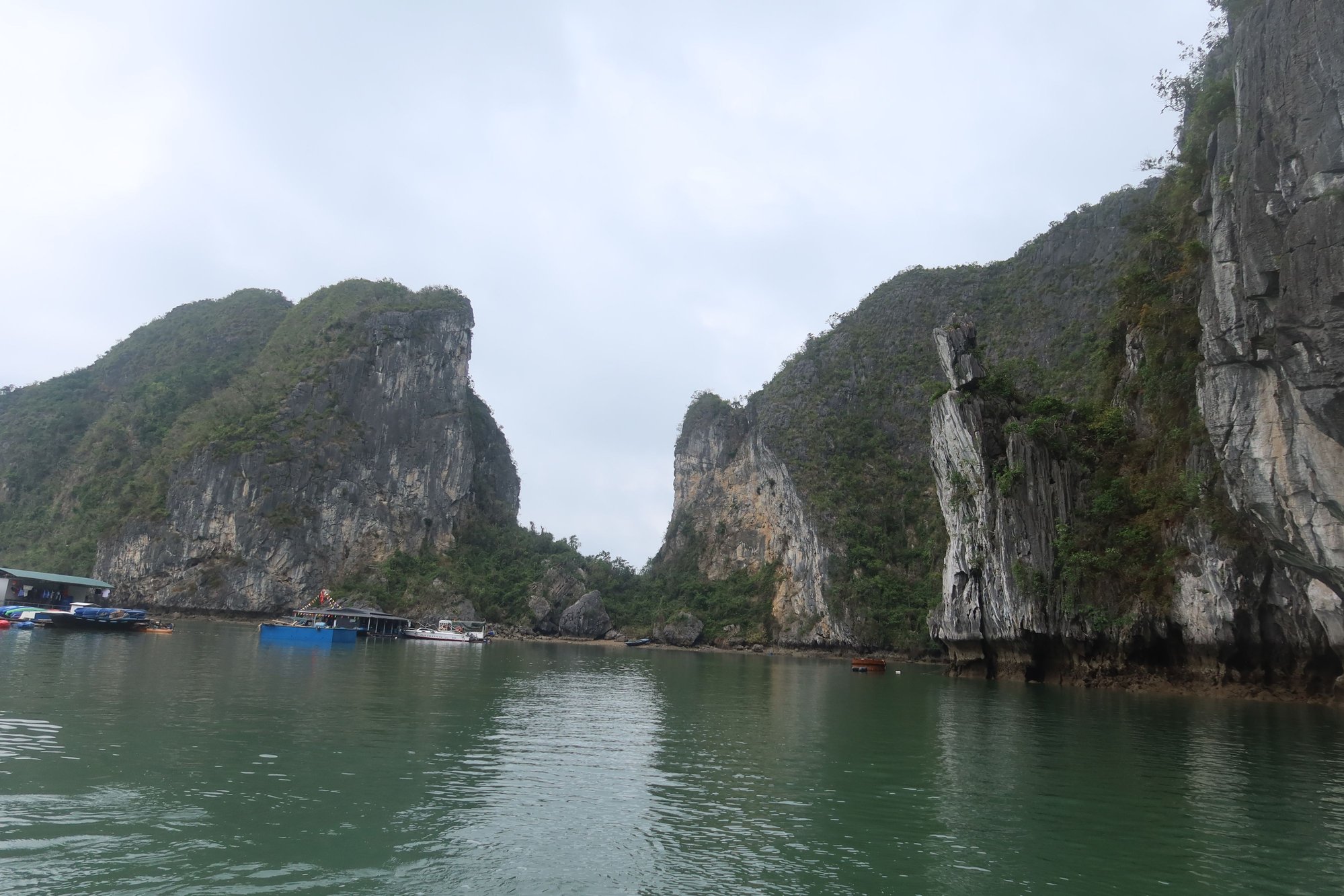
Scenes from Halong Bay




From the Mountains to the Sea, A Tapestry by Mother Nature
Today we took a day trip out of Hanoi, to Halong Bay. Halong means descending dragon in Vietnamese. Located off the coast of northeastern Vietnam near the Gulf of Tonkin, Halong Bay is known for its many limestone cliffs that rise up from the waters all throughout the bay. We went back and forth about Halong Bay including whether we would visit the main section or the lesser-trafficked Lan Ha Bay and Bai Tu Long Bay. We initially booked a 2-night stay on a ship in the bay but ultimately settled for a day trip. One, we heard a lot of negative information about the bay - the overtourism, the conditions of the bay, the trash, etc. Ultimately we decided against a longer visit given the repetitiveness of the activities, as we do not swim nor kayak. There are also hundreds of vendors for Halong Bay cruises. After doing our research, we settled on Ambassador Cruises given the proposed program and the condition of the ship.
We booked transportation with Ambassador Cruises. As such, we were picked up in front of our hotel at 6:00 AM for the 2.5-hour drive to Halong International Cruise Port, just northeast of the port city of Haiphong. Check-in at the port was smooth. The staff did a good job greeting our car, escorting us to the check-in desk, and issuing us our boarding credentials, and explaining the day's program to us.
We set sail at 9:00 AM. Leaving Halong City, we sailed into the bay, with the famous limestone mountains in full panoramic view (we can see the mountains from shore as well as the last 30 minutes in the car on the way to the port). As today was cooler and there was a light breeze on the water, it was lovely to be on the outside decks, where we mostly stayed. About 30 to 45 minutes in, we were among the mountains itself, winding through the passageways.
At 10:00 AM, an announcement was made that we are approaching our first stop - Sung Sot Cave. Passengers who were interested in visiting the cave were transferred to tender boats for the trip to the cave. Exploration of the beautiful underworld of stalactites and stalagmites involved about 300 steps into and out of the cave as well as one kilometer of boardwalk. We had 40 minutes, which was enough to enjoy the cave at a brisk pace. While more time would have been nice, we were content with what we were allotted given that we just came from Paradise and Phong Nha Caves a few days ago. Might I mention, in addition to the cave, we enjoyed gorgeous views of the bay - almost exactly as it appears in marketing materials. There were also only a dozen or so boats around, so the caves did not feel crowded at any time.
We then continued by tender to Titov Island. On the small island, we could hike to the top for views of the bay. However, given the limited time provided (40 minutes), we simply strolled along the shoreline, taking in more bay views. Other than relaxing, strolling, or hiking, there's not much to do on the island. In any way, the time passed quickly and we were back on our ship for lunch. The food is served buffet style and offered a good selection of options.
Our afternoon excursion was a bamboo boat ride through Luon Caves. An alternative was to go kayaking in the area. Similar to what we experienced in Ninh Binh and in Phong Nha, we sail through a cave, although here, on the other side of the cave is a lake with limestone on all sides. Comparably, both the rides in Ninh Binh and in Phong Nha are better. The other downside of the ride through Luon Caves is that the locals managing and operating the boats couldn't be any less friendly. They avoided any interaction with the tourists and refused to help passengers into and out of the boats, including one in front of us who asked for help (fellow passengers wound up helping her). After about 30 minutes, it was back onto the tender boats and then to the mothership. And like that, our day trip on Halong Bay was complete. We sailed back to the port, arriving before 4:00 PM, and then it was back on the highway to Hanoi, arriving at 6:00 PM.
Overall, we were glad we came to Halong Bay. The trip was more enjoyable than we had anticipated. We didn't encounter any of the crowds nor the trash that others warned us about. That said, we're also glad that we visited Halong Bay as a day trip instead of an overnight. Unless we are into swimming, kayaking, or sitting on the beach, there's not much more to do on Halong Bay. Sure, we could visit a couple more caves and but we thought Sung Sot Cave was perfect. We could visit a fishing village, but with it being so oriented towards tourism, it isn't really any authentic experience. The landscape makes Halong Bay at least worth seeing though.
Scenes from Halong Bay
May 7th, 2025 | 07:11 PM
#52
Joined: Oct 2012
Posts: 2,245
Likes: 0
Fascinating! You clearly got to some great spots in your day trip. This is the first report I've read about doing a day trip, and it makes sense to me. I don't really have a hankering to stay on a boat much, so my fear is that a longer excursion would be wasted on me.
And I also have to say that visiting the prison in Hanoi is something I would jump at the chance of doing. I don't think I've heard of a more compelling site there....
And I also have to say that visiting the prison in Hanoi is something I would jump at the chance of doing. I don't think I've heard of a more compelling site there....
May 8th, 2025 | 07:58 AM
#53
Original Poster
Joined: Sep 2012
Posts: 3,517
Likes: 0
shelemm, the day trip offered us the best of both worlds. Unless you're looking for swimming, kayaking, or more time on the water in general, a day trip is enough as you don't get to see more on the longer trips. For example, we looked at some of the overnight and two night options. Instead of visiting one cave, we get to visit two or three. Instead of one opportunity for small boat riding and kayaking, you get three. Also, the main ships are mostly stationary and you travel to the activities via tender boats, so this can get old pretty quickly.
Arts and Culture in Hanoi
We began our final day in Hanoi with a visit to the Temple of Literature, built in the 11th century by the Ly king as Vietnam's preeminent center of education. It was here that Vietnamese of all backgrounds studied to become officials in the royal court and its institutions of governance. Modeled after the Chinese education system at the time, the teachings were based on Confucian philosophy and principles. The temple was hopping today, not from visitors like us but Vietnamese gradeschoolers graduating from their classes. In addition to visiting the temple and learning about life at the school over the centuries, we watched some of the graduation ceremony, which involved Confucian religious rituals.
We then moved on to the Vietnam Fine Arts Museum just behind the Temple of Literature. Showcasing Vietnamese art spanning more than one thousand years, the first floor was devoted to imperial court art as well as Buddhist sculptures while the second floor was filled with different types of paintings.from Vietnamese artists. We especially enjoyed the Buddhist art as well as some of the lacquered paintings.
We also visited the Vietnam Museum of Ethnology. Located a little further afield than the other places we visited, this excellent museum tells the story of the Vietnamese as well as ethnic minority groups found throughout the country. There are also exhibits to other Asian cultures as well as cultures around the world. On display were dress and jewelry from the different groups as well as explanations about their religious rituals, ways of life, and housing. Outside of the main museum buildings, of which there are two, is an open-air museum with samples of housing of the different ethnic groups in Vietnam. We spent two hours here, but could have easily doubled that had we had more time and it was less hot and humid.
Lastly, we travelled over to the West Lake for a short afternoon stroll. The very large lake is dotted with temples and cafes all along the shoreline as well as large international hotels. It's possible to circumvent the lake on foot and perhaps a nice way to spend half a day if time permitted.

Entrance Gate, Temple of Literature
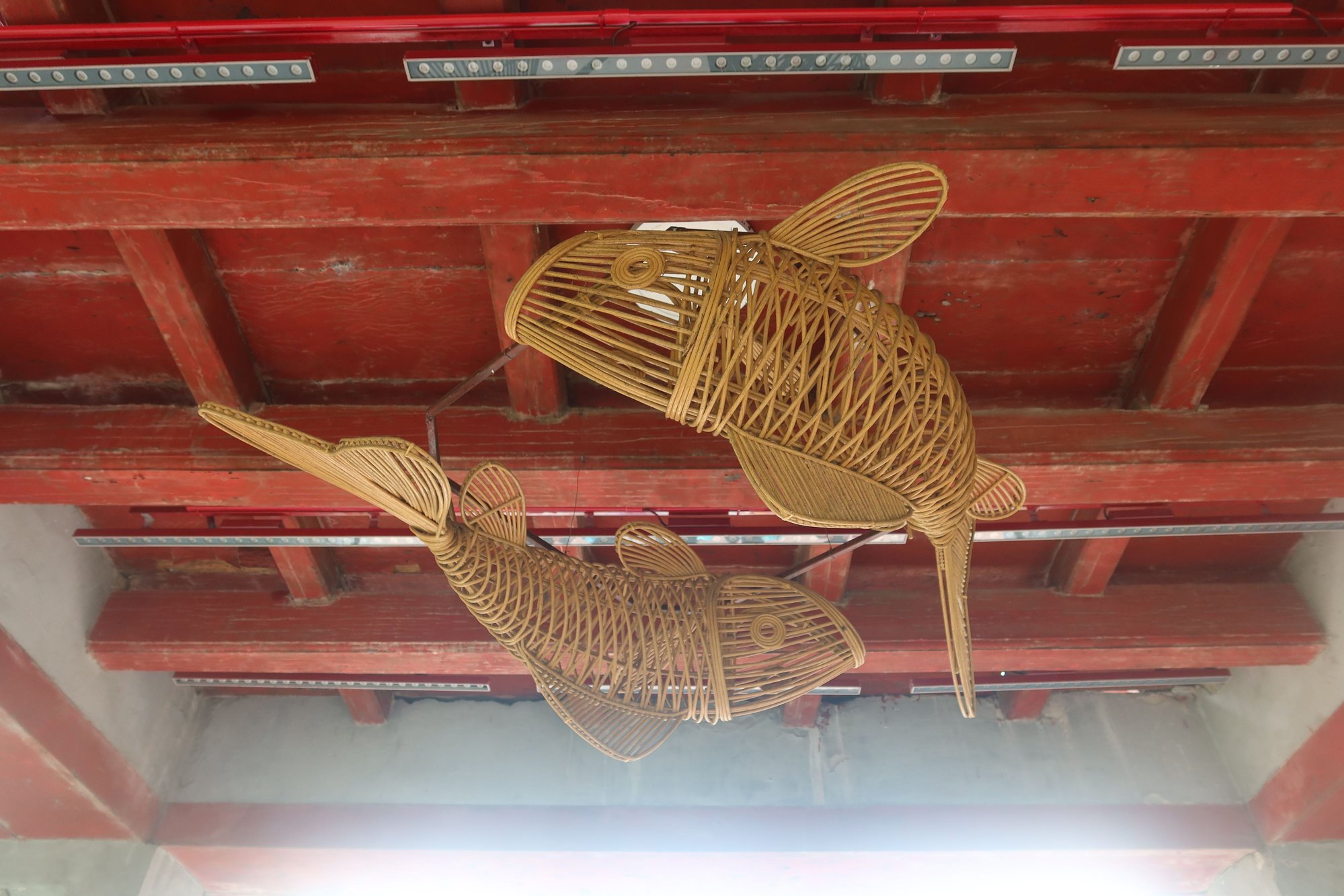
Fishes at Ceiling of One of the Gates at Temple of Literature

Graduation Ceremony, Temple of Literature

Fishing Nets for Sale, Museum of Ethnology
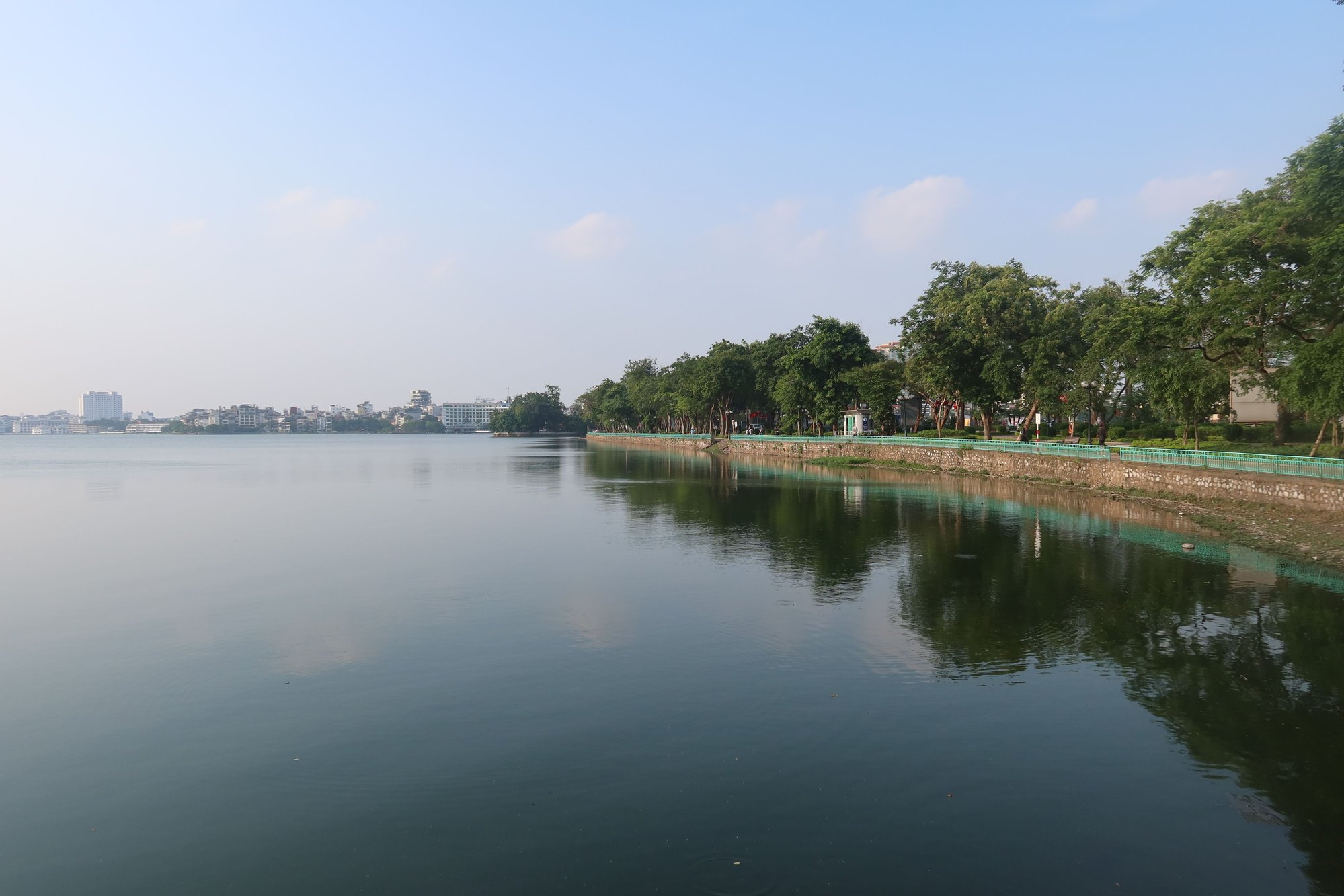
West Lake
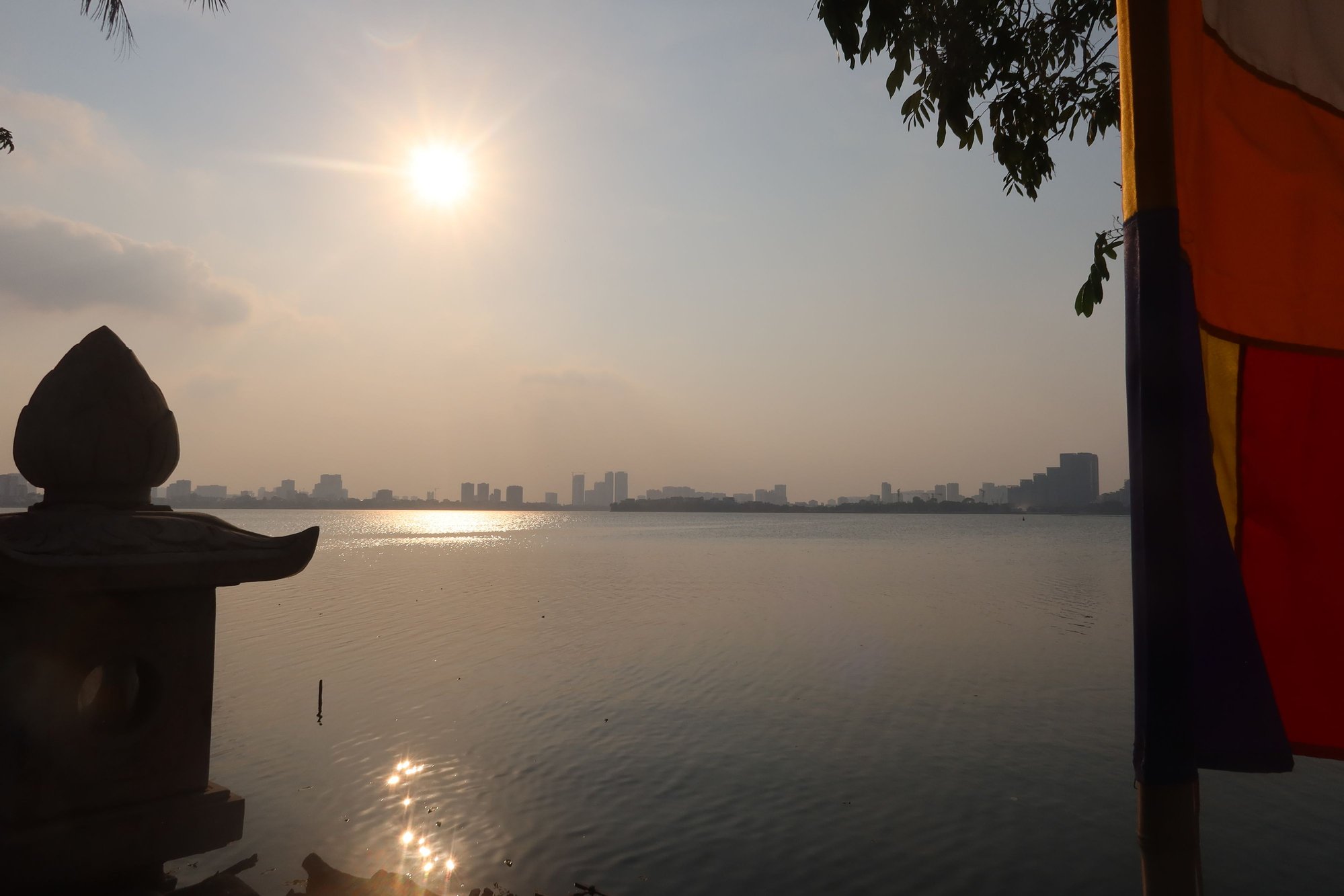
West Lake
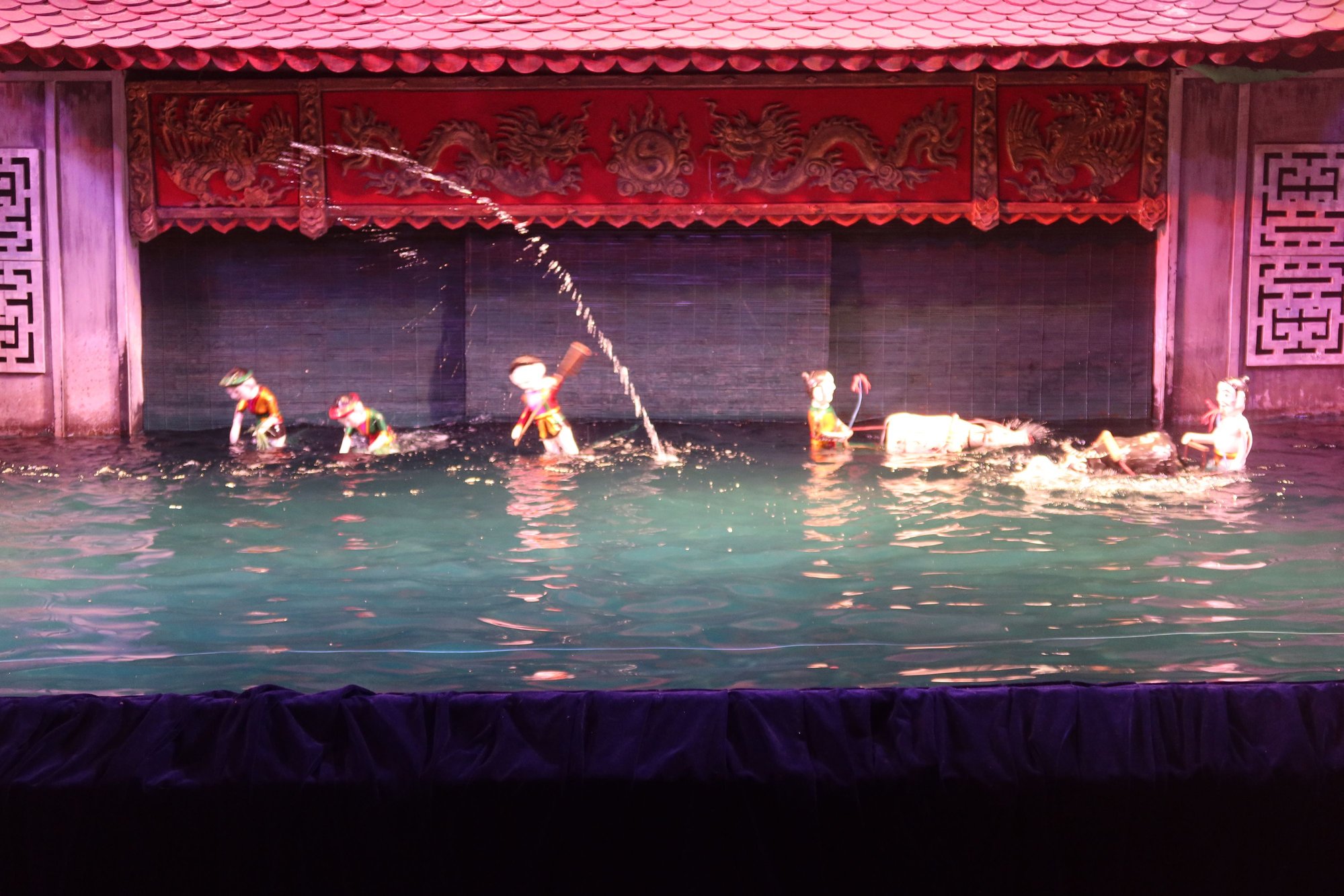
Water Puppet Show Scene
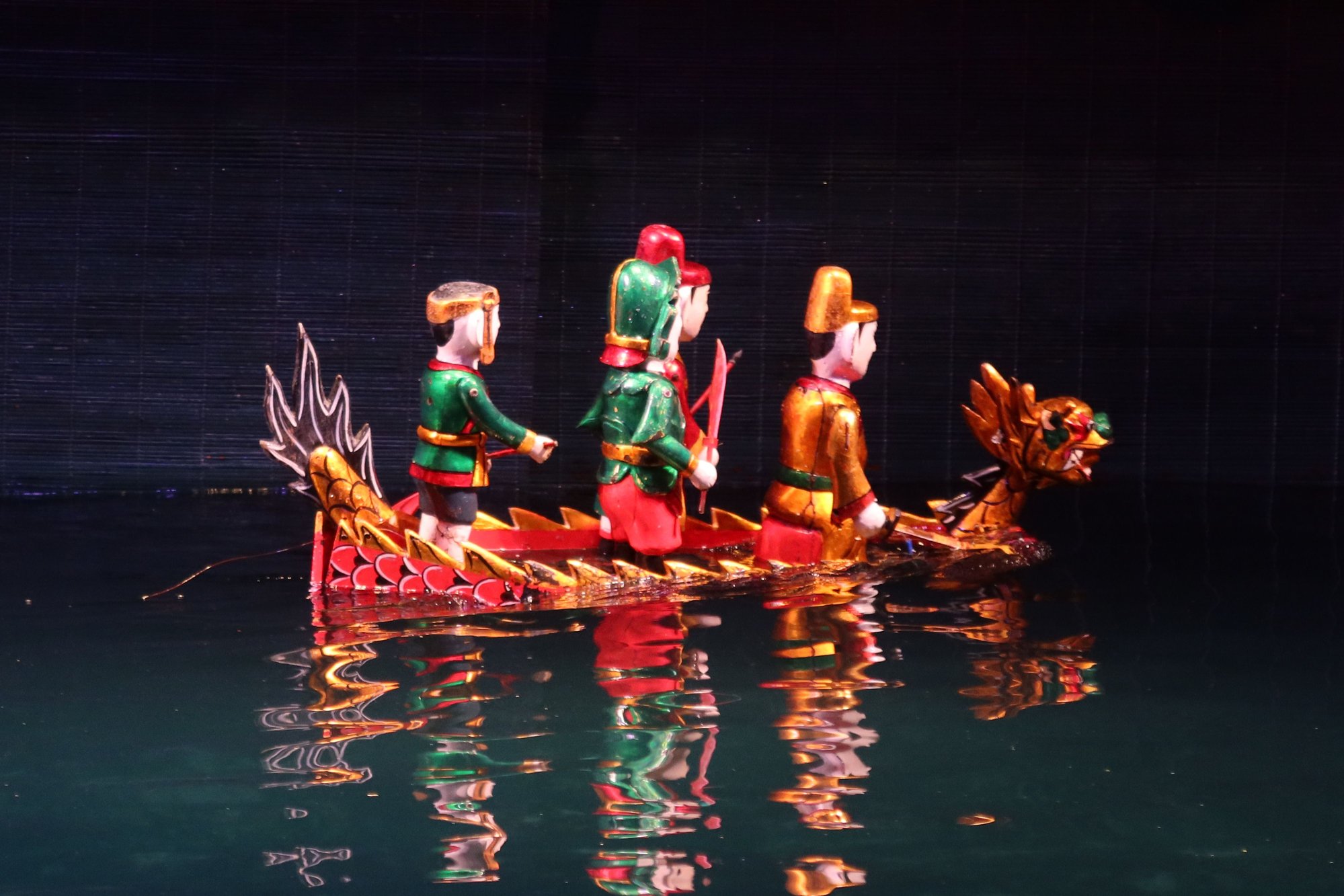
Water Puppet Show Scene
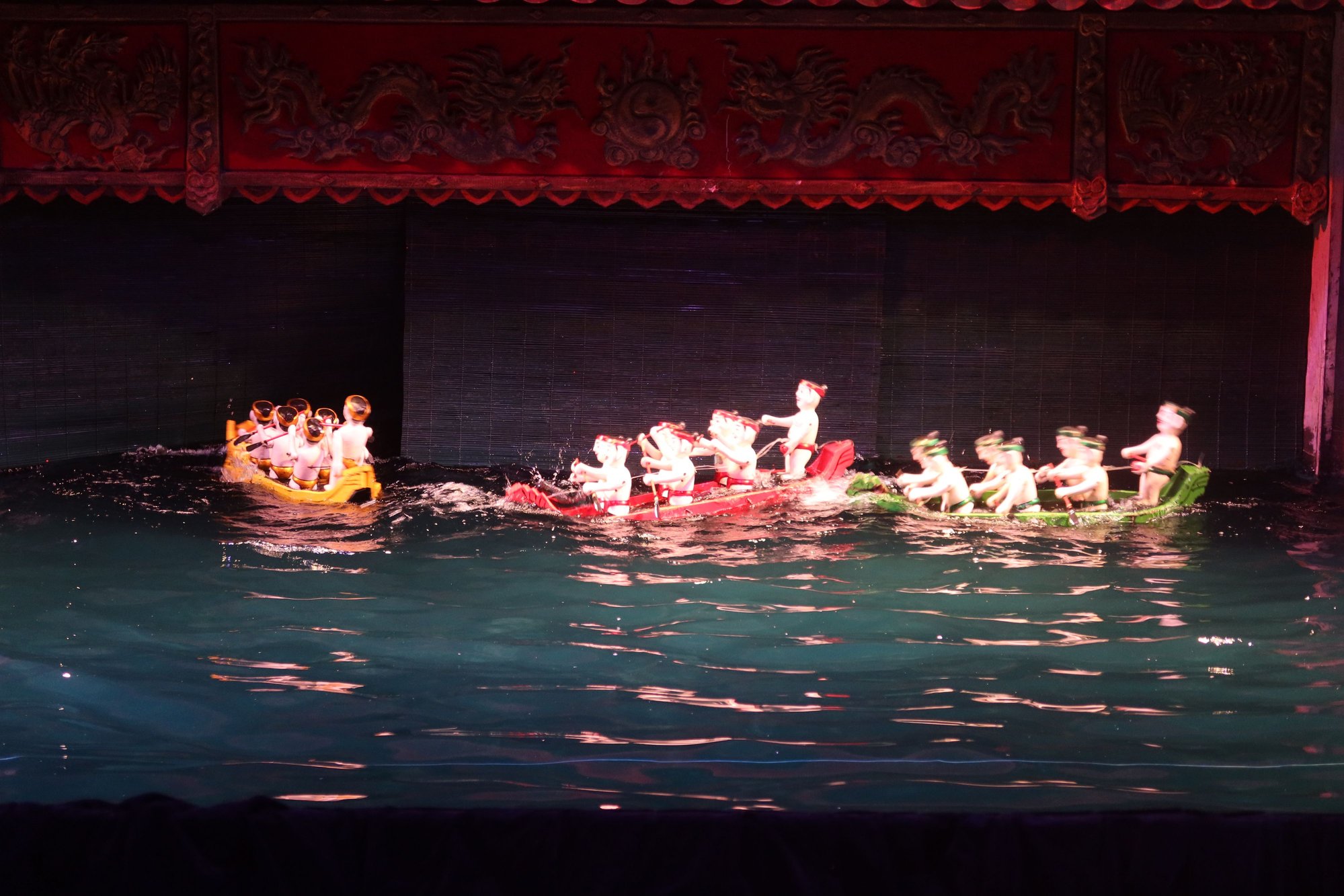
Water Puppet Show Scene
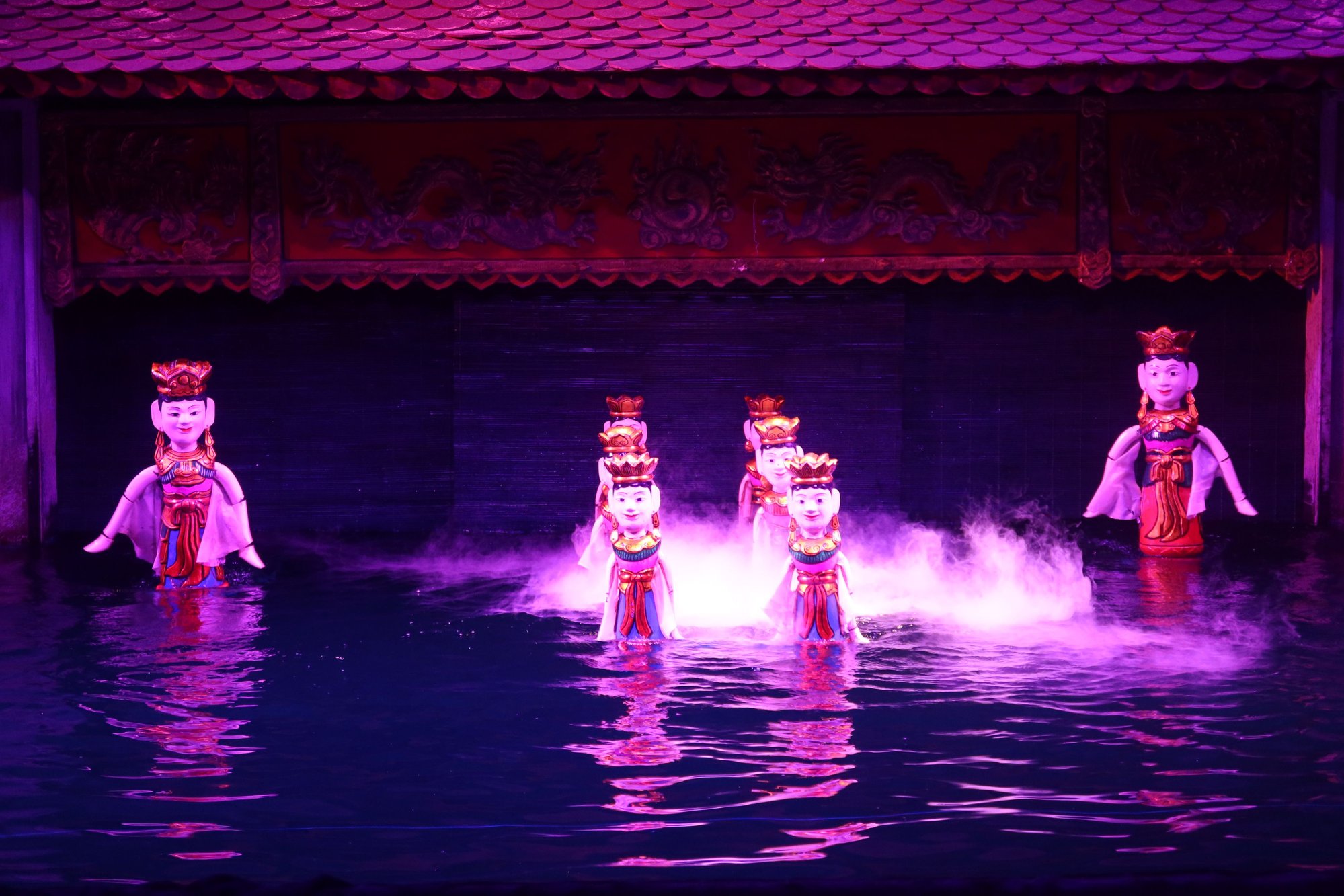
Water Puppet Show Scene
We ended our day with a water puppet show at Thang Long Water Puppet Theater near the north end of Hoan Kiem Lake. The show was hokey but enjoyable.
Arts and Culture in Hanoi
We began our final day in Hanoi with a visit to the Temple of Literature, built in the 11th century by the Ly king as Vietnam's preeminent center of education. It was here that Vietnamese of all backgrounds studied to become officials in the royal court and its institutions of governance. Modeled after the Chinese education system at the time, the teachings were based on Confucian philosophy and principles. The temple was hopping today, not from visitors like us but Vietnamese gradeschoolers graduating from their classes. In addition to visiting the temple and learning about life at the school over the centuries, we watched some of the graduation ceremony, which involved Confucian religious rituals.
We then moved on to the Vietnam Fine Arts Museum just behind the Temple of Literature. Showcasing Vietnamese art spanning more than one thousand years, the first floor was devoted to imperial court art as well as Buddhist sculptures while the second floor was filled with different types of paintings.from Vietnamese artists. We especially enjoyed the Buddhist art as well as some of the lacquered paintings.
We also visited the Vietnam Museum of Ethnology. Located a little further afield than the other places we visited, this excellent museum tells the story of the Vietnamese as well as ethnic minority groups found throughout the country. There are also exhibits to other Asian cultures as well as cultures around the world. On display were dress and jewelry from the different groups as well as explanations about their religious rituals, ways of life, and housing. Outside of the main museum buildings, of which there are two, is an open-air museum with samples of housing of the different ethnic groups in Vietnam. We spent two hours here, but could have easily doubled that had we had more time and it was less hot and humid.
Lastly, we travelled over to the West Lake for a short afternoon stroll. The very large lake is dotted with temples and cafes all along the shoreline as well as large international hotels. It's possible to circumvent the lake on foot and perhaps a nice way to spend half a day if time permitted.
Entrance Gate, Temple of Literature
Fishes at Ceiling of One of the Gates at Temple of Literature
Graduation Ceremony, Temple of Literature
Fishing Nets for Sale, Museum of Ethnology
West Lake
West Lake
Water Puppet Show Scene
Water Puppet Show Scene
Water Puppet Show Scene
Water Puppet Show Scene
We ended our day with a water puppet show at Thang Long Water Puppet Theater near the north end of Hoan Kiem Lake. The show was hokey but enjoyable.
May 9th, 2025 | 07:09 AM
#54
Original Poster
Joined: Sep 2012
Posts: 3,517
Likes: 0
After 20 days on the ground, our trip to Vietnam has come to an end. What an amazing journey across this beautiful land it has been. The people, the food, the places, the culture - we enjoyed all of it. The only negative was the intense humidity, which was in the 80 and 90 percent range daily; our only respite was during our stroll of the Han River in Danang.
The Highlights
The people of Vietnam are phenomenal. Everyone we met and interacted with were warm, helpful, and generous. People offered smiles everywhere we went and tried to help whenever they could. English is the primary foreign language used in Vietnam, and about one quarter of the people we came across were proficient in it. The older people could speak some French, and a good number in the tourism industry could speak basic Mandarin Chinese. When we couldn't communicate, we used Google Translate, which worked well.
After a while, we were able to get a bit of a grasp on written Vietnamese, as a large number of words were borrowed from Cantonese. And art and artifacts in palaces, temples, and museums were all in classical Chinese.
The Vietnamese culture was more familiar to us than what we had expected. Many traditions and practices were derived from Chinese culture, including interactions with people of different age ranks. The religious traditions, from Mahayana Buddhism to ancestor worship, follow the same practices to which we subscribe. The accessibility led to better and deeper discoveries.
The food was outstanding. From the street shops to the higher-end restaurants, we enjoyed the variety of food available. And food was very inexpensive for the most part. We enjoyed great meals for less than US$10 for the four of us. Michelin-starred restaurants aside, our meals never cost more than US$50, beverages included. Among many good meals, Madame Lan in Danang was an absolute standout.
Vietnam is an incredibly varied country in terms of landscapes. The only place we visited in the south was Saigon, which was okay. We most enjoyed our time in natural Vietnam. Ninh Binh and Phong Nha were the most memorable, along with Hoi An. As far as cities go, Hanoi was the best, although we liked Danang too. For its variety, we would rate Vietnam alongside Japan as our favorite countries in Asia.
And we cannot say enough good things about the Sofitel Metropole in Hanoi. From beginning to end, the service was stellar. The rooms were well-appointed and comfortable. The service staff was incredibly attentive. Used items in the rooms were always replaced. Food, from the breakfast buffet to the breakfast boxes offered to us, was notches above other similar hotels we stayed at. Hands down, the Metropole was the best hotel we stayed at anywhere in the world.
Our concerns about the system of government in Vietnam were relieved within the first day. People, even those who work in government, are relaxed. The only places where we witnessed negative behavior were at the immigration lines at Saigon Airport and at the Ho Chi Minh complex (comparably, it was no worse than similar personnel we've encountered in other countries and certainly not among the worst).
Yes, propaganda exists and probably more so than ever during our visit as it coincided with the 50th anniversary of the reunification of Vietnam, celebrating as Liberation Day. However, people readily recognized it as such and seem to grasp how it fits the broader context of information. Even the official government mouthpieces such as information in museum displays and guides acknowledged it as such. This trip has given us a different perspective of "communism", as the only version is the one we know from those who came before us who left mainland China decades ago.
Conclusion
We are currently in Singapore, having flown there this morning. We fly home in less than 36 hours from now.
From the Lion City, good night. Thank you for joining us on this amazing journey. Happy to comment and answer questions as it arises.
The Highlights
The people of Vietnam are phenomenal. Everyone we met and interacted with were warm, helpful, and generous. People offered smiles everywhere we went and tried to help whenever they could. English is the primary foreign language used in Vietnam, and about one quarter of the people we came across were proficient in it. The older people could speak some French, and a good number in the tourism industry could speak basic Mandarin Chinese. When we couldn't communicate, we used Google Translate, which worked well.
After a while, we were able to get a bit of a grasp on written Vietnamese, as a large number of words were borrowed from Cantonese. And art and artifacts in palaces, temples, and museums were all in classical Chinese.
The Vietnamese culture was more familiar to us than what we had expected. Many traditions and practices were derived from Chinese culture, including interactions with people of different age ranks. The religious traditions, from Mahayana Buddhism to ancestor worship, follow the same practices to which we subscribe. The accessibility led to better and deeper discoveries.
The food was outstanding. From the street shops to the higher-end restaurants, we enjoyed the variety of food available. And food was very inexpensive for the most part. We enjoyed great meals for less than US$10 for the four of us. Michelin-starred restaurants aside, our meals never cost more than US$50, beverages included. Among many good meals, Madame Lan in Danang was an absolute standout.
Vietnam is an incredibly varied country in terms of landscapes. The only place we visited in the south was Saigon, which was okay. We most enjoyed our time in natural Vietnam. Ninh Binh and Phong Nha were the most memorable, along with Hoi An. As far as cities go, Hanoi was the best, although we liked Danang too. For its variety, we would rate Vietnam alongside Japan as our favorite countries in Asia.
And we cannot say enough good things about the Sofitel Metropole in Hanoi. From beginning to end, the service was stellar. The rooms were well-appointed and comfortable. The service staff was incredibly attentive. Used items in the rooms were always replaced. Food, from the breakfast buffet to the breakfast boxes offered to us, was notches above other similar hotels we stayed at. Hands down, the Metropole was the best hotel we stayed at anywhere in the world.
Our concerns about the system of government in Vietnam were relieved within the first day. People, even those who work in government, are relaxed. The only places where we witnessed negative behavior were at the immigration lines at Saigon Airport and at the Ho Chi Minh complex (comparably, it was no worse than similar personnel we've encountered in other countries and certainly not among the worst).
Yes, propaganda exists and probably more so than ever during our visit as it coincided with the 50th anniversary of the reunification of Vietnam, celebrating as Liberation Day. However, people readily recognized it as such and seem to grasp how it fits the broader context of information. Even the official government mouthpieces such as information in museum displays and guides acknowledged it as such. This trip has given us a different perspective of "communism", as the only version is the one we know from those who came before us who left mainland China decades ago.
Conclusion
We are currently in Singapore, having flown there this morning. We fly home in less than 36 hours from now.
From the Lion City, good night. Thank you for joining us on this amazing journey. Happy to comment and answer questions as it arises.
May 9th, 2025 | 08:49 AM
#55
Joined: Oct 2012
Posts: 2,245
Likes: 0
You covered a lot of territory and saw so much. Impressive on any level. I can't go anytime real soon, but it will be my next big trip.
No matter how much info I have scoured so far, I definitely learned a lot from your report. Always good to have that first hand recounting.
No matter how much info I have scoured so far, I definitely learned a lot from your report. Always good to have that first hand recounting.
May 13th, 2025 | 05:27 AM
#59

Joined: Jan 2004
Posts: 3,618
Likes: 0
So many diverse experiences in one trip! Our visits to Vietnam have been similar. I'm glad you enjoyed your trip to Halong Bay. I know opinions are polarized on that. We went (albeit back in 2011) on an overnight cruise to Bai Tu Long Bay on a small junk (just 9 pax) and considered it a positive.
I've enjoyed following along. It's been fun to "revisit" places we've been, especially recently - and I've picked up some ideas (Ninh Binh...) for the next time, whenever that may be.
Our trip in the Galapagos was fantastic and a very intensive learning experience - as much a crash course as it was a vacation. It is such a unique ecosystem. I took a camera (instead of just a phone) and had a blast capturing birds, tortoises, iguanas, sea lions, etc. We chose a small, 16-pax catamaran, and our group ended up being just 10 people - making it a more intimate experience. And the city of Quito is worth time, as well.
I've enjoyed following along. It's been fun to "revisit" places we've been, especially recently - and I've picked up some ideas (Ninh Binh...) for the next time, whenever that may be.
Our trip in the Galapagos was fantastic and a very intensive learning experience - as much a crash course as it was a vacation. It is such a unique ecosystem. I took a camera (instead of just a phone) and had a blast capturing birds, tortoises, iguanas, sea lions, etc. We chose a small, 16-pax catamaran, and our group ended up being just 10 people - making it a more intimate experience. And the city of Quito is worth time, as well.

