279 Best Sights in Peru

Background Illustration for Sights

We've compiled the best of the best in Peru - browse our top choices for the top things to see or do during your stay.

Lagunas de Llanganuco

Fodor's Choice

Make sure your phone is fully charged when you visit these ravishing lakes, which are some of the most photogenic gems of the Peruvian sierra. Seen in sunlight, their crystalline waters shine a luminescent turquoise—an explosion of color against the gray of the encircling ice caps. Access to the area is via a giant gorge formed millions of years ago by a retreating glacier. If you look closely, you can see waterfalls of glacial melt snaking their way down the gorge's flanks, falling silently into the lake.

There are also many quenual (paper-bark) trees on the encircling slopes, while high above are visible treeless alpine meadows and the hanging glaciers of the looming mountains. At the lower lake, called Lago Chinancocha, you can hire a rowboat (S/5 per person) to take you to the center. A few trailside signs give info about local flora and fauna.

The easiest way to get here is with a group tour from Huaraz (about S/40 plus the entrance fee), though if you're going on the Santa Cruz trek the lake will probably be your starting point. Tours stop here and at many other spots on the Callejón de Huaylas, finishing in Caraz. All visitors must pay the Huascarán National Park fee.

Machu Picchu

Fodor's Choice

The exquisite architecture of the massive Inca stone structures, the formidable backdrop of steep sugarloaf hills, and the Urubamba River winding far below have made Machu Picchu the iconic symbol of Peru. It's a mystical city, the most famous archaeological site in South America, and one of the world's must-see destinations.

How to Visit: You must purchase your ticket by selecting one of four circuits, or routes (a fifth is reserved for those walking the Inca Trail) and the hour that you plan to enter. The first slot begins at 6 am, and these continue hourly through to 3 pm, the final entry slot of the day. You cannot backtrack on the route and the only tickets that allow you to leave and reenter Machu Picchu are the two (Circuits 3 and 4) that include access to Huayna Picchu or Machu Picchu Mountain. Circuits 1 and 2 allow the classic photo of Machu Picchu from the House of the Guardian, with Circuit 2 being the most complete to visit the majority of Inca structures. According to regulations, a licensed guide must accompany you, although this is not necessarily enforced. Either way, you will have just 2½ hours at the site from entrance to exit, so hiring a guide will enhance your experience considerably.

You can purchase all tickets by yourself online using a credit card at  www.ticketmachupicchu.com or  www.machupicchu.gob.pe. It’s advisable to do so at least a month in advance. If you have your heart set on hiking Huayna Picchu, make sure to book the ticket at least two to three months in advance, or even more during the high tourist season. 

Manu Biosphere Reserve

Fodor's Choice

Scientists consider the Manu Biosphere Reserve to be one of the most biodiverse places on earth, and much of its vast wilderness has barely been studied, since it is still home to uncontacted Indigenous groups. Straddling the boundary of the Madre de Dios and Cusco provinces, the reserve is Peru's second-largest protected area, encompassing nearly 4.5 million acres of pristine tropical forests. Its extraordinary biological diversity is in part due to its precipitous terrain, which ranges in altitude from 3,450 meters (11,320 feet) down to 300 meters (less than 1,000 feet). This geographical diversity results in varied ecosystems—from high-altitude puna grasslands to luxuriant cloud forests and seemingly endless rainforests—which, in turn, shelter a stunning range of flora and fauna. To top it off, a near-total absence of humans means that the animals here are less skittish and more easily observed.

Whereas Manu's highland cloud forest is home to dozens of hummingbird species, the spectacular cock of the rock, and the Andean bear (aka spectacled bear), the reserve's lower parts hold most of its more than 200 mammal species, including 13 species of monkeys, which scrutinize visitors with the same curiosity they elicit. White caimans sun themselves on sandy riverbanks, while the larger black caimans lurk in the oxbow lakes. With luck, you may see a tapir, giant river otter, or one of the region's elusive jaguars. No matter what, you are bound to see a sampling of the avian life that has made Manu world-famous. The area counts more than 1,000 bird species, only one-ninth of those known to science. They include several species of macaws, toucans, jacamars, cocoi herons, harpy eagles, razor-billed currasows, blue-headed parrots, and horned screamers. Manu is also home to hundreds of colorful butterfly species and an array of ants, beetles, and spiders, as well as millions of mosquitoes, so be sure to take an ample supply of insect repellent.

A UNESCO World Heritage Site, the Biosphere Reserve is divided into three distinct zones. The smallest, and most accessible, is what's known as the "cultural zone," home to several Indigenous groups and the majority of the jungle lodges. Access is permitted to all—even independent travelers, in theory—though it would be extremely difficult to visit it on your own. About three times the size of the cultural zone, Manu's "reserved zone" contains various nature lodges, which can only be visited on a guided tour with one of a dozen agencies authorized to take people into the area. The western 80% of Manu is designated a national park and is closed to all but authorized researchers and the Indigenous peoples who reside there.

Recommended Fodor's Video

Mines of Santa Bárbara

Fodor's Choice

This ghostly abandoned mine dates from 1563, when the discovery of mercury in the hills south of Huancavelica turned the region into a key cog in Spain's precious-metals machine. It devoured the lives of countless Indigenous mitayos (labor conscripts) until 1786, when one of the mine shafts collapsed, killing 200 workers. Thereafter it was sporadically worked by private concessioners until finally being shuttered in the 1970s. If you make the two-hour trek from town, you can see what remains of the former mining village, complete with church and school. The mine itself, however, is sealed off due to the poisonous gases still present inside. You can also pay a taxi driver S/60 to take you and wait as you explore. The mine is tentatively slated to become a UNESCO World Heritage Site, so to get the jump on the crowds, go now.

Huancavelica, Peru
Sight Details
Free

Something incorrect in this review?

Mirador de San Blas

San Blas Fodor's Choice

Set seven blocks northeast of Plaza de Armas, this charming spot perched high within the cobblestoned pedestrian streets of hip San Blas is one of the best spots to observe Cusco from above—and try to make out its original puma shape. A great time to visit is at sunset, when the city starts turning on its lights and locals start packing the district's little bars and bistros.

Cl. Kiskapata at Cl. Pasñapakana 133, Cusco, Peru

Something incorrect in this review?

Monasterio de Santa Catalina

Fodor's Choice

A city unto itself, this 5-acre complex of mud-brick, Iberian-style buildings—a working convent and one of Peru's most famed cultural treasures—is surrounded by vibrant fortresslike walls and separated by neat, open plazas and colorful gardens. Founded in 1579 and closed to the public for the first 400 years, Santa Catalina was an exclusive retreat for the daughters of Arequipa's wealthiest colonial patrons. Now visitors can catch a peek at life in this historic monastery. Narrow streets run past the Courtyard of Silence, where teenage nuns lived during their first year, and the Cloister of Oranges, where nuns decorated their rooms with lace sheets, silk curtains, and antique furnishings. Though it once housed about 400 nuns, fewer than 30 call it home today. Admission includes a one-hour guided tour (tip S/15–S/20) in English. Afterward, head to the cafeteria for the nuns' famous torta de naranja (orange cake), pastries, and tea. Besides Thursday, when it closes at 8:30, opening hours are from 9 to 6. There are also night tours on Thursday, but times can vary, so check before you go.

Museo de Arte de Lima (MALI)

El Centro Fodor's Choice

Built in 1871 as the Palacio de la Exposición, this mammoth neoclassical structure was designed by the Italian architect Antonio Leonardi, with metal columns from the workshop of Gustav Eiffel (who later built the famous Parisian tower). The ground floor hosts temporary exhibitions by national and international artists, while the second level houses a permanent exhibition that spans Peru's past, with everything from pre-Columbian artifacts and colonial-era art to republican-era paintings and drawings that provide a glimpse into 19th- and 20th-century Peruvian life. One of the museum's treasures is the collection of quipus, or "talking knots"—webs of strings that were the closest thing the Incas had to writing.

Leave time to sip an espresso in the café near the entrance.

Museo de Arte Precolombino

Fodor's Choice

For a different perspective on pre-Columbian ceramics, head to this spectacular museum, known as MAP, where art and pre-Columbian culture merge seamlessly. Twelve rooms in the 1580 Casa Cabrera, which was used as the convent of Santa Clara until the 17th century, showcase an astounding collection of pre-Columbian art from the 13th to 16th centuries, mostly in the form of carvings, ceramics, and jewelry. The art and artifacts were made by the Huari and Nazca, as well as the Inca, cultures. The stylish displays have excellent labels in Spanish and English that place the artifacts in their artistic and historical context. On the walls is commentary from European artists on South American art. Swiss artist Paul Klee wrote: "I wish I was newly born, and totally ignorant of Europe, innocent of facts and fashions, to be almost primitive." Most Cusco museums close at dark, but MAP remains open every evening. For a break after a walk around, find your way to the on-site café, one of Cusco's best restaurants (reservations are required for dinner).

Plaza de la Nazarenas 231, Cusco, Peru
084-595–092
Sight Details
S/20

Something incorrect in this review?

Museo de Culturas Indígenas

Fodor's Choice

This small, musty museum housed in a pale-blue building on the Malecón Tarapacá has an impressive collection of colorful headdresses made from the feathers of jungle birds and an array of other traditional handiwork by the main Amazonian tribes. If you're interested in Indigenous cultures, you won't want to miss it. The displays include a wealth of information about the lives of the Amazon Basin's Native peoples and an array of artifacts collected in Peru, Brazil, Colombia, and the Guianas over the course of decades. Items range from the quotidian (clothing, paddles, woven bags) to the ceremonial (musical instruments, headdresses, necklaces with the teeth of jungle animals). Among the more striking items are the jewelry, embroidered cloths and cushmas (tunics), painted ceramic wares, blowguns, spears, bows and arrows, and ceremonial headdresses.

Museo Larco

Pueblo Libre Fodor's Choice

Hot-pink bougainvillea spills over the white walls of this lovely colonial mansion, which is built atop a pre-Columbian temple. What those walls house is the city's most exquisite collection of ancient art, with works from all of Peru's major pre-Hispanic cultures spanning several thousand years. Highlights include a Moche stirrup vessel detailing grisly human sacrifices, a selection of Inca quipus (knots used for record-keeping), and thousands of ceramic "portrait heads" that give astonishingly realistic insights into their subjects' personalities. The sala erótica reveals that Peru's ancient artisans were an uninhibited lot, creating clay pottery adorned with explicit sexual images. Guides are a good idea, and the cost is just S/35 per group. The café overlooking the museum's garden is an excellent option for lunch or dinner.

Museo Nacional Tumbas Reales de Sipán

Fodor's Choice

This striking pyramidal complex, which ranks among Peru's best museums, was inaugurated in 2002 as a showcase for the artifacts from the tomb of the Lord of Sipán, one of the great archaeological finds of the 20th century. The discovery introduced the world to the splendors of Moche art, and the exhibits here detail the placement of every piece of jewelry, scrap of clothing, or ceramic vase in the three tombs unearthed at Huaca Rajada, 50 km (31 miles) to the east. As you descend through the museum's three floors, in a path that mimics that of the original diggers, you'll see spectacular turquoise-and-gold earrings, bizarre hairless dogs buried with the Señor, and life-size mock-ups of Mochica warriors. The story of how Walter Alva, the Peruvian scientist behind the find, tracked local huaqueros (looters) as he raced to uncover the graves is every bit as heart-pounding as the treasures themselves.

English-speaking guides are available to help with the Spanish-only descriptions and confusing order of exhibits.

Museo Pedro de Osma

Barranco Fodor's Choice

Even if it contained no art, this century-old Beaux-Arts mansion would be worth the trip for its design elements alone. The mansard-roofed structure—with inlaid wood floors, delicately painted ceilings, and stained-glass windows in every room—was the home of a wealthy collector of religious artifacts. The best of his collection is permanently on display. The finest of the paintings, the 18th-century Virgen de Pomata, combines Marian iconography with Indigenous symbols in the Holy Mother's mountain-shaped robes festooned with garlands of corn. Other halls contain canvases of archangels, fine silverwork, and sculptures of Huamanga alabaster. Make sure to visit the manicured grounds.

Museo Santuarios Andinos

Fodor's Choice

Referred to as the Juanita Museum, this fascinating little museum at the Universidad Católica Santa Maria holds the frozen bodies of four young girls who were apparently sacrificed more than 500 years ago by the Inca to appease the gods. The "Juanita" mummy, said to be frozen around the age of 13, was the first one to be found in 1995 near the summit of Mt. Ampato by local climber Miguel Zárate and anthropologist Johan Reinhard. When neighboring Volcán Sabancaya erupted, the ice that held Juanita in her sacrificial tomb melted, and she rolled partway down the mountain and into a crater. English-speaking guides will show you around the museum, and you can watch a video detailing the expedition.

Nazca Lines

Fodor's Choice

No less astonishing than Machu Picchu or other Peruvian wonders, this UNESCO World Heritage Site was discovered (or rediscovered) in 1927 by Peruvian archaeologist Toribio Mejía Xesspe, who stumbled upon them on a walk amid the foothills. Almost invisible from ground level, the lines were made by removing the surface stones and piling them beside the lighter soil underneath. More than 300 geometrical and biomorphic figures, some measuring up to 300 meters (1,000 feet) across, are etched into the desert floor, including a hummingbird, a monkey, a spider, a pelican, a condor, a whale, and an "astronaut," so named because of his goldfish-bowl-shaped head. In 2020, a research team came across a faded feline outline on a hillside. The catlike geoglyph stretches for 37 meters (120 feet) and has been dated to between 200 BC–100 BC, meaning it's part of the Late Paracas period and older than any of the other geoglyphs found in the area. Theories abound as to the purpose of these symbols, from landing strip for aliens to astronomical rituals or travel markers. Since 2000, investigators have discovered hundreds of additional figures, leading many to speculate that science hasn't begun to fathom this most puzzling of Peru's ancient mysteries.

Pampas de San José, Nazca, Peru

Something incorrect in this review?

Parque Nacional Huascarán

Fodor's Choice

The Lagunas de Llanganuco are just one of the gateways to Parque Nacional Huascarán, which covers 3,400 square km (1,300 square miles) and was created in 1975 to protect flora and fauna in the Cordillera Blanca.This incredible mountain range has a total of 663 glaciers and includes the highest peaks in the Peruvian Andes.

Huascarán, which soars to 6,768 meters (22,205 feet), is the highest in Peru. The smaller Alpamayo, 5,947 meters (19,511 feet), is said by many to be the most beautiful mountain in the world; its majestic flanks inspire awe and wonder in those lucky enough to get a glimpse. Not far away, the monstrous Chopicalqui and Chacraraju rise above 6,000 meters (19,700 feet).

Within the park's boundaries you'll also find more than 770 plant species. Sadly, there's a scarcity of wildlife in the park: many animals have been decimated by hunting and the loss of natural habitats. Among the 120 avian species and 10 species of mammals, you're most likely to see wild ducks and condors. With a good bit of patience—and an equal amount of luck—you may also glimpse foxes, deer, pumas, and vizcachas.

The giant national park attracts a plethora of nature lovers, including campers, hikers, and mountain climbers. Myriad treks weave through the region, ranging from fairly easy one-day hikes to 20-day marathons. Within the park, you can head out on the popular Llanganuco–Santa Cruz loop, a three- to five-day trek through mountain valleys, past crystalline lakes, and over a 4,750-meter-high (15,584-foot-high) pass. Other popular hikes include the one-day Lake Churup trek, the two-day Quilcayhuanca-Cayesh trek, and the two-day Ishinca trek. Check with agencies in Huaraz for maps, trail information, and insider advice before heading out.

If possible, plan on visiting Laguna 69, one of the park's high points; it's frequently included in hikes and day trips from Huaraz. Although experienced hikers who know how to survive in harsh mountain conditions may decide to head out on their own, it's always safer to arrange for a guide in Huaraz. You can opt to have donkeys or llamas carry the heavy stuff, leaving you with just a day pack. The most common ailments on these treks are sore feet and altitude sickness. Wear comfortable, broken-in hiking shoes, and take precautions to avoid feeling the elevation (drink lots of water, avoid prolonged exposure to the sun, and allow yourself time to acclimatize before you head out). The best time to go trekking is during the dry season, from May through September. July and August are the driest months—though dry season doesn't mean an absence of rain or even snow, so dress appropriately.

Some hikers decide to enter the park at night to avoid paying the cost of a multiday pass, but the money from these fees goes to protect the Andean habitat; consider this before you slip in after hours (nighttime safety is also a concern). You can purchase a pass at the Huaraz office of Parque Nacional Huascarán, as well as at the Lagunas de Llanganuco. Be sure to carry a copy of your passport with you.

Plaza de Armas

El Centro Fodor's Choice

This massive square has been the center of the city since 1535. Over the years it has served many functions, from open-air theater for melodramas to impromptu ring for bullfights. Huge fires once burned in the center for people sentenced to death by the Spanish Inquisition. Much has changed over the years, but one thing remaining is the bronze fountain unveiled in 1651. It was here that José de San Martín declared the country's independence from Spain in 1821.

Plaza de Armas

Plaza de Armas Fodor's Choice

With park benches, green lawns, and splendid views of the Catedral, Cusco's gorgeous colonial Plaza de Armas invites you to stay awhile. Take a seat on one of those park benches, and the world will come to you—without moving an inch, you'll be able to purchase postcards, paintings, and snacks, organize a trip to Machu Picchu, get your photograph taken, and get those dirty boots polished.

What you see today is a direct descendant of imperial Cusco's central square, which the Inca called the Haukaypata (the only name indicated on today's street signs) and which extended as far as the Plaza del Regocijo.

According to belief, this was the exact center of the Inca Empire, Tawantinsuyo, the Four Corners of the Earth. Today, continuing the tradition, it's the tourism epicenter. From the plaza you'll see the Catedral and Iglesia de la Compañía de Jesús on two sides and the graceful archways of the colonial portales, or covered arcades, lining the other sides. Soft lighting bathes the plaza each evening and creates one of Cusco's iconic views. Many of the city's frequent parades (and some protests) pass through the plaza, especially on Sunday. Enjoy the views of colonial Cusco, but note that any attempt to sit on one of those inviting green lawns will prompt furious whistle-blowing from the police.

Rainbow Mountain

Fodor's Choice

With almost as many names as colors, Rainbow Mountain, aka Vinicunca, aka Montaña de Siete Colores (Mountain of Seven Colors), is a fairly recent addition to Peru's top-attraction list. Until a few years ago, the multicolored mountain was just another snow-capped peak. When the ice and snow that covered the mountain started to melt (this might be the one time in your life that you will want to say "thank you, global warming"), the water mixed with minerals in the ground like iron sulfide, chlorite, and goethite to create the striking stripes of color. Rainbow Mountain is about three hours from Cusco by car, and requires a strenuous, high-altitude hike, so you will need to plan your visit with time to acclimatize first. Do yourself a favor and book a tour. This is a full day's adventure and hiking in high altitude can really knock you out; you'll appreciate the chance to nap on the drive back to your hotel.

Many photos of this mountain are heavily Photoshopped so do not be disappointed if the mountain is not quite as vivid as you have been led to expect. Also, dull weather conditions can dampen the effect, so try to plan around good weather if you have flexibility in your schedule.

Cordillera de Vilcanota, Peru

Something incorrect in this review?

Reserva Nacional de Paracas

Fodor's Choice

If a two-hour jaunt around the Islas Ballestas doesn't satisfy your thirst for guano, sea lions, and seabirds, then a land trip to this 3,350-square-km (1,290-square-mile) park just might. The stunning coastal reserve, on a peninsula south of Pisco, teems with wildlife. Pelicans, condors, and red-and-white flamingos congregate and breed here; the latter are said to have inspired the red-and-white flag General San Martín designed when he liberated Peru. On shore you can't miss the sound (or smell) of the hundreds of sea lions, while on the water you might spot penguins, sea turtles, dolphins, manta rays, and even hammerhead sharks.

Named for the blustering paracas (sandstorms) that buffet the coast each winter, the Reserva Nacional de Paracas (Paracas National Reserve) is Peru's first park for marine conservation. Organized tours take you along the thin dirt tracks that crisscross the peninsula, past sheltered lagoons, rugged cliffs full of caves, and small fishing villages. This is prime walking territory, as you can stroll from the bay to the Julio Tello Museum, and on to the fishing village of Lagunilla 5 km (3 miles) farther across the neck of the peninsula. Adjacent to the museum are colonies of flamingos, best seen June through July (and absent January through March, when they fly to the sierra). Hike another 6 km (4 miles) to reach Mirador de Lobos (Sea-Lion Lookout) at Punta El Arquillo. Carved into the highest point in the cliffs above Paracas Bay, 14 km (9 miles) from the museum, is El Candelabro geoglyph. Note that you must hire a guide to explore the land trails. Four-hour minibus tours of the entire park can be arranged through local hotels and travel agencies for about S/50.

Reserva Nacional Pacaya Samiria

Fodor's Choice

This hard-to-reach park comprises a vast expanse of wilderness between the Marañón and Ucayali Rivers, which flow together to form the Amazon. The reserve is Peru's largest, encompassing more than 20,000 square km (7,722 square miles)—which makes it about the size of El Salvador. The landscape is diverse, comprising a patchwork of seasonally flooded forests, oxbow lakes, black-water rivers, aguaje palm swamps, and vast expanses of lowland rainforest. The diversity extends to the animal inhabitants, which include pink river dolphins, black caimans, more than a dozen kinds of monkeys, and more than 500 bird species. As with many South American reserves, there are people living in Pacaya Samiria, around 42,000 according to recent estimates. The park can be reached only by boat, and some cruises visit its northern sector, which is relatively close to the town of Nauta.

Confluence of Marañón and Ucayali Rivers, Peru
Sight Details
S/30 per day, usually included with tour

Something incorrect in this review?

Ruinas Huari

Fodor's Choice

Recent excavations at this massive archaeological site have uncovered multilevel underground galleries, burial chambers, circular plazas, arched portals, and other architectural wonders. Together they make this capital city of the Huari culture one of the most impressive non-Inca ruins in the Peruvian sierra. The Huari flourished from around AD 700 to 1100, and wandering the quiet alleys of this 2,023-hectare (5,000-acre) complex gives you a sense of how its 60,000 residents lived, worshipped, and died. Especially noteworthy are the temples and communal tombs. There's a small museum on-site with mummies and ceramics, as well as a lounge to rest in after roaming the cactus-covered grounds. The best way to visit is to take a tour from a travel agency in town for S/30, as taxis and colectivos to the site are sporadic and hard to figure out.

Quinua Hwy., Ayacucho, Peru
066-312–056
Sight Details
S/6
Museum closed Mon.

Something incorrect in this review?

Ruta del Sillar

Fodor's Choice

The best way to understand how Arequipa's grand buildings are made is through a tour of the sites where sillar is extracted. About 2 km (1 mile) in length, the Ruta del Sillar was spearheaded by Arequipa's Center for Research, Education, and Development (CIED) and comprises visits to the quarries of Añashuayco, Cortadores, and Culebrillas, which are all set on the northwestern outskirts of the city. The Ruta del Sillar is a popular half-day trip, with tour operators like Peru Mistika offering morning and afternoon departures. At the first stop, Culebrillas, you'll walk for about 20 minutes into a stunning, serpentine, whitewashed desert canyon, the Quebrada de Culebrillas, whose walls are etched with the petroglyphs of the Wari people—they resided here about 10 centuries ago. At Añashuayco, the second stop, the quarry features men at work on stunning sillar sculptures of animals, human figures, and carved cliffs. There's an extra S/3 fee to enter two areas with the most elaborate statues.  

Canteras Añashuayco, Cerro Colorado, Arequipa, Peru
Sight Details
S/5

Something incorrect in this review?

Salineras

Fodor's Choice

The famed terraced Inca salt pans of Salineras, which take advantage of a natural phenomenon, are still in use: the Inca dug shallow pools into a sloped hillside. The pools filled with water, and upon evaporation, salt crystallized and could be harvested. On-site shops offer many varieties of the salt mixed with different herbs for use at home—some for culinary seasoning, others for therapeutic soaks. This stunning site is a popular day trip from Cusco; it's often paired with visits to nearby Moray and Ollantaytambo.

Tambo Colorado

Fodor's Choice

The great Inca Pachacutec himself probably stayed at this, one of Peru's most underrated archaeological sites. The labyrinthine alleyways and trapezoidal plaza of this huge adobe settlement were devised as an outpost for soldiers and visiting dignitaries of the far-flung Andean empire, making it the most important Inca site on the Peruvian coast. Today, Tambo Colorado is incredibly well preserved, owing to its bone-dry setting. When you go, you'll feel some of the same grandeur found in the stones of the Sacred Valley around Cuzco.

Tambo Colorado, or Pucahuasi ("red resting place") in Quechua, derives its name from the bright bands of imperial red, yellow, and white with which it was once blazoned. The site comprises several sections laid out around a large central plaza, and you can see the quarters where the great Inca received his guests. Notice that the plaza's distinctive trapezoid shape is mirrored in many of the tambo's architectural features, such as the trapezoidal windows and portals. Modern engineers have argued these elements are anti-seismic in nature, something that is highly necessary in this volatile region.

Be sure to visit the on-site museum, which houses many finds by the great Peruvian archaeologist Julio C. Tello, the site's excavator.

Tambopata National Reserve and Bahuaja-Sonene National Park

Fodor's Choice

A vast expanse of protected wilderness stretches eastward from Puerto Maldonado to Bolivia and southward all the way into the Andean foothills. Its forests, rivers, palm swamps, and oxbow lakes are home to hundreds of bird and butterfly species, monkeys, tarantulas, turtles, and countless other jungle critters. This amazing natural diversity can be experienced from any of a dozen nature lodges scattered along the Madre de Dios River, the Tambopata River (which flows into the Madre de Dios at Puerto Maldonado), or the more distant Heath River.

Together, the contiguous Tambopata National Reserve and Bahuaja-Sonene National Park protect 3.8 million acres, an area the size of Connecticut. Several indigenous Ese'Eja communities border the park; "Bahuaja" and "Sonene" are the Ese'Eja names for the Tambopata and Heath Rivers, respectively. The Río Heath forms Peru's southeastern boundary with neighboring Bolivia, and the former Pampas de Río Heath Reserve, along the border, is now incorporated into Bahuaja-Sonene. It includes an out-of-place "pampas" ecosystem that resembles an African savanna more than the lush Amazon forest that borders it.

Peru collaborates on conservation with Bolivia, whose adjoining Madidi National Park forms a vast, cross-border protected area that covers 7.2 million acres. Only environmentally friendly activities are permitted in Tambopata. In addition to participating in tourism, local communities collect Brazil nuts from the forest floor and aguaje palm fruit in the swampland.

Elevations here range from 500 meters (1,640 feet) to a lofty 3,000 meters (9,840 feet), providing fertile habitat for an astounding diversity of animals and plants. The area holds a world record in the number of butterfly species (1,234).

These protected areas contain Peru's largest collpas, or clay licks, which are visited by more than a dozen parrot, parakeet, and macaw species each morning. They congregate at dawn to eat the mineral-rich clay on the steep riverbank, and it's a beautifully fascinating sight to get to witness.

Taquile Island

Fodor's Choice

East of Puno in the high-altitude sunshine, Taquile's brown, dusty landscape contrasts with green terraces, bright flowers, and the surrounding blue waters. Snowcapped Bolivian mountains loom in the distance.

Taquile folk, both men and women, are known for weaving some of Peru's loveliest textiles, a UNESCO Intangible Heritage. Islanders still wear traditional dress and have successfully maintained the cooperative lifestyle of their ancestors. The most important piece in Taquile's obligatory knitted "uniform" is the chullo. This large, floppy hat is worn high on the head and indicates a man's social status: if it's red and white, he is single; if it's red/pink, he's married. Here, weaving is also often the basis of social relations. For example, if a man wants to marry, he must show that he can make his own chullo.

Taquile's steep hill has long, curvy trails leading to the main square, where islanders often perform local dances for tourists. There are many ways to reach the top of Taquile, where there are Inca and Tiahuanaco ruins. The most popular way is to climb the 533 stone steps, though if you want to avoid an arduous walk, some tours will take you to the other side, thus avoiding the steps. The island is 35 km (22 miles) from Puno, and the trip takes about four hours in a slow boat and two hours on a speedboat each way with no transportation on land once you arrive. There are a few shops and small restaurants, as well as an excellent textile store. Overnight stays are primarily based in local homes, and most tours include lunch with a local family. Note that the annual Taquile festival the third week of July is a great time to visit.

Vilcashuamán and Intihuatana

Fodor's Choice

Four long hours south of Ayacucho on winding, unpaved roads is the former Inca provincial capital of Vilcashuamán, set where the north–south Inca highway crossed the east–west trade route from Cusco to the Pacific. Erected by the great Inca Pachacutec after his defeat of the Chanca people in 1438, the site displays the same monumental stone architecture that's ubiquitous in the Sacred Valley. Especially impressive are the sun temple (sadly now capped by a Spanish colonial church) and a five-tiered platform, known as an ushnu, crowned by an Inca throne. You can also visit the trapezoidal plaza, as well as the stepped fields once farmed by Inca peasants.

An hour's walk from Vilcashuamán (or a half-hour's walk south past the main road from Ayacucho) is Intihuatana, aka Pumacocha, a site built for Inca royalty that includes a palace and tower beside a man-made lagoon. Former Inca baths, a sun temple, and a sacrificial altar can also be seen on the grounds. Check out the unusual 13-angled boulder, one of the odd-shaped rocks that are an Inca construction hallmark.

Ayacucho travel agencies can organize tours of both sites (S/65), or you can catch a bus or colectivo for S/15–S/20. Be sure to ask around to confirm where these public transport options depart from, as pickup points change frequently.

Km 118, Vilcashuamán Hwy., Ayacucho, Peru
Sight Details
S/5

Something incorrect in this review?

Awana Kancha

PISAC, PERU - MARCH 2, 2006: Unidentified woman at Awana Kancha Llama Farm at Cusco-Pisac highway in Peru. Awana Kancha is a center which preserves the local fabric arts: wool-making and weaving.
Goran Bogicevic / Shutterstock

Loosely translated as "palace of weaving," Awana Kancha provides an opportunity to see products made from South America's four camelids (alpaca, llama, vicuña, and guanaco) from start to finish: the animal, the shearing, the textile weaving and dyeing, and the finished products, which you can purchase in the showroom. This is a good place to shop for high-quality textiles that you can trust. It makes a great stop for the whole family, as kids can feed the camelids that are on-site.

Plaza de Armas

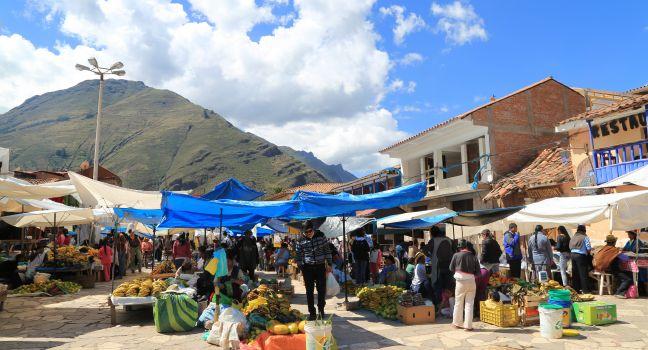
Pisac, Peru -  April, 20 2014 : The famous Sunday market in Pisac, Peru where tourist will find all kinds of handicrafts,antiques,Alpaca wool clothing and local food.
padchas / Shutterstock

Pisac's central square held the local Indigenous Artisanal Market for many years before it was moved to its own permanent space northwest of the plaza. You'll now find many of the ceramics, jewelry, and textiles vendors in rented retail spaces on nearby side streets. A tradition that continues in Plaza de Armas is the 11 am Sunday Quechua Mass at the Iglesia San Pedro Apóstolo. Watch the elaborate costumed procession led by the mayor, who carries his varayoc, a ceremonial staff, from the church after the service. 

Pisac, Peru

Something incorrect in this review?

Acueductos de Cantalloc

Like the Incas, the Nazca had an advanced understanding of hydraulics, and this system of puquios (spiral-shaped stone wells) just outside the city limits testifies to their engineering genius. The wells are actually entry points to a complex network of underground aqueducts the Nazca built to funnel the scarce runoff from the Andean foothills; they would then pool this runoff in reservoirs and use it to irrigate their crops. Today some 46 puquios still exist; most are in good working order. Their existence continues to be vital to 900 subsistence-farming families in the region as well as (scandalously) to a few local washerwomen, who've been known to sneak in to do their weekly scrubbing.

Off Carretera Interoceánica, Nazca, Peru
Sight Details
S/10

Something incorrect in this review?