169 Best Sights in Boston, Massachusetts

Background Illustration for Sights

We've compiled the best of the best in Boston - browse our top choices for the top things to see or do during your stay.

John F. Kennedy Presidential Library and Museum

South Boston Fodor's Choice

Sitting at the edge of Dorchester Bay, this stark, white building (a modernist monument designed by I. M. Pei) pays homage to the life and presidency of John F. Kennedy, as well as to members of his family, including his wife, Jacqueline, and brother Robert. The library-museum is both a center for serious scholarship and a focus for Boston's nostalgia for her native son. 

The library is the official repository of JFK's presidential papers and displays re-creations of his desk in the Oval Office and of the television studio in which he debated Richard Nixon in the 1960 election. Permanent exhibits focus on his life before politics, the 1960 presidential election, the Peace Corps, and the U.S. space program. There's also a permanent display on the late Jacqueline Kennedy Onassis. The facility also includes a store and a small café.

Boston Public Garden

Back Bay Fodor's Choice
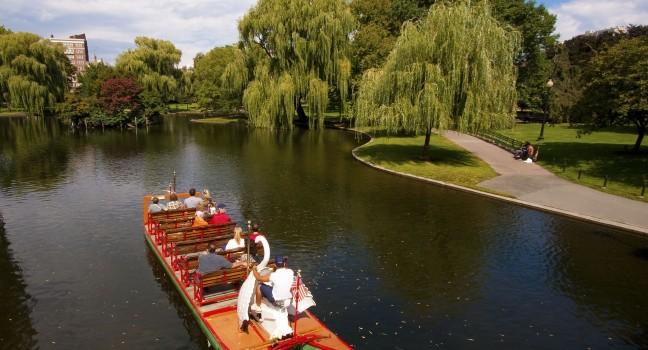
Public Garden in Boston with the famous Swam Boats. Massachusetts - USA.
Marcio Jose Bastos Silva / Shutterstock

America's oldest botanical garden is replete with gorgeous formal plantings, a 4-acre lagoon famous since 1877 for its foot-pedal–powered (by a captain) Swan Boats ( swanboats.com), and the Make Way for Ducklings bronzes sculpted by Nancy Schön, a tribute to the 1941 classic children's story by Robert McCloskey.

Keep in mind that Boston Public Garden and Boston Common are two separate entities with different histories and purposes and a distinct boundary between them at Charles Street. The Common has been public land since Boston was founded in 1630, whereas the Public Garden belongs to a newer Boston, occupying what had been salt marshes on the edge of the Common. By 1837 the tract was covered with an abundance of ornamental plantings donated by a group of private citizens. Near the Swan Boat dock is what has been described as the world's smallest suspension bridge, designed in 1867 to cross the pond at its narrowest point. The beds along the main walkways are replanted every spring. The tulips during the first two weeks of May are especially colorful, and there's a sampling of native and European tree species.

Acorn Street

Beacon Hill Fodor's Choice

Often called the city's most photographed passageway, Acorn Street offers its visitors an iconic image of "historic Boston." Short, steep, and narrow, the cobblestone street may be Boston's roughest ride, so leave your car behind. Brick row houses—once the homes of 19th-century artisans and tradespeople—line one side and, on the other, doors lead to Mt. Vernon's hidden gardens. Find American flags, creative door knockers, window boxes, and gas lights aplenty.

Recommended Fodor's Video

Arnold Arboretum of Harvard University

Jamaica Plain Fodor's Choice

This 281-acre living laboratory contains more than 4,000 kinds of woody plants, most from the hardy north temperate zone. The rhododendrons, azaleas, lilacs, magnolias, and fruit trees are eye-popping when in bloom, and something is always in season from April through September. The Larz Anderson bonsai collection contains individual specimens imported from Japan. In the visitor center there is a 40-to-1 scale model of the arboretum (with 4,000 tiny trees). If you visit during May, Lilac Sunday (usually held on Mother's Day) is a celebration of blooming trees, and is the only day picnicking is allowed in the arboretum.

Boston Athenæum

Beacon Hill Fodor's Choice

One of the oldest libraries in the country, the Athenæum was founded in 1807. Membership in this cathedral of scholarship has been passed down for generations, but it is open in part to the public. Access the first floor overlooking the Granary Burying Ground with a general ticket, or get a day pass for the whole library and the fifth-floor terrace. Art and architecture tours explore the whole building. Among the holdings are most of George Washington's private library, as well as King's Chapel Library, sent from England by William III in 1698. With a nod to the Information Age, an online catalog contains records for more than 600,000 volumes.

10½ Beacon St., Boston, MA, 02108, USA
617-227–0270
Sight Details
$10; $15 for art and architecture tours, which includes admission
Closed Sun.

Something incorrect in this review?

Boston Children's Museum

Fort Point Channel Fodor's Choice

You know you'll have found the country's second-oldest children's museum when you find the giant Hood milk bottle structure. This museum has always been ahead of the curve with creative hands-on exhibits, cultural diversity, and problem-solving. Some of the most popular stops are also the simplest, like the bubble-making machinery and the two-story climbing maze. At the Japanese House, you're invited to take off your shoes and step inside a Kyoto silk merchant's home. Children can dig, climb, and build at the Construction Zone. In the toddler PlaySpace, children under three can run free in a safe environment. There's also a full schedule of special exhibits, festivals, and performances, and Children's Wharf out front is a beautiful place to walk or rest.

Boston Common

Beacon Hill Fodor's Choice

Nothing is more central to the city than Boston Common, the oldest public park in the United States and undoubtedly the largest and most famous of the town commons around which New England settlements were traditionally arranged. Dating from 1634, the Common started as 50 acres for grazing cattle until 1830 when cows were banned. Don't confuse the Common with its sister park, the Public Garden, where the Swan Boats glide and flowers bloom three seasons of the year.

Take a break and enjoy lunch at one of the food trucks parked at the Brewer Fountain Plaza from spring through fall. A few steps away, the Freedom Trail starts in front of the Boston Visitor Information Center. The new MLK memorial sculpture, The Embrace, is close by and worth a visit.

The Common's highest point, near the Parkman Bandstand, was once called Flagstaff Hill and is now surmounted by the Soldiers and Sailors Monument, honoring Civil War troops. The Common's only body of water is the Frog Pond, a tame and frog-free concrete depression used as a wading pool and spray fountain during summer and for ice-skating in winter.

Central Burying Ground lends the park an eerie vibe at its site on Boylston Street; in fact, the Common boasts a fair amount of haunted history. Across from the State House, on the Beacon Street side, sits the splendidly restored Robert Gould Shaw 54th Regiment Memorial, executed in deep-relief bronze by Augustus Saint-Gaudens in 1897.  This is Freedom Trail stop 1.

Boston Harbor Islands National Recreation Area

Waterfront Fodor's Choice

Comprising 34 tiny islands and peninsulas, this is one of the city's best hidden gems—and it's literally out of sight. Stretching from South Boston (Castle Island) to the coastlines of South Shore towns Hingham and Hull, each island is different, but most feature abundant nature with miles of lightly traveled trails, shoreline, sea life, and wild plants. The focal point is 39-acre Georges Island and its partially restored pre–Civil War Fort Warren that once held Confederate prisoners. Pets and alcohol are not allowed on the Harbor Islands.  Ferries shuttle visitors from Boston's Long Wharf to Georges, Thompson, and Spectacle islands daily during summer months. Plan to spend a whole day exploring!

191 W. Atlantic Ave., Boston, MA, 02110, USA
617-227–4321
Sight Details
$24.95 (round-trip ferry ticket)
Ferry schedule runs mid-May--mid-Oct. and goes from Boston to Georges, Thompson, and Spectacle islands

Something incorrect in this review?

Boston Harborwalk

Seaport Fodor's Choice

Stretching for 43 continuous miles, Boston Harborwalk is a walking trail that skirts the twists and turns of the coast from Charlestown down to the city of Quincy. In the Seaport District specifically, the Harborwalk journeys along Fort Point Channel, around Fan Pier, up Seaport Boulevard, and out and around the Black Falcon Cruise Terminal. Along the way, pedestrians can see art exhibits, stationary viewfinders, open green spaces, and incredible Boston Harbor views. Marked signs point the way, and maps can be found online.

Boston Public Library

Back Bay Fodor's Choice

This venerable institution is a handsome temple to reading and a valuable research library, as well as an art gallery of sorts, and you don't need a library card to enjoy it. At the main entrance hall of the 1895 Renaissance Revival building, take in the immense stone lions by Louis St. Gaudens, the vaulted ceiling, and the marble staircase. The corridor at the top of the stairs leads to Bates Hall, one of Boston's most sumptuous interior spaces. This is the main reading room, 218 feet long with a barrel vault ceiling 50 feet high. The murals at the head of the staircase, depicting the nine muses, are the work of the French artist Pierre Puvis de Chavannes; those in the room to the right are Edwin Austin Abbey's interpretations of the Holy Grail legend. Upstairs, in the public areas, is John Singer Sargent's mural series Triumph of Religion. The library offers free art and architecture tours. The McKim building contains a Renaissance-style courtyard inspired by Rome's Palazzo della Cancelleria. A covered arcade furnished with chairs rings a fountain; you can bring books or lunch into the peaceful courtyard.

Boston Tea Party Ships & Museum

Fort Point Channel Fodor's Choice

Situated at the Congress Street Bridge near the site of Griffin's Wharf, this lively museum offers an interactive look at the past in a place as close as possible to the actual spot where the Boston Tea Party took place on December 16, 1773. Actors in period costumes greet patrons, assign them real-life Colonial personas, and then ask a few people to heave boxes of tea into the water from aboard historical reproductions of the ships forcibly boarded and unloaded the night Boston Harbor became a teapot. There are 3D holograms, talking portraits, and even the Robinson Half Tea Chest, one of two original tea chests known to exist.  Abigail's Tea Room (you don't need a museum ticket for entry) features a tea tasting of five tea blends that would have been aboard the ships.

Bunker Hill Monument

Charlestown Fodor's Choice

 Two misunderstandings surround this famous monument. First, the Battle of Bunker Hill was actually fought on Breed's Hill, which is where the monument sits today. (The real Bunker Hill is about ½ mile to the north of the monument.) In truth, Bunker was the originally planned locale for the battle, and for that reason its name stuck. Second, although the battle is generally considered a Colonial success, the Americans lost. It was a Pyrrhic victory for the British Redcoats, who sacrificed nearly half of their 2,200 men; American casualties numbered 400 to 600. One thing is true: the Battle of Bunker Hill put the British on notice that they were up against a formidable opponent. According to history books, this is also the location of the famous war cry, "Don't fire until you see the whites of their eyes," uttered by American colonel William Prescott or General Israel Putnam (there's still debate on who gave the actual command). This was a shout-out to an 18th-century Prussian warning to soldiers that lack of ammunition and notorious musket inaccuracy meant every shot needed to count. The Americans did employ a deadly delayed-action strategy on June 17, 1775, and conclusively proved themselves capable of defeating the forces of the British Empire.

Among the dead were the brilliant young American doctor and political activist Joseph Warren, recently commissioned as a major general but fighting as a private, and the British major John Pitcairn, who two months prior had led the Redcoats into Lexington. Pitcairn is believed to be buried in the crypt of Old North Church.

In 1823 the committee formed to construct a monument on the site of the battle chose the form of an Egyptian obelisk. Architect Solomon Willard designed a 221-foot-tall granite obelisk, a tremendous feat of engineering for its day. The Marquis de Lafayette laid the cornerstone of the monument in 1825, but because of a lack of funds, it wasn't dedicated until 1843. Daniel Webster's stirring words at the ceremony commemorating the laying of its cornerstone have gone down in history: "Let it rise! Let it rise, till it meets the sun in his coming. Let the earliest light of the morning gild it, and parting day linger and play upon its summit."

The monument's zenith is reached by a flight of 294 tightly spiraled steps. While the elevator is still under repair, the views from the observatory are worth the effort of the arduous climb if you can. The tower is only open for climbing between 1 and 4 pm. The adjacent museum's artifacts and exhibits tell the story of the battle, while a detailed diorama depicts the action in miniature. This is Freedom Trail stop 16.

The Casino at Encore Boston Harbor

Fodor's Choice

While not in Somerville, we would be remiss if we didn't mention that giant skyscraper on the Somerville horizon. Located in Everett, directly across the Mystic River from Assembly Row (accessible by car or water shuttle from Long Wharf North in downtown Boston), this Wynn Resort property is a feather in the area's cap. The casino boasts a main floor of 40-foot ceilings, red Rubino glass chandeliers, and 2,700-plus classic and state-of-the-art slot machines. The upstairs elegant terrace level is for table games, private gambling salons, high-limit gaming rooms, and a spectacular view of the action below.  

After a night at the casino tables, dining at one of the property's gorgeous restaurants (there are 10) is a safe bet. Seamark just opened to much fanfare, with a seafood-centric menu from local chef Micheal Schlow. Check out Red 8 for some of the best Chinese around, as well as Rare for the most uniquely curated steak program in New England, including exclusive Japanese cuts from Kobe and the Kagoshima prefecture and American Wagyu. The hotel is posh with grand rooms and suites.

Castle Island

South Boston Fodor's Choice

Although it once was, Castle Island is no longer, well, an island. Capping the South Boston neighborhood, Castle Island is accessible by car and by foot from Day Boulevard. Its centerpiece is Fort Independence, built in 1801 (although there have been battlements on-site since 1644), open for free tours on summer weekend afternoons. Castle Island is a popular spot to walk dogs, jog, or cycle, whether just around the island itself or along the water-set Pleasure Bay Loop. There's also a nice playground for kids. Stop by Castle Island institution Sullivan's for a hot dog, fried seafood dinner, or ice cream. Views of the harbor and its outlying islands are expansive.

Charles Street

Beacon Hill Fodor's Choice

In keeping with the historic character of the area, Charles Street is void of neon signs, but you will see bricks aplenty in Beacon Hill's most popular—and only—commercial development. Spend the day shopping at locally owned clothing, antiques, and gift boutiques. Make sure to stop for lunch at one of the local cafés or the legendary Sevens bar. Charles Street sparkles at dusk from gas-fueled street lamps, making it a romantic place for an evening stroll.

Custom House & Tower

Financial District Fodor's Choice

At the time of its construction in 1847, the Custom House was the most expensive ever built in the United States and today it is one of Boston’s most recognizable buildings. It resembles a Greek Revival temple and features an iconic tower that was added in 1915, earning it the title of the city's tallest skyscraper. Today, Marriott operates it as a hotel and vacation club, but the public can take two elevators up 26 floors to the observation deck for unparalleled views of Downtown and Boston Harbor. Tours (30 minutes) leave once daily at 2 pm; there are no tours on Friday. Tours are free, but space is limited, so call ahead to make a reservation---tours book out months in advance.

Emerald Necklace Conservancy

Fenway-Kenmore Fodor's Choice

The six large public parks known as Boston's Emerald Necklace stretch 7 miles from the Back Bay Fens to Franklin Park in Dorchester, and include Arnold Arboretum, Jamaica Pond, Olmsted Park, and the Riverway. The linear parks, designed by master landscape architect Frederick Law Olmsted more than 100 years ago, remain a well-groomed urban masterpiece.

Faneuil Hall

Government Center Fodor's Choice

Faneuil Hall (pronounced Fan-yoo'uhl or Fan-yuhl) was erected in 1742, the gift of wealthy merchant Peter Faneuil, who wanted the hall to serve as both a place for town meetings and a public market. It burned in 1761 and was immediately reconstructed according to the original plan of its designer, the Scottish portrait painter John Smibert (who lies in the Granary Burying Ground). In 1763 the political leader James Otis helped inaugurate the era that culminated in American independence when he dedicated the rebuilt hall to the cause of liberty.

In 1772, Samuel Adams stood here and first suggested that Massachusetts and the other colonies organize a Committee of Correspondence to maintain semiclandestine lines of communication in the face of hardening British repression. In later years the hall again lived up to Otis's dedication when the abolitionists Wendell Phillips and Charles Sumner pleaded for support from its podium. The tradition continues to this day: in presidential-election years the hall is the site of debates between contenders in the Massachusetts primary.

Faneuil Hall was substantially enlarged and remodeled in 1805 according to a Greek Revival design of the noted architect Charles Bulfinch; this is the building you see today. Its purposes remain the same: the balconied Great Hall is available to citizens' groups on presentation of a request signed by a required number of responsible parties; it also plays host to regular concerts.

Inside Faneuil Hall are dozens of paintings of famous Americans, including the mural Webster's Reply to Hayne and Gilbert Stuart's portrait of Washington at Dorchester Heights. Park rangers give informational talks about the history and importance of Faneuil Hall every half hour. There are interactive displays about Boston sights, and National Park Service rangers at the visitor center on the first floor can provide maps and other information.

On the building's top floors are the headquarters and museum and library of the Ancient and Honorable Artillery Company of Massachusetts, which is free to visit (but a donation is welcome). Founded in 1638, it's the oldest militia in the Western Hemisphere, and the third-oldest in the world, after the Swiss Guard and the Honourable Artillery Company of London. The museum is open Wednesday through Friday from 11 am to 3 pm.

When such men as Andrew Jackson and Daniel Webster debated the future of the Republic here, the fragrances of bacon and snuff—sold by merchants in Quincy Market across the road—greeted their noses. Today the aroma of coffee wafts through the hall from a snack bar. The shops at ground level sell New England bric-a-brac. This is Freedom Trail stop 11.

Faneuil Hall Marketplace

Government Center Fodor's Choice

A well-known complex of historical significance, shopping, eating, and street performers, Faneuil Hall Marketplace is a place for all things Boston. Stretching out in front of historical Faneuil Hall, the largest area known as Quincy Market attracts huge crowds of tourists and locals throughout the year. In the early ’70s, demolition was a distinct possibility for the decrepit buildings. Fortunately, with the participation of the Boston Redevelopment Authority, architect Benjamin Thompson planned a renovation of Quincy Market, and the Rouse Corporation of Baltimore undertook its restoration, which was completed in 1976. Try to look beyond the shop windows to the grand design of the market buildings themselves; they represent a vision of the market as urban centerpiece, an idea whose time has certainly come again.

The market consists of three block-long annexes: Quincy Market, North Market, and South Market, each 535 feet long and across a plaza from Faneuil Hall and ending at the horseshoe-shaped building of Marketplace Center Shops. The structures were designed in 1826 by Alexander Parris as part of a public-works project instituted by Boston's second mayor, Josiah Quincy, to alleviate the cramped conditions of Faneuil Hall and clean up the refuse that collected in Town Dock, the pond behind it. The central structure, made of granite, with a Doric colonnade at either end and topped by a classical dome and rotunda, has kept its traditional market-stall layout, but the stalls now purvey international and specialty foods: sushi, frozen yogurt, bagels, calzones, sausage-on-a-stick, Chinese noodles, barbecue, and baklava, plus all the boutique chocolate-chip cookies your heart desires. ArtsBoston's BOSTIX Booth can also be found in the marketplace; stop by for same-day, discounted theater and sight tickets. 

In between Quincy Market and South Market colonnades, be sure to stop and take a seat next to the sculpture of legendary Boston Celtics coach, Red Auerbach, smoking one of his famous stogies.

Along the arcades on either side of the Central Market are mostly kiosk-based vendors selling sweatshirts, photographs of Boston, and arts and crafts—some schlocky, some not—alongside a couple of patioed bars and restaurants, including the new Sam Adams Brewery (perfectly poised within sight of his famous statue). The North and South markets house a mixture of chain stores and specialty boutiques.

Faneuil Hall provides a splash of color; during the winter holidays, trees along the cobblestone walks are strung with thousands of sparkling lights and the interior Quincy Market rotunda is home to a 20-foot Christmas tree. In summer up to 50,000 people a day descend on the market; the outdoor cafés are an excellent spot to watch the hordes if you can find a seat. Year-round the pedestrian walkways draw street performers, and rings of strollers form around magicians and musicians.

Fenway Park

Fenway-Kenmore Fodor's Choice

Fenway Park is Major League Baseball's oldest ballpark and has seen some stuff since its 1912 opening. For one, it's the home field for the Boston Red Sox, which overcame the "Curse of the Bambino" to win World Series championships in 2004, 2007, 2013, and 2018. Ticket-holding Sox fans can browse display cases mounted inside Fenway Park before and during a ballgame; these shed light on and show off memorabilia from particular players and eras of the club team's history. Fenway offers hour-long behind-the-scenes guided walking tours of the park; there are also specialized tour options.

Granary Burying Ground

Beacon Hill Fodor's Choice

Boston's cemeteries are among the most historic in America, and the Granary, established in 1660, is no exception. Headstones are elaborately ornamented with skeletons, winged skulls, and other carved Colonial folk art. Samuel Adams, John Hancock, and Paul Revere are among the impressive list of the estimated 5,000 folks interred here; there hasn't been a new burial since 1880. Note the winged hourglasses carved into the stone gateway of the burial ground; they are a 19th-century addition. This is Freedom Trail stop 4.

Greenway Carousel

Waterfront Fodor's Choice

You'll never see another carousel quite like this gorgeous, hand-carved custom one that brings to life the air, sea, and land animals that are native to New England—think peregrine falcon, monarch butterfly, lobster, and gray squirrel among many others. Installed in 2013, this delightful children's ride doesn't have nearly enough mileage on it yet.

Harpoon Brewery and Beer Hall

Seaport Fodor's Choice

Harpoon Brewery holds Massachusetts's first-ever brewing permit, obtained in 1986 by three college friends who wanted to create a fresh beer culture in their hometown. Today, Harpoon's Boston brewery features 25-minute guided tours and tastings for beer lovers from around the globe. Harpoon's on-site beer hall pours a rotating lineup of limited-edition and pilot beers, non-brand beers, and ciders—try a flight of UFOs or Clown Shoes. It also serves handmade pretzels and pizza.

306 Northern Ave., Boston, MA, 02210, USA
617-456–2322
Sight Details
$5 tasting and 25-minute brewery tour

Something incorrect in this review?

Harvard Art Museums

Harvard Square Fodor's Choice

This is Harvard University's oldest museum, and in late 2014, it became the combined collections of the Busch-Reisinger, Fogg, and Arthur M. Sackler Museums. All three were united under one glorious, mostly glass roof, under the umbrella name Harvard Art Museums. Housed in a facility designed by award-winning architect Renzo Piano, the 204,000-square-foot museum is spread over seven levels, allowing more of Harvard’s 250,000-piece art collection, featuring European and American art from the Middle Ages to the present day, to be seen in one place. Highlights include American and European paintings, sculptures, and decorative arts from the Fogg Museum; Asian art, Buddhist cave-temple sculptures, and Chinese bronzes from the Arthur M. Sackler collection; and works by German expressionists, materials related to the Bauhaus, and postwar contemporary art from German-speaking Europe from the Busch-Reisinger Museum.

Thanks to a new initiative in 2023, you can explore the three museums for free. In addition to the gallery spaces, there's a 300-seat theater, Jenny's Cafe, a museum shop, and the Calderwood Courtyard, plus conservation and research labs.

Harvard Museum of Natural History

Harvard Square Fodor's Choice

The Harvard Museum of Natural History (which exhibits specimens from the Museum of Comparative Zoology, the Harvard University Herbaria, and the Mineralogical and Geological Museum) reminds us nature is the original masterpiece. Cases are packed with zoological specimens, from tiny hummingbirds and deer mice to rare Indian rhinoceroses and one of the largest Amazon pirarucu ever caught. View fossils and skeletons alongside marvelous minerals, including a 1,600-pound amethyst geode. Harvard's world-famous Blaschka Glass Flowers collection is a creative approach to flora, with more than 4,300 hand-blown glass plant models. The museum combines historic exhibits drawn from the university's vast collections with new and changing multimedia exhibitions, such as In Search of Thoreau’s Flowers: An Exploration of Change and the new The Blaschkas at the Microscope: Lessons in Botany, plus a renovated Earth & Planetary Sciences gallery.

Harvard Square

Fodor's Choice

Tides of students, tourists, and politically charged proponents are all part of the nonstop pedestrian flow at this most celebrated of Cambridge crossroads. Harvard Square is where Massachusetts Avenue, coming from Boston, turns and widens into a triangle broad enough to accommodate a brick peninsula (above the T station). The restored 1928 kiosk in the center of the square once served as the entrance to the MBTA station, and is now home to lively street musicians and artists selling their paintings and photos on blankets. Harvard Yard, with its lecture halls, residential houses, libraries, and museums, is one long border of the square; the other three are composed of clusters of banks, retailers, and restaurants.

Time in the square raises people-watching to a high art form. On an average afternoon you'll hear earnest conversations in dozens of foreign languages; see every kind of youthful uniform from slouchy sweats to impeccable prep; wander by street musicians playing guitars and flutes; and wonder at how students reading textbooks out in the sunshine can get any work done among the commotion.

The historic buildings are worth noting. It's a thrill to walk though the big brick-and-wrought-iron gates to Harvard Yard on up to Widener Library, the university's flagship library. More than 50 miles of bookshelves snake around this imposing neoclassical structure, designed by one of the nation's first major African American architects, Julian Abele. It holds more than 3.5 million volumes in 450 languages, but is unfortunately only open to students and four guests.

Across Garden Street, through an ornamental arch, is Cambridge Common, decreed a public pasture in 1631. It's said that under a large tree that once stood in this meadow George Washington took command of the Continental Army on July 3, 1775. A stone memorial now marks the site of the "Washington Elm." Also on the common is the Irish Famine Memorial by Derry artist Maurice Harron, unveiled in 1997 to coincide with the 150th anniversary of "Black ’47," the deadliest year of the potato famine. At the center of the common a large memorial commemorates the Union soldiers who lost their lives in the Civil War. On the far side of the common is a fantastic park and newly renovated playground.

Institute of Contemporary Art/Boston

Seaport Fodor's Choice

It's hard to say what's more cutting-edge: the Institute of Contemporary Art/Boston's cantilevered building or the works that reside within. The events calendar is studded with changing, thematic exhibitions by the contemporary art world's brightest talents. Visitors will also see some curated pieces from the ICA's permanent collection, including some by Robert Mapplethorpe, Yayoi Kusama, and Louise Bourgeois. Live programming, from film festivals to talks to outdoor concerts, take place regularly. Don't miss the ICA Store on the ground level, where you can pick up an inventive trinket of your own.

Isabella Stewart Gardner Museum

Fenway-Kenmore Fodor's Choice

A spirited society woman, Isabella Stewart came in 1860 from New York to marry John Lowell Gardner, one of Boston's leading citizens. "Mrs. Jack" promptly set about becoming the most un-Bostonian of the Proper Bostonians. She built a Venetian palazzo to hold her collected art. Her will stipulated that the building remain exactly as she left it—paintings, furniture, down to the smallest object in a hall cabinet—and so it has remained.

Gardner's palazzo includes such masterpieces as Titian's Europa, Giotto's Presentation of Christ in the Temple, and John Singer Sargent's El Jaleo. Eight balconies adorn the majestic Venetian courtyard, and themed rooms include Raphael, Spanish Cloister, Gothic, Chinese Loggia, and a magnificent Tapestry Room for concerts, where Gardner entertained Henry James and Edith Wharton.

On March 18, 1990, the Gardner was the target of a sensational art heist. Thieves disguised as police officers stole 12 works, including Vermeer's The Concert. None of the art has been recovered. Because Mrs. Gardner's will prohibited substituting other works for any stolen art, empty expanses of wall identify spots where the paintings once hung. The heist is the subject of a 2021 Netflix documentary, This is a Robbery.

The modern Renzo Piano–designed addition houses a music hall, exhibit space, and conservation labs.

Larz Anderson Auto Museum

Fodor's Choice

Almost every year from 1899 to 1948 wealthy socialites Larz and Isabel Anderson bought a car, which they kept at their Brookline estate in a castlelike carriage house built in 1888 (originally to stable horses). After Isabel’s death in 1948, the building was turned into a museum. Today, visitors can see 14 of their cars in this special collection. Weekend lawn events, May through October, feature unique cars.

The Lawn on D

Seaport Fodor's Choice

Stop, rest awhile, and have some fun. That's the purpose of The Lawn on D, a free-to-all open green space that features a plethora of games like bocce, corn hole, Ping-Pong, and pickleball, and chairs for lounging. In warmer weather, you can often catch a live concert or film screening here, or a public art installation. A concession stand makes sure visitors are well fed. The only catch? You can't bring Fido.