49 Best Sights in Quebec City, Quebec

Background Illustration for Sights

We've compiled the best of the best in Quebec City - browse our top choices for the top things to see or do during your stay.

Huron-Wendat Village

A 25-minute drive outside city limits takes you into another world, that of the Huron-Wendat Nation, one group of Canada's First Nations peoples. The Huron-Wendat are famous for their handcrafted clothing, decorations, and hunting tools, which are on display at the village. A "traditional site" offers a fascinating traditional village exhibition, complete with longhouse, dances, and storytelling. Visitors can take guided tours and discover some stunning crafts in the huge gift shop. Traditional meals are served in an on-site restaurant. The spectacular Kabir Kouba waterfall, carved into a deep and steep gorge, is definitely worth a stop as well.

575 Chef Stanislas Koska, Wendake, G0A 4V0, Canada
418-842–4308
Sight Details
Guided tour C$19.55

Something incorrect in this review?

Fairmont Le Château Frontenac

Upper Town Fodor's Choice
Chateau Frontenac, best known landmark of Quebec, Canada
Asier Villafranca/Shutterstock

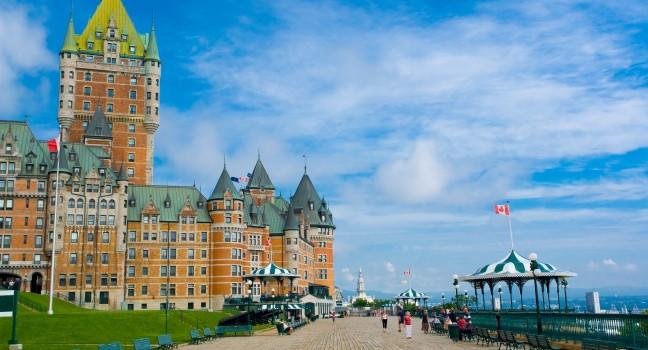
Québec City’s most photographed landmark, the Château Frontenac, commands the skyline above the St. Lawrence River, proudly reigning as the city’s crown jewel. Built in 1893 to attract luxury rail travelers, it belongs to a distinguished series of opulent château-style hotels commissioned across Canada. New York architect Bruce Price designed the hotel to impress, outfitting it with marble fixtures, cozy fireplaces in every room, and carefully selected antiques—luxuries unmatched at the time. The site once housed the residence of colonial governors Samuel de Champlain and the Comte de Frontenac, whose name the hotel proudly bears. The addition of a 20-story tower in 1924 finalized its iconic silhouette. Since then, Le Château, as locals call it, has hosted royalty—including Prince William and Kate Middleton, Queen Elizabeth II, and Princess Grace of Monaco—alongside Hollywood legends and world leaders. During WWII, Roosevelt and Churchill met here twice for wartime conferences, sealing the hotel’s legacy at the crossroads of history and glamour.

While the hotel itself doesn't offer guided tours, you can still dive deep into its storied past! Québec Cicerone Tours provides an exceptional experience, with guides in period costumes bringing legends to life within this historic landmark. Tours cost C$24 per adult and C$12 per child.

La Citadelle de Québec

Upper Town Fodor's Choice
A member of the Canadian Royal 22nd Regiment stands guard at the gates to the Citadel in Old Quebec City, Quebec, Canada.
Gary Blakeley / Shutterstock

Perched atop Cap Diamant, the city's highest point, the Citadelle stands as North America's largest fortified base still actively occupied by troops. This 25-building fortress is, quite literally, the star of the Fortifications of Québec National Historic Site. Its strategic purpose was clear: protect the port, prevent enemy advancements on the Plains of Abraham, and offer refuge during an attack. Since 1920, the Citadelle has been home to Canada's most storied French-speaking military formation, the Royal 22nd Regiment. Their history is proudly displayed in the museum, located in a former powder magazine built in 1750, showcasing firearms, uniforms, and decorations dating back to the 17th century. Every summer morning, visitors can catch the troops' impressive 30-minute concert, with soldiers clad in military crimson coats and black fur hats, all under the watchful eye of the regiment's well-behaved goat mascot. Due to its status as an operational military base, all visits to the Citadelle are exclusively guided.  Its prime location, perched high above the St. Lawrence River with stunning city views, makes it worth a visit even if you opt not to take a tour.

Recommended Fodor's Video

Place Royale

Lower Town Fodor's Choice
QUEBEC CITY, CANADA - AUGUST 25: Place royal place part of Old Quebec, a UNESCO world heritage treasure on August 25, 2010 in Quebec City, Canada.
meunierd / Shutterstock

Place Royale is where Samuel de Champlain founded the City of Québec in 1608; more than 400 years and several iterations later, this cobblestone square is still considered to be the cradle of French-speaking North America. Flanked on one side by the oldest stone church in North America, Église Notre-Dame-des-Victoires, and on the other by houses with steep Normandy-style roofs, dormer windows, and chimneys, once the homes of wealthy merchants, Place Royale is the epicenter of Old Québec. Until 1686 the area was called Place du Marché, but its name changed when a bust of Louis XIV was placed at its center. During the late 1600s and early 1700s, when Place Royale was continually under threat of British attack, the colonists moved progressively higher to safer quarters atop the cliff in Upper Town. After the French colony fell to British rule in 1759, Place Royale flourished again with shipbuilding, logging, fishing, and fur trading. The Fresque des Quebecois, a 4,665-square-foot trompe-l'oeil mural depicting 400 years of Québec's history, is to the east of the square, at the corner of rue Notre-Dame and côte de la Montagne.

Plains of Abraham

Upper Town Fodor's Choice
Martello Tower Plaines Abraham
LSOphoto / iStockphoto

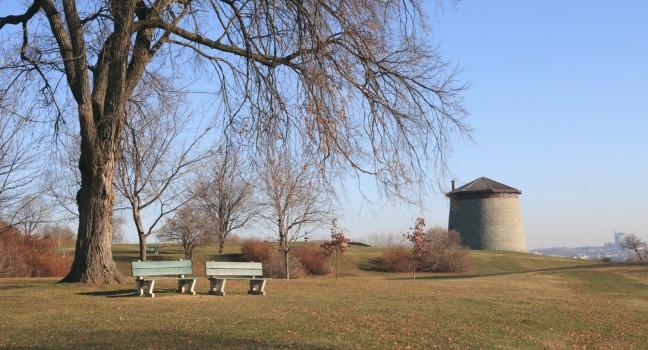
This expansive urban park holds a pivotal place in Canadian history: it's the very ground where the famous Battle of Québec unfolded on September 13, 1759. This brief, yet acrimonious, clash within the larger Seven Years' War ultimately decided Canada's fate as the French lost the city to the British. On that fateful date, British soldiers under General Wolfe's command scaled the steep cliff face under the cover of darkness. They ultimately defeated the French through a single, devastating volley of musket fire, concluding the battle in less than 30 minutes. To truly grasp this pivotal moment, visit the Museum of the Plains of Abraham and explore the family-friendly activities at the nearby Martello Towers.

Today, this historic landscape transforms with the seasons. Locals flock here for cross-country skiing and to admire the majestic St. Lawrence River, even as it freezes over in winter. Come July, the park pulsates with energy as the Summer Festival takes over, drawing tens of thousands of concertgoers. Whatever the weather, head to Parc du Bastion-de-la-Reine for the ultimate Québec City postcard view.

Avenue Cartier

Montcalm Fodor's Choice

The mix of reasonably priced restaurants and bars, groceries and specialty food shops, and boutiques makes avenue Cartier a favorite lunchtime and after-work stop for many local residents. After business hours the street hums with locals running errands or soaking up the sun on patios. When darkness falls, the avenue's patrons get noticeably younger. The attraction? A half-dozen nightclubs and pubs that offer everything from wine and quiet conversation to Latin music and earsplitting dance tunes.

Québec City, G1R 2S3, Canada

Something incorrect in this review?

Église Notre-Dame-des-Victoires

Lower Town Fodor's Choice

Step into history at Notre-Dame-des-Victoires, North America's oldest stone church. This beautiful sanctuary on Place Royale, with its fortress-shaped altar, stands as a testament to a turbulent past. Built in 1688 and meticulously restored, it honors the Virgin Mary for aiding French forces against British invasions in 1690 and 1711. Inside, discover interesting paintings and a model of Le Brezé, the ship that brought French soldiers in 1664. Its side chapel is dedicated to Sainte Genevieve, Paris's patron saint.

32 rue Sous-le-Fort, Québec City, G1K 4G7, Canada
418-692–1650
Sight Details
Closed Mon.–Tue.

Something incorrect in this review?

L'Escalier Casse-Cou

Lower Town Fodor's Choice

Often regarded as one of the Old City's most iconic attractions, this stairway lives up to its playful name: Breakneck Steps. It's not just for the stunning views of the neighborhood; the sheer ambition and steepness of city architect Charles Baillairgé's 1893 design truly explain its moniker. Yet, despite the ominous name, no serious injuries have been reported on its 59 steps. This iron masterpiece was quite the upgrade from the original 17th-century wooden stairway, which first dared to link Upper and Lower Town.

Maison de la littérature

Upper Town Fodor's Choice

This stunning library, housed in a former 19th-century Methodist church, is a true gem for design, architecture, and culture enthusiasts alike. Completely revamped a few years ago, its now whitewashed, design-heavy interior earned international acclaim and architectural awards. Inside, you'll find compelling permanent exhibitions on French Canadian literature and culture, along with weekly showings of various genres of French-Canadian movies.

Monastère des Augustines

Upper Town Fodor's Choice

In 1639, Augustinian nuns arrived from Dieppe, France, tasked with caring for the sick in the new colony. They established North America's first hospital north of Mexico, the Hôtel-Dieu. The complex underwent a full renovation and expansion in 2015 and now includes a quiet, health-conscious restaurant (with silent breakfast!), a holistic spa, and accommodations ranging from contemporary en suite rooms to dorm-like rooms with antique furniture—the perfect canvas for a calm retreat. The museum showcases an extensive collection of liturgical and medical artifacts, while the richly decorated chapel (by Thomas Baillairgé) and the 1659 vaults, used by nuns as shelter from bombardments, are also worth visiting. A small order of nuns continues to reside within the monastery, truly making it a place of living memory.

32 rue Charlevoix, Québec City, G1R 5N1, Canada
418-692–2492
Sight Details
C$17
Museum closed Oct.-Apr.

Something incorrect in this review?

Musée de la Civilisation

Lower Town Fodor's Choice

Wedged between narrow streets at the foot of the cliff, this spacious museum, with its striking limestone-and-glass façade, was designed by architect Moshe Safdie to seamlessly blend into the landscape. Its bell tower thoughtfully echoes the shape of the city's church steeples. A new exhibition, running until 2030, powerfully witnesses the narratives of 95,000 First Nations and Inuit women and men of Québec as they reflect on history, embrace the present, and envision a hopeful future. The temporary exhibits here are always well worth a visit too.

85 rue Dalhousie, Québec City, G1K 8R2, Canada
866-710–8031
Sight Details
C$21
Closed Mon. from early Sept. to late June

Something incorrect in this review?

Musée national des beaux-arts du Québec

Montcalm Fodor's Choice

Situated on the city's liveliest avenue, the Grand Allée, this neoclassical museum in the park with a slick and modern wing is a remarkable steel-and-glass setting for its collection of 22,000 traditional and contemporary pieces of Québec art. Designed by starchitects Rem Koolhaas and Shohei Shigematsu, the Lassonde Pavilion, added in 2016, features three stacked, cascading galleries; a grand stairwell that spirals dramatically from the top floor to the basement, where a rising almost-mile-long tunnel connects to the museum’s three other wings. MNBAQ houses works by local legends Jean-Paul Riopelle, Jean-Paul Lemieux, Alfred Pellan, Fernand Leduc, and Horatio Walker that are particularly notable, as well as temporary exhibits by international artists such as Turner, Miró, and Giacometti. The original museum building in Parc des Champs-de-Bataille is part of an abandoned prison dating from 1867; a hallway of cells, with the iron bars and courtyard, has been preserved as part of a permanent exhibition on the prison's history.

179 Grande Allée Ouest, Québec City, G1R 2H1, Canada
418-643–2150
Sight Details
C$25
Closed Mon. from Sept. to Jun.

Something incorrect in this review?

Musée National des Beaux-Arts du Québec

Upper Town Fodor's Choice

Situated on the city's liveliest avenue, the Grand Allée, this neoclassical museum in the park with a slick and modern wing is a remarkable steel-and-glass setting for its collection of 22,000 traditional and contemporary pieces of Québec art. Designed by starchitects Rem Koolhaas and Shohei Shigematsu, the Lassonde Pavilion, added in 2016, features three stacked, cascading galleries; a grand stairwell that spirals dramatically from the top floor to the basement, where a rising almost-mile-long tunnel connects to the museum’s three other wings; and views of the neighboring neo-Gothic church from both the rooftop terrace and courtyard. MNBAQ houses works by local legends Jean-Paul Riopelle, Jean-Paul Lemieux, Alfred Pellan, Fernand Leduc, and Horatio Walker that are particularly notable, as well as temporary exhibits by international artists such as Turner, Miro, and Giacometti. The original museum building in Parc des Champs-de-Bataille is part of an abandoned prison dating from 1867; a hallway of cells, with the iron bars and courtyard, has been preserved as part of a permanent exhibition on the prison's history.

Parc des Champs-de-Bataille, Québec City, G1R 5H3, Canada
418-643–2150
Sight Details
C$16 for permanent collection; C$25 for temporary exhibits
Closed Mon. Sept.–May

Something incorrect in this review?

Observatoire de la Capitale

Montcalm Fodor's Choice

Located atop the Édifice Marie-Guyart, the city's tallest building, Observatoire de la Capitale offers a spectacular panorama of Québec City from 31 stories up. The site features an overview of the city's history with 3-D imagery, audiovisual displays in both French and English, and a time-travel theme with a 1960s twist.

Promenade Samuel-de-Champlain

Outside the Old City Fodor's Choice

This 6.8 km (4.2-mile) promenade along the St. Lawrence River offers a truly gorgeous and privileged space to enjoy the water. It's a beloved local hotspot, boasting stunning vistas of the river and the two bridges spanning it to the west. The park's creative and contemporary landscape design attracts a lively crowd of pedestrians, cyclists, and inline skaters on sunny summer days, with children often seen playing by the fountains and on the sprawling lawns. Toward the eastern end, you'll discover a charming café and an observation tower, alongside the newly inaugurated Station de la Plage. This spectacular addition features a sandy beach area complete with chairs and umbrellas, and an infinity pool that truly gives the impression of bathing directly in the river, complemented by cascading water fountains. During high season, shuttle bus #400 conveniently transports visitors directly from Petit-Champlain in Lower Town to this scenic stretch every 30 minutes.

Québec–Lévis Ferry

Lower Town Fodor's Choice

Crossing the St. Lawrence River on this ferry will reward you with a striking view of the Québec City skyline, with the Château Frontenac and the Québec Seminary high atop the cliff. The view is even more impressive at night. Ferries generally run every 20 or 30 minutes from 6 am until 6 pm, and then every hour until 2:20 am; there are additional ferries from April through November.

10 rue des Traversiers, Québec City, G1K 8L8, Canada
877-787–7483
Sight Details
C$4.15 each way (pedestrians, cyclists, car passengers)

Something incorrect in this review?

Rue du Petit-Champlain

Lower Town Fodor's Choice

Rue du Petit-Champlain, the oldest street in the city, was once the main thoroughfare of a harbor village, with trading posts and the homes of rich merchants. Today it has pleasant boutiques, art galleries, and cafés, and on summer days the street is packed with tourists. Natural-fiber weaving, Inuit carvings, hand-painted silks, local designers, and enameled copper crafts are among local specialties for sale here. If you're coming from Upper Town, take the Escalier Casse-Cou (Breakneck Steps) down, and the funicular back up (or round-trip): both deliver you to the start of this busy, unique street.

Terrasse Dufferin

Upper Town Fodor's Choice

At the very heart of Old Québec City's Upper Town, a wide boardwalk with an intricate wrought-iron guardrail encircles the iconic Château Frontenac. This promenade is lined with cannons brought by the British for defense in the late 18th century, offering breathtaking panoramic views of the St. Lawrence River's narrowest point, Île d'Orléans, and the distant Laurentian and Appalachian mountains. This enchanting spot shines year-round. Summers burst with lively street performers, while winters transform it into a thrilling, 70 km/h (43.5 mph) wooden toboggan run. From its western end, the Promenade des Gouverneurs extends towards Cap Diamant and La Citadelle. You can also board the funicular here, descending to Rue du Petit-Champlain. It truly is the ideal starting or ending point for any Old Québec discovery walk.

Jardin des Gouverneurs

Upper Town
Obelisk at Governors Garden in Quebec City, Canada.
gregobagel / iStockphoto

In this small park just south of the Château Frontenac stands the Wolfe-Montcalm Monument, a 50-foot-tall obelisk that pays tribute to both a winning (English) and a losing (French) general. The monument recalls the 1759 battle on the Plains of Abraham, which essentially ended French rule here. British general James Wolfe lived only long enough to hear of his victory; French general Louis-Joseph Montcalm died shortly after Wolfe, with the knowledge that the city was lost. On the south side of the park is avenue Ste-Geneviève, lined with well-preserved Victorian houses dating from 1850 to 1900. Many have been converted to inns, B&Bs, and hotels.

Québec City, G1R 4P5, Canada

Something incorrect in this review?

Jardin Jeanne-d'Arc

Upper Town
Flowers at the beautiful Joan of Arc garden in Quebec City (Jeanne D'arc).
(c) Fer737ng | Dreamstime.com

This urban park, bright with colorful flowers in summer, is lined with stunning 19th-century mansions on one side and offers sweeping river views over the Plains of Abraham on the other. It's often adorned with seasonal decorations, making it a lovely place to rest between museum visits. At its heart stands an equestrian statue of Joan of Arc, a symbol of military courage and France itself. The statue pays tribute to the heroes of 1759, near the very spot where New France fell to the British. The park also holds a special place in Canadian history: it's where the national anthem, "O Canada," was first played on June 24, 1880.

av. Wilfrid-Laurier, Québec City, G1R 2K5, Canada

Something incorrect in this review?

Aquarium du Québec

Outside the Old City

Have breakfast with the walruses, lunch (carefully) with the polar bears, and spend the afternoon watching the seals do their tricks at this cliff-top aquarium overlooking the St. Lawrence and Québec City's two main bridges. When you tire of the mammals, check out the thousands of species of fresh and saltwater fish in the aquarium's massive, three-level aquatic gallery, or have some hands-on experiences with mollusks, starfish, and stingrays. Don't miss the jellyfish ballet or seahorse tanks. This is the only aquarium in North America with examples of all five species of cold-water seals. Experience the Arctic with the brand-new immersive projections of polar bear, narwhal, whale, polar fox, and more in their natural habitat. For an even more immersive experience, there is a re-creation of the feeling of cold, even in summer. Chill factor guaranteed!

1675 av. des Hôtels, Québec City, G1W 4S3, Canada
418-659–5264
Sight Details
C$23.50

Something incorrect in this review?

Baie de Beauport

Outside the Old City

Just minutes from Old Québec, Baie de Beauport offers a vibrant escape on the St. Lawrence River, also easily accessible by car via the Corridor du Littoral waterfront bike path. Its expansive sandy beach is perfect for sunbathing, enjoying stunning city views, and a variety of water sports, including kayak, canoe, and stand-up paddle. On land, visitors can enjoy volleyball and an outdoor climbing wall. Food is readily available on site, including a lively beach bar. The summer buzz peaks with La Cigale festival in early August. This multi-day, California-vibe beach festival hosts not only the best of Québec musicians but also a slew of indie international acts like Half Moon Run and Foster the People, making it especially appealing to English speakers.

Québec City, G1J 5L7, Canada
Sight Details
C$2 per adult

Something incorrect in this review?

Basilique-Cathédrale Notre-Dame de Québec

Upper Town

François de Laval, the first bishop of New France and founder of Canada's Catholic Church, once ruled a diocese that stretched to the Gulf of Mexico. Videos and pictures astutely illustrate his life throughout the visit.

Laval's original cathedral burned down and has been rebuilt several times, but the current basilica still has a chancel lamp that was a gift from Louis XIV, the Sun King. The church's interior includes a canopy dais over the Episcopal throne, a ceiling of painted clouds decorated with gold leaf, and richly colored stained-glass windows. A "holy door" was added to the church in 2014. The large crypt was Québec City's first cemetery; more than 900 bodies are interred here, including, perhaps, Samuel de Champlain's; archaeologists have been searching for his tomb since 1950. Guided tours of the cathedral and crypt are available (by appointment only).

16 rue de Buade, Québec City, G1R 4A1, Canada
418-692–2533

Something incorrect in this review?

Cathedral of the Holy Trinity

Upper Town

The first Anglican cathedral outside the British Isles was erected in the heart of Québec City's Upper Town between 1800 and 1804. Its simple, dignified façade is reminiscent of London's St. Martin-in-the-Fields, and the pediment, archway, and Ionic pilasters introduced Palladian architecture to Canada. The land on which the cathedral was built was originally given to the Récollets (Franciscan monks from France) in 1681 by the king of France for a church and monastery. When Québec came under British rule, the Récollets made the church available to the Anglicans for services. Later, King George III ordered construction of the present cathedral, with an area set aside for members of the royal family. A portion of the north balcony is still reserved for the use of the reigning sovereign or his or her representative. The cathedral's impressive rear organ has 3,058 pipes. Even more impressive is the smaller English chamber organ, built in 1790, which was donated to the cathedral for the bicentennial celebrations in 2004.

31 rue des Jardins, Québec City, G1R 4L6, Canada
418-692–2193
Sight Details
Free

Something incorrect in this review?

Édifice Price

Upper Town

Styled after the Empire State Building, this 17-story Art Deco structure was the city's first skyscraper when it was built in 1929. It served as headquarters of the Price Brothers Company, a lumber firm founded by Sir William Price, and today is an official residence of the premier of Québec, who uses the top two floors.

65 rue Ste-Anne, Québec City, G1R 3X5, Canada

Something incorrect in this review?

Fortifications of Québec National Historic Site

Upper Town

Thick stone walls stretch along 5 km (3 miles), connected by four gates—St-Jean, St-Louis, Kent, and the more modern Prescott—and adjoined by forts, bastions, and even a citadel. With such a special and unique landmark, it's not difficult to understand why the Historic District of Old Québec is a UNESCO World Heritage site. These nearly intact ramparts, virtually the only ones of their kind in North America, recall the complex history of the French and British regimes in Québec City. French colonists began building ramparts along the city's cliffs as early as 1690 to protect themselves from the British, but they had trouble convincing the French government to take the threat of invasion seriously. And when the British did invade in 1759, the walls were unsurprisingly still incomplete. The British, despite attacks by the Americans during the American Revolution and the War of 1812, took over a century to finish them—and they never saw armed conflict.

From June to September, Parks Canada offers two distinct guided tours of Québec City's fortifications, each led by a knowledgeable history guide. The first is a two-hour tour, departing from the Frontenac Kiosk on Dufferin Terrace. This experience leads participants along the fortification walls and into a soldier's casemate—an area exclusively accessible on this tour—while sharing fascinating historical tidbits about the city. The second tour is entirely within Artillery Park, one of the oldest military compounds in the Americas, dating back to 1712. This experience focuses on the social and architectural heritage of the ramparts building, which has housed French, British, and Canadian soldiers throughout history.

Grande-Allée

Montcalm

One of the city's oldest streets, the Grande Allée was the route people took from outlying areas to come sell their furs in town. In the 19th century, the wealthy built neo-Gothic and Queen Anne–style mansions here, which now house trendy cafés, clubs, and restaurants. The street actually has four names: inside the city walls it's rue St-Louis; outside the walls, Grande Allée Est; farther west, Grande Allée Ouest; then finally, boulevard Laurier.

Québec City, G1S 1B6, Canada

Something incorrect in this review?

Henry Stuart House

Montcalm

If you want to get a firsthand look at how the well-to-do English residents of Québec City lived in a bygone era, this is the place. Built in 1849 by the wife of wealthy businessman William Henry, the Regency-style cottage was bought in 1918 by the sisters Adèle and Mary Stuart. Active in such philanthropic organizations as the Red Cross and the Historical and Literary Society, the sisters were pillars of Québec City's English-speaking community. They also maintained an English-style garden behind the house. The home has since been classified a historic site for its immaculate physical condition and the museumlike quality of its furnishings, almost all of them Victorian. Guided tours of the house and garden start on the hour and include a cup of tea and piece of lemon cake.

82 Grande Allée Ouest, Québec City, G1R 2G6, Canada
418-647–4347
Sight Details
C$10
Closed Sun. and Mon. and Sept.–late June.

Something incorrect in this review?

Hôtel du Parlement

Upper Town

The Assemblée Nationale du Québec, the sole French-speaking legislature in continental North America, convenes within the stately Second Empire–style building constructed between 1877 and 1886. If the Assembly is in session, try to secure a spot in the visitors' gallery to witness the spirited exchanges between the federalist-leaning Liberals and the secessionist Parti Quebecois. But even if a session isn't underway, the buildings themselves, designed by Québec architect Eugène-Étienne Taché, are well worth exploring. The façade is adorned with statues of pivotal figures in Québec history, including Cartier, Champlain, Frontenac, Wolfe, and Montcalm.

A 60-minute guided tour (offered in English or French) provides access to the President's Gallery, the Parlementaire restaurant, the Legislative Council Chamber, and the National Assembly Chamber. Keep in mind that tours may be restricted during legislative sessions. Additionally, outdoor tours of the gardens and statues are available during the summer months.

1045 rue des Parlementaires, Québec City, G1A 1A3, Canada
866-337–8837
Sight Details
Free
Closed Sun.
Reservations mandatory

Something incorrect in this review?

Louis S. St. Laurent Heritage House

Montcalm

A costumed maid or chauffeur greets you when you visit this elegant Grande Allée house, the former home of Louis S. St. Laurent, prime minister of Canada from 1948 to 1957. Within the house, which is now part of the federally owned Plains of Abraham properties, period furnishings and multimedia touches tell St. Laurent's story and illustrate the lifestyle of upper-crust families in 1950s Québec City.

201 Grande Allée Est, Québec City, G1R 2H8, Canada
418-648–4071
Sight Details
C$10, including house, nearby Martello Towers, and minibus tour of Plains of Abraham
June 24–Labor Day, daily 1–5; early Sept.–June 23, group visits by reservation only
Closed Oct.–June

Something incorrect in this review?