334 Best Sights in Turkey

Background Illustration for Sights

We've compiled the best of the best in Turkey - browse our top choices for the top things to see or do during your stay.

Ephesus Archaeological Site

Fodor's Choice

The ruin of Ephesus, once the most important Greco-Roman city of the eastern Mediterranean, is one of the best preserved ancient sites in the world. Today, modern travelers can trace the splendor and collapse of ancient civilizations in Ephesus's spectacular landscape of ruined temples, theaters, and colonnaded streets. There are two entrances to the site, which is on a hill: one at the top of the site (Üst Kapı, or Upper Gate) and one at the bottom (Alt Kapı, or Lower Gate—this is where to find the public dolmuş stop). The main avenue is about a mile long but there are a number of intriguing detours, so a minimum visit of two hours can easily stretch to four. Buy water and a light snack in Selçuk town before you head for Ephesus. In summer, when shade is at a premium, a hat is a very good idea. Highlights of the site include the spectacular theater, backed by the western slope of Mt. Pion, which once seated an estimated 25,000 to 40,000 spectators; the beautiful two-story Library of Celsus; and the terrace houses, the multi-storied houses of the nobility, with terraces and courtyards (which have a separate entrance fee).

Hierapolis

The sprawling, well-maintained site of Hierapolis is lovely proof of how long the magical springs of Pamukkale have drawn eager travelers and pilgrims to partake of the waters' supposed healing powers. The ruins that can be seen today date from the time of the Roman Empire, but there are references to a settlement here as far back as the 5th century BC. Because the ruins are spread over nearly 3 km (2 miles), prepare for some walking—or hop on the mini-van shuttle, which runs between the North Gate and the Sacred Pool every 30 minutes. The main points of interest are well marked along the path and include a vast and beautiful necropolis (cemetery) with more than 1,000 cut-stone sarcophagi spilling all the way down to the base of the hill; the ruins of a Temple of Apollo and a bulky Byzantine church; a monumental fountain known as the Nymphaeum, just north of the Apollo Temple; and the Ploutonion, built over a cave that leaks poisonous fumes from the bowels of the earth, so deadly that the Romans revered and feared it as a portal to the Underworld. Below the theater, near the Sacred Pool, the stone building that enclosed Hierapolis's public baths is now The Hierapolis (Pamukkale) Archaeological Museum (Müzesi) with a fine display of impressive carved sarcophagi and marble reliefs, statues, and funerary stelae found at the site.

Pamukkale, Türkiye
258-272–2077-visitor center (for information)
Sight Details
€30 (does not include admission to Sacred Pool)

Something incorrect in this review?

Urla Köstem Olive Oil Museum

Claiming to be the world's largest olive oil museum, this museum 22 km (14 miles) east of Urla presents several concepts under its very large roof, and its full five acres. The vision of this private museum, founded by Dr. Levent Köstem and his wife, is about olives and olive oil culture, paying homage to 3,000 years of olive cultivation in the Eastern Mediterranean. Food and natural products, local olives, olive oil, wines from the Köstem organic olive farm, and neighboring villages and vineyards are available to taste and buy at the Köstem Shop and Café.

Recommended Fodor's Video

Ayasofya Mosque

Sultanahmet Fodor's Choice
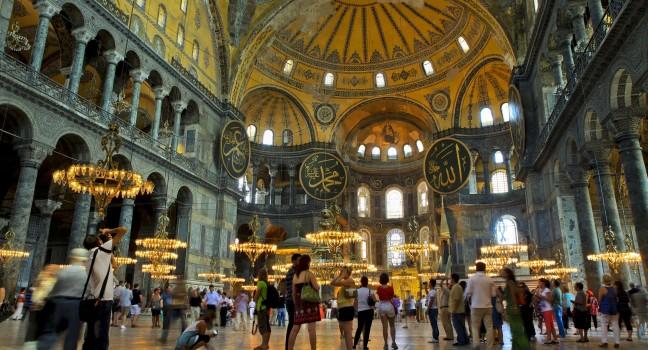
ISTANBUL,TURKEY - AUGUST 15: Tourists visit Hagia Sophia on August 15, 2012 in Istanbul, Turkey. Hagia Sophia is a former Orthodox patriarchal basilica, later a mosque and now a museum.
Sadik Gulec / Shutterstock

Variously referred to as either Hagia Sophia or Ayasofya, this soaring edifice is perhaps the greatest work of Byzantine architecture, and for almost a thousand years, starting from its completion in 537, it was the world's largest and most important religious monument. As Emperor Justinian may well have intended, the impression that will stay with you longest, years after a visit, is the sight of the dome. As you enter, the half domes trick you before the great space opens up with the immense dome, almost 18 stories high and more than 100 feet across, towering above. Look up into it, and you'll see the spectacle of thousands of gold tiles glittering in the light of 40 windows. Only Saint Peter's in Rome, not completed until the 17th century, surpasses Ayasofya in size and grandeur. It was the cathedral of Constantinople, the heart of the city's spiritual life, and the scene of imperial coronations.

When Mehmet II conquered the city in 1453, he famously sprinkled dirt on his head before entering the church after the conquest as a sign of humility. His first order was for Ayasofya to be turned into a mosque, and, in keeping with the Islamic proscription against figural images, mosaics were plastered over. Successive sultans added the four minarets, mihrab (prayer niche), and minbar (pulpit for the imam) that visitors see today, as well as the large black medallions inscribed in Arabic with the names of Allah, Muhammad, and the early caliphs. In 1935, Atatürk turned Ayasofya into a museum—a project of restoration, including the uncovering of precious mosaics, began, with the later now mostly finished and visible. In 2020, Ayasofya reverted into an active mosque, but it's possible to visit as a non-Muslim.

Restoration efforts uncovered, among other things, four large, beautifully preserved mosaics of seraphim, or six-winged angels, in the pendentive of the dome, which had been plastered over 160 years earlier but these and the mosaics in the upstairs galleries are currently closed. At the far end of the south gallery are several imperial portraits, including, on the left, the Empress Zoe, whose husband's face and name were clearly changed as she went through three of them. On the right is Emperor John Comnenus II with his Hungarian wife Irene and their son, Alexius, on the perpendicular wall. Also in the upper level is the great 13th-century Deesis mosaic of Christ flanked by the Virgin and John the Baptist, breathing the life of the early Renaissance that Byzantine artists would carry west to Italy after the fall of the city to the Turks—note how the shadows match the true light source to the left. The central gallery was used by female worshippers. The north gallery is famous for its graffiti, ranging from Nordic runes to a complete Byzantine galley under sail. On your way out of the church, through the "vestibule of the warriors," a mirror reminds you to look back at the mosaic of Justinian and Constantine presenting Ayasofya and Constantinople, respectively, to the Virgin Mary.

The tombs of various sultans and princes can be visited for free through a separate entrance around the back of Ayasofya (daily 9–7:30).

Dolmabahçe Sarayı

Besiktas Fodor's Choice
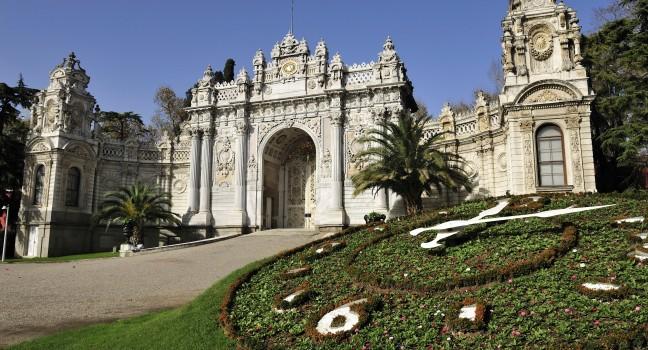
Dolmabahce palace, Istanbul, Turkey.
senai aksoy / Shutterstock

Abdülmecid I, whose free-spending lifestyle later bankrupted the empire, had this palace built between 1843 and 1856 as a symbol of Turkey's march toward European-style modernization. It's also where Atatürk died (and all clocks in the palace are turned to his time of death). Its name means "filled-in garden," inspired by the imperial garden planted here by Sultan Ahmet I (ruled 1603–17). Abdülmecid gave father and son Garabet and Nikoğos Balyan complete freedom and an unlimited budget, the only demand being that the palace "surpass any other palace of any other potentate anywhere in the world." The result, an extraordinary mixture of Turkish and European architectural and decorative styles, is as over-the-top and showy as a palace should be—and every bit as garish as Versailles. Dolmabahçe is divided into the public Selamlık and the private Harem. Afterward, stroll along the palace's nearly ½-km (¼-mile)-long waterfront facade and through the formal gardens, which have the Crystal Pavilion and Clock Museum.

Kapalı Çarşı

The Bazaar Quarter and Environs Fodor's Choice
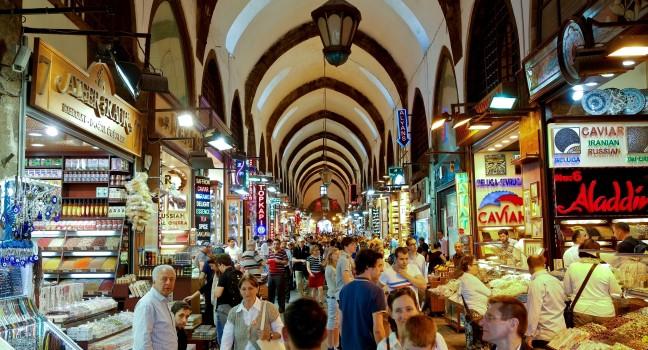
ISTANBUL, May1: People shopping in the Grand Bazar in Istanbul, Turkey, one of the largest covered markets in the world, Istanbul, May 1, 2013
Rob van Esch / Shutterstock

Take a deep breath and plunge into this maze of winding covered streets crammed with more than 4,000 tiny shops, cafés, restaurants, mosques, and courtyards. Originally built by Mehmet II (the Conqueror) in 1461 over the main Byzantine shopping streets, the Grand Bazaar was rebuilt after fires in both 1943 and 1954. It's said that this early version of a shopping mall contains the largest concentration of stores under one roof anywhere in the world, and that's easy to believe.

Some of the most aggressive salesmanship in the world takes place here, so take yet another deep breath, and put up your guard while exploring. Oddly enough, though, the sales pitches, the crowds, and the sheer volume of junky trinkets on offer can be hypnotizing. Enjoy a glass of tea while you browse through leather goods, carpets, fabric, clothing, furniture, ceramics, and gold and silver jewelry. Remember, whether you're bargaining for a pair of shoes or an antique carpet, the best prices are offered when the would-be seller thinks you are about to slip away.

Yeniçeriler Cad. and Çadırcılar Cad., Istanbul, Türkiye
212-519–1248
Sight Details
Closed Sun.

Something incorrect in this review?

İstanbul Arkeoloji Müzeleri

Sultanahmet Fodor's Choice
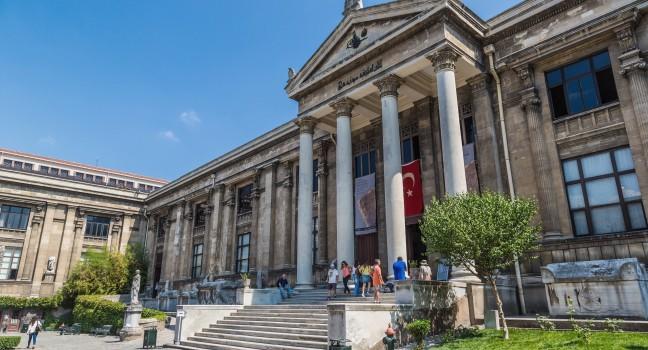
ISTANBUL - MAY 25: Istanbul Archaeology Museums on may 25, 2013 in Istanbul, Turkey. The complex of three museums contain more than a million pieces of different eras.
S-F / Shutterstock

Step into this vast repository of spectacular finds, housed in a three-building complex in a forecourt of Topkapı Palace, to get a head-spinning look at the civilizations that have thrived for thousands of years in and around Turkey. The main museum was established in 1891, when forward-thinking archaeologist and painter Osman Hamdi Bey campaigned to keep native antiquities and some items from the former countries of the Ottoman Empire in Turkish hands. The most stunning pieces are sarcophagi that include the so-called Alexander Sarcophagus, found in Lebanon, carved with scenes from Alexander the Great's battles, and once believed, wrongly, to be his final resting place. A fascinating exhibit on Istanbul through the ages has artifacts and fragments brought from historical sites around the city that shed light on its complex past, from prehistory through the Byzantine period. Exhibits on Anatolia include a display of some of the artifacts found in excavations at Troy, including a smattering of gold jewelry.

Don't miss a visit to the Çinili Köşk (Tiled Pavilion), one of the most visually pleasing sights in all of Istanbul—a bright profusion of colored tiles covers this onetime hunting lodge of Mehmet the Conqueror, built in 1472. Inside are ceramics from the early Seljuk and Ottoman empires, as well as brilliant tiles from İznik, the city that produced perhaps the finest ceramics in the world during the 16th and 17th centuries. In summer, you can mull over these glimpses into the distant past as you sip coffee or tea at the café in the garden, surrounded by fragments of ancient sculptures.

The Eski Şark Eserleri Müzesi (Museum of the Ancient Orient) transports you to even earlier times: a majority of the panels, mosaics, obelisks, and other artifacts here, from Anatolia, Mesopotamia, and elsewhere in the Arab world, date from the pre-Christian centuries. One of the most significant pieces in the collection is a 13th-century BC tablet on which is recorded the Treaty of Kadesh, perhaps the world's earliest known peace treaty, an accord between the Hittite King Hattusili III and the Egyptian pharaoh Ramesses II. Also noteworthy are reliefs from the ancient city of Babylon, dating from the era of the famous king Nebuchadnezzar II. As of this writing, it is temporarily closed.

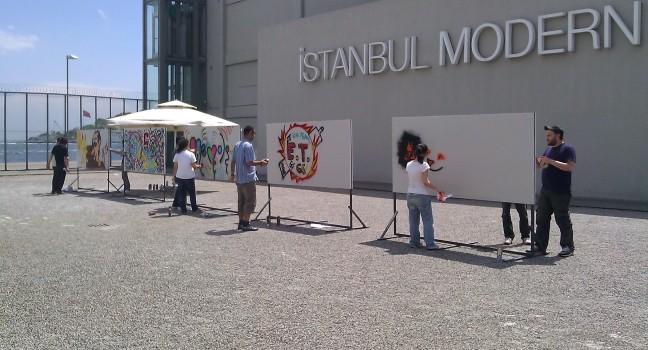
İstanbul Modern

Beyoglu Fodor's Choice
Street Art Istanbul Modern Style 2
Street Art Istanbul Modern Style 2 by

Istanbul's first museum for contemporary art showcases paintings, sculptures, photography, and magnificent works in other media from Turkey and around the world. The Renzo Piano–designed building (of Paris's Pompidou and London's The Shard fame), unveiled in 2022 after a four-year build, is worth seeing just by itself. A private tour can be organized in English for groups of 10 or more (400 TL per person) and will give you a good introduction to the art scene in Turkey. The museum also has a small cinema, café, and design store.

Tophane İskele Cd. 1/1, Istanbul, 34433, Türkiye
212-334–7300
Sight Details
650 TL
Closed Mon.

Something incorrect in this review?

Süleymaniye Mosque

The Bazaar Quarter and Environs Fodor's Choice
ISTANBUL MAY 05: The Suleiman Mosque (Turkish: Suleymaniye Camii) is a grand 16th-century mosque in Istanbul, on May 05 2014 in Istanbul, Turkey.
muratart / Shutterstock

On a hilltop opposite Istanbul University is one of the city's most magnificent mosques, considered one of the architect Sinan's masterpieces. The architectural thrill of the mosque, which was built between 1550 and 1557 and fully restored in 2010, is the enormous dome, the highest of any Ottoman mosque. Supported by four square columns and arches, as well as exterior walls with smaller domes on either side, the soaring space gives the impression that it's held up principally by divine intervention. Except for around the mihrab (prayer niche), there is little in the way of tile work—though the intricate stained-glass windows and baroque decorations painted on the domes more than make up for that. The tomb of Sinan is just outside the walls, on the northern corner, while those of his patron, Süleyman the Magnificent, and the sultan's wife, Roxelana, are in the adjacent cemetery. Stroll around the beautiful grounds, and don't miss the wonderful views of the Golden Horn.

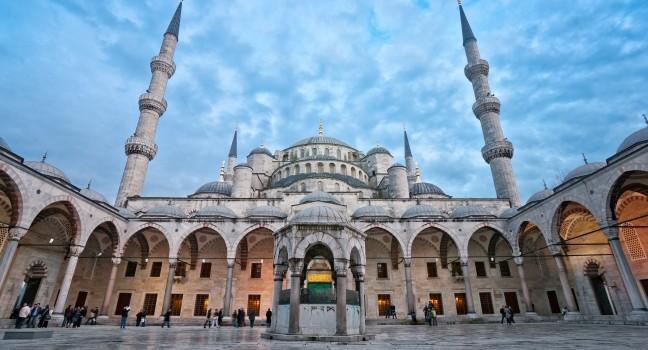
Sultan Ahmed Mosque (Blue Mosque)

Sultanahmet Fodor's Choice
The Blue Mosque, (Sultanahmet Camii), Istanbul, Turkey.
Luciano Mortula / Shutterstock

Only after you enter this mosque, most often referred to as the Blue Mosque, do you understand its moniker. The inside is covered with 20,000 shimmering blue-green İznik tiles interspersed with 260 stained-glass windows; calligraphy and intricate floral patterns are painted on the ceiling. After the dark corners and stern faces of the Byzantine mosaics in Ayasofya, this mosque feels gloriously airy and full of light. Indeed, this favorable comparison was the intention of architect Mehmet Ağa (a former student of the famous Ottoman architect Sinan), whose goal was to surpass Justinian's crowning achievement (Ayasofya). At the behest of Sultan Ahmet I (ruled 1603–17), he created this masterpiece of Ottoman craftsmanship, starting in 1609 and completing it in just eight years, and many believe he indeed succeeded in outdoing the splendor of Ayasofya.

Mehmet Ağa actually went a little too far, though, when he surrounded the massive structure with six minarets: this number linked the Blue Mosque with the Masjid al-Haram in Mecca—and this could not be allowed. So Sultan Ahmet I was forced to send Mehmet Ağa down to the Holy City to build a seventh minaret for al-Haram and re-establish the eminence of that mosque. Sultan Ahmet and some of his family are interred in the türbe (mausoleum) at a corner of the complex.

From outside of the Blue Mosque you can see the genius of Mehmet Ağa, who didn't attempt to surpass the massive dome of Ayasofya across the way, but instead built a secession of domes of varying sizes to cover the huge interior space, creating an effect that is both whimsical and uplifting.

Sultanahmet Sq., Istanbul, Türkiye
Sight Details
Free
Visit outside of prayer times.

Something incorrect in this review?

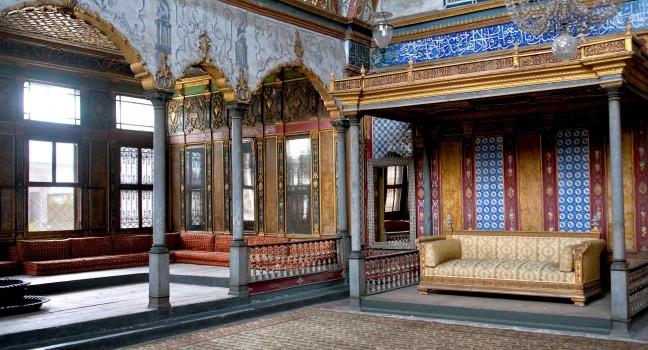
Topkapı Sarayı

Sultanahmet Fodor's Choice
Harem in Topkapi palace, Istanbul, Turkey
vvoe / Shutterstock

This vast palace on Sarayburnu (Seraglio Point) was the residence of sultans and their harems in addition to being the seat of Ottoman rule from the 1460s until the mid-19th century, when Sultan Abdülmecid I moved his court to Dolmabahçe Palace. Sultan Mehmet II built the original Topkapı Palace between 1459 and 1465, shortly after his conquest of Constantinople. Over the centuries, it grew to include four courtyards and quarters for some 5,000 full-time residents. The main entrance, or Imperial Gate, leads to the Court of the Janissaries, also known as the First Courtyard. The modestly beautiful Hagia Irene (Church of St. Irene) is believed to stand on the site of the first church of Byzantium (separate admission). You will begin to experience the grandeur of the palace when you pass through the Bab-üs Selam (Gate of Salutation). Enter the Harem (separate admission) on the other side of the Divan from the Outer Treasury. The Treasury contains the popular jewels, including the 86-carat Spoonmaker's Diamond, the emerald-studded Topkapı Dagger, and two uncut emeralds (each weighing about 8 pounds).

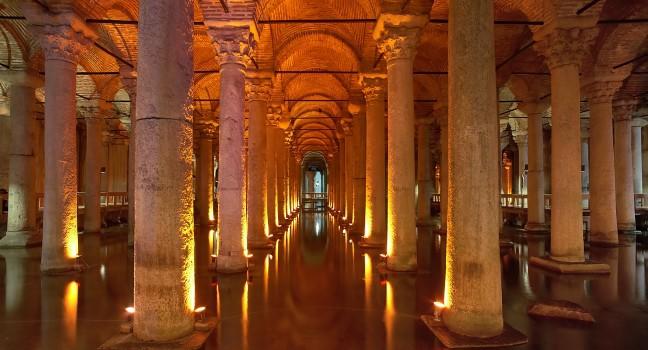
Yerebatan Sarnıcı

Sultanahmet Fodor's Choice
Underground Basilica Cistern (Yerebatan Sarnici) in Istanbul, Turkey.
Mikhail Markovskiy / Shutterstock

The major problem with the site of Byzantium was the lack of fresh water. So, for the city to grow, a great system of aqueducts and cisterns was built, the most famous of which is the Basilica Cistern, whose present form dates from the reign of Justinian in the 6th century. A journey through this ancient underground waterway takes you along dimly lit walkways that weave around 336 marble columns rising 26 feet to support Byzantine arches and domes, from which water drips unceasingly. The two most famous columns feature upturned Medusa heads. The cistern was always kept full as a precaution against long sieges, and fish, presumably descendants of those that arrived in Byzantine times, still flit through the dark waters. A hauntingly beautiful oasis of cool, shadowed, cathedral-like stillness (with Turkish instrumental music playing softly in the background), the cistern is a particularly relaxing place to get away from the hubbub of the Old City. What's more, an extensive renovation has just been completed, which aimed to strengthen its resilience against earthquakes. Come early to avoid the long lines and have a more peaceful visit.

Yerebatan Cad. at Divan Yolu, Istanbul, Türkiye
212-512–1570
Sight Details
Day ticket TL900. Night ticket TL1,400.

Something incorrect in this review?

Adana Arkeoloji Müzesi

Fodor's Choice

Adana’s archaeology museum, in a restored former textile factory, has a nicely presented collection of local finds, including Roman mosaics, statues, and carved sarcophagi. The museum complex itself houses six separate museums, one each for archaeology, mosaics, ethnography, agriculture, industry, and urban life. Though there's no audio guide available, the lively displays help to bring the curated finds to life.

Ahmet Cevdet Yağ Blv. No: 7, Adana, 01120, Türkiye
322-454–3855
Sight Details
190 TL
Closed Mon.

Something incorrect in this review?

Akdamar

Fodor's Choice

On the tranquil, uninhabited islet of Akdamar, among the wild olive and almond trees, stand the scant remains of a monastery that include the truly splendid Church of the Holy Cross. Built in AD 921 by an Armenian king, Gagik Artsruni of Vaspurakan, the compound was originally part of a palace, but was later converted to a monastery. Incredible high-relief carvings on the exterior make the church one of the most enchanting spots in Turkey. Much of the Old Testament is depicted here: look for Adam and Eve, David and Goliath, and Jonah and the whale. Along the top is a frieze of running animals; another frieze shows a vineyard where laborers work the fields and women dance with bears; and, of course, King Gagik, almost hidden above the entrance, is depicted, offering his church to Christ. The monastery operated until WWI, and since 2010 annual religious services have been allowed, usually in early September.

There are a handful of small cafés and gift shops on the island, and a few coves that offer the opportunity to swim in the alkaline lake. One of the most charming things about the island may be the large number of gray rabbits scampering about. To reach Akdamar from Van, take a minibus (20 TL) or follow Route 300 to Gevaş, which is about 20 miles away. Just past Gevaş, you'll see ferries waiting at the well-marked landing to collect the required number of passengers—between 10 and 15—for the 20-minute ride. Normally it costs 30 TL per person but if there aren't enough passengers the round-trip is around 300 TL. Boats return to the mainland hourly until 6 pm.

Van, Turkey
Sight Details
TL35

Something incorrect in this review?

Alanya Kalesi

Fodor's Choice

Views of the splendid castle or kale, on a mighty crag surrounded on three sides by the sea, dominate all roads into Alanya. The crenellated outer walls are 6½ km (about 4 miles) long and include 140 bastions. The road pierces these outer walls through a modern break, dividing as it heads up the summit. One section leads to the İç Kale (inner fortress), the other to the Ehmedek (garrison); both have places to park. Near the entrance to the Ehmedek are the remains of the original bedestan (bazaar); the old shops around its open courtyard now touting souvenirs. Along a road to the top of the promontory, a ticket office defends the inner keep. Inside are the ruins of a Byzantine church, its 6th-century frescoes of the evangelists faded almost beyond recognition.

The Seljuk sultan Keykubad probably also had a palace here, although discoveries by the McGhee Center of Georgetown University indicates that in times of peace the Seljuk elite likely preferred their pleasure gardens and their hunting and equestrian sports on the well-watered plain below. Steps ascend to the battlement on the summit. A viewing platform is built on the spot where condemned prisoners and women convicted of adultery were once cast to their deaths. The ticket is also valid for the Ehmedek. Admire the ruined monastery down below but do not attempt to descend toward it—the mountainside is very treacherous.

Alaçatı Beach

Fodor's Choice

The sandy beach at Alaçatı, about 6 km (nearly 4 miles) south of town, is ideal for windsurfing, with strong winds and few waves. Unfortunately, there is only a small public beach here, but many of the comfortable private beach clubs and hotels with private beaches allow nonguests for a day rate. The water is cooler at Alaçatı than it is at other beaches, and stunningly blue over the pale fine sand. In addition to windsurfing, water sports like waterskiing, banana boat rides, and kitesurfing are available here. Amenities: food and drink; showers; toilets; water sports. Best for: windsurfing.

Alaçatı Plajı, Alaçati, Türkiye

Something incorrect in this review?

Amyntas Kaya Mezarları

Fodor's Choice

These impressive ancient Lycian rock tombs are carved into the cliff that looms above town. Follow the signs to Kaya Caddesi (literally "Rock Avenue") near the local minibus station, and then climb the approximately 200 steps leading up to the rocks (not for the faint-hearted). Your effort will be well rewarded—particularly at dusk, when the cliffs take on a reddish glow. The largest and best-known is the Tomb of Amyntas, son of Hermepias (c. 350 BC), carved to resemble the facade of an Ionic temple and presumably the burial place of a local ruler or nobleman. Inside are the slabs where corpses were laid out. Keep your eyes peeled for the ancient sarcophagi scattered throughout Fethiye.

Fethiye, 48300, Türkiye
Sight Details
115 TL

Something incorrect in this review?

Anadolu Medeniyetleri Müzesi

Fodor's Choice

The Museum of Anatolian Civilizations is a real gem, showcasing many of Turkey's best ancient treasures and providing excellent insight into the incredible amount of history that has played out here. Housed in a 15th-century bedesten (similar to a kervansaray), the museum covers every major civilization that has had a presence in Anatolia, going back more than 10 millennia. Highlights of the vast collection include finds dating from 7000 BC—among them famous mother goddess figurines and wall paintings of animals and geometric patterns from the Neolithic site of Çatalhöyük, one of the oldest human settlements ever discovered. Other items on display include clay cuneiform tablets—the earliest written records found in Anatolia—from the Assyrian trade colonies period, as well as a 13th-century BC bronze tablet (the only such bronze tablet found in Anatolia) recording a Hittite treaty. A significant collection of monumental stonework from around Anatolia, including well-preserved neo-Hittite reliefs depicting the epic of Gilgamesh, from the archaeological site of Karkamış (Kargamış) in Gaziantep, is on display in the central hall.

Anemurium

Fodor's Choice

The extensive ruins of ancient Anemurium—mostly dating from the late Roman/early Byzantine period—are built primarily of durable Roman concrete, which makes them better preserved but less picturesque than the average stone ruins. Their idyllic seaside setting, with overgrown paths leading between the structures and the waves crashing nearby, more than makes up for that, however. The marked turnoff to the site is 5 km (3 miles) west of Anamur.

Anemurium, whose ancient name refers to the winds that often blow through the site, has long inspired the curiosity of foreign visitors: English archaeologist Francis Beaufort excavated here in the 19th century. Beside the entrance is a bath building, once part of a gymnasium. Beyond this is a small well-preserved theater, or odeon, opposite which sit the scant remains of a large theater. A second Roman bath is easily the best preserved in the country, with even the great vaulted roof of the two-story building still standing. Behind it are the remains of an aqueduct, while one set of old city walls climbs up a steep slope to the unexcavated acropolis. Beside the road there are also numerous tombs, some with frescoes and mosaics. At the end of the road there's a pebbly beach, where you can take a dip when you've finished exploring, but there are no showers or other facilities.

At the time of writing in October 2024, the site is closed temporarily for some restoration work, so check ahead of your visit.

at the end of Anamuryum Cad., Anamur, 33660, Türkiye
324-814–1677
Sight Details
TL 60

Something incorrect in this review?

Antalya Müzesi

Fodor's Choice

The province of Antalya has a rich array of archaeological sites, and their curated finds constitute a first-rate collection at the Antalya Müzesi. The star is Perge; statues which fill gallery after gallery here including one just for the gods, from Aphrodite to Zeus. There are also Turkish crafts, costumes, and prehistoric artifacts from the Karain Cave, with bits of Byzantine iconography and some fossils thrown in. One gallery is filled with fine Roman sarcophagi from the 2nd century AD, including a wonderful one illustrating the labors of a steadily aging Hercules. Upstairs are several coin hordes; the large one from Elmalı was recently returned to the museum after being smuggled to the United States. Ticketing is a little tricky; the €15 ticket cost (550 TL) includes an audioguide—ask for a ticket without the audioguide for cheaper entry. If you have the time, walk to the museum from the center of town along the clifftop promenade, which offers a fine sea view.

Anıtkabir

Fodor's Choice

Atatürk's picture is on every single piece of Turkish currency, his visage hangs in just about every office and official building in the country, and his principles and ideas are the foundations of modern Turkish political thought. So his vast mausoleum, perched on a hilltop overlooking the capital city he built, is on a scale suitable to his stature in Turkey. A marble promenade flanked with Hittite-style lions leads to the imposing mausoleum, where a huge sarcophagus lies beyond a colonnade with inscriptions from his speeches and below a ceiling of brilliant gold mosaics. An adjoining museum contains personal belongings from the revered man's life, including his clothes, automobiles, and personal library. The corridors underneath the tomb house an in-depth exhibit on the 1919–22 War of Independence. To reach the mausoleum, you can take the metro to Tandoğan and walk up the long road that ascends from the main entrance at the northern end of the grounds. A quicker way is to take a taxi to the alternate entrance on Akdeniz Caddesi, on the southeast side.

Aphrodisias

Fodor's Choice

Though most of what you see today dates from the 1st and 2nd century AD, archaeological evidence indicates that the local dedication to Aphrodite follows a long history of veneration of pre-Hellenic goddesses, such as the Anatolian mother goddess and the Babylonian god Ishtar. Only about half of the site has been excavated. It's much less crowded than Ephesus, and enough remains to conjure the ancient city. Once you reach the pretty, rural site, it is a short walk from the parking area to the main gate. Then choose the circuit to follow to reach all notable buildings. The lovely Tetrapylon gateway has four rows of columns and some of the best, remaining friezes. Behind it, the vast Temple of Aphrodite was built in the 1st century BC on the model of the great temples at Ephesus and later transformed into a basilica church. Its gate and many of its columns are still standing. At the far point of the area is the impressive, well-preserved 1st century AD stadium which could seat up to 30,000 spectators to watch footraces, boxing, and wrestling matches. You'll also find the once-magnificent ruined residence, the fine Odeon (also known as the Bouleuterion, or Council House); an intimate, semicircular concert hall and public meeting room; towering public baths; and the sprawling agora. The 7,000 white-marble seats of the city's theater, built into the side of a small hill, are simply dazzling on a bright day. The adjacent School of Philosophy has a colonnaded courtyard with chambers lining both sides.

In the museum, just before the ticket booth, Aphrodisias bursts back into life in vivid friezes and sculptures that seem almost about to draw breath. The museum's collection includes dozens of impressive statues and reliefs from the site, including Aphrodite herself, with excellent labeling (particularly in the grand display in the Sevgi Gönül Salonu) explaining their significance and symbolism.

The Archaeological and Haleplibahçe Mosaic Museums

Fodor's Choice

Urfa's fantastic archaeological museum reopened in 2015 in an imposingly large building amid leafy open space. It still has an impressive collection covering the area's long history, interspersed with lifelike recreations of the living conditions in prehistoric times. Especially interesting are sculptures from Göbekli Tepe and the full-size re-creation of one of its temples, but the star of the show is a white, alien-looking statue with obsidian eyes, found in the Gölbaşı lake in 1993. Nearly 13,500 years old, it is the world's oldest full-size man-made human figure. There are also Hittite sculptures from the area, a collection of exquisitely carved antique wooden doors, and a classical sculpture garden.

Also included in the ticket price is entry to the neighboring Haleplibahçe Mosaic Museum, which houses an incredible array of mosaics that would have once formed part of a Roman-era palace. These include mosaics depicting the life of Achilles, including his mother holding him by the heel and dipping him into the waters of the River Styx. and a magnificent scene of Amazon queens hunting wild beasts.

Haleplibahçe Cad., Sanliurfa, Turkey
414-313–1588
Sight Details
5 TL
Tues.–Sun. 8–5

Something incorrect in this review?

Aspendos Archaeological Site

Fodor's Choice

Although there are many Roman theaters still standing, none are quite as perfect as the one at Aspendos, built by a local architect named Xenon during the reign of Emperor Marcus Aurelius (AD 161 to 180). It owes its current preservation to the fact that the Seljuk Turks repurposed it as a royal palace in the 13th century; traces of the distinctive Seljuk red-and-yellow paint work are still visible. In its heyday, it could hold 15,000 spectators and is most striking for the broad curve of seats, perfectly proportioned porticoes, and rich decoration.

The Greeks liked open vistas behind their stages, but the Romans preferred enclosed spaces. The stage building you see today was once covered by an elaborate screen of marble columns, and its niches were filled with statues. The only extant relief on site depicts Dionysus (Bacchus) watching over the theater. The acoustics are fine, and the theater continues to be used—for concerts and for the Aspendos International Opera and Ballet Festival, held every September, rather than for wild-animal and gladiator spectacles as in Roman times. Most visitors just see the theater, but don't miss out on the rest of the site, which is up a zigzagging trail behind it. The rewards are a tall Nymphaion (a sanctuary to the nymphs built around a fountain decorated with a marble dolphin) and the remains of a Byzantine basilica and market hall. You can also see, below in the plain, the stadium and the aqueduct which used an ingenious siphon system.

Sarıabalı Köyü, Serik, Antalya, 07500, Türkiye
242-892–1325
Sight Details
560 TL

Something incorrect in this review?

Ayder Hot Springs

Fodor's Choice

Ayder is also known for its kaplıcaları (hot springs), reputed to cure all types of ailments. Whether this is true or not, the springs, housed in a modern, marble-lined building near the village's mosque, are good for a relaxing soak after a day of hiking. There's a large pool to splash around in and a hammam area where you can give yourself a good scrub. There are separate facilities for men and women, as well as private rooms for couples that want to bathe together.

Ayder, Turkey
464-657–2102
Sight Details
TL30, TL100 for a private room

Something incorrect in this review?

Balık Pazarı

Fodor's Choice

Fethiye's lively Balık Pazarı (fish market) is, quite simply, a fun place to be. Set in the heart of the old town, it's a bubbling hub where locals and visitors alike come to enjoy freshly caught seafood beneath the ample shade of fig trees. Browse the produce from the salesmen that squeeze into its spare nooks, or grab a seat and a cup of tea. The market operates with a unique twist: if you like, you can buy your fish from the vendors and take it to one of the surrounding restaurants, where they may cook it for a fee.

Bergama

Fodor's Choice

One of the Turkey's best preserved ancient cities, UNESCO World Heritage Site, and target of most cruises' disembarking passengers, Bergama, lies just 40 km (25 miles) east down a well-trodden tourist path. Known during Greek and Roman times as Pergamon, the city was renowned for its arts and medicine. Its lofty status is confirmed by a treasure trove of ruins including temples, palaces, shops, a library, and a 10,000-seat theater, the steepest of its age. In the center of the new town, many artifacts are on display at the archaeology museum.

Bergama, Turkey
0232-631–0778-archaeology museum
Sight Details
25 TL
Apr.–Oct., daily 8–7; Nov.–Mar. 8–5

Something incorrect in this review?

Bodrum Castle and Museum of Underwater Archaeology

Fodor's Choice

Built in the early 15th century by the Knights Hospitaller (Knights of St. John), the Petrium, better known as Bodrum Castle or the Castle of St. Peter, rises between Bodrum's twin harbors like an illustration from a fairy tale. With German knight-architect Heinrich Schlegelholt at the helm, the knightly builders plundered the Mausoleum at Halicarnassus for green volcanic stone, marble columns, and reliefs to create this showpiece of late-medieval architecture, whose walls are studded with 249 coats of arms, including the crests of the Plantagenets and d'Aubussons. The castle's towers and gardens are visible from many parts of town, and the name "Bodrum" itself likely derives from the word Petrium. Some of the castle's towers are named after the homeland languages of the knights who built them: France, Germany, Italy, and England (the English Tower, embellished with a relief of a lion, is known as the Lion Tower). The castle now houses the fascinating Museum of Underwater Archaeology, where displays include the world's oldest excavated shipwreck (Uluburun), the tomb of the so-called "Carian Princess," and the sunken cargoes of many ancient and medieval ships that sank off the treacherous Aegean coast, plus land finds from around the Peninsula, including Pedasa. Visiting the Castle requires climbing multiple flights of steep stone stairs.

Kale Cad., Bodrum, 48400, Türkiye
252-214–1261
Sight Details
€23; audio guide 350 TL

Something incorrect in this review?

Cennet and Cehennem

Fodor's Choice

This is an intriguing attraction that has been drawing visitors since before Roman times. These are two natural sinkholes that were created by an ancient subsidence. The first, located just beyond a small café and ticket booth, is the one referred to as Cennet (Heaven). A five-minute walk takes you down to the peaceful valley floor and the well-preserved 5th-century AD Byzantine Church of the Virgin Mary. The path then descends into a huge, aircraft-hangar-like natural cavern, which might have been the site of a spring known among the ancients as the fountain of knowledge.

Back up the stairs a short walk leads to the Cehennem (Hell) sinkhole, which is narrower, with walls too steep to enter, and deep enough for little sunlight to reach the bottom. A dark and gloomy place, pagan, Christian, and Muslim sources all identify it as an entrance to hell. The road continues to a third cavern, the Cave of Wishes (Dilek Mağarası), also known as Asthma Cave (Astım Mağarası) for the purported respiratory benefits of its humid air. Romans picked crocuses here, and even today you may be met by villagers selling bunches of the little flowers.

Hasanaliler Köyü, Kizkalesi, 33940, Türkiye
Sight Details
TL 450

Something incorrect in this review?

Chimaera

Fodor's Choice

At the far southern end of Çıralı, an evening scramble up a sometimes steep path will bring you to the Chimaera (Yanartaş in Turkish), named after the ferocious fire-breathing beast of legend. Flames can still be seen rising from cracks in the rock, apparently also burning the gas deep below, since they reignite even if covered. In times past, the flames were apparently even more vigorous, visible by sailors offshore, and the ruins of an ancient stone building can be seen near the flames.

To reach the Chimaera, take either of the main roads to the end of Çıralı, and then head inland. If you're staying in Olympos it's a 7-km (4.5-mile), 90-minute walk, so you may want to drive or bike to the bottom of the hill, or take a tour, which most hotels in the area will arrange. You can see the flames in the day, but they're best at night. Bring a flashlight for all the stairs, since there's no lighting. In peak season, you'll need to choose between going as late as possible to avoid the crowds or in daylight so you can see the pretty mountainside.