46 Best Sights in Rome, Italy

Background Illustration for Sights

We've compiled the best of the best in Rome - browse our top choices for the top things to see or do during your stay.

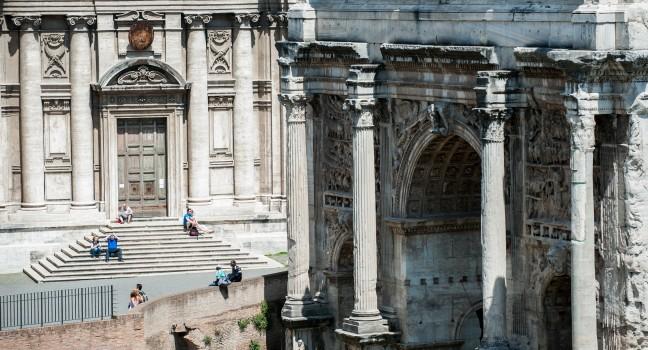
Arco di Settimio Severo

Campitelli Fodor's Choice
Arco di Settimio Severo, Rome, Italy
© Ross Brinkerhoff / Fodor’s Travel

One of the grandest triumphal arches erected by a Roman emperor, this richly decorated monument was built in AD 203 to celebrate Severus's victory over the Parthians. It was once topped by a bronze statuary group depicting a chariot drawn by four (or perhaps as many as six) life-size horses. Masterpieces of Roman statuary, the stone reliefs on the arch were probably based on huge painted panels depicting the event, a kind of visual report on his foreign campaigns that would have been displayed during the emperor's triumphal parade in Rome to impress his subjects (and, like much statuary then, were originally painted in florid, lifelike colors).

West end of Foro Romano, Rome, 00186, Italy
Sight Details
€18 24-hr ticket required

Something incorrect in this review?

Colosseum

Colosseo Fodor's Choice
Colosseum, Rome, Italy
© Ross Brinkerhoff / Fodor’s Travel

The most spectacular extant edifice of ancient Rome, the Colosseum has a history that is half gore, half glory. Once able to house 50,000 spectators, it was built to impress Romans with its spectacles involving wild animals and fearsome gladiators from the farthest reaches of the empire. Senators had marble seats up front, the vestal virgins took the ringside position, the plebs sat in wooden tiers at the back, and the masses watched from the top tier. Looming over all was the amazing velarium, an ingenious system of sail-like awnings rigged on ropes and maneuvered by sailors from the imperial fleet, who would unfurl them to protect the arena's occupants from sun or rain.

From the second floor, you can get a bird's-eye view of the hypogeum—the subterranean passageways that were the architectural engine rooms that made the slaughter above proceed like clockwork. In a scene prefiguring something from Dante's Inferno, hundreds of beasts would wait to be launched via a series of slave-powered hoists and lifts into the bloodthirsty sand of the arena above.

Designed by order of the emperor Vespasian in AD 72 and completed by his son Titus in AD 80, the arena has a circumference of 573 yards, and its external walls were built with travertine from nearby Tivoli. Its construction was a remarkable feat of engineering, for it stands on marshy terrain reclaimed by draining an artificial lake that formed part of the vast palace of Nero. Originally known as the Flavian amphitheater (Vespasian's and Titus's family name was Flavius), it came to be known as the Colosseum thanks to a colossal gilded bronze statue that once stood nearby.

The legend made famous by the Venerable Bede says that as long as the Colosseum stands, Rome will stand; and when Rome falls, so will the world . . . not that the prophecy deterred medieval and Renaissance princes and popes from using the Colosseum as a quarry. In the 19th century, poets came to view the arena by moonlight; today, mellow golden spotlights make the arena a spectacular sight at night, and evening visits are possible with guided tours from May through October. To enter, book a combination ticket (with the Roman Forum and Palatine Hill) in advance online, though if you have a Roma Pass, you can use it.

Tickets cost €18. Aim for early or late slots to minimize lines, as even the preferential lanes get busy in the middle of the day. Alternatively, you can book a tour online with a company (do your research to make sure it's reputable) that lets you skip the line. Avoid the tours sold on the spot around the Colosseum; although you can skip the lines, the tour guides tend to be dry, the tour groups huge, and the tour itself rushed. To see the arena or the underground, you must purchase a special timed-entry ticket with those features, though the arena is included if you buy the Roman Forum–Palatine complex €24 two-day Full Experience ticket.

Piazza del Colosseo, Rome, 00184, Italy
Sight Details
Requires either the €18 24-hr ticket or the €24 Full Experience ticket (can include the arena, the underground, and/or the attic for no additional fee, but it must be specified during the purchase)

Something incorrect in this review?

Casa di Augustus

Campitelli Fodor's Choice

First discovered in the 1970s and open to the public only since 2006, this was the residence of Octavian Augustus (27 BC–AD 14) after his victory at Actium. (Archaeologists have recently found two courtyards rather than one, though, in the style of Rome's ancient Greek kings, suggesting Augustus maintained this house after his ascension to prominence.) Four rooms have exquisite examples of decorative frescoes on the walls; startlingly vivid and detailed are the depictions of a narrow stage with side doors, as well as some striking comic theater masks. An exquisitely painted upper room has been identified as the Emperor's study.

Northwest crest of Palatine Hill, Rome, 00184, Italy
Sight Details
€22 2-day Full Experience ticket required
Closed Mon.

Something incorrect in this review?

Recommended Fodor's Video

Palatine Hill

Monti Fodor's Choice

Just beyond the Arco di Tito, the Clivus Palatinus—the road connecting the Forum and the Palatine Hill—gently rises to the heights of the Colle Palatino (Palatine Hill), the oldest inhabited site in Rome. Now charmingly bucolic, with pines and olive trees providing shade in summer, this is where Romulus is said to have founded the city that bears his name, and despite its location overlooking the Forum's traffic and attendant noise, the Palatine was the most coveted address for ancient Rome's rich and famous. During the Roman Republic it was home to wealthy patrician families—Cicero, Catiline, Crassus, and Agrippa all had homes here—and when Augustus (who had himself been born on the hill) came to power, declaring himself to be the new Romulus, it would thereafter become the home of emperors. The Houses of Livia and Augustus (which you can visit with the S.U.P.E.R. ticket, for the same price as the Roman Forum admission) are today the hill's best-preserved structures, replete with fabulous frescoes. If you only have time for one, the House of Augustus is the more spectacular of the two. After Augustus's relatively modest residence, Tiberius extended the palace and other structures followed, notably the gigantic extravaganza constructed for Emperor Domitian which makes up much of what we see today.

Entrances at Piazza del Colosseo and Via di San Gregorio 30, Rome, 00184, Italy
06-39967700
Sight Details
€16 combined ticket, includes single entry to Palatine Hill–Forum site and single entry to Colosseum (if used within 2 days); S.U.P.E.R. ticket €16 (€18 with online reservation) includes access to the Houses of Augustus and Livia, the Palatine Museum, Aula Isiaca, Santa Maria Antiqua, and Temple of Romulus
Jan.–Feb. 15, daily 8:30–4:30; Feb. 16–Mar. 15, daily 8:30–5; Mar. 16–last Sat. in Mar., daily 8:30–5:30; last Sun. in Mar.–Aug., daily 8:30–7:15; Sept., daily 8:30–7; Oct. 1–last Sat. in Oct., daily 8:30–6:30; last Sun. in Oct.–Dec., daily 8:30–4:30

Something incorrect in this review?

The Roman Forum

Monti Fodor's Choice

Whether it's from the main entrance on Via dei Fori Imperali or by the entrance at the Arch of Titus, descend into the extraordinary archaeological complex that is the Foro Romano and the Palatine Hill, once the very heart of the Roman world. The Forum began life as a marshy valley between the Capitoline and Palatine hills—a valley crossed by a mud track and used as a cemetery by Iron Age settlers. Over the years, a market center and some huts were established here, and after the land was drained in the 6th century BC, the site eventually became a political, religious, and commercial center: the Forum.

Hundreds of years of plunder reduced the Forum to its current desolate state. But this enormous area was once Rome's pulsating hub, filled with stately and extravagant temples, palaces, and shops and crowded with people from all corners of the empire. Adding to today's confusion is the fact that the Forum developed over many centuries; what you see today are not the ruins from just one period but from a span of almost 900 years, from about 500 BC to AD 400. Nonetheless, the enduring romance of the place, with its lonely columns and great broken fragments of sculpted marble and stone, makes for a quintessential Roman experience.

There is always a line at the Colosseum ticket office for the combined Colosseum/Palatine/Forum ticket, but in high season, lines sometimes also form at the Forum and Palatine entrances. Those who don't want to risk waiting in line can book their tickets online in advance, for a €2 surcharge. Choose the print-at-home option (a PDF on a smartphone works, too) and avoid the line to pick up tickets. Your ticket is valid for one entrance to the Roman Forum and the Palatine Hill which are part of a single continuous complex. Certain sites within the Forum require a S.U.P.E.R. ticket .

Entrance at Via dei Fori Imperiali, Rome, 00186, Italy
06-39967700
Sight Details
€16 (combined ticket with the Colosseum and Palatine Hill, if used within 2 days); audio guide €5
Jan.–Feb. 15, daily 8:30–4:30; Feb. 16–Mar. 15, daily 8:30–5; Mar. 16–last Sat. in Mar., daily 8:30–5:30; last Sun. in Mar.–Aug., 8:30–7:15; Sept., daily 8:30–7; Oct. 1–last Sat. in Oct., daily 8:30–6:30; last Sun. in Oct.–Dec., 8:30–4:30

Something incorrect in this review?

Arco di Costantino

Colosseo

This majestic arch was erected in AD 315 to commemorate Constantine's victory over Maxentius at the Milvian Bridge. It was just before this battle, in AD 312, that Constantine—the emperor who converted Rome to Christianity—legendarily had a vision of a cross and heard the words "In this sign thou shalt conquer." Many of the costly marble decorations for the arch were scavenged from earlier monuments, both saving money and placing Constantine in line with the great emperors of the past. It is easy to picture ranks of Roman centurions marching under the great barrel vault.

Piazza del Colosseo, Rome, 00184, Italy

Something incorrect in this review?

Arco di Tito

Campitelli

Standing at the northern approach to the Palatine Hill on the Via Sacra, this triumphal arch was erected in AD 81 to celebrate the sack of Jerusalem 10 years earlier, after the First Jewish–Roman War. The superb view of the Colosseum from the arch reminds us that it was the emperor Titus who helped finish the vast amphitheater, begun earlier by his father, Vespasian. Under the arch are two great sculpted reliefs, both showing scenes from Titus's triumphal parade along this very Via Sacra. You still can make out the spoils of war plundered from Herod's Temple, including a gigantic seven-branched candelabrum (menorah) and silver trumpets. During his sacking of Jerusalem, Titus killed or deported most of the Jewish population, thus initiating the Jewish diaspora—an event that would have far-reaching historical consequences.

East end of Via Sacra, Rome, 00186, Italy
Sight Details
€18 24-hour ticket required

Something incorrect in this review?

Basilica di Massenzio

Campitelli

Although its great arched vaults still dominate the north side of the Via Sacra, only about one-third of the original of this gigantic basilica (in the sense of a Roman courthouse and meeting hall) remains, so you can imagine what a wonder this building was when first erected. Begun under the emperor Maxentius about AD 306, the edifice was a center of judicial and commercial activity, the last of its kind to be built in Rome. Over the centuries, like so many Roman monuments, it was exploited as a quarry for building materials and was stripped of its sumptuous marble and stucco decorations. Its coffered vaults, like that of the Pantheon's dome, were later copied by many Renaissance artists and architects.

Via Sacra, Rome, 00186, Italy
Sight Details
€18 24-hour ticket required

Something incorrect in this review?

Basilica Emilia

Campitelli

Once a great colonnaded hall, this served as a meeting place for merchants and as a courthouse from the 2nd century BC; it was rebuilt by Augustus in the 1st century AD. To the right as you enter the Forum from Via dei Fori Imperiali, a spot on one of the basilica's preserved pieces of floor testifies to one of Rome's more harrowing moments—and to the hall's purpose. That's where bronze coins melted, leaving behind green stains, when Rome was sacked and the basilica was burned by the Visigoths in 410 AD. The term "basilica" refers here to the particular architectural form developed by the Romans: a rectangular hall flanked by colonnades, it could serve as a court of law or a center for business and commerce. The basilica would later become the building type adopted for the first official places of Christian worship in the city.

Rome, 00186, Italy
Sight Details
€18 24-hour ticket required

Something incorrect in this review?

Basilica Giulia

Campitelli

The Basilica Giulia owes its name to Julius Caesar, who ordered its construction; it was later completed by his adopted heir, Augustus. One of several such basilicas in the center of Rome, it was where the Centumviri, the hundred-or-so judges forming the civil court, met to hear cases. The open space between the Basilica Emilia and this basilica was the heart of the Forum proper—the prototype of Italy's Renaissance piazzas and the center of civic and social activity in ancient Rome.

Via Sacra, Rome, 00186, Italy
Sight Details
€18 24-hour ticket required

Something incorrect in this review?

Carcere Mamertino

Campitelli

The state prison of the ancient city has two subterranean cells where Rome's enemies, most famously the Goth, Jugurtha, and the indomitable Gaul, Vercingetorix, were imprisoned and died of either starvation or strangulation. Legend has it that, under Nero, saints Peter and Paul were imprisoned in the lower cell, and they used the water from a miraculous spring that appeared to baptize their jailers. A church, San Giuseppe dei Falegnami, now stands over the prison. The multimedia tour has received mixed reviews: it focuses on the Christian history of the site, and the audio is more fluffy than historical.

Clivo Argentario, 1, Rome, 00186, Italy
06-69924652
Sight Details
€10

Something incorrect in this review?

Casa di Livia

Campitelli

First excavated in 1839, this house was identifiable from the name inscribed on a lead pipe, Iulia Augusta. In other words, it belonged to the notorious Livia who—according to Robert Graves's I, Claudius—made a career of dispatching half of the Roman imperial family. (There's actually very little evidence for such claims.) She was the wife of Rome's first, and possibly greatest, emperor, Augustus. He married Livia when she was six months pregnant by her previous husband, whom Augustus "encouraged" to get a divorce.

As empress, Livia became a role model for Roman women, serving her husband faithfully, shunning excessive displays of wealth, and managing her household. But she also had real influence: as well as playing politics behind the scenes, she even had the rare honor (for a woman) of being in charge of her own finances. Here, atop the Palatine, is where she made her private retreat and living quarters. The delicate, delightful frescoes reflect the sophisticated taste of wealthy Romans, whose love of beauty and theatrical conception of nature were revived by their descendants in the Renaissance Age.

Northwest crest of Palatino, Rome, 00184, Italy
Sight Details
€22 2-day Full Experience ticket required
Closed Tues.

Something incorrect in this review?

Case Romane del Celio

Celio

Formerly accessible only through the church of Santi Giovanni e Paolo, this important ancient Roman excavation was opened in 2002 as a museum in its own right. An underground honeycomb of rooms, the site consists of the lower levels of a so-called insula, or apartment block, the heights of which were a wonder to ancient Roman contemporaries.

Through the door on the left of the Clivo di Scauro lane, a portico leads to the Room of the Genie, where painted figures grace the walls virtually untouched over two millennia. Farther on is the Confessio altar of Saint John and Saint Paul, officials at Constantine's court who were executed under Julian the Apostate. Still lower is the Antiquarium, where state-of-the-art lighting showcases amphorae, pots, and ancient Roman bricks, with stamps so fresh they might have been imprinted yesterday.

Via del Clivio di Scauro, Rome, 00184, Italy
Sight Details
€8
Closed Tues. and Thurs.

Something incorrect in this review?

Circo Massimo

Aventino

From the belvedere of the Domus Flavia on the Palatine Hill, you can see the Circus Maximus; there's also a great free view from Piazzale Ugo La Malfa on the Aventine Hill side. The giant space where 300,000 spectators once watched chariot races while the emperor looked on is ancient Rome's oldest and largest racetrack; it lies in a natural hollow between the two hills. The oval course stretches about 650 yards from end to end; on certain occasions, there were as many as 24 chariot races a day, and competitions could last for 15 days. The charioteers could amass fortunes rather like the sports stars of today. (The Portuguese Diocles is said to have totted up winnings of 35 million sestertii.)

The noise and the excitement of the crowd must have reached astonishing levels as the charioteers competed in teams, each with their own colors—the Reds, the Blues, etc. Betting also provided Rome's majority of unemployed with a potentially lucrative occupation. The central ridge was the site of two Egyptian obelisks (now in Piazza del Popolo and Piazza San Giovanni in Laterano). Picture the great chariot race scene from MGM's Ben-Hur and you have an inkling of what this was like.  The "Circo Massimo Experience," a 40-minute augmented and virtual reality experience through the stadium, costs €12.

Between Palatine and Aventine Hills, Rome, 00153, Italy
06-0608
Sight Details
Free

Something incorrect in this review?

Colonna di Foca

Campitelli

The last monument to be added to the Forum was erected in AD 608 in honor of the Byzantine emperor Phocas, who had donated the Pantheon to Pope Boniface IV. It stands 44 feet high and remains in good condition.

West end of Foro Romano, Rome, 00186, Italy
Sight Details
€18 24-hour ticket required

Something incorrect in this review?

Colonna di Traiano

Monti

The remarkable series of reliefs spiraling up this column, which has stood in this spot since AD 113, celebrate the emperor's victories over the Dacians in today's Romania. The scenes on the column are an important primary source for information on the Roman army and its tactics. An inscription on the base declares that the column was erected in Trajan's honor and that its height corresponds to the height of the hill that was razed to create a level area for the grandiose Foro di Traiano. The emperor's ashes, no longer here, were kept in a golden urn in a chamber at the column's base; his statue stood atop the column until 1587, when the pope had it replaced with a statue of St. Peter.

Via del Foro di Traiano, Rome, 00186, Italy

Something incorrect in this review?

Comitium

Campitelli

The open space in front of the Curia was the political hub of ancient Rome. Julius Caesar had rearranged the Comitium, moving the Curia to its current site and transferring the imperial Rostra, the podium from which orators spoke to the people (decorated originally with the prows of captured ships, or rostra, the source for the term "rostrum"), to a spot just south of where the Arch of Septimius Severus would be built. It was from this location that Mark Antony delivered his funeral oration in Caesar's honor. On the left of the Rostra stands what remains of the Tempio di Saturno, which served as ancient Rome's state treasury. The area of the Comitium has been under excavation for several years and is currently not open to visitors.

West end of Foro Romano, Rome, 00186, Italy
Sight Details
€18 24-hour ticket required

Something incorrect in this review?

Crypta Balbi

Jewish Ghetto

The fourth component of the magnificent collections of the Museo Nazionale Romano, this museum is unusual because it represents several periods of Roman history. The crypt is part of the Balbus Theater complex (13 BC), and other parts of the complex are from the medieval period, up through the 20th century. Though the interior lacks the lingering opulence of some other Roman sites, its evolution via continuous use over centuries offers a unique archaeological glimpse at how the city transformed. Note that recent restoration works have resulted in closures here; check for updates before visiting.

Via delle Botteghe Oscure, 31, Rome, 00186, Italy
06-684851
Sight Details
€8 Crypta Balbi only; €12 includes three other Museo Nazionale Romano sites over a 1-wk period (Palazzo Altemps, Palazzo Massimo, Museo Diocleziano)
Closed Mon.

Something incorrect in this review?

Curia Giulia

Campitelli

This large brick structure next to the Arch of Septimius Severus, restored during Diocletian's reign in the late 3rd century AD, is the Forum's best-preserved building—thanks largely to having been turned into a church in the 7th century. By the time the Curia was built, the Senate, which met here, had lost practically all of the power and prestige that it had possessed during the Republican era. Still, the Curia appears much as the original Senate house would have looked. Note, especially, the intricately inlaid 3rd-century floor of marble and porphyry, a method called opus sectile.

Via Sacra, Rome, 00186, Italy
Sight Details
€24 2-day Full Experience ticket required
Closed weekdays

Something incorrect in this review?

Domus Augustana

Campitelli

In the imperial palace complex, this area, named in the 19th century for the "Augustuses" (a generic term used for emperors, in honor of Augustus himself), consisted of private apartments built for Emperor Domitian and his family. Here Domitian—"Dominus et Deus," as he liked to be called—would retire to dismember flies (at least, according to Suetonius) before his eventual assassination.

Southern crest of Palatine Hill, Rome, 00184, Italy
Sight Details
€18 24-hour ticket required

Something incorrect in this review?

Domus Aurea

Monti

Legend has it that Nero fiddled while Rome burned. Fancying himself a great actor and poet, he played, as it turns out, his harp to accompany his recital of "The Destruction of Troy" while gazing at the flames of Rome's catastrophic fire of AD 64. Anti-Neronian historians propagandized that Nero, in fact, had set the Great Fire to clear out a vast tract of the city center to build his new palace. Today's historians discount this as historical folderol (going so far as to point to the fact that there was a full moon on the evening of July 19, hardly the propitious occasion to commit arson).

Regardless, Nero did get to build his new palace, the extravagant Domus Aurea (Golden House)—a vast "suburban villa" that was inspired by the emperor's pleasure palace at Baia on the Bay of Naples. His new digs were huge and sumptuous, with a facade of pure gold; seawater piped into the baths; decorations of mother-of-pearl, fretted ivory, and other precious materials; and vast gardens. It was said that after completing this gigantic house, Nero exclaimed, "Now I can live like a human being!" Note that access to the site is exclusively via guided tours that use virtual-reality headsets for part of the presentation. Booking ahead is essential.

Viale della Domus Aurea, 1, Rome, 00184, Italy
06-21115843
Sight Details
€18; €26 including guided visit and virtual reality experience
Closed Mon.--Thurs.
Reservations essential

Something incorrect in this review?

Domus Flavia

Campitelli

Domitian used this area of the imperial palace complex for official functions and ceremonies. It included a basilica where the emperor could hold judiciary hearings. There was also a large audience hall, a peristyle (a columned courtyard), and the imperial triclinium (dining room)—some of its mosaic floors and stone banquettes are still in place. According to Suetonius, Domitian had the walls and courtyards of this and the adjoining Domus Augustana covered with the shiniest marble to act as mirrors to alert him to any knife pointed at his back. They failed in their purpose: he died in a palace plot, engineered, some say, by his wife Domitia.

Southern crest of Palatine Hill, Rome, 00184, Italy
Sight Details
€18 24-hour ticket required

Something incorrect in this review?

Foro di Augusto

Monti

These ruins, along with those of the Foro di Nerva, on the northeast side of Via dei Fori Imperiali, give only a hint of what must have been impressive edifices. The three columns are all that remain of the Temple of Mars Ultor.

Via dei Fori Imperiali, Rome, 00186, Italy
Sight Details
€24 2-day Full Experience ticket required

Something incorrect in this review?

Foro di Cesare

Campitelli

In an attempt to rival the Roman Forum, Julius Caesar had this extension built in the middle of the 1st century BC. Each year without fail, on the Ides of March, flowers are laid at the foot of Caesar's statue.

Via dei Fori Imperiali, Rome, 00186, Italy
06-0608
Sight Details
€18 24-hour ticket required

Something incorrect in this review?

Foro di Traiano

Monti

Of all the Fori Imperiali, Trajan's was the grandest and most imposing, a veritable city unto itself. Designed by architect Apollodorus of Damascus, it comprised a vast basilica, two libraries, and a colonnade laid out around the square—all at one time covered with rich marble ornamentation. Adjoining the forum were the Mercati di Traiano (Trajan's Markets), a huge multilevel brick complex of shops, taverns, walkways, and terraces, as well as administrative offices involved in the mammoth task of feeding the city.

The Museo dei Fori Imperiali (Imperial Forums Museum) takes advantage of the Forum's soaring vaulted spaces to showcase archaeological fragments and sculptures while presenting a video re-creation of the original complex. In addition, the series of terraced rooms offers an impressive overview of the entire forum. A pedestrian walkway, the Via Alessandrina, also allows for an excellent (and free) view of Trajan's Forum.

To build a complex of this magnitude, Apollodorus and his patrons clearly had great confidence, not to mention almost unlimited means and cheap labor at their disposal (readily provided by slaves captured in Trajan's Dacian Wars). The complex also contained two semicircular lecture halls, one at either end, which are thought to have been associated with the libraries in Trajan's Forum. The markets' architectural centerpiece is the enormous curved wall, or exedra, that shores up the side of the Quirinal Hill excavated by Apollodorus's gangs of laborers. Covered galleries and streets were constructed at various levels, following the exedra's curves and giving the complex a strikingly modern appearance.

As you enter the markets, a large vaulted hall stands in front of you. Two stories of shops and offices rise up on either side. Head for the flight of steps at the far end that leads down to Via Biberatica. (Bibere is Latin for "to drink," and the shops that open onto the street are believed to have been taverns.) Then head back to the three retail and administrative tiers that line the upper levels of the great exedra and look out over the remains of the Forum. Empty and bare today, the cubicles were once ancient Rome's busiest market stalls. Though it seems to be part of the market, the Torre delle Milizie (Tower of the Militia), the tall brick tower that is a prominent feature of Rome's skyline, was actually built in the early 1200s.

Via IV Novembre, 94, Rome, 00187, Italy
06-0608
Sight Details
€13

Something incorrect in this review?

Imperial Forums

Monti

A complex of five grandly conceived complexes flanked with colonnades, the Fori Imperiali contain monuments of triumph, law courts, and temples. The complexes were tacked on to the Roman Forum, from the time of Julius Caesar in the 1st century BC until Trajan in the very early 2nd century AD, to accommodate the ever-growing need for buildings of administration and grand monuments.

From Piazza del Colosseo, head northwest on Via dei Fori Imperiali toward Piazza Venezia. Now that the road has been closed to private traffic, it's more pleasant for pedestrians (it's closed to all traffic on Sunday). On the walls to your left, maps in marble and bronze, put up by Benito Mussolini, show the extent of the Roman Republic and Empire (at the time of writing, these were partially obstructed by work on Rome's new subway line, Metro C). The dictator's own dreams of empire led him to construct this avenue, cutting brutally through the Fori Imperiali, and the medieval and Renaissance buildings that had grown upon the ruins, so that he would have a suitable venue for parades celebrating his expected military triumphs. Among the Fori Imperiali along the avenue, you can see the Foro di Cesare (Forum of Caesar) and the Foro di Augusto (Forum of Augustus). The grandest was the Foro di Traiano (Forum of Trajan), with its huge semicircular Mercati di Traiano and the Colonna Traiana (Trajan's Column). You can walk through part of Trajan's Markets on the Via Alessandrina and visit the Museo dei Fori Imperiali, which presents the Imperial Forums and shows how they would have been used through ancient fragments, artifacts, and modern multimedia.

Via dei Fori Imperiali, Rome, 00186, Italy
06-0608
Sight Details
Museum €14
Museum daily 9:30–7:30

Something incorrect in this review?

Le Domus Romane di Palazzo Valentini

Campitelli

If you find your imagination stretching to picture Rome as it was two millennia ago, then check out this "new" ancient site just a stone's throw from Piazza Venezia. As was common practice in Renaissance-era Rome, 16th-century builders simply filled in ancient structures with landfill, using them as part of the foundation for Palazzo Valentini. In doing so, the builders also unwittingly preserved the ruins beneath, which archaeologists rediscovered during excavations in 2007. It took another three years for the two opulent, imperial-era domus (upscale urban houses) to open to the public.

Descending below Palazzo Valentini is like walking into another world. Not only are the houses luxurious and well preserved—retaining their beautiful mosaics, inlaid marble floors, and staircases—but the ruins have been made to "come alive" through multimedia. Sophisticated light shows recreate what it all would have looked like, while a dramatic, automated voice-over accompanies you as you walk through the rooms, pointing out cool finds: the heating system for the private baths, the mysterious fragment of a statue, the marks left by wooden beams used to fill in the foundations of Palazzo Valentini during the Renaissance, and a WWII bunker and escape tunnel connected to the domus. If it sounds corny, hold your skepticism: it's an effective, excellent way to actually "experience" the houses as ancient Romans would have—and to learn a lot about ancient Rome in the process. To see a multimedia presentation about the detailed battle scenes sculpted onto Trajan's Column above the site, book the "Percorso Domus + Colonna Traiana" option.

The multimedia tour takes about an hour. There are limited spots, so book in advance over the phone, online, or in person; make sure you book one of the English tours.

Via Foro Traiano, 84, Rome, 00186, Italy
06-87165343
Sight Details
€13.50, including booking fee
Closed Tues.

Something incorrect in this review?

Museo delle Mura

Via Appia Antica

Rome's first walls were erected in the 6th century BC, but the ancient city greatly expanded over the next few centuries, and when Rome was at its peak, it didn't need walls. In the 3rd century AD, however, Emperor Aurelian commissioned a 12-mile wall to protect the city. Although many considered this a sign of weakness, it was more than a century before those walls were first breached in a siege that would herald the end of the empire. The ancient walls eventually became the fortifications of the papal city and remained in use for 16 centuries until the unification of Italy in 1870. Studding the Aurelian Walls were 18 main gates, the best preserved of which is the Porta di San Sebastiano at the entrance to the Via Appia Antica. This gate is also home to a small museum that allows you to walk a section of the ancient ramparts and take in some truly wonderful views. Note that the museum closes relatively early, at 2 pm.

Via di Porta San Sebastiano, 18, Rome, 00179, Italy
06-060608
Sight Details
Closed Mon.

Something incorrect in this review?

Museo delle Terme di Diocleziano

Repubblica

Though part of this ancient bath complex (the largest in the Roman world) is now the church of Santa Maria degli Angeli, and other parts were transformed into a Carthusian monastery or razed to make room for later urban development, a visit still gives you a sense of the scale and grandeur of this complex, which included a gymnasium, library, and public baths. Upon entering the church, you see the major structures of the baths, partly covered by 16th- and 17th-century overlay, some of which is by Michelangelo. The calm monastery cloister is filled with the Museo Nazionale Romano's collection of inscriptions; other rooms have pieces associated especially with remote Roman antiquity (think: huts), as well as archaeological finds from Rome's Republican and imperial periods, including a rare painted relief of the god Mithras.

Viale Enrico de Nicola, 78, Rome, 00185, Italy
06-39967700
Sight Details
€8, or €12 for a combined ticket including access to Crypta Balbi, Palazzo Massimo alle Terme, and Palazzo Altemps (valid for 1 wk)
Closed Mon.

Something incorrect in this review?

Porta Maggiore

Esquilino

The massive, 1st-century-AD arch was built as part of the original Aqua Claudia and then incorporated into the walls hurriedly erected in the late 3rd century as Rome's fortunes began to decline. The great arch of the aqueduct subsequently became a porta (city gate) and gives an idea of the grand scale of ancient Roman public works. On the Piazzale Labicano side, to the east, is the curious Baker's Tomb, erected in the 1st century BC by a prosperous baker (predating both the aqueduct and the city walls); it's shaped like an oven to signal the deceased's trade. The site is now in the middle of a public transport node and is close to Rome's first tram depot (going back to 1889).

Piazza di Porta Maggiore, Rome, 00184, Italy

Something incorrect in this review?