39 Best Sights in The Romantic Road, Germany

Background Illustration for Sights

We've compiled the best of the best in The Romantic Road - browse our top choices for the top things to see or do during your stay.

Fuggerei and Fuggerhäuser

The world's oldest social housing project, this settlement was established by the wealthy Fugger family in 1516 to accommodate employees of the family's textile mills and Augsburg's deserving poor. The 67 homes with 140 apartments still serve the same purpose and house about 150 people today. It's financed almost exclusively from the assets of the Fugger family foundation, because the annual rent of \"one Rhenish guilder\" (€1) hasn't changed, either. Residents must be Augsburg citizens, Catholic, and destitute through no fault of their own—and must pray three times daily for their original benefactors, the Fugger family. The most famous resident was Mozart's great-grandfather. You can view model apartments at Ochsengasse 51 for a fee, or view the settlement from the exterior from the outside free of charge. The Fuggerei was mostly destroyed during World War II, but it was rebuilt according to original plans, although with such modern conveniences as heating and electricity. Many residents survived Allied bombings by escaping to the little underground shelter the Fugger family had the foresight to build; today, it is a small wartime museum worth making part of your visit.

Münster

Fodor's Choice

Ulm's Minster, built by the citizens of their own initiative, is the largest evangelical church in Germany and one of the most elaborately decorated. Its church tower, just 13 feet higher than that of the Cologne Cathedral, is the world's highest, at 536 feet. It stands over the huddled medieval gables of Old Ulm with a single, filigree tower that challenges the physically fit to plod up the 768 steps of a spiral stone staircase to a spectacular observation point below the spire. On clear days, the steeple rewards you with views of the Swiss and Bavarian Alps, 100 miles to the south. Construction on the cathedral began in the late-Gothic age (1377) and took five centuries; it gave rise to the legend of the sparrow, which was said to have helped the townspeople in their building by inspiring them to pile the wood used in construction lengthwise instead of width-wise on wagons in order to pass through the city gates. Completed in the neo-Gothic years of the late 19th century, the church contains some notable treasures, including late-Gothic choir stalls and a Renaissance altar as well as images of the inspirational sparrow. Ulm was heavily bombed during World War II, but the church was spared. Its mighty organ can be heard in special recitals every Sunday at noon from Easter until November.

Rathaus

Fodor's Choice

Augsburg's town hall was Germany's largest when it was built in the early 1600s; it's now regarded as the finest secular Renaissance structure north of the Alps. Its huge and opulent 14-meter (45-feet) tall Goldener Saal (Golden Hall) was finished in 1643. Open to the public (except during official city functions), the tower was given its name because of its rich decoration: 8 pounds of 23k gold is spread over its wall frescoes, carved pillars, and coffered ceiling. The building is closed until 2026 for a major renovation, so visitors can only see the outside.

Recommended Fodor's Video

Residenz und Hofgarten Würzburg

Fodor's Choice

Würzburg's prince-bishops lived in this glorious baroque palace after moving down from the hilltop Festung Marienberg. Construction started in 1719 under the brilliant direction of Balthasar Neumann. Most of the interior decoration was entrusted to the Italian stuccoist Antonio Bossi and the Venetian painter Giovanni Battista Tiepolo. It's the spirit of the pleasure-loving Prince-Bishop Johann Philipp Franz von Schönborn, however, that infuses the Residenz. Now considered one of Europe's most sumptuous palaces, this dazzling structure is a 10-minute walk from the train station, along pedestrian-only Kaiserstrasse and then Theaterstrasse.

\n

Tours start in the Vestibule, which was built to accommodate carriages drawn by six horses. The king's guests were swept directly up the Treppenhaus, the largest baroque staircase in the country. Halfway up, the stairway splits and peels away 180 degrees to the left and to the right. Soaring above on the vaulting is Tiepolo's giant fresco The Four Continents, a gorgeous exercise in blue and pink that's larger than the Sistine Chapel's ceiling. Each quarter of the massive fresco depicts the European outlook on the world in 1750—the savage Americas; Africa and its many unusual creatures; cultured Asia, where learning and knowledge originated; and finally the perfection of Europe, with Würzburg as the center of the universe. Take a careful look at the Asian elephant's trunk and find the ostrich in Africa. Tiepolo had never seen these creatures but painted on reports of them; he could only assume that the fastest and largest bird in the world would have big muscular legs. He immortalized himself and Balthasar Neumann as two of the figures—they're not too difficult to spot.

\n

Next, make your way to the Weissersaal (White Room) and then beyond to the grandest of the state rooms, the Kaisersaal (Throne Room). Tiepolo's frescoes show the 12th-century visit of Emperor Frederick Barbarossa, when he came to Würzburg to claim his bride. If you take part in the guided tour, you'll also see private chambers of the various former residents (guided tours in English are given daily at 11 and 3). The Spiegelkabinett (Mirror Cabinet) was completely destroyed by Allied bombing but then reconstructed using the techniques of the original rococo artisans.

\n

Finally, visit the expansive formal Hofgarten (Court Gardens), to see its stately gushing fountains and trim ankle-high shrubs that outline geometric flowerbeds and gravel walks.  On weekends, the Hofkeller wine cellar, below the Residenz, runs tours that include wine tasting. Ask at the ticket counter.

Schloss Harburg

Fodor's Choice

At the point where the little Wörnitz River breaks through the Franconian Jura Mountains, 20 km (12 miles) southeast of Nördlingen, you'll find one of southern Germany's best-preserved medieval castles. Schloss Harburg was already old when it passed into the possession of the count of Oettingen-Wallerstein in 1295; before that time it belonged to the Hohenstaufen emperors. The same family still owns the castle, now offering 45-minute guided tours in English and German daily during the season. The castle is on B25, which runs under it through a tunnel in the rock.

Burg Str. 1, Harburg, 86655, Germany
09080-96--860
Sight Details
Castle €5 (includes guided tour); garden from €3
Closed mid-Nov.--early Mar.

Something incorrect in this review?

Schloss Miltenberg

Fodor's Choice

You won't want to miss the walk up to medieval Schloss Miltenberg (c. 1200), if only for stunning views of the town, ramparts, and river. The emblematic castle and grounds benefitted from a total restoration in 2011 and now house the icons museum and a gallery of contemporary art. The gardens are charming, a tranquil spot to rest and take in the scenery.

Schlossgasse, Miltenberg, 63897, Germany

Something incorrect in this review?

Stadtmauer

Fodor's Choice

Rothenburg's city walls are more than 4 km (2½ miles) long and dotted with 42 red-roofed watchtowers. Due to its age, only about half of the wall can be accessed on foot, but it provides an excellent way of circumnavigating the town from above. Let your imagination take you back 600 years as you explore the low, covered sentries' walkways, which are punctuated by cannons, turrets, and areas where the town guards met. Stairs every 200 or 300 yards provide ready access or departure. Called the Tower Trail, there are superb views of the tangle of pointed and tiled red roofs and of the rolling country beyond through viewpoints, many of which are narrow slits, since this was a protection against invaders.  Parts of the wall feature plaques of individuals and groups which contributed to the wall's restoration after WWII.

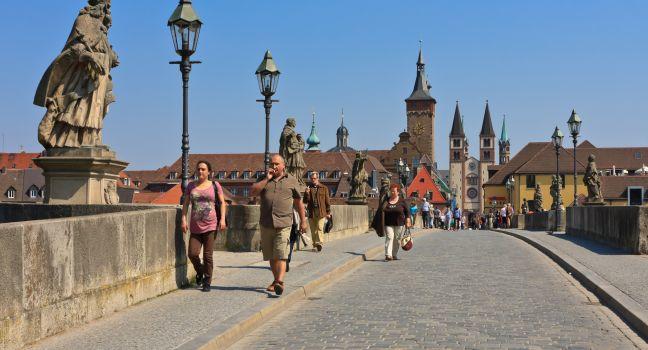
Alte Mainbrücke

WURZBURG, GERMANY - APRIL 20th 2011: People walking over the Alte Mainbrucke in Wurzburg with many nice statues of saints is known as the oldest bridge (built 1473-1543) on a sunny spring day
Xseon / Shutterstock

A stone bridge—Germany's first—built in 1120 once stood on this site, over the Main River, but that ancient structure was replaced beginning in 1476. Twin rows of graceful statues of saints now line the bridge, placed here in 1730, at the height of Würzburg's baroque period. They were largely destroyed in 1945, but have been lovingly restored since then. Note the Patronna Franconiae (commonly known as the Weeping Madonna). There's a beautiful view of the Marienberg Fortress from the bridge.

Augsburg Puppenkiste

This children's puppet theater next to Rotes Tor has been an institution in Germany from its inception in 1948, and it's still loved by kids and parents alike. The museum features puppets in historic or fairy-tale settings. Check the website for puppet-show times (held near-daily, though only in German).

Bavarian Railway Museum

This open-air museum features more than 100 vintage railroad engines and coaches, including steam engines from 1917 to the diesels and electrics of the mid-1900s, behind the old Nordlingen train station. This is a branch of the main Bavarian Railway Museum in Munich.

\n

Brechthaus

This modest artisan's house was the birthplace of the renowned playwright Bertolt Brecht (1898–1956), author of Mother Courage and The Threepenny Opera. It's now a museum documenting his life and work.

Deutsches Weihnachtsmuseum

It's Christmas year-round at the German Christmas Museum, a hit among visitors even in the summer heat, as it provides an in-depth history of the holiday and many of its symbols, including Christmas trees. There's a unique collection of 150 historical Santa Claus figurines, mostly from the 1870s to the 1950s, and other holiday items, including hand-carved and hand-painted figures.

Dom St. Kilian

Construction on Würzburg's Romanesque cathedral, the fourth-largest of its kind in Germany, began in 1045. Centuries of design are contained under one roof; the side wings were designed in a late-Gothic style in the 16th century, followed by extensive Baroque stucco work 200 years later. Most of the building collapsed following the bombing of the city near the end of World War II. Reconstruction, completed in 1967, brought a combination of modern design influences alongside a faithful restoration of the past thousand years of the church's history. Visit the side chapel designed by the baroque architect Balthasar Neumann, and tombs of the bishops of Würzburg, designed by Tilman Riemenschneider. Tours (in German only) are offered daily at 12:30 from mid-April through October.

Domerpfarrg. 10, Würzburg, 97070, Germany
0931-3866–2900
Sight Details
Church free; tours €5

Something incorrect in this review?

Dom St. Maria

Augsburg's imposing cathedral contains the oldest cycle of stained glass in central Europe and important paintings by local resident Hans Holbein the Elder, which adorn the altar. The celebrated stained-glass windows from the 11th century are on the south side of the nave and depict the prophets Jonah, Daniel, Hosea, Moses, and David. Originally built in the 9th century, the cathedral stands out because of its square Gothic towers, products of a 14th-century update. A 10th-century Romanesque crypt also remains from the cathedral's early years. Those celebrated stained-glass windows, from the 11th century, are on the south side of the nave and depict prophets Jonah, Daniel, Hosea, Moses, and David.

\n

A short walk from the cathedral takes you to the quiet courtyards and small raised garden of the former episcopal residence, a series of 18th-century baroque and rococo buildings that now serve as the Swabian regional government offices. To the back of the cathedral at Kornhausg. 3–5 is the Diocese Museum of St. Afra, where the cathedral's treasures are on display.

Dompl., Johannisg. 8, Augsburg, 86152, Germany
0281-3166 0
Sight Details
Cathedral free; museum €4
Museum closed Mon.

Something incorrect in this review?

Festung Marienberg

Visible from just about anywhere in town, this hilltop complex was the original home of the prince-bishops beginning in the 13th century. The oldest buildings, including the Marienkirche (Church of the Virgin Mary) date from around AD 700, although excavations show there was a settlement here in the Iron Age, approximately 1200 BC. In addition to the rough-hewn medieval fortifications, there are a number of Renaissance and baroque apartments. Tours in English, normally held on weekends, meet at the Museum Shop. To reach the Marienberg, make the fairly steep climb on foot through vineyards or take Bus 9, starting at the Residenz, with several stops in the city. It runs about every 40 minutes from April to October. The fortress is undergoing renovations through 2030, with a rolling schedule of closed sections. The fortress also houses the history museum, Museum für Franken, which requires a separate admission ticket.

\n

Residenzplatz 2, Würzburg, 97070, Germany
0931-335–750
Sight Details
Tours €4
Closed Mon. and Oct.–mid-Mar.

Something incorrect in this review?

Fugger und Welser Erlebnismuseum

This museum, housed in a fine restored Renaissance building, is dedicated to two of the city's most influential benefactors, the Fugger and Welser families, whose banking and merchant empire brought Italian art and world artifacts along with wealth to Augsburg in the 15th to 18th centuries. Providing insight into how the families contributed to the city, the museum offers both a glimpse into life in the 15th century through the Industrial Revolution, and a hands-on lesson in Augsburg history.

Ausser Pfaffengässchen 23, Augsburg, 86152, Germany
0821-502–070
Sight Details
€6
Closed weekdays mid-Oct.--Feb. Closed Mon. Mar.--mid-Oct.

Something incorrect in this review?

Jewish Museum of Augsburg and Swabia

Housed in a 1917 synagogue which escaped major damage on Kristallnacht (night of the broken glass) in 1938, it was restored in the 1990s both for religious services and as a cultural center for theater and concert performances; the glorious blue and gold domed ceiling provides excellent acoustics. The museum tells the story of centuries of Jewish life in Augsburg before WWII, including famous residents. Most notable is the Peter Lamfrom family, who was a shirtmaker in this textile town. The family escaped in 1938, winding up in Portland, Oregon, where he named his new clothing company after the local Columbia River. Daughter Gert (Gertrude) and her husband grew the business into the Columbia Sportswear Company.

Halderstr. 6-8, Augsburg, 86150, Germany
0821-3240
Sight Details
€6
Closed weekends and Jewish holidays

Something incorrect in this review?

Leopold Mozart House

Leopold Mozart---father of Wolfgang Amadeus Mozart---was born in this house, and lived here until moving to Salzburg at age 18 to continue his music education. Leopold was already a composer and teacher, which shaped his influence on his even more talented son. The museum is nine rooms on three floors, filled with original letters, compositions, musical instruments and other artifacts of Leopold and his more famous son. One of the rooms is a small Baroque theater.

Maximilian Museum

Augsburg's main museum houses a permanent exhibition of Augsburg arts and crafts, including sculptures and gold and silver handicrafts, in a 16th-century merchant's mansion, focusing on the medieval, renaissance and industrial revolution periods when the city was one of the most wealthy and influential in Bavaria and Europe.

Minster St. Georg

Dinkelsbühl's main church is the standout sight in town. At 235 feet long it's large enough to be a cathedral, and is among the best examples in Bavaria of the late-Gothic style. Note the complex fan vaulting that spreads sinuously across the ceiling. If you can face the climb, head up the 200-foot tower for amazing views over the jumble of rooftops any weekend that the weather allows. The tower was built in the 12th century as a free-standing structure, 200 years before the adjoining church was built. 

Marktpl., Kirchhöflein 6, Dinkelsbühl, 91550, Germany
09851-2245
Sight Details
Free; tower €2
Closed Sat.--Mon.

Something incorrect in this review?

Mittelalteriches Kriminalmuseum

The museum is housed in two historic buildings filled with examples of torture and public humiliation from the Middle Ages to the 19th century, along with legal documents and books pertaining to all kinds of crimes from being drunk in public to misleading advertising to murder. You'll find a wide selection of handcuffs, finger screws, and metal facemasks, which were shaped to \"fit\" the nature of various crimes; for example, one mask has a very long tongue and was meant to be worn by a so-called blabbermouth. Want to know the origin of the modern drunk tank? Find it here: the drunk was imprisoned inside a large, heavy beer or wine barrel and forced to stick his arms out of this literal person-sized tank. On top of the anti-crime accoutrements, you'll also find an entire section on witchcraft. You'll return home with a greater appreciation of modern criminal punishment.

Castle Lane 3--5, Rothenburg ob der Tauber, 91541, Germany
9861--5339
Sight Details
€9.50

Something incorrect in this review?

Museum für Franken

A highlight of any visit to Festung Marienberg is likely to be this remarkable collection of art treasures. Be sure to visit the gallery devoted to Würzburg-born sculptor Tilman Riemenschneider (1460–1531). Also on view are paintings by Tiepolo and Cranach the Elder, as well as porcelain, firearms, antique toys, and ancient Greek and Roman art. Other exhibits showcase enormous old winepresses and narrate the history of Franconian wine making.

Oberer Burgweg, Würzburg, 97082, Germany
0931-205–940
Sight Details
€5
Closed Mon.

Something incorrect in this review?

Museum im Kulturspeicher

Housed in a century-old former granary alongside the Main River, huge galleries are filled with a collection that ranges from historical paintings to contemporary art and sculptures. Portraits from the 1880s flow into a gallery of photos of pre-World War II Würzburg; kinetic sculptures move as you walk past or around them; there's also a collection of neon art.  One mesmerizing multi-dimensional artwork changes shape and perspective as the viewer moves around it.

Oskar-Laredo-Platz 1, Würzburg, 97080, Germany
931-322---250
Sight Details
€10

Something incorrect in this review?

Nördlinger Ries

Nördlingen lies in the center of a huge, basinlike depression, the Ries, that until the beginning of this century was believed to be the remains of an extinct volcano. In 1960 it was proven by two Americans that the 24-km-wide (15-mile-wide) crater was caused by an asteroid at least 1 km (½ mile) in diameter. The compressed rock, or Suevit, formed by the explosive impact of the meteorite was used to construct many of the town's buildings, including St. Georg's tower. If you want, you can bike around the crater.

Perlachturm

This plastered brick bell tower has foundations dating to AD 989, when it was constructed as a watchtower, and is now part of the Church of St. Peter of Perlach, built in the 1600s. Climb the 258 stairs to the top of the 230-foot tower for gorgeous views of Augsburg and the countryside. Just be sure to time it to avoid being beneath the bells when they chime.

Pilgrimage Church of Wies

This church, also known simply as Wieskirche (church in the meadow), has been a UNESCO World Heritage Site since 1983. It is a glorious example of German rococo architecture, in an Alpine meadow just off the Romantic Road. Its yellow-and-white walls and steep red roof are set off by the dark backdrop of the Trauchgauer Mountains. The architect Dominicus Zimmermann, former mayor of Landsberg and creator of much of that town's architecture, built the church in 1745 on the spot where six years earlier a local woman claimed to see tears running down the face of a picture of Christ. Visit it on a bright day if you can, when light streaming through its high windows displays the the glittering gold and white interior. A complex oval plan is animated by brilliantly colored stucco work, statues, and gilt, and a ceiling fresco completes the decoration. Concerts are presented in the church from the end of June through the beginning of August but are not listed on the Wieskirche English-language site; there's a separate German-language site listing these ( www.wieskonzerte.de).

Wies 12, Steingaden, 86989, Germany
8862-932–930
Sight Details
Free (donations accepted)
Closed Sun. until 1 pm and during hrs of worship

Something incorrect in this review?

Rathaus

Built in 1370, the city hall maintains its original, opulently painted Renaissance facade despite its interior having been gutted by World War II bombs. Paintings depicting virtues, commandments, and vices dating back to the 1500s adorn the exterior and an astronomical clock to rival that in Prague was added in 1520. Still in official use, most of the interior is closed to tourists; however, inside hangs a reproduction of the local tailor Ludwig Berblinger's flying machine. In 1811 Berblinger, a local eccentric, cobbled together a pair of wings and made a big splash by trying to fly across the river. He didn't make it, but he grabbed a place in German history books for his efforts.

Marktpl. 1, Ulm, 89073, Germany
0731-1610
Sight Details
Closed Sat. and Sun.

Something incorrect in this review?

Rathaus

The heart of the city is the city hall, where a car-free square has become a popular gathering point with a great view. Half of the town hall is Gothic, begun in 1240; the other half is neoclassical, started in 1572, and renovated after its original facade was destroyed by a fire 500 years ago. You can climb the 220 stairs of the tower to get a good view of the Franken countryside.

Residenzschloss Mergentheim

The Teutonic Knights' former castle, at the eastern end of the town, had its peak from 1527 to 1809, when the highly influential and resident Deutschmeister received guests, including the Kaiser, here. The powerful Hohenlohe family joined the Teutonic Order, founded in 1190, and gifted them this property in 1219. Although it lost its luster after the Napoleonic wars, the medieval castle has remarkable architectural features: originally, a moated castle, the building was expanded beginning in 1568 and converted to a palace. Baroque features, including an intricately carved wooden staircase, were added in the late 18th century. Post–World War II restoration work has converted the buildings into a museum that follows the history of the Teutonic Order. The castle also hosts classical concerts, lectures, and events for families and children.

Schloss 16, Bad Mergentheim, 97980, Germany
07931-52212
Sight Details
Gardens free, castle €7, Guided tour €10
Closed Mon. and Tues. Apr.--Oct.; closed Sun.--Wed. Nov.--Mar.

Something incorrect in this review?

Rothenberg Museum

Formerly known as the Reichsstadtmuseum (Imperial Town Museum), it is housed in a former Dominican convent dating back to the 13th century, including a cloister where one of the artifacts is the great tankard, or Pokal, of the Meistertrunk, which legend says saved the town in the Thirty Years' War in the 1600s when the conquering general could not empty it on a bet. The town purchased the property in 1933 and converted it into a museum. Exhibits include hunting weapons used by Marie Antoinette, a hunting rifle belonging to Frederick the Great of Prussia, musical instruments and original Biedermeier room reconstructed from a Rothenburg townhouse from the early 1800s. A large gallery is devoted to Jewish life in Rothenberg and their contributions to the city and region from the 13th century to the Third Reich.

Klosterhof 5, Rothenburg ob der Tauber, 91541, Germany
09861-939–043
Sight Details
€6
Closed Sun.

Something incorrect in this review?