48 Best Sights in The Pfalz and Rhine Terrace, Germany

Background Illustration for Sights

We've compiled the best of the best in The Pfalz and Rhine Terrace - browse our top choices for the top things to see or do during your stay.

Burg Trifels

Fodor's Choice
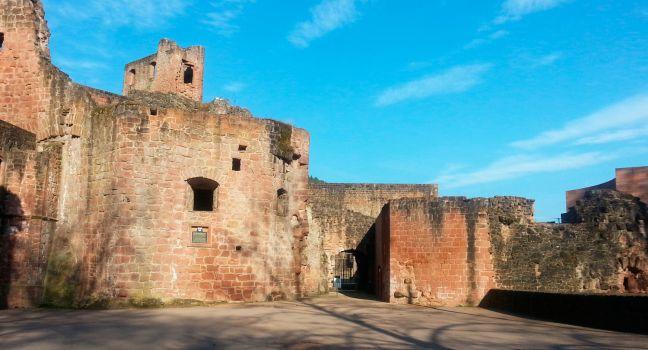
The fortress Trifels in Germany on a sunny day.
(c) Fuchsphotography | Dreamstime.com

Burg Trifels is on the highest of three sandstone bluffs overlooking Annweiler, 15 km (9 miles) northwest of Gleiszellen. Celts, Romans, and Salians all had settlements on this site, but it was under the Hohenstaufen emperors (12th and 13th centuries) that Trifels was built on a grand scale. It housed the crown jewels from 1125 to 1274 (replicas are on display today). It was also an imperial prison, perhaps where Richard the Lion-Hearted was held captive in 1193–94. Although it was never conquered, the fortress was severely damaged by lightning in 1602. Reconstruction began in 1938, shaped by visions of grandeur to create a national shrine to the imperial past. The monumental proportions of some parts of today's castle bear no resemblance to those of the original Romanesque structure. The imperial hall is a grand setting for summer concerts. On foot: From Annweiler, follow the local signs for Burg Trifels. The hike is about an hour. By car: Follow the A65 in the direction of Karl-Ludwigshafen, take exit Landau-Süd, then B10 to Annweiler west. From there follow the local signs. Parking is at the foot of the fortress, a 20-minute walk to the top.
Burg Trifels, Annweiler, 76855, Germany
06346-8470
Sight Details
€4.50
Closed Dec. and Jan. Closed weekdays Feb.–mid-Mar. and Nov. Closed Mon. mid-Mar.–Oct.

Something incorrect in this review?

Schloss Villa Ludwigshöhe

Fodor's Choice
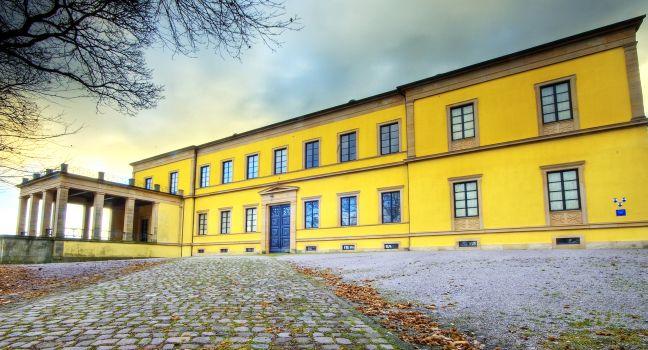
Schloss Villa Ludwigshöhe, The Pfalz and Rhine Terrace, Germany, Europe.
Wolfgang Staudt, via Wikimedia Commons [CC BY 2.0]

Bavaria's King Ludwig I's Italian-style villa sits on the slopes overlooking Edenkoben and Rhodt unter Rietburg. The house is now used as a space for art exhibitions and musical events: the former dining room is used for classical concerts; the cellars house exhibitions of 20th-century ceramics; and an extensive collection of paintings and prints by the leading German impressionist Max Slevogt (1868–1932) is also on display. Hourly tours are included in the admission fee.

\n

Schloss Villa Ludwigshöhe is reachable by car, bus, or foot; the No. 506 Palatina bus goes directly from Edenkoben on Sunday and holidays. If you opt to walk, the Weinlehrpfad (educational trailpath) takes about 45 minutes. Historical winepresses and vintners' tools are displayed at intervals along the path, which starts at the corner of Landauer Strasse and Villa Strasse in Edenkoben. Due to major renovations the house is closed to the public until 2025.

Villastr. 64, Edenkoben, 67480, Germany
06323-93016
Sight Details
€6
Closed Dec.–mid-Mar. Closed Mon. mid-Mar.–Oct. Closed weekdays in Nov.

Something incorrect in this review?

Dom

Fodor's Choice

This cathedral's interior is a virtual sculpture gallery of elaborate monuments and tombstones of archbishops, bishops, and canons, many of which are significant artworks in their own right. Emperor Otto II began building the oldest of the Rhineland's trio of grand Romanesque cathedrals in 975, the year in which he named Willigis archbishop and chancellor of the empire. Henry II, the last Saxon emperor of the Holy Roman Empire, was crowned here in 1002, as was his successor, Konrad II, the first Salian emperor, in 1024. In 1009, on the very day of its consecration, the cathedral burned to the ground. It was the first of seven fires the Dom has endured. Today's cathedral dates mostly from the 11th to 13th century. During the Gothic period, remodeling diluted the Romanesque identity of the original; an imposing baroque spire was added in the 18th century. Nevertheless, the building remains essentially Romanesque, and its floor plan demonstrates a clear link to the cathedrals in Speyer and Worms. Individual and group tours can be arranged through the Tourist Service Center.

Domstr. 3, Mainz, 55116, Germany
06131-2530
Sight Details
Free (donations requested)

Something incorrect in this review?

Recommended Fodor's Video

Jewish Quarter

Fodor's Choice

Speyer was an important medieval Jewish cultural center. Behind the Palatinate Historical Museum is the Jewish quarter, a UNESCO World Heritage site since 2021, where you'll find synagogue remains from 1104; Germany's oldest (circa 1126) ritual baths, the 33-foot-deep Mikwe; and the Museum SchPIRA, which displays objects such as gravestones and coins from the Middle Ages.

Kaiserdom

Fodor's Choice

The Kaiserdom, one of the finest Romanesque cathedrals in the world and a UNESCO World Heritage site, conveys the pomp and majesty of the early Holy Roman emperors. It was built between 1030 and 1061 by the emperors Konrad II, Henry III, and Henry IV. The last replaced the flat ceiling with groin vaults in the late 11th century, an innovative feat in its day. A restoration program in the 1950s returned the building to almost exactly its original condition. The four towers symbolize the four seasons and the idea that the power of the empire extends in all four directions. Look up as you enter the nearly 100-foot-high portal; it's richly carved with mythical creatures. In contrast to Gothic cathedrals, whose walls are supported externally by flying buttresses, allowing for a minimum of masonry and a maximum of light, at Speyer the columns supporting the roof are massive. You can climb the 304 steps of the southwest tower (access Apr.–Oct.) to reach the viewing platform, from where there is a splendid panorama. Another highlight is the Krypta which lies beneath the chancel. It's the largest crypt in Germany and is strikingly beautiful in its simplicity. Four emperors, four kings, and three empresses are buried here.

Edith-Stein-Pl. 4, Speyer, 67346, Germany
06232-102–120
Sight Details
Crypt €4; audio guide €9; tower €6.50; combined ticket for access to crypt, tower and audio guide €12

Something incorrect in this review?

Oppenheimer Kellerlabyrinth

Fodor's Choice
Beneath Oppenheim's surface, there are five layers of cellars, tunnels, and stairways. Thought to have been built in the 14th century, their purpose remains unknown. Of the 40 km (24 miles) of complex underground passageways, today ¾ km (½ mile) is open to the public; contact the Oppenheim tourist office to arrange a tour.

St. Stephanskirche

Fodor's Choice

It's just a short walk up Gaustrasse from Schillerplatz to the church, which affords a hilltop view of the city. Nearly 200,000 people make the trip each year to see the nine magnificent blue stained-glass windows designed by the Russian-born artist Marc Chagall. This is the only German church for which Chagall designed windows.

Kleine Weissg. 12, Mainz, 55116, Germany
06131-231–640

Something incorrect in this review?

Stiftung Kunsthaus Heylshof in Worms

Fodor's Choice

Located in the Heylshofgarten, this is one of the leading art museums of the region. It has an exquisite collection of German, Dutch, and French paintings as well as stained glass, glassware, porcelain, and ceramics dating from the 15th to the 19th century.

Stephansg. 9, Worms, 67547, Germany
06241-22000
Sight Details
€5
Closed Jan. and Feb. Closed Mon. Mar.–Dec.

Something incorrect in this review?

Technik Museum

Fodor's Choice
Built on the site of a former aircraft works just outside the city center (about a 10-minute walk from the Kaiserdom), the Technik Museum houses 300 exhibits including space suits, a landing capsule, and an original Russian BURAN space shuttle as part of Europe's largest aerospace exhibition. In addition, there are walk-in exhibits including a Boeing 747 and a 46-meter-long U9 submarine; and there's also a collection of vintage cars, ships, locomotives, and motorcycles. While you're here, don't miss one of the world's biggest collections of mechanical musical instruments at the Wilhelmsbau Museum (entry included in ticket price) or a movie on the curved screen of the IMAX DOME theater. Allow at least three hours to visit this extensive museum, which covers several large buildings.

Wormser Dom St. Peter

Fodor's Choice

In contrast to Speyer's Romanesque cathedral, the Worms Cathedral of St. Peter is much more Gothic. In part this is simply a matter of chronology, since Speyer Cathedral was finished in 1061, nearly 70 years before the one in Worms was even begun—and long before the lighter, more vertical lines of the Gothic style evolved. In addition, Speyer Cathedral was left largely untouched, but the Worms Cathedral underwent frequent remodeling. The Gothic influence here can be seen both inside and out, from the elaborate tympanum with biblical scenes over the southern portal (today's entrance) to the great rose window in the west choir and the five sculptures in the north aisle recounting the life of Christ. The cathedral was gutted by fire in 1689 in the War of the Palatinate Succession. For this reason, many of the furnishings are baroque, including the magnificent gilt high altar from 1742, designed by the master architect Balthasar Neumann (1687–1753). The choir stalls are no less decorative. They were built between 1755 and 1759 in rococo style. Walk around the building to see the artistic detail of the exterior.

Katharinenkirche

Oppenheim with Katharinenkirche in the Mainz-Bingen district of Rhineland-Palatinate in Germany.
(c) Prillfoto | Dreamstime.com

On the way to Oppenheim, the vine-covered hills parallel to the Rhine gradually steepen. Then, unexpectedly, the spires of Oppenheim's Gothic St. Catherine's Church come into view. The contrast of its pink sandstone facade against a bright blue sky is striking. Built between 1225 and 1439, it's the most important Gothic church between Strasbourg and Cologne. The interior affords a rare opportunity to admire magnificent original 14th-century stained-glass windows including two rose windows, the Lily Window and the Oppenheim Rose. The church houses masterfully carved tombstones, and the chapel behind it has a Beinhaus (charnel house) containing the bones of 20,000 citizens and soldiers from the 15th to 18th century. A viewing platform in the crossing tower is accessible, as part of a guided tour, when the shop is open.

Katharinenstr. 1, Oppenheim, 55276, Germany
06133-2381
Sight Details
Guided tours 5€ (includes climbing the tower)
Shop closed Mon. Easter–Oct.

Something incorrect in this review?

Klosterruine Limburg

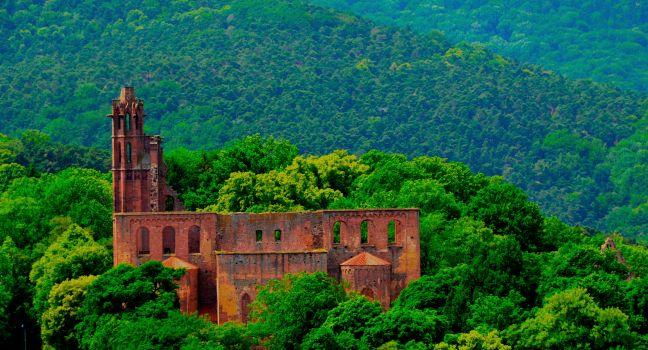
The ruined abbey of Limburg, near Bad Dürkheim, in the Palatinate Forest (Germany).
(c) Mpearzzz | Dreamstime.com

Overlooking the suburb of Grethen are the ruins of Kloster Limburg. Emperor Konrad II laid the cornerstone in 1030, supposedly on the same day that he laid the cornerstone of the Kaiserdom in Speyer. The monastery was never completely rebuilt after a fire in 1504, but it's a majestic backdrop for open-air performances in the summer months.

Luitpoldweg 1, Bad Dürkheim, 67098, Germany

Something incorrect in this review?

Schloss- und Festungsruine Hardenburg

Kaiserslauterer Str., Bad Dürkheim, 67098, Germany
06322-7530
Sight Details
€4.50
Closed Dec.--Jan. Closed weekdays Feb.–mid-Mar. and Nov. Closed Mon.--Wed. mid-Mar.–Oct.

Something incorrect in this review?

Alter Kastanienhof

For a delicious rendition of the regional specialty Saumagen (meat, herbs and potatoes cooked in a sow's stomach), stop here. The restaurant has a charming interior courtyard and sunny south-facing terrace, and the staff make knowledgeable recommendations from the small but excellent list of local wines.

Theresienstr. 79, Rhodt unter Rietburg, 76835, Germany
06323-988--1300
Sight Details
Wednesday and Thursday

Something incorrect in this review?

Church of St. Ulrich

A Gothic gem inside and out, this is the only 15th-century church in the Palatinate region whose walls have been entirely preserved, though the interior has changed according to the style of the times. Despite having been looted during the French Revolution and turned first into a wine warehouse and later a military prison, the basic exterior structure of the church hasn't been altered. The interior includes stained glass that dates from the Middle Ages and wooden figures from around 1500.

Marktpl., Deidesheim, 67146, Germany

Something incorrect in this review?

Consulat des Weines

Oenophiles won't want to miss this Vinothek in the charming village of St. Martin. It offers more than 80 varieties of wine from its vineyards in St. Martin and nearby Edenkoben. The sheer variety makes it easy to overindulge—good thing there's a hotel and restaurant on-site. Centrally located on Maikammerer Strasse near the St. Martiner Castell hotel.

Deutsches Weinbaumuseum

Oppenheim and its neighbors to the north, Nierstein and Nackenheim, are home to some of Rheinhessen's best-known vineyards. The Deutsches Weinbaumuseum has wine-related artifacts that chronicle the region's 2,000-year-old winemaking tradition, not to mention the world's largest collection of mousetraps and more than 2,000 corkscrews.

Wormser Str. 49, Oppenheim, 55276, Germany
06133-2544
Sight Details
€5
Closed Nov.–Mar. Closed Mon. Apr.–Oct.

Something incorrect in this review?

Dom und Diözesanmuseum

From the Middle Ages until secularization in the early 19th century, the archbishops of Mainz, who numbered among the imperial electors, were extremely influential politicians and property owners. The wealth of religious art treasures they left behind can be viewed in the cathedral cloisters.

Domstr. 3, Mainz, 55116, Germany
06131-253–344
Sight Details
€5
Closed Mon.

Something incorrect in this review?

Eisenbahn Museum

Thirty historic train engines and railway cars are on display at the Eisenbahn Museum behind the main train station. Take a ride through the Palatinate Forest on one of the museum's historic steam trains, the Kuckucksbähnel, which departs from Track 5 around 10:45 am on intermittent days between May and mid-October, and in December (check the website for the latest schedule). There are special seasonal trips during wine season and during the run-up to Christmas. It takes a little more than an hour to cover the 13-km (8-mile) stretch from Neustadt to Elmstein.

Neustadt Hauptbahnhof, Neustadt, 67403, Germany
06321-30390
Sight Details
Museum €5; Kuckucksbähnel €18
Closed Mon. and Tues. and late-Dec.–Feb.

Something incorrect in this review?

Elwetrische-Brunnen

While in the Pfalz, keep your eyes peeled for the elusive Elwetritschen—mythical, birdlike creatures rumored to roam the forest and vineyards at night. Hunting the creatures is something of a local prank. Sculptor Gernot Rumpf has immortalized the Elwetrischen in a fountain (Brunnen) on Marstallplatz. Near the market square, search for the one that "escaped" from its misty home.

Marstallpl., Neustadt, 67433, Germany

Something incorrect in this review?

Gutenberg Museum

Opposite the east end of the cathedral (closest to the Rhine) stands this fascinating museum, which is devoted to the history of writing, printing, and books. Exhibits include historical printing presses, incunabula (books printed in Europe before 1501), and medieval manuscripts with illuminated letters, as well as two precious 42-line Gutenberg bibles printed circa 1455. A replica workshop demonstrates how Gutenberg implemented his invention of movable type.

Hambacher Schloss

On the Wine Road, it's a brief drive to the Neustadt suburb of Hambach. The sturdy block of Hambacher Schloss is considered the cradle of German democracy. It was here, on May 27, 1832, that 30,000 patriots demonstrated for German unity, raising the German colors for the first time. Inside there are exhibits and interactive displays about the uprising and the history of the castle. The French destroyed the 11th-century imperial fortress in 1688. Reconstruction finally began after World War II, in neo-Gothic style, and the castle is now an impressive setting for theater and concerts. On a clear day, you can see the spire of Strasbourg Cathedral and the northern fringe of the Black Forest from the terrace restaurant.

Hambacher Schloss, Neustadt, 67434, Germany
06321-926–290
Sight Details
€6.50; tours (in German) €10
Closed Mon.

Something incorrect in this review?

Heidenmauer

One kilometer (½ mile) northwest of town lies the Heidenmauer, the remains of an ancient Celtic ring wall more than 2 km (1 mile) in circumference and up to 20 feet thick in parts. The remnants are on the Kastanienberg, above the quarry. Nearby are the rock drawings at Kriemhildenstuhl, an old Roman quarry where the legionnaires of Mainz excavated sandstone.

Bad Dürkheim, 67098, Germany

Something incorrect in this review?

Heylshofgarten

An imperial palace once stood in this park just north of the cathedral. It was the site of the fateful 1521 meeting between Luther and Emperor Charles V that ultimately led to the Reformation. Luther refused to recant his theses demanding Church reforms and went into exile in Eisenach, where he translated the New Testament in 1521 and 1522.

Stephansg. 9, Worms, 67547, Germany

Something incorrect in this review?

Historisches Museum der Pfalz

Opposite the cathedral, the museum houses the Domschatz (Cathedral Treasury). Other collections chronicle the art and cultural history of Speyer and the Pfalz from the Stone Age to modern times. Don't miss the Golden Hat of Schifferstadt, a Bronze Age headdress used in religious ceremonies dating back to approximately 1300 BC. The Wine Museum houses the world's oldest bottle of wine, which is still liquid and dates to circa AD 300. The giant 35-foot-long wooden winepress from 1727 is also worth a look. The museum is currently undegoing renovation, and some exhibition rooms may be closed to the public.

Dompl. 4, Speyer, 67346, Germany
06232-620-222
Sight Details
From €9
Closed Mon.

Something incorrect in this review?

Holiday Park

The Holiday Park, in Hassloch, 10 km (6 miles) east of Neustadt, is one of Europe's largest amusement parks. The admission fee covers all attractions, shows, special events, and the children's world. The free-fall tower is a long-standing favorite, and Expedition GeForce is one of the largest roller coasters in Europe, with a steep drop of 82 degrees. For a great panoramic view of the surroundings, whirl through the air on Lighthouse-Tower, Germany's tallest carousel (265 feet). On Saturday in summer, the "Party Summer Nights" spectacular features live music and an outdoor laser light show and fireworks. Hours vary, so be sure to check the web site if you want to go.

Holiday Parkstr. 1–5, Neustadt, 67454, Germany
06324-59930
Sight Details
€49.50
Closed early Nov.–late Mar.

Something incorrect in this review?

Jüdischen Museum Worms Raschihaus

This first synagogue in Worms was built in 1034, rebuilt in 1175, and expanded in 1213 with a synagogue for women. Destroyed in 1938, it was rebuilt in 1961 using as much of the original masonry as had survived. It is located in the Jewish quarter, which is along the town wall between Martinspforte and Friesenspitze and between Judengasse and Hintere Judengasse. Next door to the synagogue is a former study hall, dance hall, and Jewish home for the elderly, which now houses the city archives and the Jewish Museum. The well-written, illustrated booklet Jewish Worms chronicles a millennium of Jewish history in Worms.

Synagogenpl., Worms, 67547, Germany
06241-853–4707-Jewish Museum
Sight Details
Museum €2.50
Museum closed Mon.

Something incorrect in this review?

Jüdischer Friedhof

This is the oldest Jewish cemetery in Europe and also one of the most atmospheric and picturesque. The oldest of some 2,000 tombstones date from 1076. Entry is via the gate on Willy-Brandt-Ring.  Male visitors must cover their heads to enter the cemetery.

Willy-Brandt-Ring 21, Worms, 67547, Germany
Sight Details
Closed Sat. and Jewish holidays

Something incorrect in this review?

Kallstadt

From Freinsheim, it's a gentle if slightly hilly 3-km (1.8-mile) walk (or cycle) through the vineyards to Kallstadt, a village known outside of Germany for two very famous exports to the United States: food entrepreneur Henry J. Heinz and the family Drumpf (now known as Trump). In the Pfalz, however, Kallstadt is best known for Saumagen, both the local dish (stuffed pig's stomach) and the vineyard of the same name. Enjoy a glass at Weinhaus Henninger along the very cute Weinstrasse (closed Monday), and take a short stroll around the tiny village before returning to Freinsheim.

Kallstadt, Germany

Something incorrect in this review?

Katholische Pfarrkirche St. Martin

Perched dramatically on the northern edge of St. Martin against a backdrop of vineyards, this late-Gothic church was thought to have been built around 1200 (the interior was renovated in the mid-1980s). Renaissance tombstones and a Madonna sculpture carved from a single piece of oak are among the intriguing artworks found inside.