



A darkened footstep on the Munich Cathedral’s floor just might be that of the Devil itself.
The distinctive towers of the Munich Cathedral compete with the clouds, shaping the city skyline. Inside, the image is just as powerful; the Cathedral seems to stand in a different era entirely, with its late-Gothic architecture, stained-glass window designs, and even a 500-year-old automaton clock with quaint figures, planets, and signs of the zodiac that move each day at midday. It is a place to admire and a place for tranquility. That is, of course, except for the time the Devil is said to have stepped in.
Tricking the Devil
City legend states that a footprint, clearly seen amongst the tiles of the Cathedral, were made by the Devil himself. There are many versions of this tale, but the most popular says that when construction of the church began in 1468, the Devil was rather unhappy about it and set his sights on stopping the church’s success as a place of worship. The Devil enticed the architect, Jörg von Halsbach, into a deal, promising to help build the building so long as the church had no windows, which would mean it was celebrating the dark rather than the light, or so the story goes.
The church was duly constructed (rather quickly in only 20 years, perhaps due to the Devil’s help) but the architect was a wily one. Due to a high altar at the time, windows that were installed towards the back of the Church were hidden from view at first. This visual trickery led to a few different endings depending on which tale you’re listening to. One version goes that the Devil came to survey his handiwork only to discover he had been cheated out of the deal, stamping his foot in rage. Visitors today can still see this Teufelstritt or “Devil’s footprint,” the black mark the Devil stamped on the floor a few feet inside the cathedral, where he realized he had been duped.
View this post on Instagram
Another version of the story goes that the Devil stamped his foot with pleasure at finding the Cathedral had been made with no windows, and according to Munich Cathedral’s Mysterious Places guide, once he discovered he had been tricked, he used his resulting rage to turn himself into an icy wind that “still often blows around the cathedral today.”
Recommended Fodor’s Video
If you visit the Cathedral in Munich today, you’ll more than likely experience some of these extraordinary winds, as the Cathedral’s tall towers and location in the city center are ripe for wind tunnels. If you believe these legends, perhaps this is the Devil trying to find a way to blow the cathedral over, to hide his embarrassment at his folly.
So which tale to believe? Jake Slisz, owner and tour guide of Heart of Munich Tours, explains that the beauty of folklore is that it is less about one specific story and more about the act of sharing them with one another.
“Not understanding the exact origins of folklore makes sharing these stories even more fun,” explains Slisz. “Human civilization is built on stories. Although not [always] completely true, they do give us an insight into the past.”
He goes on to theorize that the footprint may belong to the architect who died shortly after the Cathedral was built, or, if it was the Devil, he must have been wearing some nice shoes, since it looks mostly like a human footprint.

Where Else Did the Devil Step?
Scotti Stephens, a tour guide and owner of BayernTrips, explains that Bavaria, and Munich in particular, has even more history with the Devil than you may expect.
“Just north of Munich in the UNESCO World Heritage city of Regensburg, the Devil was also involved in building the massive Stone Bridge [Steinerne Brücke] across the northernmost point of the Danube River,” explains Stephens. “Being a prideful tradesman, the builder of the bridge and the builder of the cathedral bet on who would finish their project first. The bridge builder quickly realized that the cathedral was rising much faster than his bridge. Frustrated by the difficult currents of the Danube, he called upon the Devil for help. The Devil agreed to assist him and speed up the construction, but demanded the souls of the first three living beings to cross the completed bridge as payment.”
Stephens goes on to explain that the bridge was then completed in record time–sound familiar?–but that once a huge ceremony was created to celebrate the completion, the builder realized the first men to cross the bridge would be condemned to hell forever, so he quickly drove a rooster, a hen, and a dog across the bridge, cheating the Devil of his promised souls.
What were the consequences? Similar to the Munich Cathedral, Stephens explains how the Devil tried to destroy his creation in a fit of rage.
“He flew underneath the bridge and tried to bust it apart and dislodge it from the riverbed. However, the bridge was already so massive and solid that he couldn’t break it,” says Stephens. “All he managed was to put a kink in the bridge. To this day, the Stone Bridge has a distinct “hump” in the middle because the Devil pushed up on it so hard that he bent the stone forever.”
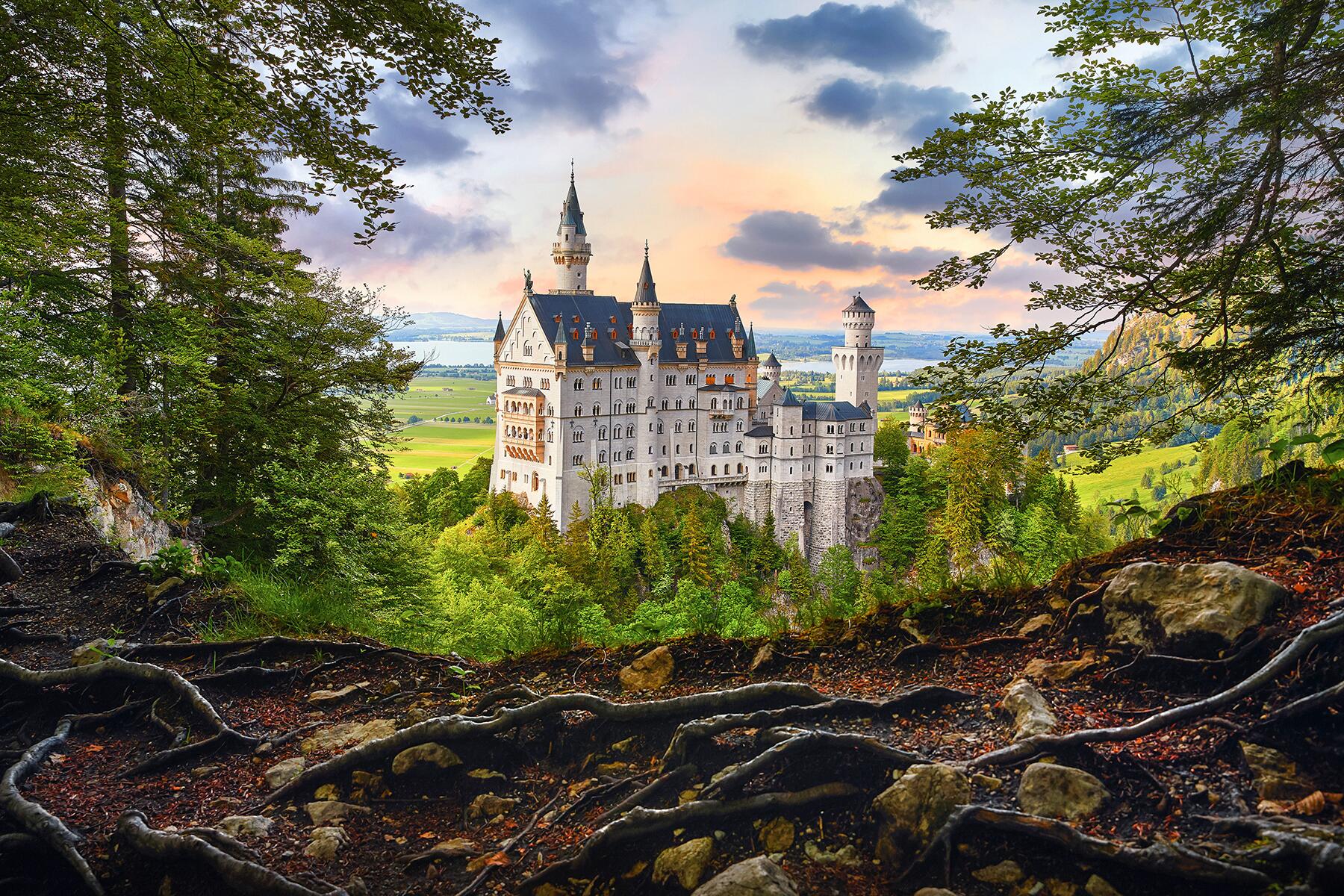
While the Bavarian culture and landscape—dotted with half-timber houses, castles such as the Neuschwanstein Castle surrounded by the Alps, and tales of collective guilt, shipwrecks, and ancient contracts—is ripe for inspiring the imagination for these folktales, the “physical” traces of the Devil are not just limited to Bavaria.
European folklore is understandably fascinated with tales of the Devil, demons, and darkness, and many stories come with a physical component. Other “Devil’s footprints” exist in South Devon, England, if you’re so inclined to hear a tale of mysterious hoof prints, while elsewhere in Germany, the Gothic-style St Mary’s Church in Lübeck has physical “evidence” of the Devil in a slab of stone next to the church, after a similar altercation when the Devil offered to lend a helping hand in construction.
Whether or not you believe in the footprint’s mysterious origins, the Munich Cathedral tale is undeniably a compelling one – and fits more widely into German folklore’s ability to not shy away from the darker aspects of magic that attracts so many tourists today.