352 Best Sights in Belgium

Background Illustration for Sights

We've compiled the best of the best in Belgium - browse our top choices for the top things to see or do during your stay.

Openluchtmuseum Middelheim

Fodor's Choice

The Middelheim Open Air Sculpture Museum is a selfie wonderland, albeit of the more classical variety, with some 200 sculptures from artists including Jean Arp, Henry Moore, Rodin, and Ossip Zadkine spread across an attractive park and castle complex. Look up into the trees for bronze figures by the Spanish artist Juan Muňoz and in the Braem pavilion for smaller, more fragile sculptures.

Middelheimlaan 61, 2020, Unknown
03-288–3360
Sight Details
Free, except for special exhibitions
Oct.--Mar., 10–5; Apr., Sept., 10--7; May, Aug., 10--8; June and July, 10--9

Something incorrect in this review?

Palais Royal

Upper Town Fodor's Choice
The Belgium Royal Family vacations in the Chateau de Laeken, so it's become a tradition during the summer months (late July--early September) to open up the official residence, otherwise known as the Palais Royal, to visitors. The palace was erected on the site of the former Palace of the Dukes of Brabant (aka Coudenburg), which was burned down in 1731, and the underground excavation of which you can still tour. The existing building was begun in 1820, but redesigned in the early 19th century by the extravagant Leopold II to fit a more glamorous Louis XII style. Today, it holds a remarkable collection of tapestries, art, and antiques from all over the world; pay special attention to the Congo-inspired mirror room, the ceiling of which is encrusted with more than a million jewel beetle carapaces. And best of all, it's free.

Palais Royale

Upper Town Fodor's Choice

The Belgium Royal Family lives in the Château de Laeken these days, and it's become a tradition to open up their inner-city residence to visitors during summer. The building was erected on the site of the former Palace of the Dukes of Brabant (aka Coudenburg), which burned down in 1731—you can still tour its underground excavation next door. Work on the existing palace was begun in 1820 but redesigned in a more garish neoclassical style in the early 19th century by Leopold II. The Mirror Room, which was commissioned by the king to evoke the Congo, is a chilling reminder of where the funds came from to furnish his largesse. The room's ceiling was later covered in the pearlescent carapaces of 1.5 million jewel beetles as part of a remarkable artwork created in 2002. Today, the palace holds a remarkable collection of tapestries, art, and antiques from all over the world.

Recommended Fodor's Video

Parc du Cinquantenaire

Cinquantenaire Fodor's Choice

The most picturesque park in the city is a joy in summer when its shaded grassy lawns and paths fill with joggers, picnickers, dance troupes, and even climbers practicing on its walls. It is home to a number of museums as well as the capital's take on the Arc de Triomphe: the triumphalist Arcade du Cinquantenaire, which was commissioned by King Leopold II to mark Belgium's 50th anniversary in 1880—it was only finished in 1905, just in time for the 75th celebrations. Pay special attention to the park's northwest corner, where you'll find the Great Mosque. This was originally built as an Arabic-style folly for a national exhibition in 1880 but was gifted to King Faisal ibn Abd al-Aziz of Saudi Arabia to use as a place of worship in 1967, and has remained a mosque ever since. Near to it you'll also find the Pavillon des Passions Humaines, a small temple that was one of Victor Horta's earlier designs in the city. It houses a remarkable public sculpture by Jef Lambeauf, depicting a mass of writhing naked bodies, which caused a public outcry when it was unveiled in 1898. It has been sealed up ever since, but you can now join guided group tours (in English and French; €12) on every last Sunday of the month to see it; book at the Musée Art & Histoire. Parts of the park may be inaccessible as extensive renovations continue in the lead-up to Belgium's 200th anniversary celebrations in 2030.

Plantentuin Meise

Fodor's Choice

Belgium's national botanic garden is a sprawling site that takes up most of the southern fringes of Meise. It wraps the old estate of Kasteel van Bouchou, which, despite being utterly destroyed during the French Revolution, was later rebuilt and now houses a museum all about the grounds. Beyond its moat lies an English-style garden filled with exotic plants from around the world, but the pièce de résistance here is the Plant Palace, the largest greenhouse in Belgium and one of the biggest in Europe. It is a vast biome of 35 hothouses filled with huge water-lily pads and tropical wonders. Other sights, such as the much smaller, mid-19th-century Balat Greenhouse, which was originally intended for a zoo, are just as fascinating for those interested. In addition, you'll find medieval, medicinal, and rose gardens, rhododendron woods, trails, art, an apiary, and some 18,000 plant species. Visit any time, though spring is naturally the most colorful season.

Plantin-Moretus Museum/Prentenkabinet

Oude Stad Fodor's Choice

For three centuries, beginning in 1555, this UNESCO-listed building was the home and printing plant of an extraordinary publishing dynasty; the family printed innumerable bibles, breviaries, and missals. Christophe Plantin's greatest technical achievement was the Biblia Regia (in Room 16), eight large volumes containing the Bible in Latin, Greek, Hebrew, Syriac, and Aramaic, complete with notes, glossaries, and grammars.

Reien

Fodor's Choice

Bruges's narrow and meandering canals, or reien, with their old humpback stone bridges, give the city its character, opening up perspective and imposing their calm. The view from the Meebrug is especially picturesque. Farther along the Groenerei are the Godshuizen De Pelikaan, almshouses dating from the early 18th century. There are several such charitable buildings in the city, tiny houses built by the guilds for the poor, some still serving their original purpose. Steenhouwersdijk overlooks the brick rear gables that were part of the original county hall. The Vismarkt (Fish Market) has 19th-century buildings designed in classical style; fresh seafood from Zeebrugge is sold Tuesday–Saturday. Just beyond is the little Huidenvettersplein (Tanners’ Square), with its 17th-century guild house. Next to it, from the Rozenhoedkaai canal, the view of the heart of the city includes the pinnacles of the town hall, basilica, and Belfry—the essence of Bruges.

For a swan's-eye view of the city, 30-minute canal cruises costing €12 are offered by five different companies. All five ply the same route and depart from jetties along the Dijver, between the Gruuthusemuseum and Vismarkt.

Royal Museum of Fine Arts (KMSKA)

South of the Center Fodor's Choice

Reopened in 2022 after more than a decade of extensive restoration work, the Royal Museum of Fine Arts (Koninklijk Museum voor Schone Kunsten) collection is studded with masterworks from Bruegel to Ensor, and is a must for any student of Flemish art. Paintings recovered from the French after the fall of Napoléon form the nucleus of a collection of 2,500 artworks. There are rooms devoted to Peter Paul Rubens and to Anthony van Dyck, and others focused almost entirely on Jacob Jordaens and Bruegel. The collection of Flemish Primitives includes works by Van Eyck, Memling, Roger van der Weyden, Joachim Patinir, and Quinten Metsys. On the first floor, there’s a representative survey of Belgian art of the past 150 years—Emile Claus, Rik Wouters, Permeke, Magritte, Delvaux, and especially James Ensor. Be sure to pick up a museum map as you enter, as the revamped layout is almost a building-within-a-building design---it's easy to lose your bearings inside the complex labyrinth of galleries.

Leopold de Waelplaats 2, Antwerp, 2000, Belgium
03-224–7300
Sight Details
€20

Something incorrect in this review?

Rubenshuis

Meir Fodor's Choice

A fabulous picture of Rubens as painter and patrician is presented here at his own house, where the elaborate portico and temple, designed by Rubens in Italian Baroque style, were the only things still standing three centuries after the house was built. Most of what you can see today is a reconstruction (completed in 1946) from the master's own design. It represents Rubens at the pinnacle of his fame, when he was appointed court painter to Archduke Albrecht and, with his wife, was sent on a diplomatic mission to Madrid, where he also painted some 40 portraits. He conducted peace negotiations in London on behalf of Philip IV of Spain, and while in London he painted the ceiling of the Whitehall Banqueting Hall and was knighted by Charles I of Great Britain.

Rubens completed about 2,500 paintings, nearly all characterized by the energy and exuberance that were his hallmark. The interior of the house is closed to visitors until at least 2030, while it undergoes essential renovations. In the meantime, you can explore a re-creation of Rubens's original courtyard garden, now containing 17,500 plants. It was redesigned in 2024, with the help of Antwerp fashion design legend Dries Van Noten, to ensure a riot of color throughout the year. The garden is accessed via a new visitor center, which also opened in 2024. Located in the basement here is the Rubens Experience, a 30-minute audiovisual journey that immerses you in the life and times of the great artist. Note that these shows alternate between English and Dutch—English presentations begin at half past each hour.

Hopland 13, Antwerp, 2000, Belgium
03-201–1555
Sight Details
€12 garden and Rubens Experience; €8 garden only
Closed Wed.

Something incorrect in this review?

Sint-Alexius Begijnhof and Museum

Fodor's Choice

The begijnhofs (“beguinages” in French) were home to religious-minded women who wanted a life of devotion to God without having to take the Orders (of fidelity and poverty) that nuns were beholden to. This UNESCO-listed begijnhof was originally formed in 1288, and in its 17th-century heyday was home to some 200 beguines. The last beguine here died in 1975, but you’ll find an interesting museum spread across a pair of houses that covers the life of the beguines and local folklore.  

Sint-Baafs Kathedraal

Fodor's Choice

Construction on the cathedral of St. Bavo (or Sint-Baaf) began in the 12th century but it wasn't finished for hundreds of years. Consequently, you can spy every flavor of medieval Gothic in its stonework, from the more austere early sculpting to the fine Brabantine style that swept the Low Countries in the 15th and 16th centuries. Inside is breathtaking but, for the past five centuries, most visitors come here for one thing: to see the famous Ghent Altarpiece (also called the Adoration of the Mystic Lamb), one of the most influential paintings of the Middle Ages.

The altarpiece, a series of 12 panels, was created by the brothers Jan and Hubert van Eyck and has long lived in infamy. It has been the victim of several thefts, and after one of its lower panels was stolen in 1934, it was never recovered (a replica stands in its place), giving rise to numerous conspiracy theories and inspiring Albert Camus's novel The Fall. Ongoing restoration of the altarpiece since 2012 has seen what remains gradually returned to its original condition, with visitors able to see the restoration work up close at the Museum of Fine Arts. The rest now sits in a newly built visitor center, with augmented-reality tours offering an in-depth look at the history of this iconic artwork.

Elsewhere, the cathedral has many works of art. Its ornate pulpit, made of white Italian marble and black Danish oak, was carved in the 18th century by the sculptor Laurent Delvaux. A Rubens masterpiece, Saint Bavo's Entry into the Monastery, also hangs in one of the chapels. Other treasures include a Baroque-style organ built in 1623 and a crypt crammed with tapestries, church paraphernalia, and 15th- and 16th-century frescoes.

Sint-Baafsplein, Ghent, 9000, Belgium
09-397--1500
Sight Details
Cathedral free; Altarpiece visit €13; AR tours €16
Closed during mass

Something incorrect in this review?

Sint-Janshospitaal Museum

Fodor's Choice

Home to an impressive collection of Hans Memling paintings, this is one of the oldest surviving medieval hospitals in Europe. It was founded in the 12th century and remained in use until the 20th century. The highlights of the collection are the seven major works (and plenty of minor ones) by Hans Memling (1440–94) that are of breathtaking quality and rank among the greatest—and certainly the most spiritual—of the Flemish Primitives school. Memling was born in Germany, but spent the greater part of his life in Bruges. Note: There are plans for the museum to close for an unspecified period in 2023 for necessary restoration work.

Sint-Pieterskerk

Fodor's Choice

This magnificent Gothic church was originally built in AD 986, though the current version dates to the 15th century. It has survived countless wars, most notably in 1914 when fire collapsed its roof, and then again in 1944 when the northern transept was bombed. Inside, the church is filled with art of the late medieval era. Among the finest pieces is the 15th-century Last Supper triptych by Leuven-based Flemish Primitive artist Dieric Bouts, still hanging in its original place in the chapel. You can explore this and other artworks through an AR tour that tells the story of the church.

Grote Markt 1, Leuven, 3000, Belgium
016-272--959-tour
Sight Details
€12 HoloLens tour; €5 tablet tour
Closed Wed. Oct.–Mar.

Something incorrect in this review?

Sint-Romboutskathedraal

Fodor's Choice

Begun in the 13th century, but only completed in the 1520s, this cathedral represents a magnificent achievement by three generations of the Keldermans family of architects, who were active in cathedral building throughout Flanders. The beautifully proportioned tower, 318 feet high, was intended to be the tallest in the world, but the builders ran out of money before they could reach their goal. Inside are two remarkable 40-ton carillons of 49 bells each. Carillon playing was virtually invented in Mechelen (the Russian word for carillon means “sound of Mechelen”). The best place to listen to the bells is in the Minderbroedersgang. Chief among the art treasures is Van Dyck’s Christus an het Kruis (Crucifixion) in the south transept. The remains of the cathedral’s namesake, Sint-Rombout (St. Rumbold), are hidden in the high altar. Climb the tower for an exhilarating 360-degree view of the city and the surrounding region—space at the top is limited, however, so reservations are recommended.

Steamtrain Dendermonde–Puurs

Fodor's Choice

These charming heritage trains (both steam and diesel) only run on Sunday in the summer, between July and September, and on other days for special occasions (see website). The oldest (Cockerill 2643) dates back to 1907, though the steamers mostly come from the early 20th century. Its journey from Baasrode-Noord, a few miles east of Dendermonde, to the small village of Puurs takes you through countryside wrapped by the Scheldt. There is room for bicycles, so if you only want to travel one-way and cycle the 17 km (10½ miles) back alongside the river to Dendermonde, you can.

Texture

Fodor's Choice

Flanders's damp conditions were perfect for growing flax, a crop used to make food, oil, and fibers, particularly linen. It might seem an uninspiring subject, but the crop is so woven into the history of Kortrijk that visits to Texture are surprisingly fascinating. The flax grown in the area had a lighter color, gaining the Leie the nickname the "Golden River." When processed in its waters, flax was even thought to gain unique properties, such was the quality of the linen produced. In reality, it was just generations of local knowledge that made its cloth so fine. By the 15th century, Flanders was the epicenter of the linen industry, and Kortrijk its jewel, especially famed for its damask. The city's fortunes ebbed and flowed with the industry, taking a hit in the 19th century, as industrial cotton and linen flooded the market; post–World War II, it would collapse entirely. The museum explores this journey, from the multitude of uses for the crop (even the U.S. dollar bill is made of 25% flax) to its complicated history, with no shortage of style.

Théâtre Royal de Toone

Lower Town Fodor's Choice

This marionette theater troupe has been going for eight generations, performing plays in the old Brusseleir dialect with hefty doses of local humor and innuendo. It's suitable for kids, though, and even if your French isn't up to scratch, there's fun to be had just looking around. Plays last two hours (including intermission) and are held on Thursday, Friday, and Saturday (twice). These range from "puppet" Hamlet and Faust to The Passion, with tickets sold just before each show. Alternatively, many people come just for the quirky downstairs bar, Toone (Tuesday–Sunday, noon–midnight), which is locally famous in its own right and is scattered with marionettes and memorabilia.

Tour of Flanders Museum

Fodor's Choice

Cycling is everything in this part of Flanders. It's here that the famous Tour of Flanders (known as "De Ronde") culminates, and the city even has its own museum dedicated to the race. Regardless of whether you get shivers at the sight Eddy Mercx's racing glove or care little about the sport, it draws you in nicely. Audio guides explain what you're seeing; there's even a virtual cycling machine to give you a taste of the Tour. It's not just about the race, either, and gives an interesting overview of the Flemish Ardennes, whose hills, history, and isolation made it the perfect playground for the Tour organizers. At the ticket desk, you can also organize bike hire and cycling tours of the area.

Markt 43, Oudenaarde, 9700, Belgium
055-339--933
Sight Details
€12

Something incorrect in this review?

Train World

Schaerbeek Fodor's Choice

In 1835, Belgium established the first steam passenger railway on mainland Europe—it connected Brussels and Mechelen—and it was one of the first to establish a national railway network. Train World pays full homage to this illustrious history. Located in the hangars of Belgium's oldest functioning station, Schaerbeek, it contains 20 full-size locomotives, many of which you can clamber aboard and explore.

Universiteitsbibliotheek

Fodor's Choice

Leuven's original Flemish-Renaissance library was set up in the old Cloth Hall on Naamsestraat in 1636. But after the university was disbanded during the French Revolutionary Wars, its collection was ushered away to Paris. Though destroyed in 1940 by British-German artillery fire, it was rebuilt post-war to the same design; today, visitors can climb the 300 steps to the top of the tower where a carillon of 63 bells, weighing 35 tons, rings out across the square.

Monseigneur Ladeuzeplein 21, Leuven, 3000, Belgium
016-324--660
Sight Details
€8 tower and audio guide; last climb is at 5 pm
Reservations required

Something incorrect in this review?

Zwin Natuur Park

Fodor's Choice

Zwin is a remarkable 390-acre nature reserve and bird sanctuary reaching the Netherlands border, preserved thanks to the efforts of naturalist Count Léon Lippens in the early 20th century. The Zwin was once a busy estuary, connecting Bruges with the North Sea. In fact, in 1340 Edward III of England and his Flemish allies sailed here to conquer the French fleet, readying to attack England. But after silting up in the 16th century, the waterway has retreated into quiet marsh and tidal channels, encircled by dunes and dikes—the largest salt marsh in Belgium. Saltwater washes into the soil, making for some unusual flora and fauna. Visit in spring for the bird migrations and from mid-July for the flowers, especially the native zwinneblomme, or sea lavender. From the top of the dike there’s a splendid view of the dunes and inlets. Storks nest in the aviary, which also holds thousands of aquatic birds and birds of prey, including the red-beaked sheldrake, gray plover, avocet, and sandpiper. If you get hungry, The Shelter bistro is at the park entrance.

Graaf Léon Lippensdreef 8, Knokke-Heist, 8300, Belgium
050-607–086
Sight Details
€12 (€10 if bought 24 hrs in advance)
Closed weekdays Jan. and Feb.

Something incorrect in this review?

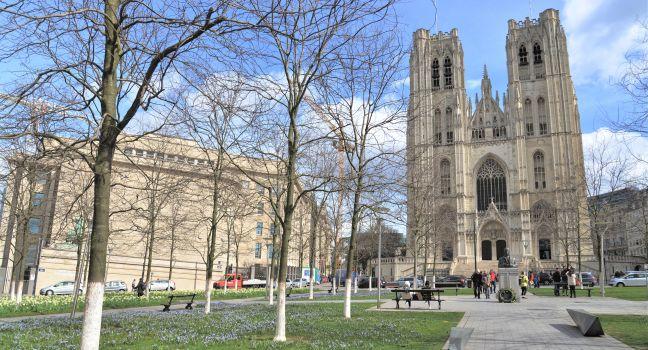
Cathédrale St-Michel et Ste-Gudula

Upper Town
Brussels, Belgium - March 30, 2015: Tourists are walking around and sitting in front of Cathedral of St. Michael and St. Gudula, Brussels, Belgium.
Niradj | Dreamstime.com

All of Belgium's royal weddings take place in this fine cathedral, with its twin Gothic towers and Baroque chapels. One namesake, St-Michel, is recognized as the patron saint of Brussels, typically pictured slaying a dragon (Satan), but mention Ste-Gudule and most people will draw a blank. Very little is known about this daughter of a 7th-century Carolingian nobleman, but her relics have been preserved here for the past 1,000 years. Construction of the cathedral began in 1226 and continued through the 15th century; chapels were added in the 16th and 17th centuries. Free guided tours take place on Saturdays (2 pm).

Pl. Sainte-Gudule, Brussels, 1000, Belgium
02-229--2490
Sight Details
Crypt: €4; archaeological site: €2
Treasury closed Sun., Mon., and Fri.
Booking required for tours

Something incorrect in this review?

Centraal Station

Centraal Station
ANTWERP - AUG 21: Interior of Antwerp central railway station on August 21, 2013 in Antwerp, Belgium.  Antwerp central railway station is the main railway station in the Belgian city of Antwerp.
Takashi Images / Shutterstock

The neo-Baroque railway terminal was built at the turn of the 20th century during the reign of Leopold II of Belgium, a monarch not given to understatement. The magnificent exterior and splendid, vaulted ticket-office hall and staircases call out for hissing steam engines, peremptory conductors, scurrying porters, and languid ladies wrapped in boas. Today most departures and arrivals are humble commuter trains, but the station still inspires. Two underground levels, added to accommodate high-speed trains, has turned the track areas into an impressively vast open space.

Place du Grand Sablon

Upper Town
BRUSSELS, BELGIUM - JUNE 29, 2010: Place du Grand Sablon boasts antique stores, boutiques, hotels, restaurants, auction houses,  pastry shops and Belgian chocolatiers, on June 29 in Brussels.
eFesenko / Shutterstock

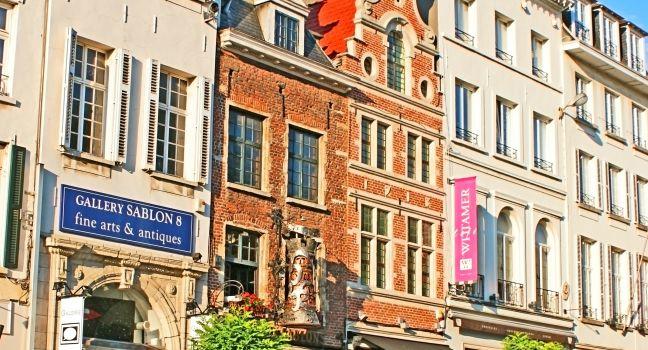
Once nothing more than a sandy hill, "Sand Square" is now an elegant place, surrounded by numerous restaurants, cafés, and antiques shops, some in intriguing alleys and arcades. For a little tranquility, pop into the beautiful Église Notre Dame du Sablon at the eastern end of the square, a flamboyant Gothic church founded in 1304. It's one of Brussels’s most beautiful, and at night its stained-glass windows are illuminated from within to magical effect. Opposite the Grand Sablon, you'll find the tiny garden of place du Petit Sablon. This is surrounded by a wrought-iron fence, topped by 48 small bronze statues representing the city’s guilds. Toward the rear of the garden, you'll find a fountain dedicated to the counts Egmont and Homes, who protested the introduction of the Spanish Inquisition by Philip II and were beheaded for their trouble.

Pl. du Grand Sablon, Brussels, 1000, Belgium

Something incorrect in this review?

Place Sainte-Catherine

Lower Town
BRUSSELS, BELGIUM-AUGUST 29, 2014: Place Saint Catherine, which was built on place of the old port. This square is a favorite place for tourists searching Belgian sea food restaurants.
skyfish / Shutterstock

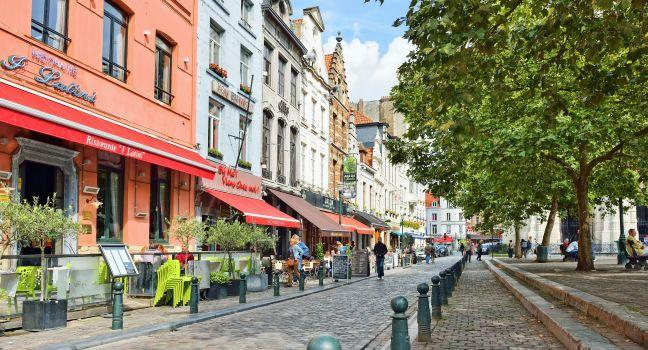
If you find the Grand Place overrun by tourists, head to Place Sainte-Catherine, whose markets are a favorite among locals, who come to shop for necessities (Thursday–Saturday 7–5; Wednesday organic market 7:30–3). At night, it often has a mobile bar, while the square's fishmonger serves great seafood ( see Restaurants).

Soaring over this scene is the Church of Sainte-Catherine, a rather grand Baroque church with a magnificent rose window. On the outside wall of the church is, bizarrely, the only remaining historical public urinal in Brussels, which dates from 1873 and is still in use. The church also overlooks the neighboring Vismet (fish market). A canal used to run through here, when the Port of Brussels extended deep into the city, and this was the site of a fish market up until 1955. It's now reduced to a couple of elongated ponds lined by seafood restaurants—some good, many of them overpriced.

From there, head along Rue de Peuplier to find the Church of St John the Baptist at the Beguinage, a magnificent 17th-century Flemish Baroque church that was once surrounded by a vast community of beguines, a lay religious movement of unmarried Christian women who devoted their lives to God but never took the orders of a nun. Their beguinage once spanned more than 1,000 houses, across 7 hectares, and the surrounding streets here are often colonized by filmmakers seeking a taste of old Brussels.

Pl. Sainte-Catherine, Brussels, 1000, Belgium

Something incorrect in this review?

101st Airborne Museum

Also known informally as "Le Mess," this museum in the former Belgian army's officers' mess contains dioramas based on actual photos that depict the lives of U.S. 101st Airborne Division troops as they defended the town in 1944. Make sure you take time to check out the "bomb shelter" in the basement: a very loud and very immersive surround-sound reenactment of an air raid—a definite eye-opener, even though there is no actual danger involved.

Av. de la Gare 11, Bastogne, 6600, Belgium
061-501–200
Sight Details
€10
Closed Mon. Apr.–Sept.; closed weekdays Oct.–Mar.

Something incorrect in this review?

Abbaye d'Aulne

The landscape gets much prettier as you slip southwest of the city toward an area known as the Vallée de la Paix (Valley of Peace). The main reason to go is for the ruins of Aulne Abbey, which lie just 10 km (6 miles) from Charleroi. Its history dates back to the 7th century. In In its heyday, it was run by Cistercian monks. By the mid-1800s the last monk had moved on and the site became a hospice before being left to ruin. But with the demise of the abbey, so too vanished its beer-making roots, until they were resurrected in 1950 by a local brewer who followed the old methods of the monks. These beers can be tried at the nearby Brasserie de l’Abbaye d’Aulne, which also does good food. 

Rue Émile Vandervelde 291, Thuin, 6534, Belgium
071-554--928
Sight Details
€5 (cash only)
Closed Mon. and Tues. Seasonal closure Oct.–Mar.

Something incorrect in this review?

Abbaye de Stavelot

Only a Romanesque tower remains of the original buildings that formed the Ancienne Abbaye (Old Abbey). The grand rose-color building that stands on the site today dates from the 18th century, and it is now home to three museums and the local tourist office. The Musée du Circuit de Spa-Francorchamps is dedicated to race cars and the nearby racetrack. Monoplace and Brigatti cars are on display, and one of several films on racing draws you into a virtual ride on the track. The high-tech Musée Historique de la Principauté de Stavelot-Malmedy displays archaeological remains and religious objects found in and around the region. The Musée Guillaume Apollinaire is devoted to the life and work of the French poet and essayist, who spent time here during his youth. Some of his original manuscripts are on display.

Pl. St-Remacle, Stavelot, 4970, Belgium
32-080-880–878
Sight Details
€10 for a visit to all three museums

Something incorrect in this review?

Abbaye Notre-Dame de la Paix (Chimay Abbey)

Like their counterparts in Scourmont, the Trappistine nuns of Chimay live a life of solemn prayer. Visits can be arranged here, however, with guided tours within the grounds, cloister, and abbey church held every Thursday and Saturday at 2:30 pm. You'll need to book in advance, especially if you need an English guide, but it's a fascinating insight into a little-seen world. 
Chau. de Trélon 1, Chimay, 6460, Belgium
0475-397--836
Sight Details
Free (a donation is customary)
Reservations are essential

Something incorrect in this review?

Abbaye Notre-Dame de Scourmont

Chimay is synonymous with the beer that shares its name. But the brewery that makes it is actually 9 km (5½ miles) south of the village. Here, the monks of the Scourmont Trappist monastery still supervise the production of some of the best cheese and beer in Belgium. They have been here since 1850, when the Princes of Chimay gifted them a space on the plateau. But it's no longer just a small operation. You can find Chimay beer in most of Europe, and even in China these days. Its Red (brown and fruity) and Blue (darker, more bitter) beers are ubiquitous. Yet at the same time, little has changed here. The monks still live a life of seclusion. The abbey is not open to the public, except for retreats, but you can visit the church and the gardens. You can also taste their wares at the nearby bar-restaurant L'Espace Chimay (at the Auberge de Poteaupré), less than half a mile away, where an exhibition (€6) explores the history and workings of the abbey brewery and ends with a tasting. 

Rte. du Rond Point 294, Chimay, 6464, Belgium
060-210--511
Sight Details
Free
Espace Chimay: closed Mon.

Something incorrect in this review?