


11 Best Sights in Upper Town, Brussels

We've compiled the best of the best in Upper Town - browse our top choices for the top things to see or do during your stay.
Musée des Instruments de Musique (MIM)
This four-story building is almost as impressive as the museum it houses. Built in 1899, architect Paul Saintenoy didn't hold back. Its elaborate facade twists its glass and iron into a symphony of Art Nouveau. Inside, it's no less fascinating. If you've ever wanted to know what a gamelan or Tibetan temple bell sounds like, here's your chance. In addition to seeing more than 2,000 instruments, you can listen to most of them via headphones. Head to the rooftop café for fantastic views of the city; also look out for MIM's regular lunchtime concerts—some are even free.
Musée Fin-de-Siècle
The collection focuses on an era (1868–1914) when European art stopped gazing all moist-eyed at history and instead turned its attention to the world around it. The museum charts this changing of the guard, beginning with the rebellion against academic tradition and the dominant themes of Romanticism that gave rise to the birth of Realism, through to the freer style of the Impressionists, and all the way up to World War I. Belgian painters featured include Guillaume Vogel and the powerful imagery of Symbolist Léon Spillaert, who runs the gamut from Impressionist-style beaches to brooding self-portraits and Gothic-infused horror. Elsewhere, work by masters such as Paul Gauguin, Auguste Rodin, and Emile Galle place the collection and the art scene of the period at the center of a burgeoning international movement. A powerful reminder of a time when Brussels was one of the great creative capitals.
Recommended Fodor's Video
Musée Magritte
Palais Royal
The Belgium Royal Family vacations in the Chateau de Laeken, so it's become a tradition during the summer months (late July--early September) to open up the official residence, otherwise known as the Palais Royal, to visitors. The palace was erected on the site of the former Palace of the Dukes of Brabant (aka Coudenburg), which was burned down in 1731, and the underground excavation of which you can still tour. The existing building was begun in 1820, but redesigned in the early 19th century by the extravagant Leopold II to fit a more glamorous Louis XII style. Today, it holds a remarkable collection of tapestries, art, and antiques from all over the world; pay special attention to the Congo-inspired mirror room, the ceiling of which is encrusted with more than a million jewel beetle carapaces. And best of all, it's free.
Palais Royale
The Belgium Royal Family lives in the Château de Laeken these days, and it's become a tradition to open up their inner-city residence to visitors during summer. The building was erected on the site of the former Palace of the Dukes of Brabant (aka Coudenburg), which burned down in 1731—you can still tour its underground excavation next door. Work on the existing palace was begun in 1820 but redesigned in a more garish neoclassical style in the early 19th century by Leopold II. The Mirror Room, which was commissioned by the king to evoke the Congo, is a chilling reminder of where the funds came from to furnish his largesse. The room's ceiling was later covered in the pearlescent carapaces of 1.5 million jewel beetles as part of a remarkable artwork created in 2002. Today, the palace holds a remarkable collection of tapestries, art, and antiques from all over the world.
Cathédrale St-Michel et Ste-Gudula
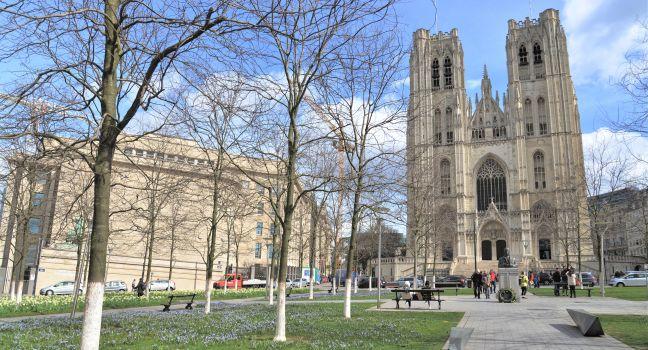
All of Belgium's royal weddings take place in this fine cathedral, with its twin Gothic towers and Baroque chapels. One namesake, St-Michel, is recognized as the patron saint of Brussels, typically pictured slaying a dragon (Satan), but mention Ste-Gudule and most people will draw a blank. Very little is known about this daughter of a 7th-century Carolingian nobleman, but her relics have been preserved here for the past 1,000 years. Construction of the cathedral began in 1226 and continued through the 15th century; chapels were added in the 16th and 17th centuries. Free guided tours take place on Saturdays (2 pm).
Place du Grand Sablon
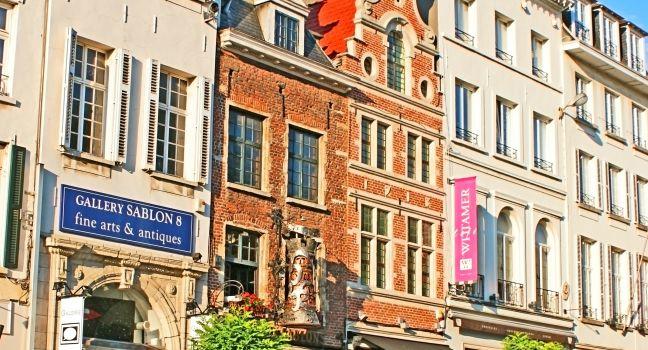
Once nothing more than a sandy hill, "Sand Square" is now an elegant place, surrounded by numerous restaurants, cafés, and antiques shops, some in intriguing alleys and arcades. For a little tranquility, pop into the beautiful Église Notre Dame du Sablon at the eastern end of the square, a flamboyant Gothic church founded in 1304. It's one of Brussels’s most beautiful, and at night its stained-glass windows are illuminated from within to magical effect. Opposite the Grand Sablon, you'll find the tiny garden of place du Petit Sablon. This is surrounded by a wrought-iron fence, topped by 48 small bronze statues representing the city’s guilds. Toward the rear of the garden, you'll find a fountain dedicated to the counts Egmont and Homes, who protested the introduction of the Spanish Inquisition by Philip II and were beheaded for their trouble.
KBR Museum
The Royal Library of Belgium's (KBR) museum is dedicated to the manuscript collection of the Burgundian dukes. It is also getting a makeover for 2025, with a new section on Gregorian chants adding a musical element to visits. It's much anticipated, as this is one of the unsung gems of the city, having only opened back in 2020. So fragile is its 600-year-old collection that books are swapped out every six months to avoid the light damaging their exquisite illuminations. Weapons, jewelry, and paintings from the era flesh out the exhibits. You'll also find regular free lunchtime classical concerts in the library's fourth-floor music room.
Musée Juif de Belgique
This museum traces the history of the Jewish faith and the fate of its followers in Belgium. The extensive collection includes religious objects dating from the 16th century, including documents, religious items, and books. In addition, it has hosted some truly excellent temporary exhibitions, ranging from the Jewish influence on superheroes to the work of prominent Jewish artists.
Musée Oldmasters
The Oldmasters Museum pays special attention to the so-called Flemish Primitives of the 15th century, who revolutionized the art of painting with oil. The Spanish and the Austrians pilfered some of the finest works, but there's plenty left to savor, including works by Memling, Petrus Christus, Rogier van der Weyden, and Hieronymus Bosch. The collection of pieces by Pieter Bruegel the Elder is particularly eye-catching; it includes The Fall of Icarus, in which the figure of the mythological hero disappearing in the sea is but one detail of a scene where people continue to go about their business. There are English-language brochures and guided tours available.
Not finding what you're looking for?
We've got a few suggestions for nearby spots.Théâtre Royal de Toone0.1 miles away
Impasse Ste-Pétronille, Brussels, Brussels Capital, 1000, Belgium
We recommend
11 Sights in
Lower Town
Manneken Pis0.1 miles away
Rue du Chêne, Brussels, Brussels Capital, 1000, Belgium
We recommend
11 Sights in
Lower Town
Grand Place0.2 miles away
Grand Place, Brussels, Brussels Capital, 1000, Belgium
We recommend
11 Sights in
Lower Town
Musée de la Ville de Bruxelles0.3 miles away
Grand Place, Brussels, Brussels Capital, 1000, Belgium
We recommend
11 Sights in
Lower Town
MOIR0.4 miles away
Rue du Marché aux Poulets 30, Brussels, Brussels Capital, 1000, Belgium
We recommend
11 Sights in
Lower Town


