



- ⁄
- Travel News
- ⁄
- Outdoors
Hop on a journey to discover the world’s most fascinating sacred mountains.
There’s something enigmatic about the mountains, something that has intrigued and bewildered people for centuries. Mountain peaks are closer to hypothetical heaven, have an axis mundi, and can bridge our world and another dimension. That’s why the concept of sacred mountains can be found on every continent and plays a role in numerous religions. From the awe-inspiring giants of the Himalayas to the lava-spitting volcanoes in the Canaries, these are some of the most striking venerated peaks in the world.
Top Picks for You
Mount Kailash
WHERE: China
Rising up like a finger of an ancient giant God, Mount Kailash is a breathtaking feat of nature. A crown jewel of Transhimalaya, it has a whopping altitude of almost 7 thousand meters and is immediately recognizable by its snowy peak that glistens on a sunny day. Mount Kailash is sacred for not one but four world religions. Hinduism, Jainism, Buddhism, and the native Tibetan religion, Bön, regard the summit as the abode of the deities, the gateway to heaven, and the central world mountain. You can approach the foothills of Kailash, but it’s forbidden to climb it. Even if you wanted to, the quest would prove impossible. The rocky peak with a 1,800 meters elevation has been dimmed unclimbable, and to this day, no human has laid his feet on the summit.
Adam's Peak
WHERE: Sri Lanka
When you see the silhouette of the towering Adam’s Peak in the distance, you find it easier to believe in divine interventions. Standing taller than anything else in the landscape, it’s a unique place holy to multiple faiths, each seeing it as proof of their belief. Sri Pada is what you find on the very top, a “sacred footprint” stone formation. Now, that’s where religions differ in interpretation. Buddhists worship it as a mark of Buddha himself; for Muslims, it’s a sign of Adam (hence the name), Hinduism regards it as a print of Shiva, and Christians think it belongs to St. Thomas, who brought Christianity to Sri Lanka.
In any case, Adam’s Peak is a marvelous oeuvre of nature that should be seen and visited. Thousands of pilgrims ascend the windy mountain trail to reach Sri Pada. You can also embark on such a journey to be rewarded with all-encompassing tropical views from the top.
Recommended Fodor’s Video
Croagh Patrick
WHERE: Ireland
Some places on our planet have more powerful energy than others. Croagh Patrick is one of them. One of the most venerated peaks in Ireland, an important pilgrimage site that draws crowds annually, it has been frequented by devotees for centuries. First, prehistoric humans erected their proto-religious structures around the mystic pyramid-shaped peak. Then with the rise of Christianity, it was believed that Saint Patrick fasted for forty days on the top of the Croagh.
INSIDER TIPIt’s worth visiting for the desolated County Mayo hill panoramas and the challenging climb to the early 20th-century chapel on the summit.
Gyeryongsan
WHERE: South Korea
Gyeryongsan is both a paradise for outdoor lovers and a revered ethereal gate to heaven. Translated as a “chicken dragon mountain” because of the shape of the ridge, it’s a beautiful area full of hiking trails, ancient pagodas in the woods, a kaleidoscope of waterfalls, and lush flora and fauna. You can easily visit it as the mountain is included in Gyeryongsan National Park, a popular day trip from major South Korean cities. In the local tradition, it is believed that this peak has the most of qi (traditional concept of vital energy) out of all the places in the country.
INSIDER TIPVisit the kaleidoscope of charming mountainside Buddhist temples such as Donghaksa, Gapsa, and Sin-Wonsa. Also, you can hike to the picturesque Amyongchu Falls.
Mount Athos
WHERE: Greece
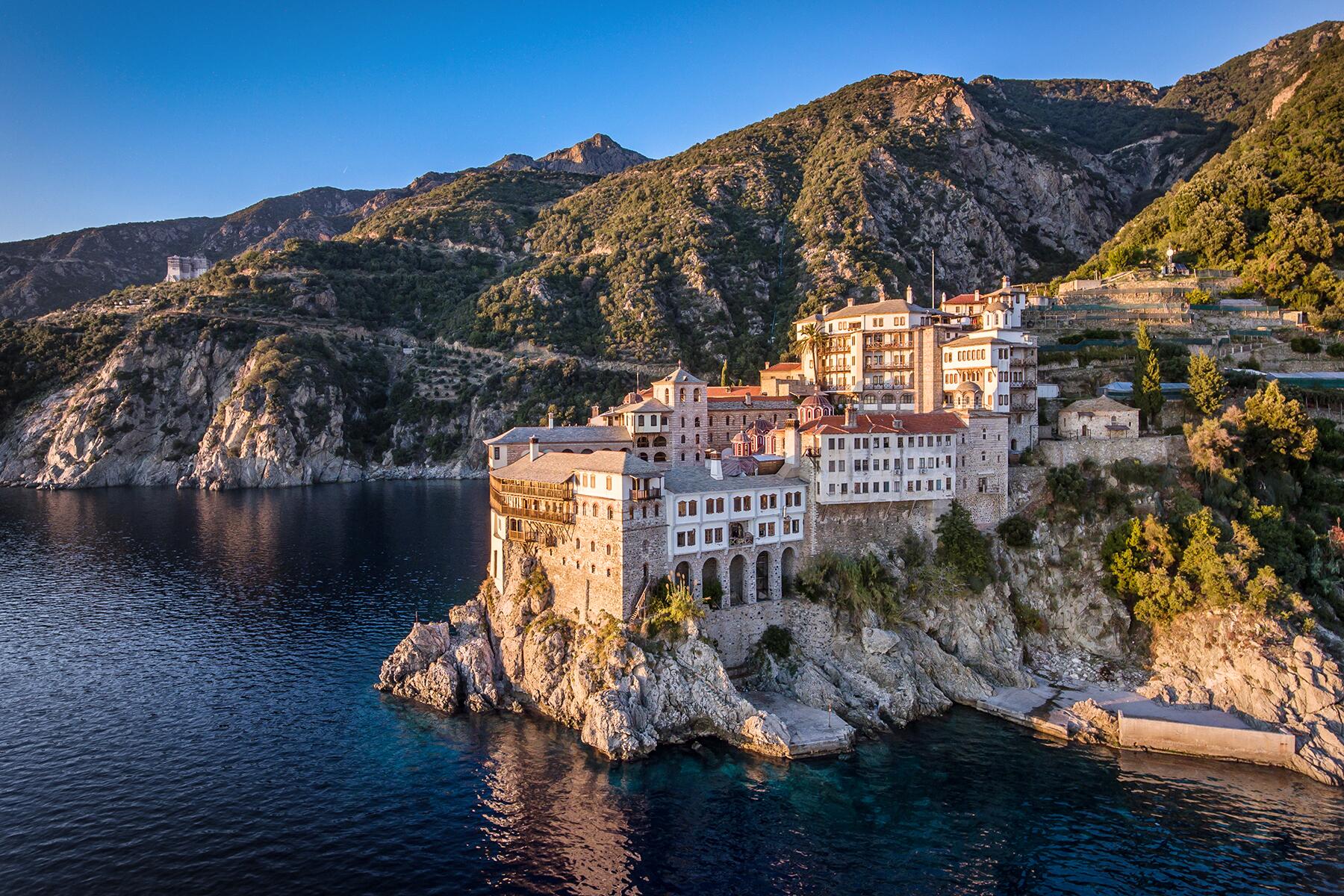
There’s a country within a country in Greece where you can’t enter without a special permit. The Mount Athos monastic community, an area with special jurisdiction within the EU formed around the eponymous peak, is a holy site for the Orthodox Christians. Women are categorically prohibited (including animal females) from entering, and the men should be Orthodox to get inside and wait for a diamonitirion or special permission. Few places in Europe have the same levels of secrecy and prohibition. But that’s exactly what makes Mount Athos a mysterious and incredibly interesting destination. Currently, there is a total of 20 monasteries in the community and a little more than 2 thousand monks living.
INSIDER TIPWhile you may not get inside, you can still admire the gargantuan silhouette of the mountain and get a glimpse of the monastery’s architecture on a boat cruise.
Mount Sinai
WHERE: Egypt
On Mount Sinai, Moses (or Musa in Muslim tradition) received the Ten Commandments from God, a story found in Christianity, Judaism, and Islam. The actual summit where it happened remains disputed because of the ambiguity of interpretations of the holy texts. Egypt’s peak, Mount Sinai (or Jabal Musa meaning Mount Moses), is often regarded as a possible place of divine contact. Located on the Sinai Peninsula and surrounded by high rocky mountains, it’s a place for pilgrimage and magnificent natural attractions.
Usually, the ascent to the summit is combined with visiting the 6th-century UNESCO-protected Saint Catherine’s Monastery, generally regarded as one of the world’s oldest Christian places of worship. Then, you also have a chapel and a mosque neighboring each other on the 2,285 meters high summit.
Uluru
WHERE: Australia
Natural magic unfolds in central Australia. A mythical Uluru “island mountain” ascends from the bush, mesmerizing with shapes that seem extraterrestrial. This giant sandstone is a holy site for Pitjantjatjara Aboriginal people (also named Aṉangu) native to the area and a spot of immense spiritual power. It changes color with the sunrise and sunset, turns into a big waterfall when it rains and is a marvel in any sense.
Today Uluru stands unbothered by the mortals in its still red glory, but it was quite different before. Until 2019 it was a popular place for climbing, and lots of tourists got on top. Upon the request of Pitjantjatjara, this activity was stopped entirely.
INSIDER TIPYou can visit the area with an experienced Aṉangu guide, profiting from the miles of trails, excellent birdwatching opportunities, and astonishing sunsets.
Teide
WHERE: Spain
Towering over the mind-blowing island scenery of Tenerife, Telde is an active volcano and the highest peak in Spain. For the now-extinct indigenous inhabitants of the Canary Islands that lived here before Spanish colonization, Telde was a center of the world that held the sky. Leading life with eruptions gave birth to stories of Guayota, a devil, a king of evil spirits with the Tibicena demons by his side that comes out of the crater of Telde to menace the ordinary folk. Achamán, a good deity representing the skies, can only defeat him.
Nowadays, Telde is a huge National Park and a UNESCO-protected sight that is a must-visit for anyone coming to Tenerife. You can easily spend a few days around the mountain hiking, touring pastoral villages, savoring the local cuisine, and enjoying the oceanic panoramas.
Mount Olympus
WHERE: Greece
The highest peak in the country and arguably the most well-known name on the list, Mount Olympus is a surprisingly tranquil and idyllic place to visit. For ancient Greeks, its peak Mytikas was believed to be the home of the twelve Olympian gods. The deities chose a wonderful area to live, the craggy summits of the Olympus Massif top wide plateaus and black pine forests creating a stunning landscape.
Mount Olympus is a vast National Park that invites visitors to hike the miles of scenic trails, admire its lush Mediterranean beauty, and even climb the mythical Myticas for a chance to greet Zeus and Gera.
Blanca Peak, Mount Taylor, San Francisco Peaks, and Hesperus Peak
WHERE: USA
Four mountains are core to designating the borders of Dinétah, the homeland of the Navajo. This Navajo tribe sees Blanca Peak, Mount Taylor, San Francisco Peaks, and Hesperus Peak as sacred and world-forming. Each of the mountain ranges is given a particular color that follows the cosmic journey of the sun. Also, the peaks have genders according to the Navajo belief system. Four is a sacred number in the tribe’s faith, and the mountains are said to possess supernatural significance.
The best way to visit the area is by being guided by local Navajo guides who will show you the most interesting spots, give an insight into the tribe’s beliefs, and share insider tips for exploring the region.
Mount Roraima
WHERE: Between Venezuela, Brazil, and Guyana
There’s hardly a more astounding border in the world than Mount Roraima. One of the breathtaking table-top mountains of the Pakaraima range, it is a sight to behold. It’s a tepui, a sacred formation for the native Pemon people who believe that gods live on these mysterious flat giants. Also, Roraima remains one of the enigmas of the natural world, a place where animals that predate dinosaurs live (like pebble toads) and an area that has gray spots that scientists have never explored. Roraima is the original wilderness, nature’s last secret.
You can also see it for yourself. The best way to trek the mountain is from the Venezuelan side. The tepui is a part of the wonderful Canaima National Park that should be high on your bucket list.
INSIDER TIPLiterary researchers believe that Mount Roraima might have served as one of the inspirations for Arthur Conan Doyle’s “The Lost World.”
Mount Kenya
WHERE: Kenya
As the second-highest mountain peak in Africa, Mount Kenya is impressive in its expansive, larger-than-life rocky glory. All ethnic groups that live around the peak consider it sacred. For Kikuyu, Ameru, Embu, and Maasai people, Mount Kenya is the axis mundi, the home of God, a place where everything starts and ends. Coming here, you’re entering an impressive universe of black lava plains, volcanic summits, verdant flora, and monumental glaciers. Kenya is named after this mountain; that’s how important it is for the local identity.
Choose it as a less-crowded, more rewarding alternative for Kilimanjaro. The vast 715 square kilometers-wide Mount Kenya National Park includes the mountain, which will excite any outdoor enthusiast.
Ausangate
WHERE: Peru
Cute llamas and alpacas enjoy the fresh air next to the crystal-clear mountain lakes with gargantuan rocks rising in the background. Welcome to Ausangate, the gem of the Peruvian Andes and one of the most important mythic mountains in the Incan belief system. The stunning 6,384 meters high peak is the home of the apu, or the deity of mountains that looks out for the Quechua people that inhabit this part of the Andes. Every important summit has its own apu, but the one in Ausangate is among the most powerful. During spring, the Q’oyllur Rit’i sees many Quechua pilgrims coming to the mountain to give gifts to apu and ask for the blessing.
The Ausangate trek is among the most gratifying in Peru. The start of the hike is usually in the town of Pacchanta. It is best to hire a local guide to get insight into the Quechua way of life and culture. You can also climb Ausangate independently; just come prepared and save several days for an ascent.
Naturally the volcanos are often best candidates for sacredness considering theat and wrath they present to the peoples who live near them... and so most of the sacred mountains are actually the volcanos.